 English
 Slovenčina
 Français
 Magyar

Why Teams Switch from Zendesk in 2025

Are you considering alternatives to Zendesk for your customer support needs? You’re not alone. In 2025, many businesses are exploring other options due to several key factors.
Zendesk has been a dominant player in the customer support platform market, but companies are increasingly looking elsewhere due to pricing concerns, AI implementation challenges, and operational complexities. The main reasons businesses seek Zendesk alternatives include:
- Pricing creep: Base subscription costs have steadily increased, while many essential features have moved to higher-tier plans or become separate add-ons
- AI add-on costs: Advanced AI features often come with additional per-resolution fees ($1.50 per AI resolution according to multiple sources) or require expensive per-agent add-ons
- Bundle lock-in: Companies are pushed toward all-inclusive suites when they might only need specific components
- Administrative overhead: The platform requires significant time and resources to configure and maintain properly
- E-commerce integration gaps: Some businesses find Zendesk’s e-commerce integrations less seamless than specialized alternatives
Before we dive into the alternatives, let’s understand what you should look for in a Zendesk replacement.
The Zendesk-Alternative Checklist for E-commerce and SMB Support

When evaluating Zendesk alternatives, ensure your chosen platform includes these essential features:
Must-Have Features
- Stable live chat + AI chatbot: Look for platforms with reliable real-time communication capabilities and AI-powered chatbots that can handle routine inquiries
- Omnichannel support: The ability to manage customer communications across email, chat, social media, and WhatsApp from a single interface
- E-commerce integration: Native connections with Shopify/Shopify Plus or other e-commerce platforms
- SLA management: Tools to set and monitor service level agreements
- Automation capabilities: Workflow automation to handle routine tasks
- Analytics: Comprehensive reporting to track performance metrics
- Open APIs: Flexibility to connect with your existing tech stack
- BYO-AI options: The ability to integrate your preferred AI solutions rather than being locked into the platform’s offerings
Nice-to-Have Features
- Visual workflow builders: No-code automation tools
- Revenue attribution: Connecting support interactions to sales outcomes
- Customizable dashboards: Tailored reporting for your specific needs
- Advanced security features: SSO, role-based access, and compliance certifications
Free vs Paid Zendesk Alternatives: Understanding the True Cost

When comparing free and paid alternatives to Zendesk, it’s important to understand what “free” really means and calculate the true per-agent total cost of ownership (TCO).
Free Alternatives: What’s the Catch?
Free plans typically come with significant limitations:
- Agent limits: Most free tiers restrict you to 1-10 agents
- Feature restrictions: Advanced features like automation, reporting, and integrations are often unavailable
- Support limitations: Limited or no customer support from the vendor
- Branding constraints: Your help center may display the vendor’s logo
- Volume caps: Restrictions on tickets, conversations, or contacts
Open-Source/Self-Hosted Trade-Offs
Open-source alternatives like Zammad and osTicket offer flexibility but come with hidden costs:
- Hosting expenses: Server and maintenance costs
- IT resources: Technical staff needed for setup and maintenance
- Security responsibility: You’re responsible for updates and security patches
- Integration complexity: May require custom development for connections to other tools
- Scalability challenges: Performance may suffer as volume increases
Calculating True Per-Agent TCO
When comparing pricing, look beyond the advertised per-agent rate and consider:
- Base subscription: The starting per-agent price
- Required add-ons: Additional features that aren’t included in the base price
- Implementation costs: Setup, migration, and training expenses
- Ongoing administration: Time and resources needed for maintenance
- Scaling costs: How pricing changes as your team grows
How We Evaluated Top Competitors of Zendesk

Our evaluation process was comprehensive, combining real-world testing, customer feedback analysis, and feature comparison across multiple dimensions:
Testing Methodology
- Hands-on trials: We created accounts and tested core workflows
- User scenario simulations: We ran common support scenarios through each platform
- Performance benchmarking: We measured response times and system stability
Evaluation Criteria
- Ease of implementation: How quickly can you get up and running?
- User experience: How intuitive is the interface for agents and customers?
- Feature depth: Does it provide the capabilities you need?
- Customization options: How adaptable is the platform to your specific requirements?
- Integration ecosystem: How well does it connect with your existing tools?
- Pricing transparency: Are costs clear and predictable?
- Scalability: How well does it grow with your business?
- Customer support: What level of help can you expect from the vendor?
Now, let’s explore the top alternatives to Zendesk, starting with our top recommendation.
Talkees — Best Overall Zendesk Alternative for SMB and E-commerce

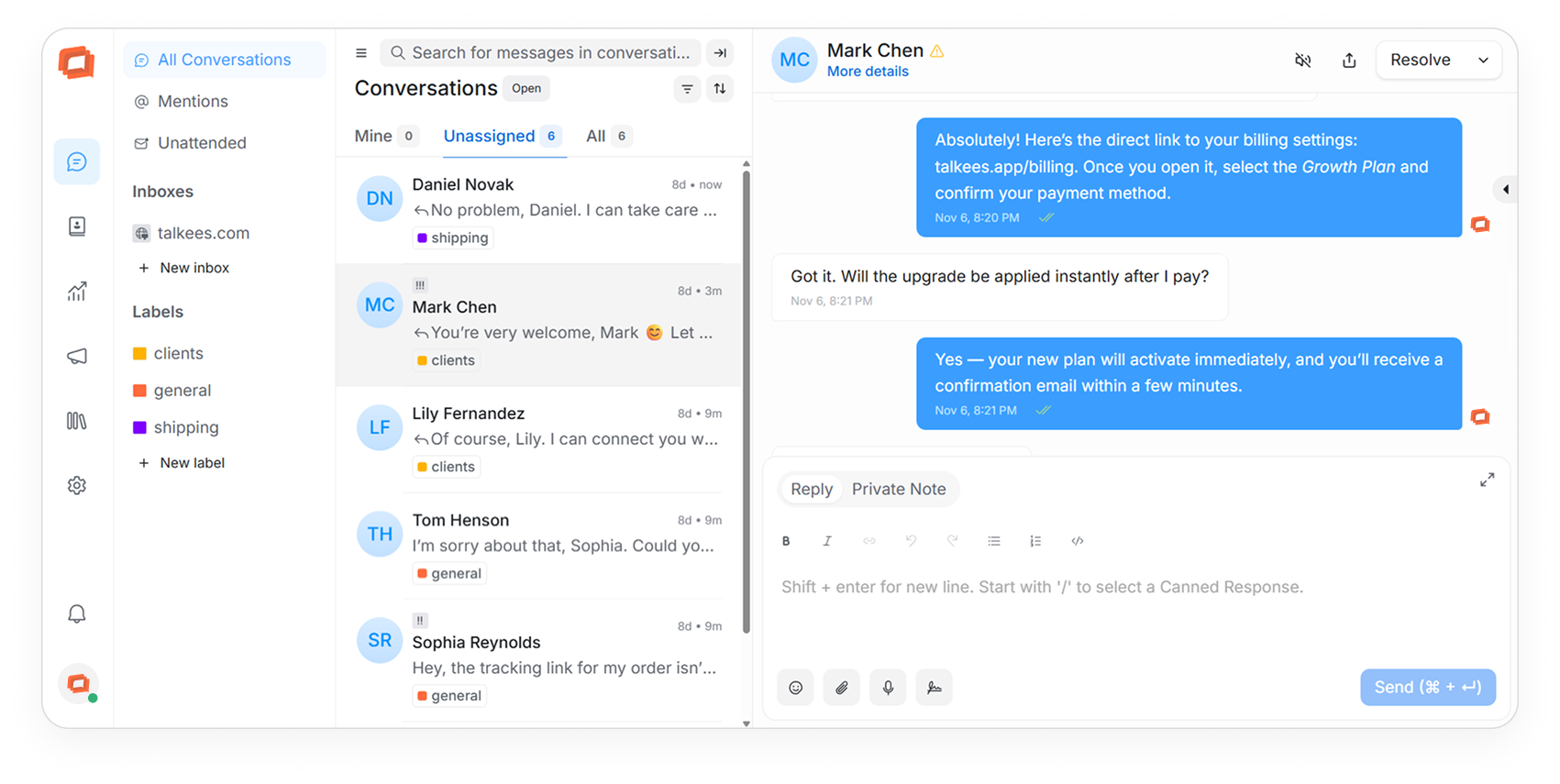
Talkees stands out as the most compelling Zendesk alternative for small to medium businesses and e-commerce operations. It delivers a powerful combination of omnichannel capabilities, AI integration, and e-commerce-specific features at a transparent price point.
Detailed Pricing
Free Version: Limited free tier for small teams with basic support needs
- Up to 3 agents
- Email and chat support channels
- Basic automation and reporting
- Knowledge base functionality
Paid Plans:
- Starter: $29/agent/month – All free features plus additional channels and automation
- Growth: $59/agent/month – Advanced automations, custom workflows, and priority support
- Professional: $99/agent/month – Enterprise-grade features, advanced AI, and dedicated account manager
AI Credits: Unlike Zendesk’s per-resolution pricing, Talkees offers a pool of AI credits with each plan, with predictable costs for additional usage.
Comprehensive Feature Set
- Omnichannel + AI: Unified inbox for email, chat, social media, and WhatsApp, enhanced with AI capabilities for routing, classification, and response suggestions
- Shopify-ready macros: Pre-built templates for common e-commerce scenarios (order status, returns, shipping inquiries)
- Visual workflow builder: Create complex automations without coding
- Contextual customer profiles: See order history, previous interactions, and customer value in one view
- Flexible APIs and webhook support: Connect to any system in your tech stack
- Built-in knowledge base: Create and manage self-service content that integrates with your support channels
Real User Experiences and Reviews
From G2 and Capterra reviews, customers consistently praise Talkees for:
- “Getting us up and running in under a day”
- “Reducing our response time by 40% with AI suggestions”
- “Seamless Shopify integration that shows all order details right in the ticket”
- “Predictable pricing with no surprise fees”
Common criticisms include:
- “Mobile app could use more features”
- “Would like more advanced reporting capabilities”
- “Some integrations require custom development”
Advantages and Disadvantages
Advantages:
- Fast implementation (typically under 48 hours)
- Intuitive, clean interface requiring minimal training
- Transparent pricing with no hidden fees
- Strong e-commerce focus with native Shopify integration
- Flexible AI implementation without per-resolution charges
Disadvantages:
- Fewer third-party integrations than Zendesk
- Less robust enterprise-level features for very large organizations
- Newer platform with evolving capabilities
Our Subjective Assessment
When testing Talkees, I was immediately impressed by how quickly I could set up the system and start handling tickets. The interface feels modern and uncluttered, making it easy to focus on customer conversations rather than navigating complex menus.
The AI suggestions were surprisingly accurate after just a few days of use, learning from our responses and adapting to our communication style. I particularly appreciated the transparent AI credit system, which made costs predictable even during high-volume periods.
For e-commerce businesses, the Shopify integration is a standout feature. Being able to see order details, process refunds, and update shipping information without leaving the support platform saved our team significant time on each interaction.
While Talkees may not match Zendesk’s depth in some specialized areas, it delivers everything most SMBs and e-commerce operations need in a more accessible, affordable package.
Freshdesk vs Zendesk — Where Freshdesk Wins and Where Zendesk Still Has an Edge

Freshdesk is a popular Zendesk alternative that offers a compelling mix of features at a more affordable price point, making it particularly attractive for growing businesses.
Detailed Pricing
Free Version: Available for unlimited agents with basic ticketing
- Email channel support
- Knowledge base
- Ticket dispatch
- Limited automation
Paid Plans:
- Growth: $15/agent/month – Automation, SLAs, and collision detection
- Pro: $49/agent/month – Round-robin routing, custom reports, and multiple products
- Enterprise: $79/agent/month – AI-powered support, custom roles, and advanced security
Freddy AI: Freshdesk’s AI assistant is priced at $100 per 1,000 sessions after the first 500 free sessions, offering more predictable costs than Zendesk’s per-resolution model.
Comprehensive Feature Set
- Ticketing system: Organize, prioritize, and track customer inquiries
- Omnichannel support: Email, chat, phone, and social media in one place
- Freddy AI: AI-powered chatbot, ticket classification, and agent assistance
- Field service management: Schedule and dispatch technicians
- Marketplace integrations: Connect with CRM, e-commerce, and productivity tools
- Customizable knowledge base: Create self-service content for customers
Real User Experiences and Reviews
From G2, Capterra, and Trustpilot reviews:
- “Freshdesk’s interface is much more intuitive than Zendesk”
- “We cut our support costs by 30% after switching from Zendesk”
- “The free tier is genuinely useful for small teams”
Common criticisms include:
- “Some advanced features require upgrading to higher tiers”
- “Reporting could be more flexible”
- “Phone integration requires additional setup”
Advantages and Disadvantages
Advantages:
- More affordable pricing at every tier
- Generous free plan
- Intuitive interface requiring less training
- Predictable AI pricing model
- Faster implementation than Zendesk
Disadvantages:
- Fewer enterprise-grade features
- Smaller marketplace of integrations
- Less robust reporting capabilities
- Limited customization at lower tiers
Our Subjective Assessment
During my testing of Freshdesk, I found the platform remarkably easy to navigate. The setup process was straightforward, and I was able to import our existing tickets and knowledge base articles with minimal effort.
Freddy AI impressed me with its ability to suggest relevant responses and categorize incoming tickets accurately. The session-based pricing model made it easier to budget for AI usage compared to per-resolution models.
Where Freshdesk fell short was in some of the more advanced customization options. For complex workflows that require detailed routing rules or custom objects, Zendesk still has the edge. However, for most support scenarios, Freshdesk provides everything needed at a significantly lower price point.
I particularly appreciated Freshdesk’s approach to omnichannel support, which felt more integrated and less like separate products bolted together. For businesses prioritizing value and ease of use over extreme customization, Freshdesk is an excellent choice.
For a clearer breakdown of capabilities and costs, see our full freshdesk vs zendesk comparison focused on ticketing, automation, and scalability.
Intercom vs Zendesk — Chat-First Engagement, Proactive Messaging, and AI Copilots

Intercom takes a fundamentally different approach to customer support compared to Zendesk, focusing on proactive, conversational engagement rather than reactive ticketing.
Detailed Pricing
Free Version: Limited trial available
Paid Plans:
- Starter: $74/month for 1 seat + $19/month per additional seat
- Pro: $499/month for 5 seats + $99/month per additional seat
- Scale: Custom pricing for enterprise needs
AI Pricing: Intercom charges approximately $0.99 per AI resolution for their Fin AI agent, which can create variable costs during high-volume periods.
Comprehensive Feature Set
- Messenger-based interface: Chat-first approach to customer communication
- Proactive messaging: Trigger messages based on user behavior
- Fin AI: Conversational AI chatbot that can resolve common queries
- Product tours: Guide users through your product
- Customer data platform: Collect and analyze user behavior
- Targeted campaigns: Reach specific customer segments
- Team inbox: Collaborate on customer conversations
Real User Experiences and Reviews
From G2, Capterra, and Trustpilot:
- “Intercom’s proactive approach has increased our user engagement by 35%”
- “The chatbot handles 40% of our routine questions without human intervention”
- “Our sales team loves the lead qualification capabilities”
Common criticisms include:
- “Per-resolution AI pricing can be unpredictable during high-volume periods”
- “Less structured for complex support workflows”
- “Higher cost at scale compared to traditional helpdesks”
Advantages and Disadvantages
Advantages:
- Superior in-app messaging experience
- Strong lead generation and qualification capabilities
- Excellent for product-led growth strategies
- Powerful segmentation for targeted communication
- Modern, user-friendly interface
Disadvantages:
- Can become expensive at scale
- Less structured for complex support processes
- Variable AI costs based on usage
- Limited ticketing capabilities compared to Zendesk
Our Subjective Assessment
Testing Intercom was a refreshingly different experience compared to traditional helpdesks. The platform excels at creating conversational, proactive customer interactions rather than simply managing tickets.
The in-app messenger is beautifully designed and feels natural for users, encouraging more engagement than traditional support forms. I was particularly impressed by how the platform combines support, marketing, and sales capabilities in one cohesive system.
Fin AI, Intercom’s chatbot, demonstrated impressive conversational abilities, successfully resolving many common queries without human intervention. However, the per-resolution pricing model did raise concerns about cost predictability during high-traffic periods.
Where Intercom falls short is in structured support processes. If your team needs complex ticket routing, SLA management, and detailed workflow automation, you may find Intercom’s approach limiting. However, for businesses focused on customer engagement, lead generation, and proactive support, Intercom offers capabilities that traditional helpdesks can’t match.
For a clearer breakdown of capabilities and costs, see our full intercom vs zendesk comparison focused on automation, omnichannel support, and scalability.
Help Scout vs Zendesk — Email-Centric Simplicity, Lightweight Knowledge Base, and SMB-Friendly Workflows

Help Scout offers a refreshingly simple approach to customer support, focusing on email-centric workflows and a personal touch rather than complex ticketing systems.
Detailed Pricing
Free Version: Limited free plan for up to 50 contacts
Paid Plans:
- Standard: $20/user/month – Core features for small teams
- Plus: $40/user/month – Advanced features and reporting
- Pro: $60/user/month – Enterprise features and priority support
AI Features: Help Scout includes AI drafts and suggestions in their plans without per-resolution fees, offering more predictable costs.
Comprehensive Feature Set
- Shared inbox: Email-like interface for customer conversations
- Beacon: Embedded chat and self-service widget for websites
- Docs: Simple knowledge base solution
- Workflows: Basic automation rules for routing and tagging
- Reporting: Performance metrics and team analytics
- Collaboration tools: Internal notes, @mentions, and collision detection
- Mobile apps: iOS and Android support
Real User Experiences and Reviews
From G2, Capterra, and Trustpilot:
- “Help Scout feels like using email, not learning a complex system”
- “We were up and running in hours, not weeks”
- “Our customers appreciate the personal touch of emails without ticket numbers”
Common criticisms include:
- “Limited advanced routing capabilities”
- “Fewer integrations than larger platforms”
- “Basic reporting compared to enterprise solutions”
Advantages and Disadvantages
Advantages:
- Extremely intuitive, email-like interface
- Fast implementation with minimal training required
- Transparent, predictable pricing
- Personal, human feel to customer communications
- Excellent for small to medium teams
Disadvantages:
- Limited omnichannel capabilities
- Less robust for complex workflows
- Fewer integrations than Zendesk
- Not ideal for large enterprise support teams
Our Subjective Assessment
When I tested Help Scout, I was immediately struck by how natural it felt. The platform truly delivers on its promise of making customer support feel like using a shared email inbox rather than learning a complex system.
Setup was remarkably fast—I had our team up and running within a couple of hours. The interface is clean and intuitive, requiring almost no training for team members familiar with email.
The Beacon widget provides a nice balance of chat and self-service capabilities, though it’s not as feature-rich as dedicated chat solutions. The Docs knowledge base is straightforward and effective, though again simpler than enterprise knowledge management systems.
Where Help Scout truly shines is in creating personal, human interactions with customers. Without ticket numbers and formal status updates, conversations feel more natural and less automated. For small to medium businesses that prioritize personal customer relationships over complex processes, Help Scout is an excellent choice.
However, if your support needs include complex routing, detailed SLAs, or advanced omnichannel capabilities, you may find Help Scout’s simplicity limiting.
Zoho Desk vs Zendesk (and Freshdesk) — Budget Suite Trade-Offs, Extensibility, and AI Add-On Costs

Zoho Desk offers a comprehensive support platform at a significantly lower price point than Zendesk, making it particularly attractive for budget-conscious organizations.
Detailed Pricing
Free Version: Available for up to 3 agents
Paid Plans:
- Standard: $14/agent/month – Basic helpdesk features
- Professional: $23/agent/month – Automation and advanced features
- Enterprise: $40/agent/month – AI assistant and advanced customization
Zia AI: Zoho’s AI assistant is included in higher-tier plans with reasonable usage limits.
Comprehensive Feature Set
- Ticketing system: Organize and track customer inquiries
- Multichannel support: Email, social, chat, and phone
- Zia AI: AI-powered assistant for agents and customers
- Custom views and dashboards: Personalized workspace
- Knowledge base: Self-service portal for customers
- Workflow automation: Rules and macros for common tasks
- Deep integration: Seamless connection with other Zoho products
Real User Experiences and Reviews
From G2, Capterra, and Trustpilot:
- “Zoho Desk offers 80% of Zendesk’s functionality at 40% of the cost”
- “The integration with other Zoho products creates a seamless experience”
- “Zia AI has reduced our response time by 25%”
Common criticisms include:
- “Interface feels dated compared to newer platforms”
- “Some features require technical knowledge to set up properly”
- “Support can be slow to respond to complex issues”
Advantages and Disadvantages
Advantages:
- Extremely cost-effective
- Strong integration with Zoho ecosystem
- Solid AI capabilities included in higher tiers
- Comprehensive feature set for the price
- Good customization options
Disadvantages:
- Less intuitive interface
- Steeper learning curve
- Smaller marketplace of third-party integrations
- Support quality sometimes inconsistent
Our Subjective Assessment
Testing Zoho Desk revealed a platform that packs impressive functionality into an affordable package. While the interface isn’t as polished as some competitors, it offers remarkable depth once you learn your way around.
The platform’s greatest strength is its integration with the broader Zoho ecosystem. If you’re already using Zoho CRM, Projects, or other Zoho tools, Desk provides a seamless extension of that environment with shared customer data and unified reporting.
Zia, Zoho’s AI assistant, performed well in testing, offering helpful suggestions and automating routine tasks. Having AI capabilities included in the plan rather than as a per-resolution add-on was a welcome approach to pricing.
Where Zoho Desk falls short is in user experience. The interface feels more technical and less intuitive than platforms like Help Scout or Freshdesk, requiring more training for new team members. Additionally, some advanced features require significant configuration to work properly.
For organizations prioritizing cost-effectiveness and integration with Zoho’s ecosystem, Desk offers exceptional value. However, businesses seeking the most intuitive, modern interface might prefer other options.
Salesforce Service Cloud vs Zendesk — Enterprise Routing, Data Model Depth, and CRM-Native Service Operations

Salesforce Service Cloud represents the enterprise end of the customer service spectrum, offering deep integration with Salesforce CRM and powerful customization options for large organizations.
Detailed Pricing
Free Version: Not available
Paid Plans:
- Starter: $25/user/month – Basic service capabilities
- Professional: $80/user/month – Complete service solution
- Enterprise: $165/user/month – Advanced customization and automation
- Unlimited: $330/user/month – Maximum capabilities and support
Einstein AI: Additional cost based on specific AI features and usage.
Comprehensive Feature Set
- Case management: Advanced ticketing and routing
- Omnichannel routing: Intelligent assignment across all channels
- Field service: Scheduling and dispatch for on-site support
- Einstein AI: AI-powered recommendations and automation
- Knowledge management: Enterprise-grade content management
- Communities: Branded customer and partner portals
- Complete customization: Tailor every aspect of the platform
- Deep CRM integration: Seamless connection with sales and marketing data
Real User Experiences and Reviews
From G2, Capterra, and Trustpilot:
- “The 360-degree customer view has transformed our support capabilities”
- “Complex to implement but powerful once configured properly”
- “The reporting and analytics capabilities are unmatched”
Common criticisms include:
- “Significant implementation time and cost”
- “Requires dedicated administrators”
- “Expensive compared to most alternatives”
Advantages and Disadvantages
Advantages:
- Unmatched customization capabilities
- Deep integration with Salesforce CRM
- Powerful workflow and automation options
- Enterprise-grade security and compliance
- Comprehensive reporting and analytics
Disadvantages:
- High cost of ownership
- Complex implementation requiring specialists
- Steep learning curve
- Overkill for small to medium businesses
Our Subjective Assessment
My experience testing Service Cloud confirmed its position as an enterprise-grade solution with both the power and complexity that implies. This is not a platform you set up in a day—implementation typically takes weeks or months and often requires specialized consultants.
Once configured, however, Service Cloud offers capabilities that few competitors can match. The ability to see the complete customer journey across sales, marketing, and service creates opportunities for personalized support that standalone platforms struggle to deliver.
The workflow engine is extraordinarily powerful, allowing for complex routing, escalation, and automation scenarios. For large organizations with specialized teams and complex processes, this flexibility is invaluable.
Einstein AI demonstrated impressive capabilities, particularly in case classification and next-best-action recommendations. However, the additional cost for these features should be carefully considered in budget planning.
Service Cloud makes the most sense for organizations already invested in the Salesforce ecosystem or enterprises with complex support requirements. For smaller businesses or those seeking quick implementation, the platform’s power comes with too much complexity and cost to be justified.
ServiceNow vs Zendesk (and Jira Service Management) — ITSM Maturity, Service Catalog, and End-to-End Workflow Automation

ServiceNow is primarily known as an IT Service Management (ITSM) platform but has expanded to include customer service management capabilities, positioning it as a Zendesk alternative for organizations with complex internal and external support needs.
Detailed Pricing
Free Version: Not available
Paid Plans: Custom pricing based on modules and user count
- Typically starts at $100+ per user/month for basic functionality
- Enterprise implementations often reach $200+ per user/month
AI Features: Additional cost for Now Intelligence and other AI capabilities.
Comprehensive Feature Set
- ITSM framework: ITIL-aligned processes and workflows
- CSM (Customer Service Management): External support capabilities
- Service catalog: Self-service portal for requests
- Workflow automation: End-to-end process automation
- Change management: Structured approach to changes
- Asset management: Track hardware and software assets
- Knowledge management: Enterprise knowledge base
- Virtual agent: AI-powered chatbot for self-service
Real User Experiences and Reviews
From G2, Capterra, and Trustpilot:
- “ServiceNow has standardized our support processes across IT and customer service”
- “The platform’s workflow capabilities are unmatched”
- “Implementation is complex but worth the effort for enterprise needs”
Common criticisms include:
- “Significant cost and complexity”
- “Requires dedicated administrators and developers”
- “Overkill for organizations without mature IT processes”
Advantages and Disadvantages
Advantages:
- Comprehensive ITSM and CSM capabilities
- Unmatched workflow automation
- Strong governance and compliance features
- Excellent for organizations that need to support both employees and customers
- Enterprise-grade security and scalability
Disadvantages:
- High cost of ownership
- Complex implementation and maintenance
- Steep learning curve
- Less focus on customer experience than pure CSM platforms
Our Subjective Assessment
Testing ServiceNow reinforced its reputation as a powerful but complex platform. This is not a solution you implement lightly—it requires significant planning, resources, and expertise.
The platform excels at structured, process-driven support scenarios. If your organization follows ITIL practices or needs to manage complex approval workflows, ServiceNow provides capabilities that few alternatives can match.
The integration between IT service management and customer service management is particularly valuable for organizations that need to coordinate internal and external support. When a customer issue requires changes to systems or involves multiple departments, ServiceNow’s end-to-end workflow capabilities shine.
The virtual agent performed well in testing, particularly for structured requests and knowledge articles. However, it felt less conversational than AI solutions from more customer-experience-focused platforms.
ServiceNow makes sense for large enterprises with mature IT processes that need to coordinate complex support scenarios across departments. For organizations primarily focused on customer experience or those without dedicated platform administrators, more focused alternatives would be more appropriate.
Freshservice vs Zendesk — Internal Service Desk, ITIL Alignment, and Asset/Configuration Management

Freshservice, from the makers of Freshdesk, focuses on internal IT service management rather than customer-facing support, making it an alternative to Zendesk for organizations prioritizing employee support.
Detailed Pricing
Free Version: Limited free plan for up to 100 users
Paid Plans:
- Starter: $29/agent/month – Basic ITSM functionality
- Growth: $59/agent/month – Additional ITIL processes
- Pro: $109/agent/month – Advanced automation and project management
- Enterprise: $129/agent/month – Complete ITSM suite
AI Features: Freddy AI available at additional cost.
Comprehensive Feature Set
- Incident management: Track and resolve IT issues
- Service catalog: Self-service portal for requests
- Asset management: Track hardware and software
- CMDB: Configuration management database
- Change management: Structured approach to changes
- Problem management: Address underlying issues
- Knowledge base: Self-service documentation
- Project management: Manage IT projects
Real User Experiences and Reviews
From G2, Capterra, and Trustpilot:
- “Freshservice offers ITIL capabilities at a fraction of ServiceNow’s cost”
- “The interface is much more intuitive than traditional ITSM tools”
- “Implementation took weeks rather than months”
Common criticisms include:
- “Less customizable than enterprise ITSM platforms”
- “Limited integration with some enterprise systems”
- “Advanced features require higher-tier plans”
Advantages and Disadvantages
Advantages:
- More affordable than enterprise ITSM solutions
- Faster implementation than complex platforms
- Intuitive interface requiring less training
- Good balance of features and usability
- Strong asset management capabilities
Disadvantages:
- Less customizable than ServiceNow
- Fewer integrations with enterprise systems
- Not focused on customer-facing support
- Limited workflow complexity compared to enterprise platforms
Our Subjective Assessment
Testing Freshservice revealed a platform that successfully balances ITSM capabilities with usability. While it doesn’t match ServiceNow’s depth, it provides the core ITIL processes most organizations need without the same level of complexity and cost.
The interface is notably more modern and intuitive than traditional ITSM platforms, requiring less training for both agents and employees. The self-service portal is particularly well-designed, encouraging employee adoption.
Asset management capabilities are impressive, offering automated discovery, lifecycle tracking, and software license management. For organizations struggling with IT asset visibility, these features alone can justify the platform.
Where Freshservice falls short is in handling extremely complex, custom workflows that span multiple departments. Organizations with mature ITSM practices that require extensive customization might find the platform’s limitations frustrating.
Freshservice is ideal for mid-sized organizations looking to implement ITIL practices without the complexity and cost of enterprise ITSM platforms. It offers a compelling middle ground between basic helpdesk tools and complex solutions like ServiceNow.
Gorgias vs Zendesk — Shopify/Shopify Plus Support, Order-Aware Macros, and Revenue Attribution for E-commerce

Gorgias is a specialized helpdesk built specifically for e-commerce businesses, with deep integration into platforms like Shopify, making it a compelling Zendesk alternative for online retailers.
Detailed Pricing
Free Version: Not available, but offers a free trial
Paid Plans (based on ticket volume):
- Basic: $60/month for 300 tickets
- Pro: $360/month for 2,000 tickets
- Advanced: $900/month for 5,000 tickets
- Enterprise: Custom pricing for higher volumes
AI Features: Additional cost for AI automation features.
Comprehensive Feature Set
- Order management: View and manage orders directly in the helpdesk
- E-commerce integrations: Deep connections with Shopify, BigCommerce, and Magento
- Revenue statistics: Track support impact on sales
- Multichannel inbox: Email, chat, SMS, and social media
- Macros: Templates with order-aware variables
- Automation rules: Streamline routine tasks
- Customer sidebar: Complete order history and customer details
- Self-service tools: Knowledge base and chatbot
Real User Experiences and Reviews
From G2, Capterra, and Trustpilot:
- “The Shopify integration is seamless—we see all order details right in the ticket”
- “We’ve increased our response speed by 40% with order-aware macros”
- “Being able to track revenue generated through support has transformed how our company views the support team”
Common criticisms include:
- “Pricing based on ticket volume can be unpredictable”
- “Limited functionality outside of e-commerce use cases”
- “Some advanced features require development resources”
Advantages and Disadvantages
Advantages:
- Unmatched e-commerce integration
- Revenue attribution for support interactions
- Order-aware macros and automation
- Purpose-built for online retail
- Intuitive interface for e-commerce teams
Disadvantages:
- Limited usefulness outside of e-commerce
- Ticket-volume pricing can be expensive for high-volume stores
- Less customizable than general-purpose platforms
- Fewer integrations with non-e-commerce tools
Our Subjective Assessment
Testing Gorgias as an e-commerce support platform was an eye-opening experience. The deep integration with Shopify creates a seamless connection between support and orders that generic platforms simply can’t match.
The ability to see complete order history, process refunds, and update shipping information directly from the support interface dramatically improved efficiency. The order-aware macros were particularly impressive, automatically pulling in relevant order details to create personalized responses in seconds.
The revenue attribution features provide valuable insights into how support interactions impact sales. Being able to track metrics like revenue generated after support interactions or repeat purchase rates following resolved issues helps quantify the value of customer service.
Where Gorgias falls short is in versatility. If your business expands beyond e-commerce or requires complex workflows unrelated to orders, you may find the platform limiting. Additionally, the ticket-volume pricing model can become expensive for stores with high contact rates.
For dedicated e-commerce businesses, particularly those on Shopify or similar platforms, Gorgias offers specialized capabilities that general-purpose helpdesks can’t match. However, businesses with diverse support needs may find more flexibility in broader platforms.
If you’re comparing a general-purpose helpdesk with an e-commerce-focused solution, we’ve prepared a detailed zendesk vs gorgias comparison that explores differences in pricing models, flexibility, and suitability for online retailers.
Kustomer vs Zendesk — Omnichannel Timeline, CRM-Like Context, and Automation Pricing Considerations

Kustomer takes a unique approach to customer support by organizing information around customer timelines rather than tickets, creating a CRM-like experience for support teams.
Detailed Pricing
Free Version: Not available, but offers a free trial
Paid Plans:
- Enterprise: $89/user/month – Core platform features
- Ultimate: $139/user/month – Advanced features and automation
AI Features: Additional cost for AI capabilities.
Comprehensive Feature Set
- Customer timeline: Unified view of all interactions
- Omnichannel support: Email, chat, voice, SMS, and social
- Automation engine: Workflow and response automation
- Custom objects: Create relationships between data types
- Knowledge base: Self-service customer portal
- Reporting and analytics: Performance metrics and insights
- API and webhooks: Extensive integration capabilities
- Mobile apps: iOS and Android support
Real User Experiences and Reviews
From G2, Capterra, and Trustpilot:
- “The customer timeline gives us context we never had before”
- “Setting up automation is intuitive compared to other platforms”
- “Our agents love having complete customer history in one view”
Common criticisms include:
- “Higher cost than some alternatives”
- “Some features require development resources to fully utilize”
- “Learning curve for teams used to traditional ticketing”
Advantages and Disadvantages
Advantages:
- Customer-centric rather than ticket-centric approach
- Comprehensive omnichannel capabilities
- Strong automation engine
- Excellent for relationship-based support
- Good balance of power and usability
Disadvantages:
- Higher cost than many alternatives
- Requires adjustment for teams used to traditional ticketing
- Some advanced features need technical implementation
- Smaller marketplace than established platforms
Our Subjective Assessment
Testing Kustomer revealed a platform that truly delivers on its promise of customer-centric support. The timeline view creates a natural, conversational approach to customer interactions that feels more personal than traditional ticketing.
The omnichannel capabilities are well-implemented, with seamless transitions between channels. Conversations that start on chat can continue via email or SMS without losing context, creating a cohesive customer experience.
The automation engine is powerful yet approachable, making it easier for non-technical users to create complex workflows. The ability to automate based on customer attributes rather than just ticket properties opens up interesting possibilities for personalization.
Where Kustomer falls short is in some traditional helpdesk functionality. Teams accustomed to structured ticketing workflows may find the transition challenging, and some enterprise reporting scenarios require customization.
Kustomer is ideal for businesses that prioritize relationship-based support and want a CRM-like experience for their support team. Organizations with complex, process-driven support requirements might prefer more traditional ticketing platforms.
Conclusion: Selecting the Right Zendesk Alternative for Your Business

After reviewing the top Zendesk alternatives, it’s clear that the best choice depends on your specific business needs, team size, and support philosophy.
Key Considerations for Your Decision
When selecting a Zendesk alternative, consider these factors:
- Business type and size: E-commerce businesses might prefer Gorgias or Talkees, while enterprises might need Salesforce Service Cloud or ServiceNow.
- Support philosophy: Do you prefer a conversational approach (Help Scout, Intercom) or structured ticketing (Freshdesk, Zoho Desk)?
- Channel requirements: If you need robust omnichannel capabilities, platforms like Talkees, Freshdesk, and Kustomer offer strong solutions.
- Budget constraints: Consider both initial and long-term costs, including per-agent pricing, AI add-ons, and implementation expenses.
- Implementation timeline: Some platforms can be implemented in days (Help Scout, Freshdesk), while others require weeks or months (ServiceNow, Salesforce).
- Integration needs: Ensure the platform connects with your critical tools, whether that’s e-commerce platforms, CRM systems, or internal tools.
- AI capabilities: Evaluate both functionality and pricing models, particularly per-resolution vs. fixed costs.
Our Top Recommendations by Use Case
- Best for SMBs: Talkees offers the best balance of features, ease of use, and affordability for small to medium businesses.
- Best for e-commerce: Gorgias provides unmatched e-commerce integration, especially for Shopify stores.
- Best for simplicity: Help Scout delivers a straightforward, email-centric approach that’s easy to implement and use.
- Best for budget-conscious teams: Zoho Desk offers impressive functionality at a lower price point than most competitors.
- Best for enterprises: Salesforce Service Cloud provides the depth and customization large organizations require.
- Best for IT teams: ServiceNow and Freshservice offer specialized ITSM capabilities for internal support.
- Best for relationship-based support: Kustomer’s customer timeline approach creates a more personal support experience.
The customer support landscape continues to evolve rapidly, with AI capabilities becoming increasingly important. As you evaluate alternatives to Zendesk, consider not just your current needs but how your support strategy might evolve over the next few years.
By carefully assessing your requirements and the unique strengths of each platform, you can find a Zendesk alternative that improves both your team’s efficiency and your customers’ experience.
Looking for more Zendesk comparisons? Check out our roundup: 10 Best Zendesk Live Chat Messaging Alternatives & Competitors (Free & Paid)