 English
 Slovenčina
 Français
 Magyar

Why Do Teams Look for Zendesk Live Chat Messaging Alternatives?

Before diving into the alternatives, let’s understand the common reasons why businesses seek replacements for Zendesk Live Chat Messaging:
- High add-on costs: Zendesk’s pricing structure often includes additional fees for essential features like WhatsApp integration and advanced AI capabilities, which can quickly increase your total cost.
- Complex user interface: Many teams find Zendesk’s agent workspace overwhelming, especially for smaller operations that don’t need enterprise-level complexity.
- Limited widget customization: The standard Zendesk chat widget offers basic customization that may not align with your brand experience requirements.
- Omnichannel gaps: While Zendesk offers multiple channels, truly seamless omnichannel experiences often require higher-tier plans or additional integrations.
- Implementation complexity: Setting up Zendesk with advanced routing, SLAs, and analytics can take weeks or months, which isn’t ideal for teams needing quick deployment.
What to Look for in a Zendesk Chat Alternative

When evaluating alternatives to Zendesk Live Chat, consider these essential features:
- Native WhatsApp and social messaging: Look for platforms with built-in support for WhatsApp, Instagram, and Facebook Messenger without requiring expensive add-ons.
- Unified inbox with omnichannel routing: Ensure all customer conversations flow into a single interface with intelligent routing capabilities.
- AI capabilities: Consider solutions with built-in AI chatbots and co-pilot features that don’t require premium add-ons.
- Slack/Microsoft Teams integration: Seamless connection with your team collaboration tools is essential for efficient workflows.
- Transparent pricing: Choose platforms with clear pricing structures that avoid hidden costs and unexpected add-ons.
- Easy migration: Select solutions that offer straightforward migration paths from Zendesk with minimal disruption.
Now, let’s explore the top alternatives to Zendesk Live Chat Messaging, starting with Talkees.
How We Evaluated the Best Zendesk Alternatives for E-commerce and SMB Support Teams

Our evaluation focused on factors that matter most to small and medium businesses:
- Response SLAs: How quickly can the platform help you meet your first-response targets?
- Bot containment: What percentage of inquiries can be handled automatically?
- Setup time: How quickly can you implement and start using the platform?
- Automation depth: How sophisticated are the automation capabilities?
- Total cost of ownership: What’s the real cost when considering all necessary features?
Talkees vs Zendesk: Modern Omnichannel with Native WhatsApp Integration

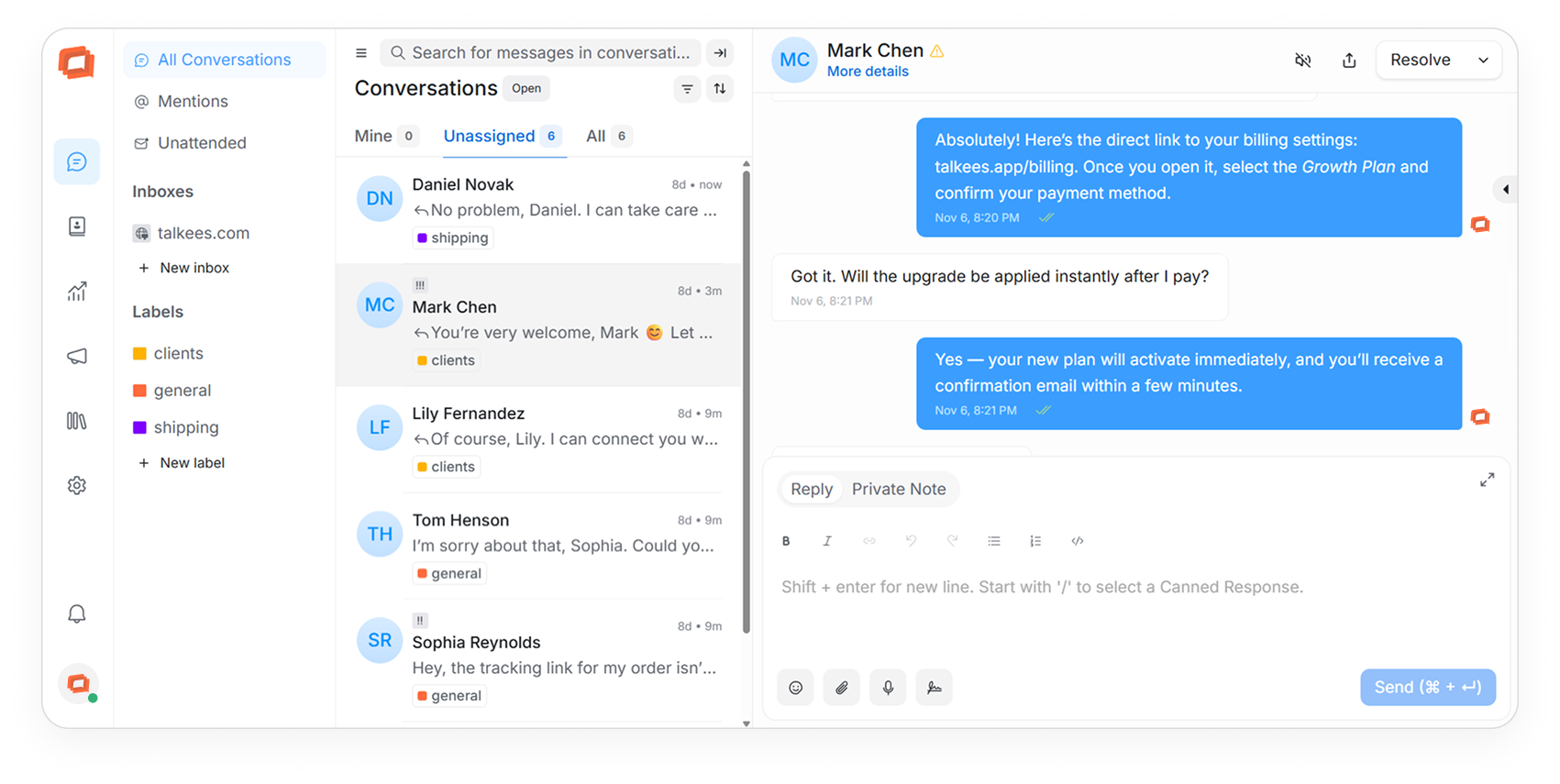
Talkees stands out as a leading Zendesk alternative with its modern approach to omnichannel messaging and customer support.
Key Features
- Native WhatsApp API integration: Connect directly to WhatsApp without additional middleware or costs
- Comprehensive AI co-pilot and chatbot: Built-in AI capabilities that work across all channels
- Flexible web widget and advanced triggers: Highly customizable chat widget with sophisticated targeting options
- Robust e-commerce integrations: Seamless connections with major platforms like Shopify, WooCommerce, and Magento
- SMB-friendly pricing: Transparent pricing model designed for growing businesses
Pricing
- Starter: $29/agent/month – Includes basic chat, email support, and knowledge base
- Growth: $59/agent/month – Adds WhatsApp integration, AI chatbot, and advanced routing
- Professional: $99/agent/month – Includes all features plus advanced analytics and custom integrations
- Enterprise: Custom pricing – For larger teams with specific requirements
All plans include unlimited contacts and conversations, making Talkees particularly cost-effective for high-volume support operations.
User Experience
Talkees offers an intuitive interface that new agents can master in hours rather than days. The unified inbox presents all conversations—whether from chat, WhatsApp, email, or social channels—in a single, coherent view with clear context and customer history.
Standout Features
- AI Co-pilot: Suggests responses, summarizes conversations, and identifies customer sentiment in real-time
- WhatsApp Business integration: Direct connection to the WhatsApp Business API without third-party costs
- Omnichannel capabilities: Seamlessly switch between channels while maintaining conversation context
- Proactive messaging: Engage customers at critical moments with targeted, automated messages
Pros
- Native WhatsApp integration without additional costs
- Intuitive interface requiring minimal training
- Comprehensive AI tools included in standard pricing
- Fast implementation (typically 1-3 days)
- Excellent customer support with quick response times
Cons
- Newer platform compared to some established alternatives
- Fewer third-party integrations than Zendesk (though covers most essential needs)
- Limited voice/call center capabilities (primarily focuses on messaging channels)
Our Experience with Talkees
During our testing, Talkees impressed us with its straightforward setup process and intuitive interface. We were able to configure the platform, connect WhatsApp, and set up basic automation within a single day. The AI co-pilot feature proved remarkably accurate at suggesting appropriate responses and identifying customer sentiment, which helped our test agents resolve issues more quickly.
The WhatsApp integration was particularly seamless—a refreshing change from the complex setup and additional costs often associated with this channel in other platforms. Small businesses and e-commerce operations will appreciate the straightforward pricing model that doesn’t penalize growth or high message volumes.
Intercom vs Zendesk: AI-First Inbox with Powerful Automation

Intercom takes an AI-first approach to customer messaging with its conversational relationship platform.
Key Features
- Fin AI Agent: Automated customer support using advanced AI technology
- Proactive messaging and product tours: Engage customers within your product or website
- Customizable chatbots: Build complex conversation flows without coding
- In-app messaging: Reach users directly within your application
- Targeted campaigns: Segment and message specific customer groups
Pricing
- Start: $74/month for 2 seats – Basic messaging and support capabilities
- Growth: $119/month for 5 seats – Adds automation and basic bots
- Scale: Custom pricing – Full AI capabilities and advanced features
- Additional AI costs: Approximately $0.99 per AI resolution beyond included allotments
User Experience
Intercom offers a clean, modern interface focused on conversations rather than tickets. The platform excels at in-product messaging but can feel less structured for traditional support workflows.
Pros
- Exceptional in-app messaging capabilities
- Strong product tour and onboarding features
- Powerful AI with Fin for automated resolutions
- Excellent for product-led companies
Cons
- Pricing scales quickly with usage and team size
- AI resolutions incur additional costs
- Less structured for complex support workflows
- Can become expensive for high-volume support
Our Experience with Intercom
Intercom shines for product-led companies that want to engage users within their applications. The Fin AI agent is impressive for handling routine inquiries, though the per-resolution pricing model can lead to unpredictable costs during busy periods. For companies focused on in-product support and proactive engagement, Intercom offers capabilities that traditional helpdesks can’t match.
For a clearer breakdown of capabilities and costs, see our full intercom vs zendesk comparison focused on automation, omnichannel support, and scalability.
Freshdesk vs Zendesk: Comprehensive Suite with Freddy AI

Freshdesk provides a full-featured omnichannel suite with AI capabilities at a lower total cost than Zendesk.
Key Features
- Freddy AI: Built-in AI assistant for agent productivity and automated responses
- Omnichannel inbox: Unified view of conversations across channels
- WhatsApp Business connectors: Native integration with WhatsApp
- Robust workflow automation: Sophisticated routing and business process automation
- Marketplace integrations: Extensive app marketplace for additional functionality
Pricing
- Growth: $15/agent/month – Basic ticketing and collaboration
- Pro: $49/agent/month – Adds automation, SLAs, and advanced reporting
- Enterprise: $79/agent/month – Full omnichannel capabilities and AI features
- Freddy AI add-on: Approximately $29/agent/month for advanced AI capabilities
User Experience
Freshdesk offers a clean interface with a reasonable learning curve. The platform balances feature depth with usability, making it suitable for both small teams and larger organizations.
Pros
- Competitive pricing compared to Zendesk
- Comprehensive feature set across channels
- Freddy AI offers solid automation capabilities
- Strong multilingual support
Cons
- Advanced AI features require add-ons
- Some features limited to higher-tier plans
- Can require significant configuration for complex workflows
Our Experience with Freshdesk
Freshdesk impressed us with its balance of features and affordability. The omnichannel capabilities work well for teams managing multiple communication channels, and Freddy AI provides useful automation without breaking the budget. Implementation is straightforward for basic setups but can require more time for complex configurations.
For a clearer breakdown of capabilities and costs, see our full freshdesk vs zendesk comparison focused on ticketing, automation, and scalability.
Crisp vs Zendesk: Fast Multichannel Setup with Powerful Campaigns

Crisp focuses on providing a quick-to-implement live chat solution with marketing capabilities for startups and small businesses.
Key Features
- Unified inbox: Manage conversations from chat, email, social media, and messaging apps
- Campaign tools: Create and manage targeted customer messaging campaigns
- Chatbots and automation: Build no-code chatbots for common scenarios
- WhatsApp integration: Connect your WhatsApp Business account
- MagicBrowse: Co-browsing functionality to see what your customers see
Pricing
- Free: Basic chat for 2 operators
- Basic: $25/month for 4 seats – Essential features for small teams
- Unlimited: $95/month for 10 seats – Full feature access for growing teams
- Enterprise: Custom pricing – Advanced security and support
User Experience
Crisp offers one of the most straightforward interfaces among Zendesk alternatives, with a focus on getting teams up and running quickly. The platform is particularly well-suited for startups and small businesses.
Pros
- Extremely fast setup (minutes rather than hours)
- Affordable pricing with seat-inclusive plans
- Built-in marketing campaign capabilities
- Co-browsing feature for enhanced support
Cons
- Less robust for complex enterprise routing
- Limited advanced reporting capabilities
- Fewer enterprise integrations than larger platforms
Our Experience with Crisp
Crisp stands out for its simplicity and speed of implementation. We had the chat widget up and running within minutes, and connecting additional channels was equally straightforward. The marketing campaign features add value beyond typical support functionality, making Crisp an excellent choice for small teams that want to combine support and engagement in one platform.
If you’re comparing two support and engagement platforms, we’ve prepared a detailed crisp vs zendesk comparison covering features, pricing, and best-fit use cases.
LiveChat vs Zendesk: Polished Chat Experience with Extensive Marketplace

LiveChat specializes in providing a refined live chat experience with strong customization options and a rich app marketplace.
Key Features
- Sophisticated chat widget: Highly customizable chat interface with advanced targeting
- ChatBot add-on: AI-powered chatbot platform for automation
- Robust analytics: Detailed reporting on chat performance and customer satisfaction
- Extensive marketplace: Rich ecosystem of integrations and extensions
- Eye-catching UI: Visually appealing interface for both agents and customers
Pricing
- Starter: $20/agent/month – Basic chat functionality
- Team: $41/agent/month – Advanced features for growing teams
- Business: $59/agent/month – Enterprise-grade capabilities
- ChatBot add-on: Starting at $42/month for basic automation
User Experience
LiveChat offers one of the most polished chat experiences available, with an interface that’s both attractive and functional. The platform is designed specifically for chat excellence rather than trying to be an all-in-one solution.
Pros
- Superior chat widget experience and customization
- Excellent real-time monitoring and analytics
- Strong canned response and resource sharing features
- Robust app marketplace
Cons
- Requires add-ons for full omnichannel coverage
- ChatBot is a separate purchase
- Primarily focused on chat rather than comprehensive support
Our Experience with LiveChat
LiveChat excels at what its name suggests—providing an exceptional live chat experience. The widget is responsive, customizable, and integrates well with websites. The agent interface is intuitive and efficient, with useful features like message sneak-peek and typing indicators. For teams focused primarily on web chat excellence, LiveChat is hard to beat, though you’ll need additional solutions for full omnichannel support.
If you’re comparing a specialized live chat platform with a full helpdesk solution, we’ve prepared a detailed livechat vs zendesk comparison covering features, pricing, and best-fit use cases.
Tawk.to vs Zendesk: Truly Free Live Chat with Basic Automation

Tawk.to offers a genuinely free live chat solution that’s suitable for small businesses with limited budgets.
Key Features
- Forever free plan: Unlimited agents and chats at no cost
- Basic automation: Set up simple chat routing and triggered messages
- Mobile apps: Stay connected on iOS and Android devices
- Knowledge base: Create and share help articles
- Ticketing system: Convert chats to tickets for follow-up
Pricing
- Free: Unlimited agents and chats (with tawk.to branding)
- Remove branding: $12/month to remove tawk.to branding
- Hired agents: $1/hour for tawk.to-provided chat agents
User Experience
Tawk.to offers a straightforward interface focused on the essentials. While not as polished as paid alternatives, it provides the core functionality needed for basic live chat support.
Pros
- Completely free for unlimited agents and chats
- Easy to implement and use
- Includes basic knowledge base functionality
- Mobile apps for on-the-go support
Cons
- Limited customization options
- Basic reporting and analytics
- Branding removal requires payment
- Fewer advanced features than paid alternatives
Our Experience with Tawk.to
Tawk.to delivers impressive value for a free solution. During testing, we found the chat widget responsive and functional, though lacking some of the refinements of paid alternatives. The platform is ideal for small businesses, nonprofits, or startups with tight budgets that need basic live chat functionality without the cost.
Help Scout vs Zendesk: Email-First Helpdesk with Beacon Chat

Help Scout takes an email-first approach to customer support with its conversation-focused platform and Beacon chat widget.
Key Features
- Shared inbox: Collaborative email management with collision detection
- Beacon chat: Integrated chat and self-service widget
- Docs knowledge base: Create and share help documentation
- Conversation-focused interface: Support without the typical ticketing system
- AI Answers and AI Assist: AI capabilities for automation and agent assistance
Pricing
- Standard: $25/user/month – Core features for small teams
- Plus: $45/user/month – Advanced features for growing companies
- Pro: $75/user/month – Enterprise capabilities and priority support
- AI Answers: $0.75 per automated resolution after free trial
User Experience
Help Scout offers a clean, straightforward interface focused on conversations rather than tickets. The platform emphasizes simplicity and efficiency over complex workflows.
Pros
- Intuitive, email-like interface with minimal learning curve
- Beacon combines chat and self-service in one widget
- Transparent, predictable pricing
- Excellent documentation and customer support
Cons
- Less robust for complex routing or SLAs
- Limited native social channel integration
- Primarily designed for email-first support strategies
Our Experience with Help Scout
Help Scout impressed us with its simplicity and focus on the essentials. The conversation-based approach feels natural and efficient, especially for teams transitioning from email-based support. Beacon provides a clean, effective chat solution that integrates well with the knowledge base. For teams that prioritize email support with supplementary chat, Help Scout offers an excellent balance of features and usability.
Zoho Desk vs Zendesk: Value in the Zoho Ecosystem with Zia AI

Zoho Desk provides a feature-rich helpdesk with AI capabilities at a competitive price point, especially for teams already using other Zoho products.
Key Features
- Zia AI assistant: Built-in AI for agent productivity and automation
- Multichannel support: Email, chat, social, phone, and self-service
- Process automation: Sophisticated workflow and business process automation
- Contextual customer information: 360-degree view of customer interactions
- Deep Zoho ecosystem integration: Seamless connection with other Zoho applications
Pricing
- Standard: $14/agent/month – Essential helpdesk features
- Professional: $23/agent/month – Advanced automation and multichannel
- Enterprise: $40/agent/month – AI features and advanced customization
User Experience
Zoho Desk offers a comprehensive interface that can feel complex at first but provides extensive capabilities. The platform works best for teams willing to invest time in configuration.
Pros
- Excellent value for feature depth
- Strong AI capabilities with Zia
- Comprehensive automation options
- Seamless integration with Zoho ecosystem
Cons
- Interface can feel complex compared to simpler alternatives
- Best value realized when using multiple Zoho products
- Some advanced features limited to higher tiers
Our Experience with Zoho Desk
Zoho Desk provides impressive capabilities at its price point, especially the Zia AI assistant which offers practical automation without additional costs. The platform requires more configuration than some alternatives but rewards the effort with powerful workflow automation and reporting. For businesses already using Zoho CRM or other Zoho products, the seamless integration adds significant value.
If you’re comparing two popular support platforms, we’ve prepared a detailed zoho desk vs zendesk comparison covering features, pricing, and best-fit use cases.
HubSpot vs Zendesk: CRM-Native Conversations with Sales Alignment

HubSpot Service Hub integrates customer support directly with the HubSpot CRM platform, creating a unified view of customer interactions across marketing, sales, and service.
Key Features
- Conversations inbox: Unified messaging across email, chat, and Facebook Messenger
- Knowledge base: Create and share help articles with built-in SEO tools
- Customer feedback surveys: Collect and analyze customer satisfaction data
- Service automation: Create workflows to automate routine service tasks
- Deep CRM integration: Full customer context from marketing and sales
Pricing
- Free: Basic tools for small teams
- Starter: $20/month (2 paid users included) – Essential support tools
- Professional: $500/month (5 paid users included) – Advanced automation and reporting
- Enterprise: $1,200/month (10 paid users included) – Enterprise features and security
User Experience
HubSpot offers a clean, modern interface that integrates seamlessly with its CRM platform. The learning curve is moderate, with excellent onboarding resources available.
Pros
- Seamless integration with HubSpot CRM, Marketing, and Sales
- Strong knowledge base with built-in SEO tools
- Excellent customer feedback and survey capabilities
- Free tier available for basic needs
Cons
- Higher tiers can be expensive for larger teams
- Some advanced features limited to Professional and Enterprise
- Primary value comes when using the broader HubSpot ecosystem
Our Experience with HubSpot
HubSpot Service Hub shines for companies that want to align customer support with sales and marketing efforts. The unified customer view provides valuable context for support interactions, and the knowledge base tools are among the best we tested. For businesses already using HubSpot CRM or Marketing Hub, adding Service Hub creates a powerful, integrated customer experience platform.
For a clearer breakdown of capabilities and costs, see our full hubspot vs zendesk comparison focused on ticketing, automation, CRM integration, and scalability.
Gorgias vs Zendesk: Shopify-Native Support with Order Actions

Gorgias specializes in e-commerce customer support with deep integrations for online stores, particularly Shopify.
Key Features
- Order management: View and modify orders directly from support tickets
- E-commerce integrations: Deep connections with Shopify, Magento, and BigCommerce
- Social media management: Handle comments and messages from Instagram, Facebook, and other platforms
- Macros and automation: Create sophisticated response templates and workflows
- WhatsApp and SMS integration: Connect popular messaging channels
Pricing
- Basic: $60/month for 300 tickets – Essential e-commerce support
- Pro: $360/month for 2,000 tickets – Advanced features for growing stores
- Advanced: $900/month for 5,000 tickets – Enterprise capabilities for larger operations
- Enterprise: Custom pricing for high-volume needs
User Experience
Gorgias offers an intuitive interface focused on e-commerce support needs. The platform makes it easy to view order information alongside customer conversations.
Pros
- Exceptional Shopify integration with order actions
- Ticket-based pricing rather than per-agent
- Purpose-built for e-commerce support
- Strong social media management capabilities
Cons
- Primarily valuable for e-commerce businesses
- Can become expensive with high ticket volumes
- Less suitable for non-retail support needs
Our Experience with Gorgias
Gorgias impressed us with its laser focus on e-commerce support needs. The ability to view and modify orders directly within support conversations saves significant time for agents handling order-related inquiries. The social media management features are equally strong, making it easy to handle comments and direct messages across platforms. For Shopify, Magento, or BigCommerce stores, Gorgias offers specialized capabilities that general helpdesks can’t match.
For a clearer breakdown of capabilities and costs, see our full gorgias vs zendesk comparison focused on automation, integrations, and scalability.
Feature Comparison at a Glance

| Feature | Talkees | Zendesk | Intercom | Freshdesk | Crisp | LiveChat | Tawk.to | Help Scout | Zoho Desk | HubSpot | Gorgias |
|---|---|---|---|---|---|---|---|---|---|---|---|
| Widget Customization | ★★★★★ | ★★★☆☆ | ★★★★☆ | ★★★★☆ | ★★★★★ | ★★★★★ | ★★☆☆☆ | ★★★★☆ | ★★★☆☆ | ★★★★☆ | ★★★★☆ |
| Chat Triggers | ★★★★★ | ★★★★☆ | ★★★★☆ | ★★★☆☆ | ★★★★☆ | ★★★★★ | ★★☆☆☆ | ★★★★☆ | ★★★☆☆ | ★★★☆☆ | ★★★☆☆ |
| WhatsApp/Instagram | ★★★★★ | ★★★☆☆¹ | ★★★☆☆ | ★★★★☆ | ★★★★☆ | ★★☆☆☆ | ★☆☆☆☆ | ★★☆☆☆ | ★★★☆☆ | ★★☆☆☆ | ★★★★★ |
| Slack/Teams | ★★★★☆ | ★★★★★ | ★★★★☆ | ★★★☆☆ | ★★★★☆ | ★★★☆☆ | ★★☆☆☆ | ★★★★☆ | ★★★☆☆ | ★★★☆☆ | ★★★☆☆ |
| KB/AI | ★★★★☆ | ★★★★★¹ | ★★★★★ | ★★★★☆ | ★★★☆☆ | ★★★☆☆ | ★★☆☆☆ | ★★★★★ | ★★★★☆ | ★★★★☆ | ★★★☆☆ |
| Reporting | ★★★★☆ | ★★★★★ | ★★★★☆ | ★★★★☆ | ★★★☆☆ | ★★★★☆ | ★★☆☆☆ | ★★★★☆ | ★★★★☆ | ★★★★☆ | ★★★★☆ |
¹ Often requires higher-tier plans or add-ons
Free vs Paid Zendesk Alternatives: When a Free Plan Suffices

Free plans can be suitable for:
- Small teams with basic support needs
- Startups with limited budgets
- Low-volume support operations
- Teams focused primarily on email or chat
You’ll likely outgrow free plans when you need:
- Advanced routing and automation
- Comprehensive reporting and analytics
- Multiple channels beyond basic chat and email
- Team collaboration features and workflow automation
- Enterprise security and compliance features
Among the alternatives we’ve discussed, tawk.to offers the most generous free plan, while HubSpot, Freshdesk, and Zoho Desk provide free tiers with more limitations.
Open-Source vs Hosted Zendesk Alternatives: Security and Cost Considerations

When deciding between open-source and hosted solutions, consider:
Open-Source Advantages
- Complete control over your data and infrastructure
- No per-agent licensing fees
- Unlimited customization possibilities
- No vendor lock-in
Open-Source Challenges
- Requires technical expertise to implement and maintain
- Security responsibility falls entirely on your team
- Often lacks polished user interfaces
- May have higher total cost when considering development and maintenance
Hosted Solution Advantages
- Faster implementation with minimal technical requirements
- Regular updates and improvements without IT involvement
- Professional support and SLAs
- Security and compliance handled by the vendor
Hosted Solution Challenges
- Ongoing subscription costs that scale with team size
- Less control over data and infrastructure
- Potential vendor lock-in
- May have limitations on customization
Most businesses find that hosted solutions like Talkees, Intercom, or Freshdesk provide the best balance of features, security, and total cost of ownership, especially when considering the full lifecycle costs of implementation, maintenance, and updates.
Integration Mapping: WhatsApp, Slack, and Microsoft Teams Readiness

| Platform | Slack | Microsoft Teams | |
|---|---|---|---|
| Talkees | Native API | Native | Native |
| Intercom | Via Connector | Native | Via Connector |
| Freshdesk | Native | Native | Native |
| Crisp | Native | Native | Via Zapier |
| LiveChat | Via Connector | Native | Via Connector |
| Tawk.to | Limited | Via Zapier | Via Zapier |
| Help Scout | Via Integration | Native | Via Integration |
| Zoho Desk | Native | Native | Native |
| HubSpot | Via Integration | Native | Native |
| Gorgias | Native | Native | Via Integration |
Migration Checklist from Zendesk Messaging

Planning a migration from Zendesk? Follow this checklist for a smooth transition:
1. Data Export and Mapping
- Export conversation history, customer profiles, and knowledge base articles
- Map custom fields between systems
- Preserve tags and categories
- Back up all attachments and media files
2. Widget Implementation
- Configure the new chat widget to match your brand
- Set up proactive triggers and automated messages
- Test across all devices and browsers
- Implement gradually with A/B testing if possible
3. Automation and Workflow Parity
- Recreate essential workflows and automations
- Set up routing rules and agent assignments
- Configure business hours and offline behavior
- Establish SLAs and escalation paths
4. Agent Training
- Provide hands-on training sessions
- Create quick reference guides for common tasks
- Set up test environments for practice
- Gather feedback and address concerns
5. Channel Cutover
- Migrate one channel at a time when possible
- Start with lower-volume channels
- Maintain parallel systems during transition
- Communicate changes to customers proactively
Most vendors offer migration assistance, with many providing dedicated onboarding specialists to help with the transition. Talkees, for example, offers comprehensive migration support including data import, widget configuration, and agent training.
Best Picks by Use Case

Best for Affordable SMB Option
Talkees and Help Scout offer the best balance of features and affordability for small to medium businesses. Talkees provides more comprehensive omnichannel capabilities with native WhatsApp integration, while Help Scout excels with its conversation-focused approach and Beacon chat widget.
Best for AI-Heavy Workflows
Intercom and Freshdesk lead in AI capabilities. Intercom’s Fin AI Agent offers powerful automation for common inquiries, while Freshdesk’s Freddy AI provides a balance of agent assistance and customer-facing automation at a competitive price point.
Best for E-commerce/DTC
Gorgias is the clear leader for e-commerce support, with its deep Shopify integration and order management capabilities. Talkees also performs well for e-commerce with its omnichannel approach and strong social media integration.
Best for Omnichannel Support Teams
Talkees and Freshdesk excel for teams managing multiple communication channels. Talkees offers native WhatsApp API integration and a unified inbox that makes channel switching seamless, while Freshdesk provides a comprehensive omnichannel suite with strong automation capabilities.
Conclusion: Finding Your Perfect Zendesk Alternative

Choosing the right Zendesk alternative depends on your specific needs, team size, and budget. Consider these key factors:
- Channel requirements: Which communication channels are essential for your business?
- AI and automation needs: How important are chatbots and agent assistance tools?
- Team size and structure: How many agents will use the system, and how do they collaborate?
- Integration requirements: What other tools must your support platform connect with?
- Budget constraints: What’s your per-agent or total monthly budget?
For most small to medium businesses seeking a balance of features, affordability, and ease of use, Talkees stands out as our top recommendation. Its native WhatsApp integration, comprehensive AI tools, and transparent pricing make it an excellent Zendesk alternative that addresses the common pain points teams face with Zendesk Live Chat Messaging.
Whatever your choice, take advantage of free trials and demos to ensure the platform meets your specific requirements before making a final decision.
Looking for more Zendesk comparisons? Check out our roundup: 10 Best Zendesk Service Desk & Enterprise Support Alternatives & Competitors (Free & Paid)