 English
 Slovenčina
 Français
 Magyar
10 Best LiveAgent Alternatives & Competitors (Free & Paid)

Are you looking for a better customer support platform than LiveAgent? Whether you need more advanced AI capabilities, better WhatsApp integration, or simply more affordable pricing, this comprehensive guide compares the top LiveAgent alternatives available in 2025.
We’ve thoroughly evaluated each platform based on AI capabilities, channel coverage, integration options, and pricing to help you find the perfect solution for your business needs.
Why Businesses Seek LiveAgent Alternatives: Cost, Features, and Integration Challenges

LiveAgent has built a solid reputation as a help desk solution, but many teams are exploring alternatives for several key reasons:
- Pricing tiers that scale poorly: While LiveAgent starts affordably (around $15-49 per agent/month), costs can quickly add up as your team grows
- Limited AI capabilities: As customer expectations evolve, LiveAgent’s basic automation features fall short compared to AI-first alternatives
- WhatsApp integration limitations: LiveAgent caps WhatsApp numbers to just three, even on higher-tier plans, restricting multi-brand support
- Integration friction: Many users report complex setup processes, limited vendor support on lower tiers, and challenges with deep CRM integrations
- Scalability concerns: As support operations grow, LiveAgent’s infrastructure may struggle with high-volume environments
For growing businesses, these limitations often trigger the search for alternatives that offer more flexible pricing, better AI capabilities, and seamless integrations with essential business tools.
Key Features to Look for in LiveAgent Alternatives in 2025

When evaluating LiveAgent alternatives, prioritize platforms that offer:
- AI-powered automation: Look for solutions with robust AI chatbots that can handle routine inquiries and seamlessly transition to live agents when needed
- Unified inbox: Ensure the platform consolidates all communication channels (email, chat, social media, WhatsApp) into a single interface
- Flexible pricing models: Consider alternatives with transparent pricing that scales reasonably as your team grows
- Comprehensive integration ecosystem: Verify compatibility with your essential tools (CRM, e-commerce platform, knowledge base)
- Omnichannel capabilities: Ensure support for all channels your customers use, with particular attention to WhatsApp limits
- Custom AI capabilities: Look for platforms that allow AI customization to match your brand voice and specific use cases
- Robust analytics: Prioritize solutions offering detailed insights into team performance, customer satisfaction, and AI effectiveness
- Easy migration path: Choose platforms that simplify the transition from LiveAgent with minimal disruption
The right alternative should address your current pain points while providing a foundation for future growth and evolving customer expectations.
Evaluating LiveAgent Alternatives: Criteria for Success

To properly compare LiveAgent alternatives, we assessed each platform across these critical dimensions:
- AI depth and quality: How sophisticated are the AI capabilities? Can they handle complex inquiries or just basic FAQs?
- Channel coverage: Does the platform support all necessary communication channels without arbitrary limits?
- Integration capabilities: How well does it connect with your existing tech stack and business workflows?
- Pricing structure: Is pricing transparent, predictable, and reasonable as you scale?
- Security and compliance: What certifications and data protection measures are in place?
- Ease of migration: How difficult is it to transition from LiveAgent to this alternative?
- Customer support: What level of assistance is available during implementation and beyond?
- Mobile experience: How robust are the mobile applications for agents on the go?
These criteria help identify which alternatives truly address the limitations of LiveAgent while providing additional value for specific business needs.
Talkees vs LiveAgent: The Best Entry Point for SMBs

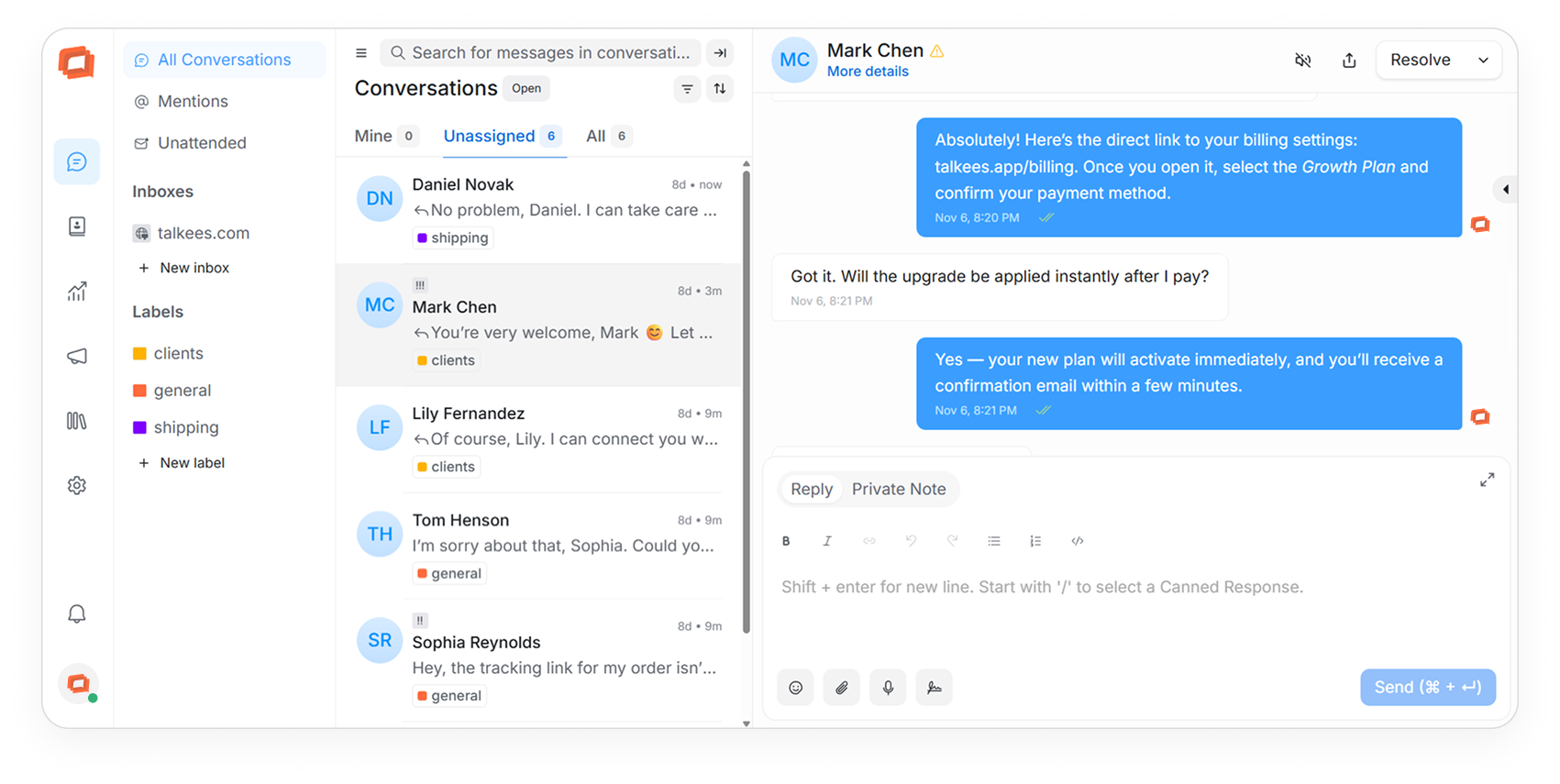
Talkees stands out as an AI-first omnichannel support platform that addresses many of LiveAgent’s limitations while remaining accessible to small and medium-sized businesses.
Pricing and Value
- Talkees: Offers flexible, transparent pricing that scales with your business. Plans start at a competitive rate with predictable costs as you grow.
- LiveAgent: Tiered pricing ($15-$49/agent/month) that can become expensive as teams expand, with additional costs for advanced features.
Key Features
Talkees delivers a comprehensive set of features designed for modern customer support:
- Advanced AI chatbot: Handles up to 70% of routine inquiries automatically, with seamless human handoff
- True omnichannel inbox: Unifies email, chat, social, and WhatsApp without arbitrary number limits
- Custom AI integration: Allows tailoring of AI responses to match your brand voice and specific use cases
- Knowledge base automation: Automatically identifies gaps in documentation based on customer inquiries
- Flexible WhatsApp integration: Supports multiple WhatsApp numbers for multi-brand businesses
- E-commerce integrations: Native connections with Shopify, WooCommerce, and other platforms
User Experience
Talkees provides an intuitive interface that requires minimal training, with a clean design that helps agents manage multiple conversations efficiently. The mobile app delivers a full-featured experience for remote teams.
Real User Feedback
“After struggling with LiveAgent’s WhatsApp limitations, switching to Talkees was a revelation. We can now manage all our brands through a single platform, and the AI actually resolves most basic inquiries without human intervention.” – E-commerce Support Manager
Our Assessment
Talkees offers the ideal balance of affordability, AI capabilities, and ease of use for SMBs looking to upgrade from LiveAgent. Its flexible pricing model and quick implementation make it particularly well-suited for growing e-commerce and SaaS companies that need sophisticated support tools without enterprise complexity.
Best for: SMBs seeking an AI-powered alternative to LiveAgent with better WhatsApp integration and more predictable pricing.
Freshdesk vs LiveAgent: Ticketing Automation and Cost Efficiency

Freshdesk offers a robust ticketing system with strong automation capabilities, making it a popular LiveAgent alternative for businesses focused on email-based support.
Pricing and Value
- Freshdesk: Free plan available for up to 10 agents. Paid plans range from $15/agent/month (Growth) to $79/agent/month (Enterprise). Freddy AI Copilot costs an additional $29/agent/month.
- LiveAgent: No truly free plan, with paid tiers from $15-$49/agent/month.
Key Features
Freshdesk delivers comprehensive help desk functionality with several standout features:
- Freddy AI Copilot: Assists agents with suggested responses and ticket categorization
- Robust ticketing system: Advanced routing, automation, and SLA management
- Collision detection: Prevents multiple agents from working on the same ticket
- Team collaboration tools: Internal notes, @mentions, and shared ownership
- Self-service portal: Customizable knowledge base and community forums
- Omnichannel add-ons: Available but often require higher-tier plans
User Experience
Freshdesk offers a clean, intuitive interface that most agents can learn quickly. The platform provides extensive customization options, though this can sometimes create complexity during initial setup.
Real User Feedback
“Freshdesk’s automation rules have reduced our response time by 40%. The free tier was perfect for getting started, and the upgrade path has been reasonable as we’ve grown.” – IT Support Manager
Our Assessment
Freshdesk excels at ticket management and offers excellent value with its free tier for small teams. While its AI capabilities require add-ons that increase the total cost, the platform provides a more scalable solution than LiveAgent for growing support operations.
The main drawbacks include potential costs for omnichannel features and less specialized WhatsApp integration compared to some alternatives. However, for teams primarily handling email support tickets, Freshdesk offers an excellent balance of features and affordability.
Best for: Teams focused on email ticketing who want a scalable platform with optional AI capabilities and a free entry point.
LiveAgent as the Benchmark: Strengths and Limitations

Before exploring more alternatives, let’s establish LiveAgent’s position as the benchmark against which other platforms are measured.
Key Strengths
- All-in-one solution: Combines ticketing, live chat, social media, and call center in one platform
- Affordable entry point: Starting at $15/agent/month, it’s accessible to small businesses
- Extensive integrations: Over 200 integrations with popular business tools
- Strong live chat: Real-time typing view and visitor monitoring
- Built-in call center: Integrated VoIP capabilities without requiring a separate platform
Notable Limitations
- WhatsApp restrictions: Limited to three WhatsApp numbers even on premium plans
- Basic AI capabilities: Lacks advanced AI for ticket resolution and agent assistance
- Mobile app limitations: Less robust than desktop experience
- Scalability concerns: Performance can degrade with high ticket volumes
- Integration depth: Some integrations lack comprehensive data syncing
- Limited enterprise features: Restricted SSO, data governance, and compliance features
Ideal Use Case
LiveAgent works best for small businesses with straightforward support needs across email, chat, and occasional phone support. It’s particularly well-suited for companies with limited budgets who need an all-in-one solution without advanced AI requirements.
For a clearer breakdown of capabilities and costs, see our full freshdesk vs liveagent comparison focused on ticketing, automation, and omnichannel support.
Zendesk vs LiveAgent: Enterprise Workflows for Growing Companies

Zendesk is a market leader in customer support platforms, offering enterprise-grade capabilities that address many of LiveAgent’s limitations.
Pricing and Value
- Zendesk: Suite Team ($55/agent/month), Suite Professional ($115/agent/month), Suite Enterprise ($169/agent/month)
- LiveAgent: $15-$49/agent/month across tiers
Key Features
Zendesk delivers comprehensive enterprise-grade support capabilities:
- Zendesk AI: Advanced AI for ticket triage, suggested responses, and automated resolution
- Sophisticated workflows: Complex routing, approval flows, and business rules
- Robust reporting: Advanced analytics and customizable dashboards
- Enterprise security: SOC 2, HIPAA compliance, and advanced data governance
- Extensive marketplace: Over 1,000 integrations and add-ons
- Omnichannel capabilities: Unified support across all channels with enterprise-grade reliability
User Experience
Zendesk offers a polished, professional interface with extensive customization options. While powerful, this can create a steeper learning curve than simpler alternatives. The mobile experience is robust but can be overwhelming for occasional users.
Real User Feedback
“Zendesk handles our complex workflow needs perfectly, with excellent reliability at scale. The AI features have significantly improved our efficiency, though the total cost is substantial when you add all necessary components.” – Enterprise Support Director
Our Assessment
Zendesk represents a significant upgrade from LiveAgent in terms of capabilities, particularly for larger organizations with complex support needs. Its AI features, workflow options, and enterprise security make it ideal for businesses that have outgrown LiveAgent’s limitations.
However, the higher price point and implementation complexity make Zendesk less suitable for small businesses or those with straightforward support requirements. The platform truly shines when its advanced capabilities align with sophisticated business needs.
Best for: Growing mid-market and enterprise companies requiring advanced workflows, comprehensive reporting, and enterprise-grade security and compliance.
Intercom vs LiveAgent: Proactive Support and Pricing Predictability

Intercom takes a different approach to customer support, focusing on proactive engagement and conversational support rather than traditional ticketing.
Pricing and Value
- Intercom: Essential ($29/seat/month), Advanced ($85/seat/month), and Expert ($132/seat/month). Fin AI costs an additional $0.99 per resolution.
- LiveAgent: $15-$49/agent/month across tiers
Key Features
Intercom offers a distinctive approach to customer engagement:
- Fin AI chatbot: Advanced AI that can resolve up to 50% of common inquiries
- Proactive messaging: Targeted outreach based on user behavior and attributes
- Product tours: In-app guidance and onboarding flows
- Conversational support: Chat-first approach with ticketing capabilities
- Customer data platform: Rich user profiles and segmentation
- Developer platform: Extensive customization options for technical teams
User Experience
Intercom provides a modern, messaging-focused interface that feels more like a communication tool than a traditional help desk. This approach resonates with teams seeking a more conversational relationship with customers.
Real User Feedback
“Intercom completely changed how we think about support. Instead of waiting for tickets, we can proactively engage users at the right moment. The AI chatbot handles basic questions, letting our team focus on complex issues.” – Customer Success Director
Our Assessment
Intercom excels at proactive, conversational support that goes beyond traditional ticketing. Its AI capabilities are among the most advanced in the market, though the per-resolution pricing model can lead to unpredictable costs as usage scales.
The platform is particularly effective for SaaS companies and businesses with web or mobile applications, where in-context support provides significant value. However, it may be less suitable for companies with heavy email support needs or those requiring complex ticketing workflows.
Best for: SaaS, e-commerce, and digital-first businesses seeking proactive, conversational support with advanced AI capabilities.
Help Scout vs LiveAgent: Simplified Shared Inbox Experience
Help Scout focuses on delivering an exceptionally straightforward shared inbox experience, making it ideal for teams that prioritize email-based support.
Pricing and Value
- Help Scout: Standard ($22/user/month), Plus ($40/user/month), Pro ($65/user/month). AI Answers add-on costs $0.75 per resolution.
- LiveAgent: $15-$49/agent/month across tiers
Key Features
Help Scout delivers a focused set of features optimized for email support:
- Clean shared inbox: Streamlined email management without complexity
- Beacon chat widget: Lightweight chat and self-service tool
- Docs knowledge base: Simple yet powerful documentation platform
- Collaboration tools: Internal notes, @mentions, and saved replies
- AI Answers: Optional AI for automatic responses to common questions
- Workflows automation: Basic routing and assignment rules
User Experience
Help Scout offers perhaps the cleanest, most intuitive interface of any platform in this comparison. The learning curve is minimal, making it ideal for teams that value simplicity and efficiency.
Real User Feedback
“After trying several complex platforms, Help Scout was a breath of fresh air. Our team was productive from day one, and customers appreciate the personal touch in our communications.” – Customer Support Lead
Our Assessment
Help Scout excels at delivering a streamlined, human-centered support experience focused primarily on email. Its simplicity is both a strength and limitation—perfect for teams that prioritize email support but potentially restrictive for those needing comprehensive omnichannel capabilities.
The platform’s pricing is transparent and reasonable, though adding AI capabilities increases the total cost. For businesses that value personal, efficient email support without complexity, Help Scout offers an excellent alternative to LiveAgent.
Best for: Email-focused support teams that value simplicity, personal communication, and a minimal learning curve.
Zoho Desk vs LiveAgent: CRM Integration and Pricing Structure

Zoho Desk offers tight integration with the broader Zoho ecosystem, making it particularly valuable for businesses already using Zoho CRM or other Zoho products.
Pricing and Value
- Zoho Desk: Free plan (up to 3 agents), Standard ($14/user/month), Professional ($23/user/month), Enterprise ($40/user/month)
- LiveAgent: $15-$49/agent/month across tiers
Key Features
Zoho Desk provides comprehensive help desk functionality with several distinctive capabilities:
- Zia AI assistant: AI-powered suggestions and automations
- CRM-native context: Seamless integration with Zoho CRM
- Multichannel support: Email, phone, chat, social media in one platform
- Process automation: Sophisticated workflow and assignment rules
- Custom functions: Scriptable business logic for complex scenarios
- Team collaboration: Internal discussions and knowledge sharing
User Experience
Zoho Desk offers a feature-rich interface that balances functionality with usability. While not as immediately intuitive as some alternatives, it provides extensive customization options that reward investment in setup and configuration.
Real User Feedback
“As a Zoho CRM user, adding Zoho Desk was a no-brainer. The shared customer context between sales and support has eliminated many communication problems, and the pricing is extremely reasonable.” – Operations Manager
Our Assessment
Zoho Desk provides exceptional value, particularly for businesses already invested in the Zoho ecosystem. The tight CRM integration creates a unified customer view that many other platforms struggle to match without additional configuration.
The platform’s AI capabilities, while not as advanced as some competitors, offer practical automation for routine tasks. For businesses seeking an affordable, CRM-connected alternative to LiveAgent, Zoho Desk presents a compelling option.
Best for: Zoho CRM users, budget-conscious teams, and businesses seeking strong process automation with moderate AI capabilities.
Tidio vs LiveAgent: Focused on E-commerce and Chat Solutions

Tidio specializes in providing powerful live chat and AI chatbots with particular strength in e-commerce integration, making it an excellent LiveAgent alternative for online stores.
Pricing and Value
- Tidio: Free plan available. Paid plans start around $29/month with Lyro AI chatbot capabilities.
- LiveAgent: $15-$49/agent/month across tiers
Key Features
Tidio delivers focused chat and automation capabilities:
- Lyro AI chatbots: Advanced conversational AI that handles common customer inquiries
- E-commerce integration: Native connections with Shopify, WooCommerce, and other platforms
- Visual chatbot builder: No-code interface for creating automated conversations
- Live typing insights: See what customers are typing before they send messages
- Visitor tracking: Monitor website visitors and initiate proactive chats
- Multilingual support: Automatic translation for global businesses
User Experience
Tidio offers an exceptionally clean, user-friendly interface focused on chat management. The visual chatbot builder makes automation accessible even to non-technical users.
Real User Feedback
“Tidio’s integration with our Shopify store was effortless, and the AI chatbot now handles about 65% of our customer questions automatically. The impact on our conversion rate was noticeable within the first month.” – E-commerce Store Owner
Our Assessment
Tidio excels at providing powerful chat and AI capabilities with minimal complexity. Its focus on e-commerce makes it particularly valuable for online stores seeking to improve conversion rates and provide immediate customer assistance.
While Tidio may not offer the comprehensive ticketing capabilities of some alternatives, its specialized focus delivers exceptional results in its core areas. For businesses prioritizing website chat and e-commerce integration, Tidio represents an excellent LiveAgent alternative.
Best for: E-commerce businesses, startups, and companies prioritizing website chat and conversion optimization.
Crisp vs LiveAgent: Messaging-First Solutions for Startups

Crisp takes a messaging-first approach to customer support, with a particular focus on serving startups and small businesses with an affordable, feature-rich platform.
Pricing and Value
- Crisp: Pricing starts around $45/month per workspace with unlimited team members on most plans.
- LiveAgent: $15-$49/agent/month across tiers
Key Features
Crisp delivers a comprehensive messaging platform with several innovative capabilities:
- Unified messaging inbox: Centralized management of all customer conversations
- MagicBrowse co-browsing: See what customers see to solve problems faster
- Status page: Communicate service status and incidents
- Chatbot automation: Basic chatbot capabilities for common inquiries
- Knowledge base: Self-service customer support documentation
- Campaign messaging: Proactive customer outreach
User Experience
Crisp offers a modern, messaging-focused interface that feels familiar to users of consumer messaging apps. This approach reduces the learning curve and encourages team adoption.
Real User Feedback
“Crisp gives us enterprise-level messaging capabilities at startup-friendly pricing. The co-browsing feature has been a game-changer for resolving complex issues, and our customers love the real-time chat experience.” – SaaS Founder
Our Assessment
Crisp excels at providing a messaging-centric support experience with innovative features like co-browsing that aren’t commonly found in platforms at this price point. Its workspace-based pricing model (rather than per-agent) can offer significant savings for growing teams.
While Crisp may not provide the depth of ticketing capabilities found in some alternatives, its focus on real-time communication delivers exceptional value for businesses prioritizing immediate customer interaction. For startups and small businesses seeking an affordable, messaging-first LiveAgent alternative, Crisp is an excellent choice.
Best for: Startups, small businesses, and teams prioritizing real-time customer communication with predictable pricing.
LiveChat vs LiveAgent: Live Chat Specialization and Ecosystem

LiveChat focuses exclusively on providing the best possible live chat experience, with additional products in its ecosystem to handle other support channels.
Pricing and Value
- LiveChat: Starter plan begins around $19/agent/month, with higher tiers for additional features.
- LiveAgent: $15-$49/agent/month across tiers
Key Features
LiveChat delivers specialized chat capabilities with several distinctive features:
- Advanced chat routing: Sophisticated distribution of incoming chats
- ChatBot platform: Separate but integrated AI chatbot solution
- HelpDesk integration: Connected ticketing system for non-chat communications
- Robust analytics: Detailed reporting on chat performance and customer satisfaction
- Advanced customization: Extensive branding and behavior options
- Proactive chat: Rules-based initiation of conversations with website visitors
User Experience
LiveChat provides a focused, highly optimized interface for managing chat conversations. This specialization results in a streamlined experience for agents handling chat support.
Real User Feedback
“We evaluated several platforms but chose LiveChat for its superior chat experience. The interface is intuitive for agents, and customers consistently comment on the smooth interaction. When we needed ticketing, adding their HelpDesk product was straightforward.” – Digital Marketing Director
Our Assessment
LiveChat excels at its core function—providing exceptional website chat capabilities. Rather than attempting to be an all-in-one solution, it focuses on being the best possible chat platform, with companion products available for other channels.
This approach delivers outstanding results for businesses that prioritize chat as their primary support channel. While requiring additional products for comprehensive support creates some complexity, the quality of each specialized component often exceeds what’s available in all-in-one solutions.
Best for: Businesses prioritizing website chat excellence who are willing to use a modular approach to customer support.
Free vs Paid LiveAgent Alternatives: Understanding Value and Limits

When considering LiveAgent alternatives, many businesses are drawn to free options. Here’s how free plans compare to paid alternatives:
Free Plan Limitations
Most free plans come with significant restrictions:
- Agent limits: Typically capped at 1-5 agents (Freshdesk: 10, Zoho Desk: 3)
- Feature restrictions: Advanced routing, automation, and reporting are usually limited
- Channel constraints: Often restricted to email only, with chat/social as paid add-ons
- Storage caps: Limited attachment storage and history retention
- Branding requirements: Vendor branding on customer-facing elements
- Support limitations: Reduced access to customer support
When Free Plans Make Sense
Free plans are ideal for:
- Very small teams just starting out
- Businesses with minimal support volume
- Organizations testing different platforms before committing
- Startups with limited funding prioritizing other investments
Paid Plan Advantages
Paid plans deliver several critical benefits:
- Comprehensive functionality: Access to all channels and features
- Scalability: Ability to grow without hitting artificial limits
- Professional appearance: Removal of vendor branding
- Advanced automation: Time-saving workflows and AI capabilities
- Robust reporting: Insights to improve team performance
- Priority support: Faster assistance when issues arise
Value-Based Selection
Rather than focusing solely on cost, evaluate platforms based on value:
- Calculate cost per resolution: Divide monthly cost by number of tickets resolved
- Factor time savings: Consider how automation reduces agent workload
- Evaluate customer impact: Assess how improved support affects retention and satisfaction
- Project growth needs: Ensure the platform can scale with your business
Free plans often represent false economy when factoring in these considerations, as the limitations can reduce efficiency and customer satisfaction.
Quick Recommendations by Use Case: Finding Your Best LiveAgent Alternative

Based on our comprehensive evaluation, here are our top recommendations for specific business needs:
Best for E-commerce
Talkees – Provides excellent Shopify/WooCommerce integration, AI chatbots that can handle order status and returns, and flexible WhatsApp support for multi-brand businesses.
Best for SaaS Companies
Intercom – Delivers exceptional in-app support, proactive onboarding, and advanced AI capabilities that align perfectly with SaaS customer journeys.
Best for B2B Support
Zendesk – Offers the robust workflow capabilities, SLA management, and enterprise security features essential for complex B2B support operations.
Best for Multilingual Teams
Talkees – Provides advanced translation capabilities and supports agent assignment based on language skills, with AI that handles multiple languages effectively.
Best for High-Volume Inboxes
Freshdesk – Delivers excellent ticket routing, automation rules, and collision detection that keep high-volume support operations running smoothly.
Best for Budget-Conscious Teams
Zoho Desk – Offers exceptional value with its free tier (3 agents) and affordable paid plans, without sacrificing essential functionality.
Best for Phone-Heavy Support
Zendesk – Provides advanced call routing, recording, and analytics capabilities essential for teams where voice support is the primary channel.
Best for Chat-Focused Support
LiveChat or Tidio – Both excel at providing exceptional website chat experiences with robust customization and visitor tracking.
Best for Gmail-Centric Teams
Hiver – Works directly within Gmail, allowing teams to maintain their familiar email interface while adding collaboration features.
Best for WhatsApp-First Support
Talkees – Offers superior WhatsApp integration without the number limitations found in LiveAgent, making it ideal for WhatsApp-heavy support strategies.
Migration Considerations from LiveAgent: A Step-by-Step Guide

Transitioning from LiveAgent to a new platform requires careful planning. Follow these steps to ensure a smooth migration:
1. Data Export and Preparation
- Export all tickets: Use LiveAgent’s export tools to create backups of historical tickets
- Document custom fields: Map LiveAgent custom fields to equivalent fields in your new platform
- Inventory integrations: List all connected systems that will need to be reconfigured
- Export knowledge base: Save all KB articles for import to the new system
- Capture automation rules: Document existing workflows that need to be recreated
2. Platform Setup and Configuration
- Configure user accounts: Set up agent profiles with appropriate permissions
- Recreate workflows: Build automation rules matching your LiveAgent processes
- Set up integrations: Connect CRM, e-commerce, and other essential systems
- Import knowledge base: Transfer and format KB articles in the new system
- Configure channels: Set up email addresses, chat widgets, and social connections
3. Testing and Validation
- Run parallel systems: Operate both platforms simultaneously during initial testing
- Verify ticket routing: Ensure new tickets are properly assigned and categorized
- Test automations: Confirm that workflows function as expected
- Validate reporting: Check that metrics match between systems where applicable
- Conduct agent training: Ensure team members are comfortable with the new interface
4. Cutover Strategy
- Plan a low-volume period: Schedule the final cutover during a typically quiet time
- Communicate with customers: Inform them about any changes they might notice
- Redirect channels: Update email forwarding, chat widgets, and social connections
- Monitor closely: Watch for any issues during the first 48 hours post-migration
- Maintain LiveAgent access: Keep your LiveAgent account active for a short period to access historical data if needed
5. Post-Migration Optimization
- Gather agent feedback: Identify any workflow improvements needed
- Review performance metrics: Compare pre- and post-migration efficiency
- Refine automations: Optimize rules based on actual usage patterns
- Expand feature adoption: Gradually implement advanced features not available in LiveAgent
Migration Timeline Expectations
- Small teams (1-5 agents): 1-2 weeks from export to full cutover
- Mid-sized teams (6-20 agents): 2-4 weeks with parallel testing
- Large teams (21+ agents): 4-8 weeks with phased implementation
With proper planning, most businesses can successfully migrate from LiveAgent to a new platform with minimal disruption to customer support operations.
FAQs: Common Questions About LiveAgent and Its Alternatives

LiveAgent vs Zendesk: Which is better?
Zendesk offers more advanced features, better scalability, and stronger enterprise capabilities than LiveAgent, but at a significantly higher price point. LiveAgent provides better value for small teams with straightforward support needs, while Zendesk excels for complex operations requiring sophisticated workflows and reporting.
For a clear breakdown of capabilities and costs, see our full liveagent vs zendesk comparison focused on ticketing, automation, and scalability.
Freshdesk vs LiveAgent: How do they compare?
Freshdesk offers a more generous free plan (up to 10 agents) and stronger ticketing capabilities than LiveAgent. LiveAgent provides better built-in live chat and a more affordable entry point for paid plans. Freshdesk’s Freddy AI capabilities are more advanced, but require additional investment.
LiveAgent vs Freshdesk: Which has better integrations?
Both platforms offer extensive integration libraries, but Freshdesk’s marketplace is more comprehensive, particularly for enterprise applications. LiveAgent claims over 200 integrations with strong coverage of e-commerce platforms, while Freshdesk excels with CRM and business tool connections.
Which LiveAgent alternative has the best AI capabilities?
Intercom and Talkees offer the most advanced AI capabilities among LiveAgent alternatives. Intercom’s Fin AI excels at conversational support, while Talkees provides strong AI across multiple channels including WhatsApp. Both significantly outperform LiveAgent’s basic automation features.
Can I migrate my existing tickets from LiveAgent to a new platform?
Yes, most platforms provide import tools that can handle LiveAgent’s exported ticket data. The migration complexity depends on your ticket volume and custom field usage. Many vendors offer migration assistance, with some providing this service at no additional cost.
Which LiveAgent alternative is most affordable?
Zoho Desk offers the best value among LiveAgent alternatives, with a free plan supporting up to 3 agents and paid plans starting at $14/user/month. For teams needing more advanced features, Freshdesk provides excellent value with its free tier supporting up to 10 agents.
How do WhatsApp capabilities compare across alternatives?
Talkees offers the most robust WhatsApp integration among LiveAgent alternatives, with no arbitrary limits on WhatsApp numbers. LiveAgent restricts accounts to three WhatsApp numbers even on premium plans, while other alternatives vary in their WhatsApp support capabilities and limitations.
Which alternative has the easiest transition from LiveAgent?
Freshdesk typically offers the smoothest transition from LiveAgent due to its similar ticketing structure and comprehensive migration tools. Talkees also provides strong migration support with a focus on preserving historical data and maintaining continuity during the transition.
After thoroughly evaluating the top LiveAgent alternatives, it’s clear that several platforms offer significant advantages depending on your specific business needs. Whether you prioritize advanced AI capabilities, omnichannel support, or cost-effectiveness, there’s an alternative that can better serve your requirements.
For most SMBs, especially those in e-commerce or SaaS, Talkees provides the best combination of AI capabilities, channel flexibility, and reasonable pricing. Its lack of WhatsApp limitations and powerful automation features address key LiveAgent shortcomings while remaining accessible to growing businesses.
For enterprise-level needs, Zendesk delivers unmatched depth and scalability, albeit at a higher price point. Meanwhile, budget-conscious teams will find exceptional value in Zoho Desk and Freshdesk, both offering generous free tiers and affordable paid plans.
Ultimately, the right choice depends on your specific support channels, volume, and business requirements. We recommend taking advantage of free trials to experience these platforms firsthand before making your final decision.