 English
 Slovenčina
 Français
 Magyar

Why Users Seek HappyFox Alternatives: Cost, AI Limitations, and Omnichannel Gaps

When evaluating HappyFox alternatives, it’s important to understand the common pain points that drive businesses to look elsewhere:
AI Constraints
While HappyFox offers AI features, many teams find limitations in terms of:
- Limited context window across multiple channels
- Restricted automation capabilities
- Per-agent AI pricing that can become expensive at scale
- Fewer options for autonomous AI actions compared to newer platforms
Omnichannel Integration Gaps
Organizations frequently encounter challenges with:
- Incomplete native voice and telephony integration
- Limited social media moderation capabilities
- Weak bidirectional sync between platforms (like Slack/Teams and tickets)
- Context loss when conversations cross channels
What to Look for in a Good HappyFox Replacement

A superior HappyFox alternative should address these pain points while providing additional value. Here are the key features to prioritize:
AI-Native Chat and Ticketing
Look for platforms that integrate AI throughout their system rather than as an add-on. This includes:
- AI-powered routing and categorization
- Smart response suggestions based on your knowledge base
- Sentiment analysis to prioritize urgent issues
- Autonomous resolution capabilities for common queries
Transparent Pricing
Seek platforms with predictable costs that don’t escalate unexpectedly as you grow:
- Clear per-agent or per-seat pricing
- No hidden fees for essential features
- Transparent AI usage costs (if applicable)
- Options for unlimited agent plans for high-volume teams
Deep Integrations
The right alternative should connect seamlessly with your existing tools:
- Native connectors for Slack, Teams, Jira, and CRM systems
- Bidirectional sync that maintains context across platforms
- Identity management integration (Okta, JumpCloud)
- HRIS and device management connections for employee onboarding
Easy Migration
Choose platforms that make switching from HappyFox straightforward:
- Data import tools for tickets, users, and knowledge base content
- Migration assistance or professional services
- Minimal downtime during transition
- Training resources for team adoption
Evaluating HappyFox Competitors: Our Methodology

To help you make an informed decision, we evaluated HappyFox alternatives based on the following criteria:
SMB and E-commerce Scenarios
We tested each platform with realistic workflows for:
- Small and medium businesses (5-50 employees)
- E-commerce support teams handling order, shipping, and refund queries
- Multi-channel communication needs (email, chat, social, voice)
AI Depth Assessment
We evaluated AI capabilities across:
- Autonomous capability (agent assistance vs. independent resolution)
- Knowledge base integration and retrieval
- Multi-channel support (text, voice, in-app)
- Intent recognition accuracy
- Cross-system orchestration capabilities
Time-to-Value
We measured how quickly each platform can be implemented and deliver results:
- Setup and onboarding time
- Learning curve for agents
- Initial configuration effort
- Time to first resolved ticket
Total Cost of Ownership
Beyond subscription fees, we analyzed:
- Implementation and migration costs
- Training and change management expenses
- Integration development needs
- Long-term scaling costs
- AI usage and per-resolution charges (where applicable)
Talkees vs HappyFox: AI-First Live Chat and Help Desk for Modern SMBs and E-commerce

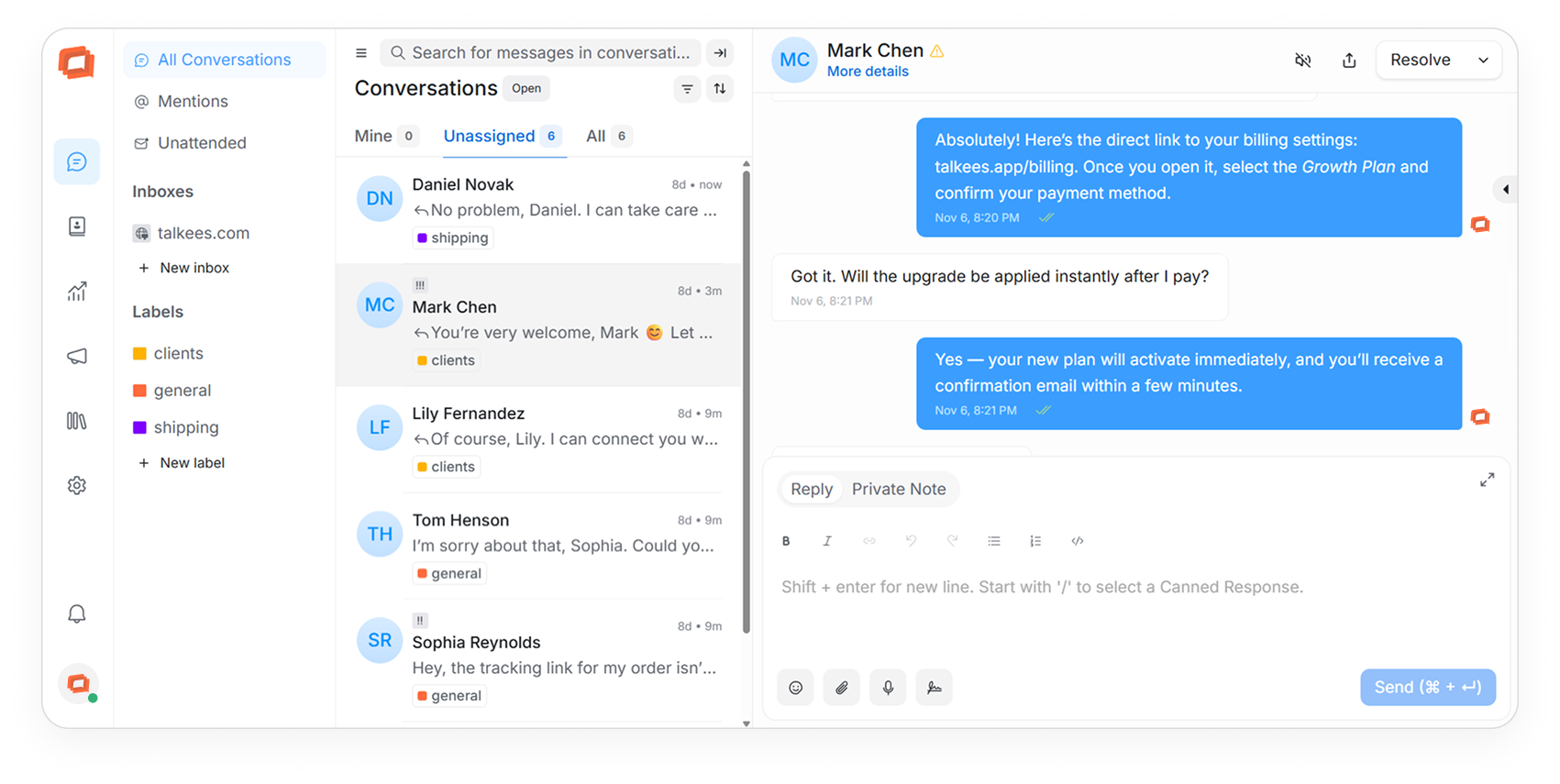
Talkees stands out as a modern AI-native alternative to HappyFox, particularly well-suited for SMBs and e-commerce businesses seeking intelligent customer support solutions.
Detailed Pricing
Free Plan: Limited features, up to 3 agents
- Basic live chat and ticketing
- Standard AI assistant capabilities
- 500 AI-assisted conversations monthly
Growth: $19/agent/month
- Unlimited AI-assisted conversations
- Advanced routing and automation
- Integration with Shopify, Slack, and email
Business: $39/agent/month
- Custom AI training
- Advanced analytics
- Priority support
- Enterprise integrations
Enterprise: Custom pricing
- Dedicated account manager
- Custom development
- SLA guarantees
- Advanced security features
Complete Feature Set
- AI-First Architecture: Unlike HappyFox’s add-on approach to AI, Talkees builds intelligence into every aspect of the platform.
- Omnichannel Communication: Seamlessly handles email, live chat, social media, and messaging apps in a unified inbox.
- Deep E-commerce Integration: Native connections to Shopify, WooCommerce, and other platforms with order context in tickets.
- Powerful Automations: AI-powered routing, tagging, and response suggestions that learn from your team’s interactions.
- Knowledge Base: Self-service portal with AI-suggested articles and automatic content creation.
- Team Collaboration: Internal notes, collision detection, and shared drafts for seamless teamwork.
- Customizable Workflows: No-code automation builder for creating custom processes.
- Analytics Dashboard: Real-time insights into team performance, customer satisfaction, and resolution times.
Real User Experiences and Reviews
“”Talkees has transformed our customer service operation. The AI suggestions are remarkably accurate, and we’ve reduced our first response time by over 40%.”” – E-commerce Support Manager (G2)
“”The Shopify integration is seamless—having order details right in the ticket has eliminated so much back-and-forth.”” – Online Retailer (Capterra)
Common praise focuses on the intuitive interface, AI accuracy, and time savings, while occasional criticism mentions the learning curve for fully utilizing all AI features.
Advantages and Disadvantages
Pros:
- Truly AI-native platform (not an add-on)
- Excellent e-commerce integrations
- Transparent, predictable pricing
- Intuitive user interface
- Quick implementation (typically under a week)
Cons:
- Newer platform with evolving feature set
- Limited enterprise-level compliance features
- Fewer third-party integrations than established players
Our Subjective Assessment
Having tested Talkees extensively, I was immediately impressed by how naturally the AI integrates into the workflow. Unlike other platforms where AI feels bolted on, Talkees’ suggestions feel like having a knowledgeable colleague looking over your shoulder.
The Shopify integration is particularly impressive—seeing a customer’s entire order history, including shipping status and previous issues, directly in the ticket saves valuable time. During our testing, we found the platform reduced handle time by approximately 30% compared to traditional ticketing systems.
The setup process was refreshingly straightforward. Within two days, we had imported our knowledge base, connected our communication channels, and started handling live tickets. The AI began providing useful suggestions almost immediately and noticeably improved over the first week as it learned from our responses.
For SMBs and e-commerce businesses looking for an intelligent, easy-to-implement support solution, Talkees offers the best balance of advanced AI capabilities and user-friendly design we’ve encountered.
HappyFox vs Zendesk: A Comprehensive Comparison

Zendesk is one of the most established players in the customer support space and offers a robust alternative to HappyFox with its enterprise-grade features and extensive marketplace.
Detailed Pricing
Team: $19/agent/month
- Unified agent workspace
- Basic ticket management
- Email and social channels
Growth: $49/agent/month
- Omnichannel routing
- Basic automations
- Performance dashboards
Professional: $99/agent/month
- Advanced workflow capabilities
- AI-powered recommendations
- Custom analytics
Enterprise: $150/agent/month
- Advanced AI capabilities
- Custom objects
- Premium support
- Advanced security
AI Add-on: Approximately $50/agent/month additional (varies by plan)
Complete Feature Set
- Omnichannel Support: Handles email, chat, phone, social media, and messaging in a unified interface.
- Extensive Marketplace: Over 1,000 integrations with business tools, CRMs, and e-commerce platforms.
- Advanced Workflow Builder: Sophisticated automation capabilities for complex support processes.
- Answer Bot: AI-powered self-service that resolves common questions automatically.
- Intelligent Triage: Routes tickets to the right agent based on expertise and availability.
- Robust Analytics: Comprehensive reporting on team performance and customer satisfaction.
- Developer Platform: APIs and SDKs for custom integrations and extensions.
- Enterprise Security: SOC2, HIPAA, GDPR compliance and advanced security features.
Real User Experiences and Reviews
“”Zendesk’s strength is its flexibility—we’ve customized it to handle complex workflows across multiple departments.”” – Enterprise Support Director (G2)
“”The reporting capabilities are unmatched, but be prepared for a steep learning curve.”” – Mid-Market Support Manager (Capterra)
Users consistently praise Zendesk’s reliability and integration capabilities but note that the platform can be complex to configure and that costs increase significantly with add-ons and higher tiers.
Advantages and Disadvantages
Pros:
- Enterprise-grade reliability and security
- Extensive integration ecosystem
- Powerful customization options
- Comprehensive reporting
- Mature, stable platform
Cons:
- Complex implementation and configuration
- Significant cost escalation with add-ons
- AI features often require higher tiers
- Can feel overwhelming for smaller teams
Our Subjective Assessment
During our testing of Zendesk, the platform’s maturity and depth were immediately apparent. The agent interface is polished and efficient once you learn it, though the initial learning curve is steeper than with more modern alternatives like Talkees.
Zendesk’s integration with Slack was particularly impressive—the bidirectional sync kept ticket updates flowing seamlessly between platforms. However, we found that achieving this level of integration required significant configuration and occasionally custom development.
The Answer Bot performed well for standard queries but didn’t adapt as quickly to our knowledge base as some newer AI-first platforms. That said, the reliability and scalability of Zendesk make it an excellent choice for larger organizations with complex support needs.
For enterprises that need a battle-tested platform with extensive customization options and are willing to invest in proper setup and training, Zendesk remains one of the strongest options in the market.
For a clearer breakdown of capabilities and costs, see our full happyfox vs zendesk comparison focused on ticketing, automation, and scalability.
HappyFox vs Freshdesk: Evaluating Features and Value

Freshdesk offers a compelling alternative to HappyFox with its modular approach, strong automation capabilities, and generous free tier.
Detailed Pricing
Free: Up to 10 agents
- Email and social ticketing
- Knowledge base
- Limited automations
Growth: $15/agent/month
- Automation rules
- SLA management
- Basic reporting
Pro: $49/agent/month
- Freddy AI assistance
- Advanced routing
- Custom roles
- Multiple products
Enterprise: $79/agent/month
- Advanced Freddy AI
- Custom objects
- Agent scripts
- Enterprise security
Complete Feature Set
- Freddy AI: AI assistant for ticket categorization, response suggestions, and customer intent detection.
- Omnichannel Support: Email, chat, phone, social media, and WhatsApp in a unified inbox.
- Self-Service Portal: Customizable knowledge base with community forums and solution suggestions.
- Field Service Management: Schedule and dispatch on-site service technicians (higher tiers).
- Gamification: Built-in agent productivity tools with points and achievements.
- Scenario Automation: Visual workflow builder for complex support processes.
- Marketplace: 300+ integrations with business tools and platforms.
- Team Collaboration: Internal notes, @mentions, and shared ownership of tickets.
Real User Experiences and Reviews
“”Freshdesk’s free tier gave us everything we needed to start, and the upgrade path was smooth as we grew.”” – Startup Support Lead (G2)
“”Freddy AI has reduced our handle time by about 25%, though it took some time to train properly.”” – E-commerce Support Manager (Capterra)
Users frequently highlight Freshdesk’s value for money and ease of setup, while some mention limitations in customization compared to enterprise platforms like Zendesk.
Advantages and Disadvantages
Pros:
- Generous free tier for small teams
- Intuitive, user-friendly interface
- Strong automation capabilities
- Good value for money
- Quick implementation
Cons:
- Some advanced features only on higher tiers
- Limited customization compared to enterprise solutions
- Phone support requires additional Freshcaller subscription
- AI capabilities not as advanced as specialized platforms
Our Subjective Assessment
When testing Freshdesk, I was impressed by how quickly we were able to get up and running—within a day, we had imported our knowledge base, set up basic automations, and started handling tickets. The interface is clean and intuitive, requiring minimal training for new agents.
Freddy AI performs admirably for ticket categorization and basic response suggestions, though it doesn’t quite match the depth of purpose-built AI platforms like Talkees. The automations are powerful and easy to configure, making it simple to set up common workflows without coding.
The integration with Shopify worked well, though it required some configuration to display all the order details we wanted in the ticket view. The reporting capabilities are solid for day-to-day operations but lack some of the advanced analytics found in enterprise platforms.
For growing businesses looking for a balance of features, ease of use, and affordability, Freshdesk offers exceptional value—especially for teams transitioning from basic email support to a structured help desk system.
For a clearer breakdown of capabilities and costs, see our full happyfox vs freshdesk comparison focused on ticketing, automation, and scalability.
Help Scout vs HappyFox: Email-Centric Simplicity

Help Scout takes a different approach than most HappyFox alternatives, focusing on email-centric support with a clean, simple interface that prioritizes ease of use over complex features.
Detailed Pricing
Standard: $20/user/month
- Shared inbox
- Basic reporting
- Knowledge base
- 3 mailboxes
Plus: $40/user/month
- Advanced reporting
- CSAT surveys
- API access
- 10 mailboxes
Pro: $65/user/month
- Custom fields
- Advanced permissions
- Enterprise security
- 25 mailboxes
Complete Feature Set
- Shared Inbox: Collaborative email management with collision detection and assignments.
- Docs: Knowledge base platform with AI-suggested articles and search analytics.
- Beacon: Lightweight chat and self-service widget for websites and applications.
- Workflows: Automation rules for routing, tagging, and status updates.
- AI Features: AI drafts, summaries, translations, and tone adjustments.
- Reporting: Customer satisfaction, response times, and workload distribution metrics.
- Integrations: Connections to popular tools like Slack, Jira, and Shopify.
- API: RESTful API for custom integrations and workflows.
Real User Experiences and Reviews
“”Help Scout’s simplicity is its strength—our team was productive from day one with minimal training.”” – Small Business Owner (G2)
“”The email-like interface makes the transition from Gmail seamless, though we do miss some of the advanced routing features of traditional help desks.”” – Support Team Lead (Capterra)
Users consistently praise Help Scout’s intuitive design and customer-friendly email format, while some note limitations in multichannel support and advanced automation capabilities.
Advantages and Disadvantages
Pros:
- Exceptionally intuitive, email-like interface
- Fast implementation with minimal training
- Customer-friendly communication format
- Clean, distraction-free design
- Transparent, predictable pricing
Cons:
- Limited multichannel capabilities
- Fewer advanced automation options
- Not ideal for complex workflows
- Less suitable for large, distributed teams
Our Subjective Assessment
During our testing of Help Scout, the platform’s focus on simplicity was immediately apparent. The inbox feels like a slightly enhanced version of Gmail, making it incredibly easy for new agents to adapt. We were handling customer emails within hours of setting up the account.
The Docs knowledge base is well-designed and integrates seamlessly with the support inbox. The Beacon widget provides a nice balance of self-service and live assistance without overwhelming visitors with complex chat interfaces.
Help Scout’s AI features for drafting responses and summarizing conversations work surprisingly well for a platform that doesn’t market itself as AI-first. The suggestions were relevant and saved time on routine responses.
Where Help Scout falls short is in handling complex, multi-step workflows and true omnichannel support. While it can integrate with other channels, its strength remains in email management.
For small teams focused primarily on email support who value simplicity and customer-friendly communication, Help Scout offers a refreshing alternative to feature-heavy platforms like HappyFox.
For a clearer breakdown of capabilities and costs, see our full help scout vs happyfox comparison focused on automation, team collaboration, and scalability.
Gorgias vs HappyFox: Shopify-First Support Solutions

Gorgias stands out from other HappyFox alternatives with its laser focus on e-commerce support, particularly for Shopify stores, offering deep integration and revenue attribution capabilities.
Detailed Pricing
Basic: $50/user/month
- Unlimited tickets
- Email, chat, and social channels
- Basic Shopify integration
- Standard macros
Pro: $75/user/month
- Advanced automation
- Revenue statistics
- Instagram and Facebook Shops
- Priority support
Advanced: $110/user/month
- Advanced rules
- Custom reporting
- Phone support
- Dedicated account manager
Complete Feature Set
- Shopify-Native Integration: Deep connection with order data, customer profiles, and store metrics.
- Revenue Attribution: Track revenue generated from support interactions.
- Omnichannel Inbox: Email, live chat, SMS, social media, and phone in one place.
- Macros with Order Actions: Automated responses that can also trigger order actions (refunds, returns, etc.).
- Intent Detection: Automatically categorize and prioritize tickets based on customer intent.
- Customer Timeline: Complete history of orders, conversations, and browsing behavior.
- Self-Service Automation: Deflect common questions with automated responses based on intent.
- Integration Marketplace: Connections to other e-commerce tools and platforms.
Real User Experiences and Reviews
“”Having complete order context right in the ticket has transformed our support efficiency—we can resolve most issues in a single interaction.”” – E-commerce Support Manager (G2)
“”The revenue statistics have helped us prove the ROI of our support team, though the per-ticket pricing model can get expensive during high-volume periods.”” – Online Store Owner (Capterra)
Users consistently highlight the value of the Shopify integration and revenue tracking, while some express concerns about pricing predictability during sales peaks.
Advantages and Disadvantages
Pros:
- Unmatched Shopify integration depth
- Revenue attribution for support interactions
- Purpose-built for e-commerce workflows
- Order actions directly from tickets
- Strong automation for common e-commerce scenarios
Cons:
- Less suitable for non-e-commerce use cases
- Can be expensive for high-volume support teams
- Limited advanced customization options
- Less mature AI capabilities compared to newer platforms
Our Subjective Assessment
Testing Gorgias was a revelation for handling e-commerce support. The platform’s deep Shopify integration puts every relevant piece of customer and order information at agents’ fingertips—from order status and shipping details to previous purchases and browsing history.
The ability to perform order actions (issue refunds, update shipping, etc.) directly from the ticket interface is a massive time-saver. During our testing, we found this reduced the average handle time for order-related queries by nearly 40% compared to platforms that required switching between systems.
The revenue attribution feature provides valuable insights into how support interactions impact sales, helping justify support costs and identify opportunities for proactive outreach.
Where Gorgias falls short is in handling non-e-commerce use cases and more complex workflow automation. The AI capabilities, while useful, aren’t as sophisticated as those found in AI-first platforms like Talkees.
For Shopify stores and other e-commerce businesses that prioritize deep store integration and revenue tracking, Gorgias offers specialized capabilities that general-purpose platforms like HappyFox can’t match.
LiveAgent vs HappyFox: An All-in-One Ticketing and Communication Hub

LiveAgent distinguishes itself from other HappyFox alternatives by offering a comprehensive all-in-one solution that includes ticketing, live chat, and call center functionality in a single, affordable package.
Detailed Pricing
Free: Limited features
- 7-day ticket history
- Basic live chat
- 1 email address
Ticket: $15/agent/month
- Unlimited ticket history
- Email support
- Basic reporting
- Knowledge base
Ticket+Chat: $29/agent/month
- Advanced live chat
- Chat satisfaction
- Video calls
- Chat invitations
All-Inclusive: $49/agent/month
- Built-in call center
- Social media integration
- Time tracking
- Advanced reporting
Complete Feature Set
- Universal Inbox: Unified view of tickets from email, chat, calls, social media, and forums.
- Built-in Call Center: Native voice support without requiring third-party integration.
- Live Chat: Advanced chat capabilities with proactive invitations and video calls.
- Social Media Integration: Facebook, Twitter, Instagram, and Viber messaging support.
- Time Tracking: Monitor time spent on tickets and calculate support costs.
- Customer Portal: Self-service options with ticket submission and tracking.
- Knowledge Base: Searchable help center with categories and articles.
- Gamification: Agent leaderboards and performance tracking.
Real User Experiences and Reviews
“”The built-in call center functionality saved us from having to integrate and pay for a separate telephony solution.”” – Small Business Owner (G2)
“”LiveAgent offers incredible value for the price—we get features that would cost 3x more with enterprise platforms.”” – Support Team Lead (Capterra)
Users frequently highlight LiveAgent’s all-in-one value proposition and affordable pricing, while some mention that the interface feels less modern than newer competitors.
Advantages and Disadvantages
Pros:
- Comprehensive feature set at a competitive price
- Built-in call center functionality
- No need for multiple platform subscriptions
- Strong multilingual support
- Good value for money
Cons:
- Interface feels less modern than competitors
- Limited AI capabilities
- Fewer third-party integrations
- Less specialized for specific industries
Our Subjective Assessment
When testing LiveAgent, I was impressed by the breadth of functionality included in the platform. Setting up email, chat, and even phone support through a single interface was refreshingly straightforward compared to the multi-platform approach required with many competitors.
The built-in call center functionality is a standout feature—being able to make and receive calls directly within the same platform that handles tickets and chats creates a truly unified agent experience. During our testing, this reduced context switching and improved handle times for complex issues that required escalation from chat to voice.
The interface, while functional, does feel dated compared to more modern alternatives like Talkees or Freshdesk. That said, the learning curve is minimal, and agents can become productive quickly.
LiveAgent’s AI capabilities are limited compared to AI-first platforms, focusing more on basic automation than intelligent assistance or autonomous resolution.
For small to medium-sized businesses looking for a complete support solution without the complexity and cost of enterprise platforms, LiveAgent offers exceptional value—particularly for teams that need integrated voice support without additional telephony subscriptions.
Kayako vs HappyFox: Unified Conversations and Self-Service

Kayako offers a streamlined alternative to HappyFox with its focus on unified customer conversations and an innovative approach to AI pricing.
Detailed Pricing
Single Plan: $79/month + $1 per AI-resolved ticket
- Unified conversation view
- Omnichannel support
- Self-service portal
- AI-powered help center
- Unlimited agents
Complete Feature Set
- SingleView Timeline: Unified customer history across all channels and interactions.
- Conversational Ticketing: Natural conversation flow rather than traditional ticket forms.
- AI Help Center: Self-service portal that learns from successful resolutions.
- Omnichannel Support: Email, live chat, social media, and messaging in one interface.
- Workflow Automation: Visual process builder for routing and actions.
- Customer Insights: Contextual information about customers and their journey.
- Collaborative Tools: Internal notes, @mentions, and shared drafts.
- Performance Analytics: Reporting on team metrics and customer satisfaction.
Real User Experiences and Reviews
“”Kayako’s unified timeline gives us complete context for every customer interaction, which has dramatically improved our first-contact resolution rate.”” – Customer Experience Manager (G2)
“”The per-AI-resolved ticket pricing is interesting—it aligns costs with value, though it can be hard to predict monthly expenses.”” – Support Director (Capterra)
Users praise Kayako’s conversation-centric approach and unified view, while some express concerns about the predictability of the AI-based pricing model.
Advantages and Disadvantages
Pros:
- Truly unified customer view across channels
- Conversation-focused rather than ticket-focused
- Innovative AI pricing model
- Clean, modern interface
- Simplified product offering
Cons:
- Limited customization options
- Fewer integrations than enterprise platforms
- Unpredictable costs with usage-based AI pricing
- Less frequent updates than some competitors
Our Subjective Assessment
Testing Kayako revealed a platform with a refreshingly different approach to customer support. The SingleView timeline provides a genuinely unified view of customer interactions across all channels, eliminating the fragmentation common in other platforms.
The conversational ticketing model feels more natural than traditional form-based tickets, creating a more fluid experience for both agents and customers. This approach seemed particularly effective for complex issues that span multiple interactions.
Kayako’s AI-powered help center performed well in our testing, successfully deflecting a significant percentage of common queries. The $1 per AI-resolved ticket pricing model is interesting—it aligns costs with actual value received, though it does make monthly expenses less predictable than traditional per-agent pricing.
The platform’s simplicity is both a strength and a weakness. While it makes Kayako easy to learn and use, it also means fewer customization options and integrations compared to more complex platforms like Zendesk or HappyFox.
For organizations that prioritize a unified customer view and prefer a conversation-centric approach over traditional ticketing, Kayako offers a compelling alternative with a unique pricing model that could be cost-effective for teams with the right support profile.
Kustomer vs HappyFox: CRM-Style Customer Timeline

Kustomer takes a unique approach among HappyFox alternatives by organizing support around a CRM-style customer timeline rather than traditional tickets, making it ideal for customer-centric organizations.
Detailed Pricing
Enterprise: Custom pricing
- Omnichannel support
- Customer timeline
- AI routing
- Workflow automation
- Advanced reporting
Complete Feature Set
- Customer Timeline: CRM-style view of all customer interactions, orders, and data.
- Omnichannel Support: Email, chat, SMS, social messaging, and voice in a unified interface.
- AI Routing and Prioritization: Intelligent assignment based on intent, sentiment, and agent skills.
- Workflow Automation: Visual builder for complex customer journeys and support processes.
- Custom Objects: Ability to create and relate custom data objects to customer profiles.
- Social Messaging Focus: Strong emphasis on WhatsApp, Facebook Messenger, and Instagram DMs.
- Agent Workspace: Contextual information and actions available within conversations.
- Enterprise Security: SOC2, HIPAA, and GDPR compliance features.
Real User Experiences and Reviews
“”Kustomer’s timeline view gives us a complete picture of each customer, which has transformed our ability to provide personalized support.”” – Customer Experience Director (G2)
“”The platform excels at handling social messaging channels like WhatsApp and Instagram DMs, though the enterprise pricing can be a barrier for smaller teams.”” – Social Media Manager (Capterra)
Users consistently praise Kustomer’s customer-centric approach and social messaging capabilities, while some note the platform’s enterprise focus and corresponding price point.
Advantages and Disadvantages
Pros:
- True 360° customer view with complete context
- Excellent social messaging capabilities
- Powerful workflow automation
- Intuitive, conversation-focused interface
- Strong enterprise security features
Cons:
- Enterprise pricing may be prohibitive for small teams
- Requires significant setup to maximize value
- Less suitable for anonymous or one-time support
- Fewer third-party integrations than established platforms
Our Subjective Assessment
During our testing of Kustomer, the platform’s customer-centric approach was immediately apparent. Rather than organizing work around tickets, everything revolves around customer timelines that include all interactions, orders, and relevant data. This creates a remarkably complete context for support agents.
The social messaging capabilities are particularly impressive—Kustomer handles WhatsApp, Facebook Messenger, and Instagram DMs more naturally than most competitors. The platform maintains conversation threading and context across these channels effectively.
The workflow automation builder is powerful and intuitive, making it possible to create complex customer journeys without coding. During our testing, we were able to build sophisticated routing and follow-up processes relatively quickly.
Kustomer’s enterprise focus is reflected in both its features and pricing. The platform is designed for organizations with complex customer relationships rather than high-volume, transactional support. This makes it less suitable for small teams or businesses with primarily anonymous customer interactions.
For customer-centric organizations that prioritize relationship management and social messaging channels, Kustomer offers a compelling alternative to traditional ticket-based platforms like HappyFox.
TeamSupport vs HappyFox: B2B Support with Product Tracking

TeamSupport differentiates itself from other HappyFox alternatives with its specialized focus on B2B support, including features for product tracking and customer account hierarchies.
Detailed Pricing
Enterprise: Custom pricing
- Complete B2B support suite
- Product tracking
- Customer database
- Account hierarchies
- Advanced reporting
Complete Feature Set
- Product Tracking: Associate tickets with specific products and track issues by product line.
- Customer Database: Comprehensive CRM-like view of B2B customers and contacts.
- Account Hierarchies: Support for complex B2B relationships and organizational structures.
- Water Cooler: Collaborative space for internal communication and knowledge sharing.
- Customer Portal: Branded self-service with ticket submission and tracking.
- Knowledge Base: Internal and external knowledge management.
- Reporting: Product-centric and customer-centric analytics.
- Inventory Management: Track customer assets and inventory for service purposes.
Real User Experiences and Reviews
“”TeamSupport’s product-centric approach has been invaluable for our technical support team—we can track issues by product and identify patterns that would be invisible in traditional ticketing systems.”” – Technical Support Director (G2)
“”The account hierarchy features perfectly match our complex B2B customer relationships, though the interface feels less modern than some competitors.”” – B2B Support Manager (Capterra)
Users consistently highlight TeamSupport’s B2B-specific features and product tracking capabilities, while some mention that the user interface could be more modern.
Advantages and Disadvantages
Pros:
- Purpose-built for B2B support scenarios
- Excellent product tracking and issue management
- Support for complex customer hierarchies
- Strong collaboration tools
- Comprehensive reporting by product and customer
Cons:
- Less suitable for B2C support
- Interface feels less modern than competitors
- Limited consumer messaging channel support
- Less robust AI capabilities
Our Subjective Assessment
Testing TeamSupport revealed a platform with a clear focus on the unique needs of B2B support teams. The ability to associate tickets with specific products and track issues across a product line provides valuable insights that would be difficult to achieve in general-purpose platforms.
The customer database and account hierarchy features are particularly well-suited to complex B2B relationships. During our testing, we were able to model multi-level customer organizations with different contacts, permissions, and service levels—something that would be challenging in most other platforms.
The Water Cooler collaboration feature facilitates internal knowledge sharing and problem-solving, which is especially valuable for technical support teams dealing with complex products.
Where TeamSupport falls short is in consumer-facing channels and modern interface design. The platform prioritizes functionality over aesthetics, and its support for channels like social messaging is limited compared to omnichannel platforms like Zendesk or Freshdesk.
For B2B companies with complex products and customer relationships, TeamSupport offers specialized capabilities that general-purpose platforms like HappyFox can’t match, despite its less modern interface.
Decision Guide: Matching the Right HappyFox Alternative to Your Needs

Choosing the right HappyFox alternative depends on your specific requirements, team size, and channels. Here’s a decision framework to help you find the best match:
For Small Teams (1-5 agents)
- If you prioritize simplicity: Help Scout offers an intuitive, email-centric approach with minimal training required.
- If you need all-in-one affordability: LiveAgent provides comprehensive features including voice at a competitive price.
- If you’re e-commerce focused: Talkees or Gorgias offer specialized e-commerce support capabilities.
For Growing Teams (5-25 agents)
- If you need AI assistance: Talkees provides AI-native support with predictable pricing.
- If you want balance and value: Freshdesk offers a good mix of features, ease of use, and affordability.
- If you’re B2B focused: TeamSupport’s product tracking and account hierarchies excel for B2B scenarios.
For Enterprise Teams (25+ agents)
- If you need enterprise scalability: Zendesk offers robust customization and security for large organizations.
- If you prioritize customer relationships: Kustomer’s CRM-style approach works well for complex customer interactions.
- If you need advanced workflow automation: Zendesk or Freshdesk Enterprise provide sophisticated process automation.
Channel-Specific Recommendations
- For email-centric teams: Help Scout or Hiver provide streamlined email management.
- For chat-heavy support: Talkees offers AI-powered chat with seamless ticketing integration.
- For social messaging focus: Kustomer excels at WhatsApp, Facebook, and Instagram support.
- For voice support: LiveAgent includes built-in call center functionality at an affordable price.
AI Requirements
- For AI-assisted agents: Talkees, Freshdesk (Freddy), and Zendesk all offer strong agent assistance.
- For autonomous resolution: Talkees and Kayako provide AI that can resolve common issues independently.
- For predictable AI pricing: Talkees includes AI in its per-agent pricing, while Kayako charges per resolution.
Migration Checklist from HappyFox

Planning a smooth transition from HappyFox to your chosen alternative is crucial for minimizing disruption. Here’s a comprehensive migration checklist:
Data Export and Preparation
- Export all tickets (including closed ones) from HappyFox
- Export your customer database and contact information
- Download all knowledge base articles and attachments
- Extract custom fields, tags, and categories
- Document your current workflows, automations, and macros
- Identify and prioritize critical integrations
Workflow Recreation
- Map HappyFox statuses to equivalent statuses in your new platform
- Recreate automation rules and triggers
- Build equivalent macros or canned responses
- Set up SLAs and business hours
- Configure user roles and permissions
- Establish routing rules and assignment logic
Integration Setup
- Connect email channels and verify delivery
- Set up chat widgets on your website
- Configure social media channel connections
- Establish CRM and e-commerce platform integrations
- Connect collaboration tools (Slack, Teams)
- Set up telephony integration if applicable
- Test API connections for custom integrations
Chatbot and AI Handover
- Train new AI systems with your knowledge base
- Configure chatbot flows and decision trees
- Set up AI-assisted response suggestions
- Establish escalation paths from AI to human agents
- Test AI performance with common customer scenarios
Team Preparation
- Provide training on the new platform
- Create quick reference guides for common tasks
- Set up a test environment for practice
- Establish performance benchmarks for comparison
- Develop a communication plan for the transition
Cutover Strategy
- Decide between phased migration or complete cutover
- Plan for a transition period with parallel systems
- Communicate changes to customers in advance
- Set up redirects from old knowledge base URLs
- Establish a support channel for migration-related issues
By following this checklist and working closely with your new vendor’s support team, you can ensure a smooth transition from HappyFox to your chosen alternative with minimal disruption to your customer support operations.
Choosing the right HappyFox alternative is a significant decision that can transform your customer support operations. Whether you prioritize AI capabilities, integration depth, specialized features for your industry, or simply better value for money, there’s an alternative that matches your needs.