 English
 Slovenčina
 Français
 Magyar

What Makes a Great ManyChat Alternative

When evaluating ManyChat alternatives, several key features separate good options from great ones:
- Unified inbox capabilities are essential—you need a platform that seamlessly integrates email, chat, and social media conversations in one interface. This creates a cohesive customer experience regardless of which channel they use to reach you.
- Powerful broadcast and growth tools should be available to help you engage your audience effectively. Look for platforms that make it easy to create, schedule, and analyze marketing campaigns.
- AI capabilities have become increasingly important. The best alternatives offer AI chatbots that can be trained on your specific knowledge base, providing accurate, brand-consistent responses without constant human intervention.
- Fair pricing models are crucial too. Rather than contact-based pricing that penalizes growth, look for per-seat pricing that scales more predictably with your team size.
How to Migrate from ManyChat Without Losing Momentum

Migrating from ManyChat requires careful planning to maintain your marketing and support momentum. Start by mapping your existing flows, tags, and templates to understand what needs to be recreated on your new platform.
Pay special attention to:
- Automated sequences and conversation flows
- Customer tags and segmentation
- Message templates and creative assets
- One-Time Notification (OTN) replacements
- JSON configurations for Facebook ads
- Comment reply automations
Most platforms allow you to export your contact lists, though you’ll likely need to rebuild your automation flows from scratch. Plan for a transition period where you might run both systems simultaneously to ensure nothing falls through the cracks.
How We Evaluate ManyChat Alternatives

When comparing ManyChat alternatives, we focus on several critical factors:
- Automation depth: How sophisticated are the conversation flows and logic?
- Channel coverage: Does the platform support WhatsApp, Instagram, and other key messaging channels?
- E-commerce integrations: How well does it connect with Shopify, WooCommerce, and other online stores?
- Total cost to scale: What’s the pricing structure as your business grows?
We also consider ease of use, customer support quality, AI capabilities, and the availability of templates and pre-built workflows.
Talkees vs ManyChat: Modern Omnichannel Live Chat + AI Chatbot
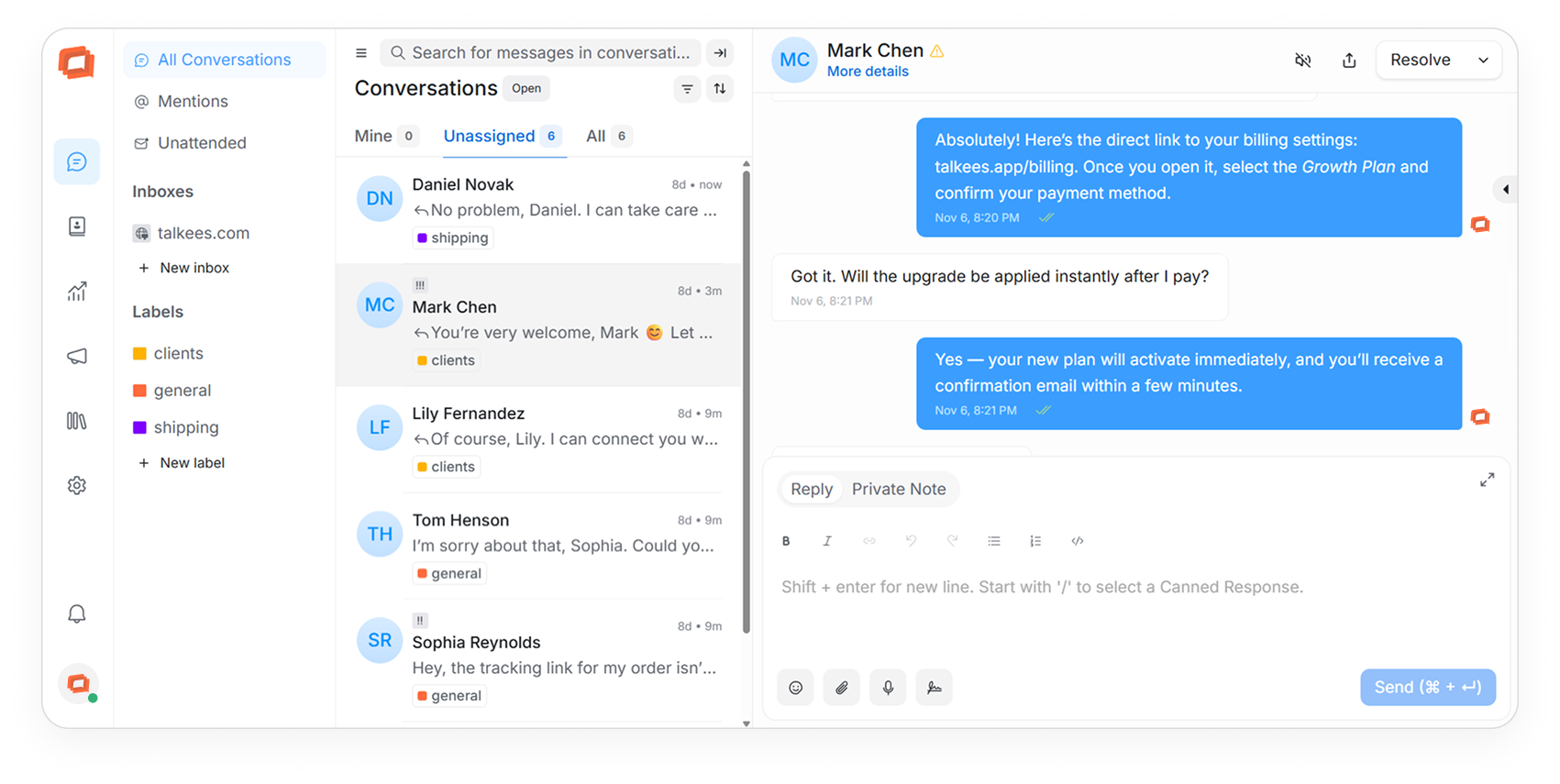
Talkees stands out as a powerful ManyChat alternative that combines modern omnichannel live chat with sophisticated AI chatbot capabilities.
Pricing
- Free plan: Available for small businesses just getting started
- Growth plan: $29/month per agent (billed annually)
- Pro plan: $49/month per agent (billed annually)
- Enterprise: Custom pricing for larger teams
Unlike ManyChat’s contact-based pricing, Talkees offers transparent per-seat pricing that doesn’t penalize you for growing your customer base. This makes costs more predictable as you scale.
Key Features
- Unified omnichannel inbox that brings together conversations from web chat, WhatsApp, Instagram, email, and other channels
- AI chatbot with custom LLM integrations that can be trained on your knowledge base, product catalog, and previous conversations
- Deep e-commerce integrations with Shopify and WooCommerce that allow for order tracking, product recommendations, and cart recovery
- Team collaboration tools including conversation assignments, internal notes, and performance analytics
- Customizable chat widgets that match your brand identity and website design
Real User Experiences
Talkees users consistently praise the platform’s ease of use and powerful AI capabilities. One e-commerce store owner reported: “After switching from ManyChat, we saw a 35% increase in chat conversion rates and reduced our support response time by over 60%.”
Users particularly appreciate the seamless handoff between the AI chatbot and human agents when complex issues arise. The AI correctly identifies when a conversation needs human intervention, maintaining context throughout the transfer.
Advantages Over ManyChat
- More comprehensive omnichannel capabilities with a truly unified inbox
- Superior AI that can be trained on your specific business knowledge
- Transparent per-seat pricing instead of contact-based fees
- More robust website chat functionality
- Better integration with e-commerce platforms
Disadvantages Compared to ManyChat
- Newer platform with a smaller community of users sharing templates
- Fewer pre-built marketing automation templates
- Less focus on Facebook-specific growth tools
Our Subjective Assessment
Having tested Talkees extensively, we found its interface significantly more intuitive than ManyChat’s, especially for managing conversations across multiple channels. The AI capabilities are genuinely impressive—able to answer complex product questions and handle basic customer service tasks with minimal setup.
For businesses prioritizing customer support and sales over pure marketing automation, Talkees offers a more balanced solution. The transparent pricing model also makes it easier to forecast costs as your business scales.
Intercom as a ManyChat Competitor
Intercom is a well-established customer messaging platform that serves as a robust alternative to ManyChat, particularly for businesses needing advanced help desk and ticketing capabilities alongside chatbot functionality.
Pricing
- Starter: $74/month (billed annually)
- Pro: $99/month per seat (billed annually)
- Scale: Custom pricing
- Additional costs: Intercom charges for resolution-based AI usage, which can add up quickly
Intercom’s pricing is significantly higher than ManyChat, positioning it more as an enterprise solution.
Key Features
- Comprehensive help desk with ticketing system
- Advanced AI chatbots with Resolution Bot technology
- Powerful website chat widget with customization options
- Product tours and onboarding flows
- Extensive integration marketplace
Real User Experiences
Intercom users consistently praise the platform’s robust feature set and reliability. One SaaS company reported: “Intercom reduced our first response time by 80% and helped us scale support without adding headcount.”
However, some users mention the steep learning curve and high costs as drawbacks. A startup founder noted: “While powerful, Intercom required significant investment in both money and time to fully implement.”
Advantages Over ManyChat
- More comprehensive customer support tools
- Superior website chat experience
- Better suited for SaaS and enterprise companies
- More advanced knowledge base capabilities
- Robust ticketing system
Disadvantages Compared to ManyChat
- Significantly higher price point
- Less focus on social media marketing automation
- Steeper learning curve
- Can be overkill for simple chatbot needs
Our Subjective Assessment
In our testing, Intercom impressed with its polished interface and comprehensive support capabilities. The AI bot is particularly effective at resolving common customer queries without human intervention.
However, the platform feels designed primarily for customer support teams rather than marketers, making it less intuitive for creating marketing automation flows compared to ManyChat. The pricing also makes it difficult to recommend for small businesses or those just starting with chatbots.
Chatfuel vs ManyChat: Instagram/WhatsApp Automation Strengths
Chatfuel is one of the most direct competitors to ManyChat, with a similar focus on social media marketing automation but some key differences in approach and pricing.
Pricing
- Free plan: Limited features, Chatfuel branding
- Pro: $15/month (billed annually)
- Premium: $99/month (billed annually)
- WhatsApp: Separate pricing structure starting at $25/month
Chatfuel uses a conversation-based pricing model rather than contact-based, which can be more economical for businesses with large audiences but lower engagement rates.
Key Features
- Strong Instagram and WhatsApp automation capabilities
- Extensive template library (over 60 templates)
- Visual flow builder
- AI responses for common questions
- Product catalog integration for e-commerce
Real User Experiences
Users appreciate Chatfuel’s focus on Instagram and its intuitive flow builder. An Instagram-focused business owner shared: “Chatfuel’s Instagram automation helped us increase engagement by 45% and capture leads directly from comments.”
However, some users note limitations in the live chat and inbox features. A marketing agency reported: “While great for automation, Chatfuel falls short when handling live conversations compared to other platforms.”
Advantages Over ManyChat
- More extensive template library
- Often more affordable for large audiences with lower engagement
- Strong focus on Instagram automation
- Better handling of keyword grouping for natural language understanding
Disadvantages Compared to ManyChat
- Limited live chat and inbox features
- Less robust integration ecosystem
- Separate pricing for different channels can become complicated
- Less advanced segmentation capabilities
Our Subjective Assessment
In our testing, Chatfuel excelled at Instagram and Facebook Messenger automation, with an intuitive flow builder that makes creating conversation paths straightforward. The template library is genuinely useful, offering ready-made solutions for common marketing scenarios.
However, we found the platform less capable when it comes to unified inbox features and live chat support. For businesses primarily focused on Instagram marketing automation, Chatfuel is compelling, but those needing comprehensive omnichannel capabilities might find it lacking.
If you’re still deciding which platform is the better fit, we’ve prepared a separate in-depth comparison of chatfuel vs manychat that breaks down features, pricing, and real-world use cases
MobileMonkey (Customers.ai) vs ManyChat: Outbound DM and Lead-Gen Focus

MobileMonkey, now part of Customers.ai, positions itself as an “OmniChat” solution with a strong focus on lead generation and outbound messaging capabilities.
Pricing
- Free plan: Limited features, suitable for testing
- Pro: $19/month (billed annually)
- Unicorn: $49/month (billed annually)
- Team: $299/month (billed annually)
MobileMonkey’s pricing is structured around features and team size rather than contacts, making it potentially more cost-effective for businesses with large audiences.
Key Features
- OmniChat technology for deploying one chatbot across multiple channels
- Strong focus on lead generation tools
- Unified inbox for all messaging channels
- SMS marketing capabilities
- Drip campaign automation
Real User Experiences
Users highlight MobileMonkey’s lead generation capabilities as a key strength. A digital marketing agency noted: “MobileMonkey’s lead generation tools helped us increase qualified leads by 60% for our clients.”
Some users mention challenges with the learning curve. A small business owner shared: “The platform has powerful features but took longer to master than we expected.”
Advantages Over ManyChat
- OmniChat approach simplifies multi-channel deployment
- More robust lead generation tools
- Better SMS marketing capabilities
- Unified inbox for all conversations
- More predictable pricing for large audiences
Disadvantages Compared to ManyChat
- Less intuitive interface for beginners
- Fewer pre-built templates
- Less developed AI capabilities
- Not as strong for e-commerce integration
Our Subjective Assessment
During our testing, MobileMonkey impressed with its lead generation focus and the ability to deploy one chatbot across multiple channels. The OmniChat approach genuinely saves time when managing conversations across different platforms.
However, the interface isn’t as intuitive as some competitors, and the platform feels designed primarily for aggressive lead generation rather than balanced customer engagement. For businesses focused on lead generation and outbound messaging, MobileMonkey offers compelling features, but those seeking a more balanced solution might look elsewhere.
Omnichat vs ManyChat: WhatsApp/LINE/Instagram Commerce

Omnichat specializes in conversational commerce, with particularly strong capabilities for WhatsApp, LINE, and Instagram shopping experiences.
Pricing
- Essential: $49/month (3 team members)
- Professional: $99/month (5 team members)
- Enterprise: Custom pricing
Omnichat offers team-based pricing with different tiers based on features and team size.
Key Features
- Strong focus on conversational commerce for WhatsApp, LINE, and Instagram
- Unified inbox for all messaging channels
- Abandoned cart recovery automation
- Customer segmentation and targeting
- Integration with major e-commerce platforms
Real User Experiences
E-commerce businesses particularly praise Omnichat’s commerce capabilities. An online retailer reported: “Omnichat’s abandoned cart recovery through WhatsApp achieved a 25% recovery rate, significantly higher than our email campaigns.”
Users in Asia highlight the platform’s strength with regional messaging apps. A business operating in multiple Asian markets noted: “Omnichat’s support for LINE and other regional apps has been crucial for our expansion.”
Advantages Over ManyChat
- Superior e-commerce integration, especially for abandoned cart recovery
- Better support for Asian messaging apps like LINE
- More robust unified inbox for customer support
- Strong regional optimization for APAC merchants
- Better WhatsApp commerce capabilities
Disadvantages Compared to ManyChat
- Less focus on Facebook-specific marketing tools
- Fewer templates and pre-built flows
- Less developed community and resource library
- More regional focus might not benefit global businesses
Our Subjective Assessment
In our evaluation, Omnichat stood out for its e-commerce capabilities, particularly for businesses operating in Asia or heavily utilizing WhatsApp for sales. The abandoned cart recovery features are genuinely effective, with thoughtful implementation of messaging app capabilities for commerce.
The platform feels purpose-built for conversational commerce rather than general marketing automation, making it ideal for e-commerce businesses but potentially less suitable for content creators or service businesses. For merchants focused on WhatsApp, LINE, and Instagram commerce, especially in APAC regions, Omnichat offers specialized features that general platforms like ManyChat lack.
Botmother vs ManyChat: Multi-Platform Bot Builder with Developer Flexibility

Botmother takes a different approach from ManyChat, positioning itself as a flexible, developer-friendly platform for building sophisticated bots across multiple messaging platforms.
Pricing
- Free plan: Available with basic features
- Standard: $49/month
- Professional: $99/month
- Enterprise: Custom pricing
Botmother’s pricing is based on features and message volume rather than contacts.
Key Features
- One bot deployable across multiple messaging platforms
- Unlimited scenario size and user count
- Strong API capabilities and custom integration options
- Visual flow builder with advanced logic
- OpenAI integration for AI-powered responses
Real User Experiences
Developers and technically-minded marketers appreciate Botmother’s flexibility. A developer at a marketing agency shared: “Botmother gives us the control we need to build truly custom bot experiences that we couldn’t achieve with more closed platforms.”
Some users note the learning curve. A marketing manager commented: “The flexibility comes with complexity—it took us longer to get started compared to more templated solutions.”
Advantages Over ManyChat
- Greater flexibility for custom development
- One bot deployable across multiple platforms
- No limits on scenario size or user count
- Better API and integration capabilities
- More developer-centric approach for custom solutions
Disadvantages Compared to ManyChat
- Steeper learning curve for non-technical users
- Fewer pre-built templates and marketing-specific features
- Less intuitive for simple marketing automation
- Smaller community and resource library
Our Subjective Assessment
During our testing, Botmother impressed with its flexibility and developer-friendly approach. The ability to deploy one bot across multiple platforms with sophisticated logic is powerful for businesses with complex needs.
However, the platform definitely requires more technical knowledge than ManyChat, making it less suitable for marketers looking for quick, template-based solutions. For businesses with development resources or complex use cases that require customization, Botmother offers a level of control that more closed platforms can’t match.
Make (Integromat) vs ManyChat: When to Replace Bots with Automations

Make (formerly Integromat) takes a different approach to automation, focusing on workflow automation rather than conversational interfaces.
Pricing
- Free plan: 1,000 operations per month
- Core: $9/month (10,000 operations)
- Pro: $16/month (30,000 operations)
- Teams: $29/month (60,000 operations)
- Enterprise: Custom pricing
Make’s pricing is based on operations (automated tasks) rather than contacts or conversations.
Key Features
- Visual workflow builder for creating complex automations
- Over 1,000 app integrations
- Real-time execution and scheduling
- Data storage and transformation capabilities
- Webhooks and custom API integration
Real User Experiences
Users value Make’s flexibility and integration capabilities. A marketing operations manager noted: “Make allows us to create sophisticated workflows connecting our CRM, messaging platforms, and analytics tools that would be impossible with a traditional chatbot platform.”
Technical users particularly appreciate the platform. A business automation consultant shared: “For complex automation needs, Make offers unmatched flexibility compared to chatbot-specific platforms.”
Advantages Over ManyChat
- Much broader integration capabilities
- More flexible workflow automation
- Better data transformation capabilities
- Can extend chatbot functionality with advanced workflows
- More predictable pricing based on operations
Disadvantages Compared to ManyChat
- Not a chatbot platform by default (requires integration with chat tools)
- Steeper learning curve
- Less focus on marketing-specific templates
- Requires more technical knowledge to implement
Our Subjective Assessment
Make isn’t a direct replacement for ManyChat but rather a complementary tool or alternative approach for businesses that need sophisticated workflow automation. In our testing, we found Make exceptionally powerful for connecting different systems and creating complex automation sequences.
For businesses that value workflow automation over conversational interfaces, or those looking to extend their chatbot capabilities with advanced integrations, Make offers compelling capabilities. However, it’s not a plug-and-play solution for those seeking a simple chatbot platform.
Landbot vs ManyChat: Web Chat Flow-Builder for Websites and WhatsApp

Landbot focuses on creating conversational experiences for websites and WhatsApp, with a strong emphasis on visual, no-code building tools.
Pricing
- Starter: $37/month (billed annually) or $45/month (billed monthly)
- Pro: $87/month (billed annually) or $105/month (billed monthly)
- Business: Custom pricing
Landbot uses a plan-based pricing model rather than charging by contacts.
Key Features
- Visual, drag-and-drop builder for conversational landing pages
- Strong website chat and WhatsApp integration
- Rich UI elements including carousels, buttons, and image pickers
- Native WhatsApp flow builder with template creation and approval workflows
- Integration with major CRM and marketing platforms
Real User Experiences
Website-focused businesses praise Landbot’s conversational landing pages. A lead generation consultant shared: “Landbot’s conversational landing pages increased our conversion rates by 35% compared to traditional forms.”
WhatsApp users highlight the platform’s strength in that channel. An e-commerce manager noted: “Landbot makes WhatsApp automation straightforward with its visual builder and template management.”
Advantages Over ManyChat
- Superior web chat and conversational landing page capabilities
- Better WhatsApp-centric design and template management
- More predictable plan-based pricing
- Richer visual elements for engaging conversations
- Better for website conversion optimization
Disadvantages Compared to ManyChat
- Less focus on social media marketing automation
- Limited native social integrations for Instagram and Facebook
- Fewer marketing-specific templates and growth tools
- Less developed community and resource library
Our Subjective Assessment
During our evaluation, Landbot impressed with its visual builder and website-focused capabilities. The conversational landing pages are genuinely effective at increasing engagement and conversion rates compared to traditional forms.
The platform feels purpose-built for website chat and WhatsApp, making it ideal for businesses that prioritize these channels over social media marketing. For web-first businesses looking to create engaging conversational experiences and WhatsApp automation, Landbot offers compelling features that ManyChat can’t match.
Flow XO vs ManyChat: Flexible Cross-Channel Flows
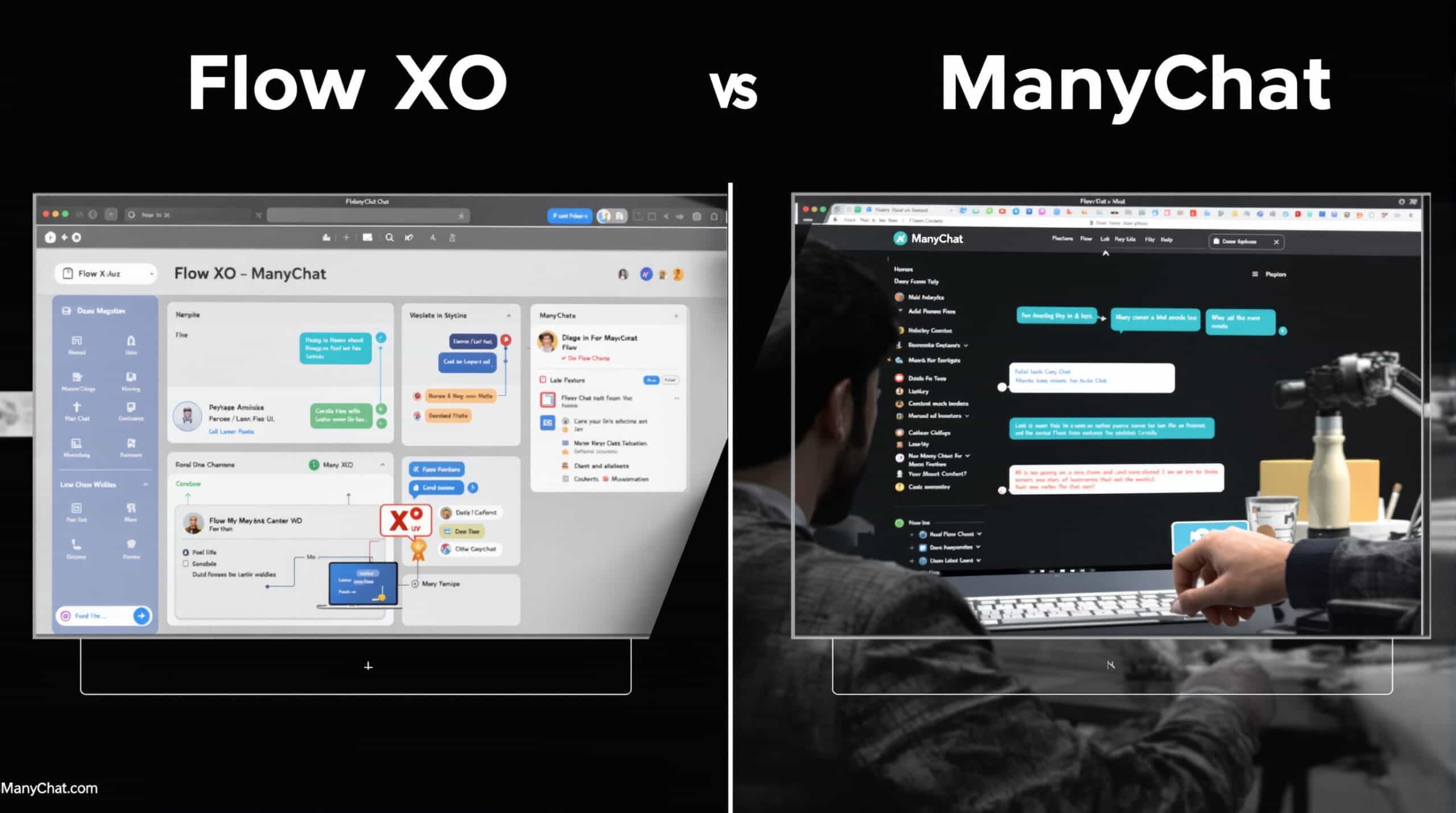
Flow XO provides a flexible platform for building chatbots and automated workflows across multiple channels, including Telegram, Slack, and traditional messaging platforms.
Pricing
- Free plan: Up to 5 bots, 500 interactions
- Standard: $19/month (15,000 interactions)
- Additional interactions: $5 per 25,000
Flow XO uses an interaction-based pricing model rather than charging by contacts.
Key Features
- Support for multiple channels including Telegram, Slack, and Messenger
- Visual flow builder with conditional logic
- Over 100 integrations with popular services
- Custom JavaScript for advanced functionality
- User management and team collaboration
Real User Experiences
Users appreciate Flow XO’s flexibility across channels. A marketing consultant noted: “Flow XO allowed us to deploy consistent chatbot experiences across Telegram, Slack, and our website without building separate bots.”
Technical users highlight the platform’s extensibility. A developer shared: “The ability to use custom JavaScript within flows gives us the flexibility to create sophisticated logic that other platforms don’t support.”
Advantages Over ManyChat
- Better support for Telegram, Slack, and other messaging platforms
- More flexible flow building with custom JavaScript
- Interaction-based pricing can be more economical
- Greater extensibility for custom solutions
- Better for technical users who need programming capabilities
Disadvantages Compared to ManyChat
- Less focus on marketing-specific features and growth tools
- Smaller template library
- Less intuitive for non-technical users
- Fewer Instagram-specific capabilities
- Less developed community resources
Our Subjective Assessment
In our testing, Flow XO demonstrated impressive flexibility for building cross-channel chatbot experiences. The ability to use custom JavaScript within flows provides a level of customization that more closed platforms can’t match.
However, the platform requires more technical knowledge than ManyChat, making it less suitable for marketers looking for quick, template-based solutions. For businesses that need to deploy consistent chatbot experiences across multiple channels, especially less common ones like Telegram and Slack, Flow XO offers valuable capabilities.
Botsify vs ManyChat: Website Chat + Human Handoff

Botsify focuses on website chat with strong human handoff capabilities, positioning itself as a balanced solution for both automated and human-assisted conversations.
Pricing
- Self-Service: $49/month
- Pro: $149/month
- Business: $499/month
- Enterprise: Custom pricing
Botsify’s pricing is based on features and usage rather than contacts.
Key Features
- Website chat with human handoff capabilities
- Training on knowledge base documents
- Multi-language support
- Integration with WordPress, Shopify, and other platforms
- Template library for quick deployment
Real User Experiences
Users value Botsify’s balance of automation and human support. A customer service manager shared: “Botsify’s human handoff feature allows our agents to seamlessly take over conversations when needed, providing a better customer experience.”
Knowledge base training receives positive feedback. A support team leader noted: “Training the bot on our documentation was straightforward and significantly reduced repetitive questions for our team.”
Advantages Over ManyChat
- Better website chat experience
- Stronger human handoff capabilities
- Superior knowledge base training
- Better multi-language support
- More focus on customer support use cases
Disadvantages Compared to ManyChat
- Limited social media marketing automation
- Fewer growth tools and lead generation features
- Less developed Instagram and Facebook integration
- Smaller template library for marketing use cases
- Less robust analytics for marketing campaigns
Our Subjective Assessment
During our evaluation, Botsify impressed with its website chat capabilities and the smooth handoff between bot and human agents. The knowledge base training feature effectively reduces repetitive questions, allowing support teams to focus on more complex issues.
The platform feels designed primarily for customer support rather than marketing automation, making it ideal for businesses prioritizing support efficiency. For companies looking to balance automated website chat with human support, Botsify offers a compelling alternative to ManyChat.
SendPulse vs ManyChat: All-in-One Marketing Suite

SendPulse offers a comprehensive marketing suite that includes chatbots alongside email marketing, SMS, web push notifications, and other channels.
Pricing
- Free plan: Up to 500 subscribers
- Standard: Starting at $6.40/month (based on subscribers)
- Pro: Starting at $7.68/month (based on subscribers)
- Enterprise: Custom pricing
- Chatbot pricing: Separate pricing starting at $9.85/month
SendPulse’s pricing varies by channel, with separate costs for email, SMS, chatbots, and other features.
Key Features
- Comprehensive marketing suite (email, SMS, chatbot, web push)
- Visual chatbot builder for Facebook Messenger and Telegram
- WhatsApp templates and business messaging
- Audience segmentation across channels
- A/B testing for marketing campaigns
Real User Experiences
Marketers appreciate SendPulse’s multi-channel approach. A digital marketing manager shared: “SendPulse allows us to coordinate messaging across email, SMS, and chat from one platform, creating more consistent customer journeys.”
Some users note the learning curve. A small business owner commented: “The platform offers many features, but it took time to learn how to use them effectively together.”
Advantages Over ManyChat
- More comprehensive marketing suite beyond just chatbots
- Better email marketing capabilities
- Integrated SMS, web push, and other channels
- More cohesive multi-channel campaign management
- Often more economical for businesses using multiple channels
Disadvantages Compared to ManyChat
- Less specialized chatbot features
- Fewer templates and pre-built chatbot flows
- Less intuitive chatbot builder for beginners
- Not as strong for Instagram automation
- Separate pricing for different channels can become complex
Our Subjective Assessment
In our testing, SendPulse impressed with its comprehensive approach to marketing automation across multiple channels. The ability to coordinate messaging across email, SMS, chatbots, and web push from one platform creates more consistent customer experiences.
However, the chatbot capabilities aren’t as specialized or advanced as dedicated platforms like ManyChat. For businesses looking for an all-in-one marketing solution rather than a specialized chatbot platform, SendPulse offers a compelling value proposition, especially for those already using email marketing and other channels.
Tidio vs ManyChat: Website Live Chat First

Tidio focuses primarily on website live chat with AI capabilities, offering a balanced solution for businesses that prioritize website engagement.
Pricing
- Free plan: Up to 50 unique chats per month
- Communicator: $18/month per agent (billed annually)
- Chatbots: $39/month (billed annually)
- Tidio+: Custom pricing
Tidio uses a hybrid pricing model with per-agent charges for live chat and feature-based pricing for chatbots.
Key Features
- Website live chat with customizable widgets
- AI chatbot (Lyro) for automated responses
- Visitor tracking and behavior-based triggers
- Integration with major e-commerce platforms
- Pre-built chatbot templates for common scenarios
Real User Experiences
Website owners praise Tidio’s live chat capabilities. An e-commerce store manager shared: “Tidio’s live chat increased our conversion rate by 15% by allowing us to engage with customers at critical moments in their shopping journey.”
Users highlight the AI assistant’s effectiveness. A small business owner noted: “Tidio’s AI chatbot handles about 70% of common questions, freeing our team to focus on more complex customer needs.”
Advantages Over ManyChat
- Superior website live chat experience
- Better visitor tracking and behavior-based triggers
- More intuitive interface for website engagement
- Strong AI capabilities with Lyro
- Better for website-focused businesses
Disadvantages Compared to ManyChat
- Less focus on social media marketing automation
- Limited Instagram and Facebook-specific features
- Fewer marketing-oriented templates and growth tools
- Less robust for broadcast messaging campaigns
- Seat-based pricing can become expensive for larger teams
Our Subjective Assessment
During our evaluation, Tidio impressed with its website chat capabilities and the Lyro AI assistant. The platform makes it easy to engage website visitors at critical moments, potentially increasing conversion rates and customer satisfaction.
The interface is intuitive and the setup process straightforward, making it accessible even for small businesses without technical resources. For companies that prioritize website engagement over social media marketing, Tidio offers a more focused alternative to ManyChat with strong AI capabilities.
For a clearer breakdown of capabilities and costs, see our full tidio vs manychat comparison focused on chat automation, engagement channels, and scalability.
Quick Picks by Use Case: Which ManyChat Alternative Is Right for You?

For E-commerce Growth
- Best overall: Talkees – Combines strong e-commerce integrations with AI capabilities and omnichannel support
- Best for WhatsApp commerce: Omnichat – Specialized features for conversational commerce in WhatsApp
- Best for website conversion: Landbot – Conversational landing pages and web chat optimization
For SMB Support Teams
- Best for balanced support/sales: Tidio – Intuitive live chat with AI capabilities
- Best for knowledge base integration: Botsify – Strong training on documentation and human handoff
- Best for multi-channel support: Talkees – Unified inbox across channels with AI deflection
For Instagram-First Creators
- Best for Instagram automation: Chatfuel – Specialized features for Instagram engagement
- Best for cross-platform consistency: Flow XO – Deploy consistent experiences across multiple channels
- Best for creator marketing: ManyChat – Still strong for Instagram-focused marketing automation
For WhatsApp-First Markets
- Best for WhatsApp commerce: Omnichat – Specialized for WhatsApp business messaging
- Best for WhatsApp automation: Landbot – Visual builder for WhatsApp flows
- Best for WhatsApp support: Talkees – Combines WhatsApp with other channels in a unified inbox
For AI-Heavy Projects
- Best for customizable AI: Talkees – Custom LLM integrations and knowledge base training
- Best for developer-friendly AI: Botmother – OpenAI integration with developer flexibility
- Best for support automation: Tidio – Lyro AI assistant with effective deflection capabilities
Decision Checklist: Finding Your Ideal ManyChat Alternative

When choosing the right ManyChat alternative for your business, consider these key factors:
- Primary channels: Which messaging platforms are most important for your business? Prioritize platforms that excel in those channels.
- Use case priority: Are you focused on marketing, sales, support, or a combination? Different platforms specialize in different areas.
- Technical resources: How much technical expertise do you have? Some alternatives require more technical knowledge than others.
- Integration needs: What other tools do you need to connect with? Check for native integrations with your essential platforms.
- Budget model: Do you prefer contact-based, seat-based, or interaction-based pricing? Choose a pricing model that aligns with your usage patterns.
- Team size: How many people need access? Consider per-seat costs for larger teams.
- AI requirements: How important is artificial intelligence for your use case? Evaluate the AI capabilities and customization options.
- Growth trajectory: How quickly are you growing? Select a platform that scales economically with your business.
By carefully evaluating these factors against the alternatives we’ve reviewed, you can find the platform that best fits your specific needs and helps you move beyond ManyChat’s limitations.
Remember that the best choice isn’t necessarily the platform with the most features, but the one that aligns most closely with your business goals, technical capabilities, and customer engagement strategy.