 English
 Slovenčina
 Français
 Magyar

Why Businesses Look for Zoho SalesIQ Alternatives

Many businesses start exploring alternatives to Zoho SalesIQ when they encounter specific limitations or challenges. Here are the most common reasons:
Rising Costs and Limited Free Tier
While Zoho SalesIQ offers competitive initial pricing, the total cost can increase significantly as your business grows:
- Free plan limitations: The free tier allows only 3 operators, 10,000 visitors/month, and 100 chat sessions/month
- Paid tier structure: Basic (~$7/operator/month), Professional (~$12.75/operator/month), and Enterprise (~$20/operator/month) with annual billing
- Hidden cost factors:
- Visitor and chat caps that businesses quickly outgrow
- AI features often require additional payment
- Channel add-ons like WhatsApp connectors usually cost extra
For example, a 5-agent support team on the Professional plan would pay approximately $63.75/month as a base price, not including AI or channel add-ons. A 15-agent team on Enterprise would start at around $300/month, but visitor caps and additional fees for WhatsApp can double or triple this amount as usage grows.
AI Chatbot Limitations
Most businesses want AI chatbots that can handle a significant portion of inquiries, but several constraints can limit effectiveness:
- Training and knowledge base issues: Without solid knowledge sources, bots often struggle with edge cases or provide incorrect answers
- Plan restrictions: Bot counts and monthly bot sessions are tiered, meaning seasonal spikes can exhaust your monthly allocation
- Handoff problems: Poor bot-to-agent transitions can frustrate users and lose valuable context
- Cost structure: Many alternatives charge per AI resolution, per conversation, or per credit, which can quickly exceed per-seat pricing models when handling thousands of inquiries
WhatsApp Business Integration Challenges
For businesses operating in markets where WhatsApp is the primary communication channel, integration limitations can be particularly problematic:
- Cost structure complexity: You typically pay a platform fee, a Business Solution Provider (BSP) fee, plus Meta’s per-conversation pricing
- Common limitations:
- Basic or missing shared WhatsApp inbox functionality
- Constraints on template messages and broadcasts
- Limited support for product catalogs and in-chat payments
- Complicated number provisioning and verification processes
WordPress Plugin Restrictions
If your business relies on WordPress or WooCommerce, you may encounter several integration challenges:
- Limited widget customization: Difficulty matching your brand, language, and accessibility requirements
- WooCommerce context gaps: Cart contents and order history may not flow to agents without custom work
- Performance issues: Heavy scripts can negatively impact Core Web Vitals and page speed
- Multi-site complexity: Managing different widgets, routing rules, or languages across sub-sites can be cumbersome
What to Look for in Zoho SalesIQ Alternatives

When evaluating alternatives to Zoho SalesIQ, focus on these key features to ensure you’re getting a solution that addresses your specific needs:
1. Native WhatsApp and Social DM Support
If messaging apps are crucial to your communication strategy, look for:
- Official WhatsApp Business API support with a vetted Business Solution Provider (BSP)
- Shared inbox capabilities including:
- Template approvals with green-tick verification
- Interactive message support (buttons, lists)
- Attachment handling (images, PDFs)
- Agent assignment and SLA management
- Transparent pricing that clearly separates platform fees, BSP charges, and Meta conversation costs
2. AI Capabilities with Custom Data Support
For effective AI implementation, prioritize platforms that offer:
- Retrieval-augmented generation (RAG) or knowledge ingestion from:
- Your website, help center, and documents
- E-commerce catalogs (Shopify/WooCommerce)
- CRM and ticketing systems
- Strong guardrails: Source citations, refusal policies for inappropriate requests, PII masking, and smooth human handoff
- Clear AI pricing models: Whether per-seat, per-conversation, or per-resolution, with predictable overage costs
3. Unified Omnichannel Inbox
Agent efficiency depends on having all customer communications in one place:
- Channel consolidation: Website chat, email, WhatsApp, Instagram DM, Facebook Messenger, and SMS in a single interface
- Intelligent routing: Rules based on channel, language, skill, or URL
- Collaboration tools: Private notes, collision detection, assignment capabilities, and SLA management
- Workflow automation: Chat-to-ticket conversion, macros, canned replies, and internal tagging
- Comprehensive analytics: Per-channel volume, response times, resolution metrics, and customer satisfaction
4. WordPress and E-commerce Integration
If you run a content site or online store, look for:
- Official WordPress plugin with regular updates and substantial active installations
- Quick setup process: Plugin installation, API key configuration, and widget activation without code edits
- Customization options: Brand colors, launch rules, and mobile behavior settings
- E-commerce context: Cart contents and order lookup visibility for agents
5. Transparent Pricing Without Hidden Costs
Avoid surprise expenses by understanding the pricing structure:
- Clear pricing models: Per-seat vs. per-conversation vs. hybrid approaches
- Channel costs: WhatsApp and SMS typically carry additional BSP fees and Meta conversation charges
- AI billing: Per message, per resolution, or credit-based with transparent overage rates
- Data retention: Some free tiers limit chat history; confirm export capabilities
6. GDPR and Data Privacy Compliance
Protect your business and customers with robust privacy features:
- Documentation: Available Data Processing Addendum (DPA) and published sub-processor list
- Consent tools: Cookie banner integration for chat tracking
- Data residency options: Clear information about where data is stored (EU/EEA availability)
- Security measures: Encryption in transit/at rest, role-based access, audit logs, and SSO on higher tiers
How We Evaluated the Top SalesIQ Competitors

Our evaluation process focused on six critical areas that impact day-to-day operations and long-term success:
- Routing logic accuracy and flexibility (20%): How effectively the platform directs visitors to the right agents
- Bot-to-agent handoff quality (20%): The smoothness and context preservation during escalations
- Reporting and analytics depth (20%): The quality of insights and exportability of data
- APIs and webhook reliability (15%): Integration capabilities and developer-friendliness
- Uptime SLAs and status transparency (15%): Service reliability and communication during incidents
- Data residency and compliance posture (10%): Privacy controls and regulatory adherence
We conducted hands-on tests with three typical setups: a 5-agent SMB (~1,000 chats/month), a 20-agent team (~10,000 chats/month), and a 50-agent operation (~50,000 chats/month). Our evaluation included channel coverage tests, WordPress integration assessment, documentation review, and support responsiveness checks.
Talkees as a Zoho SalesIQ Alternative

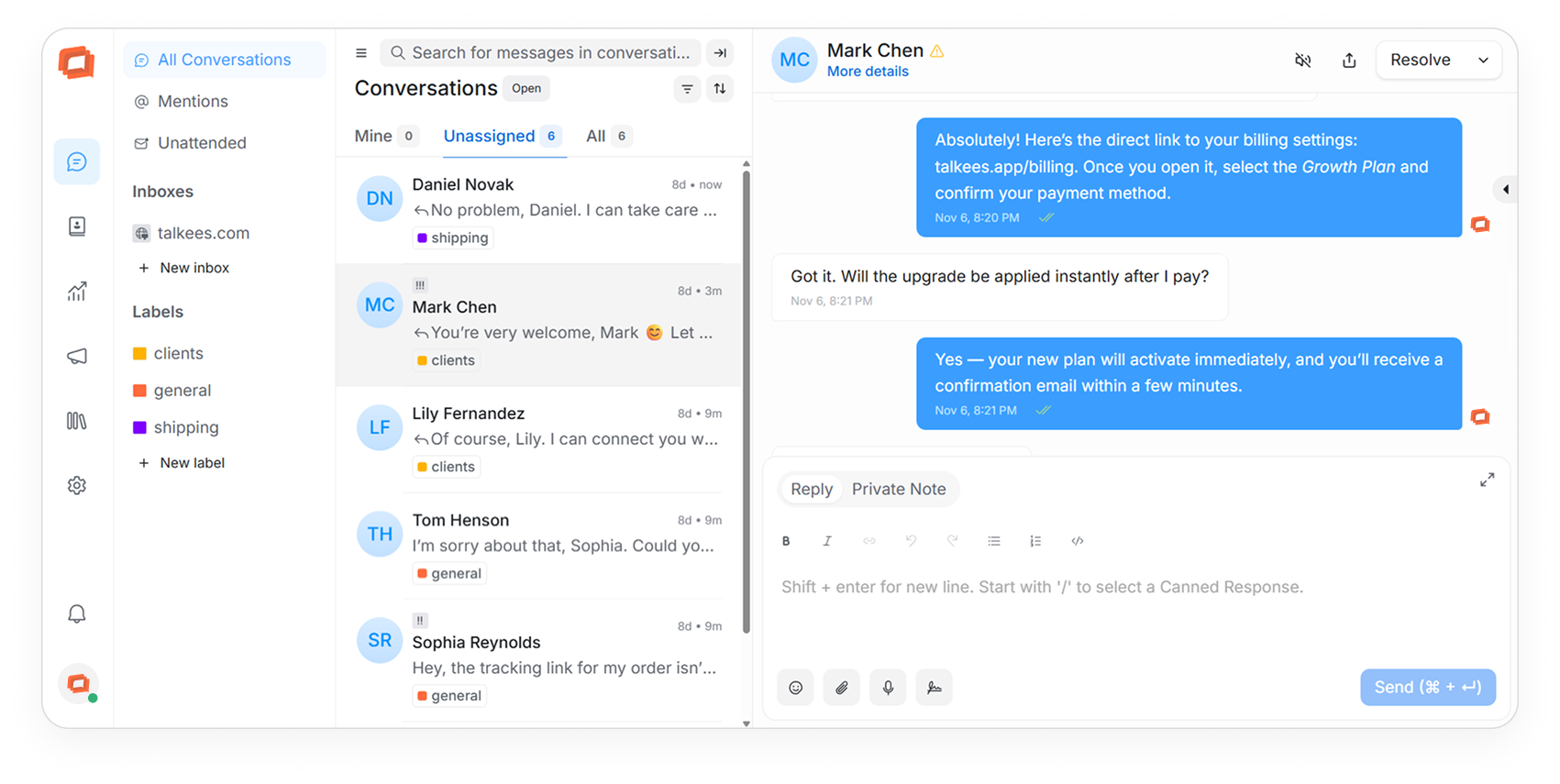
Talkees stands out as a modern, flexible alternative to Zoho SalesIQ, combining powerful AI capabilities with omnichannel messaging in a package that’s both WordPress-friendly and affordably priced for SMBs and e-commerce businesses.
Key Features and Strengths
AI-Powered Conversations
Talkees uses modern AI to reduce response times and maintain context across multi-turn conversations, resulting in fewer dead ends and smoother escalations. This helps businesses achieve:
- 30-60% bot containment for FAQs
- Lower escalation rates (under 40% for common topics)
- Fast first response times (under 30 seconds on chat)
True Omnichannel Inbox
With Talkees, you can manage conversations across WhatsApp, email, social channels, and website chat from a single interface. This eliminates the need to copy-paste from phone WhatsApp into your help desk, as conversations maintain their full history, tags, and satisfaction ratings regardless of channel.
WordPress-Friendly Implementation
Talkees offers a WordPress-friendly widget that integrates seamlessly with common themes and page builders. You can add the widget once and control behavior globally without code edits. For WooCommerce stores, agents can see valuable context like cart value, last product viewed, or order status during chats.
Fair, Transparent Pricing
Talkees is priced competitively for SMBs and e-commerce teams, with straightforward per-seat plans and predictable scaling costs. Unlike enterprise solutions that force you into expensive bundles, Talkees provides AI and WhatsApp capabilities without premium pricing.
Who Benefits Most from Talkees
- E-commerce stores needing both sales and support in one place
- SMB support teams replacing disjointed tools with a unified solution
- Businesses in WhatsApp-first markets requiring centralized compliance and transcripts
Real-World Evaluation
Talkees performs strongly across our evaluation criteria:
- Routing and handoff: Skill-based routing with full context transfer during escalations
- Reporting: Comprehensive dashboards for conversation volume, response times, bot containment, and agent performance
- APIs and integrations: REST APIs and webhooks for key events, with connections to popular CRMs and e-commerce platforms
- Reliability: Published status page, SLA options, role-based access controls, and GDPR-friendly data settings
Pricing and Value
Talkees uses a transparent pricing model designed for predictable costs as you scale. While specific pricing should be verified on their website, the platform is positioned as an affordable alternative that avoids the enterprise-level pricing of competitors while delivering comparable functionality.
When comparing total cost of ownership, consider all components: seats/agents, AI usage, WhatsApp conversation costs, and any necessary add-ons. Many teams with 3-10 agents can expect to stay in the low hundreds of dollars per month for the complete package.
Intercom: In-App Messaging and Automation for PLG SaaS

Intercom plays in a different league than many Zoho SalesIQ alternatives. It’s the preferred solution for product-led growth (PLG) SaaS teams that need sophisticated in-app messaging, automated onboarding, and enterprise-grade scalability.
Key Features and Strengths
Powerful In-App Messaging
Intercom excels at targeting messages based on user events and properties (e.g., “first project created,” “hit usage threshold,” “trial day 10”), making it ideal for activation, upsell, and feature discovery campaigns.
Interactive Product Tours
Guide users step-by-step to reach “Aha!” moments with contextual tours that launch when users land on specific screens.
Advanced AI Capabilities
Intercom’s AI (e.g., Fin) answers common questions, handles triage, and routes to appropriate teams, significantly reducing repetitive tickets and improving response times.
Extensive Automation
Create behavioral triggers, audience rules, and no-code journeys that guide users through onboarding, expansion, and retention without constant operational intervention.
Rich Ecosystem for SaaS
Benefit from a broad marketplace, APIs/webhooks, and data sync patterns that integrate smoothly with product analytics, data warehouses, and CRMs.
Considerations and Limitations
Higher Total Cost of Ownership
Intercom’s pricing combines per-seat costs with usage-based AI charges. Platform bundles typically start around $29/seat/month with additional pay-per-AI-resolution fees. Higher bundles may run $39 / $99 / $139 per seat.
Scaling AI Costs
As bot coverage grows, so does the per-resolution bill. It’s essential to model this early to avoid surprises.
Feature Tiering
Advanced capabilities (complex automation or product-led tooling) often require higher-tier bundles, which affects procurement planning.
Who Benefits Most from Intercom
- PLG SaaS companies with rich product experiences and multiple activation steps
- Teams needing interactive tours, in-app prompts, and AI bots that scale globally
- Businesses willing to accept higher TCO in exchange for lifecycle automation and strong integrations
Pricing Example
For a support/growth team of 15:
- Intercom at $39/seat: 15 × $39 = $585/month + AI per-resolution fees
- Zoho SalesIQ Professional at $12.75/operator: 15 × $12.75 = $191.25/month (annual billing)
The price difference can be justified if Intercom’s in-app tours, bot deflection, and targeted onboarding significantly improve activation and expansion revenue.
LiveChat: Dependable Live Chat with Marketplace Add-Ons

LiveChat focuses squarely on the “support-first” side of the market. It’s a mature, reliable platform that prioritizes agent workflows and efficiency, with a rich marketplace of add-ons for automation, ticketing, and analytics.
Key Features and Strengths
Agent Productivity Tools
LiveChat shines with features like message sneak-peek, canned responses, real-time typing view, chat transfer/takeover, private notes, tags, and collision detection to prevent double replies.
Routing and SLA Management
Assignment rules, queues, working hours, and load balancing help teams meet response targets without manual intervention.
Customer Feedback and Reporting
Post-chat surveys, CSAT collection, and dashboards for chat volume, response time, resolution time, and agent performance provide valuable insights.
Proactive Engagement
Behavior-based greetings and time-on-page triggers drive conversations without being intrusive.
E-commerce Depth
Native Shopify/WooCommerce integrations, product links in chat, and context sharing with agents help resolve “Where’s my order?” and product questions efficiently.
Marketplace Expansion
LiveChat’s large marketplace (200+ integrations) lets you add chatbots (via ChatBot.com), ticketing (HelpDesk), knowledge base functionality, CRM connectors, and commerce integrations as needed.
Pricing Structure
LiveChat uses a predictable per-seat model where your bill scales with headcount:
- 5 agents on an entry plan (~$24/seat): about $120/month
- 10 agents on a mid plan (~$49/seat): about $490/month
- 25 agents on a mid plan (~$49/seat): about $1,225/month
Advanced features like chatbots (via ChatBot.com), ticketing (HelpDesk), and knowledge base are separate purchases from the same vendor ecosystem or marketplace partners.
Who Benefits Most from LiveChat
- Service teams (5-50+ agents) needing reliable live chat, clean workflows, and strong e-commerce support
- E-commerce businesses using WooCommerce/Shopify that need cart data in chat
- High-volume pre-sales teams deploying proactive invitations on product pages
- Support teams requiring seamless chat-to-ticket workflows
Tidio: E-Commerce-First Live Chat + AI

Tidio is built specifically for online stores. If your business runs on Shopify or WooCommerce and you want chat to increase conversion and recover abandoned carts, Tidio’s native store apps, AI capabilities, and conversation-based pricing make it a practical Zoho SalesIQ alternative.
Key Features and Strengths
E-Commerce Platform Integration
Tidio installs directly from app stores, syncs customer and order context into the chat sidebar, and triggers conversations at key funnel steps like product views, cart pages, and checkout.
Effective AI Assistant
Tidio’s AI agent (Lyro) can automatically resolve common questions about shipping, returns, and order status. When properly trained, it can achieve up to 70% automation rates.
Visual Chatbot Templates for Commerce
Prebuilt flows for abandoned carts, product suggestions, discount offers, and post-purchase support dramatically reduce setup time.
Quick Implementation
Tidio offers a lightweight widget, clean mobile apps, and minimal administrative overhead—ideal for small teams juggling multiple responsibilities.
Pricing Structure
- Free plan available for very small stores
- Paid plans start at around $29 per 100 conversations/month
- AI add-on (Lyro) available on a pay-as-you-go basis from approximately $39/month after included thresholds
This conversation-based pricing differs from Zoho SalesIQ’s per-operator model. For a boutique store with about 250 conversations/month, you might budget roughly $87/month with Tidio for 300 conversations, plus AI if needed. A comparable Zoho SalesIQ setup for 3 operators on its mid-tier would typically cost less than $40/month—but you’d need to monitor visitor/chat caps instead of conversation bundles.
Who Benefits Most from Tidio
- Shopify/WooCommerce stores wanting plug-and-play integration and e-commerce playbooks
- Seasonal businesses that prefer conversation-based pricing rather than paying per seat upfront
- Stores focusing on cart recovery and pre-sales chat rather than extensive visitor tracking
Considerations and Limitations
- Conversation caps: Paid tiers are sold in bundles (e.g., 100 conversations), so costs scale linearly with volume
- Separate AI pricing: Lyro is powerful but requires an additional investment of $39+/month after thresholds
- Plan-specific features: WhatsApp/social DMs and advanced analytics may require higher-tier plans
Drift: B2B Revenue Chat with Account-Based Routing

Drift occupies the premium end of the market, focusing on enterprise B2B teams driven by pipeline generation. If your business uses account-based marketing/selling, relies heavily on CRM data, and measures “speed-to-lead” in seconds, Drift offers sophisticated capabilities that justify its higher price point.
Key Features and Strengths
Account-Based Routing and Fastlane
Drift can recognize target accounts on your site through firmographic enrichment and route VIP visitors to the right SDR/AE instantly—by territory, segment, or named account lists.
Revenue Playbooks with A/B Testing
Create prebuilt flows for demo requests, pricing pages, account-specific CTAs, and event follow-ups. You can test different approaches to optimize meeting booking rates.
Integrated Sales Tools
In-chat calendar booking, round-robin meeting assignment, and Drift Video for asynchronous follow-ups reduce friction between first click and first meeting.
RevOps Ecosystem Integration
Deep connections with Salesforce, HubSpot, Marketo/Pardot, enrichment tools, and intent data providers make Drift valuable for teams already running ABM lists and outbound campaigns.
Enterprise Controls
SSO/SCIM, role-based access, advanced permissions, and negotiated SLAs on upper tiers provide the security and reliability enterprise buyers require.
Pricing and TCO
Drift uses quote-based, enterprise-style pricing. Industry comparisons commonly cite the entry package at around $2,500/month for Premium, with higher tiers available by quote. There’s no free plan available.
Total monthly cost includes the core subscription, onboarding/implementation fees, potential add-ons, and your team’s time to design and maintain playbooks.
For context, many teams pay Zoho SalesIQ on a per-operator model (e.g., $7–$20 per operator/month). Drift’s baseline is a flat subscription that often starts in the low thousands per month.
Who Benefits Most from Drift
- Mid-market and enterprise B2B companies with established revenue operations, ABM account lists, and CRMs like Salesforce
- Websites with significant pipeline intent traffic where routing the right buyer to the right rep quickly materially impacts SQL generation
- Organizations wanting to consolidate chat, meeting scheduling, and ABM playbooks without multiple point solutions
Trade-Offs to Consider
- Premium pricing: Excellent for teams with mature funnels but excessive for lean SMB support or early-stage e-commerce
- Operational requirements: The platform’s power comes from well-designed playbooks and routing logic, requiring dedicated RevOps resources
- Channel focus: Drift excels at website and in-app chat for B2B. WhatsApp and broader social messaging typically require partner integrations
Freshchat (Freshworks): Omnichannel Chat with Freddy AI and WhatsApp

Freshchat shifts focus back to support and engagement at scale, offering an omnichannel inbox with native WhatsApp Business integration, AI automation via Freddy AI, and seamless integration with Freshdesk for ticketing workflows.
Key Features and Strengths
Omnichannel + WhatsApp
Connect web chat, WhatsApp Business, Facebook Messenger, Instagram DMs, and more into a single inbox. WhatsApp is officially supported, with standard WhatsApp Business API conversation fees applied through your BSP.
Freddy AI (Bots + Agent Assist)
Build automated flows, deflect routine questions, and use AI to summarize long threads. Freddy can handle self-service and then hand off to human agents with complete context.
Freshdesk Ecosystem Advantage
If you use Freshdesk, Freshcaller, or Freshservice, Freshchat provides a unified support stack—create tickets from chats, sync customer context, and report across channels.
Free Tier for Small Teams
A free plan supports up to 10 agents, with AI capabilities available on paid plans starting around $19/agent/month. Higher tiers can reach about $95/agent/month.
Modern Agent Experience
Collision detection, canned responses, SLAs, and assignment rules keep conversations moving efficiently, while mobile apps enable on-the-go responses.
Pricing Structure
- Free plan: up to 10 agents (good for trials and very small teams)
- Paid plans: AI capabilities start at approximately $19/agent/month, with higher tiers available
- Additional costs: WhatsApp Business API conversation fees (from Meta) + BSP/provider charges
Who Benefits Most from Freshchat
- SMB and mid-market support teams wanting an all-in-one Freshdesk + chat + WhatsApp solution
- E-commerce stores relying on WhatsApp/Messenger that need AI to deflect repetitive questions
- Teams outgrowing basic live chat and ready for unified omnichannel messaging with measurable SLAs and AI
Considerations and Limitations
- Feature distribution across tiers: WhatsApp connectivity, Freddy AI bots, advanced routing, and SLAs may require different plan levels
- Usage caps: Some tiers include limits on bot runs or AI credits
- Product naming: Freshchat vs Freshdesk Messaging can create confusion—verify you’re purchasing the right Freshworks product
HubSpot Live Chat: Free Chat Tied to HubSpot CRM

HubSpot Live Chat earns its place among Zoho SalesIQ alternatives for one simple reason: if you already run your marketing and sales on HubSpot, its free chat integrates natively with your CRM without additional setup. This tight connection between conversations and contact records is the primary value—especially for lean teams that want to quickly implement chat and see leads flow directly into deals, tickets, and workflows.
Key Features and Strengths
- Free Live Chat + Shared Inbox Built into HubSpot’s Conversations, every chat becomes a CRM engagement on the contact timeline, simplifying attribution and follow-ups.
- Basic Bot Capabilities Create decision-tree flows for lead qualification, routing, and meeting booking. These are form-like rather than advanced AI conversations.
- Unified Communications Manage forms, chat, and email in one place if you’re using HubSpot’s inbox and pipelines—convenient for small teams avoiding tool proliferation.
- WordPress and Shopify Integration Official WordPress plugin and native Shopify app sync customers and orders into the CRM for context.
Channel and AI Limitations
- Limited Omnichannel Without Upgrades Adding WhatsApp, Instagram DM, or Facebook Messenger typically requires a paid Hub (e.g., Marketing/Service tiers) or a marketplace app from a WhatsApp BSP partner, plus Meta’s per-conversation fees.
- Basic Bot Functionality Bots handle qualification and routing but lack the deeper intent handling and deflection analytics of specialized platforms without additional automation/AI.
Pricing Structure
- Free: Live chat and shared inbox with HubSpot CRM (typically free for basic usage)
- Starter: From about $20/seat/month for core Hub features
- Marketing Hub Professional: Starts around $800/month including 3 seats
Additional costs may include marketplace apps (e.g., WhatsApp connectors) and Meta conversation charges for messaging platforms.
Who Benefits Most from HubSpot Live Chat
- Teams already committed to HubSpot’s CRM and Hubs
- Small businesses needing free, low-lift chat to capture leads into the CRM
- Organizations valuing CRM automation (workflows, sequences) more than advanced bot design or extensive channel coverage
When to Consider Alternatives
- WhatsApp-first businesses requiring native integration from day one
- Teams needing powerful AI bots with high deflection targets
- Support operations requiring extensive channel options beyond web chat
Zendesk Chat: Enterprise-Grade Omnichannel Inside Zendesk Suite

Zendesk Chat is the heavyweight alternative in this comparison, operating within the broader Zendesk Suite to provide true omnichannel agent workspace capabilities (web chat, email, voice, WhatsApp, and social DMs) that scale reliably for high-volume support teams.
Key Features and Strengths
- Native Omnichannel, One Inbox WhatsApp, Facebook Messenger, Instagram DM, web chat, and email all reside in a unified Agent Workspace. For WhatsApp, you’ll connect a business number and pay Meta’s per-conversation fees in addition to your Zendesk subscription.
- Automation and AI for Scale Flow Builder and Answer Bot enable guided conversations and self-service, with robust triggers/macros, skill-based routing, SLAs, and agent collision detection to deflect FAQs before handoff.
- Comprehensive Reporting Zendesk Explore provides team/agent dashboards, backlog and SLA views, and custom reports—useful for managing multiple brands or regions.
- Extensive Ecosystem Apps, APIs, and webhooks connect Zendesk to Shopify, Salesforce/HubSpot, Slack, Zapier, and internal systems. The web widget easily embeds on WordPress and custom sites.
- Enterprise Operations Multi-brand support, roles/permissions, audit logs, and data residency options make Zendesk suitable for teams with compliance requirements.
Pricing Structure
Most buyers choose the Zendesk Suite rather than standalone Chat:
- Suite Team: $55/user/month
- Suite Growth: $89/user/month
- Suite Professional: $115/user/month (annual billing)
A legacy “Zendesk Chat” entry tier may be available around $11/agent/month, but with limited functionality compared to the Suite.
Additional costs include WhatsApp/social conversation fees (charged by Meta and partners) and potential add-ons depending on your plan.
Cost Example
A 12-agent support team on Suite Growth would pay approximately $1,068/month (annual billing). This includes chat, ticketing, knowledge base, reporting, and omnichannel capabilities.
Who Benefits Most from Zendesk Chat
- Mid-market to enterprise support teams, 24/7 operations, and multi-brand organizations
- E-commerce and marketplaces needing a shared inbox across web chat, email, WhatsApp, and Instagram
- Regulated or global teams with governance, audit, and data residency requirements
Considerations and Limitations
- Steeper learning curve and longer implementation timeline than chat-only tools
- Higher TCO than Zoho SalesIQ, Tidio, or LiveChat for basic website chat
- Plan complexity can complicate scoping—define needs upfront
Crisp: Affordable All-In-One Inbox with Bots and Knowledge Base

Crisp offers a modern, unified inbox without per-seat pricing headaches. It’s an excellent Zoho SalesIQ alternative if your site runs on WordPress and you need built-in bots and a knowledge base on a tight budget.
Key Features and Strengths
All-In-One Inbox
Handle website chat, email, and social DMs (Facebook Messenger, Instagram, Telegram) in one place. WhatsApp Business is available via official BSP partners with additional provider fees.
Bots and Automation
Create chatbot flows with a visual builder, set up routing rules, and configure automated replies for FAQs, lead capture, and after-hours coverage. Full bot capabilities are available on the top tier.
Built-In Knowledge Base
Publish searchable, multi-language help articles that appear inside the chat widget to deflect repetitive questions.
Co-Browsing and Video Calls
“MagicBrowse” co-browsing, screen sharing, and call options help agents solve complex issues faster—particularly useful for e-commerce checkouts and onboarding.
Real-Time Translation
LiveTranslate helps small teams support multiple languages without adding headcount.
WordPress Integration
Official plugin, 5-minute setup, and easy styling. Crisp automatically identifies logged-in WordPress users and passes profile data to agents—valuable for WooCommerce stores and membership sites.
Pricing Structure
- Free plan for basic live chat (with starter constraints)
- Pro typically around $25/month (flat, per website/workspace)
- Unlimited commonly around $95/month, including chatbots, knowledge base, co-browsing, and advanced automation
Unlike many Zoho SalesIQ competitors, Crisp uses a flat, per-site model rather than per-agent pricing—often making it cheaper once you have 3-10 agents. Example: a 5-agent team on a per-seat tool at $20/seat would pay $100/month just to start; Crisp Pro is roughly $25/month for the whole team, while Unlimited is approximately $95/month.
Who Benefits Most from Crisp
- Startups and SMBs wanting an affordable, modern inbox with automation and a knowledge base without per-agent costs
- WordPress & WooCommerce sites valuing fast plugin installation, automatic user identification, and co-browsing to resolve purchase issues
- Content-driven publishers needing a self-serve help center embedded into chat
Considerations and Limitations
- Advanced automation and knowledge base require the Unlimited plan
- WhatsApp integration typically needs a Business API provider (BSP) and adds to total cost
- Reporting and enterprise controls are lighter than enterprise-class suites
Olark: Simple Live Chat with Automation Rules

Olark stands at the opposite end of the spectrum from comprehensive platforms: it’s purposefully simple. If you’re evaluating Zoho SalesIQ alternatives because you want a fast, no-frills live chat that anyone on your team can use, Olark is one of the easiest to deploy and maintain.
Key Features and Strengths
- Streamlined Live Chat Olark focuses on providing reliable website chat with basic automation rules, visitor details in the sidebar, searchable transcripts, and straightforward reports.
- Automation Capabilities Set up rules to auto-greet visitors on specific pages, route by URL or business hours, tag/transcript automatically, and trigger messages based on time on page. These cover most entry-level use cases without complex conditions.
- Operator Tools Benefit from canned responses, chat ratings, inline notes/tags, chat transfers, and searchable transcripts for QA and coaching.
- Widget Customization Adjust colors, language, position, and behavior for simple brand alignment without deep UI theming.
- Integration Options Connect directly to common CRMs/marketing tools (HubSpot, Salesforce, Mailchimp) or use Zapier for everything else.
- Platform Support Simple WordPress plugin, easy Shopify/BigCommerce installation, and manual embed options for any CMS. Most implementations can go from zero to live in under 30 minutes.
Pricing and TCO
- Starting price: $29 per seat/month
- Add-ons: Basic automation is included without complicated extras
- Example cost: A 4-agent support team would pay roughly $116/month before taxes
Who Benefits Most from Olark
- Small businesses and e-commerce stores that want a reliable chat button on their site
- Lean support teams who don’t need WhatsApp/social DMs or AI deflection
- WordPress and Shopify sites where quick installation and low maintenance matter more than advanced features
Considerations and Limitations
- Minimal omnichannel: No native WhatsApp or social inbox
- Limited analytics: Less robust visitor tracking and lead scoring compared to SalesIQ
- Fewer automation conditions and no advanced AI/bot builder out of the box
Quick Comparison: Zoho SalesIQ vs Alternatives

Here’s a side-by-side comparison of key factors to consider when evaluating Zoho SalesIQ alternatives:
| Platform | Pricing Model | AI Capabilities | WordPress | Best For | |
|---|---|---|---|---|---|
| Zoho SalesIQ | Per-operator; Free (3 operators; 10K visitors/mo; 100 chats/mo); Basic ~$7/operator/mo; Professional ~$12.75/operator/mo; Enterprise ~$20/operator/mo | Zobot + Answer Bot; ChatGPT integration; bot session caps by plan | Native support | Official plugin | Teams already using Zoho |
| Talkees | SMB-friendly, transparent pricing | Modern AI with custom data and omnichannel automation | Built-in | WordPress-friendly widget | SMBs and e-commerce wanting AI + WhatsApp in one affordable package |
| Intercom | Per-seat + AI usage; starting ~$29/seat/mo + per-resolution fees | Market-leading Fin AI, strong automations | Available (plan/add-on dependent) | Plugin/embed | PLG SaaS and scale-ups needing in-app messaging |
| LiveChat | Per-seat; ~$20-30/agent/mo entry tier | Via ChatBot.com add-on | Via marketplace | Excellent plugin | Service teams wanting reliable agent experience |
| Tidio | Per-conversation; ~$29/100 conversations + AI add-on from ~$39/mo | Lyro AI with high automation on FAQs | Via partner/BSP | Official plugin | E-commerce SMBs preferring per-conversation pricing |
| Drift | Enterprise-first; from ~$2,500/mo | Strong playbooks, ABM workflows | Primarily via third-party | Easy embed | Enterprise B2B with ABM and pipeline goals |
| Freshchat | Free for small teams; AI from ~$19/agent/mo | Freddy AI for bots and agent assist | Native support | Plugin/embeds | Teams using Freshdesk who need WhatsApp |
| HubSpot Live Chat | Free with HubSpot CRM; advanced features require Hub upgrades | Basic bots free; advanced in paid Hubs | Via add-on/Hub | Official plugin | Teams committed to HubSpot ecosystem |
| Zendesk Chat | Suite Team ~$55/agent/mo; Growth ~$89/mo; Pro ~$115/mo | Answer Bot in higher tiers | Native | Straightforward embed | Large support teams needing omnichannel at scale |
| Crisp | Free plan; Pro ~$25/mo; Unlimited ~$95/mo | No-code bots + KB on Unlimited tier | Via Crisp plugin | Excellent plugin | Startups and SMBs wanting all-in-one inbox without enterprise costs |
| Olark | ~$29/agent/mo | Basic automation rules | Limited omnichannel | Plugin/embeds | Small teams wanting simple, reliable live chat |
Choosing the Right SalesIQ Alternative for Your Use Case

Different businesses have different requirements. Here’s how to choose the right Zoho SalesIQ alternative based on your specific needs:
For E-commerce Stores
If you run an online store on Shopify, WooCommerce, or BigCommerce, prioritize:
Best options:
- Tidio — E-commerce-first with Shopify/WooCommerce sync, prebuilt sales templates, and Lyro AI
- LiveChat — Excellent WooCommerce integration with cart visibility for agents
- Talkees — Modern AI + omnichannel with WordPress-friendly implementation
- Crisp — Affordable all-in-one solution with strong WordPress/WooCommerce support
Decision factors:
- Do you need cart data visible to agents? Choose LiveChat, Crisp, or Tidio
- Expecting high conversation volume? Per-seat plans may be more cost-effective than conversation-based billing
- Need WhatsApp for checkout or order updates? Favor Talkees, Freshchat, or Zendesk
For SMB Support Teams
Small-to-medium businesses looking for simplicity and affordability should consider:
Best options:
- LiveChat — Mature platform with minimal setup and robust helpdesk workflows
- Crisp — Budget-friendly with modern UI and no-code chatbot options
- Olark — Simple live chat with basic automation rules
- Freshchat — Free plan for small teams; Freddy AI on paid tiers
- Talkees — Fair pricing with omnichannel support without enterprise complexity
Decision factors:
- Team size under 5 agents with <500 chats/month? LiveChat, Crisp, or Freshchat Free will cover most needs
- Already using HubSpot CRM? HubSpot Live Chat reduces integration work
- Planning to add AI later? Tidio, Freshchat, Talkees, or Zendesk offer cleaner upgrade paths
For AI-Driven Projects
If advanced automation and AI are your priority:
Best options:
- Intercom — Powerful AI plus product tours for PLG SaaS; higher TCO but enterprise-ready
- Talkees — Modern AI that leverages your custom data, plus omnichannel capabilities
- Tidio — Lyro AI claims high deflection rates on common questions
- Zendesk — Enterprise-grade with native WhatsApp and deep support workflows
- Drift — Revenue-focused with account-based routing and A/B playbooks
Decision factors:
- Need AI tied to onboarding and product tours? Choose Intercom
- Require AI + WhatsApp in one platform? Consider Talkees or Zendesk
- Watch AI pricing models carefully: per-resolution (Intercom) vs conversation bundles (Tidio) vs per-seat AI (Freshchat) can dramatically impact costs based on volume
For WhatsApp-First Markets
Businesses operating in regions where WhatsApp is the primary communication channel should focus on:
Best options:
- Talkees — Built-in WhatsApp alongside email and social channels
- Freshchat — Native WhatsApp integration plus bots and multichannel inbox
- Zendesk — Native WhatsApp and social channels with enterprise routing/reporting
- HubSpot — Add WhatsApp via marketplace connectors (best if already using HubSpot)
- LiveChat — WhatsApp via marketplace partners
Budget considerations:
- Total monthly cost = platform subscription + WhatsApp BSP fee + Meta’s per-conversation charges
- For WhatsApp-centric operations, avoid web-chat-only tools in favor of platforms with native WhatsApp support
For WordPress Sites
Content-heavy sites, blogs, and WooCommerce stores should prioritize:
Best options:
- Crisp — Excellent WordPress support, affordable, with bots and knowledge base
- Tidio — Official WordPress plugin, quick installation, good for WooCommerce
- LiveChat — Official plugin, stable at scale, marketplace for extensions
- HubSpot Live Chat — Official WP plugin with CRM integration
- Talkees — WordPress-friendly widget with omnichannel capabilities
Migration Checklist from Zoho SalesIQ

If you decide to switch from Zoho SalesIQ to another platform, follow this practical, low-risk migration plan:
Step 1 — Export Data from Zoho SalesIQ
Start by preserving your customer context, maintaining reporting continuity, and avoiding GDPR issues:
What to export:
- Chats/transcripts: Date/time, visitor ID or email, operator, department, URL, UTM parameters, device, country, transcript text, ratings, resolution, and tags
- Contacts/leads: Name, email, phone, first/last seen, pages visited, lead score
- Tags and taxonomies: Conversation tags/topics, lead segments, departments, routing groups
Export methods:
- Via UI: Reports → Chat History → Export (CSV). Also export Contacts and Tags
- Via API: For large data sets, use SalesIQ APIs to paginate chats and contacts
- GDPR note: Record the export date and retention policy; keep raw exports encrypted
Data preparation:
- Normalize tags to a consistent taxonomy (aim for 12-20 well-defined tags instead of 100+)
- De-duplicate contacts based on email/phone
- Map fields to your new platform’s schema
Step 2 — Recreate Critical Triggers and Automation
Focus on the 20% of rules that drive 80% of outcomes:
Inventory current rules:
- Proactive chat triggers: URL conditions, time on page, returning visitor count, cart value, country, UTM source
- Routing/assignment: Skill-based, department, business hours, VIP customers
- Bot flows: FAQs, qualification, meeting scheduling, order lookup
Priority playbooks to recreate:
- Pricing page engagement: Show help message after 45 seconds
- Cart abandonment: Offer assistance on exit intent for carts ≥ $50
- Returning visitor recognition: Welcome returning visitors with FAQ shortcuts
- After-hours coverage: Bot answers + email capture with next-morning follow-up
Step 3 — Replace the SalesIQ Chat Widget
Implement a reversible approach to avoid disruption:
Preparation:
- Set up a staging environment or plan a maintenance window during low traffic
- Identify high-priority pages: homepage, pricing, cart, checkout, contact, help center
- Choose delivery method: plugin, embed code, or Google Tag Manager
Installation process:
- Disable the Zoho SalesIQ plugin/embed and purge cache/CDN
- Install the new chat plugin or add its snippet via GTM with a test trigger
- Verify only one widget loads and check performance impact
- Integrate with your consent management for GDPR compliance
- Style the widget to match your brand and set business hours
Rollout strategy:
- Use GTM to A/B test the old vs new widget for 5-10% of traffic
- Monitor first response time, satisfaction, and bounce rate for 24-48 hours
- If stable, increase to 50% → 100% of traffic
- Keep the Zoho plugin disabled but available for 7-14 days as a rollback option
Step 4 — Switch WhatsApp Integrations
Maintain WhatsApp continuity with minimal disruption:
Preparation:
- Identify your WhatsApp Business Account owner, current BSP, and approved templates
- Document quality ratings, phone number status, and messaging limits
- Export automation flows tied to WhatsApp
Integration options:
- Use native WhatsApp in your new platform
- Maintain the channel through a BSP and connect via your new platform’s integration
- Budget for platform fees, BSP charges, and Meta conversation costs
Number portability:
- Request number migration from your current BSP to the new one
- Schedule a 1-hour window during low traffic (most ports complete in 5-60 minutes)
- Recreate your templates in the new platform (submit 24-48 hours ahead for approval)
Verification and compliance:
- Configure webhook endpoints, agent routing, and SLAs
- Test inbound and outbound messaging with media, quick replies, and buttons
- Update “Click to WhatsApp” links and maintain opt-in records
By following this structured migration approach, you can transition smoothly from Zoho SalesIQ to your chosen alternative while preserving data, maintaining customer communications, and minimizing disruption to your business.
Looking for more Zoho comparisons? Check out our roundup: 10 Best Zoho Desk Alternatives & Comptetitors (Free & Paid)