 English
 Slovenčina
 Français
 Magyar

Why Are Businesses Looking for Trengo Alternatives?

Before diving into specific alternatives, it’s important to understand why many businesses are looking beyond Trengo. Despite its strengths as an omnichannel inbox, several limitations have prompted users to explore other options:
- Tiered pricing structure: Trengo’s conversation-based pricing model can become expensive as your support volume grows, with additional costs of approximately €18 per 100 extra conversations beyond your plan’s limits.
- WhatsApp Business API constraints: While Trengo offers WhatsApp integration, some businesses find limitations in how the platform handles template approvals, broadcasts, and attribution tracking.
- Flowbot limitations: Trengo’s automation capabilities through Flowbots have certain restrictions that may not satisfy complex automation needs, particularly for AI-heavy projects.
- Integration gaps: Some users report challenges with integrating Trengo seamlessly with their existing tech stack, especially for specialized CRM systems or custom workflows.
- Mobile app performance: Several users have reported issues with the mobile app experience, which can be problematic for teams that need to provide support on the go.
What Makes a Great Trengo Alternative in 2025?

A truly effective Trengo alternative should address these limitations while providing additional value. Here are the key features to look for:
Native WhatsApp and Social Messaging Support
The best alternatives offer official WhatsApp Business API integration with Green Tick verification, allowing for seamless template approval, broadcast messaging, and proper attribution tracking. Support for other channels like Instagram, Facebook Messenger, and emerging platforms like WeChat should be native rather than through third-party connections.
Advanced AI Chatbot Capabilities
Look for platforms that provide sophisticated, no-code chatbot builders that can handle complex conversation flows across multiple channels. The best alternatives offer AI-powered bots that can understand intent, extract entities, and maintain context throughout customer interactions.
True Omnichannel Inbox Experience
A unified inbox that genuinely consolidates all customer conversations from various channels (email, chat, social, voice) is essential. The platform should maintain conversation context when customers switch between channels and provide agents with a complete customer history.
Open API and Integration Flexibility
Robust API access and pre-built integrations with popular platforms like Shopify, HubSpot, and Salesforce ensure that your customer communication platform works seamlessly with your existing tech stack. Look for platforms that offer Zapier integration for additional connectivity options.
Voice and Desktop Support
While messaging is increasingly important, voice support remains critical for complex customer issues. The best Trengo alternatives offer either native voice capabilities or seamless integration with telephony providers. A dedicated desktop app can also enhance agent productivity.
GDPR-Grade Security and Compliance
As privacy regulations tighten globally, your chosen platform should offer enterprise-grade security features, including role-based access controls, data encryption, and compliance with regulations like GDPR.
How to Choose the Right Trengo Alternative for Your Use Case

Different businesses have different needs when it comes to customer communication platforms. Here’s how to identify the right solution based on your specific use case:
For E-commerce Businesses
If you run an online store, prioritize platforms with strong Shopify or WooCommerce integrations, robust WhatsApp Business API support for order updates and abandoned cart recovery, and automation capabilities for handling common customer inquiries.
For SMB Support Teams
Small and medium-sized businesses should focus on platforms with transparent pricing, easy setup, and the ability to scale as your team grows. Look for solutions that don’t require extensive technical knowledge to implement and maintain.
For Teams Switching from Tidio
If you’re migrating from Tidio, prioritize platforms that offer similar ease of use but with more advanced features. Look for solutions that make the migration process straightforward, with tools to import your existing chat history and settings.
For AI-Heavy Projects
For businesses focusing on automation and AI, choose platforms with advanced chatbot capabilities, natural language processing, and the ability to integrate with specialized AI services. The solution should allow for sophisticated conversation flows and continuous improvement through machine learning.
Now, let’s examine the top Trengo alternatives in detail, starting with Talkees.
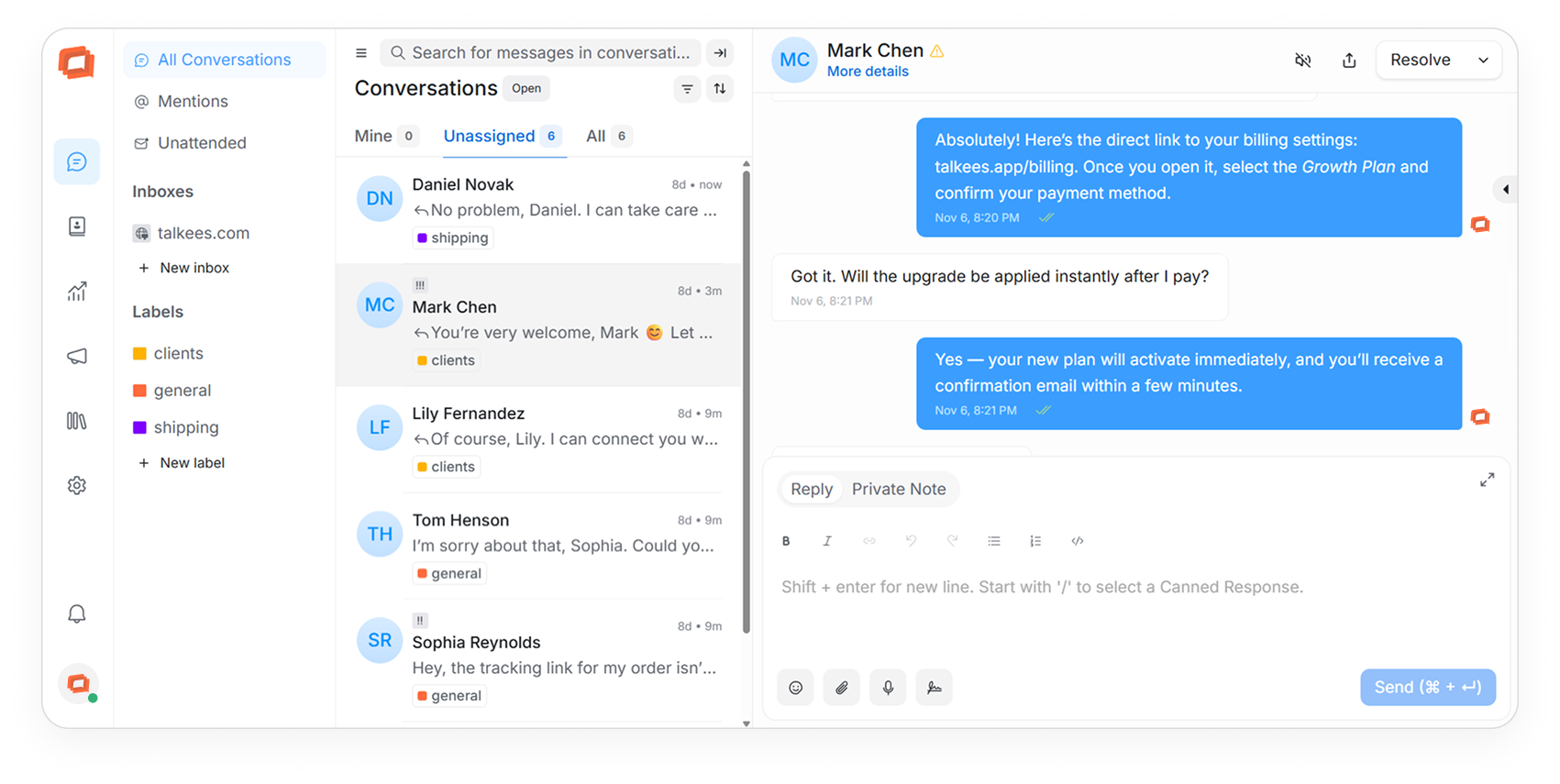
Talkees vs Trengo: AI-First Live Chat with Native WhatsApp Support
Talkees stands out as a leading Trengo alternative, offering an AI-first approach to customer communication that combines powerful live chat capabilities with native WhatsApp integration.
Comprehensive Overview of Talkees
Pricing Structure:
- Free Plan: Includes basic live chat functionality with limited AI credits
- Starter Plan: $29/month for small teams with up to 3 agents, 1,000 AI credits
- Growth Plan: $79/month for growing teams with up to 10 agents, 5,000 AI credits
- Scale Plan: $199/month for larger operations with up to 25 agents, 15,000 AI credits
- Enterprise: Custom pricing for organizations with specific needs and higher volume requirements
Each plan includes unlimited conversations, ensuring you won’t face unexpected costs as your support volume grows.
Key Features:
- AI-Powered Chatbot: No-code bot builder with advanced intent recognition and entity extraction
- Native WhatsApp Business API: Official integration with template management and broadcast capabilities
- Unified Inbox: Consolidates conversations from web chat, WhatsApp, Instagram, and other channels
- Advanced Routing: Skill-based and round-robin assignment with workload balancing
- Powerful Analytics: Detailed insights into conversation metrics, agent performance, and customer satisfaction
- Open API: Comprehensive API access with webhooks for custom integrations
- Zapier Integration: Connect with 5,000+ apps without coding
- Desktop Application: Dedicated app for Windows and Mac for improved agent productivity
Real User Experiences:
Talkees has garnered positive reviews for its intuitive interface and powerful AI capabilities. Users particularly appreciate the platform’s ability to handle high volumes of WhatsApp messages while maintaining fast response times.
“After switching from Trengo to Talkees, we saw a 40% reduction in first response time and a significant improvement in customer satisfaction,” reports one e-commerce manager. “The AI chatbot handles about 70% of our routine inquiries, freeing our agents to focus on more complex issues.”
Advantages:
- Truly unlimited conversations with no hidden fees
- Superior AI capabilities with continuous improvement
- Native WhatsApp integration with proper attribution tracking
- Intuitive interface with minimal learning curve
- Excellent value for money compared to conversation-based pricing models
Limitations:
- As a newer platform, it has fewer third-party integrations than some established competitors
- Advanced analytics features are limited to higher-tier plans
- Voice capabilities currently rely on integrations rather than native functionality
Our Subjective Assessment of Talkees
During our testing of Talkees, we were immediately impressed by the platform’s modern, clean interface. The onboarding process was remarkably straightforward—we had our first chatbot up and running within 30 minutes, complete with basic intent recognition and integration with our test WhatsApp Business account.
The AI capabilities genuinely surprised us. Unlike some competitors that offer basic decision-tree bots with an “AI” label, Talkees’ natural language understanding was capable of handling nuanced customer inquiries and maintaining context throughout conversations. We particularly appreciated how the platform suggested improvements to our bot based on actual customer interactions.
The WhatsApp integration worked flawlessly, with template approvals processing much faster than we experienced with Trengo. Broadcast messaging was intuitive to set up, and the attribution tracking gave us clear insights into which messages led to conversions.
From an agent perspective, the unified inbox was a pleasure to use. Conversations from different channels appeared in a consistent format, and the context panel provided all the necessary customer information without overwhelming the interface. The ability to collaborate with internal notes and @mentions streamlined our test team’s workflow considerably.
While Talkees may not have all the enterprise features of platforms like Zendesk, it strikes an excellent balance between powerful functionality and usability. For businesses looking to move beyond Trengo’s limitations without breaking the bank, Talkees represents one of the most compelling options on the market in 2025.
Trengo vs Zendesk: When to Choose an Enterprise CX Suite
Zendesk is a well-established player in the customer experience space, offering a comprehensive suite of tools that extends far beyond a simple shared inbox. Let’s explore how it compares to Trengo.
Detailed Pricing Comparison
Zendesk Pricing:
- Suite Team: $49/agent/month (billed annually)
- Suite Growth: $79/agent/month (billed annually)
- Suite Professional: $99/agent/month (billed annually)
- Suite Enterprise: $150/agent/month (billed annually)
All plans include omnichannel support, though advanced features like AI-powered bots and custom reporting are limited to higher tiers.
Feature Breakdown:
- Omnichannel Support: Zendesk offers robust support for email, chat, voice, social messaging, and WhatsApp
- Knowledge Base: Comprehensive knowledge management system included in all plans
- Analytics: Advanced reporting and analytics, particularly strong in higher-tier plans
- Automation: Sophisticated workflow automation and AI-powered answer bot
- Marketplace: Extensive app marketplace with 1,000+ integrations
User Experiences:
Zendesk is widely praised for its comprehensive feature set and reliability. Enterprise users particularly appreciate the platform’s scalability and extensive customization options.
“Zendesk gave us the enterprise-grade tools we needed to manage our global support operation,” notes a customer service director at a multinational company. “The ability to maintain consistent service levels across regions while customizing workflows for local requirements has been invaluable.”
Advantages:
- Comprehensive enterprise-grade functionality
- Excellent scalability for large teams
- Native voice capabilities
- Extensive marketplace of integrations
- Robust compliance and security features
Limitations:
- Significant cost, especially for larger teams
- Steeper learning curve than more focused solutions
- Can be complex to implement and maintain
- Requires substantial configuration to maximize value
When Zendesk Makes Sense Over Trengo
Zendesk is the better choice when:
- You need an enterprise-grade solution with comprehensive compliance features
- Voice support is a critical channel for your business
- You have a large, global team requiring sophisticated workflow management
- Your organization values having a single vendor for all customer experience tools
- You require extensive customization and integration capabilities
However, for smaller teams or businesses primarily focused on messaging channels, Zendesk’s complexity and cost may outweigh its benefits compared to more focused alternatives like Talkees.
If you’re evaluating broader customer support platforms, we also prepared a separate in-depth comparison of trengo vs zendesk, focusing on scalability, pricing models, and long-term fit for growing teams.
Trengo vs Front: Collaboration-Centric Inbox for Support Teams

Front takes a different approach to customer communication, focusing on creating a collaborative email-like experience rather than trying to be a comprehensive help desk solution.
Front’s Pricing and Features
Pricing Structure:
- Starter: $19/seat/month (billed annually)
- Growth: $49/seat/month (billed annually)
- Scale: $99/seat/month (billed annually)
Key Features:
- Shared Inbox: Team email management with assignment and ownership features
- Collaboration Tools: Internal comments, @mentions, and shared drafts
- Channel Support: Email, SMS, WhatsApp (via integrations), web chat
- Analytics: Team performance metrics and SLA tracking
- Automation: Rules-based workflows and canned responses
- Integrations: CRM, project management, and other business tools
User Feedback:
Front users consistently praise the platform’s intuitive interface and collaboration features. The platform is particularly popular among teams transitioning from email-based support to a more structured approach.
“Front gave us exactly what we needed—a way to collaborate on customer emails without the complexity of a full-blown help desk,” shares an account management team lead. “The ability to have internal discussions about customer inquiries without switching tools has been a game-changer for our workflow.”
Advantages:
- Excellent email-centric collaboration
- Intuitive interface with minimal learning curve
- Strong assignment and ownership features
- Good integration with CRM platforms
- Clear, predictable per-seat pricing
Limitations:
- Limited native channel support compared to omnichannel platforms
- Less robust automation capabilities
- Fewer advanced features for complex support operations
- WhatsApp support requires third-party integration
When Front Is the Better Choice
Front is ideal when:
- Your support is primarily email-based with some additional channels
- Team collaboration on customer communication is your primary need
- You want a familiar, email-like interface with added collaboration features
- You prefer simplicity over comprehensive functionality
- You’re transitioning from shared email accounts to a more structured approach
For teams with heavy WhatsApp or social messaging requirements, or those needing advanced automation, Front may not provide the depth of features offered by Trengo or other alternatives.
For a clearer breakdown of capabilities and costs, see our full trengo vs front comparison focused on shared inbox workflows, automation, and scalability.
Trengo vs MessageBird: Deep WhatsApp Business API Integration
MessageBird specializes in omnichannel messaging with particular strength in SMS and WhatsApp Business API implementation.
MessageBird’s Offering
Pricing Structure:
- Pay-as-you-go: Based on message volume and features used
- Custom plans: Available for businesses with specific requirements
- WhatsApp Business API: Separate pricing based on conversation types and volume
Key Features:
- Omnichannel Messaging: Strong support for WhatsApp, SMS, Voice, and other channels
- Flow Builder: Visual workflow creator for automated customer journeys
- Inbox: Unified inbox for managing customer conversations
- APIs: Comprehensive API access for custom implementations
- Global Reach: Excellent international coverage for messaging services
User Experiences:
MessageBird receives positive reviews for its messaging capabilities and API flexibility. Businesses with international customers particularly value the platform’s global reach.
“MessageBird’s WhatsApp Business API implementation is one of the best we’ve used,” reports a digital marketing director. “The template approval process is streamlined, and the delivery rates for our broadcast campaigns have been consistently high.”
Advantages:
- Excellent WhatsApp Business API implementation
- Strong SMS capabilities with global coverage
- Flexible API-first approach
- Good scalability for high-volume messaging
- Pay-as-you-go pricing can be cost-effective for specific use cases
Limitations:
- Less comprehensive as a complete support solution
- User interface not as intuitive as some competitors
- Limited built-in analytics compared to dedicated help desk platforms
- Can become expensive with high message volumes
MessageBird vs Trengo: Key Differences
MessageBird excels in WhatsApp Business API implementation and programmable messaging, while Trengo offers a more comprehensive support platform. MessageBird is the better choice when your primary focus is on WhatsApp and SMS messaging, particularly for marketing and transactional communications.
For businesses that need a complete customer support solution with ticketing, knowledge base, and advanced collaboration features, MessageBird may need to be supplemented with additional tools.
If you’re deciding between a messaging-first platform and a full support solution, we’ve prepared a detailed comparison of trengo vs messagebird that explores differences in pricing models, channel support, and ideal business use cases.
Intercom as a Trengo Alternative: Proactive Messaging for SaaS
Intercom has established itself as a popular platform for SaaS companies looking to engage with users through in-app messaging, chat, and proactive outreach.
Intercom’s Pricing and Features
Pricing Structure:
- Starter: $74/month (includes 2,000 active people)
- Growth: $119/month (includes 2,000 active people)
- Scale: Custom pricing
Additional costs apply for extra seats, active contacts, and premium features.
Key Features:
- In-app Messaging: Native integration for web and mobile applications
- Chatbots: Automated customer support and lead qualification
- Product Tours: Guided onboarding experiences for new users
- Knowledge Base: Self-service help center
- Outbound Messaging: Targeted campaigns based on user behavior
- Team Inbox: Collaborative customer communication management
User Feedback:
Intercom is highly regarded by SaaS companies for its ability to engage users within their products. The platform’s proactive messaging capabilities receive particular praise.
“Intercom transformed how we onboard and support our users,” explains a product manager at a B2B SaaS company. “The combination of in-app messaging, targeted outreach, and self-service resources has significantly improved our user activation and retention metrics.”
Advantages:
- Excellent in-app messaging experience
- Strong product tour and onboarding capabilities
- Good integration with product analytics
- Effective chatbots for qualification and support
- Proactive messaging based on user behavior
Limitations:
- Can become expensive as contact count grows
- Less suited for non-SaaS businesses
- Limited channel support compared to true omnichannel platforms
- Less robust for complex customer support workflows
When Intercom Makes Sense Over Trengo
Intercom is the better choice when:
- You run a SaaS or web application and need in-app messaging
- User onboarding and product adoption are primary concerns
- You want to implement proactive, behavior-based messaging
- Your support strategy focuses on self-service and automation
- You need to align product, marketing, and support communications
For businesses without web or mobile applications, or those primarily focused on external channels like WhatsApp or social media, other alternatives may be more suitable.
Freshdesk as a Trengo Alternative: Budget-Friendly Ticketing
Freshdesk offers a comprehensive ticketing system with omnichannel capabilities at a competitive price point.
Freshdesk’s Offering
Pricing Structure:
- Free: Basic ticketing for unlimited agents
- Growth: $15/agent/month (billed annually)
- Pro: $49/agent/month (billed annually)
- Enterprise: $79/agent/month (billed annually)
Key Features:
- Ticketing System: Comprehensive ticket management with automation
- Omnichannel: Support for email, phone, chat, and social channels
- Knowledge Base: Self-service portal with community forums
- Automation: Workflow automations and chatbots (Freddy AI)
- Reporting: Detailed analytics on team performance and customer satisfaction
- Field Service: Optional add-on for on-site support management
User Experiences:
Freshdesk users appreciate the platform’s value for money and comprehensive feature set. The intuitive interface receives consistent praise, particularly from smaller teams.
“Freshdesk gave us enterprise-level features at a price point that worked for our growing business,” shares a support manager at a mid-sized company. “The automation capabilities have allowed us to handle increasing ticket volumes without adding headcount.”
Advantages:
- Excellent value for money
- Comprehensive ticketing functionality
- Good knowledge base capabilities
- Intuitive interface with minimal training required
- Free plan available for basic needs
Limitations:
- Omnichannel features require higher-tier plans
- WhatsApp integration not as robust as specialized platforms
- Some advanced features require add-ons
- Mobile app has limitations compared to desktop experience
Freshdesk vs Trengo: Key Considerations
Freshdesk excels as a ticketing-first platform with omnichannel capabilities added on, while Trengo is built around an omnichannel inbox. Freshdesk is particularly well-suited for businesses that:
- Prioritize ticket management and workflow automation
- Have budget constraints but need comprehensive features
- Value self-service and knowledge base capabilities
- Need a platform that can scale from free to enterprise
- Want marketplace integrations and add-ons for customization
For businesses that primarily engage with customers through messaging channels like WhatsApp, Trengo or other messaging-focused alternatives may provide a more streamlined experience.
Zoho Desk as a Trengo Alternative: Affordable Help Desk Inside the Zoho Ecosystem

Zoho Desk provides a comprehensive help desk solution that integrates seamlessly with the broader Zoho suite of business applications.
Zoho Desk’s Pricing and Features
Pricing Structure:
- Standard: $14/agent/month (billed annually)
- Professional: $23/agent/month (billed annually)
- Enterprise: $40/agent/month (billed annually)
- Free plan: Available for up to 3 agents
Key Features:
- Ticketing System: Comprehensive ticket management with automation
- Omnichannel: Support for email, phone, chat, social media
- Zia: AI assistant for agents and customers
- SLA Management: Advanced service level agreement tracking
- Knowledge Base: Self-service portal with community capabilities
- Zoho Integration: Seamless connection with other Zoho products
User Feedback:
Zoho Desk receives positive reviews for its value and integration with the Zoho ecosystem. Users particularly appreciate the platform’s customization options.
“As a Zoho CRM user, adding Zoho Desk was a natural choice,” explains an operations manager. “The seamless data flow between sales and support has eliminated silos and given us a complete view of customer interactions.”
Advantages:
- Excellent integration with Zoho ecosystem
- Strong workflow and SLA management
- Good value for money
- AI assistant (Zia) for productivity
- Highly customizable to specific business processes
Limitations:
- Less intuitive interface than some competitors
- WhatsApp integration not as robust as specialized platforms
- Some advanced features limited to higher tiers
- Best value realized when using other Zoho products
When Zoho Desk Is the Better Choice
Zoho Desk is particularly well-suited for:
- Existing Zoho users (CRM, Projects, etc.)
- Businesses with complex SLA and workflow requirements
- Companies looking for an affordable, feature-rich help desk
- Organizations that value customization and automation
- Teams that need AI assistance for agents and customers
For businesses not using other Zoho products or those primarily focused on messaging channels, other alternatives may provide better specialized functionality.
Help Scout as a Trengo Alternative: Email-First Support with Docs

Help Scout focuses on delivering an exceptional email support experience with a clean interface and powerful knowledge base capabilities.
Help Scout’s Offering
Pricing Structure:
- Standard: $20/user/month (billed annually)
- Plus: $40/user/month (billed annually)
- Pro: Custom pricing
Key Features:
- Shared Inbox: Collaborative email management
- Docs: Comprehensive knowledge base platform
- Beacon: Embedded chat and self-service widget
- Workflows: Automation for routing and responses
- Reporting: Detailed analytics on team performance
- API: Open API for custom integrations
User Experiences:
Help Scout users consistently praise the platform’s clean interface and focus on email support. The knowledge base functionality receives particular acclaim.
“Help Scout’s simplicity is its strength,” notes a customer support lead at a software company. “We don’t need all the bells and whistles of enterprise platforms—just a reliable, intuitive tool that helps us provide excellent email support and self-service resources.”
Advantages:
- Clean, intuitive interface
- Excellent email support workflow
- Superior knowledge base functionality (Docs)
- Lightweight chat and self-service widget (Beacon)
- Transparent, predictable pricing
Limitations:
- Limited omnichannel capabilities compared to competitors
- Basic chat functionality
- Less robust for social messaging and WhatsApp
- Fewer advanced automation features
Help Scout vs Trengo: When to Choose Each
Help Scout is the better choice when:
- Email is your primary support channel
- Documentation and self-service are key priorities
- You value simplicity and ease of use over feature breadth
- Your team prefers a clean, focused interface
- You need strong knowledge base capabilities
For businesses that require robust omnichannel support, particularly for WhatsApp and social messaging, Trengo or other alternatives like Talkees would be more suitable.
Gorgias as a Trengo Alternative: Shopify-Native Support

Gorgias has established itself as the leading help desk solution specifically designed for e-commerce businesses, with deep integration into platforms like Shopify.
Gorgias’ Pricing and Features
Pricing Structure:
- Basic: $50/month (includes 350 tickets)
- Pro: $250/month (includes 2,000 tickets)
- Advanced: $625/month (includes 5,000 tickets)
- Enterprise: Custom pricing
Additional tickets can be purchased as needed.
Key Features:
- E-commerce Integration: Deep integration with Shopify, Magento, and BigCommerce
- Order Management: View and edit orders directly from the help desk
- Omnichannel: Support for email, chat, SMS, social media
- Automation: Macros and rules specific to e-commerce workflows
- Revenue Statistics: Track revenue generated through support interactions
- Self-service: Knowledge base and automated responses
User Feedback:
Gorgias receives enthusiastic reviews from e-commerce merchants, particularly Shopify store owners. The ability to manage orders directly from the help desk is frequently cited as a major advantage.
“Gorgias paid for itself within the first month,” shares an e-commerce founder. “Being able to view order details, process returns, and answer product questions all from the same interface has dramatically improved our efficiency and customer satisfaction.”
Advantages:
- Unmatched e-commerce integration
- Order management directly in the help desk
- Revenue attribution for support interactions
- Purpose-built for online stores
- Macros and templates designed for e-commerce
Limitations:
- Ticket-based pricing can become expensive with high volume
- Less suitable for non-e-commerce businesses
- WhatsApp integration not as robust as specialized platforms
- More limited general help desk features compared to some alternatives
When Gorgias Is the Better Choice
Gorgias is ideal for:
- Shopify, Magento, or BigCommerce merchants
- Businesses that need to manage orders through their help desk
- E-commerce teams focused on support-driven revenue
- Stores with social media as a significant support channel
- Companies that want purpose-built e-commerce support workflows
For businesses outside the e-commerce space or those with more general help desk requirements, other alternatives would be more appropriate.
LiveAgent as a Trengo Alternative: All-in-One Help Desk with Call Center
LiveAgent offers a comprehensive help desk solution with particularly strong call center capabilities and the option for on-premise deployment.
LiveAgent’s Offering
Pricing Structure:
- Free: Basic features for one agent
- Ticket: $15/agent/month (billed annually)
- Ticket+Chat: $29/agent/month (billed annually)
- All-Inclusive: $49/agent/month (billed annually)
Key Features:
- Ticketing System: Comprehensive ticket management
- Live Chat: Advanced chat functionality with proactive invitations
- Call Center: Built-in voice capabilities with IVR and call routing
- Video Calls: Native video calling support
- Knowledge Base: Self-service portal with community forums
- On-Premise Option: Available for regulated industries
User Experiences:
LiveAgent users appreciate the platform’s comprehensive feature set and value for money. The built-in call center functionality receives particular praise.
“LiveAgent gave us everything we needed in one platform,” explains an IT support manager. “The integrated voice capabilities eliminated the need for a separate phone system, and the on-premise option met our compliance requirements.”
Advantages:
- Comprehensive all-in-one solution
- Excellent built-in call center functionality
- Strong video call support
- Good value for money
- On-premise option for compliance requirements
Limitations:
- Interface not as modern as some competitors
- WhatsApp integration less seamless than specialized platforms
- Learning curve due to feature breadth
- Mobile app has limitations compared to desktop
LiveAgent vs Trengo: Key Differences
LiveAgent excels as an all-in-one help desk with strong call center capabilities, while Trengo focuses on omnichannel messaging. LiveAgent is particularly well-suited for:
- Businesses with significant voice support requirements
- Organizations that need video calling capabilities
- Companies in regulated industries requiring on-premise deployment
- Teams looking for a comprehensive solution at a competitive price
- Businesses that value feature breadth over specialized functionality
For companies primarily focused on messaging channels like WhatsApp, or those seeking a more modern interface, other alternatives may be more appropriate.
Conclusion: Choosing the Right Platform for Your Business Needs

After reviewing the top Trengo alternatives, it’s clear that the best choice depends on your specific business requirements, channels, and workflow preferences. Here’s a quick summary to guide your decision:
- Talkees: Best for businesses seeking an AI-first approach with native WhatsApp support and unlimited conversations at a predictable price.
- Zendesk: Ideal for enterprise organizations requiring comprehensive functionality, native voice support, and extensive customization.
- Front: Perfect for teams transitioning from email to a collaborative inbox with a familiar, intuitive interface.
- MessageBird: Best for businesses prioritizing WhatsApp Business API and SMS capabilities, particularly for marketing and transactional messages.
- Intercom: Ideal for SaaS companies looking to engage users through in-app messaging, product tours, and proactive outreach.
- Freshdesk: Great for budget-conscious teams needing a comprehensive ticketing system with omnichannel capabilities.
- Zoho Desk: Best for existing Zoho users seeking seamless integration with their CRM and business applications.
- Help Scout: Perfect for email-focused support teams that value simplicity and knowledge base functionality.
- Gorgias: Ideal for e-commerce businesses, especially Shopify merchants, who need deep store integration.
- LiveAgent: Best for organizations requiring comprehensive help desk features with built-in call center capabilities.
When making your decision, consider not only your current needs but also your future growth plans. The right platform should scale with your business, accommodate increasing message volumes, and adapt to evolving customer communication preferences.
Remember to take advantage of free trials and demos before committing to a platform. This hands-on experience will provide valuable insights into user experience, feature functionality, and compatibility with your team’s workflow.
By carefully evaluating these Trengo alternatives against your specific requirements, you can select a platform that not only addresses your current pain points but also positions your customer support operation for long-term success.