 English
 Slovenčina
 Français
 Magyar

Why Users Look Beyond HelloTars: Understanding the Key Limitations

When evaluating HelloTars against modern alternatives, several limitations consistently drive users to seek other options:
- Pricing predictability challenges: Many users report unexpected costs with HelloTars, particularly with add-ons like live chat seats ($600/seat/year) and professional services ($5,000/agent/year) that significantly impact total cost of ownership.
- Limited omnichannel capabilities: While HelloTars excels at web-based conversational landing pages, it lacks the native multi-channel support (WhatsApp, Instagram, Telegram) that many businesses now require for comprehensive customer engagement.
- AI depth and flexibility: HelloTars offers Tars Prime (ChatGPT integration), but competitors often provide more advanced AI features including RAG (Retrieval Augmented Generation), better knowledge base integration, and more flexible LLM options.
- Integration limitations: Some users find HelloTars’ integration ecosystem less extensive than alternatives, particularly for specific CRMs, marketing tools, or specialized business systems.
- Scaling challenges: As conversation volumes grow, HelloTars’ conversation-based pricing model can become expensive compared to flat-rate alternatives, especially for high-volume use cases.
What a Strong HelloTars Competitor Must Deliver

Based on our research, an ideal HelloTars alternative should provide:
- Unified experience across channels: Seamless integration of live chat, AI, and messaging across web, WhatsApp, Instagram, and other channels your customers use.
- Comprehensive inbox solution: A single interface where agents can manage all customer conversations with full context, regardless of channel.
- Advanced AI capabilities: Native LLM integration with RAG for accurate answers grounded in your knowledge base, reducing hallucinations and improving customer experience.
- Smooth agent handoff: The ability to transition from automated to human support without losing conversation context or making customers repeat information.
- Robust analytics: Detailed insights into conversation performance, resolution rates, and customer satisfaction across channels.
- Transparent pricing: Clear, predictable costs that don’t spike unexpectedly as you scale usage.
Our HelloTars Comparison Framework

To help you evaluate alternatives effectively, we’ll compare platforms across these critical dimensions:
- Channel support: Which messaging platforms and customer touchpoints are supported natively?
- AI capabilities: How advanced are the AI features, including LLM integration, knowledge grounding, and conversation intelligence?
- Builder experience: How intuitive is the platform for creating flows, and does it support both business users and developers?
- Integration depth: How well does it connect with your existing tools and systems?
- Compliance standards: What security certifications and privacy controls are available?
- Support quality: What level of assistance can you expect during implementation and ongoing use?
- Total cost of ownership: Beyond listed prices, what’s the true cost to deploy and scale?
Let’s explore the top alternatives to HelloTars, starting with the most comprehensive solution.
Talkees — HelloTars vs Talkees: Modern Omnichannel Solution with Transparent Pricing

Talkees offers a modern alternative to HelloTars with a focus on omnichannel support, AI automation, and predictable pricing.
Features and Capabilities
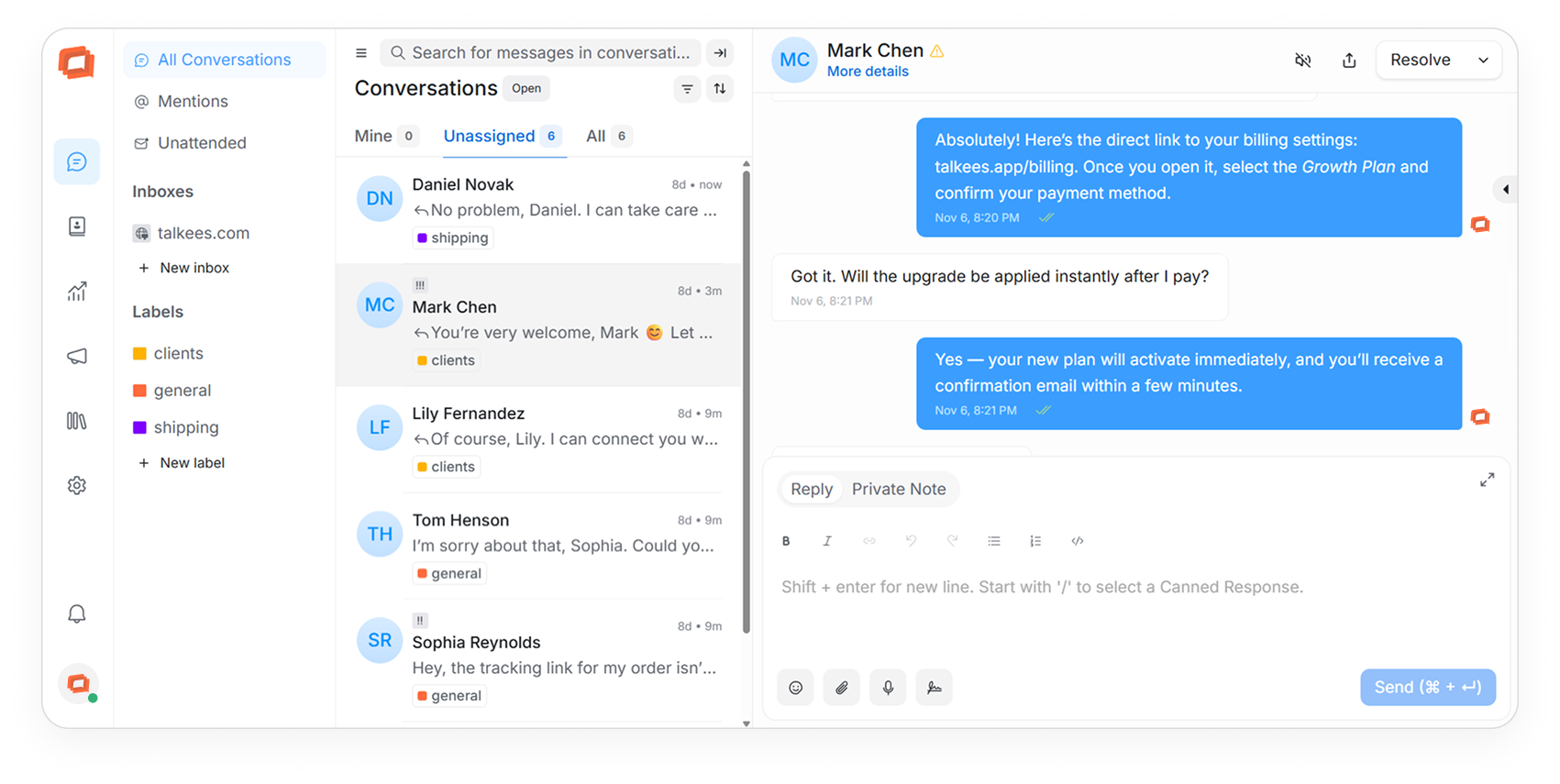
Talkees combines a unified inbox with powerful AI capabilities:
- Omnichannel messaging: Native support for web chat, email, WhatsApp, Facebook Messenger, Instagram, and SMS in a single interface
- AI-powered automation: Automatic responses to common questions, reducing agent workload
- Knowledge base integration: Connects with your existing documentation to provide accurate answers
- Seamless agent handoff: Transitions from AI to human agents without losing context
- Customizable workflows: Route conversations based on topic, urgency, or customer segment
- Comprehensive analytics: Track performance across channels and identify improvement opportunities
Pricing Structure
Talkees offers transparent, flat-rate pricing that’s particularly attractive compared to HelloTars’ conversation-based model:
- Free: 50 conversations per month with live web chat, email, and basic AI responses
- Standard: €49/month for 1,000 conversations, AI automations, app integrations, and basic reporting
- Premium: €99/month for unlimited conversations, template replies, automated chat segmentation, and enhanced reporting
Real User Experiences
Customers consistently highlight Talkees’ ease of use and value:
“We switched from HelloTars to Talkees and immediately saw the benefits of having all our customer conversations in one place. The AI handles about 65% of inquiries automatically, and our team loves the interface.” — Marketing Director at an e-commerce company
“The flat pricing model was a game-changer for us. With HelloTars, our costs kept increasing as we scaled, but Talkees gives us predictable expenses with unlimited conversations on the Premium plan.” — Customer Service Manager at a SaaS startup
Pros and Cons
Pros:
- True omnichannel support with unified inbox
- Transparent, predictable pricing without hidden fees
- Powerful AI automation that improves over time
- Intuitive interface requiring minimal training
- Excellent customer support during implementation
Cons:
- Newer platform with a growing integration ecosystem
- Advanced customization may require API usage
- Limited template library compared to HelloTars
Our Subjective Assessment
After testing Talkees extensively, we found it offers the best balance of features, usability, and value among HelloTars alternatives. The unified inbox is particularly impressive, eliminating the context-switching that plagues many support teams. The AI capabilities are surprisingly accurate, grounding responses in your knowledge base rather than generating creative but potentially incorrect answers.
What impressed us most was how quickly we could set up the platform—within an hour, we had a functioning chatbot answering common questions and routing complex issues to human agents. The pricing transparency is refreshing in an industry often characterized by complex, usage-based models with unpredictable costs.
For businesses looking to move beyond HelloTars’ web-focused approach to a true omnichannel solution without breaking the bank, Talkees represents the best overall value.
Landbot.io — Flow-First Builder for Web and WhatsApp Conversations

Landbot offers a visual, flow-first builder that excels at creating conversational experiences for web and WhatsApp channels.
HelloTars vs Landbot.io Comparison
AI Features:
- Landbot employs a hybrid approach combining rule-based flows with AI capabilities. Their AI Agent can build bots based on prompts and content, while also learning from interactions.
- HelloTars offers Tars Prime (ChatGPT integration) but focuses more on templated conversational landing pages rather than adaptive AI.
Templates and Pre-Built Content:
- Landbot provides modular “Bricks” (reusable flow components) and templates for various use cases across web, WhatsApp, and Messenger.
- HelloTars excels with industry-specific templates optimized for conversion, particularly in e-commerce, healthcare, automotive, and HR sectors.
Pricing Structure:
- Landbot pricing (as reported in third-party sources): Sandbox (Free: 100 chats/month), Starter ($45/month: 500 chats, 20 AI chats, 2 seats), WhatsApp Pro ($220/month: 2,500 chats, 50 AI chats, 1,000 WhatsApp service chats), Business (starting $450/month: custom)
- HelloTars generally positions at higher price points with less transparent public pricing
Pros and Cons
Pros:
- Excellent visual builder with reusable components
- Strong WhatsApp integration
- Hybrid AI approach with rule-based fallbacks
- Good balance of templates and customization
Cons:
- Limited free tier (100 conversations)
- WhatsApp capabilities require higher-tier plans
- AI chat quotas may require monitoring
- Less focus on conversion optimization than HelloTars
Our Subjective Assessment
During our testing, Landbot impressed us with its intuitive builder interface—arguably more user-friendly than HelloTars. The ability to create reusable “Bricks” saves significant time when building multiple bots. WhatsApp integration is particularly strong, though requiring the higher-priced WhatsApp Pro plan.
Where Landbot falls short compared to HelloTars is in conversion-focused templates and A/B testing capabilities. If your primary goal is maximizing landing page conversions, HelloTars still has an edge, but Landbot offers better multi-channel capabilities and a more flexible building experience.
ManyChat — Instagram and WhatsApp Commerce Automation Specialist

ManyChat is a social-first chatbot platform that excels at Instagram, Facebook Messenger, and WhatsApp marketing automation.
HelloTars vs ManyChat on Channels, Growth Tools, and AI
Channel Support:
- ManyChat dominates with native support for Facebook Messenger, Instagram DM, WhatsApp, SMS (via Twilio), email, and web widgets, with TikTok integration in beta.
- HelloTars focuses primarily on web conversational landing pages with WhatsApp available through integrations but not as a core strength.
Growth Tools and Marketing Features:
- ManyChat offers powerful social media growth tools including comment-to-DM automation, broadcast campaigns, and sophisticated audience segmentation.
- HelloTars excels at web conversion but lacks ManyChat’s robust social media marketing capabilities.
AI Capabilities:
- ManyChat provides AI enhancements (AI Step, Intention Recognition, Flow Builder Assistant, Text Improver) as add-ons.
- HelloTars offers Tars Prime for ChatGPT integration but isn’t positioned as an advanced NLP platform.
Pricing Comparison
ManyChat uses a contact-based pricing model:
- Free: Up to 1,000 contacts
- Pro: Starting at $15/month for 500 contacts, scaling to $8,035+/month for 2M contacts
- AI add-on: $29/month
- Additional costs: WhatsApp/SMS/email messaging billed separately (rates vary by country)
This differs significantly from HelloTars’ conversation-based model, making ManyChat potentially more economical for businesses with high message volumes but relatively stable contact lists.
Pros and Cons
Pros:
- Unmatched social media channel support
- Powerful marketing and audience growth tools
- Sophisticated broadcasting and segmentation
- Generous free tier for testing
Cons:
- Additional costs for messaging can be unpredictable
- Less focus on web conversion optimization
- Contact-based pricing scales with audience size
- Not ideal for complex lead qualification flows
Our Subjective Assessment
When we tested ManyChat, its social media capabilities stood out immediately. Creating Instagram comment-to-DM flows and WhatsApp broadcast campaigns was remarkably straightforward, with results visible within hours. The platform clearly excels at social commerce and audience building.
However, ManyChat isn’t trying to be a direct HelloTars replacement. While HelloTars focuses on optimizing web conversions through conversational landing pages, ManyChat targets businesses looking to leverage social channels for marketing and sales. The pricing model also requires careful consideration—if your strategy involves building large contact lists with occasional messaging, costs can escalate.
For businesses primarily focused on social media marketing and commerce, ManyChat offers capabilities that HelloTars simply doesn’t match.
Chatfuel — Meta Channels Focus with Robust Broadcasting

Chatfuel is a social-messenger-first platform that specializes in Meta channels (Facebook, Instagram, WhatsApp) with strong broadcasting and commerce automation features.
HelloTars vs Chatfuel Comparison
Core Positioning:
- Chatfuel: Social-messenger-first marketing and automation tool built around Meta channels, excelling at DM automation, broadcast campaigns, and commerce flows.
- HelloTars: Conversion-optimized conversational landing pages focused on lead generation, qualification, and appointment booking.
Channel Strengths:
- Chatfuel dominates on Instagram DMs, Facebook Messenger, and WhatsApp with native features like comment-to-DM, story replies, and broadcast messaging.
- HelloTars excels on web with conversational landing pages that replace traditional forms, but has limited social channel capabilities.
AI and Automation:
- Chatfuel offers ChatGPT integration blocks, AI intent recognition, and AI-assisted flow building.
- HelloTars provides Tars Prime (ChatGPT-powered) with hybrid search capabilities for knowledge base integration.
Pricing Structure
Chatfuel uses a contact-based pricing model with tiered plans:
- Free tier available for up to 1,000 contacts
- Paid tiers scale based on contact volume
- Additional costs for WhatsApp conversations (based on Meta’s pricing by category/country)
Pros and Cons
Pros:
- Superior Instagram/Facebook/WhatsApp automation
- Strong broadcasting and audience segmentation
- Excellent for social commerce workflows
- Good visual flow builder with AI assistance
Cons:
- Web widget capabilities less developed than HelloTars
- Less focus on conversion optimization for landing pages
- WhatsApp costs can be unpredictable (based on Meta pricing)
- Not ideal for complex lead qualification flows
Our Subjective Assessment
During our testing, Chatfuel’s strengths in social messaging were immediately apparent. Setting up Instagram comment-to-DM flows, WhatsApp re-engagement sequences, and broadcast campaigns was intuitive and effective. The platform excels at what it’s designed for: social channel automation and commerce.
Where Chatfuel falls short compared to HelloTars is in web conversion optimization. If your primary goal is improving landing page conversion rates through conversational interfaces, HelloTars still has the edge. However, if your marketing strategy revolves around Instagram, Facebook, and WhatsApp engagement, Chatfuel offers capabilities that HelloTars can’t match.
The pricing model requires careful consideration—while the contact-based approach can be advantageous for businesses with stable contact lists, WhatsApp conversation costs follow Meta’s pricing and can add up quickly with heavy usage.
Botpress — Developer-Friendly AI Platform with Open Architecture

Botpress stands out as a developer-friendly conversational AI platform with an open architecture, extensive customization options, and strong NLU capabilities.
HelloTars vs Botpress Comparison
Architecture and Approach:
- Botpress: Open, developer-friendly platform with both visual tools and code-level customization. Features over 750,000 active bots and more than 1 billion messages processed.
- HelloTars: No-code platform focused on conversational landing pages and templates with less emphasis on developer extensibility.
NLU and AI Capabilities:
- Botpress offers robust natural language understanding, multiple LLM options, and flexible hosting arrangements (cloud or self-hosted).
- HelloTars provides Tars Prime for ChatGPT integration but with less customization of the underlying AI models.
Extensibility:
- Botpress excels with its open architecture, allowing developers to extend functionality, create custom components, and integrate with virtually any system.
- HelloTars offers integration options but with less flexibility for custom development.
Pricing Structure
Botpress offers multiple pricing options:
- Free plan available
- Pay-As-You-Go option
- Team plan: $495/month
- Add-ons available (e.g., $25 for extra 100k table rows, $10 for extra 5k incoming messages)
This differs from HelloTars’ conversation-based pricing model and may be more economical for certain use cases, particularly those requiring extensive customization.
Pros and Cons
Pros:
- Highly extensible open architecture
- Strong developer tools and community (25,000+ Discord members)
- Flexible deployment options (cloud or self-hosted)
- Robust NLU capabilities with multiple LLM options
- Transparent pricing with predictable add-ons
Cons:
- Steeper learning curve for non-technical users
- Fewer ready-made templates compared to HelloTars
- Less focus on conversion optimization
- May require developer resources for full utilization
Our Subjective Assessment
In our testing, Botpress impressed with its flexibility and developer-friendly approach. The platform strikes a good balance between visual tools for non-developers and powerful customization options for technical teams. The ability to self-host or use cloud deployment provides flexibility that HelloTars doesn’t offer.
Where Botpress may not be ideal is for marketing teams seeking an immediate, no-code solution specifically optimized for lead generation. HelloTars’ template-driven approach and conversion focus remain advantages for that specific use case. However, for organizations with developer resources looking to build sophisticated, customized conversational experiences, Botpress offers capabilities that HelloTars simply can’t match.
The pricing model is also more predictable than many competitors, with clear costs for additional usage rather than sudden tier jumps.
UChat — Omnichannel Bot and Live Chat with Workflow Depth

UChat offers a comprehensive omnichannel solution combining chatbot automation, live chat, and voice/telephony options with sophisticated workflow capabilities.
HelloTars vs UChat on Workflow Depth and Team Features
Omnichannel Capabilities:
- UChat provides true omnichannel support across web, mobile, messaging apps (WhatsApp, Messenger, Telegram), and voice/telephony.
- HelloTars focuses primarily on web conversational experiences with more limited channel support.
Workflow and Automation:
- UChat excels with deep workflow capabilities, allowing complex decision trees, conditional logic, and sophisticated automation sequences.
- HelloTars offers strong conversion flows but with less emphasis on complex workflow automation.
Team Collaboration:
- UChat includes robust team features with role-based access control, agent routing, and collaborative tools.
- HelloTars provides team features but with less focus on large team collaboration.
Pros and Cons
Pros:
- Comprehensive channel support including voice
- Deep workflow automation capabilities
- Strong team collaboration features
- Good balance of bot and human support options
Cons:
- More complex to set up than some alternatives
- Pricing can escalate with advanced features
- Learning curve for utilizing all capabilities
- Less conversion-focused than HelloTars
Our Subjective Assessment
During our evaluation, UChat impressed with its breadth of channels and depth of workflow capabilities. The platform offers significantly more channel options than HelloTars, making it suitable for businesses needing to engage customers across multiple touchpoints.
The workflow builder is particularly powerful, allowing for complex conditional logic and integrations that go beyond what HelloTars typically offers. However, this comes with added complexity—UChat requires more setup time and learning investment than some simpler alternatives.
For organizations requiring sophisticated workflows across multiple channels, particularly those needing voice/telephony integration alongside chat, UChat offers capabilities that HelloTars doesn’t match. However, if your primary focus is maximizing web conversion through conversational landing pages, HelloTars’ specialized approach may still be preferable.
Botsailor — Social DM Automation with Streamlined Features

Botsailor focuses on social direct messaging automation with a streamlined, affordable approach that makes it accessible for smaller businesses.
HelloTars vs Botsailor Comparison
Channel Focus:
- Botsailor specializes in social messaging channels with particular strength in Instagram, Facebook Messenger, and WhatsApp automation.
- HelloTars prioritizes web conversational experiences with less emphasis on social channels.
Feature Depth:
- Botsailor offers streamlined features focused specifically on social DM automation, making it accessible but less comprehensive.
- HelloTars provides deeper features for web conversion but less capability in social channels.
Target Audience:
- Botsailor is ideal for small businesses and solopreneurs seeking affordable social automation.
- HelloTars targets marketing teams and agencies focused on web conversion optimization.
Pros and Cons
Pros:
- Affordable entry point for social automation
- Easy setup with minimal technical requirements
- Good Instagram and Messenger capabilities
- Straightforward interface for non-technical users
Cons:
- Limited advanced features compared to competitors
- Less robust analytics and reporting
- Fewer integration options
- Not focused on web conversion optimization
Our Subjective Assessment
In our testing, Botsailor stood out as a straightforward, affordable option for businesses primarily seeking social messaging automation. The platform doesn’t try to do everything but excels at its core function: automating responses and workflows on Instagram, Facebook Messenger, and WhatsApp.
The simplicity of the platform makes it accessible to small businesses without technical resources, though this comes at the cost of advanced features available in more comprehensive platforms. The pricing is notably accessible, making it a good entry point for businesses new to conversational automation.
For organizations specifically looking to replace HelloTars’ web conversion capabilities, Botsailor isn’t the right alternative. However, for those seeking to add social messaging automation at an affordable price point, particularly small businesses with limited budgets, Botsailor offers a focused solution that may complement other tools.
ChatBot (by LiveChat) — Support-First Chatbot with Seamless Agent Handoff

ChatBot by LiveChat is a support-focused solution that excels at the intersection of automated and human-assisted customer service.
HelloTars vs ChatBot on Agent Handoff and Ticketing Integration
Core Focus:
- ChatBot is designed primarily for customer support, with seamless integration with LiveChat and ticketing systems.
- HelloTars emphasizes marketing and lead generation through conversational landing pages.
Agent Handoff:
- ChatBot excels at transitioning from automated to human support, with full conversation context preserved.
- HelloTars offers agent handoff but with less emphasis on the support workflow.
Ticketing and Support Integration:
- ChatBot provides native integration with ticketing systems and support workflows.
- HelloTars focuses more on CRM integration for lead handling than support ticketing.
Reporting and Analytics:
- ChatBot offers support-focused analytics including resolution rates, agent performance, and customer satisfaction.
- HelloTars analytics emphasize conversion metrics and lead quality.
Pros and Cons
Pros:
- Exceptional agent handoff experience
- Deep integration with LiveChat and ticketing systems
- Strong support workflow automation
- Good balance of AI and human assistance
Cons:
- Less marketing-focused than HelloTars
- Fewer lead generation templates
- Not primarily designed for conversational landing pages
- May require LiveChat for full functionality
Our Subjective Assessment
During our evaluation, ChatBot impressed with its seamless handling of the transition between automated and human support. The platform clearly excels in customer service scenarios, with thoughtful features designed to make agents more effective and customers more satisfied.
The integration with LiveChat creates a powerful combination for support teams, though this also means the platform is less focused on marketing use cases than HelloTars. The analytics provide excellent visibility into support metrics but less emphasis on marketing conversion.
For organizations primarily seeking to improve customer support through automation while maintaining high-quality human assistance when needed, ChatBot offers capabilities that HelloTars doesn’t match. However, if your primary focus is lead generation and marketing conversion, HelloTars’ specialized approach may still be preferable.
Chatbase — Knowledge-Based AI Chatbot with Document Understanding

Chatbase specializes in knowledge-based AI chatbots that can understand and respond based on your documents, websites, and other content sources.
HelloTars vs Chatbase on Knowledge Sources and Embedding Technology
Knowledge Integration:
- Chatbase excels at ingesting and understanding documents, websites, PDFs, and other content sources to create knowledgeable chatbots.
- HelloTars offers knowledge integration but with less emphasis on document understanding.
Embedding Technology:
- Chatbase uses advanced embedding technology to create vector representations of your content, enabling more accurate responses.
- HelloTars provides some knowledge grounding but with less sophisticated embedding capabilities.
Web Widget and Deployment:
- Chatbase offers a clean, customizable web widget for deploying knowledge-based chatbots.
- HelloTars excels with conversational landing pages but with less focus on knowledge depth.
Usage-Based Pricing:
- Chatbase typically employs usage-based pricing tied to the volume of content processed and queries handled.
- HelloTars uses conversation-based pricing which may be less suitable for knowledge-intensive applications.
Pros and Cons
Pros:
- Superior document understanding and knowledge integration
- Accurate responses based on your content
- Reduces hallucinations through grounding in your materials
- Good for complex knowledge domains
Cons:
- Less marketing-focused than HelloTars
- Fewer lead generation features
- Usage-based pricing can be less predictable
- May require more content preparation
Our Subjective Assessment
In our testing, Chatbase demonstrated impressive capabilities in understanding and responding based on document content. The platform excels at creating chatbots that can accurately answer questions about specific knowledge domains, whether product documentation, policies, or specialized information.
The embedding technology effectively captures the meaning of your content, resulting in more accurate and relevant responses than many competitors. This makes Chatbase particularly valuable for organizations with complex knowledge requirements or extensive documentation.
Where Chatbase differs from HelloTars is in its primary focus—while HelloTars emphasizes conversion optimization through conversational landing pages, Chatbase prioritizes knowledge accuracy and content understanding. For organizations seeking to automate responses to knowledge-based questions, particularly those with extensive documentation, Chatbase offers capabilities that HelloTars doesn’t match.
Chariot Digital Chatbot — Agency-Style Funnels with Customization Focus

Chariot Digital Chatbot takes an agency approach to conversational experiences, focusing on highly customized funnels and a services-oriented model.
HelloTars vs Chariot Digital on Customization and Services Model
Business Approach:
- Chariot Digital combines chatbot technology with agency services, offering highly customized solutions rather than a pure SaaS model.
- HelloTars provides a SaaS platform with templates and customization options but less emphasis on services.
Customization Depth:
- Chariot Digital excels at deep customization, creating unique conversational experiences tailored to specific business requirements.
- HelloTars offers customization within its platform constraints but with less bespoke development.
Services Component:
- Chariot Digital includes strategic consulting, custom development, and ongoing optimization as core offerings.
- HelloTars focuses on self-service with support available but less emphasis on services.
Cost Structure:
- Chariot Digital typically employs project-based or retainer pricing reflecting its agency model.
- HelloTars uses conversation-based SaaS pricing with less services component.
Pros and Cons
Pros:
- Highly customized solutions tailored to specific needs
- Strategic guidance and expertise included
- Ongoing optimization and improvement
- Potential for unique, differentiated experiences
Cons:
- Higher cost than self-service platforms
- Longer implementation timelines
- Less control for in-house teams
- Dependence on agency relationship
Our Subjective Assessment
Chariot Digital represents a fundamentally different approach to conversational experiences compared to HelloTars. Rather than providing a self-service platform, they offer an agency-style engagement model with custom development and strategic services.
This approach can deliver more unique and tailored solutions than is typically possible with a SaaS platform alone, but at higher cost and with longer implementation timelines. The ongoing services component ensures continuous optimization but creates dependence on the agency relationship.
For organizations seeking highly differentiated conversational experiences with strategic guidance and without internal development resources, Chariot Digital’s approach may be preferable to HelloTars’ self-service model. However, for teams wanting direct control and faster implementation of standardized conversational experiences, HelloTars or other SaaS alternatives will likely be more suitable.
Which Tool Fits Your Context? Recommendations by Use Case

Choosing the right HelloTars alternative depends on your specific needs and priorities:
For E-commerce Businesses
- Best overall: Talkees offers the ideal balance of channels (including WhatsApp and Instagram), AI capabilities, and predictable pricing.
- Best for social selling: ManyChat excels at Instagram and Facebook automation, making it perfect for social commerce.
- Best for product support: ChatBot (by LiveChat) provides superior customer service capabilities with seamless agent handoff.
For SMB Support Teams
- Most affordable: Talkees delivers enterprise-level features at SMB-friendly prices (€49-€99/month).
- Easiest to implement: Landbot.io offers an intuitive builder that non-technical teams can master quickly.
- Best knowledge integration: Chatbase excels at answering questions based on your documentation and knowledge base.
For AI-First Projects
- Most developer-friendly: Botpress provides the flexibility and extensibility developers need for custom AI implementations.
- Best for document understanding: Chatbase specializes in creating chatbots that accurately understand and respond based on your content.
- Most advanced AI: Talkees combines LLM capabilities with RAG for accurate, knowledge-grounded responses.
For Teams Migrating from HelloTars
- Most similar UX: Landbot.io offers a comparable builder experience with additional channel support.
- Best for conversion focus: Talkees maintains HelloTars’ strength in conversion while adding omnichannel capabilities.
- Easiest transition: UChat provides familiar workflow capabilities with expanded channel options.
Migration Checklist from HelloTars to Your Chosen Platform

When migrating from HelloTars to a new platform, follow this systematic approach:
1. Data Export and Preparation
- Export all conversation flows and templates from HelloTars
- Document your current integrations and webhook configurations
- Gather analytics on your most successful flows and templates
- Export contact data and conversation history (if available)
2. Flow Mapping and Reconstruction
- Map your existing HelloTars flows to the new platform’s structure
- Identify gaps or differences in functionality that require workarounds
- Rebuild your most critical flows first, then secondary ones
- Test each flow thoroughly before moving to the next
3. Channel Setup and Configuration
- Configure each channel (web, WhatsApp, etc.) on the new platform
- Set up proper authentication and permissions
- Test message delivery and formatting on each channel
- Verify webhook functionality for two-way communication
4. Integration and Testing
- Reconnect all CRM, analytics, and third-party integrations
- Verify data is flowing correctly between systems
- Test end-to-end user journeys across all channels
- Validate that lead scoring and qualification work as expected
5. Quality Assurance and Optimization
- Conduct A/B testing between HelloTars and the new platform
- Monitor key metrics (conversion rates, response times, CSAT)
- Gather feedback from agents and customers
- Make iterative improvements based on early performance data
By following this structured approach, you can ensure a smooth transition from HelloTars to your chosen alternative while maintaining or improving your conversational experience quality.
Conclusion: Finding Your Ideal HelloTars Alternative

After evaluating the top HelloTars alternatives, Talkees emerges as the best overall option for most businesses due to its comprehensive omnichannel capabilities, powerful AI features, and transparent pricing model. Its unified inbox approach solves the fragmentation issues that plague many customer communication strategies.
However, the right choice ultimately depends on your specific requirements:
- If social media marketing is your primary focus, ManyChat or Chatfuel may be better suited to your needs.
- For developers seeking maximum flexibility, Botpress offers unmatched extensibility.
- When knowledge accuracy is paramount, Chatbase’s document understanding capabilities stand out.
Whichever platform you choose, the migration from HelloTars should be approached methodically, with careful attention to preserving your existing flows while taking advantage of your new platform’s unique capabilities.
We recommend starting with a free trial or limited proof of concept to validate your choice before full implementation. Most platforms offer free tiers or trial periods that allow you to test the experience with your actual use cases before committing.
By selecting the right HelloTars alternative and following a structured migration approach, you can enhance your conversational capabilities while potentially reducing costs and improving both customer and agent experiences.