 English
 Slovenčina
 Français
 Magyar

Why Look for Alternatives to Salesforce Service Cloud?

When evaluating customer support platforms in 2026, businesses face a critical choice between two distinct paradigms: chat-first, digital-native platforms and traditional voice/contact center systems. This decision has significant implications for your operational costs, implementation timelines, and customer experience strategy.
The search for Salesforce Service Cloud alternatives is often driven by several key factors: hidden total cost of ownership (TCO), expensive add-ons, heavy administrative overhead, and disappointingly slow time-to-value. Many organizations discover that Salesforce’s complex pricing structure and extensive customization requirements create unexpected costs that can equal or even exceed the base license spend.
Before diving into specific alternatives, it’s important to understand the fundamental differences between chat-first platforms and traditional voice systems, as this distinction will guide your selection process.
Chat-First Platforms vs. Traditional Voice Systems: Key Differences

Chat-First Platforms: Benefits of Digital-First Support
Chat-first platforms centralize email, web chat, in-app messaging, social DMs, and automation into a unified agent inbox, offering several distinct advantages:
- Efficiency through concurrency: While phone agents handle one call at a time, chat agents can manage multiple conversations simultaneously. Research from TELUS International shows that for moderately complex issues, agents can safely handle 2.5-3 concurrent chats, with some teams scaling to 4-5 for simple queries. This directly reduces cost per resolution at the same staffing level.
- Faster implementation and time-to-value: Modern chat-first tools are cloud-native with no-code automation, one-click channel add-ons, and app marketplaces. SMBs and e-commerce brands can go live in days rather than months.
- Ideal for e-commerce and SaaS: Order status inquiries, returns, account access, and billing questions are perfectly suited for chat and asynchronous messaging where customers are already browsing. Written transcripts also enhance QA and agent coaching.
- AI-ready architecture: Digital conversations naturally feed AI assistants to triage, summarize, and auto-respond using knowledge base content. Many vendors now support BYO LLM (Bring Your Own Language Model) options with OpenAI, Anthropic, or private models.
Traditional Voice Systems: When They Excel
Voice-based contact center platforms still offer unique advantages in specific scenarios:
- Superior for high-stakes, emotional interactions: Voice communication carries tone and empathy, often resolving complex or sensitive issues faster. Regulated industries like finance, healthcare, and utilities frequently require voice recording, advanced QA, and strict compliance measures.
- Enterprise routing and workforce management: Platforms like NICE CXone and Genesys Cloud CX excel at complex global routing rules, forecasting/scheduling, and quality management across large call volumes.
- Deep telephony features: CTI screen-pops, whisper/coaching, voice analytics, and mature SLA tooling are built into these systems.
Essential Features of a Modern Customer Support Platform in 2026

When evaluating Salesforce Service Cloud alternatives, ensure your chosen platform includes these critical capabilities:
- Omnichannel inbox: A unified agent workspace that consolidates email, chat, messaging, social, and voice interactions with complete conversation history.
- AI chatbot and agent assistance: Look for platforms with either native AI capabilities or the flexibility to integrate your preferred LLM, with features like ticket classification, suggested responses, and conversation summarization.
- No-code automation: Workflow builders that enable non-technical staff to create complex routing rules, SLA triggers, and automated responses.
- E-commerce integrations: Native connections to platforms like Shopify, WooCommerce, and payment systems to provide agents with order context.
- Transparent pricing: Clear cost structures that avoid the add-on stacking common with Salesforce, including predictable AI usage costs.
Comparing NICE CXone to Other Platforms: Key Considerations

NICE CXone is a powerful contact center solution with robust voice capabilities, but many teams are exploring alternatives that offer faster implementation, more transparent pricing, and chat-first architectures. When evaluating NICE CXone vs. chat-first platforms, consider:
- Channel mix: If 60%+ of your contacts are digital (email, chat, messaging, social), a chat-first platform will likely deliver better economics through concurrency.
- Implementation speed: Chat-first platforms typically launch in under 14 days for SMBs and digital brands, while voice-first CCaaS projects often require telephony provisioning, routing design, and QA frameworks.
- Cost structure: Chat-first suites often start around $7-40/agent/month for basic tiers, while voice-first CCaaS like NICE CXone and Genesys typically quote at higher price points with enterprise-grade features.
- AI approach: Consider whether you need a platform with native AI or one that allows you to bring your own LLM, along with how AI usage is priced (per agent, per token, or per resolution).
Now, let’s examine the top 10 Salesforce Service Cloud alternatives, starting with Talkees.
Detailed Reviews of 10 Salesforce Service Cloud Alternatives

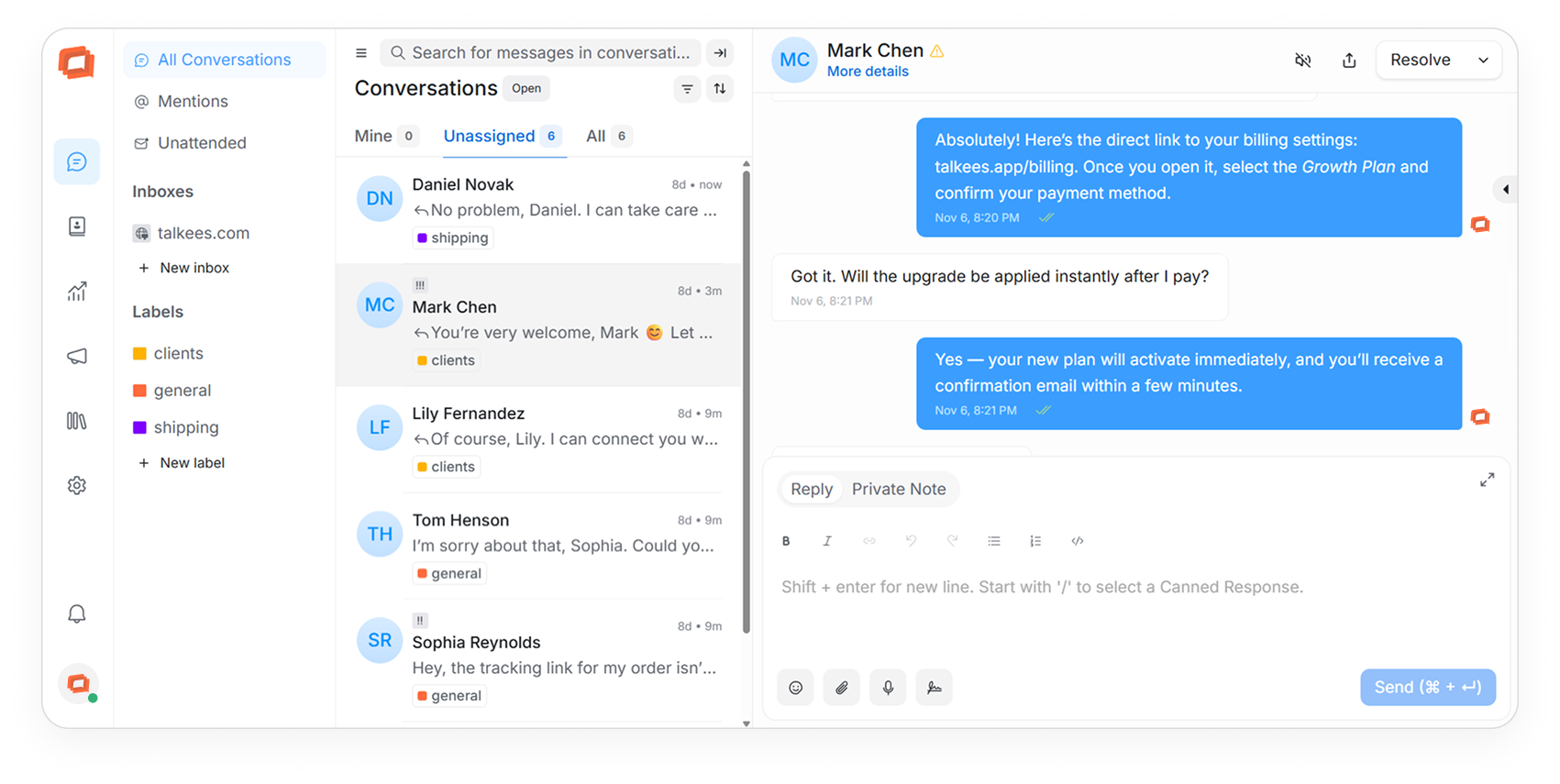
1. Talkees — Chat-First, AI-Ready Help Desk with Transparent Pricing
Overview: Talkees is a modern, chat-first customer support platform designed for businesses looking to move away from complex legacy systems like Salesforce Service Cloud.
Pricing:
- Free plan: Limited features for small teams getting started
- Standard: $29/agent/month (billed annually)
- Professional: $59/agent/month (billed annually)
- Enterprise: Custom pricing with advanced features
- AI credits included in each tier with transparent overage rates
Key Features:
- Unified inbox across email, chat, social channels, and messaging apps
- BYO LLM capability allowing you to connect your preferred AI model
- No-code automation builder for complex workflows
- One-click integration with Shopify, WordPress, and other e-commerce platforms
- AI-powered ticket triage, classification, and suggested responses
- Transparent pricing without hidden fees or mandatory add-ons
Pros:
- Significantly faster implementation than Salesforce (days vs. months)
- Higher agent efficiency through 2.5-3x concurrency with chat
- Clean, intuitive interface requiring minimal training
- Flexible AI approach with predictable costs
- Strong e-commerce integrations with order context in agent view
Cons:
- Newer platform with growing marketplace integrations
- Advanced enterprise voice features require integration with telephony partners
- Not as deeply customizable as Salesforce for highly specific workflows
Our Experience: During our testing, Talkees impressed us with its clean, intuitive interface and remarkably quick setup process. We had a functional help desk running with Shopify integration in under 48 hours. The AI assistant provided genuinely helpful response suggestions and accurate ticket classification. Agents particularly appreciated the unified timeline that prevented them from switching between multiple tabs. The BYO LLM option gave us control over AI costs while maintaining quality responses. For teams currently struggling with Salesforce’s complexity, Talkees offers a refreshingly straightforward alternative with substantially lower TCO.
2. Zendesk — Mature Omnichannel Platform with Robust Ticketing
Overview: Zendesk is a well-established customer service platform with comprehensive ticketing capabilities and a mature marketplace of integrations.
Pricing:
- Support Team: $19/agent/month (ticketing only)
- Suite Team: $55/agent/month
- Suite Growth: $89/agent/month
- Suite Professional: $115/agent/month
- Suite Enterprise: $169/agent/month
- AI add-ons: $50/agent/month for Zendesk AI features
Key Features:
- Comprehensive ticketing system with robust workflow capabilities
- Extensive integration marketplace with 1,000+ apps
- Omnichannel support across email, chat, phone, social media
- Advanced reporting and analytics
- Knowledge base and community forum capabilities
Pros:
- Mature platform with proven reliability at scale
- Strong customization options and workflow capabilities
- Comprehensive reporting and analytics
- Large ecosystem of integrations and partners
Cons:
- AI features require additional payment and are relatively expensive
- Implementation can be complex for advanced use cases
- Higher total cost compared to newer alternatives
- Some users report a steeper learning curve
Our Experience: Zendesk delivers a robust, enterprise-grade support experience with excellent reliability. During our evaluation, we found the platform extremely capable but noticed that achieving the same functionality as newer platforms often required multiple add-ons and integrations, increasing both cost and complexity. The ticketing system is comprehensive, but the interface feels less modern than some competitors. Zendesk excels for organizations with complex support requirements who need proven reliability and don’t mind paying a premium.
3. Freshdesk — SMB-Friendly Pricing with Solid Automation
Overview: Freshdesk offers a user-friendly help desk solution with competitive pricing and a growing set of AI capabilities through its Freddy AI platform.
Pricing:
- Free: Basic ticketing for up to 10 agents
- Growth: $15/agent/month
- Pro: $49/agent/month
- Enterprise: $79/agent/month
- Freddy AI add-ons: Additional costs for advanced AI features (Freddy Copilot $29/agent/month; additional sessions beyond free quota at $100 per 1,000)
Key Features:
- Intuitive ticket management with automation
- Freddy AI for chatbots and agent assistance
- Multichannel support (email, chat, phone, social)
- Self-service knowledge base
- Customizable ticket fields and workflows
Pros:
- Competitive pricing with a generous free tier
- User-friendly interface requiring minimal training
- Solid automation capabilities
- Good balance of features for small to mid-sized businesses
Cons:
- Advanced AI features require additional payment
- Enterprise features not as robust as Salesforce or Zendesk
- Some users report occasional performance issues
- Reporting capabilities less advanced than premium alternatives
Our Experience: Freshdesk impressed us with its balance of functionality and ease of use. The platform was quick to set up, and agents found the interface intuitive. Freddy AI provided useful automation, though the most advanced features required additional payment. For small to mid-sized businesses, Freshdesk offers excellent value with a substantially lower learning curve than Salesforce Service Cloud. The multichannel capabilities worked well in our testing, though larger enterprises with complex routing needs might find some limitations.
4. Zoho Desk — Best for Teams in the Zoho Ecosystem
Overview: Zoho Desk is part of the broader Zoho ecosystem, offering deep integration with Zoho CRM and other Zoho applications while providing solid help desk functionality.
Pricing:
- Free: Up to 3 agents
- Standard: $14/agent/month
- Professional: $23/agent/month
- Enterprise: $40/agent/month
- All plans billed annually with monthly options available at higher rates
Key Features:
- Seamless integration with Zoho CRM and other Zoho applications
- Zia AI assistant for ticket insights and automation
- Multichannel support across email, social, chat, and phone
- Customizable help center and knowledge base
- Time-based SLA management and escalations
Pros:
- Excellent value for money compared to enterprise alternatives
- Strong AI capabilities with Zia included in higher tiers
- Seamless experience for teams already using Zoho products
- Comprehensive customization options
Cons:
- Best experience requires commitment to the Zoho ecosystem
- Some advanced features only available in higher tiers
- Third-party integrations not as extensive as Zendesk
- Interface can feel busy with many options
Our Experience: For organizations already using Zoho products, Zoho Desk provides exceptional value and integration. During our testing, we found the platform highly capable with particularly strong automation features through Zia AI. The context sharing between Zoho CRM and Desk was seamless, giving agents complete customer visibility. The interface is feature-rich but can feel overwhelming initially. For teams looking for an affordable alternative to Salesforce Service Cloud who don’t mind some UI complexity, Zoho Desk offers excellent functionality at a fraction of the cost.
5. HubSpot Service Hub — Native to HubSpot CRM with Easy Automation
Overview: HubSpot Service Hub integrates seamlessly with HubSpot’s CRM platform, providing a unified customer view across marketing, sales, and service.
Pricing:
- Starter: $15/seat/month
- Professional: $100/seat/month (requires onboarding fee ~$1,500)
- Enterprise: $150/seat/month (requires onboarding fee ~$3,500)
- All plans require annual commitment
Key Features:
- Native integration with HubSpot CRM, Marketing Hub, and Sales Hub
- Conversation inbox for email, chat, and Facebook Messenger
- Knowledge base and customer feedback tools
- Automation and ticket routing
- Customer satisfaction surveys and reporting
Pros:
- Unified customer view across marketing, sales, and service
- Intuitive interface with minimal training required
- Strong automation capabilities
- Excellent for businesses already using HubSpot products
Cons:
- Mandatory onboarding fees for higher tiers
- Limited advanced routing compared to contact center solutions
- Less robust telephony integration than specialized platforms
- Higher total cost when considering required onboarding
Our Experience: HubSpot Service Hub shines for organizations already invested in the HubSpot ecosystem. The platform offers a clean, intuitive interface that our test agents mastered quickly. The seamless connection between customer service interactions and CRM data provided excellent context for resolving issues. However, we found the telephony capabilities less robust than specialized contact center solutions, and the mandatory onboarding fees for Professional and Enterprise tiers add significant cost. For HubSpot users, Service Hub is a natural extension, but organizations prioritizing advanced voice capabilities may need to look elsewhere.
6. Sprinklr Service — Enterprise Social and Messaging at Scale
Overview: Sprinklr Service offers enterprise-grade customer care with particular strength in social media and messaging channels.
Pricing:
- Self-Serve: $199/seat/month
- Enterprise: Custom pricing
- Implementation and onboarding services typically required
Key Features:
- Support for 30+ digital channels including all major social networks
- AI-powered routing and response suggestions
- Unified agent workspace across all channels
- Advanced automation and workflow capabilities
- Enterprise-grade security and compliance
Pros:
- Exceptional social media and messaging channel support
- Powerful AI capabilities for large-scale operations
- Comprehensive analytics and reporting
- Strong enterprise security and compliance features
Cons:
- Premium pricing positions it for larger organizations
- Complex implementation requiring professional services
- Steeper learning curve than simpler alternatives
- Overkill for organizations without significant social volume
Our Experience: Sprinklr Service impressed us with its comprehensive channel coverage and enterprise capabilities. The platform excels at handling high volumes of social media interactions with sophisticated routing and AI assistance. However, the implementation process was considerably more complex than chat-first alternatives, and the pricing positions it firmly for larger enterprises. Organizations with significant social media support needs will find Sprinklr’s capabilities worth the investment, but smaller teams or those with simpler requirements may find it unnecessarily complex.
7. Genesys Cloud CX — Voice-First CCaaS with Advanced Routing
Overview: Genesys Cloud CX is a comprehensive contact center solution with particular strength in voice interactions, workforce management, and complex routing scenarios.
Pricing:
- CX1: $75/user/month
- CX2: $115/user/month
- CX3: $155/user/month
- CX4: $240/user/month
- Digital-only options: CX2 Digital $95/user/month; CX3 Digital $135/user/month
- AI features include token allotments with potential overage charges
Key Features:
- Advanced call routing and IVR capabilities
- Comprehensive workforce management
- Omnichannel support with unified desktop
- AI-powered interaction analytics
- Extensive integration capabilities
Pros:
- Enterprise-grade voice capabilities
- Sophisticated workforce management and forecasting
- Strong compliance and security features
- Comprehensive quality management
Cons:
- Higher price point than chat-first alternatives
- More complex implementation requiring specialized expertise
- Primarily designed for voice-heavy contact centers
- Digital channels well-supported but not the primary focus
Our Experience: Genesys Cloud CX provides exceptional capabilities for organizations with complex voice requirements. During our evaluation, we found the platform’s routing capabilities, workforce management, and quality assurance features to be best-in-class. The implementation process was more involved than chat-first platforms, requiring specialized expertise. For organizations with high call volumes and complex routing needs, Genesys represents a strong alternative to NICE CXone, but businesses with primarily digital interactions may find better value in chat-first platforms.
8. Kustomer — Conversation-Centric CRM for DTC and Social Messaging
Overview: Kustomer offers a unified customer timeline approach that combines CRM and support functionality with strong social messaging capabilities.
Pricing:
- Enterprise: $150/seat/month (billed annually) + mandatory one-time onboarding fee $3,500
- Custom options available for larger implementations
Key Features:
- Unified customer timeline across all interactions
- Strong social messaging support (Instagram, Facebook, WhatsApp)
- Native CRM capabilities integrated with support
- AI-powered automation and routing
- Customizable workflows and views
Pros:
- Comprehensive customer view without switching systems
- Excellent for direct-to-consumer brands with social engagement
- Strong AI capabilities for automation
- Modern, intuitive interface
Cons:
- Higher price point than some alternatives
- Mandatory onboarding fee adds to initial cost
- Less mature marketplace than established platforms
- Higher TCO for small teams compared to entry-level alternatives
Our Experience: Kustomer’s unified timeline approach provides an impressive agent experience, eliminating the need to switch between CRM and support systems. During our testing, the platform excelled at handling social messaging channels, making it particularly valuable for brands with significant Instagram, Facebook, and WhatsApp volume. The AI capabilities were strong, providing useful automation and insights. However, the pricing and mandatory onboarding fee position Kustomer for mid-market to enterprise organizations rather than small businesses.
9. Oracle NetSuite / Oracle Service — Deep ERP/Field-Service Integration
Overview: Oracle NetSuite Service and Oracle Service Cloud provide comprehensive customer service capabilities with deep integration into Oracle’s ERP and business systems.
Pricing:
- Custom pricing based on organization size and requirements
- Typically requires significant implementation investment
- Annual contracts with enterprise-grade support options
Key Features:
- Deep integration with Oracle ERP and business systems
- Comprehensive case management
- Field service management capabilities
- Advanced workflow and business rules
- Enterprise-grade security and compliance
Pros:
- Seamless connection to Oracle business systems
- Strong capabilities for field service management
- Comprehensive enterprise security and compliance
- Robust workflow capabilities for complex processes
Cons:
- Lengthy implementation timelines (typically months)
- Higher total cost of ownership than cloud-native alternatives
- Complex administration requiring specialized expertise
- Best suited for existing Oracle customers
Our Experience: Oracle’s service solutions excel for organizations deeply invested in the Oracle ecosystem, particularly those with complex ERP integration needs or field service requirements. The implementation process was significantly longer than cloud-native alternatives, requiring specialized expertise. For Oracle-centric enterprises with complex business processes, the platform offers powerful capabilities and seamless integration. However, organizations seeking rapid deployment or primarily digital support channels will find more agile alternatives elsewhere.
10. LiveAgent — Fast, Budget All-in-One for Small Teams
Overview: LiveAgent offers a comprehensive ticketing, live chat, and call center solution at a budget-friendly price point, making it particularly attractive for small to medium-sized businesses.
Pricing:
- Ticket: $15/agent/month
- Ticket+Chat: $29/agent/month
- All-Inclusive: $49/agent/month
- 30-day free trial available across all plans
Key Features:
- Unified ticketing system with email, chat, and voice
- Real-time visitor monitoring
- Video calling capabilities
- Knowledge base and customer portal
- 200+ integrations available
Pros:
- Excellent value for money with all-in-one pricing
- Quick implementation with minimal complexity
- Good balance of features for small businesses
- Generous 30-day trial period
Cons:
- Interface feels less modern than some alternatives
- Limited enterprise features for large-scale deployments
- Less robust AI capabilities than AI-native platforms
- Reporting not as comprehensive as enterprise alternatives
Our Experience: LiveAgent delivers impressive functionality at a budget-friendly price point. During our evaluation, we found the platform quick to implement with a straightforward learning curve. The all-in-one approach combining ticketing, chat, and voice worked well for general support needs. While the interface feels somewhat dated compared to newer alternatives, the functionality is solid. For small teams looking for comprehensive support capabilities without breaking the bank, LiveAgent offers excellent value and simplicity.
How to Choose Between Salesforce Service Cloud Alternatives

When evaluating these alternatives to Salesforce Service Cloud, consider these key decision factors:
Channel Mix and Volume Profile
- Chat-first platforms (Talkees, Zendesk, Freshdesk, Zoho Desk, Kustomer) excel when:
- 60%+ of your contacts are digital (email, chat, messaging, social)
- You’re an e-commerce or DTC brand needing fast rollout with contextual order information
- You want to leverage AI deflection and agent assistance with transparent pricing
- Your team has fewer than 150 agents and doesn’t need full workforce management on day one
- Voice-first platforms (NICE CXone, Genesys Cloud CX, Oracle Service) make sense when:
- 50%+ of your volume is phone-heavy or you operate in regulated industries
- You need advanced skills-based routing, forecasting, scheduling, and call recording
- You’re consolidating multiple call centers or migrating from legacy PBXs
- Compliance and uptime requirements are strict and mission-critical
Implementation Timeline and Resources
Consider your required time-to-value:
- Chat-first platforms typically deploy in 2-4 weeks
- Voice-first CCaaS solutions often require 2-3 months for full implementation
- Enterprise platforms like Oracle may take 3-6 months or longer
Total Cost of Ownership
Look beyond the per-seat price to understand:
- AI usage costs (tokens, per-resolution fees)
- Required add-ons for essential functionality
- Implementation and onboarding fees
- Ongoing administration requirements
Migration Playbook from Salesforce Service Cloud

If you’re planning to migrate from Salesforce Service Cloud, follow these key steps:
- Data export and mapping: Extract your cases, contacts, and custom objects; create a field mapping document for your new platform
- Channel cutover planning: Plan a phased approach starting with one channel (typically email) before moving to chat, voice, and social
- Bot and knowledge base transfer: Export your knowledge articles and chatbot flows; adapt them to your new platform’s format
- Agent training: Provide comprehensive training on the new system with side-by-side comparison guides
- Phased go-live: Implement a rolling cutover with a small agent team before full deployment
- Parallel operation: Consider running both systems in parallel for a short period to ensure smooth transition
Conclusion: Making the Right Choice for Your Support Team

The decision between chat-first platforms and traditional voice systems ultimately depends on your channel mix, volume profile, and business requirements. For most e-commerce operators and SMB support teams, a chat-first platform with smart automation will deliver the highest ROI, while voice-heavy operations in regulated industries may still benefit from traditional CCaaS solutions.
When evaluating alternatives to Salesforce Service Cloud, focus on:
- Agent experience and productivity
- Implementation timeline and complexity
- Total cost of ownership including AI usage
- Integration capabilities with your existing tech stack
- Flexibility to adapt as your channel mix evolves
By carefully assessing these factors, you can select the platform that best aligns with your support strategy while avoiding the hidden costs and complexity that often accompany Salesforce Service Cloud implementations.