 English
 Slovenčina
 Français
 Magyar

Why Users Look for Qualified Alternatives in 2026

If you’re evaluating alternatives to Qualified, you’re likely facing one of these three common challenges:
- High cost of ownership – Qualified’s entry-level contracts typically start around $70,000+ per year. Many buyers discover that implementation time (60-90 days) and specialist staffing requirements (RevOps/SDR for playbook maintenance) can drive the real cost significantly higher.
- Salesforce dependency – Qualified is built specifically for Salesforce, creating potential limitations if you use HubSpot or a mixed CRM environment. This tight Salesforce coupling is beneficial for Salesforce-standard enterprises but poses lock-in risks for organizations with diverse tech stacks.
- AI and seat limitations – As teams look to scale their conversational capabilities, Qualified’s AI features and seat-based licensing can become restrictive, especially for growing organizations.
What to Look for in a Qualified Alternative in 2026

When evaluating Qualified alternatives, focus on these key capabilities:
- AI quality – Look for platforms that offer genuine free-text qualification, objection handling, and autonomous meeting booking.
- Omnichannel inbox – Ensure the solution provides a unified view across web chat, email, SMS, WhatsApp, and social channels.
- CRM integration depth – Evaluate how well the platform connects with your existing CRM (Salesforce, HubSpot, or others).
- Privacy and compliance – Check for SOC2, HIPAA, GDPR compliance if relevant to your industry.
- Extensibility – Consider the API capabilities and integration marketplace.
- Total cost of ownership – Factor in implementation time, ongoing maintenance, and scalability costs.
How We Evaluated the Top Qualified Competitors

Our evaluation process examined:
- Feature parity – We assessed how well each alternative delivers on core conversational marketing capabilities.
- AI capabilities – We tested the quality of AI interactions, qualification accuracy, and autonomous capabilities.
- Implementation time – We measured how quickly each platform can be deployed and show results.
- Scalability – We evaluated how well each solution grows with your business.
- Support quality – We examined the level of customer support and implementation assistance.
- Total cost of ownership – We analyzed all costs, including licenses, implementation, and maintenance.
Free vs Paid Qualified Alternatives: Who Each Tier Fits

Free alternatives work best for:
- Small businesses with limited website traffic
- Teams wanting to test conversational marketing before investing
- Organizations with basic chat needs and technical resources to handle limitations
Paid alternatives are essential for:
- Mid-market and enterprise companies with significant visitor volume
- Sales teams requiring deep CRM integration and analytics
- Organizations needing compliance features (HIPAA, SOC2)
- Teams seeking advanced AI capabilities and omnichannel support
Talkees vs Qualified: AI-First Live Chat with Transparent Pricing

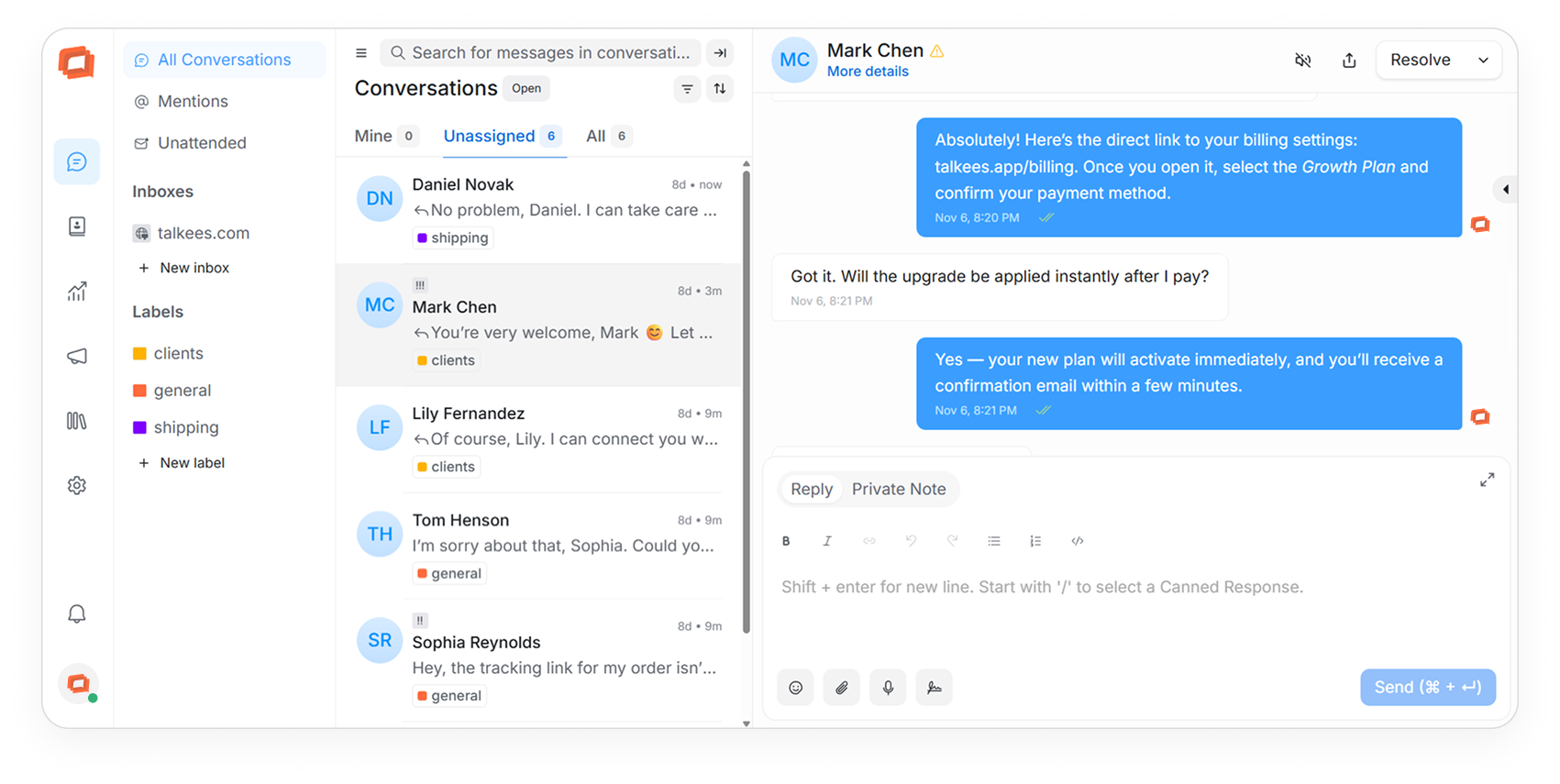
Talkees offers an AI-first live chat and omnichannel support platform with transparent, flexible pricing that addresses many of the pain points Qualified users experience.
Key Features
- Advanced AI chatbot that qualifies leads in natural language and books meetings autonomously
- Omnichannel inbox unifying web chat, email, WhatsApp, and social media conversations
- Seamless CRM integration with both Salesforce and HubSpot (plus other major CRMs)
- Flexible pricing model that scales with your usage rather than forcing high minimums
- Rapid deployment typically measured in days rather than months
Pricing
- Free Plan: Limited conversations and basic features to get started
- Growth: $499/month for growing teams (includes AI capabilities)
- Professional: $999/month for businesses needing advanced features
- Enterprise: Custom pricing for larger organizations requiring dedicated support, SLAs, and compliance features
Real User Experiences
Talkees users consistently praise the platform’s intuitive interface and rapid setup process. Many report seeing qualified meetings booked within the first week of implementation, compared to the months often required with Qualified.
G2 reviews highlight Talkees’ responsive support team and regular feature updates. Users particularly appreciate the balance between AI automation and human handoff capabilities.
Advantages
- Significantly lower cost of entry compared to Qualified
- Works across multiple CRMs without dependency on Salesforce
- Faster implementation (days vs. months)
- True omnichannel support with consistent context across channels
- Transparent pricing without hidden fees
Disadvantages
- Newer platform with a smaller community than established competitors
- May lack some enterprise-specific features for very large organizations
- Advanced customization requires developer resources
Our Assessment
After testing Talkees extensively, we found its AI capabilities particularly impressive. The chatbot successfully handled complex qualification scenarios and maintained context across multiple conversation turns. The omnichannel experience feels cohesive rather than bolted together, and the platform’s pricing transparency is refreshing in a market often characterized by opaque costs.
For most mid-market companies and growing businesses, Talkees provides an excellent balance of functionality, ease of use, and cost-effectiveness. The platform shines for teams that want advanced AI capabilities without Salesforce lock-in or enterprise pricing.
Intercom vs Qualified: Powerful Automation for Product-Led Teams

Intercom offers robust automation and AI capabilities (through its Fin AI assistant) designed primarily for product-led teams—though at a premium price point.
Key Features
- Fin AI assistant that resolves customer inquiries autonomously
- Strong support automation for ticket deflection and customer service
- In-app messaging and product tours for user onboarding
- Unified inbox for managing customer communications
- Extensive integrations with product and marketing tools
Pricing
- Starter: $74/month billed annually ($888/year)
- Pro and Enterprise: Custom pricing based on needs
- Fin AI: Approximately $0.99 per successful resolution (usage-based)
Real User Experiences
Intercom users appreciate the platform’s support-focused approach and in-app messaging capabilities. Many report significant reductions in support ticket volume after implementing Fin AI, with some achieving up to 66% automated resolution rates.
However, users note that costs can escalate quickly with high conversation volumes, and the sales-focused features aren’t as strong as support capabilities.
Advantages
- Excellent for customer support automation
- Strong in-app messaging capabilities
- Per-resolution AI pricing can be efficient for certain use cases
- Robust knowledge base integration
Disadvantages
- Less focused on sales qualification than Qualified
- Costs can scale unpredictably with usage
- Requires significant setup for sales use cases
Our Assessment
We found Intercom to be exceptionally strong for support-heavy organizations and product-led teams. The Fin AI assistant is impressive at resolving common support questions, and the platform excels at customer engagement throughout the product lifecycle.
However, for pure sales qualification and pipeline generation, Intercom requires more configuration than sales-first alternatives. The pricing model works well for support use cases but can become expensive for high-volume sales conversations.
Drift vs Qualified: Enterprise ABM Chat with Deep Salesforce Alignment

Drift offers enterprise-grade account-based marketing chat and routing with strong Salesforce integration—but comes with a high total cost of ownership.
Key Features
- Conversational marketing platform with advanced playbooks
- Account-based targeting and personalization
- Deep Salesforce integration similar to Qualified
- Video capabilities for personalized outreach
- Enterprise-grade security and compliance
Pricing
- Standard plan: Approximately $2,500/month (~$30,000/year)
- Advanced tiers: Custom pricing, often reaching $90,000+/year for enterprise features
Real User Experiences
Drift users value the platform’s enterprise capabilities and ABM features. Many large organizations appreciate the deep Salesforce integration and advanced targeting options.
However, users consistently mention the high cost and complex implementation process. Many report needing dedicated RevOps resources to maintain playbooks and optimize the platform.
Advantages
- Comprehensive enterprise ABM capabilities
- Strong Salesforce integration
- Established brand with large community
- Extensive integration marketplace
Disadvantages
- High cost comparable to Qualified
- Complex implementation (typically 60-90 days)
- Requires ongoing specialist resources
- Less CRM-agnostic than newer alternatives
Our Assessment
In our testing, Drift proved to be a capable enterprise platform with particularly strong ABM capabilities. The playbook system offers significant flexibility, but at the cost of complexity.
For Salesforce-centric enterprise teams already invested in ABM, Drift provides a viable alternative to Qualified with similar capabilities. However, organizations seeking to reduce costs or implementation time may want to consider other options.
HubSpot Conversations vs Qualified: Native CRM + Chatbots for Growing Teams

HubSpot Conversations provides native chat and conversational capabilities directly integrated with the HubSpot CRM—ideal for teams already using HubSpot.
Key Features
- Native HubSpot CRM integration with automatic record association
- Unified inbox for email, chat, and social communications
- Chatflow builder for automated conversations
- Help Desk workspace for ticketing and support (in Service Hub)
- Conversation Intelligence for call recording and insights (in Sales Hub)
Pricing
- Free: Basic chat capabilities included in HubSpot’s free CRM
- Starter: Additional features with Marketing, Sales, or Service Hub ($45/month)
- Professional: Advanced automation and routing ($450/month per Hub)
- Enterprise: Full capabilities, including Service Hub at approximately $3,600/month
Real User Experiences
HubSpot users appreciate the seamless integration with their existing CRM and the unified view of customer communications. Many highlight the value of having conversations automatically tied to contacts, deals, and tickets without additional integration work.
Users note that while the free tier offers basic functionality, advanced features require paid Hub subscriptions, which can add up for growing teams.
Advantages
- Seamless HubSpot CRM integration
- No additional vendor to manage
- Unified view of customer interactions
- Straightforward implementation for HubSpot users
Disadvantages
- Advanced features require paid Hub subscriptions
- Less powerful for Salesforce-centric organizations
- AI capabilities not as advanced as specialized alternatives
- Limited customization compared to dedicated chat platforms
Our Assessment
For teams already using HubSpot, Conversations provides a compelling native solution that eliminates the need for another vendor. The automatic record association and unified inbox create a seamless experience for both agents and customers.
While not as feature-rich as dedicated conversational platforms in some areas, the integration advantages and potential cost savings make it an excellent choice for HubSpot-centric organizations.
Zendesk Messaging (Suite) vs Qualified: Ticketing-Centric Support with Live Chat

Zendesk Messaging, part of Zendesk Suite, offers ticketing-centric support with integrated live chat and bot capabilities.
Key Features
- Unified ticketing system with conversation history
- AI-powered answer bot for ticket deflection
- Omnichannel messaging (web, mobile, social)
- Advanced routing and SLAs for support teams
- Robust reporting on support metrics
Pricing
- Suite Team: $55/agent/month (billed annually)
- Suite Growth: $89/agent/month
- Suite Professional: $115/agent/month
- Suite Enterprise: $169/agent/month
Real User Experiences
Zendesk users value the platform’s strength in support ticketing and case management. Many highlight the seamless transition between automated and human support, as well as the comprehensive reporting capabilities.
Users note that while Zendesk excels at support, its sales-focused capabilities aren’t as strong as dedicated conversational marketing platforms.
Advantages
- Excellent for support-first organizations
- Strong ticketing and case management
- Comprehensive SLA capabilities
- Established platform with extensive documentation
Disadvantages
- Less focused on sales qualification and pipeline generation
- Not as deeply integrated with Salesforce as Qualified
- Per-agent pricing can become expensive at scale
Our Assessment
Zendesk Messaging is ideally suited for organizations that prioritize customer support over sales conversations. The ticketing-first approach provides excellent structure for managing customer issues and ensuring nothing falls through the cracks.
For companies looking to replace Qualified primarily for support use cases, Zendesk offers a compelling alternative with strong omnichannel capabilities and established support workflows.
Freshchat (Freshdesk Messaging) vs Qualified: Affordable Omnichannel with Modern Automation

Freshchat, part of the Freshworks suite, provides affordable omnichannel messaging with modern automation capabilities.
Key Features
- AI-powered chatbot (Freddy AI) for automation
- Omnichannel inbox supporting web, WhatsApp, Apple Business Chat, and more
- Team inbox with assignment and collaboration tools
- Campaign messaging for proactive engagement
- Integration with Freshdesk and other Freshworks products
Pricing
- Free: Basic features for small teams
- Growth: $19/agent/month
- Pro: $49/agent/month
- Enterprise: $99/agent/month
Real User Experiences
Freshchat users appreciate the platform’s modern interface and affordable pricing structure. Many highlight the omnichannel capabilities and the smooth integration with other Freshworks products.
Users note that while the platform offers good value, some advanced enterprise features found in Qualified may require additional configuration or aren’t available.
Advantages
- Affordable pricing structure
- Strong omnichannel support
- Modern, user-friendly interface
- Good AI capabilities with Freddy
Disadvantages
- Less established in enterprise environments
- Not as deeply integrated with Salesforce as Qualified
- Fewer advanced ABM capabilities
Our Assessment
In our testing, Freshchat impressed with its balance of functionality and affordability. The platform offers a modern approach to customer conversations with strong AI capabilities through Freddy.
For mid-market organizations looking for a cost-effective alternative to Qualified with good omnichannel support, Freshchat provides excellent value. The platform is particularly well-suited for teams already using other Freshworks products.
Zoho SalesIQ vs Qualified: Visitor Tracking and Tight Zoho CRM Integration

Zoho SalesIQ combines visitor tracking, lead scoring, and chat functionality with tight integration to the Zoho ecosystem.
Key Features
- Real-time visitor tracking with engagement scoring
- Proactive chat triggers based on visitor behavior
- Native Zoho CRM integration for seamless data flow
- AI-powered chatbots for automation
- Advanced analytics on visitor behavior and conversions
Pricing
- Basic: $10/agent/month
- Professional: $20/agent/month
- Enterprise: $40/agent/month
Real User Experiences
Zoho SalesIQ users value the platform’s deep integration with Zoho CRM and the comprehensive visitor tracking capabilities. Many highlight the affordability compared to enterprise alternatives like Qualified.
Users note that while the platform works exceptionally well within the Zoho ecosystem, integration with other CRMs can require additional work.
Advantages
- Excellent value for the feature set
- Comprehensive visitor tracking and scoring
- Seamless Zoho CRM integration
- Good balance of sales and support capabilities
Disadvantages
- Best suited for Zoho ecosystem users
- Less established in enterprise environments
- Fewer advanced ABM capabilities than Qualified
Our Assessment
Zoho SalesIQ offers impressive capabilities at a fraction of the cost of enterprise platforms like Qualified. The visitor tracking and lead scoring features provide valuable insights for sales teams, while the chat functionality supports both sales and support use cases.
For organizations using Zoho CRM or considering the Zoho ecosystem, SalesIQ represents an excellent value proposition with capabilities that rival more expensive alternatives.
Crisp vs Qualified: Shared Inbox and Developer-Friendly APIs for Startups

Crisp offers a shared inbox approach to customer communication with developer-friendly APIs and a focus on startups and SMBs.
Key Features
- Shared inbox for team collaboration
- Multichannel support (chat, email, social)
- MagicBrowse for co-browsing with customers
- LiveTranslate for multilingual support
- Developer-friendly APIs and webhooks
Pricing
- Free: Basic features for small teams
- Pro: €25/workspace/month
- Unlimited: €95/workspace/month
- Enterprise: €295/workspace/month
Real User Experiences
Crisp users appreciate the platform’s simplicity and the workspace-based pricing model that doesn’t penalize adding team members. Many highlight the developer-friendly approach and the quality of features like co-browsing and live translation.
Users note that while Crisp excels for startups and SMBs, it may lack some of the enterprise-grade features found in platforms like Qualified.
Advantages
- Workspace-based pricing (unlimited agents)
- Developer-friendly with strong API
- Unique features like co-browsing and translation
- Simple, intuitive interface
Disadvantages
- Less focused on enterprise ABM use cases
- Fewer advanced sales qualification features
- Less established in large enterprise environments
Our Assessment
Crisp stands out with its workspace-based pricing model and developer-friendly approach. The platform offers excellent value for startups and SMBs that need a flexible communication solution without per-seat pricing penalties.
While not directly comparable to Qualified for enterprise ABM use cases, Crisp provides a compelling alternative for smaller organizations and development-focused teams that want to build custom experiences.
Tidio vs Qualified: Quick Shopify/WooCommerce Chat + AI for E-commerce

Tidio offers a streamlined chat solution with AI capabilities, particularly well-suited for e-commerce platforms like Shopify and WooCommerce.
Key Features
- AI chatbot (Lyro) for automated responses
- Quick e-commerce integration with Shopify and WooCommerce
- Live typing insights to see what customers are writing
- Visitor tracking for proactive engagement
- Multichannel inbox for team collaboration
Pricing
- Free: Basic features with limitations
- Starter: $29/month
- Communicator: $59/month
- Lyro AI: Additional $39/month
Real User Experiences
Tidio users value the platform’s simplicity and the quick integration with e-commerce platforms. Many highlight the effectiveness of the Lyro AI chatbot for answering common customer questions and reducing support workload.
Users note that while Tidio works exceptionally well for e-commerce, it may not have all the B2B sales features found in platforms like Qualified.
Advantages
- Excellent e-commerce integration
- User-friendly interface with minimal learning curve
- Effective AI capabilities with Lyro
- Affordable pricing structure
Disadvantages
- More focused on e-commerce than B2B sales
- Fewer enterprise-grade features
- Less deep CRM integration than Qualified
Our Assessment
Tidio impressed us with its streamlined approach and effectiveness for e-commerce businesses. The platform makes it exceptionally easy to get started with live chat and AI automation, particularly for Shopify and WooCommerce stores.
For e-commerce businesses looking for a simple, effective alternative to more complex platforms like Qualified, Tidio offers excellent value and a focus on the features that matter most for online retail.
Gorgias vs Qualified: Shopify-Native Support Automation for High-Volume Stores

Gorgias provides Shopify-native customer support automation designed specifically for high-volume e-commerce operations.
Key Features
- Native Shopify integration with order data
- Automated responses based on order status
- Multichannel support (chat, email, social)
- Macros and templates for quick responses
- Revenue statistics tied to support interactions
Pricing
- Basic: $10/month (limited)
- Pro: Starting at $60/month for 600 tickets
- Advanced: Starting at $360/month for 3,000 tickets
- Enterprise: Custom pricing for high-volume needs
Real User Experiences
Gorgias users consistently praise the platform’s deep Shopify integration and the ability to access order information directly within support conversations. Many highlight the time savings from automated responses based on order status and the comprehensive view of customer history.
Users note that the ticket-based pricing model works well for e-commerce but requires careful monitoring as volume grows.
Advantages
- Exceptional Shopify integration
- Order data directly in conversations
- Strong social media channel support
- Revenue attribution for support interactions
Disadvantages
- Primarily focused on e-commerce support
- Less suitable for B2B sales use cases
- Ticket-based pricing can escalate with volume
Our Assessment
Gorgias stands out as a purpose-built solution for e-commerce support, particularly for Shopify stores. The platform’s ability to incorporate order data directly into conversations creates a seamless experience for both agents and customers.
While not directly comparable to Qualified for B2B sales use cases, Gorgias offers an excellent alternative for e-commerce businesses that prioritize customer support and want to tie support interactions to revenue outcomes.
Decision Guide: Map Your Use Case to the Right Qualified Competitor

To choose the right Qualified alternative, consider your primary use case:
For B2B Pipeline Generation
- Talkees: Best for teams wanting AI-first qualification with omnichannel support
- Drift: Ideal for enterprise ABM with Salesforce integration
- HubSpot Conversations: Perfect for HubSpot-centric organizations
For Support-Heavy Teams
- Intercom: Excellent for product-led companies with support automation needs
- Zendesk Messaging: Best for ticketing-centric support organizations
- Freshchat: Good balance of features and affordability for support teams
For E-commerce
- Tidio: Ideal for Shopify/WooCommerce stores needing simple implementation
- Gorgias: Best for high-volume Shopify stores with complex support needs
- Crisp: Good for stores wanting unlimited agents and developer flexibility
For AI-First Projects
- Talkees: Leading choice for autonomous qualification and meeting booking
- Intercom (Fin): Strong for support automation and knowledge base integration
- Freshchat (Freddy): Good balance of AI capabilities and affordability
Final Thoughts: Choosing the Right Qualified Alternative in 2026

When evaluating alternatives to Qualified, focus on matching the solution to your specific needs rather than simply comparing feature lists. Consider these factors:
- CRM alignment: Choose a platform that integrates well with your primary CRM (Salesforce, HubSpot, or others).
- Primary outcome: Determine whether you’re focused on generating pipeline, providing support, or enabling e-commerce success.
- Budget reality: Factor in not just license costs but also implementation time, ongoing maintenance, and potential headcount requirements.
- AI maturity: Evaluate how autonomous and effective each platform’s AI capabilities are for your specific use cases.
- Implementation timeline: Consider how quickly you need to see results and choose a platform that aligns with your timeline.
For most organizations moving away from Qualified, the ideal alternative will provide similar or better capabilities with greater flexibility, faster implementation, and a more favorable cost structure. Talkees stands out for its AI-first approach, omnichannel capabilities, and transparent pricing, making it an excellent choice for teams looking to modernize their conversational marketing strategy in 2026.
Take the time to request demos, run pilot programs, and speak with reference customers before making your final decision. The right conversational platform can transform your customer engagement strategy and deliver measurable improvements in pipeline generation, support efficiency, and overall customer experience.