 English
 Slovenčina
 Français
 Magyar
Why Consider Alternatives to MessageBird in 2025?

Many businesses are moving away from MessageBird (now rebranded as Bird) in 2025 due to several key challenges:
- Pricing thresholds and unpredictability: MessageBird’s pay-as-you-go model can lead to unexpected costs as your volume grows. Many businesses report surprise fees when crossing usage thresholds.
- Limited Inbox and Flow Builder features: While functional, MessageBird’s tools lack some advanced capabilities that modern businesses need for seamless customer communication.
- AI integration gaps: As AI becomes essential for customer engagement, MessageBird’s AI implementation requires more developer work compared to alternatives offering pre-built AI solutions.
- Bundle lock-in concerns: The platform’s structure can make it difficult to pick and choose only the services you need without paying for bundled features.
What Makes a Strong MessageBird Alternative?

When evaluating MessageBird alternatives, look for platforms that deliver:
- Complete omnichannel coverage: Support for WhatsApp, SMS, email, social media, and voice in a unified interface
- Inbox parity or better: Shared inbox with collision detection, mobile apps, and native channel features
- Powerful automation: Visual workflow builders that require minimal technical knowledge
- AI capabilities: Pre-built AI agents, real-time suggestions, and easy integration with models like OpenAI
- Transparent pricing: Clear costs without hidden fees or unexpected thresholds
- Enterprise-grade reliability: Strong uptime guarantees and responsive support
- Seamless integration: Easy connection with your existing tools like Zendesk, HubSpot, Zapier, and more
Talkees vs MessageBird: Modern Omnichannel Solution with Stable Live Chat + AI Chatbot

Talkees stands out as a leading MessageBird alternative, particularly for e-commerce operators, SMBs, and support teams seeking a modern, flexible solution.
Features and Capabilities
Talkees delivers a comprehensive communication platform with several advantages over MessageBird:
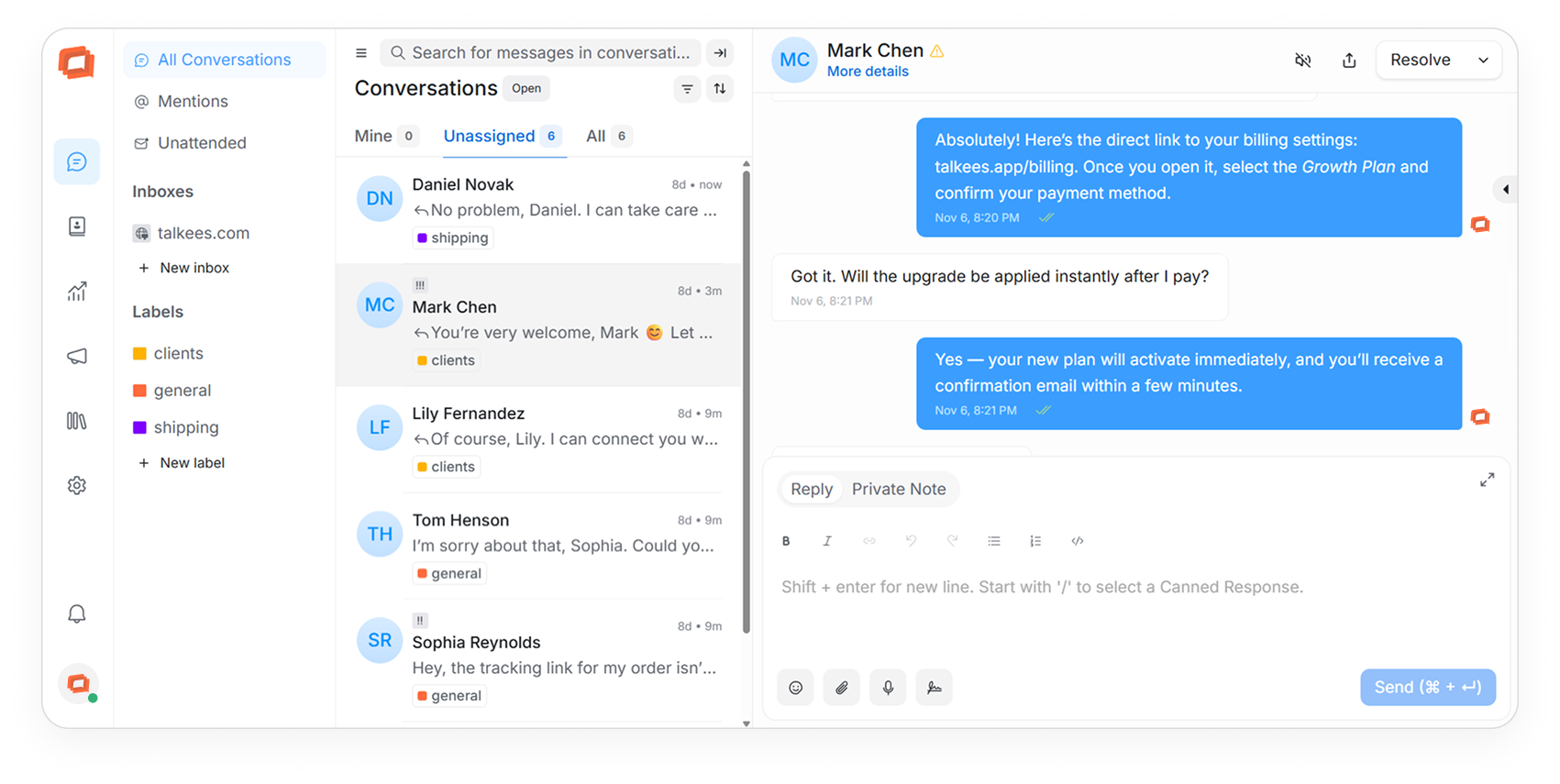
- True omnichannel inbox: Unified conversations across WhatsApp, SMS, email, Instagram, and Facebook Messenger with full native features like voice notes and read receipts
- Mobile-first approach: Robust mobile apps for iOS and Android, allowing your team to respond from anywhere
- AI-powered automation: No-code visual workflow builder with pre-built templates and AI agents that require minimal setup
- Flexible pricing model: Transparent subscription-based pricing with no surprise fees or hidden thresholds
- Bring-your-own AI: Easy integration with OpenAI, Google, and other AI providers for customized experiences
Pricing Structure
Talkees offers a more predictable pricing model compared to MessageBird:
- Starter: $49/month for 5 users, unlimited contacts
- Business: $129/month for 10 users, unlimited contacts, advanced automation
- Enterprise: Custom pricing for larger teams with dedicated support
All plans include unlimited WhatsApp sessions, SMS credits, and no per-message fees that can unexpectedly increase your costs.
User Experience and Support
Talkees provides exceptional support and user experience:
- 24/7 live support included in all plans
- 99.99% guaranteed uptime with transparent status page
- Dedicated customer success manager for all Business and Enterprise customers
- Comprehensive documentation and video tutorials
Our Assessment
Based on our testing, Talkees offers the best balance of features, ease of use, and value for most businesses looking to move from MessageBird. The platform excels particularly for e-commerce and support teams that need reliable WhatsApp and SMS communication without technical complexity.
- Pros:
- Predictable pricing without hidden fees
- Excellent mobile experience
- Pre-built AI agents require minimal setup
- Strong multi-channel broadcasting capabilities
- Managed compliance and 10DLC registration
- Cons:
- Newer platform with smaller developer community
- Some advanced enterprise features still in development
Twilio vs MessageBird: CPaaS Depth, Studio vs Flow Builder, and Cost at Scale

Twilio is the industry giant in the CPaaS (Communication Platform as a Service) space and offers a compelling alternative to MessageBird for developers and enterprises needing deep API customization.
Features and Capabilities
Twilio’s platform provides extensive communication capabilities:
- Comprehensive APIs: Extensive documentation and SDKs for SMS, voice, video, WhatsApp, and more
- Twilio Studio: Visual workflow builder that competes directly with MessageBird’s Flow Builder
- Global reach: Direct carrier relationships in more countries than MessageBird
- Strong compliance tools: Advanced opt-out handling, 10DLC registration workflows, and detailed compliance documentation
Pricing Structure
Twilio uses a pay-as-you-go model similar to MessageBird:
- US SMS: $0.0075-$0.0083 per message (compared to MessageBird’s ~$0.0071-$0.0073)
- Voice: Starting at $0.0130 per minute for outbound calls
- WhatsApp: Conversation-based pricing following Meta’s rates
- Number rental: ~$1/month for local numbers
- Support plans: Tiered pricing starting at $250/month
User Experience and Support
Twilio offers enterprise-grade support and developer experience:
- Extensive documentation and sample code
- Active developer community and forums
- 99.99% API uptime SLA
- Support tiers from basic to premium
Our Assessment
Twilio is ideal for organizations with developer resources who need maximum customization and global reach. It’s particularly strong for large-scale SMS operations and custom communication workflows.
- Pros:
- Exceptional documentation and developer tools
- Extensive compliance resources and guidance
- Reliable global delivery with direct carrier relationships
- Mature, battle-tested platform with predictable performance
- Cons:
- More expensive than some alternatives at scale
- Requires development resources to fully utilize
- Support plans can be costly
Sendbird vs MessageBird: In-app Chat/Voice/Video SDKs and Developer Experience

Sendbird focuses primarily on in-app chat, voice, and video capabilities, making it a strong MessageBird alternative for mobile and web applications needing embedded communication.
Features and Capabilities
Sendbird offers specialized in-app communication tools:
- Robust SDKs: Support for iOS, Android, JavaScript, React, and more
- UI Kits: Pre-built UI components that accelerate development
- Moderation tools: Advanced content filtering and user management
- Push notifications: Reliable delivery of alerts across platforms
- Voice and video calling: Integrated real-time communication
Pricing Structure
Sendbird uses a Monthly Active User (MAU) pricing model:
- Free plan: Up to 100 MAUs and 10 concurrent connections
- Starter: From $399/month for 5,000 MAUs
- Pro: From $599/month for 5,000 MAUs with additional features
- Enterprise: Custom pricing for large-scale deployments
User Experience and Support
Sendbird delivers strong developer ergonomics:
- Comprehensive documentation with code examples
- Developer dashboard for monitoring and analytics
- 99.9% uptime SLA on paid plans
- Multiple global regions for low-latency connections
Our Assessment
Sendbird excels for businesses building custom mobile and web applications with embedded chat and calling features. It’s particularly strong for social, marketplace, and community apps.
- Pros:
- Excellent developer experience with comprehensive SDKs
- Strong UI kits reduce development time
- Reliable push notification delivery
- Advanced moderation capabilities
- Cons:
- Limited omnichannel capabilities compared to MessageBird
- Primarily focused on in-app rather than customer support use cases
- Can become expensive at scale
Zendesk vs MessageBird: Helpdesk-First Omnichannel and CRM-Native Workflows

Zendesk provides a comprehensive customer service platform with strong messaging capabilities, making it a solid MessageBird alternative for support-focused teams.
Features and Capabilities
Zendesk’s messaging integration offers:
- Unified agent workspace: All customer conversations in one interface
- Sunshine platform: Customizable CRM with conversation data
- Strong automation: Triggers, macros, and workflow tools
- Native knowledge base: Integrated self-service capabilities
- Omnichannel routing: Intelligent distribution of conversations
Pricing Structure
Zendesk offers tiered pricing based on features and agent seats:
- Suite Team: $55/agent/month (annual billing)
- Suite Growth: $89/agent/month
- Suite Professional: $115/agent/month
- Enterprise: Custom pricing
All plans include messaging channels, though some advanced features require higher tiers.
User Experience and Support
Zendesk provides a polished experience for support teams:
- Intuitive agent interface with minimal training required
- Extensive marketplace of integrations
- 99.9% uptime commitment
- 24/7 support on higher-tier plans
Our Assessment
Zendesk is ideal for organizations prioritizing customer support and service over marketing or transactional messaging. It’s particularly strong for teams already using Zendesk for ticket management.
- Pros:
- Seamless integration with helpdesk functionality
- Strong reporting and analytics
- Mature, reliable platform with extensive integrations
- Excellent agent experience
- Cons:
- Less flexible for marketing or transactional messaging
- More expensive per agent than dedicated messaging platforms
- Limited developer customization compared to CPaaS options
Intercom vs MessageBird: Proactive Bots, Product Tours, and Resolution Workflows

Intercom combines messaging, chatbots, and product tours into a unified platform, making it a powerful MessageBird alternative for customer engagement.
Features and Capabilities
Intercom offers a comprehensive messaging platform:
- Conversational AI: Powerful chatbots with Fin AI agent
- Product tours: In-app onboarding and feature announcements
- Targeted messaging: Segment-based communication
- Resolution workflows: Structured conversation paths
- Help center: Integrated knowledge base
Pricing Structure
Intercom uses a seat-based pricing model:
- Essential: $39/seat/month
- Advanced: $99/seat/month
- Expert: $139/seat/month
Additional charges apply for chatbot resolution volume and active contacts.
User Experience and Support
Intercom delivers a polished experience for both businesses and end-users:
- Modern, customizable chat interface
- Easy-to-use bot builder
- Extensive reporting and analytics
- 24/5 support on higher-tier plans
Our Assessment
Intercom excels for SaaS companies and digital businesses focused on product adoption and in-app support. It’s particularly strong for proactive engagement and self-service resolution.
- Pros:
- Excellent chatbot capabilities with Fin AI
- Strong product tour and onboarding features
- Good balance of ease-of-use and customization
- Polished end-user experience
- Cons:
- Can become expensive with high contact volumes
- Less focused on SMS and traditional messaging
- Limited voice capabilities
Trengo vs MessageBird: Multichannel Inbox, WhatsApp Strengths, and Pricing Transparency

Trengo offers a unified inbox for customer communication with strong WhatsApp capabilities, making it a solid MessageBird alternative for small and medium businesses.
Features and Capabilities
Trengo provides a comprehensive communication platform:
- Unified inbox: Centralized management of all channels
- Strong WhatsApp integration: Full WhatsApp Business API support
- Team collaboration: Internal notes, assignments, and shared drafts
- Automation flows: Rule-based routing and responses
- Transparent pricing: Clear costs without hidden fees
Pricing Structure
Trengo offers per-user pricing with transparent tiers:
- Grow: €20/user/month
- Scale: €33/user/month
- Enterprise: €45/user/month
All plans include unlimited contacts, with channel fees charged separately.
User Experience and Support
Trengo delivers a straightforward, effective experience:
- Clean, intuitive interface
- Quick setup and onboarding
- Responsive support team
- Regular feature updates
Our Assessment
Trengo is ideal for small to medium businesses looking for WhatsApp-centric communication with transparent pricing. It’s particularly strong for European companies due to its regional focus.
- Pros:
- Excellent WhatsApp Business API implementation
- Transparent, predictable pricing
- Strong team collaboration features
- Good balance of simplicity and functionality
- Cons:
- Less developer-focused than CPaaS options
- Limited AI capabilities compared to some alternatives
- Fewer integrations than larger platforms
If you’re weighing support platform options, we’ve prepared a detailed trengo vs messagebird comparison covering features, pricing, and best-fit use cases.
Vonage (Nexmo) vs MessageBird: SMS/Voice APIs, WebRTC, and Carrier Coverage

Vonage (formerly Nexmo) offers robust communication APIs and global coverage, making it a strong MessageBird alternative for developers and enterprises.
Features and Capabilities
Vonage provides extensive communication capabilities:
- SMS and voice APIs: Reliable global messaging and calling
- Verify API: Two-factor authentication and verification
- WebRTC solutions: In-app voice and video
- Broad carrier coverage: Strong global reach
- Number insight: Phone number validation and information
Pricing Structure
Vonage uses a pay-as-you-go model:
- US SMS: ~$0.007 per message
- Voice: Starting at $0.0085 per minute (outbound)
- Numbers: ~$0.90/month for local numbers
- Custom pricing available for high volumes
User Experience and Support
Vonage delivers a solid developer experience:
- Comprehensive documentation
- Multiple SDKs for different languages
- Developer dashboard for monitoring
- 24/7 support for enterprise customers
Our Assessment
Vonage is well-suited for organizations needing reliable SMS, voice APIs, and verification services with global reach. It’s particularly strong for authentication use cases and international messaging.
- Pros:
- Reliable global SMS and voice delivery
- Strong verification and number insight capabilities
- Good developer documentation
- Established company with enterprise-grade infrastructure
- Cons:
- Less omnichannel-focused than MessageBird
- Limited visual workflow tools compared to alternatives
- User interface less modern than newer competitors
Sinch vs MessageBird: Enterprise Messaging, 10DLC, and Deliverability Tools

Sinch provides enterprise-grade messaging solutions with strong deliverability features, making it a compelling MessageBird alternative for large organizations.
Features and Capabilities
Sinch offers comprehensive communication tools:
- Enterprise messaging: High-volume SMS and MMS
- 10DLC and short codes: Strong US messaging compliance
- WhatsApp Business API: Certified WhatsApp solution provider
- Conversation API: Unified API for multiple channels
- Deliverability tools: Optimization for message delivery
Pricing Structure
Sinch uses a volume-based pricing model:
- SMS pricing varies by country and volume
- WhatsApp follows Meta’s conversation-based pricing
- Voice starts around $0.0085 per minute
- Custom pricing for enterprise volumes
User Experience and Support
Sinch provides enterprise-grade service:
- Reliable platform with strong uptime
- Dedicated account management for larger customers
- 24/7 support options
- Comprehensive documentation
Our Assessment
Sinch is ideal for large enterprises requiring reliable, high-volume messaging with strong deliverability. It’s particularly well-suited for global companies with complex messaging needs.
- Pros:
- Excellent deliverability rates
- Strong 10DLC and compliance support
- Robust enterprise features
- Global reach with direct carrier connections
- Cons:
- Less user-friendly for small businesses
- Limited visual workflow tools
- Can be expensive for lower volumes
Infobip vs MessageBird: Conversations Suite, Data Residency, and Omnichannel Orchestration

Infobip offers a comprehensive communication platform with strong enterprise features, making it a robust MessageBird alternative for larger organizations.
Features and Capabilities
Infobip provides extensive communication capabilities:
- Conversations suite: Unified agent workspace
- Answers chatbot platform: AI-powered automation
- Moments campaign manager: Omnichannel marketing
- On-premises options: Data residency flexibility
- Omnichannel orchestration: Coordinated customer journeys
Pricing Structure
Infobip uses a customized pricing approach:
- Volume-based pricing for messaging
- Per-seat pricing for agent solutions
- Custom enterprise packages
- Requires consultation for specific pricing
User Experience and Support
Infobip delivers enterprise-grade service:
- Comprehensive platform with extensive capabilities
- Strong global presence with local support
- Multiple deployment options (cloud, hybrid, on-premises)
- 24/7 enterprise support
Our Assessment
Infobip is well-suited for large enterprises with complex communication needs and global presence. It’s particularly strong for organizations with specific data residency or compliance requirements.
- Pros:
- Comprehensive feature set covering all communication needs
- Strong enterprise capabilities and security
- Flexible deployment options
- Global reach with local presence
- Cons:
- Complex platform with steeper learning curve
- Less transparent pricing
- May be overkill for smaller businesses
Plivo vs MessageBird: Voice/SMS APIs, Regional Pricing, and Support Model

Plivo offers reliable communication APIs with competitive pricing, making it a cost-effective MessageBird alternative for developers.
Features and Capabilities
Plivo provides focused communication capabilities:
- Voice and SMS APIs: Reliable global communication
- Elastic SIP trunking: Flexible VoIP solutions
- Regional pricing advantages: Competitive rates in many markets
- Compliance tooling: Simplified regulatory compliance
- No-code AI agents: Pre-built conversational solutions
Pricing Structure
Plivo offers transparent, competitive pricing:
- US SMS: ~$0.0055 per message (outbound)
- Voice: Starting at $0.0065 per minute (outbound)
- Numbers: ~$0.80/month for local numbers
- Volume discounts available
User Experience and Support
Plivo delivers a straightforward developer experience:
- Clean, well-documented APIs
- Multiple SDKs for different languages
- Developer-friendly dashboard
- 24/7 support options
Our Assessment
Plivo is ideal for cost-conscious developers and businesses needing reliable SMS and voice APIs. It’s particularly strong for price-sensitive use cases with moderate technical resources.
- Pros:
- Very competitive pricing in many markets
- Reliable message delivery
- Good developer documentation
- Straightforward, focused platform
- Cons:
- Less omnichannel capability than MessageBird
- Limited visual workflow tools
- Smaller ecosystem of integrations
Conclusion: Finding Your Ideal MessageBird Alternative

After analyzing the top MessageBird alternatives, Talkees emerges as the most balanced solution for most businesses, particularly e-commerce operators, SMBs, and support teams. Its combination of user-friendly design, predictable pricing, and powerful AI capabilities addresses the key pain points that cause organizations to leave MessageBird.
For developers needing maximum customization, Twilio remains the industry standard, while specialized tools like Sendbird excel for in-app experiences. Enterprise organizations with complex needs should consider Sinch or Infobip for their robust capabilities and global reach.
When making your decision, prioritize:
- Pricing transparency: Look beyond per-message costs to understand the total cost of ownership
- Channel coverage: Ensure the platform supports all the channels your customers use
- Ease of use: Consider the technical resources required to implement and maintain the solution
- AI capabilities: Evaluate how easily you can implement AI-powered experiences
- Support and reliability: Verify uptime guarantees and support responsiveness
By carefully assessing these factors against your specific business needs, you’ll find the perfect MessageBird alternative to power your customer communications in 2025 and beyond.