 English
 Slovenčina
 Français
 Magyar

Why Are Users Seeking LivePerson Alternatives?

Before diving into the alternatives, it’s important to understand why businesses are exploring options beyond LivePerson. Despite its robust capabilities, several key factors drive companies to consider other solutions:
Pricing Transparency Issues
Many businesses find LivePerson’s enterprise-style pricing model challenging. The lack of transparent, published pricing makes budgeting difficult, especially for SMBs and mid-market teams who need predictable costs. Most alternatives offer clearer pricing tiers that scale with your business.
Limited AI Flexibility
While LivePerson offers strong conversational AI, many users desire both no-code simplicity and API-level control. Modern alternatives provide user-friendly bot builders alongside developer options to integrate custom LLMs, webhooks, and SDKs—giving you the best of both worlds.
Enterprise-First Complexity
LivePerson’s enterprise orientation often translates to steep learning curves and developer dependence for customizations. Smaller teams frequently need solutions they can implement and modify without specialized technical resources.
SMB and E-commerce Specific Needs
E-commerce operators require quick integration with platforms like Shopify and WooCommerce, proactive engagement triggers for cart abandonment, and unified messaging across multiple channels. Many LivePerson alternatives excel specifically in these areas.
What Makes a Strong LivePerson Alternative?

When evaluating LivePerson competitors, look for these essential features:
Transparent Pricing Structure
Seek platforms with clear per-seat or usage-based pricing models. The best alternatives provide straightforward information about add-on costs for channels like WhatsApp or SMS, and transparent AI credit pricing where applicable.
Unified Omnichannel Experience
A robust alternative should offer a single inbox that consolidates web chat, email, WhatsApp, Facebook Messenger, Instagram, and optionally SMS/voice. This provides agents with complete context across all customer touchpoints.
Flexible AI Capabilities
Look for platforms that balance no-code visual builders (for non-technical teams) with developer-friendly SDKs and webhooks. This allows you to integrate LLMs, knowledge bases, and back-office data according to your specific needs.
Rapid Implementation
The best alternatives enable deployment in days or weeks rather than months, with clean import options from Shopify, HubSpot, Salesforce, and other common platforms.
Comprehensive Analytics
Prioritize solutions with real-time dashboards, custom reporting options, bot containment tracking, SLA monitoring, CSAT/NPS measurement, and data export capabilities for business intelligence.
Security and Compliance
Ensure your chosen platform offers SSO/SCIM, role-based access controls, audit logs, and data retention settings. Verify compliance with SOC 2, ISO, GDPR, PCI, or HIPAA standards as needed for your industry.
How We Evaluated These LivePerson Alternatives

We assessed each platform based on several critical factors:
- Total Cost of Ownership: License fees, add-ons, implementation costs, training requirements, and potential professional services.
- Automation Capabilities: Quality of no-code builders, LLM integration options, bot containment rates, and escalation effectiveness.
- Agent Experience: Interface usability, unified context, shortcuts/macros, collision detection, and mobile support.
- Analytics Depth: Dashboard quality, reporting flexibility, KPI coverage (FRT, AHT, CSAT/NPS, containment).
- Integration Ecosystem: API quality, SDK availability, webhook options, marketplace apps, and pre-built connectors.
- Reliability: Uptime commitments, support responsiveness, and incident management.
- Migration Complexity: Data export/import capabilities, channel setup requirements, bot retraining needs, and typical timeline.
Free vs. Paid: Understanding Live Chat App Tiers

When comparing LivePerson alternatives, it’s essential to understand the difference between free and paid options:
Free Plans
Free plans typically offer basic live chat functionality with limitations on:
- Number of conversations per month
- Agent seats
- Channel options (usually limited to web chat)
- Bot capabilities (basic or none)
- Integration options
These plans work well for very small businesses or testing purposes but quickly become limiting as your needs grow.
Paid Plans
Paid alternatives to LivePerson generally use one of three pricing models:
- Per-agent pricing: Cost scales with team size (most common)
- Conversation-based: Pricing tied to volume rather than seats
- Tiered unlimited-agent: Flat fee regardless of agent count, with feature limitations
Premium tiers typically unlock advanced features like:
- Full omnichannel support (WhatsApp, SMS, social media)
- Advanced AI and automation capabilities
- Deeper analytics and reporting
- Custom integrations and API access
- Enhanced security and compliance features
The right choice depends on your team size, conversation volume, and specific feature requirements.
Talkees vs LivePerson: Modern, Flexible, and Affordable CX

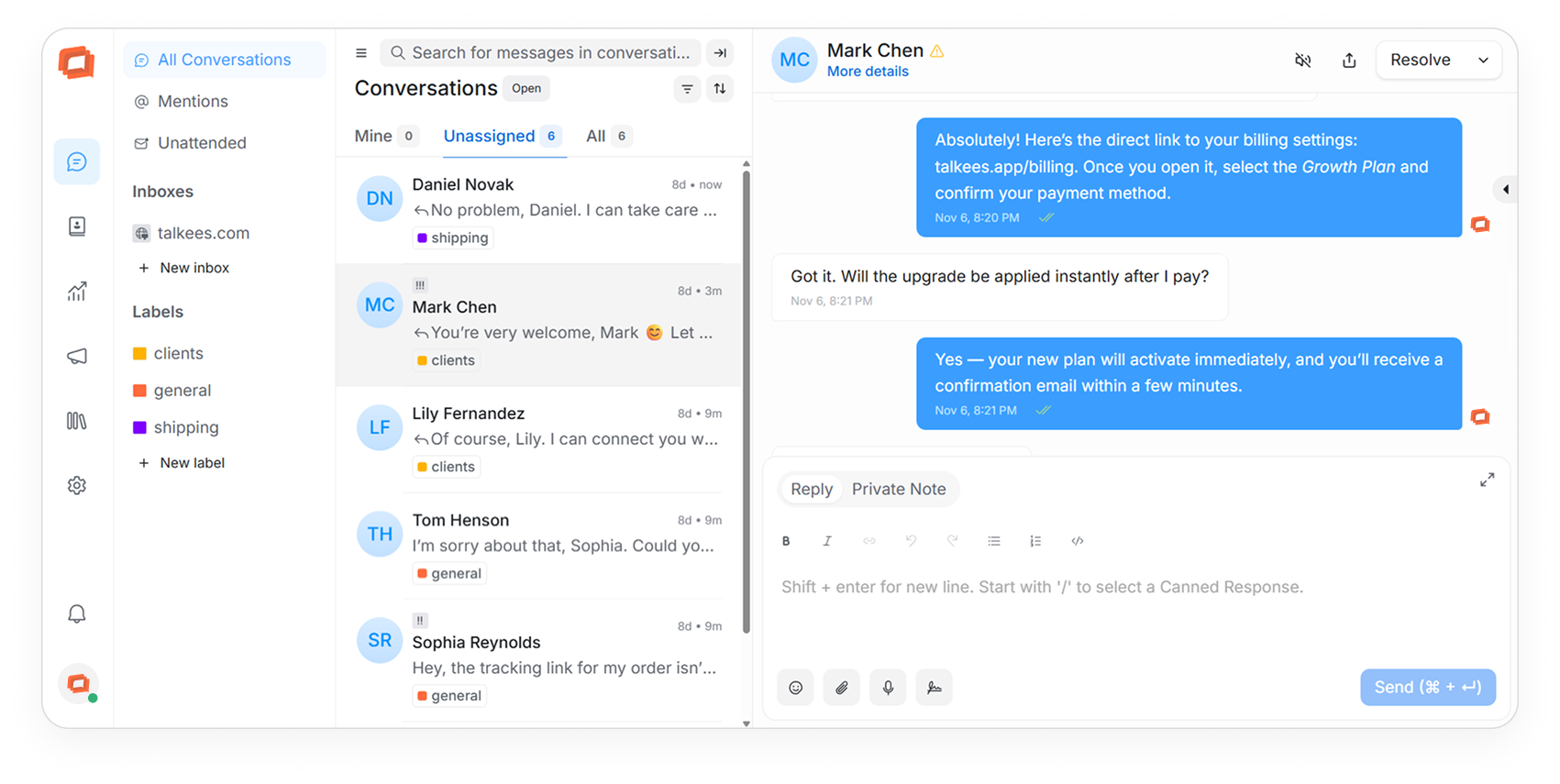
Talkees stands out as a modern alternative to LivePerson, offering a balance of powerful features and user-friendly design at a more accessible price point.
Key Features
- Unified Omnichannel Inbox: Seamlessly manage web chat, email, WhatsApp, Messenger, and Instagram DMs in one interface
- Flexible AI Architecture: No-code bot builder plus API-first approach for custom LLM integration
- Deep E-commerce Integration: Native connectors for Shopify, WooCommerce, and major CRMs
- Proactive Engagement: Behavior-triggered messages based on cart value, page visits, and exit intent
- Comprehensive Analytics: Real-time dashboards, custom reports, and conversation insights
Pricing
- Starter: $49/agent/month (billed annually) – Core messaging channels, basic automation
- Growth: $79/agent/month – Full omnichannel support, advanced automation
- Enterprise: Custom pricing – Dedicated support, custom integrations, advanced security
All plans include unlimited conversations and a 14-day free trial.
Pros
- Quick Implementation: Typically deployed in days, not months
- Transparent Pricing: Clear per-agent model without hidden costs
- User-Friendly Interface: Minimal training required for agents
- Strong E-commerce Focus: Purpose-built for online stores and digital-first businesses
- Balanced AI Approach: Both simple and advanced automation options
Cons
- Newer Platform: Less established than some competitors
- Voice Capabilities: More limited than enterprise contact center solutions
- Enterprise Features: Some advanced enterprise features still in development
Best For
Talkees is ideal for SMBs and e-commerce businesses seeking a modern, affordable omnichannel solution with strong automation capabilities. It particularly excels for teams that want to balance AI automation with human touch points.
Our Experience with Talkees
When testing Talkees, we were impressed by how quickly we could set up the platform and integrate it with our Shopify test store. The interface is intuitive, making it easy for agents to handle multiple conversations across different channels.
The AI capabilities strike a good balance—the visual bot builder is accessible enough for marketers to use, while the API options satisfy developers who want deeper customization. We particularly appreciated the proactive engagement features, which helped capture potential customers who might otherwise have abandoned their carts.
For small to mid-sized businesses looking for a LivePerson alternative that won’t break the bank or require extensive technical resources, Talkees delivers exceptional value.
Intercom vs LivePerson: Proactive Support and Product-Led Engagement

Intercom offers a product-led approach to customer engagement, combining messaging, automation, and proactive outreach in a unified platform.
Key Features
- Fin AI Agent: AI-powered chatbot with high containment rates
- Product Tours: In-app guidance and onboarding tools
- Outbound Messaging: Targeted campaigns based on user behavior
- Unified Inbox: Manage conversations across web, mobile, and email
- Help Center: Self-service knowledge base with AI suggestions
Pricing
- Essential: $74/month (includes 2 seats, additional seats $19/month)
- Advanced: $99/seat/month
- Expert: $139/seat/month
- Fin AI: $0.99 per resolution (pay for successful automations)
Pros
- Product-Led Growth: Excellent for SaaS and product-focused companies
- Proactive Engagement: Strong outbound capabilities and targeted messaging
- Modern Interface: Clean, user-friendly design for both customers and agents
- Flexible AI Pricing: Pay-per-resolution model can be cost-effective
- Strong Self-Service: Robust knowledge base and contextual help options
Cons
- Add-On Costs: Features like product tours and advanced outbound require additional fees
- Pricing Complexity: Multiple add-ons can make total cost unpredictable
- Less Omnichannel Depth: Not as strong for WhatsApp and SMS as some alternatives
- Enterprise Scalability: Some limitations for very large enterprise deployments
Best For
Intercom shines for SaaS companies, digital product teams, and businesses focused on product-led growth. It’s particularly effective for companies that want to combine support, marketing, and product engagement in one platform.
Our Experience with Intercom
During our testing, Intercom’s strength in product engagement was immediately apparent. The ability to trigger contextual messages based on user behavior creates opportunities for both support and conversion that many competitors lack.
Fin AI impressed us with its ability to handle common queries without human intervention, though we found the per-resolution pricing requires careful monitoring to avoid unexpected costs. The interface is among the most intuitive we’ve tested, making it easy for new agents to get up to speed quickly.
For product-focused companies that value proactive engagement and a modern customer experience, Intercom offers a compelling alternative to LivePerson, though watch the add-on costs carefully.
Zendesk vs LivePerson: Ticketing-First Omnichannel with Sunshine Platform

Zendesk provides a comprehensive customer service solution built around a robust ticketing system, with strong omnichannel capabilities and an extensive marketplace.
Key Features
- Zendesk Suite: Unified platform for tickets, chat, voice, and messaging
- Answer Bot: AI-powered self-service and agent assistance
- Sunshine Platform: Customizable CRM platform for building custom experiences
- Extensive Marketplace: 1,500+ integrations and apps
- Advanced Workflow Builder: Sophisticated routing and automation rules
Pricing
- Suite Team: $49/agent/month
- Suite Growth: $79/agent/month
- Suite Professional: $99/agent/month
- Suite Enterprise: $150/agent/month
Pros
- Comprehensive Solution: Handles complex support workflows across all channels
- Mature Platform: Well-established with regular updates and improvements
- Extensive Customization: Highly adaptable to specific business needs
- Strong Reporting: Detailed analytics and custom report options
- Large Community: Abundant resources, partners, and third-party extensions
Cons
- Learning Curve: More complex than some alternatives
- Implementation Time: Longer setup period for full utilization
- Can Feel Heavyweight: Sometimes too robust for simpler use cases
- AI Add-On Costs: Some advanced AI features require additional fees
Best For
Zendesk is ideal for medium to large businesses with complex support requirements spanning multiple channels. It particularly excels for organizations that need sophisticated ticketing workflows and have the resources to maximize the platform’s capabilities.
Our Experience with Zendesk
Testing Zendesk revealed its strength as a comprehensive support platform. The ticketing system is exceptionally robust, handling complex workflows with ease. The Agent Workspace provides a clean interface for managing conversations across channels, though it takes more time to master than some simpler alternatives.
The Answer Bot performed well for common queries, and the reporting capabilities are among the most comprehensive we’ve seen. However, implementation required more time and resources compared to lighter-weight options like Talkees or Tidio.
For organizations with complex support needs who value a mature, feature-rich platform with extensive customization options, Zendesk provides a strong alternative to LivePerson, though it comes with a steeper learning curve.
Genesys Cloud CX vs LivePerson: Voice-Centric Contact Center with Digital Add-Ons

Genesys Cloud CX offers an enterprise-grade contact center solution with particular strengths in voice handling and workforce optimization.
Key Features
- Omnichannel Routing: Sophisticated routing across voice and digital channels
- Workforce Engagement Management: Forecasting, scheduling, and quality management
- Voice Analytics: Advanced speech analytics and sentiment analysis
- Digital Messaging: Web chat, SMS, social, and messaging apps
- AI-Powered Automation: Bots, predictive routing, and agent assistance
Pricing
- Genesys Cloud 1 (Voice): $75/user/month
- Genesys Cloud 2 (Digital): $95/user/month
- Genesys Cloud 2 (Digital + Voice): $115/user/month
- Genesys Cloud 3 (Digital + WEM + Voice): $155/user/month
Pros
- Enterprise-Grade Voice: Exceptional telephony capabilities
- Workforce Optimization: Strong forecasting, scheduling, and quality management
- Scalability: Handles large contact center operations effectively
- Compliance: Robust security and compliance features
- Integration Depth: Rich ecosystem of integrations (117+ listed)
Cons
- Implementation Complexity: Requires significant setup and configuration
- Cost: Higher price point than many alternatives
- Learning Curve: Steeper learning curve for administrators
- Less SMB-Friendly: Primarily designed for larger operations
Best For
Genesys Cloud CX is best suited for medium to large enterprises with significant voice requirements and complex contact center operations. It’s particularly valuable for organizations that need sophisticated workforce management and quality assurance capabilities.
Our Experience with Genesys Cloud CX
Our testing of Genesys Cloud CX highlighted its strengths as an enterprise contact center solution. The voice capabilities are exceptional, with advanced routing, IVR options, and call analytics that outperform many competitors. The workforce management tools provide powerful forecasting and scheduling capabilities essential for large teams.
The platform does require more implementation time and technical expertise than simpler alternatives, making it less suitable for smaller operations. However, for organizations with complex, high-volume contact centers—particularly those with significant voice traffic—Genesys Cloud CX offers capabilities that many LivePerson alternatives can’t match.
For large enterprises that need robust voice handling alongside digital channels and advanced workforce optimization, Genesys Cloud CX presents a compelling alternative to LivePerson, though at a premium price point.
Salesforce Service Cloud vs LivePerson: CRM-Native Service with Einstein

Salesforce Service Cloud provides a comprehensive customer service solution deeply integrated with the Salesforce CRM ecosystem, enhanced by Einstein AI capabilities.
Key Features
- CRM Integration: Native connection to Salesforce Sales Cloud and other Salesforce products
- Einstein AI: Predictive service, case classification, and article recommendations
- Omni-Channel Routing: Intelligent work assignment across channels
- Service Console: Unified agent workspace with 360-degree customer view
- Field Service: Management of on-site service operations
Pricing
- Essentials: $25/user/month (limited to 10 users)
- Professional: $80/user/month
- Enterprise: $165/user/month
- Unlimited: $330/user/month
- Einstein features: Additional costs apply for advanced AI capabilities
Pros
- CRM Integration: Seamless connection with Salesforce ecosystem
- Customization: Highly adaptable to specific business requirements
- Scalability: Handles from small teams to global enterprises
- Reporting: Powerful analytics and dashboards
- Ecosystem: Vast AppExchange marketplace and partner network
Cons
- License Complexity: Multiple products and add-ons can create license sprawl
- Admin Overhead: Requires dedicated administration resources
- Implementation Time: Longer setup and configuration period
- Cost: Higher TCO when factoring in implementation and administration
- Learning Curve: Significant training required for full utilization
Best For
Salesforce Service Cloud is ideal for organizations already invested in the Salesforce ecosystem or those requiring deep CRM integration with their customer service operations. It’s particularly valuable for businesses that need a unified view of customers across sales and service.
Our Experience with Salesforce Service Cloud
During our evaluation, Salesforce Service Cloud’s strength as a CRM-native service solution was evident. The 360-degree customer view provides agents with comprehensive context that many standalone platforms can’t match. The Einstein AI features effectively prioritize cases and suggest next best actions, improving agent efficiency.
However, we also observed that realizing the platform’s full potential requires significant investment in implementation, customization, and ongoing administration. The total cost of ownership extends well beyond the license fees, with many organizations spending 1-1.5x their annual license costs on implementation.
For companies already using Salesforce products or those requiring deep integration between sales and service, Service Cloud offers a powerful alternative to LivePerson. However, the implementation complexity and admin overhead make it less suitable for organizations seeking a quick, lightweight solution.
NICE CXone vs LivePerson: Full-Stack Contact Center and AI

NICE CXone delivers a comprehensive cloud contact center solution with robust voice capabilities, advanced workforce optimization, and growing AI functionality.
Key Features
- Omnichannel Routing: Sophisticated routing across voice and digital channels
- Workforce Optimization: Forecasting, scheduling, quality management, and performance analytics
- Interaction Analytics: Voice and text analytics with sentiment detection
- Automation: IVR, chatbots, and virtual agents
- CXone Agent: AI-powered agent assistance and knowledge delivery
Pricing
Custom pricing based on configuration, typically including:
- Per-agent licensing
- Channel add-ons
- Minute-based voice charges
- Optional modules (WFO, analytics, etc.)
Pros
- Enterprise Scalability: Handles large, complex contact center operations
- Voice Expertise: Strong telephony capabilities and voice analytics
- Workforce Management: Comprehensive forecasting, scheduling, and quality tools
- Compliance: Robust security and regulatory compliance (GDPR, HIPAA, PCI-DSS)
- Reliability: High uptime and disaster recovery capabilities
Cons
- Implementation Timeline: Longer deployment periods, often 6-12+ weeks
- Complexity: Steeper learning curve for administrators
- Customization: Often requires professional services for deep customization
- Mobile Limitations: Less robust mobile experience compared to desktop
- Cost Structure: Enterprise pricing may be prohibitive for smaller organizations
Best For
NICE CXone is best suited for medium to large enterprises with complex contact center needs, particularly those with significant voice requirements and regulatory compliance concerns. It’s especially valuable for organizations in regulated industries like healthcare, financial services, and insurance.
Our Experience with NICE CXone
Our assessment of NICE CXone revealed its strengths as an enterprise-grade contact center solution. The platform excels at handling high-volume voice interactions with sophisticated routing and queuing capabilities. The workforce optimization suite provides powerful tools for forecasting, scheduling, and quality management that outperform many competitors.
The implementation process is more involved than lighter-weight alternatives, requiring careful planning and often professional services support. However, for organizations with complex requirements—particularly those in regulated industries—the platform’s robust compliance features and reliability justify the investment.
For large enterprises seeking a comprehensive contact center solution with strong voice capabilities and workforce optimization, NICE CXone offers a compelling alternative to LivePerson, though with a longer implementation timeline and higher complexity.
Sprinklr Service vs LivePerson: Social-First Omnichannel Care and Listening

Sprinklr Service stands out for its integrated approach to social listening, brand monitoring, and customer care within a unified customer experience management platform.
Key Features
- Social Listening: Comprehensive monitoring across 30+ channels and 100+ languages
- Unified-CXM Platform: Integrated social, messaging, care, and insights
- AI-Powered Analytics: Sentiment analysis, trend detection, and automated classification
- Omnichannel Care: Manage social, messaging, chat, email, and voice in one console
- Sprinklr Copilot: AI assistant for agents with response suggestions and knowledge retrieval
Pricing
Custom enterprise pricing based on:
- Modules selected (Service, Social, Marketing, etc.)
- Scale of deployment
- Channels required
- AI and automation needs
Pros
- Brand Monitoring: Unmatched social listening and brand intelligence
- Channel Breadth: Supports the widest range of social and messaging channels
- Unified Reporting: Comprehensive dashboards spanning marketing, care, and insights
- AI Capabilities: 750+ prebuilt AI models for classification and analysis
- Cross-Team Collaboration: Bridges marketing, care, and product teams
Cons
- Enterprise Focus: Less accessible for smaller organizations
- Implementation Complexity: Longer setup and configuration period
- Learning Curve: More complex interface with extensive capabilities
- Cost: Premium pricing reflects enterprise positioning
- Customization: Often requires professional services for deep customization
Best For
Sprinklr Service is ideal for large enterprises with significant social media presence, brand reputation concerns, and complex customer care requirements. It’s particularly valuable for organizations that need to monitor brand mentions across multiple markets and languages while providing coordinated response through care teams.
Our Experience with Sprinklr Service
When evaluating Sprinklr Service, its strength in social listening and brand monitoring was immediately apparent. The platform’s ability to detect and classify mentions across dozens of channels provides unprecedented visibility into brand reputation and customer sentiment. The unified agent console effectively brings together social posts, direct messages, and traditional support channels in one interface.
The implementation process is more involved than lighter-weight alternatives, requiring careful planning and often professional services support. However, for organizations with global brand monitoring needs, the platform’s comprehensive coverage and unified approach justify the investment.
For enterprises that prioritize brand reputation management alongside customer service—particularly those operating across multiple markets and languages—Sprinklr Service offers capabilities that most LivePerson alternatives can’t match, though at a premium price point.
Ada vs LivePerson: Automation-First AI Chatbots

Ada focuses on delivering high-quality automated customer experiences through AI-powered chatbots, with particular strengths in no-code bot building and continuous improvement.
Key Features
- No-Code Bot Builder: Intuitive interface for creating conversational flows
- Multilingual Support: Natural language understanding across 100+ languages
- Personalization: Dynamic conversations based on customer data
- Analytics: Detailed insights on bot performance and customer interactions
- Human Handoff: Seamless escalation to live agents when needed
Pricing
Custom pricing based on:
- Conversation volume
- Features required
- Integration needs
- Support level
Pros
- High Containment Rates: Exceptional automation capabilities reduce agent workload
- Easy Bot Creation: Intuitive interface requires minimal technical expertise
- Continuous Improvement: AI learns from interactions to improve over time
- Integration Flexibility: Works with major CRMs and customer service platforms
- Multilingual Capabilities: Strong performance across multiple languages
Cons
- Limited Direct Channels: Primary focus is web and in-app chat
- Handoff Complexity: Integration with live agent systems requires careful setup
- Enterprise Pricing: Less accessible for smaller organizations
- Narrower Focus: Specialized in automation rather than full-service platform
- Analytics Depth: Some limitations in advanced reporting compared to full CCaaS solutions
Best For
Ada is ideal for organizations looking to maximize automation in customer interactions, particularly those with high volumes of repetitive queries. It’s especially valuable for digital-first businesses seeking to scale support without proportionally increasing headcount.
Our Experience with Ada
Our assessment of Ada highlighted its strengths as an automation-first solution. The no-code bot builder is remarkably intuitive, allowing non-technical team members to create sophisticated conversational flows. The platform’s natural language understanding performed impressively across various query types, correctly identifying intent even with ambiguous phrasing.
The analytics provide clear visibility into containment rates and escalation patterns, helping identify opportunities for further automation. While Ada isn’t a complete replacement for a full-service platform like LivePerson for all use cases, its focus on automation excellence makes it a compelling choice for organizations prioritizing self-service.
For businesses looking to achieve high automation rates with minimal technical overhead, Ada offers a specialized alternative to LivePerson that can deliver significant ROI through reduced support costs.
Tidio vs LivePerson: Budget-Friendly Live Chat + Lightweight AI

Tidio offers an accessible, user-friendly live chat and chatbot solution that’s particularly well-suited for small to medium-sized businesses and e-commerce operations.
Key Features
- Live Chat: Real-time visitor communication with typing previews and file sharing
- AI Chatbots: Lyro AI agent and visual bot builder
- Visitor Insights: Live visitor list and behavior tracking
- Multichannel Support: Web chat, email, Facebook Messenger integration
- E-commerce Integration: Native connectors for Shopify, WooCommerce, and other platforms
Pricing
- Free Plan: Limited to 50 live chat conversations and 50 AI conversations per month
- Customer Service Starter: $29/month
- Growth: $59/month
- Lyro AI Agent: $39/month for 50 conversations (scales with volume)
Pros
- Ease of Use: Extremely intuitive setup and operation
- Affordable Pricing: Accessible entry point for small businesses
- Quick Implementation: Can be deployed in minutes
- E-commerce Focus: Strong integration with online stores
- Free Plan: Generous free tier for testing and small operations
Cons
- Limited Scalability: Can become challenging at enterprise scale
- Channel Limitations: Less omnichannel depth than enterprise alternatives
- Advanced Features: Fewer sophisticated routing and analytics capabilities
- AI Depth: Less advanced than enterprise-grade AI platforms
- Customization: More limited than enterprise platforms
Best For
Tidio is ideal for small to medium-sized businesses, particularly e-commerce stores, looking for an affordable and easy-to-implement customer communication solution. It’s especially valuable for organizations with limited technical resources or those just beginning their customer service automation journey.
Our Experience with Tidio
During our testing, Tidio’s standout quality was its simplicity and speed of implementation. We had the platform up and running on our test site within minutes, with basic chatbot flows created shortly thereafter. The interface is exceptionally intuitive, requiring minimal training for agents.
The Lyro AI capabilities performed surprisingly well for common e-commerce scenarios like product recommendations and order status inquiries. While not as sophisticated as enterprise AI offerings, it provides excellent value for its price point.
For small businesses seeking an affordable, user-friendly alternative to LivePerson that can be implemented quickly with minimal technical resources, Tidio offers an excellent balance of functionality and accessibility. However, larger organizations with complex requirements may find its capabilities limiting as they scale.
LiveChat vs LivePerson: Chat-First Simplicity with HelpDesk Ecosystem

LiveChat provides a focused, chat-first customer communication platform that emphasizes ease of use and integration with its broader HelpDesk ecosystem.
Key Features
- Live Chat: Real-time visitor communication with advanced customization
- ChatBot Integration: AI-powered automation through companion product
- Visitor Tracking: Real-time visitor monitoring and engagement
- HelpDesk Integration: Seamless ticketing system connection
- Knowledge Base: Self-service resource center
Pricing
- Starter: $20/agent/month (billed annually)
- Team: $41/agent/month
- Business: $50/agent/month
- Enterprise: Custom pricing
Pros
- Ease of Use: Intuitive interface with minimal learning curve
- Chat Specialization: Excellent chat-specific features and customization
- Ecosystem Integration: Works seamlessly with HelpDesk and KnowledgeBase
- Implementation Speed: Quick deployment with minimal technical requirements
- Reliability: Mature, stable platform with strong uptime
Cons
- Channel Limitations: Less omnichannel depth than some alternatives
- AI Capabilities: Less sophisticated AI than enterprise platforms (requires ChatBot add-on)
- Enterprise Features: Fewer advanced routing and analytics capabilities
- Scalability: Can become more challenging at very large scale
- Integration Depth: More limited than enterprise platforms for complex systems
Best For
LiveChat is ideal for businesses prioritizing web chat excellence with straightforward implementation and management. It’s particularly well-suited for small to medium-sized businesses that value simplicity and efficiency over complex omnichannel capabilities.
Our Experience with LiveChat
Our evaluation of LiveChat highlighted its strengths as a focused chat solution. The platform excels at what it’s designed to do—providing excellent web chat experiences with minimal complexity. The interface is clean and intuitive, making it easy for agents to manage multiple conversations efficiently.
The integration with the broader HelpDesk ecosystem adds valuable ticketing capabilities without overwhelming complexity. While the platform doesn’t offer the advanced AI and omnichannel capabilities of enterprise solutions like LivePerson, its focused approach delivers excellent value for organizations primarily concerned with web chat excellence.
For businesses seeking a straightforward, reliable chat solution with quick time-to-value and minimal technical overhead, LiveChat offers a compelling alternative to LivePerson’s more complex enterprise approach.
Conclusion: Choosing the Right LivePerson Alternative

After reviewing these ten LivePerson alternatives, two clear patterns emerge:
- No one-size-fits-all solution exists. The right choice depends on your specific needs—channel mix, AI requirements, team size, budget, and implementation timeline.
- Specialized excellence vs. broad capabilities. Some alternatives excel in specific areas (Ada for automation, Sprinklr for brand monitoring), while others offer broad functionality across multiple domains.
Recommendations by Use Case
- SMB E-commerce Teams: Talkees or Tidio offer the best balance of features, affordability, and e-commerce focus.
- Product-Led SaaS Companies: Intercom provides unmatched product engagement capabilities.
- Complex Support Operations: Zendesk delivers comprehensive ticketing and case management.
- Voice-Heavy Contact Centers: Genesys Cloud CX or NICE CXone excel for traditional call centers.
- CRM-Centric Organizations: Salesforce Service Cloud provides seamless CRM integration.
- Brand Reputation Focus: Sprinklr Service offers unmatched social listening and brand monitoring.
- Automation-First Strategy: Ada delivers exceptional containment rates and no-code bot building.
- Chat-First Simplicity: LiveChat provides focused excellence in web chat with minimal complexity.
Final Recommendation
For most organizations seeking a modern, flexible alternative to LivePerson without enterprise-first complexity, Talkees offers the most compelling combination of features, affordability, and ease of implementation. Its unified omnichannel inbox, flexible AI capabilities, and deep e-commerce integrations address the most common pain points LivePerson users experience, while its transparent pricing and rapid deployment provide immediate value.
Whatever platform you choose, we recommend conducting a 30-day pilot to measure key metrics like first response time, CSAT, bot containment, and agent handling time against your current baseline. This data-driven approach will ensure your chosen LivePerson alternative delivers measurable improvements to your customer experience and operational efficiency.