 English
 Slovenčina
 Français
 Magyar

Why Businesses Are Seeking Kore.ai Alternatives in 2026

Before diving into specific alternatives, let’s understand the key reasons organizations are exploring options beyond Kore.ai:
Total Cost of Ownership Concerns
Enterprise deployments of Kore.ai often start around $300,000/year, with professional services and integrations further increasing first-year costs. When voice capabilities or complex workflows are involved, service fees can add 1-3 times the license cost in the first year alone.
By contrast, several Kore.ai competitors offer transparent pricing models:
- Pay-as-you-go voice platforms like Retell charge $0.07-$0.08 per minute for their voice engine
- Jotform AI Agents offers tiered pricing: Free, Bronze ($34/month), Silver ($39/month), Gold ($99/month)
- Voiceflow provides Pro ($60/month) and Business ($150/month) plans with predictable costs
For perspective, at 100,000 voice minutes/month, a transparent pay-as-you-go platform at $0.075/minute costs approximately $7,500/month ($90,000/year) before LLM and telephony costs—significantly lower than enterprise license fees.
Extended Time-to-Value
Many organizations report 2-4 month implementation cycles for Kore.ai deployments, including governance setup, connector integration, custom flow creation, and security reviews.
Faster alternatives exist:
- Managed voice-first platforms like Replicant typically go live in 30-60 days
- No-code/self-serve tools like eesel, Jotform, or Voiceflow can connect to helpdesks and knowledge bases in hours, with pilots launched within a week
- Developer-first options like Rasa offer maximum control but require longer build cycles and dedicated engineering resources
Growing Administrative Complexity
As implementation scope expands, so does administrative overhead:
- Integration work connecting CRMs, ERPs, ITSM systems, ecommerce platforms, and telephony introduces planning, security, and testing requirements
- Knowledge ingestion and RAG (Retrieval Augmented Generation) requires mapping content sources, setting up permission-aware indexing, managing refresh schedules, and establishing QA processes
- Governance and compliance demands RBAC setup, audit logging, data residency controls, and model/flow version management—responsibilities smaller teams struggle to staff
- Complex pricing models require careful monitoring to forecast spending accurately
Limited Day-One AI Flexibility
Modern organizations increasingly want:
- Bring Your Own Model (BYOM) capabilities to switch between OpenAI, Anthropic, or Google Vertex AI models without vendor lock-in
- Comprehensive channel support across WhatsApp, Instagram, SMS, email, web chat, and voice as standard offerings
- Both developer and no-code pathways, allowing CX leaders to build in visual interfaces while engineers extend via SDKs and CI/CD—without heavy professional services involvement
What Features Should a Strong Kore.ai Replacement Provide?

Based on the challenges above, here’s what to look for in an effective Kore.ai alternative:
1. Combined Live Chat and AI Chatbot Capabilities
A modern replacement should integrate human chat with intelligent automation in one workspace, eliminating the need for separate “chatbot” and “chat inbox” tools.
Essential features include:
- A unified agent workspace that brings live chat, bot conversations, email, and social DMs into one queue with shared context and customer history
- AI that both augments humans and automates Tier-1 support:
- Instant AI routing and intent detection (triage in <1 second)
- AI answers grounded in your knowledge base using RAG
- Agent Assist features that draft replies, summarize threads, and suggest macros
- Seamless bot-to-human handoff with full conversation context, user profile details, and suggested next actions
- Practical UX features like typing indicators, collision detection, canned responses, file/image uploads, rich product cards, and co-browsing capabilities
2. True Omnichannel Support
Your next platform should treat channel proliferation as a design priority, not an integration afterthought.
Must-have channels include:
- Email integration with Gmail/Google Workspace and Microsoft 365, featuring threading, collision detection, and SLA rules
- Web & in-app chat with modern widgets, mobile SDKs, and product flow embedding
- Social & messaging support for WhatsApp Business, Instagram DMs, Facebook Messenger, X/Twitter, and SMS
- Unified customer timeline that prevents duplicated tickets when users switch channels
Look for channel-aware automations, intelligent routing policies, and comprehensive cross-channel reporting to optimize performance.
3. Bring Your Own AI (BYOM) Flexibility
AI flexibility is a top reason organizations reconsider Kore.ai. Your replacement should support:
- Model choice between OpenAI (GPT-4o, o4-mini), Anthropic (Claude 3.5), Google (Gemini 1.5), Meta (Llama 3.x), or on-premises models—switchable per workflow
- Retrieval-augmented generation (RAG) with connectors for Zendesk Guide, Confluence, Google Drive, Notion, and SharePoint, plus vector DB options like Pinecone, Weaviate, or PGVector
- Governance tools including prompt versioning, test sandboxes, content filters, role-based access controls, and version rollback capabilities
- Tool use & actions that can call your APIs (for refunds, subscription changes, order lookups) with safe confirmations and audit trails
This flexibility allows you to swap models as pricing or capabilities change without replatforming.
4. Transparent Pricing and Predictable TCO
Opaque pricing is a consistent pain point with Kore.ai competitors. In 2026, you should benchmark against vendors that publish their numbers:
- Jotform AI Agents: Free, Bronze ($34/mo), Silver ($39/mo), Gold ($99/mo), Enterprise (custom)
- IBM watsonx Assistant: Lite (free to 1,000 MAUs), Plus ($140 for first 1,000 MAUs), Enterprise ($6,000 for first 50k MAUs)
- Voiceflow: Pro ($60/mo), Business ($150/mo), Enterprise (custom)
- Voice-focused platforms: Retell ($0.07-$0.08/minute for voice engine, plus LLM costs)
For context, multiple third-party reviews indicate Kore.ai enterprise deals typically land around $300,000/year (custom pricing varies by scope). This isn’t necessarily “bad” if it replaces multiple tools and includes services—but costs should be clear, quotable, and modeled upfront.
5. Quick Setup and Rapid Time-to-Value
The fastest way to de-risk your search for Kore.ai alternatives is to select a platform that enables pilots in days, not months.
What “fast” implementation looks like:
- Zero-code installation: web chat live in <1 hour; Gmail/O365 connected in <1 hour; social channels authorized same day
- Knowledge ingestion: upload PDFs/URLs and connect knowledge sources in one session; first bot answers available within hours
- Templates for common flows (returns, refunds, password resets, shipping status, appointment booking)
- Staged rollout capabilities: canary testing to 10% of traffic by day 3-5; expansion to 50-100% by week 2 with rollback options
- Migration helpers: import intents from your Kore.ai bot, map channels, and follow API compatibility guides
Realistic implementation timelines vary by segment:
- SMB support teams: pilot in 3-5 days, full go-live in 2-3 weeks
- Mid-market with 3-5 channels and multiple integrations: 3-6 weeks
- Enterprise with compliance reviews: 6-12 weeks (driven by security/legal processes)
Our Evaluation Framework for Kore.ai Competitors

When comparing Kore.ai alternatives, we assess platforms across six critical dimensions:
1. Automation Coverage
We evaluate how many customer interactions the platform can resolve without human intervention, including:
- Channel coverage (web chat, email, WhatsApp/SMS, social DMs, voice)
- Workflow depth (single-turn FAQs vs. multi-turn flows with API calls)
- Multilingual capabilities (number of supported languages and quality of understanding/generation)
- Measurable KPIs in POC: automation rate, containment percentage, first-contact resolution, and CSAT on automated conversations
Vendor claims to validate during your POC include Ada’s “>70% autonomous resolution” and Boost.ai’s “boostPledge” guarantee of ≥40% automation.
2. Agent Experience
We assess how the platform serves both CX agents and platform builders:
- For business users: visual builder with reusable blocks, templates for common flows, safe testing capabilities, and a unified inbox with AI suggestions
- For technical teams: SDKs/APIs, webhooks, CI/CD for flows and prompts, versioning, A/B testing, and BYO LLM options
- Agent assist capabilities: in-thread suggestions, macro generation, auto-summaries, and context-preserving handoffs
Time-to-value signals vary widely:
- Minutes–hours: self-serve tools like eesel
- 30–60 days: managed voice rollouts (Replicant)
- 2–4 months: enterprise low-code deployments (Cognigy)
- Months: developer-first frameworks (Rasa) for custom logic
3. Integrations
We evaluate the depth and breadth of each platform’s integration capabilities:
- Systems coverage: CRM (Salesforce, HubSpot), ITSM (ServiceNow, Zendesk), ERP/Commerce (SAP, Shopify), contact center platforms, and knowledge sources
- Integration quality: prebuilt connectors vs. custom development requirements, permission-aware RAG with source attribution, and integration latency
For reference, Kore.ai markets “250+ integrations” and “300+ prebuilt AI agents” in its marketplace. We recommend testing live integrations against your specific systems to measure round-trip times and data accuracy.
4. Security & Compliance
We assess each platform’s enterprise readiness:
- Certifications: SOC 2 Type II, ISO 27001, HIPAA BAA (for PHI), GDPR compliance, PCI DSS for payments
- Security controls: audit logs, RBAC, encryption, data retention policies, and data residency options
- Voice/telephony specifics: DTMF masking for PCI, consent capture, SRTP/TLS for media, and BYOC options
Vendor examples to verify:
- Parloa: ISO 27001, SOC 2, HIPAA, PCI DSS
- Retell AI: SOC 2 Type II, HIPAA, GDPR
- Synthflow: SOC 2, HIPAA, GDPR, PCI DSS; EU hosting
Always request current certificates, penetration test summaries, subprocessor lists, and sample audit logs during evaluation.
5. Scalability & Performance
We measure each platform’s ability to handle enterprise volumes:
- End-to-end latency: p50/p90/p99 for chat and voice (target <500 ms for natural voice interaction)
- Concurrency and throughput: maximum concurrent chats/calls sustained without degradation
- Uptime and SLA commitments: target ≥99.9% with clear incident reporting
Scale signals from vendor claims (verify independently):
- Synthflow cites >45M calls/month across 30+ countries with ~500 ms latency
- Bland markets up to 1M concurrent calls
- Replicant positions 30-60 day go-lives for large voice programs
For cost modeling, calculate per-minute expenses at your expected volume. Example: at $0.07-$0.08/minute (Retell), 10,000 minutes/month costs $700-$800 for voice engine usage, plus LLM costs ($0.006-$0.06/minute depending on model).
6. Analytics & Observability
We evaluate each platform’s ability to provide actionable insights:
- Core metrics: automation rate, containment, FCR, escalation reasons, CSAT/NPS, AHT impact, cost per resolution
- Voice-specific analytics: timestamped transcripts, silence time, barge-in events, ASR error rates
- Performance monitoring: latency, uptime, failure codes, integration round-trip times
- Governance tools: versioning, rollback, A/B testing, drift alerts, and annotation pipelines
Simulation capabilities (like those offered by eesel) to preview performance on historical tickets before going live are particularly valuable.
Kore.ai at a Glance: Strengths and Limitations

Before exploring alternatives, let’s understand Kore.ai’s position in the market:
Enterprise Strengths
Kore.ai excels in several key areas:
- Multi-agent orchestration for complex workflows, coordinating specialized agents while preserving context
- Robust governance, security, and observability with enterprise-grade RBAC, audit logs, versioning, and decision tracing
- Deep integration ecosystem with 250+ prebuilt connectors to systems like Salesforce, ServiceNow, and Microsoft Dynamics
- Model- and cloud-agnostic architecture supporting BYOM and flexible deployment options
- Prebuilt agents and templates through its Agent Marketplace (300+ pre-built AI agents)
- Omnichannel support across web, mobile, messaging, and voice
- Strong analyst recognition and enterprise adoption (claimed: trusted by 400+ Fortune 2000 companies)
When Kore.ai Is the Right Choice
Kore.ai is well-suited for organizations that:
- Need to orchestrate complex, regulated workflows across multiple back-office systems
- Require hybrid or on-premises deployment, strict data residency, or BAA for PHI
- Have a dedicated platform team to manage governance and a program roadmap spanning multiple business units
- Are prepared to invest in discovery, integrations, and change management for high automation across channels
Where Kore.ai May Not Fit
Kore.ai presents challenges for some organizations:
- Total cost and pricing opacity: Enterprise engagements commonly reach $300,000/year before professional services
- Implementation complexity: Large deployments often require 2-4 months before seeing outcomes
- Administrative overhead: Running the platform requires dedicated resources for testing, content governance, and optimization
- Excessive capabilities for straightforward use cases: For basic support automation (order status, returns, shipping policy), Kore.ai’s enterprise stack may be unnecessarily complex
- Procurement friction: Lack of public pricing and extensive legal/security reviews extend the buying process
Comparison of the 10 Best Kore.ai Alternatives (Free & Paid)

To help narrow your shortlist, let’s compare how leading Kore.ai competitors differ in three key areas: core strengths, pricing models, and ideal use cases.
1. Talkees — Modern, Flexible, and Affordable Kore.ai Alternative
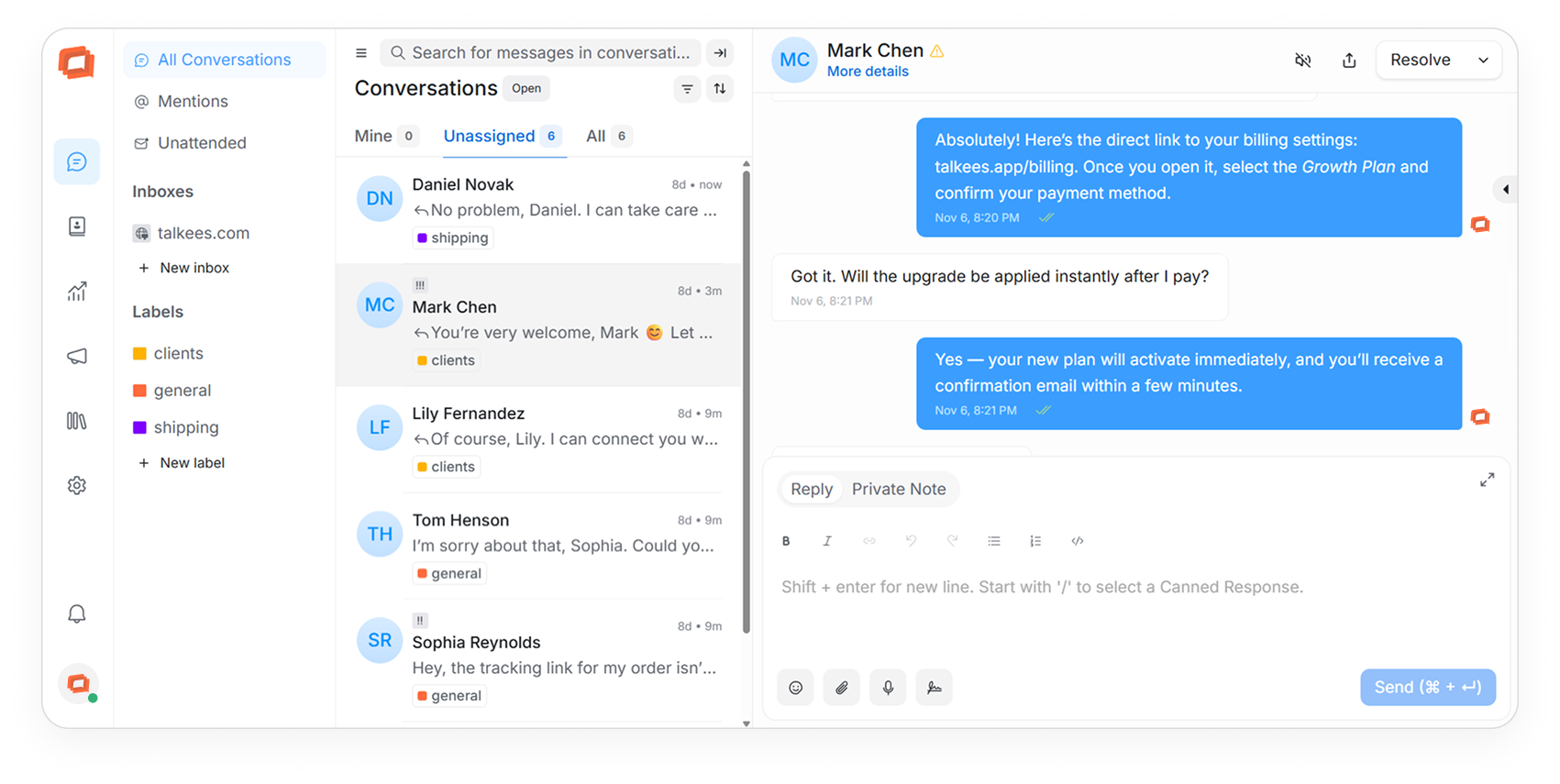
What it is: A unified live chat + AI chatbot platform designed for support teams that want one place for email, chat, and social DMs, with bring-your-own AI model flexibility.
Core features:
- Live chat + AI chatbot working together (bot answers, agent co-pilot, summary on handoff)
- Omnichannel inbox (email, web chat, social), knowledge ingestion, and BYO AI support
- Fast setup (hours–days) and straightforward administration for SMBs and e-commerce teams
Pricing model: Transparent subscription with predictable monthly billing; no opaque “contact sales only” tiers.
Best for:
- SMB and mid-market support teams needing quick time-to-value and a clean agent workspace
- E-commerce shops consolidating channels without enterprise overhead
2. Intercom — In-App Messaging and AI for Product-Led Growth
What it is: Customer communications platform with strong in-app messaging, proactive engagement, and a native AI bot (Fin).
Core features:
- Product tours, in-app messages, help center + AI answers, agent workspace
- Fin AI Agent with per-resolution pricing, plus Agent Assist and AI-generated replies
Pricing model:
- Per-seat subscriptions (Essential ~$39/seat/month, Advanced ~$99/seat/month, Expert ~$139/seat/month)
- Usage add-ons: Fin priced at ~$0.99 per successful resolution
Best for:
- SaaS products with a large signed-in user base
- Teams needing proactive in-app engagement and a modern messenger UI
3. Zendesk — Enterprise Ticketing and Workflow Automation
What it is: Enterprise-grade ticketing with a broad app marketplace and solid AI add-ons for routing, macros, and agent assistance.
Core features:
- Robust case management, views, SLAs, and workflow automations
- Extensive integrations ecosystem and role-based permissions
- AI add-ons for triage, suggestions, QA, and bots
Pricing model:
- Per-seat “Suite” plans (Suite Team $55/agent/mo, Growth $89, Professional $115)
- Optional AI add-ons (AI $50/agent/mo, WFM $25/agent/mo, QA $35/agent/mo)
Best for:
- Mid-market to enterprise contact centers standardizing on a mature ticketing platform
- Regulated operations requiring auditability and process controls
4. Freshworks (Freshdesk/Freshchat) — SMB-Friendly Omnichannel Support
What it is: A practical, cost-effective suite combining ticketing (Freshdesk) and modern messaging (Freshchat).
Core features:
- Email, chat, social, WhatsApp, and knowledge base with templated bots
- No-code automation rules; easy administration for small teams
Pricing model:
- Per-seat tiers with published entry-level plans (Freshdesk: Free; Growth ~$15/agent/mo; Pro ~$49; Enterprise ~$79)
- Messaging channels may add pass-through provider fees (e.g., WhatsApp)
Best for:
- Startups and SMBs wanting to launch in days, not months
- E-commerce and SaaS teams needing effective AI and strong basics at a reasonable price
5. Ada — Automation-First AI Chatbot for High-Volume Deflection
What it is: AI automation platform focused on resolving a large percentage of inbound questions before they reach human agents.
Core features:
- Omnichannel bots, flows, and integrations; claims to automate over 70% of inquiries
- Outcome-driven bot design with enterprise governance
Pricing model:
- Typically performance or outcome-based (per successful AI resolution); enterprise contracts via sales
Best for:
- High-volume B2C brands aiming for aggressive deflection across web, mobile, and messaging
- Teams with clear, repetitive Tier-1 intents and strong knowledge content
6. LivePerson — Enterprise Messaging and Voice with Compliance
What it is: A messaging and voice automation platform designed for complex, regulated environments (financial services, telecom).
Core features:
- Secure messaging at scale (WhatsApp, Apple Business Chat, SMS), voice bots, intent analytics
- Compliance and governance controls expected by large enterprises
Pricing model:
- Custom enterprise contracts (often seat + volume bundles); channel and telephony usage billed separately
Best for:
- Enterprises with strict compliance needs and global scale
- Telco and financial services operations consolidating messaging + voice with AI
7. Genesys Cloud CX — Full-Stack Contact Center with AI Routing
What it is: Cloud contact center platform that unifies voice, chat, email, and workforce tools with native bots and third-party AI options.
Core features:
- Skills-based routing, IVR to conversational bots, Agent Assist, analytics
- Deep telephony integration, strong SLAs, and enterprise reliability
Pricing model:
- Per-seat subscription (CX1 ~$75/user/mo, CX2 ~$110, CX3 ~$150)
- Telephony usage charged per minute and by region
Best for:
- Contact centers with significant voice volume needing one vendor for routing + AI + WFM
- Enterprises migrating from legacy PBX/IVR to cloud with measurable SLAs
8. Yellow.ai — Multilingual, Multi-Channel Automation at Global Scale
What it is: Generative + NLP hybrid platform for chat/voice/email with strong multilingual capabilities (135+ languages).
Core features:
- “Super Agent” model, RAG-style knowledge grounding, apps marketplace
- Broad channel coverage and industry templates
Pricing model:
- Custom enterprise pricing; channel and telephony pass-through fees may apply
Best for:
- Global brands needing multilingual coverage across chat + voice
- Enterprises that can invest in a governed, multi-region rollout
9. Drift — B2B Revenue Chat and ABM-Focused Conversational Marketing
What it is: Conversational marketing and sales acceleration tool for B2B—connects website chat to qualified meetings and pipeline.
Core features:
- Playbooks for ABM, lead routing to AE calendars, AI copilot for SDRs
- Site personalization and account-level targeting
Pricing model:
- Premium/Advanced/Enterprise packages via sales; often per-seat + volume
Best for:
- B2B marketing and sales teams focused on pipeline creation vs. ticket resolution
- Companies with separate helpdesk needs but wanting revenue chat on the website
10. Botpress — Developer-First Bot Platform with Granular Control
What it is: Open-source + cloud platform for teams that want to build bespoke bots with full control over flows, data, and LLMs.
Core features:
- Visual builder + pro-code, multi-LLM support, RAG integrations, CI/CD friendly
- Scale evidence: >750,000 active bots and >1B messages processed
Pricing model:
- Free plan (5 bots, 2,000 messages/mo, 100MB vector DB, $5 AI credit)
- Team plan around $495/month; enterprise custom
Best for:
- Product and engineering teams that want to own their stack and self-host if needed
- Use cases requiring custom logic, unique data pipelines, or non-standard channels
How to Choose the Right Kore.ai Alternative

Your ideal Kore.ai replacement depends on your specific needs. Here’s a decision framework based on common buyer profiles:
E-commerce Shops
What “great” looks like:
- Live chat + AI that resolves common tasks: order status, returns, exchanges, subscription changes
- Social + messaging coverage: Instagram, Facebook, WhatsApp, SMS
- 24/7 coverage with smooth human handoff during business hours
- One-click integrations with e-commerce platforms and payment gateways
Good-fit vendors:
- Talkees for fast time-to-value with live chat + AI and true omnichannel
- Intercom for product-led in-app messaging and growth tools
- Freshworks for SMB-friendly omnichannel and transparent onboarding
SMB Support Teams
What “great” looks like:
- Single workspace for email + chat + social DMs, with AI answers pulled from your knowledge base
- No-code playbooks for “how-to” and account questions; easy macros for agents
- Clear pricing, minimal admin overhead
Good-fit vendors:
- Talkees (live chat + AI + omnichannel with bring-your-own AI options)
- Freshworks for breadth at SMB price points
- Zendesk if you want extensive ticketing workflows and app marketplace
- Botpress if you have developer resources and want deeper control
Omnichannel Operations
What “great” looks like:
- Consistent automation and routing across voice, chat, email, WhatsApp/SMS, and social
- Governance and observability (RBAC, audit logs, versioning, monitoring)
- Scalable telephony with BYOC options, barge-in, and DTMF
Good-fit vendors:
- Genesys Cloud CX for full-stack voice + digital with AI routing and bots
- LivePerson for compliant enterprise messaging at scale
- Yellow.ai for multilingual needs and strong channel breadth
- Talkees for a modern, flexible omnichannel stack without heavy administration
AI-Heavy Projects
What “great” looks like:
- BYOM flexibility, RAG with permission-aware search, SDKs, webhooks, CI/CD for agents and flows
- Option to self-host private components and fine-grain data residency
- Detailed observability: trace-level logs, prompt/version management, and rollback
Good-fit vendors:
- Botpress for developer-first control and custom AI integrations
- Yellow.ai for generative + NLP hybrid and multilingual reach
- Talkees if you want BYO AI with practical omnichannel delivery and lighter admin requirements
Pricing Deep Dive: Understanding Different Models

Pricing transparency is often the deciding factor when evaluating Kore.ai alternatives. Let’s compare three common pricing models:
Per-Seat Subscriptions
How it works: You pay a fixed amount per human agent (or admin) per month.
Examples:
- Zendesk Suite Team: $55/agent/month; AI add-on: $50/agent/month
- Intercom: $39-$139/seat/month
- Genesys Cloud CX: ~$75/seat/month
Best for: Stable support teams with predictable staffing and when you want firm cost ceilings.
Pros: Budget predictability; easy to forecast; aligns with staffing.
Cons: You pay for idle seats; add-ons stack; doesn’t reflect automation gains.
Monthly Active Users (MAU)
How it works: You pay based on how many unique users engage the bot/assistant in a month; not tied to your headcount.
Examples:
- IBM watsonx Assistant: Plus $140/month for first 1,000 MAUs; Enterprise $6,000 for first 50,000 MAUs
- Jotform AI Agents: Free, Bronze $34/mo, Silver $39/mo, Gold $99/mo with session caps
Best for: High self-service ambitions where automation handles most traffic; marketing or community sites where headcount doesn’t track volume.
Pros: Simple; aligns with reach; great for public self-service.
Cons: Definition traps (what counts as “active”?); seasonal spikes; some plans force you into higher tiers prematurely.
Per-Conversation / Per-Resolution
How it works: You pay per completed bot conversation or per successful automated resolution.
Examples:
- Intercom Fin: $0.99 per AI resolution
- Ada and Decagon: outcome-based or per-conversation enterprise contracts
Best for: When you want cost to align directly with business outcomes and can define “resolution” unambiguously.
Pros: Pay for actual outcomes; clean ROI story.
Cons: Disputes over what “resolved” means; high unit prices can outpace fixed licenses; billing volatility with seasonality.
Cost Comparison Scenarios
Scenario A — SMB e-commerce: 10 agents, 15,000 monthly conversations, light automation
- Seat-based (Zendesk example):
- Base: 10 agents × $55 = $550/month
- AI add-on: 10 × $50 = $500/month
- Optional WFM + QA: 10 × ($25 + $35) = $600/month
- Estimated monthly total: $1,650 → $19,800/year
- Effective cost per conversation: $0.11
- Per-resolution (Intercom Fin example):
- Assume 40% automation = 6,000 resolutions
- Resolution fees: 6,000 × $0.99 = $5,940/month
- Plus human seats: 10 × $39 = $390/month
- Estimated monthly total: ~$6,330 → $75,960/year
- Effective cost per conversation: $0.42
Scenario B — Mid-market support: 40 agents, 50,000 monthly conversations, 60% automation target
- Seat-based:
- Example stack: 40 agents × ($55 base + $50 AI) = $4,200/month
- Optional WFM + QA: 40 × ($25 + $35) = $2,400/month
- Estimated monthly total: ~$6,600 → $79,200/year
- Effective cost per conversation: $0.132
- Per-resolution (Intercom Fin sample):
- 60% of 50,000 = 30,000 AI resolutions × $0.99 = $29,700/month → $356,400/year
- Plus seats for human agents
The takeaway: Per-resolution can be either a bargain or a budget-breaker. Under $0.30/resolution with 60% automation looks attractive; near $1.00, a fixed enterprise license may make more sense.
Migration Roadmap from Kore.ai

Transitioning from Kore.ai to a new platform requires careful planning. Here’s a structured approach to ensure a smooth migration:
Phase 1 — Inventory and Export from Kore.ai (1-2 weeks)
Export all artifacts that encode intent, behavior, or system wiring:
- Intents and training data: intent names, sample utterances, entities/slots, synonyms, regexes
- Dialogs/flows: node definitions, transitions, conditions, slot-filling, error handling
- Knowledge sources: FAQs, document links, KB URLs, content tags, metadata
- Channels and routing: channel list, entry points, handoff rules, queue names, business hours
- Integrations: connectors used, API endpoints, scopes/permissions, field mappings
- Analytics and reports: KPI dashboards, funnel drop-offs, confusion pairs
Practical tip: Normalize your dataset into a single “source of truth” spreadsheet or JSON file with columns for intent_id, intent_name, utterance, language, entity_name, etc.
Phase 2 — Map Target Platform Features and Import (1-2 weeks)
- Intents and entities: Import via the new platform’s CSV/JSON importer or through its API/SDK
- Dialog flows: Rebuild high-value flows using the new builder; preserve confirmations for risky actions
- Knowledge and RAG: Ingest KB articles and PDFs; enable permission-aware retrieval
- LLM settings: Define grounding policy, temperature, max tokens; create guardrails and escalation thresholds
Phase 3 — Map Channels and Integrations (1-3 weeks)
For each channel, plan a careful transition:
- Web chat: Add the new widget in staging, plan a snippet swap via your tag manager, and use a canary approach (5-10% of sessions initially)
- WhatsApp Business: Verify phone number ownership, set up message templates, prepare webhook URL switch
- Email: Set up a subdomain with DKIM/SPF records; test with a 10% canary on outbound automations
- Voice/telephony: Plan for number porting (3-10 business days) and configure parallel IVR entry in staging
For integrations, recreate API tokens with least privilege, map fields 1:1, confirm rate limits, and test idempotency (especially for payment operations).
Phase 4 — Testing, Shadow Mode, and Canary Rollout (2-3 weeks)
- Run unit tests on 30-50 critical flows
- Process 1,000-10,000 past conversations through the new bot offline to compare accuracy
- Have support agents test the new bot for a day
- Start with 5-10% of traffic on one channel, monitor for 24-48 hours, then ramp to 25%, 50%, 100%
Phase 5 — Cutover, Hypercare, and Decommission (1-2 weeks)
- Freeze changes in Kore.ai 24-48 hours before cutover
- Switch DNS/snippets/webhooks during off-peak hours
- Staff a “war room” for 72 hours with your CX lead, a developer, and the vendor’s CSM
- Monitor key metrics hourly: containment, FCR, escalation rate, CSAT, latency, error rates
- Rotate old Kore.ai secrets, revoke unused tokens, and update privacy notices if data processing changes
FAQs: Kore.ai vs Talkees

Q1: Do we lose any core capabilities if we move from Kore.ai to Talkees?
For most SMB, e-commerce, and omnichannel support teams, you won’t lose essential functionality—and you’ll likely gain speed, clarity, and lower overhead.
Talkees focuses on:
- Live chat + AI chatbot in one workspace (no app sprawl)
- Omnichannel inbox out of the box: website chat, email, and popular social channels
- BYO AI (bring your own model): connect leading LLMs and switch as needed
- No-code builder + pro-code extensibility: business users build flows while engineers extend with APIs
- Agent Assist: suggested replies, summaries, and next-best actions
- Modern analytics: automation rate, deflection, CSAT, first-response time
If your roadmap centers on cross-organizational orchestration under a central AI COE, Kore.ai’s enterprise breadth can be compelling. If your priority is fast, measurable customer support outcomes with clear pricing and minimal admin, Talkees is purpose-built for that.
Q2: How do pricing and TCO compare in practice?
Kore.ai typically quotes custom enterprise contracts, with annual licenses commonly around $300,000/year for larger deployments (implementation often extra). Talkees publishes transparent pricing and scales with you—so pilots and SMB rollouts don’t require six-figure commitments.
For perspective:
- If you automate 10,000 resolutions/month with a per-resolution model priced around $1, your automation bill is approximately $10,000/month.
- With enterprise flat licenses (like those reported for Kore.ai), your year-one TCO often includes substantial professional services.
Q3: How fast can we go live with Talkees vs Kore.ai?
Typical timelines:
- Kore.ai: Plan for multi-week/multi-month implementations (2-4 months is commonly cited for enterprise scope).
- Talkees: Teams routinely stand up a working pilot in days (connect your helpdesk or shop platform, import knowledge, and launch web chat), then expand to full omnichannel within 2-4 weeks.
Q4: How hard is the migration from Kore.ai to Talkees?
Most of the heavy lifting follows a standardized process:
- Export Kore.ai intents/utterances as CSV/JSON
- Import into Talkees; auto-map to new flows and review training phrases
- Recreate high-value actions using Talkees’ no-code actions or custom webhooks
- Re-index your knowledge base and historical tickets
- Map channels one-by-one and reconnect CRMs, payment gateways, and storefronts
- Run a “historical replay” of tickets to estimate containment before go-live
- Use a canary release approach (10-20% traffic → 50% → 100%)
Q5: Does Talkees support BYO AI and guardrails like Kore.ai?
Yes. Teams can:
- Attach their preferred model provider to a workspace and define per-flow prompts, temperature, and safety filters
- Use retrieval-augmented responses grounded in your latest content to reduce hallucinations
- Implement guardrails including confidence thresholds, escalation rules, PII redaction, and role-based publishing
Q6: What about omnichannel capabilities?
Talkees consolidates the channels most SMB and e-commerce teams rely on:
- Web chat and email are included by default (unified agent inbox)
- Messaging and social channels (WhatsApp, Facebook Messenger, Instagram DMs, X) are added via connectors
- The same intents and actions power chat, email, and social replies
Q7: How do we compare security, compliance, and deployment options?
Kore.ai markets strong enterprise governance and offers deployment flexibility for regulated industries. With Talkees:
- Expect standard enterprise controls: SSO, RBAC, audit events, encryption in transit/at rest, configurable retention, and data export
- Request the Trust/Compliance documentation (SOC 2 attestation, DPA/BAA if applicable, subprocessor list, data residency options)
- If you require on-prem/private cloud, raise it early in scoping
Q8: How do we measure success post-switch?
Pick a handful of KPIs and establish a baseline from your last full month on Kore.ai:
- Automation/containment rate: target +10-20 points on the top 20 intents
- First response time (FRT): target sub-10 seconds on chat; sub-1 minute on email
- Average handle time (AHT): -15-30% on top intents with Agent Assist
- CSAT: +5-10 points for automated resolutions; near parity with human-handled chats
Q9: What are the big gotchas when moving off Kore.ai?
- Over-porting old complexity: Start with 20-30 well-designed intents that cover 60-80% of volume
- Hidden data dependencies: Confirm API scopes for refunds, subscriptions, or loyalty points before launch
- Governance gaps: Set publishing roles and a two-person review for flows and prompts
- Analytics drift: Align definitions (what counts as a “resolution” or “automation” event)
Q10: What’s the quickest path to a low-risk pilot on Talkees?
- Scope: Website chat + email, top 10 intents, business hours with clear handoff
- Inputs: 500-2,000 historical tickets for training/testing; up-to-date KB
- Setup: Connect your LLM provider, enable retrieval over your docs, turn on summary + suggested replies for agents
- Success criteria after 2-3 weeks:
- ≥50% automation on the top 10 intents
- Fallbacks ≤10% on those intents
- CSAT within 5 points of human baseline (and improving)
Compared to Kore.ai’s typical 2-4 month enterprise rollout, you can validate Talkees on a real slice of traffic in days and scale progressively.
Conclusion: Making the Right Choice

The ideal Kore.ai alternative depends on your specific needs:
- If your priority is a governed, all-encompassing enterprise platform spanning multiple departments, Kore.ai remains a strong contender.
- For e-commerce shops, SMB support teams, or operations groups that need live chat + AI across email/chat/social, BYO AI flexibility, transparent pricing, and quick deployment, Talkees offers a modern, flexible, and affordable alternative that keeps your team focused on outcomes—not implementation overhead.
- For product-led SaaS companies, Intercom provides excellent in-app messaging and growth tools.
- For enterprise contact centers with significant voice volume, Genesys Cloud CX delivers a full-stack solution.
- For developer-first teams wanting complete control, Botpress offers the flexibility to build custom solutions.
Whatever your choice, focus on the fundamentals: channel coverage, integration capabilities, deployment speed, pricing transparency, and governance controls that match your organizational needs.