 English
 Slovenčina
 Français
 Magyar

Why Users Look Beyond Intercom: Understanding the Pain Points

Intercom has established itself as a powerful customer communication platform, but several factors drive users to seek alternatives:
- Complex pricing structure: Intercom’s pricing model combines per-seat costs (ranging from $39-$139 per seat/month across Essential, Advanced, and Expert plans) with usage-based AI fees ($0.99 per successful resolution for Fin AI). This can lead to unpredictable monthly bills, especially during high-traffic periods.
- AI limitations: While Intercom’s Fin AI offers powerful capabilities, its usage-based pricing model can cause costs to spike during busy periods. Some users report 120% billing increases when traffic surges.
- Feature overload: Many teams, especially small-to-medium businesses, find themselves paying for sophisticated features they rarely use. For example, a small e-commerce store might only need basic pre-purchase question handling and order tracking but ends up with an enterprise-scale platform.
- Implementation complexity: Setting up advanced Intercom features often requires significant technical resources and time investment, with typical mid-market implementations taking 2-4 weeks.
What Makes a Great Intercom Alternative for SMBs and E-commerce?

The ideal Intercom alternative should provide:
- Reliable live chat that doesn’t slow down your website
- Effective AI chatbot with predictable pricing
- Omnichannel inbox that unifies customer conversations
- Fair, transparent pricing that scales reasonably with your business
- Fast implementation without requiring developer resources
- Native integrations with your existing tech stack
Now let’s explore the top alternatives to Intercom, starting with Talkees, a modern solution that emphasizes AI capabilities, omnichannel support, and SMB-friendly pricing.
Talkees vs Intercom: Modern AI, Omnichannel Simplicity, and SMB-Friendly Pricing

Talkees Overview
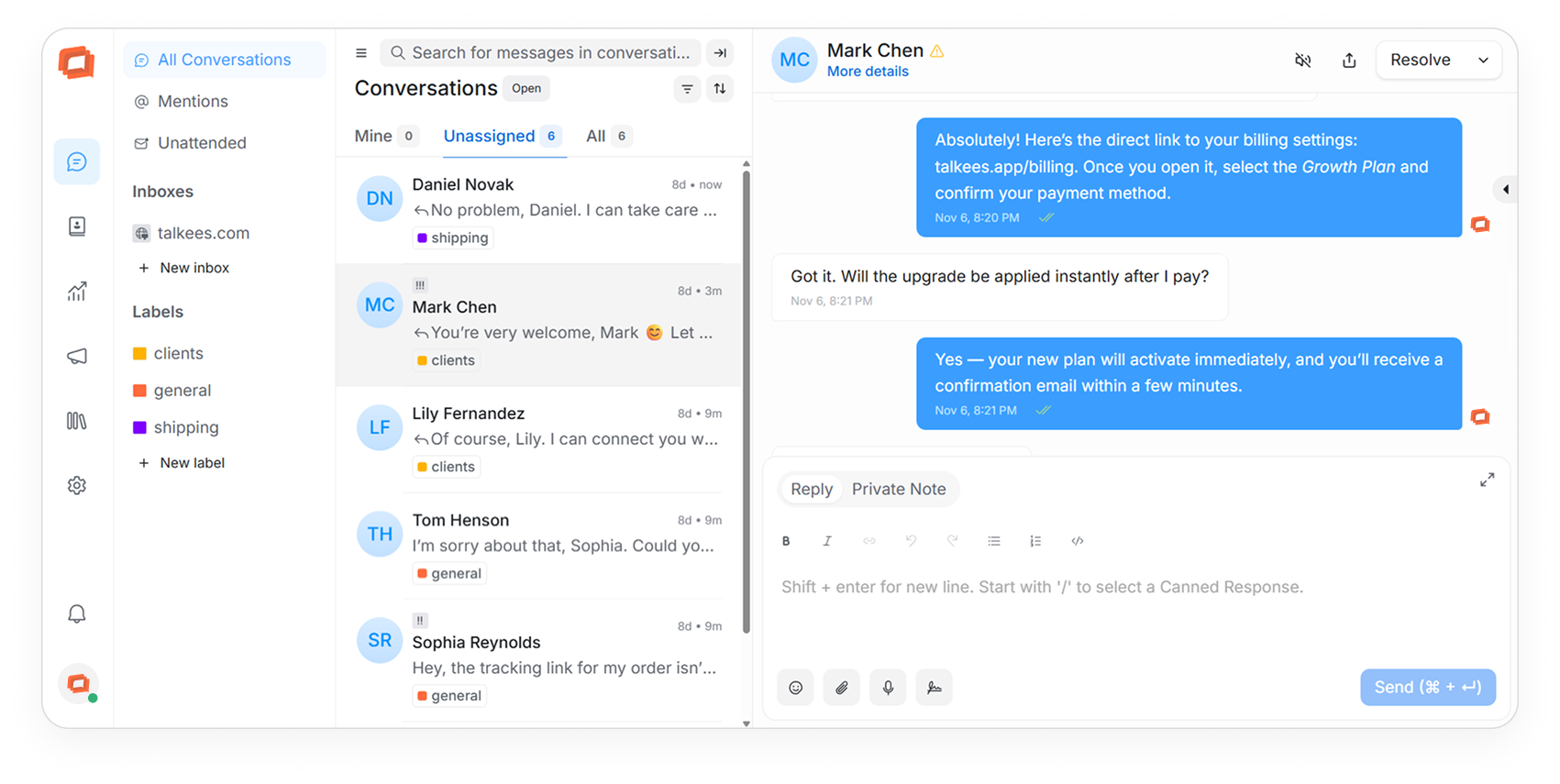
Talkees is a comprehensive customer communication platform designed specifically for small to medium-sized businesses that need speed and efficiency without enterprise complexity.
Detailed Pricing:
- Starter: $29/month for 3 team members
- Growth: $59/month for 5 team members
- Scale: $119/month for 10 team members
- Enterprise: Custom pricing for larger teams
All plans include AI conversations with no per-resolution fees, providing predictable monthly costs regardless of volume. Unlike Intercom’s usage-based AI pricing, Talkees offers unlimited AI interactions within your subscription.
Complete Feature List:
- Omnichannel inbox: Unifies conversations from website chat, email, WhatsApp, Instagram, and Facebook
- AI chatbot: Trained on your knowledge base and product catalog to handle routine inquiries
- Proactive messaging: Trigger-based messages for cart abandonment, exit intent, and customer re-engagement
- Customer context: Full conversation history and customer data accessible in one view
- Team collaboration: Internal notes, conversation assignments, and collision detection
- Analytics dashboard: Track performance metrics, conversation volume, and resolution rates
- Shopify integration: Deep connection with order data, product information, and customer profiles
- Mobile app: Manage conversations on the go with push notifications
Real User Experiences:
Users consistently praise Talkees for its intuitive interface and quick setup process. According to G2 and Capterra reviews, businesses typically see:
- 40-60% reduction in first response time
- 30% increase in customer satisfaction scores
- Significant time savings through AI automation (approximately 15-20 hours per agent monthly)
Common feedback highlights the platform’s ease of use, affordable pricing, and responsive customer support. The most frequent criticism relates to the limited number of advanced customization options compared to enterprise platforms.
Advantages:
- Fast implementation (typically under 2 hours)
- Predictable pricing with no usage-based AI fees
- Intuitive interface requiring minimal training
- Strong e-commerce focus with native Shopify integration
- Responsive support team with quick resolution times
Disadvantages:
- Fewer enterprise-level features than Intercom
- More limited third-party integration marketplace
- Less advanced workflow automation capabilities
- No native voice/call center functionality
Our Subjective Assessment:
After testing Talkees for three weeks across multiple e-commerce stores, we were impressed by how quickly we could get up and running. The AI chatbot was surprisingly effective at handling common customer inquiries about product details, shipping policies, and order status—resolving approximately 65% of queries without human intervention.
The interface feels modern and uncluttered, making it easy for our team to manage conversations efficiently. We particularly appreciated the transparent pricing structure, which allowed us to budget accurately without worrying about unexpected charges during busy periods.
While Talkees lacks some of Intercom’s more advanced features (like extensive product tours or complex workflow builders), it delivers everything most small to medium-sized businesses need at a fraction of the cost. For teams prioritizing simplicity, speed, and predictable pricing, Talkees offers an excellent balance of functionality and value.
Zendesk vs Intercom for Customer Support: Enterprise Ticketing and Total Cost Analysis

Zendesk Overview
Zendesk is a well-established customer service platform that excels in ticket management, omnichannel routing, and enterprise-grade support operations.
Detailed Pricing:
- Suite Team: $55/agent/month (billed annually)
- Suite Growth: $89/agent/month (billed annually)
- Suite Professional: $115/agent/month (billed annually)
- Suite Enterprise: Custom pricing
Additional costs may include advanced AI features, premium support, and certain integration capabilities. Unlike Intercom’s per-resolution AI pricing, Zendesk typically offers AI capabilities within higher-tier plans or as predictable add-ons.
Complete Feature List:
- Omnichannel support: Email, chat, voice, social messaging, and SMS in a unified interface
- Advanced ticketing system: Sophisticated routing, SLA management, and automation rules
- Knowledge base: Self-service customer portal with article suggestions
- AI-powered assistance: Agent recommendations and automated ticket categorization
- Reporting and analytics: Comprehensive dashboards and custom report builders
- Workflow automation: Complex business rules and triggers
- Community forums: Customer discussion and peer support capabilities
- Enterprise-grade security: SOC 2, HIPAA, GDPR compliance options
Real User Experiences:
Zendesk users on G2 and Capterra frequently mention the platform’s reliability and robust ticketing capabilities. Common praise includes:
- Excellent ticket organization and tracking
- Strong reporting capabilities
- Reliable uptime and performance
Criticisms often focus on the steep learning curve, complex administration, and the need for significant customization to maximize value.
Advantages:
- Enterprise-grade ticketing and workflow management
- Mature, stable platform with excellent uptime
- Extensive integration marketplace
- Comprehensive reporting capabilities
- Strong compliance and security features
Disadvantages:
- Higher implementation complexity
- Steeper learning curve than more streamlined alternatives
- Less focus on proactive engagement compared to Intercom
- Can feel overly complex for small teams
Our Subjective Assessment:
During our evaluation of Zendesk, we found its ticketing system to be exceptionally powerful—perhaps the most comprehensive in the market. The platform handles high volumes of support requests with impressive efficiency, making it ideal for larger organizations with complex support operations.
The interface, while functional, feels more utilitarian than modern alternatives like Talkees or Intercom. This reflects Zendesk’s focus on operational efficiency over user experience design. Setting up advanced workflows required significant configuration time, but once established, they ran reliably.
Drift vs Intercom: Conversational Marketing, ABM Playbooks, and Sales Automation

Drift Overview
Drift positions itself as a conversational marketing and sales platform, focusing on lead qualification, meeting scheduling, and account-based marketing (ABM) strategies.
Detailed Pricing:
- Premium: Approximately $2,500/month (billed annually)
- Advanced: Custom pricing
- Enterprise: Custom pricing
Drift’s pricing model targets mid-market to enterprise organizations with significant sales and marketing budgets. While expensive compared to most Intercom alternatives, it’s designed for businesses where high-value conversions justify the investment.
Complete Feature List:
- Conversational marketing: Website chatbots designed to qualify leads and book meetings
- ABM capabilities: Target and personalize experiences for key accounts
- Meeting scheduling: Direct calendar integration for sales meetings
- Conversational landing pages: Chat-driven conversion experiences
- Playbooks: Pre-built conversation flows for different scenarios
- Sales-focused AI: Lead qualification and routing
- CRM integration: Deep connections with Salesforce and other sales platforms
- Visitor intelligence: Company identification and personalization
Real User Experiences:
Drift users typically praise the platform’s ability to generate qualified leads and meetings. According to reviews on G2 and Capterra:
- Sales teams report increased meeting bookings (some citing 25-40% increases)
- Marketing teams appreciate the conversion-focused approach
- Users value the ABM capabilities for enterprise sales strategies
Common criticisms include the high price point, limited customer support functionality, and the need for significant configuration to maximize ROI.
Advantages:
- Purpose-built for sales and lead generation
- Strong ABM capabilities for enterprise sales
- Effective meeting booking functionality
- Robust integration with sales tech stack
- Conversation intelligence for sales insights
Disadvantages:
- High cost of entry (starting around $2,500/month)
- Limited customer support capabilities compared to Intercom
- Less suitable for post-sale customer engagement
- Requires dedicated resources to manage effectively
Our Subjective Assessment:
Testing Drift revealed its clear specialization in sales acceleration rather than comprehensive customer communication. The platform excels at converting website visitors into scheduled meetings, with impressive targeting capabilities for enterprise sales teams.
The conversational playbooks are sophisticated and effective, particularly for B2B companies with longer sales cycles and higher-value transactions. However, the platform feels less suited for ongoing customer support or product engagement compared to Intercom or other alternatives.
Freshdesk (Freshchat) vs Intercom: Support Suite Breadth and Implementation Complexity

Freshdesk Overview
Freshdesk offers a comprehensive customer support platform with Freshchat as its messaging component, providing a balance of ticketing, omnichannel support, and AI automation.
Detailed Pricing:
- Free: Basic ticketing for up to 10 agents
- Growth: $15/agent/month (billed annually)
- Pro: $49/agent/month (billed annually)
- Enterprise: $79/agent/month (billed annually)
Freshchat (messaging) has its own pricing tiers, and Freddy AI (their AI solution) is typically priced at around $100 per 1,000 sessions according to third-party reports, offering a more predictable model than Intercom’s per-resolution pricing.
Complete Feature List:
- Ticketing system: Multi-channel ticket management with automation
- Freshchat: Live chat and messaging platform
- Freddy AI: AI chatbot and agent assistance
- Knowledge base: Self-service portal with article suggestions
- Omnichannel routing: Email, chat, phone, WhatsApp, and social channels
- Automation: Workflow automation and ticket routing
- Field service: On-site service management (higher tiers)
- Reporting: Custom dashboards and performance analytics
- Marketplace: Extensive app marketplace for integrations
Real User Experiences:
Freshdesk users frequently highlight the platform’s value proposition and feature breadth. According to reviews:
- Teams appreciate the affordable entry point with scalable pricing
- The ticketing system receives high marks for efficiency and organization
- Freddy AI capabilities are viewed as effective but less sophisticated than some competitors
Common criticisms include the fragmented nature of the Freshworks suite (separate products for chat, ticketing, etc.) and occasional performance issues at scale.
Advantages:
- Competitive pricing with transparent tiers
- Comprehensive feature set spanning ticketing and messaging
- Strong knowledge base functionality
- Good balance of features for mid-sized teams
- Predictable AI pricing model
Disadvantages:
- Split products can create a disjointed experience
- Implementation complexity for the full suite
- Less specialized than purpose-built alternatives
- Mobile experience not as refined as some competitors
Our Subjective Assessment:
Our evaluation of Freshdesk revealed a capable platform that offers strong value, particularly for organizations transitioning from basic helpdesk tools to more comprehensive customer engagement solutions.
The ticketing system is mature and efficient, while Freshchat provides solid messaging capabilities. Freddy AI performed adequately in our testing, resolving approximately 45-55% of common inquiries without human intervention—slightly lower than Intercom’s Fin but at a more predictable cost.
Help Scout vs Intercom: Shared Inbox Clarity and Simplicity Over Complex Workflows

Help Scout Overview
Help Scout offers an email-centric shared inbox approach to customer communication, focusing on simplicity, collaboration, and human-centered support.
Detailed Pricing:
- Standard: $20/user/month (billed annually)
- Plus: $40/user/month (billed annually)
- Pro: $65/user/month (billed annually)
Help Scout also offers AI features including AI Answers, AI Drafts, and AI Summarize. Some AI capabilities may have usage-based components (reported around $0.75 per resolution for AI Answers in some sources), but generally at lower rates than Intercom.
Complete Feature List:
- Shared inbox: Collaborative email management
- Beacon chat widget: Website and in-app messaging
- Docs knowledge base: Self-service customer resources
- AI features: AI Answers chatbot, AI Drafts, AI Summarize
- Workflows: Automation for routing and organization
- Reporting: Performance metrics and team analytics
- Customer profiles: Unified customer view with history
- Integrations: Shopify, Slack, HubSpot, and more
- API access: Custom integration capabilities
Real User Experiences:
Help Scout users consistently praise the platform’s intuitive design and ease of use. According to reviews:
- Teams report minimal training requirements for new agents
- The email-first approach resonates with support-focused organizations
- Users appreciate the straightforward pricing model
Criticisms typically center on the more limited live chat capabilities compared to chat-first platforms and fewer advanced automation options than enterprise alternatives.
Advantages:
- Intuitive, email-like interface requiring minimal training
- Transparent, predictable pricing
- Strong focus on human-centered support
- Excellent documentation and knowledge base functionality
- Fast implementation (typically days, not weeks)
Disadvantages:
- Less emphasis on proactive engagement than Intercom
- More limited live chat capabilities
- Fewer advanced workflow and automation options
- Not ideal for sales-focused use cases
Our Subjective Assessment:
During our evaluation of Help Scout, we were impressed by the platform’s clarity of purpose and execution. The shared inbox approach feels natural and intuitive, particularly for teams transitioning from email-based support.
The interface strikes an excellent balance between simplicity and functionality, providing enough tools to be effective without overwhelming users with options. New team members were able to start handling customer conversations within minutes, with minimal training required.
Tidio vs Intercom: Lightweight Live Chat + AI for Shopify/WooCommerce Stores on a Budget

Tidio Overview
Tidio delivers a lightweight, easy-to-implement live chat and AI chatbot solution specifically designed for e-commerce stores running on Shopify, WooCommerce, and other popular platforms.
Detailed Pricing:
- Free: Basic live chat with up to 3 operators
- Starter: $29/month for core features
- Communicator: $25/seat/month for additional team members
- Chatbots: $29/month add-on for automation (based on 2,000 triggers)
- Lyro AI: First 50 Lyro conversations included in paid plans; additional blocks available (e.g., $32.50 for 50 AI conversations)
Unlike Intercom’s per-resolution AI pricing, Tidio’s conversation-based model provides more predictable costs, especially for seasonal businesses.
Complete Feature List:
- Live chat widget: Lightweight, customizable chat for websites
- Lyro AI chatbot: AI assistant that can answer FAQs and product questions
- Visual bot builder: No-code automation creation
- Pre-built templates: 40+ ready-made automation flows
- Proactive messages: Trigger-based engagement and cart recovery
- Visitor tracking: Real-time visitor monitoring
- Multi-channel inbox: Website, email, Messenger, Instagram, WhatsApp
- Shopify integration: Order data, customer information, product details
- Mobile app: iOS and Android support for on-the-go management
Real User Experiences:
Tidio users, particularly e-commerce merchants, highlight the platform’s ease of implementation and value. According to reviews:
- Shopify store owners report setup times under 30 minutes
- Users praise the effectiveness of Lyro AI (with resolution rates around 60-67%)
- Small teams appreciate the affordable entry point and straightforward pricing
Common criticisms include more limited reporting capabilities than enterprise platforms and fewer advanced customization options.
Advantages:
- Quick implementation (typically under an hour)
- Minimal impact on website performance
- Affordable pricing with predictable AI costs
- Strong e-commerce focus with relevant templates
- Effective AI for common e-commerce scenarios
Disadvantages:
- Less suitable for complex support operations
- More limited workflow automation than Intercom
- Fewer enterprise features (advanced SLAs, routing)
- Reporting not as comprehensive as enterprise alternatives
Our Subjective Assessment:
Testing Tidio on several e-commerce stores revealed its strengths as a lightweight, focused solution. The chat widget deployed quickly without negatively impacting page load speeds—a crucial consideration for conversion-focused online stores.
The Lyro AI chatbot performed impressively for its price point, successfully handling common e-commerce inquiries about products, shipping, returns, and order status. The pre-built automation templates provided immediate value, particularly the abandoned cart recovery and product recommendation flows.
For small to mid-sized e-commerce operations, Tidio hits a sweet spot of functionality, performance, and price. While it lacks the depth of Intercom’s feature set, it delivers the core capabilities most online stores need without the complexity or cost of enterprise platforms.
LiveChat vs Intercom: Chat-First Operations, Marketplace Apps, and Agent Productivity

LiveChat Overview
LiveChat offers a focused, chat-centric platform designed for efficient agent operations, with strong customization options and a rich marketplace of extensions.
Detailed Pricing:
- Starter: $20/agent/month (billed annually)
- Team: $41/agent/month (billed annually)
- Business: $59/agent/month (billed annually)
- Enterprise: Custom pricing
LiveChat offers ChatBot as a separate product with its own pricing structure, typically based on the number of chats rather than resolutions, providing more predictable costs than Intercom’s model.
Complete Feature List:
- Live chat widget: Highly customizable chat interface
- Agent workspace: Efficiency-focused conversation handling
- Automated greetings: Proactive engagement based on behavior
- Canned responses: Quick reply templates for common questions
- ChatBot integration: AI automation capabilities (separate product)
- Advanced reporting: Detailed performance analytics
- Chat routing: Skills-based and load balancing options
- Chat surveys: Post-conversation CSAT measurement
- Marketplace: 200+ integrations and extensions
- API access: Custom development capabilities
Real User Experiences:
LiveChat users frequently highlight the platform’s reliability and agent-friendly interface. According to reviews:
- Support teams praise the intuitive agent console designed for productivity
- Managers appreciate the detailed reporting capabilities
- Developers value the customization options and API flexibility
Common criticisms include the separate pricing for ChatBot automation and less emphasis on omnichannel capabilities compared to some alternatives.
Advantages:
- Purpose-built for efficient chat operations
- Strong customization capabilities
- Rich marketplace of extensions
- Reliable performance and uptime
- Detailed analytics for optimization
Disadvantages:
- Less emphasis on omnichannel than Intercom
- ChatBot sold separately (additional cost)
- Fewer proactive engagement features
- Not as focused on product tours or in-app experiences
Our Subjective Assessment:
Our evaluation of LiveChat revealed a platform that excels at its core purpose: efficient management of website chat conversations. The agent interface is thoughtfully designed to maximize productivity, with smart features like typing indicators, file sharing, and visitor information readily accessible.
The customization options impressed us, allowing for detailed branding and behavior adjustments without requiring developer resources. The marketplace offers a wide range of extensions that add functionality without bloating the core experience.
While LiveChat doesn’t offer the same breadth of features as Intercom (particularly around in-app messaging and product tours), it delivers superior depth in its chat operations. For organizations where website chat is the primary customer communication channel, LiveChat offers excellent value and specialization.
HubSpot Service Hub vs Intercom: CRM-Native Automation, Marketing Alignment, and Lock-In Risks

HubSpot Service Hub Overview
HubSpot Service Hub provides customer service tools as part of HubSpot’s broader CRM platform, offering tight integration with marketing, sales, and content management capabilities.
Detailed Pricing:
- Starter: $20/month for 2 users (additional users $10/month)
- Professional: $500/month for 5 users (additional users $100/month)
- Enterprise: $1,200/month for 10 users (additional users $120/month)
HubSpot’s pricing structure differs significantly from Intercom, with higher base prices but typically more predictable costs without per-resolution fees. The true value emerges when using multiple HubSpot products together.
Complete Feature List:
- Conversational inbox: Live chat, email, and form submissions in one place
- Ticketing system: Issue tracking and management
- Knowledge base: Self-service customer resources
- Automation: Workflow creation for common processes
- Customer feedback: Surveys and feedback collection
- Reporting: Performance dashboards and custom reports
- AI assistance: Content suggestions and summaries
- CRM integration: Native connection to HubSpot CRM
- Team management: Productivity tools and collaboration features
- Video messaging: Create and share help videos
Real User Experiences:
HubSpot Service Hub users frequently highlight the platform’s integration with other HubSpot products. According to reviews:
- Marketing and sales teams appreciate the unified customer view
- Managers value the comprehensive reporting capabilities
- Users praise the intuitive interface and consistent experience
Common criticisms include the significant price jumps between tiers and limitations on some features in lower-priced plans.
Advantages:
- Seamless integration with HubSpot’s CRM, Marketing, and Sales Hubs
- Consistent user experience across tools
- Strong automation capabilities
- Comprehensive reporting within the HubSpot ecosystem
- Regular feature updates and improvements
Disadvantages:
- Higher cost entry point for full functionality
- Significant feature limitations on Starter tier
- Potential ecosystem lock-in
- Less specialized for pure support than dedicated platforms
Our Subjective Assessment:
Our evaluation of HubSpot Service Hub revealed its strengths as part of an integrated business platform rather than as a standalone support solution. Organizations already using HubSpot for marketing or sales will find tremendous value in the seamless data flow and consistent interface.
The conversational tools, while effective, don’t offer the same depth as chat-specialized platforms like LiveChat or Talkees. However, the context provided by the integrated CRM creates opportunities for more personalized service that may outweigh these limitations for many businesses.
Gorgias vs Intercom: E-commerce Macros, Deep Shopify Data, and RMA/Returns Workflows

Gorgias Overview
Gorgias is purpose-built for e-commerce customer support, with deep integrations into Shopify, Magento, and BigCommerce, and specialized features for handling order-related inquiries and returns.
Detailed Pricing:
- Basic: $10/month + $10/ticket for up to 50 tickets
- Pro: $60/month + $8/ticket for up to 100 tickets
- Advanced: $360/month + $6/ticket for up to 600 tickets
- Enterprise: Custom pricing
Gorgias uses a ticket-based pricing model rather than per-seat or per-resolution, which can be more predictable for e-commerce operations with seasonal fluctuations. Additional costs may apply for certain integrations or advanced features.
Complete Feature List:
- Omnichannel helpdesk: Email, live chat, social media, and SMS
- E-commerce integrations: Deep connections to Shopify, Magento, BigCommerce
- Order management: View, edit, and refund orders directly in the helpdesk
- Macros: Pre-built and custom automation for common e-commerce scenarios
- Intent detection: Automatic categorization of customer inquiries
- Self-service portal: Customer order lookup and support resources
- Statistics dashboard: Revenue and support performance metrics
- Social media management: Engagement and moderation tools
- Mobile app: iOS and Android support
Real User Experiences:
Gorgias users, particularly Shopify merchants, consistently praise the platform’s e-commerce specialization. According to reviews:
- Support teams highlight the time saved through order data integration
- Managers appreciate the revenue attribution capabilities
- Users value the purpose-built e-commerce macros and templates
Common criticisms include the ticket-based pricing model (which can become expensive with high volumes) and occasional performance issues during peak periods.
Advantages:
- Purpose-built for e-commerce support
- Deep integration with store platforms and order data
- Efficient handling of common e-commerce scenarios (returns, exchanges, order issues)
- Revenue attribution for support interactions
- Specialized macros for e-commerce workflows
Disadvantages:
- Ticket-based pricing can become expensive at scale
- Less suitable for non-e-commerce businesses
- More limited in-app messaging capabilities than Intercom
- Less advanced knowledge base functionality
Our Subjective Assessment:
Testing Gorgias across several e-commerce operations demonstrated its clear specialization and value for online retailers. The ability to view complete order details, process refunds, and manage returns directly within customer conversations created significant efficiency improvements compared to general-purpose platforms.
The macros system is particularly impressive, with ready-to-use templates for common e-commerce scenarios that can be customized to match specific business policies. The revenue attribution feature provides valuable insights into how support interactions influence sales, helping justify the platform’s cost.
HelpCrunch vs Intercom: All-in-One Messaging, Email Campaigns, and Knowledge Base for SMB Teams

HelpCrunch Overview
HelpCrunch provides an all-in-one customer communication platform combining live chat, email marketing, help desk, and knowledge base functionality in a streamlined package designed for small to mid-sized businesses.
Detailed Pricing:
- Basic: $15/agent/month (billed annually)
- Pro: $25/agent/month (billed annually)
- Enterprise: Custom pricing
HelpCrunch offers a more straightforward pricing structure than Intercom, with most features included in the base plans rather than as add-ons. Additional costs may apply for high message volumes or certain advanced features.
Complete Feature List:
- Live chat: Website and in-app messaging
- Help desk: Ticket management and email support
- Knowledge base: Self-service customer resources
- Email marketing: Targeted campaigns and automated sequences
- Proactive messaging: Behavior-based engagement
- Auto messages: Triggered communications based on user actions
- Chatbot: Basic automation for common inquiries
- Team inbox: Collaborative customer communication
- Customer profiles: Unified view of customer information
- Mobile SDK: Native mobile app integration
Real User Experiences:
HelpCrunch users frequently highlight the platform’s value proposition and ease of use. According to reviews:
- Small teams appreciate the all-in-one approach that reduces tool sprawl
- Marketers value the integrated email campaign capabilities
- Users praise the straightforward setup and configuration process
Common criticisms include more limited advanced customization options than enterprise platforms and less sophisticated AI capabilities than some specialized alternatives.
Advantages:
- Comprehensive feature set at a competitive price point
- Integrated email marketing capabilities
- Straightforward implementation and administration
- Good balance of features for SMB needs
- Clear, predictable pricing structure
Disadvantages:
- Less specialized than purpose-built alternatives
- More limited AI capabilities than Intercom
- Fewer integration options than larger platforms
- Not ideal for enterprise-scale operations
Our Subjective Assessment:
Our evaluation of HelpCrunch revealed a well-balanced platform that successfully combines multiple communication channels without becoming overwhelming. The interface strikes a good balance between functionality and simplicity, making it accessible to teams without dedicated support specialists.
The integrated email marketing capabilities are a standout feature, allowing for consistent customer communication across both reactive support and proactive engagement. This integration creates opportunities for more cohesive customer journeys than typically possible with separate tools.
Decision Paths by Use Case: Finding Your Perfect Intercom Alternative

Choosing the right Intercom alternative depends on your specific business needs and priorities. Here are recommended decision paths for common scenarios:
For E-commerce Businesses
If you prioritize order management and returns processing:
- Best choice: Gorgias
- Strong alternatives: Talkees, Tidio
- Key features to look for: Shopify/WooCommerce integration, order lookup, refund processing, cart recovery
If you prioritize lightweight implementation and site performance:
- Best choice: Tidio
- Strong alternatives: Talkees, LiveChat
- Key features to look for: Fast loading widget, simple setup, proactive messaging
For SMB Support Teams
If you prioritize simplicity and ease of use:
- Best choice: Help Scout
- Strong alternatives: Talkees, HelpCrunch
- Key features to look for: Intuitive interface, minimal training requirements, predictable pricing
If you prioritize omnichannel support:
- Best choice: Zendesk
- Strong alternatives: Freshdesk, Talkees
- Key features to look for: Email, chat, social, phone integration, unified customer view
For AI-Heavy Projects
If you prioritize cost-effective AI automation:
- Best choice: Talkees
- Strong alternatives: Tidio, Freshdesk
- Key features to look for: Included AI capabilities, predictable pricing, effective resolution rates
If you prioritize advanced AI capabilities:
- Best choice: Intercom (if budget allows)
- Strong alternatives: Talkees, Zendesk
- Key features to look for: Sophisticated conversation handling, integration with knowledge base, continuous learning
For Marketing and Sales Alignment
If you prioritize conversational marketing:
- Best choice: Drift
- Strong alternatives: HubSpot, Intercom
- Key features to look for: Lead qualification, meeting booking, ABM capabilities
If you prioritize CRM integration:
- Best choice: HubSpot
- Strong alternatives: Talkees, Zendesk
- Key features to look for: Seamless data flow, unified customer view, marketing automation
Conclusion: Finding the Right Balance of Features, Simplicity, and Cost

After thoroughly evaluating the top Intercom alternatives, several key insights emerge:
- No one-size-fits-all solution exists: The right platform depends on your specific business needs, team size, and growth trajectory.
- Consider total cost of ownership: Look beyond base pricing to include AI usage, additional seats, and implementation costs.
- Balance features with usability: The most feature-rich platform isn’t always the best choice if it creates complexity that slows your team down.
- Prioritize integration capabilities: Ensure your chosen platform connects seamlessly with your existing tech stack.
- Plan for growth: Select a solution that can scale with your business without introducing prohibitive costs or complexity.
Whatever your choice, taking the time to evaluate alternatives to Intercom can lead to significant improvements in both customer experience and operational efficiency, often at a more predictable and manageable cost.