 English
 Slovenčina
 Français
 Magyar
Why Businesses Are Seeking HubSpot Alternatives

HubSpot’s Marketing Hub has become a standard in the industry, but several factors are driving teams to explore other options:
- Pricing escalation: As your contact list grows, HubSpot’s costs can increase dramatically. Many businesses experience sticker shock when moving from Starter to Professional tiers.
- Contact-based billing: Paying for marketing contacts becomes expensive as your database grows, even if you don’t regularly email everyone.
- Feature limitations: Many powerful automation features are locked behind higher-priced tiers.
- Workflow caps: Restrictions on the number of automation workflows you can create.
- AI maturity concerns: Some competitors offer more advanced AI capabilities at lower price points.
- Omnichannel gaps: Businesses needing unified inbox for email, chat, SMS, and social often need additional tools.
Key Features to Look for in HubSpot Marketing Alternatives

When evaluating alternatives to HubSpot’s Marketing Hub, ensure the platform you choose includes these essential capabilities:
- Omnichannel inbox: Unified management of email, live chat, social media, and SMS communications
- AI chatbots: Intelligent conversation capabilities that can handle common questions
- Transactional email support: Ability to send order confirmations, password resets, and other system messages
- Automation depth: Sophisticated workflow capabilities with conditional logic and branching
- Comprehensive reporting: Analytics that provide actionable insights on campaign performance
- GDPR compliance: Built-in tools for managing consent and data privacy
- API access: Ability to connect with your existing tech stack
- Predictable pricing: Clear understanding of costs as you scale
Free vs Paid Plans: What to Expect from Marketing Automation Tools

Understanding what you get with free versus paid plans is crucial when evaluating HubSpot alternatives:
Free Plan Limitations
Most free plans include significant restrictions:
- Contact caps: Typically 500-2,000 contacts
- Email volume limits: Often 1,000-2,000 emails per month
- Branding requirements: Provider logos on your emails
- Limited automation: Basic sequences only, no complex branching
- Restricted analytics: Basic reporting without custom options
- No transactional email: Usually requires paid plans
Paid Plan Advantages
Paid tiers unlock critical marketing capabilities:
- Advanced automation: Multi-step workflows with branching logic
- A/B testing: Email subject lines, content, and send times
- Removed branding: Professional-looking communications
- SMS marketing: Text message campaigns and automation
- Transactional email: System-triggered messages
- AI capabilities: Content generation, predictive analytics
- Custom reporting: Tailored analytics and dashboards
Talkees vs HubSpot: Omnichannel Solutions for Customer Support

Talkees offers a refreshing alternative to HubSpot for teams that prioritize customer conversations across multiple channels.
Talkees Overview
- Pricing: Straightforward per-seat pricing model without contact-based billing
- Free Plan: Available with basic features for small teams
Key Features
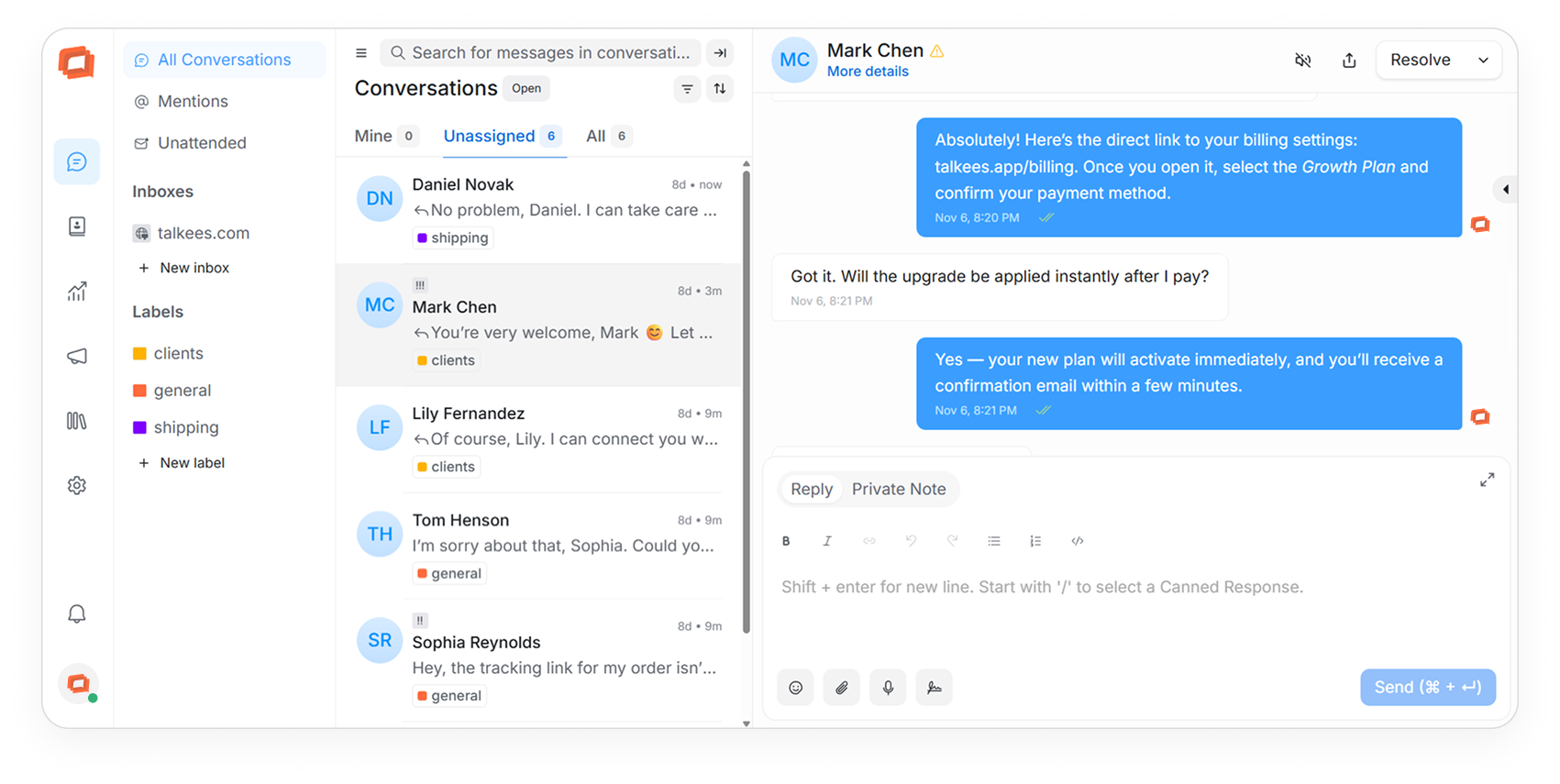
- Unified inbox: Manage email, live chat, social DMs (Facebook, Instagram), and SMS in one place
- AI chatbots: Intelligent automation that can handle up to 40% of repetitive customer inquiries
- WhatsApp integration: Direct API connection for business messaging
- Thread-based conversations: Keep all customer interactions in one timeline
- Canned responses: Quick reply templates for common questions
Who Should Choose Talkees?
- E-commerce businesses needing a unified inbox for customer support
- Support-heavy SMBs wanting to reduce response times across channels
- Teams prioritizing conversation quality over complex marketing campaigns
- Businesses looking to implement AI chat without enterprise-level costs
Talkees Advantages
- Simplicity: Focus on conversations rather than complex marketing features
- No contact-based billing: Predictable costs regardless of database size
- Fast implementation: Quick setup without lengthy onboarding
- AI-powered assistance: Suggested replies and conversation summaries
Talkees Limitations
- Not a full marketing automation platform: Focused on conversations rather than campaigns
- Less advanced email marketing: Basic email functionality compared to dedicated platforms
Our Experience with Talkees
During our testing, we found Talkees particularly impressive for its straightforward approach to omnichannel support. The AI chatbot was surprisingly effective at handling basic customer inquiries, and the unified inbox made managing conversations across different channels much simpler than juggling multiple platforms. For teams that spend more time in conversations than building marketing campaigns, Talkees offers a refreshing alternative to HubSpot’s complexity.
Mailchimp vs HubSpot: Which Is Better for SMB Email Marketing?

Mailchimp is one of the most recognized names in email marketing and offers a compelling alternative to HubSpot for small to medium-sized businesses.
Mailchimp Overview
- Pricing:
- Free: Up to 500 contacts, 1,000 monthly sends
- Essentials: From $13/month for 500 contacts
- Standard: From $20/month for 500 contacts
- Premium: From $350/month for 10,000+ contacts
Key Features
- User-friendly editor: Intuitive drag-and-drop email builder
- Customer Journey Builder: Visual automation canvas
- Content Optimizer: AI-powered suggestions for improving emails
- Send Time Optimization: Automatic delivery at optimal times
- Extensive template library: 100+ modern, responsive designs
- Strong e-commerce integration: Deep connections with Shopify, WooCommerce
Who Should Choose Mailchimp?
- Small businesses needing easy-to-use email marketing
- E-commerce stores wanting strong integration with shopping platforms
- Teams with limited technical resources who need intuitive tools
- Businesses prioritizing design and visual appeal in their emails
Mailchimp Advantages
- Ease of use: One of the most user-friendly interfaces in the market
- Excellent deliverability: Consistently strong inbox placement rates
- Strong free plan: Generous features for businesses just starting out
- Rich template library: Professional designs that require minimal customization
Mailchimp Limitations
- Limited CRM capabilities: Basic contact management compared to HubSpot
- Pricing scales steeply: Costs increase significantly with larger contact lists
- Less sophisticated automation: Fewer advanced branching options than HubSpot
Our Experience with Mailchimp
When testing Mailchimp, we were impressed by how quickly we could create and send professional-looking campaigns. The platform excels at making email marketing accessible to non-technical users, with its intuitive editor and helpful design suggestions. For businesses that primarily need strong email capabilities without complex CRM features, Mailchimp offers excellent value, especially at lower contact tiers.
Constant Contact vs HubSpot: Event Marketing and User Experience

Constant Contact offers a straightforward alternative to HubSpot with particular strengths in event marketing and local business promotion.
Constant Contact Overview
- Pricing:
- Core: Starting around $12-35/month (based on contacts)
- Plus: Higher tier with additional features
Key Features
- Event management tools: Registration, ticketing, and promotion
- Survey capabilities: Built-in tools for customer feedback
- Social media posting: Schedule and manage social content
- Simple automation: Basic drip campaigns and welcome series
- Strong local business tools: List growth features for physical stores
- Eventbrite integration: Seamless connection for event marketing
Who Should Choose Constant Contact?
- Local SMBs running events and in-person promotions
- Non-profits managing fundraisers and donor communications
- Businesses with simple email needs who value phone support
- Teams wanting straightforward tools without complex features
Constant Contact Advantages
- Excellent phone support: Strong reputation for customer service
- Event marketing focus: Superior tools for managing registrations
- Simple learning curve: Fast onboarding for non-technical users
- Donation collection: Built-in tools for non-profits
Constant Contact Limitations
- Basic automation: Less sophisticated workflow options than HubSpot
- Limited CRM features: Minimal sales pipeline functionality
- Fewer integrations: Smaller app ecosystem than some competitors
Our Experience with Constant Contact
In our testing, Constant Contact stood out for its simplicity and focus on practical tools for local businesses. The event management features were particularly impressive, making it easy to create, promote, and manage registrations. While it lacks some of the advanced capabilities of HubSpot, its straightforward approach and excellent customer support make it an attractive option for businesses that prioritize ease of use and event marketing.
SendGrid vs HubSpot: Transactional Email Capabilities

SendGrid offers a developer-friendly alternative to HubSpot with exceptional capabilities for transactional email and high-volume sending.
SendGrid Overview
- Pricing:
- Free: 100 emails/day
- Essentials: From $19.95/month for 50,000 emails
- Pro: From $89.95/month for 100,000 emails
- Premier: Custom pricing for enterprise needs
Key Features
- API-first approach: Comprehensive developer tools and SDKs
- Transactional email excellence: Optimized for system-triggered messages
- Dedicated IPs: Available for improved deliverability
- Detailed analytics: Comprehensive delivery and engagement metrics
- Email validation: Tools to verify email addresses
- Marketing Campaigns: Visual email builder and basic automation
Who Should Choose SendGrid?
- Developers and technical teams needing API-driven email
- Businesses sending high volumes of transactional messages
- E-commerce platforms requiring reliable order confirmations
- SaaS applications with user notifications and system alerts
SendGrid Advantages
- Superior deliverability: Industry-leading inbox placement
- Scalability: Handles massive email volumes efficiently
- Detailed event tracking: Comprehensive analytics on delivery and engagement
- Developer-friendly: Excellent documentation and implementation support
SendGrid Limitations
- Less marketing-focused: Primarily designed for transactional email
- Steeper learning curve: More technical than marketing-centric platforms
- Basic CRM capabilities: Limited contact management compared to HubSpot
Our Experience with SendGrid
During our evaluation, SendGrid impressed us with its reliability and technical capabilities. For businesses that prioritize transactional email and have technical resources, it offers unmatched deliverability and scalability. The platform’s API-first approach makes it ideal for developers, though marketing teams might find it less intuitive than more visual platforms. When paired with a lightweight marketing tool, SendGrid provides a powerful alternative to HubSpot for email-heavy applications.
Comparing MailerLite and HubSpot: Prioritizing Speed over Features

MailerLite offers a streamlined, affordable alternative to HubSpot for businesses that value simplicity and quick implementation.
MailerLite Overview
- Pricing:
- Free: Up to 1,000 subscribers (with limitations)
- Growing Business: From approximately $9/month for 1,000 subscribers
- Advanced: Higher tier with additional features
Key Features
- Clean, minimal editor: Straightforward drag-and-drop interface
- Website builder: Create landing pages and simple websites
- Survey tools: Built-in forms for customer feedback
- Automation workflows: Visual builder for email sequences
- E-commerce integrations: Connect with Shopify, WooCommerce
- Rich template library: 100+ responsive designs
Who Should Choose MailerLite?
- Startups and small businesses with limited marketing budgets
- Solo entrepreneurs needing simple but effective email tools
- Teams valuing speed over complexity in campaign creation
- Businesses with straightforward marketing needs
MailerLite Advantages
- Exceptional value: Feature-rich platform at affordable prices
- Intuitive interface: One of the cleanest, most user-friendly designs
- Fast implementation: Quick setup without extensive training
- Strong free plan: Generous features for businesses just starting
MailerLite Limitations
- Limited CRM capabilities: Basic contact management only
- Fewer advanced features: Less sophisticated than HubSpot’s full suite
- Basic reporting: Less detailed analytics than enterprise platforms
Our Experience with MailerLite
In our testing, MailerLite stood out for its remarkable balance of simplicity and capability. We were able to create professional campaigns within minutes of signing up, without sacrificing essential features. The platform’s clean interface and logical workflow make it particularly suitable for small teams that need to move quickly without extensive training. While it lacks some of HubSpot’s advanced features, its value proposition is compelling for businesses that prioritize speed and affordability.
ConvertKit vs HubSpot: Solutions for Creators and Solo Entrepreneurs

ConvertKit offers a creator-centric alternative to HubSpot, designed specifically for content creators, authors, and digital entrepreneurs.
ConvertKit Overview
- Pricing:
- Free: Up to 1,000 subscribers (with limitations)
- Creator: From $15/month
- Creator Pro: From $29/month
Key Features
- Visual automation builder: Intuitive workflow creation
- Tag-based segmentation: Flexible contact organization
- Commerce tools: Sell digital products and subscriptions
- Landing page builder: Create opt-in pages without coding
- Creator-focused templates: Designed for content marketing
- Subscriber-first model: Focus on audience relationships
Who Should Choose ConvertKit?
- Content creators (bloggers, podcasters, YouTubers)
- Digital product sellers offering courses or downloads
- Newsletter publishers focused on building audiences
- Solo entrepreneurs with content-driven businesses
ConvertKit Advantages
- Creator-centric design: Tools built specifically for content businesses
- Excellent tagging system: Flexible organization without complex lists
- Built-in commerce: Sell products without additional platforms
- Simple but powerful automation: Logical workflows without overwhelm
ConvertKit Limitations
- Less B2B focused: Not designed for complex sales processes
- Limited CRM features: Basic contact management compared to HubSpot
- Fewer integrations: Smaller ecosystem than enterprise platforms
Our Experience with ConvertKit
During our evaluation, ConvertKit impressed us with its laser focus on serving creators. The platform makes it remarkably easy to set up lead magnets, create audience segments, and monetize content. The visual automation builder strikes an excellent balance between power and simplicity, making it accessible to non-technical users while still offering meaningful capabilities. For content-driven businesses, ConvertKit provides a refreshing alternative to HubSpot’s broader but more complex approach.
GetResponse vs HubSpot: Comprehensive Marketing Solutions

GetResponse offers an all-in-one marketing platform that competes with HubSpot across email, webinars, landing pages, and automation.
GetResponse Overview
- Pricing:
- Free: Basic features for up to 500 contacts
- Email Marketing: From $19/month
- Marketing Automation: From $59/month
- E-commerce Marketing: From $119/month
Key Features
- Webinar hosting: Built-in webinar platform
- Conversion funnels: End-to-end sales process tools
- Website builder: Create landing pages and simple sites
- Marketing automation: Visual workflow builder
- E-commerce tools: Product recommendations and abandoned cart recovery
- Autoresponders: Time and action-based email sequences
Who Should Choose GetResponse?
- SMBs needing webinar capabilities integrated with marketing
- E-commerce businesses wanting comprehensive marketing tools
- Lean marketing teams seeking an all-in-one solution
- Businesses running online events as part of their strategy
GetResponse Advantages
- Built-in webinar platform: No need for separate webinar software
- Comprehensive toolkit: Wide range of features in one platform
- Strong automation capabilities: Sophisticated workflow options
- Good value proposition: Competitive pricing for feature set
GetResponse Limitations
- Less CRM functionality: Basic sales tools compared to HubSpot
- Learning curve: Feature richness creates some complexity
- Mobile app limitations: Less robust than desktop experience
Our Experience with GetResponse
In our testing, GetResponse stood out for its impressive breadth of features at a competitive price point. The built-in webinar platform is a genuine differentiator, eliminating the need for separate software. The conversion funnel feature makes it easy to create complete marketing campaigns, from landing page to sale. While it may not match HubSpot’s depth in CRM capabilities, GetResponse offers an excellent alternative for marketing teams that need comprehensive tools without the enterprise price tag.
Marketo vs HubSpot: Enterprise-Level Marketing Automation

Marketo (Adobe Marketo Engage) provides an enterprise-grade alternative to HubSpot for organizations with complex marketing needs and larger budgets.
Marketo Overview
- Pricing: Starting from approximately $1,195-$4,195+/month depending on package and database size
Key Features
- Advanced lead management: Sophisticated scoring and nurturing
- Account-based marketing (ABM): Tools for targeting key accounts
- Revenue attribution: Connect marketing activities to revenue
- Custom objects: Flexible data model for complex organizations
- Enterprise governance: Role-based access and approval workflows
- Deep analytics: Advanced reporting and performance insights
Who Should Choose Marketo?
- Enterprise B2B organizations with complex sales cycles
- Companies with large marketing teams and specialized roles
- Businesses needing sophisticated ABM capabilities
- Organizations with governance and compliance requirements
Marketo Advantages
- Enterprise-grade capabilities: Handles complex marketing requirements
- Scalability: Supports large organizations and high volumes
- Deep customization: Flexible to match specific business processes
- Adobe integration: Connects with broader Adobe Experience Cloud
Marketo Limitations
- High cost: Significant investment compared to mid-market options
- Implementation complexity: Requires specialized expertise
- Steeper learning curve: More technical than user-friendly alternatives
Our Experience with Marketo
Marketo impressed us with its depth and flexibility for enterprise marketing operations. During our evaluation, we noted that while the platform has a steeper learning curve than HubSpot, it offers superior capabilities for large organizations with complex needs. The platform’s strength in lead scoring, account-based marketing, and revenue attribution make it particularly valuable for B2B enterprises with longer sales cycles. However, the implementation and ongoing management require dedicated resources and expertise.
ActiveCampaign vs HubSpot: Deep Automation and User Experience

ActiveCampaign offers a powerful alternative to HubSpot with exceptional automation capabilities at a more accessible price point.
ActiveCampaign Overview
- Pricing:
- Lite: From $15/month (1,000 contacts)
- Plus: From $49/month (1,000 contacts)
- Professional: From $149/month (1,000 contacts)
- Enterprise: From $259/month (1,000 contacts)
Key Features
- Visual automation builder: Intuitive workflow creation with advanced branching
- CRM with deals pipeline: Sales automation and tracking
- Predictive sending: AI-optimized email delivery timing
- Split actions: Test different paths in automation workflows
- Site tracking: Visitor behavior monitoring for targeted messaging
- Lead and customer scoring: Automated prioritization based on engagement
Who Should Choose ActiveCampaign?
- SMBs needing sophisticated automation without enterprise costs
- E-commerce businesses requiring advanced customer journeys
- Marketing teams focused on personalization and targeted messaging
- Organizations wanting CRM and marketing in one platform
ActiveCampaign Advantages
- Automation depth: One of the best visual builders at this price point
- Value proposition: Advanced features at mid-market pricing
- Strong deliverability: Consistently high inbox placement rates
- Flexible CRM: Sales automation without the complexity of enterprise platforms
ActiveCampaign Limitations
- Learning curve for advanced features: Power comes with some complexity
- Pricing increases with contact growth: Costs scale with database size
- Less content-focused: Fewer built-in content creation tools than HubSpot
Our Experience with ActiveCampaign
During our evaluation, ActiveCampaign impressed us with its exceptional automation capabilities. The visual workflow builder is among the best we’ve tested, making it easy to create sophisticated customer journeys with conditional logic. The platform offers an excellent balance of power and usability, with particular strength in behavioral automation and e-commerce sequences. For businesses that prioritize automation depth without HubSpot’s price tag, ActiveCampaign represents a compelling alternative.
Sendinblue vs HubSpot: Multichannel Marketing and Compliance

Sendinblue (now Brevo) offers a flexible, multichannel alternative to HubSpot with particular strengths in transactional email and European compliance.
Sendinblue (Brevo) Overview
- Pricing:
- Free: Up to 300 emails per day
- Starter: From $9/month for 5,000 emails
- Business: From $18/month for higher volumes
- Enterprise: Custom pricing for large organizations
Key Features
- Email + SMS marketing: Integrated multichannel campaigns
- Transactional email API: Built-in system messaging capabilities
- Chat functionality: Website live chat and chatbots
- Landing page builder: Create conversion-focused pages
- Marketing automation: Visual workflow builder
- CRM features: Contact management and sales tracking
Who Should Choose Sendinblue (Brevo)?
- Businesses with large contact databases but moderate sending volume
- European companies concerned with data residency and GDPR
- Organizations needing combined marketing and transactional email
- SMBs looking for multichannel capabilities (email, SMS, chat)
Sendinblue (Brevo) Advantages
- Unlimited contacts: Pay for emails sent, not contacts stored
- Built-in transactional email: No separate platform needed
- European origins: Strong GDPR compliance and EU data centers
- Flexible pricing model: Pay-as-you-grow approach
Sendinblue (Brevo) Limitations
- Less advanced CRM: Basic sales tools compared to HubSpot
- Simpler automation: Less sophisticated than enterprise platforms
- Template limitations: Fewer design options than some competitors
Our Experience with Sendinblue (Brevo)
In our testing, Sendinblue (Brevo) stood out for its flexible approach to pricing and multichannel capabilities. The platform’s model of charging based on email volume rather than contacts stored makes it particularly attractive for businesses with large databases that don’t email frequently. The built-in transactional email functionality is a significant advantage, eliminating the need for a separate service. While the automation capabilities aren’t as advanced as HubSpot’s, they’re more than sufficient for most SMB needs.
Conclusion: Choosing the Right HubSpot Alternative for Your Business

Selecting the right HubSpot alternative depends on your specific needs, budget, and priorities:
- For omnichannel customer support: Talkees offers a streamlined approach to managing conversations across email, chat, social, and SMS without the complexity of a full marketing suite.
- For SMB email marketing: Mailchimp provides an intuitive platform with excellent templates and e-commerce integration at a more accessible price point than HubSpot.
- For event-focused marketing: Constant Contact delivers specialized tools for event management and local business promotion with exceptional customer support.
- For transactional email: SendGrid excels at delivering system messages with superior deliverability and developer-friendly tools.
- For speed and simplicity: MailerLite offers a clean, efficient platform that prioritizes quick implementation without sacrificing essential features.
- For content creators: ConvertKit provides specialized tools for building and monetizing audiences through content-driven marketing.
- For all-in-one marketing with webinars: GetResponse combines email, landing pages, and webinar capabilities in one affordable platform.
- For enterprise needs: Marketo delivers sophisticated capabilities for large organizations with complex requirements and dedicated resources.
- For automation depth: ActiveCampaign offers exceptional workflow capabilities at a more accessible price point than HubSpot’s higher tiers.
- For flexible, multichannel marketing: Sendinblue (Brevo) provides email, SMS, and transactional capabilities with a pay-for-what-you-send pricing model.
When evaluating these alternatives, consider not just the features and pricing today, but how the platform will scale with your business growth. The right choice balances your current needs with future flexibility, ensuring you don’t outgrow your marketing automation solution too quickly.
Looking for more HubSpot comparisons? Check out our roundup: 10 Best HubSpot Helpdesk, Support & Service Desk Alternatives & Competitors (Free & Paid).