 English
 Slovenčina
 Français
 Magyar
Why Teams Seek Helpwise Alternatives: Understanding Pain Points and Limitations
Many businesses outgrow Helpwise due to specific limitations that impact their customer support operations. The most common reasons teams explore alternatives include:
- Pricing constraints: As teams scale, Helpwise’s per-agent pricing model can become costly, especially when compared to alternatives with more flexible pricing structures.
- AI capabilities limitations: While Helpwise offers basic AI functionality, teams requiring advanced AI for automation, sentiment analysis, and customer intent detection often need more robust solutions.
- Omnichannel gaps: Some teams find Helpwise’s channel integration insufficient, particularly for specialized needs like deep e-commerce integrations or advanced WhatsApp Business capabilities.
- Performance issues: Users occasionally report notification delays, mobile app limitations, and UI inconsistencies that slow down support operations.
Understanding these pain points is crucial when evaluating alternatives that might better address your specific requirements.
What to Look for in Helpwise Competitors: Essential Features and Capabilities
When evaluating Helpwise alternatives, focus on these key capabilities that will drive efficiency and customer satisfaction:
AI Depth and Integration
Look for platforms with robust AI capabilities including:
- Intelligent chatbots that can handle complex conversations
- AI-assisted reply suggestions that learn from your team’s best responses
- Automatic tagging and prioritization based on message content
- Sentiment analysis to identify urgent or sensitive conversations
True Omnichannel Support
Ensure the platform offers genuine omnichannel capabilities:
- Unified inbox for email, live chat, SMS, WhatsApp, and social media
- Consistent experience and features across all channels
- Ability to continue conversations across different channels seamlessly
- Channel-specific features (like WhatsApp templates or Instagram DM tools)
E-commerce Integration
For online retailers, deep e-commerce integration is essential:
- Order data displayed alongside customer conversations
- Ability to process refunds, check inventory, or modify orders without switching tabs
- Integration with your specific e-commerce platform (Shopify, WooCommerce, BigCommerce, etc.)
- Customer purchase history and lifetime value insights
Automation and Workflow Tools
Evaluate the platform’s ability to automate routine tasks:
- Rule-based routing and assignment
- SLA monitoring and escalation
- Canned responses and macros
- Automated follow-ups and customer satisfaction surveys
Analytics and Reporting
Comprehensive analytics help optimize your support operations:
- Team performance metrics (response times, resolution rates, CSAT)
- Channel-specific analytics
- Custom report builders
- Trend identification and forecasting
Fair and Transparent Pricing
Consider the pricing structure and how it scales with your business:
- Per-agent vs. per-conversation pricing models
- Feature availability across different pricing tiers
- Additional costs for channels, AI features, or analytics
- Contract flexibility and minimum seat requirements
Helpwise at a Glance: Strengths and Limitations for SMBs and E-shops
Before exploring alternatives, let’s establish a clear picture of Helpwise’s current positioning:
Helpwise Strengths
- Unified inbox experience that consolidates email, chat, SMS, WhatsApp, and social channels
- Collaborative tools including shared drafts, collision detection, and internal notes
- Automation capabilities with rule-based workflows and assignments
- Reasonable starting price point for small teams
- Responsive support team frequently praised in user reviews
Helpwise Limitations
- AI capabilities are more basic compared to AI-first competitors
- Reporting depth is sometimes cited as limited by power users
- Mobile experience can be inconsistent across devices
- E-commerce integrations lack the depth offered by specialized competitors
- Enterprise features like advanced compliance certifications are limited
For SMBs and e-commerce businesses, these limitations may become more pronounced as support volumes grow and customer expectations increase.
Free vs. Paid Helpwise Alternatives: Understanding the Trade-offs
When evaluating Helpwise alternatives, it’s important to understand the distinction between free and paid options:
Free Alternatives to Helpwise
Several platforms offer free tiers or plans that can serve as Helpwise alternatives:
- MessageBird: Free for up to 50 conversations per month
- Missive: Offers a free plan with limited users and features
- Some alternatives offer extended free trials: Enchant (30 days), DelightChat (14 days)
However, free plans typically come with significant limitations:
- Restricted number of users or conversations
- Limited channel support (often email-only)
- Basic or no automation capabilities
- Limited or no access to AI features
- Minimal reporting and analytics
- Branded elements that can’t be removed
Paid Alternatives: What You’re Actually Paying For
Paid plans unlock the full potential of these platforms with:
- Complete omnichannel support
- Advanced AI and automation
- Comprehensive analytics and reporting
- White-labeled customer experiences
- Priority support and dedicated onboarding
- Enterprise-grade security and compliance features
Watch Out for These Pricing Gotchas
Before committing to any alternative, be aware of these common pricing traps:
- Hidden seat minimums: Some vendors require a minimum number of seats (e.g., Gladly requires at least 10 seats at $150/agent)
- Annual contract requirements: Many platforms offer significant discounts for annual commitments but lock you in
- Feature gating: Essential features like CSAT surveys or advanced reporting may only be available on higher tiers
- Per-conversation limits: Some e-commerce-focused platforms cap tickets and charge for overages
- Channel add-ons: WhatsApp, voice, and other channels often incur additional costs
- AI usage fees: Some platforms charge extra for AI features or have usage limits
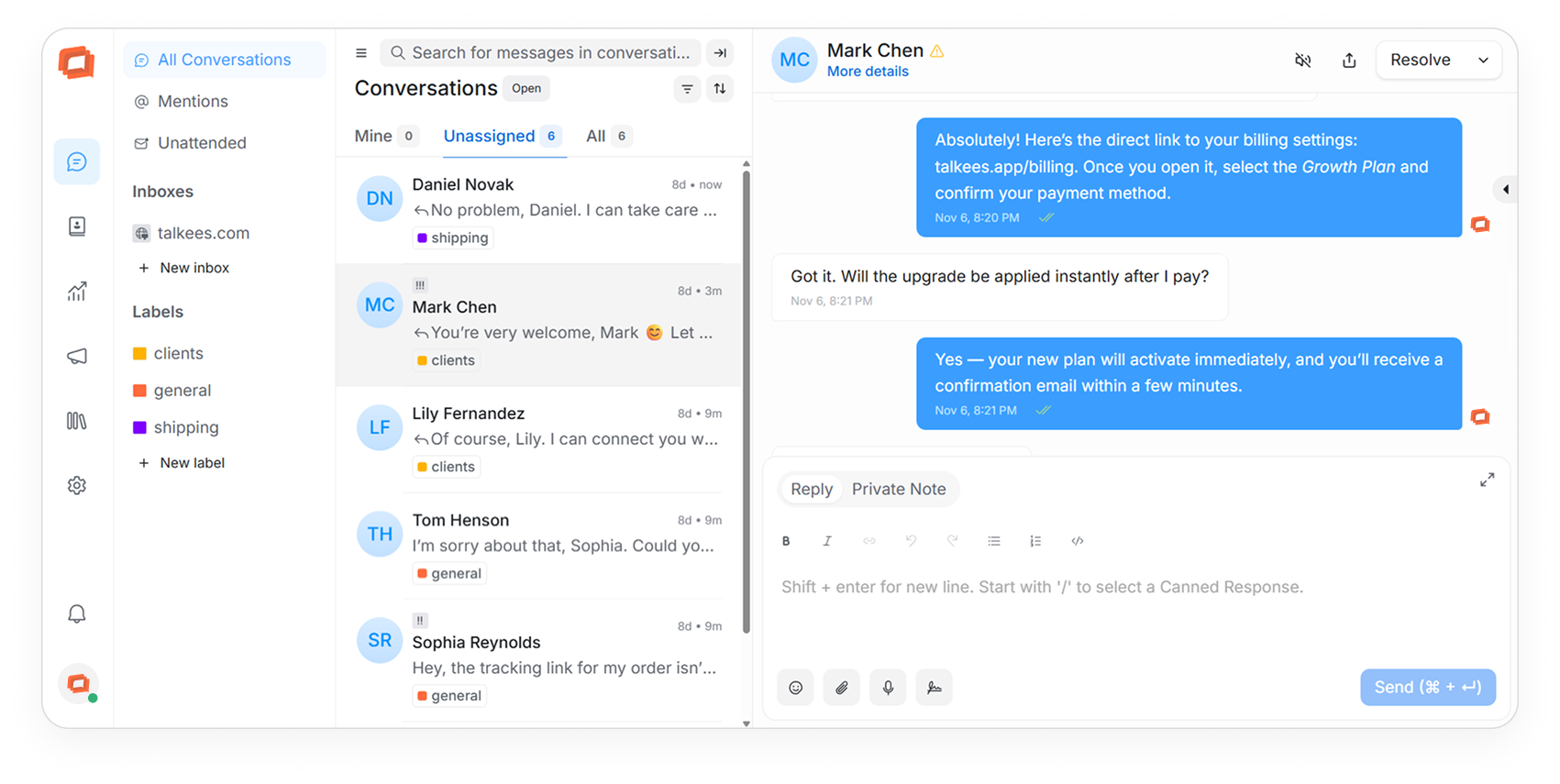
Talkees: The AI-First Omnichannel Solution with E-commerce Focus
Helpwise vs. Talkees: While Helpwise offers a solid shared inbox experience, Talkees takes support to the next level with its AI-first approach and deep e-commerce integrations.
Product Overview
Talkees is an AI-powered omnichannel support platform designed specifically for modern businesses that need to handle customer conversations across multiple channels while leveraging artificial intelligence to boost efficiency.
Key Features
- AI-powered chatbot: Built-in conversational AI that can handle common customer queries, collect information, and seamlessly hand off to human agents when needed
- Omnichannel inbox: Unified interface for email, live chat, WhatsApp, SMS, and social media
- Deep e-commerce integrations: Native connections to Shopify, WooCommerce, and other platforms with order data displayed alongside conversations
- Advanced automation: Rule-based workflows, intelligent routing, and SLA management
- Comprehensive analytics: Detailed reporting on team performance, customer satisfaction, and conversation trends
Pricing
- Starter: $29/month for 3 agents
- Growth: $79/month for 10 agents
- Scale: $199/month for 25 agents
- Enterprise: Custom pricing for larger teams
- All plans include the core AI chatbot functionality with tiered conversation limits
Pros
- True AI-first platform with sophisticated chatbot capabilities
- No seat minimums or long-term contracts required
- Transparent pricing with no hidden fees
- Excellent e-commerce integrations
- Modern, intuitive user interface
- Responsive support team
Cons
- Newer platform compared to some established competitors
- Mobile app still evolving with new features
- Some advanced enterprise features still in development
Our Experience with Talkees
During our testing, we were impressed by how quickly Talkees’ AI chatbot could be configured to handle common e-commerce scenarios like order tracking and returns. The platform felt modern and responsive, with a clean interface that new agents could learn in minutes rather than hours.
The e-commerce integration was particularly strong, pulling order details directly into conversations without requiring agents to switch between systems. The AI suggestions for agent responses were surprisingly accurate and improved noticeably during our testing period as the system learned from our team’s responses.
For businesses looking for an AI-first approach with straightforward pricing and no complicated contracts, Talkees represents an excellent Helpwise alternative.
Front: Collaboration-Centric Shared Inbox with Powerful Rules
Helpwise vs. Front: While Helpwise focuses on a straightforward shared inbox experience, Front offers more sophisticated collaboration features and powerful automation rules.
Product Overview
Front transforms email into a powerful customer communication platform by combining the familiarity of email with team collaboration tools and powerful automation capabilities.
Key Features
- Collaborative inbox: Shared drafts, internal comments, and @mentions
- Powerful rules engine: Complex automation with multiple conditions and actions
- Omnichannel support: Email, SMS, WhatsApp, social media, and custom channels
- CRM-like features: Customer context and history alongside conversations
- Extensive integrations: Connects with 50+ tools including Salesforce, Slack, and Jira
Pricing
- Starter: $19/user/month (10+ users)
- Growth: $59/user/month
- Scale: $99/user/month
- Premier: $229/user/month
- Annual contracts typically required for most plans
Pros
- Excellent collaboration features
- Powerful and flexible rules engine
- Clean, email-like interface that’s easy to adopt
- Strong integration ecosystem
- Solid mobile applications
Cons
- Higher per-seat costs compared to many alternatives
- Annual contracts required for most plans
- Can become expensive as teams scale
- Some advanced features only available on higher tiers
Our Experience with Front
When testing Front, we found its collaboration features to be exceptional. The ability to have internal discussions within email threads without creating separate chat conversations streamlined our workflow significantly.
The rules engine is one of the most powerful we’ve seen, allowing for complex automation scenarios that would require custom development on other platforms. However, this power comes at a price—both in terms of the learning curve and the actual cost per seat.
Front’s interface feels like a natural extension of email, which makes adoption easy for teams transitioning from shared Gmail or Outlook inboxes. However, the requirement for annual contracts and the relatively high per-seat cost make it less accessible for smaller teams or those with seasonal staffing fluctuations.
Gmelius: Gmail-Native Collaboration for Google Workspace Teams
Helpwise vs. Gmelius: While Helpwise operates as a separate platform, Gmelius lives directly inside Gmail, offering a seamless experience for Google Workspace users.
Product Overview
Gmelius transforms Gmail into a collaborative workspace with shared inboxes, automation, and project management capabilities—all without leaving the familiar Gmail interface.
Key Features
- Gmail-native experience: Works directly inside Gmail with no separate platform to learn
- Shared Gmail labels: Collaborate on emails using Gmail’s existing organizational structure
- Kanban boards: Convert emails into tasks with visual workflow management
- Email sequences: Automate follow-ups and drip campaigns
- Two-way Slack integration: Manage emails directly from Slack
Pricing
- Flex: $15/month for the whole team (limited features)
- Growth: $24/user/month
- Pro: $36/user/month
- 7-day free trial available
Pros
- Minimal learning curve for Gmail users
- No context switching between platforms
- Powerful collaboration directly in Gmail
- Kanban project management built-in
- Excellent Slack integration
Cons
- Limited to Google Workspace users
- Not truly omnichannel (primarily email-focused)
- Mobile experience more limited than desktop
- Less robust reporting compared to dedicated helpdesks
Our Experience with Gmelius
During our testing, Gmelius impressed us with its seamless integration into Gmail. For teams already using Google Workspace, the ability to add collaboration features without switching platforms creates a frictionless experience.
The Kanban boards are particularly useful for teams that manage projects through email, allowing visual tracking of conversation status. The email sequences feature also proved valuable for consistent follow-ups and onboarding communications.
However, Gmelius’s Gmail-centric approach is both its strength and limitation. Teams needing true omnichannel support (especially WhatsApp or social media) will find it lacking compared to dedicated platforms like Helpwise. The mobile experience, while functional, doesn’t match the desktop version’s capabilities.
For Google-centric teams focused primarily on email collaboration, Gmelius offers a compelling alternative to Helpwise with minimal disruption to existing workflows.
Hiver: Full Helpdesk Inside Gmail with Strong SLAs and Analytics
Helpwise vs. Hiver: While Helpwise operates as a separate platform, Hiver transforms Gmail into a complete helpdesk without requiring users to leave their inbox.
Product Overview
Hiver turns Gmail into a powerful customer service platform with shared inboxes, automation, and analytics—all while maintaining the familiar Gmail interface.
Key Features
- Native Gmail integration: Works entirely within Gmail
- Collision detection: Prevents duplicate responses
- SLA management: Set and track response time goals
- Harvey AI Copilot: AI assistant for summarizing emails, suggesting replies, and automating tasks
- Analytics dashboard: Comprehensive reporting on team performance
- CSAT surveys: Measure customer satisfaction directly from email
Pricing
- Lite: $15-19/user/month
- Pro: $39/user/month
- Elite: $49-59/user/month
- Free trial available
Pros
- Zero learning curve for Gmail users
- Strong SLA and analytics capabilities
- Excellent AI assistant features
- Good mobile experience through Gmail app
- Doesn’t require customers to adapt to a new system
Cons
- Limited to Google Workspace users
- Not truly omnichannel without additional integrations
- Less customizable than standalone platforms
- Some advanced features only available on higher tiers
Our Experience with Hiver
Testing Hiver revealed a thoughtfully designed product that brings helpdesk functionality to Gmail without overwhelming users. The ability to assign emails, track SLAs, and collaborate with teammates without leaving Gmail creates a seamless experience.
The Harvey AI Copilot proved surprisingly effective, offering genuinely helpful summaries of long email threads and suggesting contextually appropriate responses. The analytics dashboard provides clear visibility into team performance metrics that help identify bottlenecks.
However, Hiver’s Gmail-centric approach means it lacks native support for channels beyond email. While integrations can extend its capabilities, teams requiring true omnichannel support might find the experience less cohesive than with dedicated platforms like Helpwise.
For teams deeply invested in Gmail that primarily support customers via email, Hiver offers a compelling alternative with minimal disruption to existing workflows.
SupportBox: Pragmatic Shared Inbox for Central-European E-shops
Helpwise vs. SupportBox: While Helpwise offers broad channel support, SupportBox provides specialized features for Central European e-commerce businesses, particularly those using the Upgates platform.
Product Overview
SupportBox is a pragmatic omnichannel support solution designed specifically for Central European e-shops, with deep integration into the Upgates e-commerce platform and localized support.
Key Features
- Deep Upgates integration: Displays order status, customer details, and purchase history directly in conversations
- Omnichannel support: Email, live chat, Facebook Messenger, Instagram DMs, and PBX/phone
- AI capabilities: Automated reply generation, message translation, conversation summarization, and call transcription
- Chatbots: AI-powered bots that can handle up to 60% of common customer queries
- Regional focus: Designed for Central European markets with local language support
Pricing
- Flexible model: Pay only for the channels and users you actually use
- Upgates activation: Free through the Upgates marketplace
- Contact for detailed pricing: +420 778 443 348 or info@supportbox.cz
Pros
- Exceptional integration with Upgates e-commerce platform
- Regional expertise for Central European markets
- Local language support (Czech, Slovak)
- Flexible pricing model ideal for seasonal businesses
- Strong AI capabilities including translation
Cons
- Regional focus may limit global scaling
- Less well-known outside Central Europe
- Fewer third-party integrations than some competitors
- Documentation primarily in Czech
Our Experience with SupportBox
During our evaluation, SupportBox impressed us with its deep integration with the Upgates platform. For e-commerce businesses using Upgates, the ability to see complete order details, customer history, and purchase value directly within customer conversations creates a significant efficiency advantage.
The AI features performed well in our testing, particularly the translation capabilities which are essential for businesses serving multiple European markets. The chatbot functionality successfully handled basic customer queries about order status, shipping, and returns without human intervention.
The flexible pricing model is particularly advantageous for seasonal businesses that need to scale support up and down throughout the year. For Central European e-commerce businesses, especially those on the Upgates platform, SupportBox offers specialized functionality that generic helpdesk solutions can’t match.
Help Scout: Lightweight Helpdesk with Beacon Chat and Knowledge Base
Helpwise vs. Help Scout: While Helpwise focuses on omnichannel capabilities, Help Scout excels at combining email support, live chat, and self-service knowledge base in a streamlined package.
Product Overview
Help Scout offers a streamlined customer support platform that combines shared inbox functionality with live chat and a robust knowledge base system, all designed to provide a personal touch to customer interactions.
Key Features
- Shared inbox: Collaborative email management with notes, assignments, and workflows
- Beacon chat: Embedded live chat widget with contextual help articles
- Docs: Powerful knowledge base with built-in SEO tools
- Automation: Workflows, saved replies, and satisfaction ratings
- Reporting: Comprehensive performance metrics and customer insights
Pricing
- Standard: $20/user/month
- Plus: $40/user/month
- Pro: $65/user/month
- 15-day free trial available
Pros
- Clean, intuitive interface with minimal learning curve
- Excellent knowledge base functionality
- Good balance of features without overwhelming complexity
- Strong focus on customer experience
- Fair, transparent pricing
Cons
- Limited customization compared to enterprise platforms
- Fewer native integrations than some competitors
- Not as feature-rich for omnichannel support
- Mobile app has some limitations
Our Experience with Help Scout
When testing Help Scout, we were impressed by its thoughtful design and focus on creating personal customer experiences. The platform strikes an excellent balance between functionality and simplicity, making it easy for new team members to become productive quickly.
The Beacon chat widget is particularly well-executed, allowing customers to search knowledge base articles before starting a conversation—significantly reducing ticket volume for common questions. The knowledge base system (Docs) is one of the best we’ve seen, with excellent SEO tools and analytics.
While Help Scout doesn’t offer the same breadth of channel support as Helpwise, it excels at providing a cohesive experience across email, chat, and self-service. For teams that prioritize these channels and value simplicity over extensive customization, Help Scout offers an excellent alternative.
Zoho Desk: Suite-Driven Helpdesk with Deep Automation
Helpwise vs. Zoho Desk: While Helpwise offers a streamlined experience, Zoho Desk provides deeper automation capabilities and tight integration with the broader Zoho ecosystem.
Product Overview
Zoho Desk is a context-aware help desk software that helps businesses focus on the customer. As part of the Zoho ecosystem, it offers deep integration with Zoho’s CRM, marketing, and business process tools.
Key Features
- Zia AI assistant: Auto-tagging, sentiment analysis, and suggested replies
- Omnichannel support: Email, phone, chat, social media, and self-service
- Process automation: Advanced workflow rules and SLA management
- Customization: Highly adaptable interface and process flows
- Blueprint: Visual process designer for complex support workflows
- Extensive reporting: Customizable dashboards and analytics
Pricing
- Free: Up to 3 agents
- Standard: $14/agent/month
- Professional: $23/agent/month
- Enterprise: $40/agent/month
- Higher tier pricing reported between $44-63/agent/month for advanced features
Pros
- Powerful automation capabilities
- Excellent value for feature set
- Strong AI functionality with Zia
- Deep integration with Zoho ecosystem
- Highly customizable for complex workflows
Cons
- Steeper learning curve than simpler alternatives
- Complex UI can be overwhelming initially
- Setup and configuration can be time-consuming
- Some performance issues reported with heavy customization
- Best value realized when using multiple Zoho products
Our Experience with Zoho Desk
During our testing, Zoho Desk impressed us with its depth of functionality and automation capabilities. The Blueprint feature, which allows visual design of complex support processes, is particularly powerful for teams with sophisticated workflows.
Zia, Zoho’s AI assistant, provided useful insights and suggestions throughout our testing. Its sentiment analysis correctly identified urgent customer issues, and the auto-tagging feature accurately categorized incoming tickets, saving significant agent time.
The platform’s integration with other Zoho products creates a seamless experience for businesses using Zoho CRM or other suite applications. However, this power comes with complexity—setting up Zoho Desk optimally requires more time and technical knowledge than simpler alternatives like Helpwise.
For businesses willing to invest in setup and configuration, especially those already using other Zoho products, Zoho Desk offers exceptional value and capabilities that grow with your business.
LiveAgent: Omnichannel with Call Center and Legacy UI
Helpwise vs. LiveAgent: While Helpwise focuses on modern channels, LiveAgent offers comprehensive omnichannel support including robust call center functionality, albeit with a more traditional interface.
Product Overview
LiveAgent is a feature-rich customer support platform that combines ticketing, live chat, social media, email, and call center capabilities in a single solution.
Key Features
- Universal inbox: Consolidates all customer communications in one place
- Built-in call center: Native voice capabilities with IVR, call routing, and recording
- Live chat with real-time typing view: See what customers are typing before they send
- Video calling: Built-in video chat capability
- Extensive automation: 130+ automation rules and SLA management
- Self-service portal: Knowledge base and customer portal
Pricing
- Free: Limited plan for small teams
- Ticket: $15/agent/month
- Ticket+Chat: $29/agent/month
- All-Inclusive: $49/agent/month
Pros
- Comprehensive feature set covering all support channels
- Strong call center functionality built-in
- Excellent value for the feature set
- Good knowledge base and self-service options
- Robust time tracking and reporting
Cons
- Interface feels dated compared to modern alternatives
- Steeper learning curve due to feature density
- Setup can be complex and time-consuming
- Mobile experience less refined than desktop
- Some features feel bolted-on rather than integrated
Our Experience with LiveAgent
Testing LiveAgent revealed a platform with impressive breadth of functionality, particularly its native call center capabilities which eliminate the need for separate telephony solutions. The real-time typing view in live chat provides valuable insights into customer intent before they even submit their message.
The universal inbox successfully consolidates communications from multiple channels, though the interface feels more traditional than streamlined competitors like Helpwise. This isn’t necessarily a disadvantage for teams transitioning from legacy systems, but new users may face a steeper learning curve.
LiveAgent’s automation capabilities are extensive, with over 130 rules that can be configured to handle routine tasks. The time tracking feature provides valuable insights for workforce management and SLA compliance.
For businesses requiring comprehensive channel support including robust voice capabilities, LiveAgent offers exceptional value despite its more traditional interface and setup overhead.
HappyFox: Modern Workflows and Asset Management
Helpwise vs. HappyFox: While Helpwise offers a streamlined shared inbox, HappyFox provides more sophisticated workflow management and asset tracking capabilities.
Product Overview
HappyFox is a comprehensive help desk and customer support solution that combines ticket management, knowledge base, and workflow automation with asset management capabilities.
Key Features
- Smart ticket management: Advanced routing, tagging, and prioritization
- Asset management: Track hardware, software, and other assets alongside support tickets
- Workflow automation: Sophisticated rule engine and approval workflows
- Knowledge base: Self-service portal with contextual suggestions
- SLA management: Comprehensive service level agreement tracking and reporting
- Multilingual support: Interface and knowledge base in multiple languages
Pricing
- Mighty: Starting at $39/agent/month
- Fantastic: Starting at $59/agent/month
- Enterprise: Starting at $79/agent/month
- Enterprise Plus: Custom pricing
- Annual billing required; minimum 5 agents
Pros
- Modern, intuitive interface
- Strong workflow and task management
- Excellent asset tracking integration
- Robust SLA management
- Comprehensive reporting and analytics
Cons
- Higher starting price point
- Chat and bot features are add-ons
- Annual commitment required
- 5-agent minimum may deter very small teams
- Some advanced features limited to higher tiers
Our Experience with HappyFox
During our evaluation, HappyFox impressed us with its polished interface and sophisticated workflow capabilities. The platform strikes a good balance between power and usability, with an intuitive design that helps agents quickly adapt.
The asset management functionality is particularly valuable for teams that support internal users with hardware and software issues. Being able to track assets alongside support conversations creates a more complete picture of the customer’s environment.
The workflow automation engine is more powerful than what’s offered by Helpwise, allowing complex approval processes and conditional actions based on ticket attributes. The SLA management is also comprehensive, with granular control over business hours, response times, and escalation paths.
While HappyFox’s starting price is higher than some alternatives, the value becomes apparent for teams with complex workflows or asset tracking needs. The requirement for annual billing and minimum 5 agents does make it less accessible for very small or seasonal teams.
Zendesk: Enterprise Breadth with Steep Learning Curve and Pricing
Helpwise vs. Zendesk: While Helpwise offers a streamlined experience for small to mid-sized teams, Zendesk provides enterprise-grade capabilities with corresponding complexity and cost.
Product Overview
Zendesk is a comprehensive customer service platform that offers omnichannel support, extensive customization, and a vast marketplace of integrations and applications.
Key Features
- Complete omnichannel support: Email, chat, phone, social media, and messaging apps
- Extensive customization: Highly adaptable to complex business processes
- AI-powered automation: Answer Bot, suggested responses, and automated routing
- Robust reporting: Advanced analytics and custom dashboards
- Marketplace: 1,000+ integrations and applications
- Developer platform: APIs and tools for custom solutions
Pricing
- Suite Team: $49/agent/month
- Suite Growth: $79/agent/month
- Suite Professional: $99/agent/month
- Suite Enterprise: $150/agent/month
Pros
- Unmatched breadth of features and capabilities
- Extensive customization possibilities
- Large ecosystem of integrations and apps
- Robust enterprise-grade security and compliance
- Comprehensive reporting and analytics
Cons
- Steep learning curve for administrators
- Complex setup and configuration
- High cost, especially for advanced features
- Can feel overwhelming for smaller teams
- Performance can suffer with heavy customization
Our Experience with Zendesk
Testing Zendesk revealed a platform with exceptional depth and breadth of capabilities. For enterprise organizations with complex support requirements, Zendesk offers virtually unlimited possibilities through its extensive customization options and app marketplace.
The omnichannel experience is well-executed, with consistent handling of conversations across email, chat, phone, and messaging channels. The AI capabilities, particularly Answer Bot for self-service and suggested responses for agents, showed impressive accuracy during our testing.
However, this power comes at the cost of complexity. Setting up Zendesk optimally requires significant time investment and technical knowledge. The interface, while improved in recent versions, still presents a steeper learning curve than more streamlined alternatives like Helpwise.
For large organizations that need enterprise-grade capabilities and have the resources to properly implement and maintain the platform, Zendesk remains the industry standard. For smaller teams or those with straightforward requirements, the complexity and cost may outweigh the benefits.
Choosing the Right Helpwise Alternative by Use Case
Finding the ideal Helpwise alternative depends on your specific requirements. Here’s a breakdown of which solution works best for different scenarios:
For E-commerce Businesses Needing Live Chat + AI
- Best option: Talkees
- Why: Purpose-built for e-commerce with deep platform integrations and AI chatbot capabilities that significantly reduce agent workload
- Runner-up: SupportBox (especially for Central European e-shops using Upgates)
For SMBs Seeking Comprehensive Omnichannel Support
- Best option: LiveAgent
- Why: Offers the most complete channel coverage including native call center at a reasonable price point
- Runner-up: Helpwise (if your needs are more basic) or Zendesk (if budget allows)
For Google Workspace-Native Teams
- Best option: Hiver
- Why: Provides helpdesk functionality without leaving Gmail, minimizing disruption and training
- Runner-up: Gmelius (if Kanban-style workflow management is important)
For Teams Focused on Collaboration
- Best option: Front
- Why: Offers the strongest collaboration features with shared drafts and internal discussions
- Runner-up: Help Scout (for a simpler approach with lower per-seat costs)
For Enterprise-Scale Organizations
- Best option: Zendesk
- Why: Unmatched customization, security, compliance, and integration capabilities
- Runner-up: HappyFox (for organizations that need asset management alongside support)
For Budget-Conscious Teams
- Best option: Zoho Desk
- Why: Offers the best feature-to-price ratio, especially with the free tier for up to 3 agents
- Runner-up: LiveAgent’s Ticket plan ($15/agent/month)
Migrating from Helpwise: Ensuring a Smooth Transition
Planning a successful migration from Helpwise to a new platform requires careful preparation. Here’s how to ensure a smooth transition without disrupting your customer service:
Data Import Strategy
- Conversation history: Most alternatives offer import tools for historical conversations, though the completeness varies
- Tags and categories: Map your existing taxonomy to the new system before migration
- Templates and macros: Export and adapt your saved responses to the new platform’s format
- User accounts: Plan user provisioning and permission mapping in advance
Ensuring Automation Parity
- Document existing workflows: Map all current Helpwise automations before switching
- Test rule conversion: Build equivalent automations in your new system and test thoroughly
- Identify gaps: Some rules may need redesigning to work in the new environment
- Phase implementation: Start with critical automations, then add complexity gradually
Team Training Approach
- Create role-specific guides: Different team members need different levels of training
- Develop a training schedule: Include both group sessions and individual practice time
- Use real scenarios: Train on actual customer conversations from your business
- Designate super-users: Identify and train power users who can help others
- Plan for overlap: Maintain Helpwise access during the transition period
Measuring Migration Success
- Define baseline metrics: Document current performance (response times, resolution rates, CSAT)
- Set post-migration targets: Establish realistic goals for the new platform
- Monitor closely: Watch key metrics daily during the first few weeks
- Gather agent feedback: Regular check-ins to identify friction points
- Customer impact assessment: Monitor customer satisfaction during the transition
By following these guidelines, you can minimize disruption and ensure your team quickly becomes productive on your chosen Helpwise alternative.
Conclusion: Making the Right Choice for Your Support Needs
After thoroughly comparing the top Helpwise alternatives, it’s clear that the best choice depends on your specific requirements, team structure, and budget constraints.
For teams seeking an AI-first approach with built-in chatbots and e-commerce integration, Talkees offers the most compelling package with transparent pricing and no seat minimums. Its modern interface and powerful automation make it ideal for growing businesses looking to scale efficiently.
Organizations deeply integrated with Google Workspace should consider Hiver or Gmelius, which provide helpdesk functionality without leaving Gmail, minimizing disruption and training needs.
For Central European e-shops, especially those using Upgates, SupportBox delivers specialized functionality with local language support and flexible pricing that accommodates seasonal fluctuations.
Enterprise organizations with complex requirements will find Zendesk offers unmatched customization and integration capabilities, though at a higher price point and with a steeper learning curve.
Budget-conscious teams should look at Zoho Desk, which offers exceptional value, particularly when used alongside other Zoho products.
Regardless of which alternative you choose, plan your migration carefully with attention to data import, automation parity, team training, and performance monitoring to ensure a smooth transition from Helpwise.
The customer support landscape continues to evolve rapidly, with AI capabilities becoming increasingly important. Selecting a platform that balances current needs with future scalability will position your support team for long-term success in delivering exceptional customer experiences.