 English
 Slovenčina
 Français
 Magyar

Why Teams Seek Forethought.ai Alternatives: Price-to-Value, AI Flexibility, and Time-to-Value Concerns

Support teams typically consider Forethought.ai alternatives for several key reasons:
- Pricing transparency issues: Forethought.ai typically uses custom, quote-based pricing that can make budgeting difficult. According to third-party reports, enterprise contracts often range from $50,000 to $200,000+ annually, which may be prohibitive for growing teams.
- Implementation timeline challenges: Despite Forethought’s “Day 1” value claims, many organizations report longer setup times and substantial data requirements for effective training.
- Limited AI flexibility: While Forethought markets “agentic AI” with Autoflows, some teams find the actual action-taking capabilities (autonomous refunds, order changes) more limited than expected without significant customization.
- Integration complexity: Teams often seek alternatives with simpler integration pathways to their existing tech stack, especially for e-commerce platforms, CRMs, and messaging channels.
- Feature-to-price ratio: As the AI support market matures, newer platforms often offer comparable or better capabilities at more competitive price points.
If these concerns resonate with your experience, you’ll find value in our detailed comparison of alternatives that address these specific pain points.
What a Good Forethought.ai Replacement Must Offer: Stable Live Chat + AI Chatbot, True Omnichannel, Custom AI Integration, Transparent Pricing

When evaluating Forethought.ai alternatives, ensure the replacement solution provides these essential capabilities:
Stable Live Chat + AI Chatbot Foundation
Any viable alternative must offer reliable live chat infrastructure with AI chatbot capabilities that can handle both simple FAQs and complex customer inquiries. The system should maintain consistent performance even during traffic spikes and seamlessly transition between AI and human agents when necessary.
True Omnichannel Support
Look for platforms that provide genuine omnichannel capabilities—not just multiple disconnected channels. Your customers expect to start a conversation on chat, continue via email, and perhaps finish on WhatsApp or social media without losing context. The best Forethought alternatives maintain conversation history and context across channels.
Custom AI Integration Options
Your replacement should offer flexible AI integration options, whether through pre-built connectors to major platforms (Zendesk, Salesforce, Shopify) or robust APIs for custom development. This ensures the AI can access the data it needs to deliver accurate, actionable responses.
Transparent, Predictable Pricing
Perhaps most importantly, seek alternatives with clear pricing models—whether per-seat, per-resolution, or subscription-based—that allow you to predict costs as you scale. Hidden fees and opaque pricing structures often lead to budget surprises down the road.
Action-Taking Capabilities
The most valuable AI support systems can do more than just answer questions—they can take action through API integrations. Whether issuing refunds, updating orders, or processing cancellations, action-taking AI (sometimes called “agentic AI”) delivers significantly higher ROI than conversational-only systems.
How We Assessed Forethought.ai Competitors: Real SMB/E-commerce Scenarios, TCO, Migration Friction, and Free vs Paid Tiers

Our evaluation methodology focused on practical, real-world scenarios that support teams face daily:
- E-commerce order tracking and returns: We tested how each platform handles “where’s my order” inquiries, return requests, and refund processing—measuring both accuracy and autonomous completion rates.
- Account management and billing inquiries: We evaluated each platform’s ability to retrieve account information, update customer details, and resolve billing questions with appropriate security guardrails.
- Technical support triage and resolution: We assessed how effectively each solution could diagnose technical issues, suggest solutions, and escalate to appropriate teams when necessary.
For each scenario, we measured:
- Total Cost of Ownership (TCO): Beyond the sticker price, we calculated the true cost including implementation, integration, maintenance, and human oversight requirements.
- Migration friction: We evaluated how easily teams could transition from Forethought.ai, including data portability, training requirements, and potential disruption to ongoing support operations.
- Value tier analysis: We compared free plans, entry-level paid tiers, and enterprise offerings to identify the sweet spot for different team sizes and support volumes.
Now, let’s examine each alternative in detail, starting with Talkees.
Talkees vs Forethought.ai: Modern, Flexible, and Affordable for Growing Support Teams

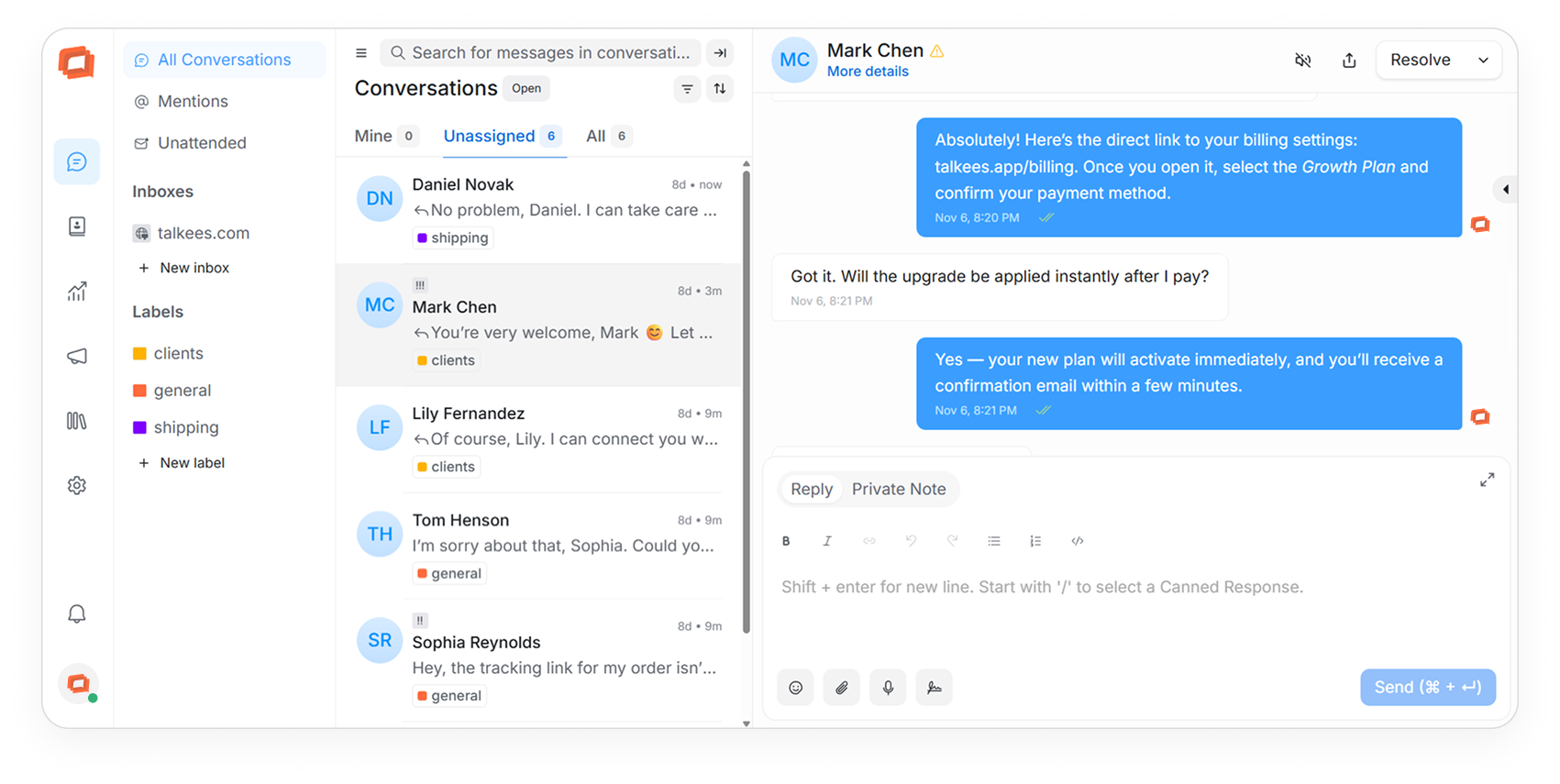
Talkees stands out as a modern alternative to Forethought.ai, offering a more flexible approach to AI-powered customer support with a focus on affordability and rapid implementation for growing teams.
Key Features and Capabilities
Talkees delivers a comprehensive support solution that includes:
- Multi-agent, agentic AI with Autoflows: Like Forethought, Talkees offers AI agents that can be trained on your historical tickets and knowledge base. However, Talkees provides a more streamlined implementation process that requires less historical data to achieve effective results.
- True omnichannel support: Talkees unifies conversations across web chat, email, voice, social media, and messaging apps into a single interface, preserving context as customers move between channels.
- Action-taking capabilities: Through secure API integrations, Talkees can execute actions like refunds, order updates, and account changes—with appropriate guardrails and human oversight options.
- Flexible integration options: Talkees offers pre-built connectors for popular platforms like Zendesk, Salesforce, Shopify, and payment processors, along with a robust API for custom integrations.
Pricing and Value
While Forethought typically requires custom enterprise quotes (often ranging from $50,000-$200,000+ annually according to third-party reports), Talkees offers more transparent pricing options:
- Flexible pricing models: Choose between per-seat, per-resolution, or hybrid pricing based on your team’s size and support volume.
- Lower entry point: Talkees provides accessible entry-level plans for growing teams that deliver enterprise-grade capabilities without enterprise-level prices.
- Predictable TCO: Clear pricing structure helps avoid the budget surprises that often come with usage-based or custom quote models.
Implementation and Time-to-Value
Talkees significantly reduces time-to-value compared to Forethought:
- Faster setup: Most teams can implement Talkees and see initial results within days or weeks, rather than the months often required for full Forethought implementation.
- Lower data requirements: Talkees’ AI can begin delivering value with less historical data, making it ideal for newer businesses or those with limited ticket history.
- Guided implementation: Talkees provides structured onboarding and implementation support to ensure quick time-to-value.
Our Assessment
For growing support teams seeking a more affordable, flexible alternative to Forethought.ai, Talkees delivers comparable AI capabilities with faster implementation and more transparent pricing. While it may not have Forethought’s enterprise market presence, Talkees offers an excellent balance of features, performance, and value that makes it particularly well-suited for SMBs and mid-market companies.
Ada.cx vs Forethought.ai: Enterprise-grade Automation—Powerful, but at What Cost and Complexity?

Ada is a well-established enterprise automation platform that offers powerful capabilities but comes with significant complexity and cost considerations.
Key Features and Capabilities
- Enterprise-grade automation: Ada provides sophisticated conversational AI designed for large organizations with complex support needs.
- E-commerce specialization: Ada has particularly strong capabilities for retail and e-commerce use cases, with pre-built integrations for major platforms.
- Extensive customization options: The platform offers deep customization capabilities for enterprises with specialized requirements.
Pricing and Value
- Custom enterprise pricing: Like Forethought, Ada typically requires custom quotes, which can lead to less predictable budgeting.
- Higher implementation costs: Ada implementations often involve significant professional services and customization costs.
- Long-term value: Despite higher initial costs, Ada can deliver strong ROI for large enterprises with high support volumes.
Our Assessment
Ada represents a powerful but complex alternative to Forethought.ai, best suited for large enterprises with substantial budgets and technical resources. For mid-market companies or those seeking faster implementation, other alternatives may provide better value.
Zendesk vs Forethought.ai: Ticketing Suite with AI—Breadth, Integrations, and Add-on Pricing

Zendesk offers a comprehensive ticketing system with AI capabilities as add-ons to its core platform.
Key Features and Capabilities
- Established ticketing ecosystem: Zendesk provides a mature, feature-rich support platform with AI capabilities integrated into its broader suite.
- Answer Bot and AI features: Zendesk’s AI offerings include automated responses, ticket routing, and agent assistance.
- Extensive marketplace: With 1,000+ integrations, Zendesk offers unmatched connectivity to other business systems.
Pricing and Value
- Tiered per-agent pricing: Zendesk follows a transparent per-agent pricing model, with plans ranging from $19 to $199 per agent per month.
- AI as add-on: Zendesk AI capabilities are typically priced as add-ons (around $55 per agent per month based on third-party reports).
- Total cost consideration: When evaluating Zendesk vs. Forethought, consider both the base platform cost and AI add-ons for accurate comparison.
Our Assessment
Zendesk represents a solid alternative for teams already using or considering its ticketing platform. However, the add-on pricing model for AI capabilities can increase costs significantly for larger teams, and its AI features may not match the depth of specialized AI-first platforms.
Intercom vs Forethought.ai: Product-led Support with Bots and In-app Messaging for Scale-ups

Intercom focuses on in-product support and conversational marketing, making it particularly well-suited for SaaS and digital-first businesses.
Key Features and Capabilities
- In-app messaging focus: Intercom excels at embedding support directly within web and mobile applications.
- Conversational marketing: Beyond support, Intercom offers lead generation and customer engagement capabilities.
- Resolution Bot: Intercom’s AI chatbot can handle routine inquiries and route complex issues to human agents.
Pricing and Value
- Seat-based pricing: Intercom typically charges per seat, with plans ranging from approximately $74-$229 per seat per month according to third-party sources.
- Additional charges: Some advanced AI features and higher message volumes may incur additional costs.
- Value for digital-first businesses: Despite higher per-seat costs, Intercom often delivers strong ROI for product-led companies.
Our Assessment
Intercom provides an excellent alternative to Forethought for digital-first businesses that prioritize in-app support and conversational marketing. However, its pricing can escalate quickly for larger teams, and its AI capabilities may be less advanced than specialized AI-first platforms.
Drift vs Forethought.ai: Revenue Chat for Sales Teams vs Support Automation Needs

Drift positions itself as a “revenue acceleration platform” with a strong focus on conversational marketing and sales enablement.
Key Features and Capabilities
- Revenue-focused conversational AI: Drift specializes in lead qualification, sales conversations, and booking meetings.
- ABM capabilities: Advanced account-based marketing features for B2B companies targeting enterprise accounts.
- Sales intelligence: Drift provides insights and analytics focused on revenue generation rather than support efficiency.
Pricing and Value
- Premium positioning: Drift typically starts around $2,500 per month for its professional plans, positioning it as a premium solution.
- Revenue impact measurement: Unlike support-focused platforms that measure cost reduction, Drift emphasizes revenue generation metrics.
Our Assessment
Drift represents a specialized alternative best suited for B2B companies prioritizing sales conversations over support automation. For teams primarily seeking support efficiency, other alternatives will likely provide better value and more relevant capabilities.
Kayako vs Forethought.ai: Streamlined Helpdesk and Self-service for Small Teams

Kayako offers a more straightforward helpdesk solution with AI capabilities, designed for efficiency and ease of use.
Key Features and Capabilities
- Unified customer view: Kayako provides a consolidated view of customer interactions across channels.
- AI-powered self-service: Knowledge base and chatbot capabilities help deflect routine inquiries.
- Mobile SDK: Strong mobile support capabilities for companies with mobile apps.
Pricing and Value
- Transparent pricing: Kayako offers a straightforward pricing model: $79 per month plus $1 per AI-resolved ticket, according to their website.
- Predictable scaling: The per-resolution component scales directly with usage, making costs more predictable as volume grows.
Our Assessment
Kayako represents an excellent alternative for smaller teams seeking a straightforward, affordable solution with transparent pricing. While it may lack some of the advanced AI capabilities of Forethought or Talkees, its simplicity and clear pricing make it an attractive option for many SMBs.
CX Genie vs Forethought.ai: Quick-start GenAI Chatbot for Startups and SMEs

CX Genie focuses on providing an accessible, quick-to-implement AI chatbot solution for smaller businesses.
Key Features and Capabilities
- Rapid implementation: Designed for quick setup with minimal technical requirements.
- Knowledge base integration: Easily connects to existing documentation to provide accurate responses.
- Basic automation: Handles routine inquiries and provides essential deflection capabilities.
Pricing and Value
- SMB-friendly pricing: CX Genie typically offers more accessible pricing tiers designed for smaller businesses.
- Lower TCO: With simpler implementation requirements, the total cost of ownership tends to be lower than enterprise alternatives.
Our Assessment
CX Genie provides a solid entry point for startups and small businesses looking to implement AI support capabilities without the complexity or cost of enterprise platforms like Forethought. While it lacks advanced features, it delivers good value for basic support automation needs.
Quidget vs Forethought.ai: Lightweight Chat Widget with Basic Automation

Quidget offers a simple, lightweight chat solution with basic automation capabilities, focused on ease of implementation.
Key Features and Capabilities
- Simple deployment: Quidget can be implemented with minimal technical resources.
- Basic automation: Handles simple FAQs and routing with rule-based logic.
- Customizable interface: Easy branding and appearance customization.
Pricing and Value
- Entry-level pricing: Quidget typically offers some of the most accessible pricing in the market.
- Limited scalability: While affordable, Quidget may not scale effectively for larger support operations or complex use cases.
Our Assessment
Quidget represents the simplest, most accessible alternative on our list. It’s best suited for very small businesses or those just beginning to implement chat support. For teams with more sophisticated needs, other alternatives will provide better capabilities and long-term value.
LiveChat vs Forethought.ai: Robust Live Chat Core with Marketplace Extensions

LiveChat provides a mature live chat platform with extensive customization options through its marketplace.
Key Features and Capabilities
- Mature chat infrastructure: LiveChat offers a reliable, feature-rich chat platform as its core offering.
- Extensive marketplace: A wide range of integrations and extensions allow for significant customization.
- Growing AI capabilities: While not initially AI-focused, LiveChat has been expanding its automation features.
Pricing and Value
- Tiered pricing: LiveChat offers transparent, tiered pricing based on the number of agents and features required.
- Add-on model: Some advanced capabilities may require additional marketplace purchases.
Our Assessment
LiveChat provides a solid alternative for teams that prioritize chat as their primary support channel and value customization through marketplace extensions. While its AI capabilities may not match specialized platforms, its mature chat infrastructure and reliability make it worth considering.
Help.center vs Forethought.ai: Knowledge Base-first Support with AI Answer Suggestions

Help.center approaches support from a knowledge management perspective, with AI used to surface relevant information.
Key Features and Capabilities
- Knowledge-centric approach: Help.center prioritizes creating and maintaining a comprehensive knowledge base.
- AI-powered suggestions: The platform uses AI to recommend relevant articles and answers.
- Self-service emphasis: Designed to maximize customer self-service and deflection.
Pricing and Value
- Content-based pricing: Help.center’s pricing typically scales based on knowledge base size and usage rather than agent seats.
- Lower entry point: Generally offers more accessible pricing for smaller teams compared to enterprise platforms.
Our Assessment
Help.center represents an interesting alternative for teams that prioritize knowledge management and self-service. While it may not offer the same breadth of conversational AI capabilities as Forethought or Talkees, its knowledge-first approach can deliver strong deflection rates for documentation-heavy support scenarios.
Choosing the Right Forethought.ai Alternative for Your Support Team

When selecting from these alternatives, consider these key factors:
- Support volume and complexity: Higher volumes and more complex inquiries typically justify more sophisticated (and often more expensive) solutions.
- Existing tech stack: Prioritize alternatives that integrate well with your current CRM, helpdesk, and e-commerce platforms.
- Action-taking requirements: If you need autonomous handling of transactions (refunds, order changes), focus on platforms with strong API capabilities and agentic AI.
- Budget constraints: Be realistic about both immediate costs and total cost of ownership, including implementation and maintenance.
- Time-to-value needs: Consider how quickly you need to see results—some platforms offer faster implementation but may sacrifice some capabilities.
Conclusion: Finding Your Ideal Forethought.ai Alternative

While Forethought.ai offers powerful capabilities, the alternatives we’ve explored provide various combinations of features, pricing models, and implementation approaches that might better suit your specific needs.
For most growing support teams seeking a balance of advanced AI capabilities, reasonable pricing, and manageable implementation, Talkees emerges as our top recommendation. Its combination of agentic AI, flexible pricing, and faster time-to-value addresses many of the common concerns that lead teams to seek Forethought alternatives.
However, each alternative has its strengths for specific scenarios:
- For enterprise-grade automation: Ada.cx
- For teams already on Zendesk: Zendesk AI
- For product-led companies: Intercom
- For sales-focused teams: Drift
- For straightforward, affordable support: Kayako
- For startups and small businesses: CX Genie or Quidget
- For chat-centric support: LiveChat
- For knowledge-first approaches: Help.center
Before making your final decision, we recommend conducting a small proof of concept with your top 2-3 choices, using real support tickets from your organization. This hands-on evaluation will reveal which platform truly delivers the best results for your specific support scenarios and customer base.
Remember that the best AI support solution isn’t necessarily the one with the most features or the highest price tag—it’s the one that most effectively addresses your team’s unique challenges and helps deliver exceptional customer experiences at a reasonable cost.