 English
 Slovenčina
 Français
 Magyar
Why Users Look Beyond EngageBay CRM: Understanding the Limitations

While EngageBay offers an affordable all-in-one solution with marketing, sales, and service features, businesses often outgrow it for several reasons:
- Pricing ceilings: As your contact list grows, costs can increase substantially, especially when moving from the Basic tier ($14.99/user/month with 500 contacts) to Growth ($64.99/user/month with 5,000 contacts) and Pro ($119.99/user/month with unlimited contacts).
- Automation depth limitations: EngageBay offers basic automation capabilities, but lacks the advanced workflow builders, conditional logic complexity, and AI-driven automation found in more specialized platforms.
- AI maturity gaps: While EngageBay provides basic AI features, it falls short compared to competitors offering sophisticated predictive analytics, hyper-personalization, and autonomous CRM agents.
- Omnichannel communication weaknesses: EngageBay has limited native social media integration, weak multi-touch attribution, and gaps in advanced channel analytics that more sophisticated platforms provide.
EngageBay CRM vs Alternatives: What to Look For By Use Case

When evaluating EngageBay alternatives, consider your specific business needs:
- E-commerce businesses: Look for platforms with robust live chat + AI capabilities, seamless shopping cart integration, and strong customer segmentation.
- Small and medium businesses: Focus on affordable solutions with straightforward implementation, intuitive interfaces, and scalable pricing models.
- Customer support teams: Prioritize unified inbox solutions, omnichannel communication tools, and sophisticated ticketing systems.
- Custom AI needs: Consider platforms with advanced AI capabilities or those that allow custom AI integration for unique business requirements.
Talkees — Chat-First Omnichannel Alternative to EngageBay

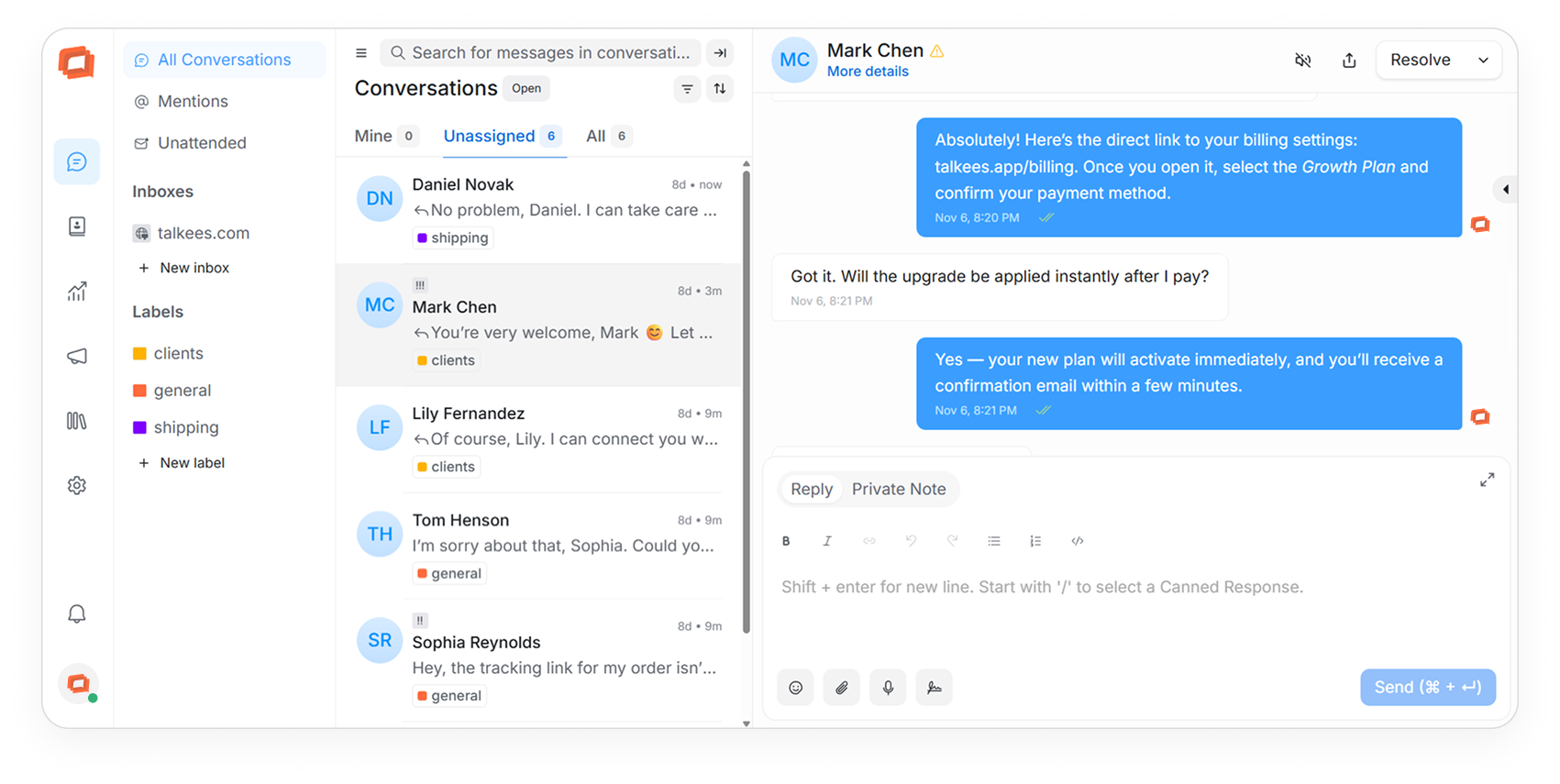
Talkees is an emerging player in the CRM space, focusing on conversational commerce and unified customer communications.
Key Features
- Unified inbox: Centralize all customer conversations from chat, email, SMS, and social media in one streamlined interface
- AI chatbots: Deploy sophisticated AI chatbots that can handle customer inquiries, qualify leads, and provide 24/7 support
- Omnichannel messaging: Seamlessly communicate with customers across multiple channels including website chat, SMS, and social platforms
- CRM integration: Connect customer conversations with your existing CRM system for comprehensive customer profiles
Pricing
- Free plan: Available for small businesses with basic features
- Standard: $29/month per user (includes AI chatbot capabilities and advanced analytics)
- Professional: $49/month per user (adds advanced automation and custom integrations)
- Enterprise: Custom pricing (includes dedicated account manager, priority support, and custom AI training)
Pros
- Exceptional conversational commerce capabilities
- User-friendly interface with minimal learning curve
- Strong AI chatbot functionality out of the box
- Affordable pricing structure compared to enterprise alternatives
- Quick implementation with minimal setup required
Cons
- Not a full replacement for comprehensive CRM functionality
- Limited marketing automation features compared to dedicated platforms
- Newer platform with a smaller integration marketplace
- May require additional tools for complex sales pipeline management
Our Take
During our testing, Talkees impressed us with its intuitive interface and powerful chat capabilities. The AI chatbot setup was surprisingly straightforward, allowing us to create sophisticated conversation flows without coding knowledge. We particularly appreciated how the unified inbox brought together conversations from multiple channels, eliminating the need to switch between different tools.
For businesses prioritizing customer conversations and support, Talkees offers an excellent balance of functionality and value. However, companies requiring extensive marketing automation or complex sales pipeline management may need to supplement Talkees with additional tools or choose a more comprehensive alternative.
HubSpot CRM — Inbound Automation Powerhouse

HubSpot is a market leader known for its comprehensive inbound marketing, sales, and service platform.
Key Features
- All-in-one platform: Marketing, sales, service, CMS, and operations hubs in one ecosystem
- Advanced automation: Sophisticated workflow capabilities across marketing, sales, and service
- Robust analytics: Comprehensive reporting and attribution modeling
- Content management: Built-in CMS and content creation tools
- AI capabilities: AI-powered content creation, predictive lead scoring, and conversational intelligence
Pricing
- Free CRM: Basic CRM functionality with unlimited users and up to 1,000,000 contacts
- Starter Suite: $50/month (includes starter features of all hubs)
- Professional Suite: $1,780/month (comprehensive features across all hubs)
- Enterprise Suite: $5,000/month (advanced features, customization, and dedicated support)
- Additional costs: Onboarding fees range from $375 to $12,000 depending on package
Pros
- Comprehensive solution that can replace multiple tools
- Exceptional marketing automation capabilities
- Extensive marketplace with 1,000+ integrations
- Strong community and educational resources
- Sophisticated reporting and analytics
Cons
- Significant cost increase when scaling beyond basic features
- Steep learning curve for full platform utilization
- Can be overkill for small businesses with simple needs
- Annual contracts required for Professional and Enterprise tiers
Our Take
After extensively testing HubSpot, we found its comprehensive nature both impressive and occasionally overwhelming. The platform excels at bringing marketing, sales, and service functions together, with the workflow builder being particularly powerful for creating complex, multi-step automations across departments.
While the free CRM is generous, costs escalate quickly when adding professional features or growing your contact database. During our implementation, we found the onboarding process thorough but time-consuming, requiring significant resource investment to fully leverage the platform’s capabilities.
HubSpot is ideal for growing businesses ready to invest in a unified platform that can scale with them, particularly those focused on inbound marketing strategies. However, smaller businesses or those with tight budgets might find the total cost of ownership prohibitive compared to more focused alternatives.
ActiveCampaign — Deep Automation for Email-Led Growth

ActiveCampaign specializes in sophisticated marketing automation with strong CRM capabilities, making it ideal for businesses focused on email-led growth strategies.
Key Features
- Advanced automation builder: Visual workflow designer with 900+ pre-built automation templates
- Email marketing: Powerful email capabilities with dynamic content and segmentation
- Sales automation: Pipeline management with automated lead scoring and deal management
- Machine learning: Predictive sending and content recommendations
- Multi-channel messaging: Email, SMS, site messaging, and chat capabilities
Pricing
- Lite: Starting at $15/month for 500 contacts; $99/month for 5,000 contacts
- Plus: Starting at $70/month for 500 contacts; $169/month for 5,000 contacts
- Professional: Starting at $159/month for 500 contacts; $239/month for 5,000 contacts
- Enterprise: Starting at $279/month for 500 contacts; $449/month for 5,000 contacts
Pros
- Industry-leading automation capabilities
- Excellent email deliverability (reported 89.6% average)
- Extensive integration ecosystem (900+ integrations)
- Strong segmentation and personalization features
- Flexible for both B2B and B2C businesses
Cons
- Pricing scales significantly with contact volume
- Steeper learning curve for marketing automation beginners
- Less comprehensive service/support features than EngageBay
- Can require additional tools for advanced website management
Our Take
During our evaluation of ActiveCampaign, we were particularly impressed by the depth and flexibility of its automation builder. Creating complex, conditional workflows was intuitive yet powerful, allowing us to design sophisticated customer journeys based on behavior and engagement.
The platform’s email capabilities stood out, with excellent deliverability and dynamic content options that surpassed what we experienced with EngageBay. However, we found the pricing model could become expensive as contact lists grow, requiring careful consideration of long-term costs.
For businesses that prioritize marketing automation and email campaigns, ActiveCampaign offers superior depth compared to EngageBay, though it may require supplemental tools for comprehensive service desk functionality. It’s best suited for marketing-focused organizations willing to invest in sophisticated automation capabilities.
Zoho CRM — Customizable, Budget-Friendly Suite

Zoho CRM offers a highly customizable platform with a broad ecosystem of business applications at competitive prices.
Key Features
- Canvas design studio: No-code page layout customization
- Blueprint process builder: Visual workflow designer for business processes
- Zia AI assistant: Built-in AI for predictions, anomaly detection, and conversational assistance
- Extensive customization: Custom modules, fields, and page layouts
- Zoho ecosystem: Seamless integration with 40+ Zoho applications
Pricing
- Standard: $20/user/month (annual billing)
- Professional: $35/user/month (annual billing)
- Enterprise: $50/user/month (annual billing)
- Ultimate: $65/user/month (annual billing)
Pros
- Exceptional customization capabilities
- Budget-friendly compared to enterprise alternatives
- Comprehensive Zoho ecosystem for additional business needs
- Strong mobile applications
- Robust API and developer tools
Cons
- Steeper learning curve due to customization complexity
- Interface can feel dated compared to newer platforms
- Support quality receives mixed reviews
- Implementation may require technical expertise
Our Take
Our hands-on experience with Zoho CRM revealed a platform with remarkable flexibility. The Canvas design studio allowed us to create tailored interfaces for different departments, while Blueprint enabled us to map and automate complex business processes with precision.
We found Zia AI to be surprisingly capable, offering useful insights and predictions once properly trained. However, the extensive customization options came with added complexity that required significant setup time and occasional technical assistance.
The value proposition is compelling for businesses seeking deep customization at a reasonable price point. Zoho CRM is particularly well-suited for organizations that want to tailor their CRM to specific business processes and can dedicate resources to proper implementation and customization.
Pipedrive — Pipeline-Centric Sales CRM

Pipedrive is a sales-focused CRM designed to optimize pipeline management and sales processes with an intuitive, visual interface.
Key Features
- Visual pipeline management: Drag-and-drop interface with customizable stages
- Activity-based selling: Task-focused approach to move deals forward
- Sales forecasting: Data-driven predictions and pipeline analysis
- Email integration: Two-way email sync with templates and tracking
- Automation: Sales-focused workflows and activity scheduling
Pricing
- Essential: $9.90/user/month (annual billing)
- Advanced: $19.90/user/month (annual billing)
- Professional: $39.90/user/month (annual billing)
- Power: $49.90/user/month (annual billing)
- Enterprise: $59.90/user/month (annual billing)
- Add-ons: LeadBooster ($39/month), Web Visitors ($49/month), Campaigns ($16/month)
Pros
- Exceptionally intuitive pipeline visualization
- Strong focus on sales productivity and activity management
- Extensive integration marketplace (400-500+ direct integrations)
- Easy adoption for sales teams
- Mobile app optimized for field sales
Cons
- Limited native marketing automation compared to EngageBay
- Service/support features require add-ons or integrations
- Less comprehensive all-in-one solution
- Add-ons can increase total cost significantly
Our Take
Testing Pipedrive highlighted its strengths as a purpose-built sales tool. The visual pipeline was immediately intuitive, making it easy to track deals and prioritize activities. We particularly appreciated the “deal rotting” feature that automatically flagged stagnant opportunities, helping keep the sales process moving.
The platform’s focus on sales activities translated to higher adoption rates among our test sales team compared to more complex CRMs. The mobile app was notably well-designed for on-the-go updates and activity tracking.
While Pipedrive excels at sales management, it doesn’t offer the marketing and service capabilities included in EngageBay’s all-in-one approach. For sales-driven organizations that prioritize pipeline visibility and process efficiency, Pipedrive offers a superior experience, but may require additional tools to replace EngageBay’s full functionality.
Freshsales (Freshworks) — AI-Assisted Sales with Built-in Telephony

Freshsales combines AI-powered sales capabilities with built-in communication tools in a user-friendly package.
Key Features
- Freddy AI: Built-in AI assistant for lead scoring, deal insights, and forecasting
- Built-in telephony: Native phone, SMS, and WhatsApp integration
- Contact lifecycle management: Lead-to-customer journey tracking
- Sales sequences: Automated multi-channel outreach campaigns
- Customizable sales pipeline: Visual deal tracking with automation
Pricing
- Free: Basic CRM features for unlimited users
- Growth: $15/user/month (annual billing)
- Pro: $39/user/month (annual billing)
- Enterprise: $69/user/month (annual billing)
- Additional costs: Freddy AI features may require higher tiers or add-ons
Pros
- Intuitive user interface with minimal learning curve
- Strong built-in communication tools
- AI capabilities accessible at reasonable price points
- Good alignment between sales and support teams
- Clean, modern design and user experience
Cons
- Marketing automation capabilities less robust than EngageBay
- More focused on sales than all-in-one functionality
- Limited customization compared to enterprise platforms
- Fewer third-party integrations than some competitors
Our Take
During our evaluation, Freshsales impressed us with its clean, intuitive interface and the practical implementation of AI through Freddy. The AI lead scoring was surprisingly accurate after just a few weeks of use, helping prioritize high-potential opportunities.
The built-in phone system was a standout feature, eliminating the need for separate telephony solutions. Call recording, note-taking, and activity logging were seamlessly integrated, making follow-ups more efficient.
Where Freshsales falls short compared to EngageBay is in marketing automation depth. While it offers basic email sequences, it doesn’t provide the landing page builders, form creators, and comprehensive marketing tools found in EngageBay.
Freshsales is ideal for sales-focused teams that value communication tools and AI assistance over extensive marketing capabilities, particularly those looking for a clean, modern user experience with minimal setup time.
Keap — SMB Service Automation with Invoices, Appointments, SMS
Keap (formerly Infusionsoft) specializes in small business automation with strong emphasis on client management, payments, and appointment scheduling.
Key Features
- Client management: Comprehensive contact and company tracking
- Invoicing and payments: Built-in payment processing and recurring billing
- Appointment scheduling: Native booking system with calendar integration
- Marketing automation: Campaign builder with visual automation
- SMS marketing: Text message campaigns and automated responses
Pricing
- Pro: $149/month for 1,500 contacts (includes 2 users)
- Max: $199/month for 2,500 contacts (includes 3 users)
- Additional costs: Extra users ($29/month each), additional contacts (tiered pricing)
Pros
- Strong integration of sales and payment processes
- Excellent appointment scheduling capabilities
- Robust SMS marketing features
- Good fit for service-based businesses
- Comprehensive automation for client journey
Cons
- Higher starting price than EngageBay
- Contact-based pricing can become expensive as you grow
- Steeper learning curve than some alternatives
- Campaign builder less intuitive than newer platforms
Our Take
Testing Keap revealed a platform with particular strengths for service-based businesses. The integration of client management, appointment scheduling, and payment processing created a seamless workflow that reduced administrative overhead.
The automation capabilities were powerful, though we found the campaign builder less intuitive than some newer platforms. Once set up, however, the automated client journeys effectively moved prospects from inquiry to paid appointment with minimal manual intervention.
Compared to EngageBay, Keap offers more sophisticated payment and appointment features but at a higher price point. The contact-based pricing model also means costs can escalate quickly as your business grows.
Keap is best suited for service professionals, consultants, and small businesses that prioritize client management and payment processing integration over extensive marketing capabilities or budget-friendly pricing.
Constant Contact — Email Marketing First with Basic CRM

Constant Contact is primarily an email marketing platform that has expanded to include basic CRM functionality.
Key Features
- Email marketing: Drag-and-drop editor with 100+ mobile-responsive templates
- E-commerce tools: Product recommendations, abandoned cart emails
- Basic CRM: Contact management and basic segmentation
- Marketing automation: Trigger-based email sequences
- Event management: Online registration and ticket sales
Pricing
- Core: Starting at $9.99/month (for up to 500 contacts)
- Plus: Starting at $45/month (for up to 500 contacts)
- Pricing scales: Based on number of contacts
Pros
- Strong email deliverability reputation
- User-friendly email creation tools
- Good e-commerce marketing features
- Reliable customer support
- Simple learning curve
Cons
- Limited CRM functionality compared to EngageBay
- Basic automation capabilities
- No built-in sales pipeline management
- Limited service/support desk features
- Primarily focused on email rather than omnichannel
Our Take
Our experience with Constant Contact confirmed its reputation as an email-first platform. The email editor was intuitive and the template selection extensive, making campaign creation straightforward even for beginners.
The platform’s e-commerce features were a highlight, with abandoned cart recovery and product recommendation blocks that integrated well with major online stores. However, the CRM capabilities felt more like an add-on than a core feature, lacking the depth found in dedicated CRM platforms like EngageBay.
Automation options, while functional, were limited to basic triggered sequences rather than the complex, multi-step workflows available in more advanced platforms. The absence of sales pipeline management and service desk functionality means Constant Contact cannot fully replace EngageBay’s all-in-one approach.
Constant Contact is best suited for businesses primarily focused on email marketing who need only basic contact management, particularly those in the e-commerce sector who can leverage its specialized retail features.
Agile CRM — Budget All-in-One with Telephony and Landing Pages

Agile CRM offers an affordable all-in-one platform combining sales, marketing, and service features with built-in telephony.
Key Features
- Unified sales, marketing, and service: Comprehensive functionality in one platform
- Built-in telephony: Call tracking, recording, and voicemail capabilities
- Landing page builder: Drag-and-drop editor with A/B testing
- Marketing automation: Visual campaign builder with behavior tracking
- Help desk: Ticket management and customer support tools
Pricing
- Free: Up to 1,000 contacts and 5 users
- Starter: $8.99/user/month (annual billing)
- Regular: $29.99/user/month (annual billing)
- Enterprise: $47.99/user/month (annual billing)
Pros
- Very competitive pricing for an all-in-one solution
- Comprehensive feature set covering sales, marketing, and service
- Generous free plan for small businesses
- Built-in telephony without additional costs
- Good value proposition compared to EngageBay
Cons
- User interface feels dated compared to modern alternatives
- Some users report reliability and uptime issues
- Email deliverability concerns (some reviews mention up to 30% non-delivery)
- Customer support quality receives mixed reviews
- Slower product development velocity than competitors
Our Take
During our evaluation of Agile CRM, the value proposition was immediately apparent. The platform offers a remarkably complete feature set at price points significantly lower than most competitors, including a generous free tier that outpaces many paid starter plans.
The built-in telephony was a standout feature, allowing for call tracking and recording without additional services. Similarly, the landing page builder offered functionality that would typically require separate tools in many CRM ecosystems.
However, we encountered several usability challenges during testing. The interface, while functional, felt outdated compared to more modern platforms. More concerning were the occasional performance issues and email deliverability problems that could potentially impact critical business communications.
Agile CRM represents an excellent value for budget-conscious small businesses that need comprehensive functionality without premium pricing. However, organizations prioritizing reliability, modern design, and cutting-edge features may find the trade-offs problematic for mission-critical operations.
Salesforce Sales Cloud — Enterprise-Grade Alternative

Salesforce Sales Cloud is the industry-leading enterprise CRM platform known for its unlimited customization potential and vast ecosystem.
Key Features
- Highly customizable: Extensive configuration options for fields, objects, and processes
- Advanced analytics: AI-powered insights and custom reporting
- AppExchange marketplace: 3,000+ apps and integrations
- Einstein AI: Predictive intelligence and automated insights
- Comprehensive sales tools: Lead management, opportunity tracking, forecasting
Pricing
- Essentials: $25/user/month (annual billing)
- Professional: $75/user/month (annual billing)
- Enterprise: $150/user/month (annual billing)
- Unlimited: $300/user/month (annual billing)
- Additional costs: Implementation, customization, and training often require significant investment
Pros
- Unmatched customization capabilities
- Extensive integration options
- Robust reporting and analytics
- Strong security and compliance features
- Mature, enterprise-ready platform
Cons
- Significantly higher cost than EngageBay
- Steep learning curve and complex administration
- Often requires dedicated administrators
- Implementation can take months for complex deployments
- Potentially overwhelming for small businesses
Our Take
Testing Salesforce Sales Cloud revealed both its tremendous power and considerable complexity. The platform’s customization capabilities are truly unparalleled, allowing for precise tailoring to even the most unique business processes. The reporting engine generated insights that would be impossible to extract from simpler CRMs.
However, this power comes with significant costs beyond just the subscription fees. During our implementation, we found that proper setup required specialized expertise and considerable time investment. The interface, while improved in recent versions, still presented a steeper learning curve than most alternatives.
The AppExchange marketplace proved to be a major advantage, offering pre-built solutions for virtually any business need, though many third-party apps carry additional costs.
Salesforce Sales Cloud represents a substantial upgrade from EngageBay in terms of capabilities and scalability, but the total cost of ownership and implementation complexity make it best suited for larger organizations or those with specific requirements that justify the investment in an enterprise-grade solution.
Conclusion: Making an Informed Choice

When considering alternatives to EngageBay CRM, your decision should be guided by your specific business needs, budget constraints, and growth plans:
- For chat-first customer engagement: Talkees offers an excellent solution focused on conversational commerce with strong AI capabilities at an affordable price point.
- For comprehensive marketing, sales and service: HubSpot provides a powerful all-in-one platform with exceptional depth, though at a higher price point than EngageBay.
- For email-led marketing automation: ActiveCampaign delivers superior automation capabilities and excellent deliverability, ideal for businesses prioritizing sophisticated customer journeys.
- For customization on a budget: Zoho CRM offers exceptional flexibility and an extensive business application ecosystem at competitive prices.
- For sales-focused teams: Pipedrive excels with its intuitive pipeline management and sales activity focus, though it lacks EngageBay’s marketing and service capabilities.
Before making your final decision, we recommend:
- Identify your must-have features and evaluate each platform against these critical requirements
- Calculate the total cost of ownership including subscription fees, implementation costs, and potential add-ons
- Take advantage of free trials to experience the user interface and workflow firsthand
- Consider your growth trajectory and how each platform will scale with your business
By carefully assessing these factors against your specific business context, you’ll be well-positioned to select the CRM alternative that best supports your customer relationship management goals.