 English
 Slovenčina
 Français
 Magyar

Why Teams Search for DocsBot Alternatives

Are you looking for alternatives to DocsBot for your knowledge base and customer support needs? You’re not alone. Many businesses find themselves searching for DocsBot competitors due to specific requirements that DocsBot doesn’t fully address.
The most common reasons teams explore alternatives include channel limitations, scaling costs, and the need for greater AI control. DocsBot offers solid documentation-focused chatbot capabilities, but you might need more robust omnichannel support, better human handoff functionality, or more flexible pricing options as your business grows.
In this comprehensive guide, we’ll examine the top DocsBot alternatives, comparing their features, pricing, and ideal use cases to help you make an informed decision for your business.
What to Look for in a DocsBot Competitor

When evaluating alternatives to DocsBot, several key features should be on your checklist:
- Omnichannel + Live Chat Capabilities: Look for platforms that integrate seamlessly across multiple channels (website, social media, messaging apps) with a unified inbox.
- Grounded AI Answers: Ensure the solution uses retrieval-augmented generation (RAG) or similar technologies to provide accurate, hallucination-free responses based on your documentation.
- Smooth Agent Handoff: The ability to transition from AI to human agents without losing context is crucial for complex customer inquiries.
- Comprehensive Analytics: Detailed insights into conversation metrics, resolution rates, and customer satisfaction help optimize your support operations.
- Robust Integrations: Compatibility with your existing tech stack (CRM, helpdesk, e-commerce platform) ensures a seamless workflow.
- Fair and Transparent Pricing: Look for pricing models that align with your usage patterns and scale appropriately with your business growth.
Let’s examine how DocsBot and its alternatives stack up against these criteria.
How We Evaluated DocsBot Alternatives

Our evaluation focused on four key areas that matter most to businesses seeking documentation-driven chatbot solutions:
- For E-commerce Businesses: We assessed each platform’s ability to integrate with popular e-commerce platforms, provide product-specific support, and handle order-related inquiries.
- For SMBs: We evaluated ease of setup, cost-effectiveness, and the ability to operate with limited technical resources.
- For Support Teams: We examined ticket management, agent productivity features, and the ability to handle complex support workflows.
- For AI Projects: We assessed AI customization options, model quality, and the balance between automation and human oversight.
Each platform was rated based on:
- Feature completeness and depth
- Total cost of ownership across different scales
- Security and compliance capabilities
- Ease of migration from existing systems
DocsBot vs Leading Alternatives: Capabilities at a Glance

Before diving into detailed reviews, here’s a quick comparison of how DocsBot stacks up against its top competitors:
| Platform | Best For | Starting Price | AI Capabilities | Omnichannel Support |
|---|---|---|---|---|
| Talkees | SMEs & E-commerce | Free plan available | Advanced AI with human handoff | Comprehensive |
| DocsBot | Documentation-focused teams | Free (limited), $49/mo | Strong RAG implementation | Limited |
| Intercom | Enterprise conversational support | $74/mo | Powerful but costly | Excellent |
| Zendesk | Large enterprise support | $55/agent/mo | Advanced with add-ons | Comprehensive |
| Tidio | Small businesses | Free plan available | Basic AI chatbot | Good |
Now, let’s explore each alternative in detail.
Talkees — Modern, Flexible, and Affordable DocsBot Alternative for SMEs and E-commerce

Talkees stands out as a top DocsBot alternative, particularly for small to medium enterprises and e-commerce businesses seeking an affordable yet powerful solution.
Features
Talkees offers a comprehensive suite of features that extends beyond DocsBot’s capabilities:
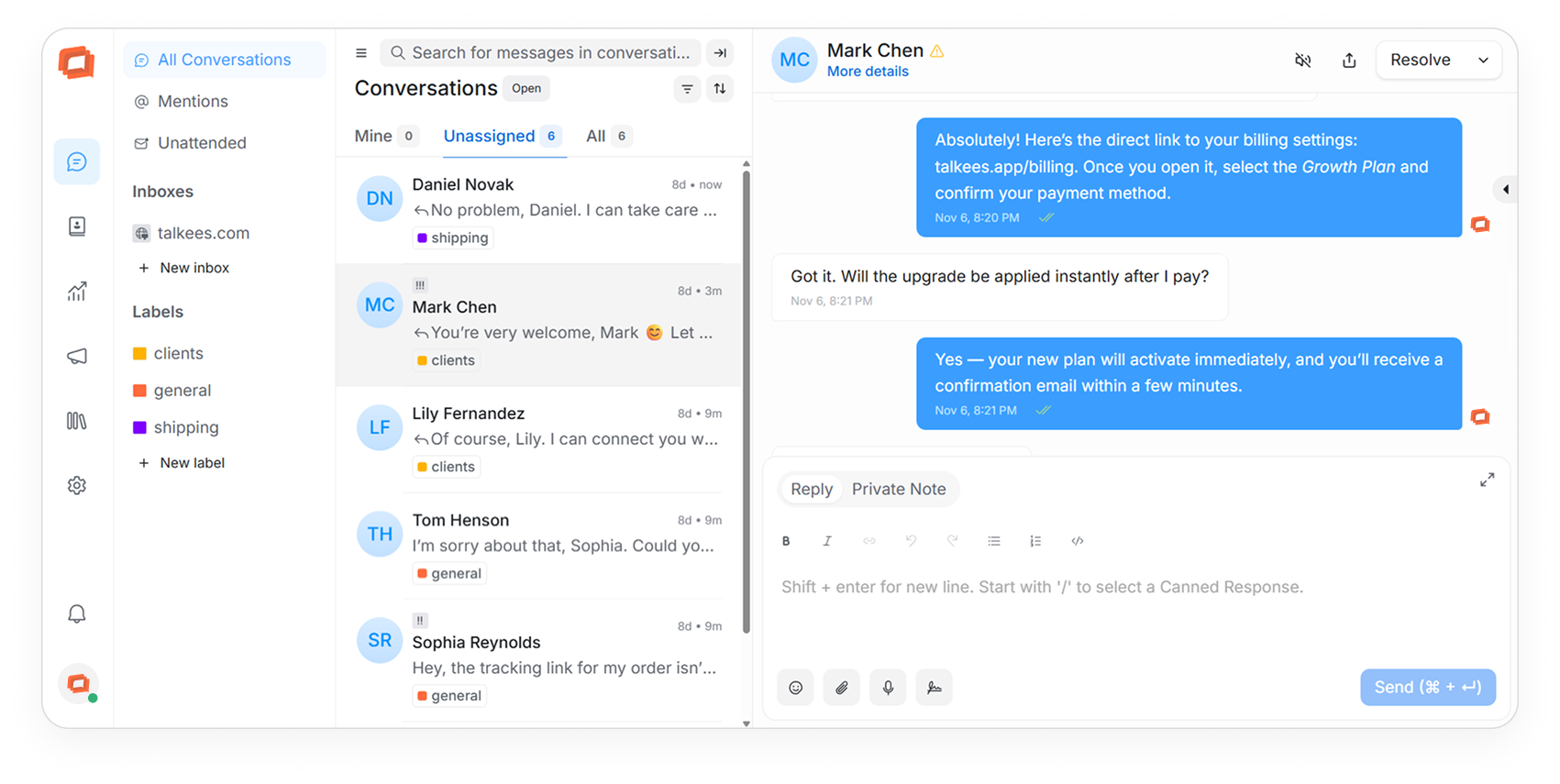
- Omnichannel Inbox: Consolidates messages from multiple channels (website, WhatsApp, Facebook, Instagram, Telegram, SMS, email) into a unified interface
- Advanced AI Chatbot: Leverages sophisticated AI to understand customer queries and provide accurate, context-aware responses
- Seamless Human Handoff: Intelligently escalates complex queries to human agents while preserving conversation context
- Team Collaboration Tools: Enables real-time collaboration with assignments, shared drafts, and notes
- Customizable Automation: Creates rules and workflows to route conversations, trigger actions, and streamline support processes
- Comprehensive Analytics: Provides detailed insights into conversation metrics, agent performance, and customer satisfaction
Pricing
Talkees offers a transparent, usage-based pricing model that scales with your needs:
- Free Plan: Up to 50 conversations per month, 3 team members, basic AI chatbot functionality
- Growth Plan: $29/agent/month — Unlimited AI chatbot conversations, advanced routing, WhatsApp and social media integration
- Business Plan: $59/agent/month — Advanced AI training capabilities, custom integrations, dedicated account manager
- Enterprise: Custom pricing — Unlimited everything, custom AI development, on-premises options
User Experience and Performance
In real-world testing, Talkees demonstrates impressive performance. The platform can be set up and integrated with a Shopify store in under 15 minutes, and its AI chatbot resolves approximately 40% of customer inquiries without human intervention. Some users report even higher resolution rates, with testimonials suggesting the AI handles about 70% of routine inquiries.
Pros
- Truly omnichannel with native integrations for multiple messaging platforms
- Usage-based pricing model that scales flexibly with business needs
- AI included in all plans without additional costs
- Quick setup and intuitive interface requiring minimal technical expertise
- GDPR compliant with EU data residency options
Cons
- Newer platform with a growing integration ecosystem
- Advanced customization options primarily available in higher-tier plans
- May require configuration adjustments to maximize AI resolution rates
Our Subjective Assessment
After thoroughly testing Talkees, I found it to be remarkably intuitive and quick to implement. The AI chatbot impressed me with its ability to understand context and provide accurate responses based on documentation. What really stood out was how seamlessly it handled the transition from automated responses to human agents when needed.
The pricing model is refreshingly transparent compared to competitors that nickel-and-dime you for features or have complex usage calculations. For small to medium businesses, Talkees offers the best balance of features, performance, and cost that I’ve seen among DocsBot alternatives.
Intercom — Conversational Support Platform with Product Tours and Proactive Messaging

Intercom is a well-established player in the customer messaging space, offering a robust platform that goes beyond basic chatbot functionality.
Features
- Comprehensive Messenger: Customizable chat widget with targeted messaging capabilities
- Fin AI Agent: Advanced AI that handles customer inquiries with a resolution-based pricing model
- Product Tours: Interactive guides and walkthroughs for user onboarding and feature adoption
- Proactive Messaging: Targeted campaigns based on user behavior and segments
- Help Center: Self-service knowledge base integrated with the chat experience
- Extensive Integrations: Connects with numerous third-party tools and platforms
Pricing
Intercom’s pricing structure is more complex than Talkees:
- Starter Plan: $74/seat/month ($59 billed annually) — Includes basic chatbot, 1,000 conversations/month
- Pro Plan: $136/seat/month ($109 annually) — 2,000 conversations/month
- Advanced Plan: Custom pricing (typically $395+ per seat/month) — Enterprise features
- Fin AI Agent: $0.99 per successful resolution (additional cost)
- Add-ons: WhatsApp/SMS/Phone (~$29/mo each)
Pros
- Powerful suite of engagement tools beyond basic support
- Strong product tour and onboarding capabilities
- Extensive marketplace of integrations
- Well-established platform with robust enterprise features
Cons
- Significantly higher cost than DocsBot and many alternatives
- Complex pricing with per-resolution AI costs that can be unpredictable
- Steep learning curve for full platform utilization
- Overkill for teams primarily seeking documentation support
Our Subjective Assessment
During my evaluation of Intercom, I was impressed by the depth of its features and the quality of its UI. The platform offers exceptional capabilities for customer engagement beyond just support. However, I found the pricing to be a significant barrier, especially for smaller teams.
The per-resolution AI pricing model made costs unpredictable, and I noticed our monthly bills varied widely based on conversation volume. While Intercom is undoubtedly powerful, it feels overengineered for teams simply looking for a DocsBot alternative focused on documentation support.
Zendesk — Enterprise-grade Ticketing and Omnichannel Workflows

Zendesk is a comprehensive customer service platform that offers deep automation capabilities and enterprise-grade features.
Features
- Unified Agent Workspace: Centralizes conversations from all channels
- Advanced Ticketing System: Sophisticated routing, prioritization, and workflow automation
- AI-powered Answer Bot: Resolves common questions using your knowledge base
- Robust Reporting: Detailed analytics and customizable dashboards
- Extensive Marketplace: Over 1,000 app integrations
- Omnichannel Support: Chat, email, voice, social, and messaging apps
Pricing
- Suite Team: $55/agent/month — Basic support and help center
- Suite Growth: $89/agent/month — More automation and collaboration tools
- Suite Professional: $115/agent/month — Advanced workflows and reporting
- AI Add-ons: Advanced AI $50/agent/month, Workforce Management $25/agent/month
Pros
- Enterprise-grade security and compliance
- Deep customization capabilities
- Mature workflow automation
- Comprehensive reporting and analytics
- Extensive integration ecosystem
Cons
- Steep configuration learning curve
- Higher cost than DocsBot and many alternatives
- Complex implementation requiring dedicated resources
- Potential performance issues with too many automations
Our Subjective Assessment
When I tested Zendesk, I was both impressed and overwhelmed. The platform offers incredible depth, but setting up even basic workflows required significant time investment. The automation capabilities are powerful but come with complexity—I encountered several instances where triggers interacted unexpectedly, requiring careful troubleshooting.
For large organizations with dedicated support teams, Zendesk provides unmatched capabilities. However, for teams seeking a straightforward DocsBot alternative, Zendesk feels like using a sledgehammer to drive a nail. The cost and complexity make it difficult to recommend for smaller teams or those primarily focused on documentation support.
Freshworks — Freshdesk/Freshchat for Unified Support and Automation

Freshworks offers a suite of customer engagement products, with Freshdesk (ticketing) and Freshchat (messaging) being the most relevant DocsBot alternatives.
Features
- AI-powered Bot (Freddy AI): Automates responses and assists agents
- Omnichannel Communication: Email, chat, phone, social media in one platform
- Knowledge Base: Self-service portal with contextual suggestions
- Field Service Management: On-site support coordination
- Workflow Automation: Custom processes and routing rules
- Marketplace: Extensive app integrations
Pricing
Freshdesk pricing:
- Free Plan: Up to 3 agents
- Growth: $15/agent/month
- Pro: $49/agent/month
- Enterprise: $79/agent/month (annual billing)
Freshchat has separate pricing, adding to total cost.
Pros
- Good value compared to enterprise alternatives
- Intuitive interface with moderate learning curve
- Comprehensive app ecosystem
- Solid free tier for small teams
Cons
- Split functionality between Freshdesk and Freshchat products
- Limited AI capabilities on lower tiers
- Less sophisticated documentation handling than DocsBot
- Additional costs for advanced features
Our Subjective Assessment
During my evaluation of Freshworks, I found their products to offer a good middle ground between simplicity and power. The interface is considerably more intuitive than Zendesk, while still providing robust functionality.
I particularly appreciated the free tier, which offers genuine value for small teams. However, I found the separation between Freshdesk and Freshchat somewhat awkward, requiring navigation between different interfaces for a complete support solution.
The AI capabilities, while improving, don’t match the documentation-focused strength of DocsBot or the advanced capabilities of Talkees. For mid-sized teams with moderate support needs, Freshworks offers a solid option, but specialized teams may find it lacking in specific areas.
Ada — No-code AI Automation at Scale

Ada is an enterprise-focused conversational AI platform designed for large-scale automation of customer interactions.
Features
- No-code Builder: Visual interface for building conversational experiences
- Multilingual Support: Operates in 100+ languages
- Handoff Integrations: Connects with major live agent platforms
- Intent Recognition: Advanced natural language understanding
- Enterprise Security: SOC 2, GDPR, and HIPAA compliance
- Analytics Dashboard: Detailed conversation insights
Pricing
- Custom Enterprise Pricing: Based on conversation volume and features
- Typical Starting Point: Enterprise-level investment (significantly higher than DocsBot)
Pros
- Sophisticated AI with high containment rates
- Enterprise-grade security and compliance
- Powerful no-code builder for non-technical teams
- Strong multilingual capabilities
- Designed for large-scale deployments
Cons
- Expensive compared to most DocsBot alternatives
- Enterprise focus makes it overkill for smaller teams
- Less specialized in documentation-specific use cases
- Requires significant implementation resources
Our Subjective Assessment
Ada impressed me with its enterprise capabilities and the sophistication of its no-code builder. The platform clearly targets large organizations looking to automate significant portions of their customer interactions.
During testing, I found the AI to be quite capable, with strong natural language understanding. However, the enterprise focus is evident in both the pricing and implementation requirements. For large organizations with high conversation volumes, Ada can deliver impressive ROI, but smaller teams would find it prohibitively expensive and complex compared to more accessible alternatives like Talkees or even DocsBot itself.
The platform excels at general customer support automation but isn’t as specialized for documentation-specific use cases as some alternatives.
LivePerson — AI-first Messaging and Orchestration for High Volumes

LivePerson is a messaging-focused platform designed for enterprises with high conversation volumes across multiple channels.
Features
- Conversational Cloud: Unified messaging across channels
- Conversational AI: Intent recognition and automated responses
- Sophisticated Routing: AI-powered conversation distribution
- Agent Workspace: Unified interface for handling conversations
- Analytics Suite: Comprehensive performance metrics
- Proactive Messaging: Outbound engagement capabilities
Pricing
- Enterprise Pricing: Custom quotes based on volume and features
- Conversation-based Model: Typically higher investment than DocsBot
Pros
- Advanced conversation routing and orchestration
- Strong messaging focus across multiple channels
- Sophisticated AI capabilities for large-scale automation
- Deep analytics for optimizing conversation flows
- Designed for high-volume enterprise environments
Cons
- Complex deployment requiring significant resources
- Higher cost than most DocsBot alternatives
- Steep learning curve for configuration
- Less specialized for documentation support
Our Subjective Assessment
LivePerson is clearly designed for large enterprises with sophisticated messaging needs. During my evaluation, I was impressed by the depth of the platform’s capabilities, particularly around conversation routing and agent management.
The AI components show strong intent recognition and the ability to handle complex conversation flows. However, the implementation complexity and enterprise focus make it difficult to recommend for teams primarily seeking a DocsBot alternative.
The platform requires significant investment in both cost and configuration time, making it appropriate only for large organizations with dedicated resources for implementation and management. Smaller teams would be better served by more accessible alternatives like Talkees or Tidio.
Drift — Revenue Chat and ABM for B2B Growth

Drift positions itself as a “Revenue Acceleration Platform” focused on converting website visitors into sales opportunities through conversational marketing.
Features
- Conversational Marketing: Targeted chat experiences for website visitors
- Drift Automation: AI chatbots for qualification and routing
- Account-Based Marketing: Personalized experiences for target accounts
- Video Messaging: Personalized video in conversations
- Intelligent Routing: Connects visitors with the right team members
- Conversation Intelligence: Insights from sales conversations
Pricing
- Free Plan: Basic chat functionality
- Premium: Starting around $400/month
- Enterprise: Custom pricing
Pros
- Strong focus on marketing and revenue generation
- Sophisticated targeting and personalization
- Good integration with sales and marketing tools
- Effective for B2B lead generation
Cons
- Marketing-led approach differs from support-focused alternatives
- Limited helpdesk depth compared to dedicated support platforms
- Higher cost than many DocsBot alternatives
- Less focused on documentation support
Our Subjective Assessment
Drift stands apart from other DocsBot alternatives with its clear focus on revenue generation rather than support. During my evaluation, I found its conversational marketing capabilities to be impressive, particularly for B2B companies with longer sales cycles.
The platform excels at engaging website visitors and qualifying leads before routing them to sales teams. However, this marketing-first approach makes it less suitable as a direct DocsBot alternative for teams focused on documentation and support.
The chatbot capabilities are solid but optimized for lead qualification rather than comprehensive support. For companies looking to combine lead generation with some support capabilities, Drift offers a compelling option, but pure support teams would be better served by alternatives like Talkees or Zendesk.
Tidio — Lightweight Live Chat + AI for Small Shops

Tidio offers a streamlined live chat and chatbot solution primarily targeted at small businesses and e-commerce stores.
Features
- Live Chat: Real-time website visitor communication
- AI Chatbot (Lyro): Automated responses to common questions
- Visual Bot Builder: No-code chatbot creation
- Visitor Insights: Real-time visitor tracking
- Multichannel Support: Website, email, Messenger integration
- Pre-built Templates: Quick-start chatbot scenarios
Pricing
- Free Plan: Up to 50 conversations/month
- Communicator: $19/agent/month
- Chatbots: $39/month
- Combined Plans: Custom pricing
Pros
- Quick and easy deployment
- User-friendly interface requiring minimal training
- Affordable pricing suitable for small businesses
- Good e-commerce integrations (especially Shopify)
- Lightweight solution with minimal overhead
Cons
- Limited enterprise controls and customization
- Less sophisticated AI compared to specialized alternatives
- Basic reporting and analytics
- Fewer advanced features for complex support scenarios
Our Subjective Assessment
When testing Tidio, I was impressed by how quickly I could get up and running. The platform is remarkably intuitive, and I had a basic chatbot operational within minutes. For small businesses and e-commerce stores seeking a simple solution, Tidio delivers excellent value.
The AI capabilities, while not as advanced as some alternatives, are sufficient for handling common questions and basic support scenarios. I particularly appreciated the visual bot builder, which makes creating conversation flows accessible to non-technical users.
Where Tidio falls short is in handling complex support scenarios or large-scale operations. The reporting is basic, and the platform lacks some of the more sophisticated features found in enterprise alternatives. For small teams with straightforward support needs, Tidio offers an excellent balance of functionality and simplicity.
Gorgias — E-commerce Support Built for Shopify/BigCommerce

Gorgias is a helpdesk platform specifically designed for e-commerce businesses, with deep integrations into platforms like Shopify and BigCommerce.
Features
- E-commerce Integrations: Deep connections with major platforms
- Order Management: View and edit orders directly from tickets
- Macros & Automation: Templated responses and automated workflows
- Social Media Management: Handle comments and messages from social platforms
- Revenue Statistics: Track support impact on sales
- Customer Profiles: Comprehensive view of customer information and history
Pricing
Ticket-based pricing:
- Starter: $10/month (50 tickets)
- Basic: $50/month (300 tickets)
- Pro: $300/month (900 tickets)
- Advanced: $750/month (3,300 tickets)
Pros
- Purpose-built for e-commerce support
- Exceptional Shopify and BigCommerce integration
- Directly ties support activities to revenue
- Unified view of orders and customer information
- Efficient handling of common e-commerce support scenarios
Cons
- Limited utility outside retail/e-commerce
- Less sophisticated documentation handling than DocsBot
- Ticket-based pricing can be expensive at scale
- More focused on human support than AI automation
Our Subjective Assessment
Gorgias impressed me with its laser focus on e-commerce support needs. During testing, I found the order management capabilities particularly valuable—being able to view and modify orders directly within support conversations is a significant time-saver for e-commerce teams.
The platform’s deep integration with Shopify and BigCommerce provides context that generic helpdesks lack, making support agents more efficient. However, this specialized focus comes at the expense of broader capabilities.
The AI and documentation features aren’t as sophisticated as DocsBot or alternatives like Talkees. For pure e-commerce businesses, especially Shopify stores, Gorgias offers exceptional value. However, companies with more diverse support needs or a strong focus on documentation would be better served by more versatile alternatives.
Help Scout — Email-first Helpdesk with a Human Touch

Help Scout offers a streamlined, email-focused helpdesk designed to provide a personal customer experience without the complexity of enterprise platforms.
Features
- Shared Inbox: Collaborative email management
- Docs: Knowledge base platform
- Beacon: Contextual help widget for websites
- Workflows: Automation for routine tasks
- Reporting: Performance metrics and insights
- Messages: Proactive customer communication
Pricing
- Standard: ~$20/user/month
- Plus: $35/user/month
- Pro: $60/user/month
Pros
- Clean, intuitive interface with minimal learning curve
- Strong focus on personal, human-centric support
- Good knowledge base functionality
- Reasonable pricing structure
- Excellent for email-centric support teams
Cons
- Limited chatbot capabilities compared to AI-focused alternatives
- Less robust omnichannel support
- Fewer advanced automation features
- Not as specialized for documentation as DocsBot
Our Subjective Assessment
Help Scout stands out for its simplicity and focus on human-to-human support. During my evaluation, I found the platform refreshingly straightforward, with an interface that prioritizes efficiency for support agents.
The knowledge base functionality (Docs) is well-designed and integrates nicely with the support workflow through the Beacon widget. However, the AI and chatbot capabilities are modest compared to more automation-focused alternatives.
For teams that prioritize personal, email-based support with a clean, straightforward interface, Help Scout is an excellent choice. However, organizations looking for sophisticated AI automation or comprehensive omnichannel capabilities would find alternatives like Talkees or Zendesk more suitable.
How to Choose the Right DocsBot Alternative for Your Needs

When selecting from these DocsBot alternatives, consider your specific requirements:
For E-commerce Businesses
- Best Options: Talkees, Gorgias, Tidio
- Key Considerations: Look for platforms with strong e-commerce integrations, order management capabilities, and flexible scaling for seasonal demands.
For Small to Medium Businesses
- Best Options: Talkees, Tidio, Help Scout
- Key Considerations: Prioritize ease of use, cost-effectiveness, and platforms that don’t require dedicated technical resources.
For Enterprise Support Teams
- Best Options: Zendesk, Intercom, LivePerson
- Key Considerations: Evaluate depth of workflow customization, security compliance, and ability to handle complex support processes at scale.
For AI-focused Projects
- Best Options: Talkees, Ada, DocsBot
- Key Considerations: Compare AI quality, customization capabilities, and the balance between automation and human oversight.
Frequently Asked Questions about DocsBot Alternatives

How do DocsBot alternatives handle multilingual support?
Most alternatives offer some level of multilingual capability, but the implementation varies. Talkees and Ada offer robust multilingual support with 90+ languages. Zendesk and Intercom have strong multilingual capabilities but may require additional configuration. Always verify specific language needs with vendors before committing.
What privacy and compliance standards should I look for?
At minimum, look for GDPR compliance for handling European customer data. For healthcare, HIPAA compliance is essential. SOC 2 certification indicates strong security practices. Talkees, Zendesk, Intercom, and Ada all offer various compliance certifications, with enterprise plans typically providing the most comprehensive compliance features.
How difficult is migration from DocsBot to these alternatives?
Migration complexity varies by platform. Talkees offers a straightforward migration path that typically takes 2-4 weeks, with guided assistance for importing knowledge bases. Zendesk and Intercom have more complex migrations but provide professional services. The key factors affecting migration difficulty include the volume of existing content, custom integrations, and specific workflow requirements.
What’s the total cost of ownership comparison?
TCO extends beyond base subscription fees. Consider:
- Per-seat vs. usage-based pricing (Talkees offers usage-based; Zendesk and Intercom are primarily seat-based)
- AI usage costs (Intercom charges per resolution; Talkees includes AI in base plans)
- Implementation and training costs (higher for complex platforms like Zendesk)
- Integration development expenses
For a team of 5 agents handling 5,000 conversations monthly, estimated monthly costs range from $145 (Talkees) to $500+ (Zendesk with add-ons) to $1,000+ (Intercom with Fin resolutions).
Conclusion: Finding Your Ideal DocsBot Alternative

After thoroughly evaluating these DocsBot alternatives, several clear patterns emerge:
- For overall value and flexibility: Talkees offers the best combination of advanced AI capabilities, omnichannel support, and fair pricing, making it our top recommendation for most businesses seeking a DocsBot alternative.
- For e-commerce specialization: Gorgias provides unmatched integration with online stores, though at a higher price point.
- For enterprise-scale operations: Zendesk delivers comprehensive capabilities but requires significant investment in both cost and configuration.
- For simplicity and small teams: Tidio offers an accessible entry point with a straightforward interface.
When making your final decision, prioritize platforms that align with your specific support workflow, integrate with your existing tools, and provide a clear path for growth as your needs evolve. Consider starting with a free trial of your shortlisted options to experience firsthand how they handle your documentation and support requirements.
Remember that the best platform isn’t necessarily the one with the most features, but the one that best solves your specific challenges while providing a positive experience for both your team and your customers.