 English
 Slovenčina
 Français
 Magyar

Daktela Alternatives: Why Teams Switch
When exploring Daktela alternatives, it’s essential to understand exactly what you need from a modern, AI-driven customer support solution. This guide compares 10 alternatives (both free and paid) through the lens of e-commerce businesses, retailers, and service teams that rely heavily on web chat, email, SMS, WhatsApp, and social media messaging.
To establish a benchmark for comparison, let’s begin with Talkees—an AI-first omnichannel chatbot and helpdesk that exemplifies what “modern and flexible” looks like in 2025.
What is Talkees?
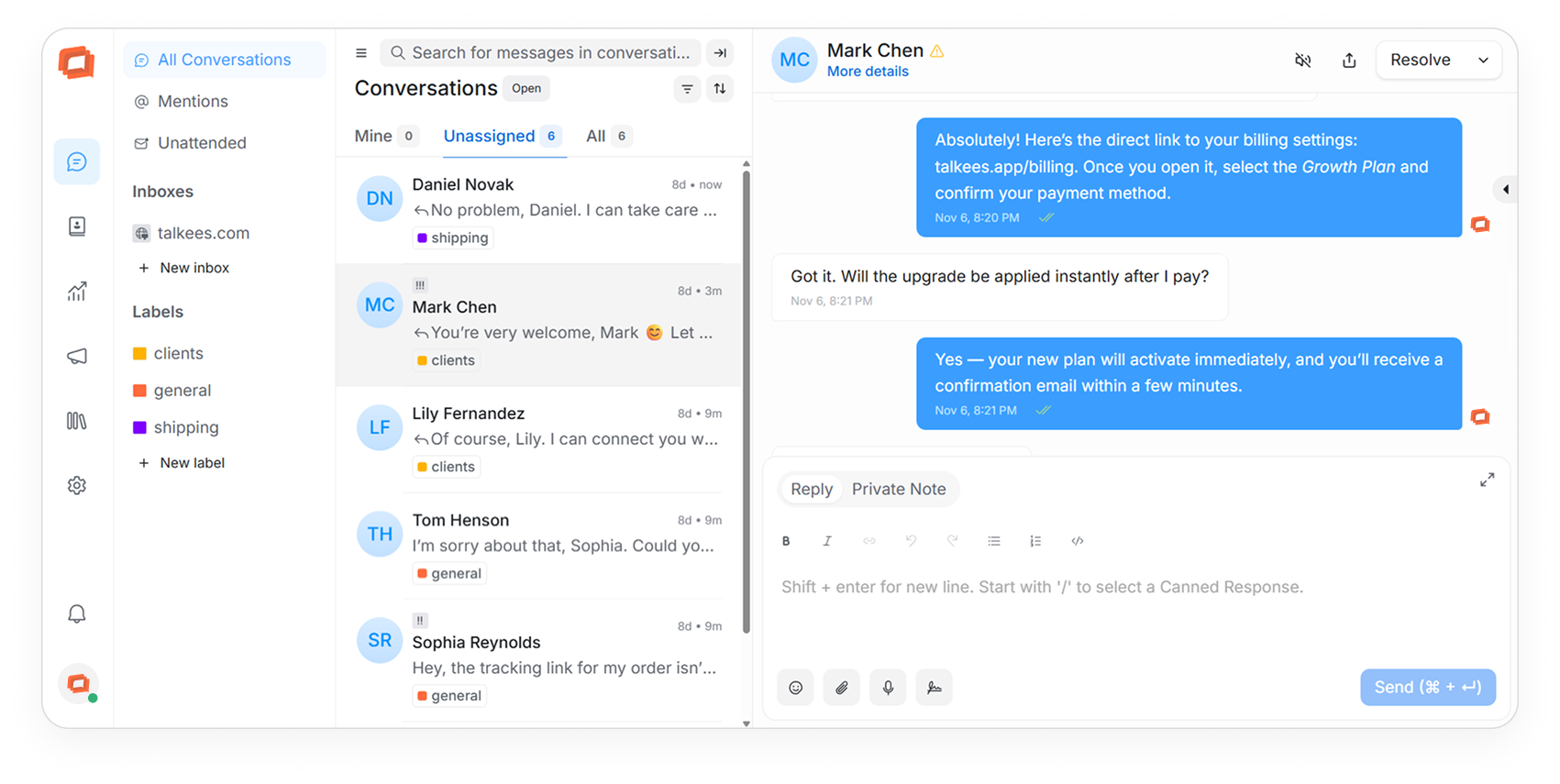
Talkees is an AI-driven, omnichannel chatbot and helpdesk designed for e-commerce businesses, retailers, and service providers. It excels at deflecting repetitive tickets, centralizing conversations across channels, and maintaining transparent pricing as you scale.
In a single, intuitive inbox, Talkees consolidates:
- Web chat on your site (live and AI-assisted)
- Email threads (shared inbox)
- SMS campaigns and one-to-one replies
- WhatsApp Business messages
- Social media direct messages (Facebook, Instagram)
This unified approach means agents no longer need to juggle multiple tabs and can respond from a single view with complete context. For example:
- An online store can answer a WhatsApp “Where’s my order?” inquiry while seeing the customer’s web chat history and previous emails in the same thread.
- A service business can confirm a booking received via Facebook DM and follow up by SMS—without losing conversation history.
Pricing Tiers and Limitations
Daktela’s pricing structure often involves complex tiers, per-seat licensing, and add-on costs for AI features. Many teams switch to alternatives seeking more transparent, predictable pricing models. Here’s how Talkees structures its pricing:
- Free — $0: Up to 50 conversations/month. Ideal for small businesses testing an AI chatbot for FAQs.
- Standard — $49/month: 1,000 conversations/month plus AI automations, app integrations, and reporting. This equals approximately $0.049 per conversation if you use the entire allowance.
- Premium — $99/month: Unlimited conversations for consistent costs during peak seasons and campaigns. For example, with 2,500 monthly conversations, this works out to approximately $0.04 per conversation—with no caps to worry about.
Key Value Proposition
- AI-first deflection: Automate common inquiries about order status, returns policy, and store hours; hand off to humans with full transcript when needed.
- True omnichannel in one place: Web chat, email, SMS, WhatsApp, and social DMs in a unified interface, eliminating the need for agents to ask customers for information they already have.
- Fast time-to-value: Begin with the free tier (50 conversations/month), then scale to Standard ($49 for 1,000 conversations) or Premium ($99 unlimited) as volume grows.
- E-commerce-friendly integration: Connects with tools businesses actually use (WooCommerce, HubSpot, Slack, Stripe), plus real-time analytics for first response time, resolution time, and CSAT.
Who Benefits Most from Talkees
- E-commerce businesses needing reliable live chat + AI chatbot without per-seat licensing surprises
- SMBs wanting email, chat, SMS, and WhatsApp under one roof with basic automations
- Teams currently using Daktela who seek simpler pricing, deeper chat automation, or a more streamlined agent UI
Daktela vs Modern Helpdesks: A Comparative Analysis

Before diving into specific alternatives, it’s helpful to understand the core components that every modern helpdesk should deliver. Use these five modules as your checklist when comparing Daktela with alternatives:
1. Messaging Hub — Unified Inbox Across Channels
What it is: A centralized inbox that integrates web chat, email, SMS, and social DMs, so agents don’t switch between tabs and customers maintain context throughout their journey.
What “good” looks like:
- True omnichannel threads: conversations continue across channels without losing history
- Identity resolution: automatic merging of duplicate contacts into one customer profile
- SLA timers: per-channel targets with visual breach warnings
- Multi-brand support: separate inboxes/branding per store or region, with shared analytics
- Desktop and mobile apps: fast notifications and reliable connections
How to test during a trial:
- Connect email forwarding, add the web chat widget to your site, and integrate SMS/WhatsApp. You should see unified threads within 30 minutes. Import recent emails to test threading and identity merging, and simulate a multi-step customer journey to confirm agents see one continuous conversation.
KPIs that matter:
- First Response Time (chat target: <60 seconds; email: 4-8 hours depending on SLA)
- Resolution Time (median per channel)
- Abandon rate (chat and social)
- Backlog trend (open vs. solved tickets)
2. Conversational AI & NLU
What it is: AI that drafts answers, handles frequent questions in your brand voice, and knows when to escalate. It should support multiple languages, reference knowledge base content, and maintain context throughout conversations.
What “good” looks like:
- Brand-voice controls: reply templates and tone settings (formal, friendly, concise)
- Retrieval-augmented answers: the bot references approved content, not just “guesses”
- Confidence thresholds + handover: if confidence is low, the AI transfers to a human with full transcript
- Multilingual support: auto-translation or native intent detection across your markets
- Agent assist (copilot): suggested replies, on-the-fly summaries, and instant call/chat notes
How to test during a trial:
- Load your FAQs and policies; connect order status via API if available. Run historical tickets through a simulation and check handover quality—agents should receive the complete bot transcript plus captured details (order ID, email).
KPIs that matter:
- Containment rate/deflection: percentage resolved by the bot without agent help
- Escalation rate and reasons
- CSAT on bot-only vs. human-assisted threads
- After-interaction work (AI summaries should reduce this)
Useful benchmark: Many e-commerce businesses report that 70-80% of incoming questions are repetitive (order status, returns, sizing)—ideal for automation. A realistic first target is 30-60% bot deflection in 60-90 days, with smooth handover for the rest.
3. Automation Workflows
What it is: The logic layer that routes, prioritizes, tags, and answers consistently—plus proactive chat/SMS campaigns to recover carts, follow up on tickets, or request reviews.
What “good” looks like:
- Visual routing: skill-based, language-based, and priority routing with SLA-aware fallbacks
- Auto-segmentation and tagging: segment by topic (returns, billing), VIPs, or order value
- Macros/canned replies: one-click multi-step actions (tag + reply + SLA reset)
- Campaigns: compliant chat/SMS campaigns with opt-in/opt-out, A/B tests, and per-country sender settings
- Event triggers: start flows on cart abandonment, shipment status, or UTM source
How to test during a trial:
- Build a “Returns” workflow: route to Tier 1, auto-tag, start a timer, and send a branded reply with a form. Launch a small SMS/chat campaign to opted-in customers and track responses.
KPIs that matter:
- SLA attainment percentage by queue
- Time-to-first-touch after routing
- Campaign reply rate and resolution rate
- Backlog reduction after implementing macros/automation
4. Knowledge Base & Helpdesk Portals
What it is: Self-service content and branded help portals that deflect tickets and provide your AI with accurate, up-to-date answers—ideally across multiple brands and languages.
What “good” looks like:
- Multiple portals (multi-brand): separate domains/themes, shared analytics
- Search and SEO: fast internal search, schema markup, and public articles indexed by Google
- Versioning and feedback: article history, owner, and user feedback to identify gaps
- Contextual surfaces: embed articles inside chat; AI cites the exact article used
- Permissions: public, logged-in, and agent-only content
How to test during a trial:
- Publish 10-15 articles, set up multiple brands/languages, enable feedback and search. Check whether the AI references these articles and how it responds when an article is updated.
KPIs that matter:
- Self-service rate: article views vs. new tickets on the same topic
- Search success (no-result searches)
- Article helpfulness percentage and top “needs update” items
- Bot answers citing KB content vs. free-text generations
5. Agent Tools
What it is: Productivity essentials that help agents work quickly and accurately: private notes, live previews, push notifications, assignments, and collision-free collaboration.
What “good” looks like:
- Private/internal notes and @mentions with audit trails
- Live chat preview: see what customers are typing before they send—crucial for speed and empathy
- Push notifications & focus mode: never miss high-priority messages
- Team assignments: queues, ownership, and collision detection (no double replies)
- Shortcuts & macros: keyboard commands, snippet libraries, and one-click workflows
- Supervisor tools: QA checklists, saved replies, and performance dashboards
How to test during a trial:
- Create macros, test @mentions and ownership changes, and verify collision detection with two agents in the same chat. Evaluate mobile/desktop notifications during peak periods.
KPIs that matter:
- Average Handle Time (AHT) and After-Interaction Work
- First Contact Resolution (FCR) rate
- Agent occupancy and time-to-first response per queue
- QA pass rate and CSAT by agent
Key Evaluation Metrics When Comparing Daktela Alternatives

When evaluating Daktela alternatives, focus on these metrics to make an informed decision:
- Containment rate (deflection): Percentage of conversations fully resolved by AI without human intervention
- Target: 30-50% in 60-90 days; 60-80% on mature FAQ coverage
- First Response Time (FRT): Time from customer message to first reply (bot or human)
- Target: <10 seconds on web chat; <30 seconds on messaging apps
- Resolution time (TTR): End-to-end time to resolve the issue
- Target: bot-only resolutions in <60 seconds for simple intents
- Customer Satisfaction (CSAT): Post-chat survey or rating
- Target: 85-90%+ on bot-only threads after content tuning
- Secondary metrics:
- Escalation rate (aim to reduce while keeping CSAT high)
- Agent minutes saved (deflected conversations × average handle time)
- Cost per resolved conversation (license + SMS fees / total resolved)
- Conversion from chat-assisted sessions and cart-recovery revenue
Talkees: The Leading Daktela Alternative
As the first alternative in our comparison, Talkees takes a chat-first approach that unifies live conversations and AI automation in one place, eliminating the need to choose between “human” or “bot” support.
Features & Capabilities
- Channels: Live web chat and email out of the box; SMS and messaging campaigns supported; integrations for Slack, HubSpot, Stripe, WooCommerce, and Google Translate (for multilingual replies).
- Agent tools: Reply templates, private/internal notes, live preview of ongoing chats, push notifications, multiple helpdesk portals (run multiple brands from one account), and comprehensive reports.
- AI automation: Instant answers to FAQs, intent-based routing, reply drafting, automated segmentation, and chat/SMS campaigns for proactive outreach (e.g., abandoned cart recovery).
- Analytics: Message volume, first response time, resolution time, and satisfaction indicators (CSAT).
Pricing (Transparent, Conversation-Based)
- Free — $0: Up to 50 conversations/month; live web chat + email; automatic AI responses
- Standard — $49/month: Up to 1,000 conversations; AI automations; app integrations; basic reports
- Premium — $99/month: Unlimited conversations; templates for common replies; auto-segmentation; reports
Ideal Use Cases
- 24/7 Customer Support (Hybrid Bot + Human)
- What to automate: Store hours, shipping/returns, size guides, warranty, pricing and discount policy, order tracking
- Setup in 60 minutes:
- Import your top 20 FAQs and product pages into the AI knowledge base
- Create a “business hours” rule: bot handles overnight with auto-handoff to agents at 9:00, preserving chat history
- Enable multilingual replies using Google Translate integration
- What to measure: Containment rate (target 35-60% for FAQs), first response time (<5 seconds via bot), CSAT trend
- Why it matters: Many e-commerce businesses find that 50-80% of incoming questions are repetitive; even automating the first answer reduces average handle time and improves CSAT after hours
- Order Status Inquiries (Self-Service + Context for Agents)
- Workflow design:
- Connect WooCommerce and map “Where is my order?” to an “Order lookup” flow
- Ask for order ID or email + ZIP; show carrier, last scan event, and ETA directly in chat
- If confidence is low, escalate with the retrieved metadata so the agent doesn’t re-ask for details
- Outcome to expect: Order-status inquiries often represent 20-40% of chat volume in retail; automating them can reduce queue length during peak periods without additional hiring
- Workflow design:
- Abandoned Cart Recovery (Chat/SMS Campaigns)
- Campaign playbook:
- Trigger a chat nudge on exit intent (“Still thinking? Here’s 10% off for the next 30 minutes”)
- Send an SMS 30-60 minutes after abandonment (opt-in required), then a final reminder in 24 hours
- Personalize by cart value or category; exclude purchasers
- Benchmark math: With 1,000 abandoned carts/month and an 8% conversion rate through campaigns, that’s 80 recovered orders. At a $50 AOV, that’s $4,000 incremental revenue—easily covering the cost of Talkees Standard ($49) or Premium ($99)
- Campaign playbook:
Quantified Impact
- Time savings: With 1,500 conversations/month at 6 minutes each (150 hours), a 40% containment rate saves ~60 hours monthly. At a $20/hour fully loaded agent cost, that’s ~$1,200 saved—versus $99 for Premium (unlimited conversations).
- Speed: Bot responses in under 1-2 seconds reduce bounce; targeting a <30-second first human reply often improves pre-sale conversion for live shoppers.
- Revenue: A modest 5-10% lift in recovered carts through chat/SMS translates into thousands in incremental monthly revenue for stores with 1,000+ abandons.
Best Practices
- Always provide a one-click “Talk to a human” option; pass the full transcript and collected metadata to agents
- Keep SMS compliant: obtain opt-in, include your brand signature, and keep unsubscribe rates below 1%
- Track four metrics weekly: containment rate, first response time, resolution time, and CSAT. Add campaign CTR and recovered revenue for cart flows
LiveAgent — Ticketing + Call Center Suite

LiveAgent combines comprehensive ticketing functionality with a robust call center suite, offering SLAs, automation, and a feature-rich platform.
Features & Capabilities
- Omnichannel coverage: Email, live chat, social media, phone, video calls, and SMS
- Call center features: IVR, call routing, call recording, and real-time monitoring
- Ticketing system: Automated ticket routing, SLA tracking, and advanced ticket management
- Knowledge base: Self-service portal, community forums, and FAQ management
- Reporting: Comprehensive analytics, custom reports, and agent performance tracking
Pricing
LiveAgent offers tiered pricing based on features and agent count, with options for both small businesses and larger enterprises.
Strengths & Limitations
Strengths:
- Comprehensive ticketing and call center features in one platform
- Strong SLA management and automation capabilities
- Extensive integration options with CRM and e-commerce platforms
Limitations:
- Complex UI with a steeper learning curve
- Per-agent licensing can become expensive at scale
- Advanced features require higher-tier plans
Our Subjective Assessment
After testing LiveAgent, we found its ticketing system to be exceptionally robust, though the interface can feel overwhelming for new users. The call center functionality is impressive, offering features typically found in dedicated call center software. While the platform excels for businesses with complex support needs, smaller teams might find it over-engineered for their requirements. The per-agent pricing model could become a limitation for growing teams.
Zendesk — Enterprise Helpdesk with Deep Reporting

Zendesk is a market-leading enterprise helpdesk solution known for its powerful workflows, extensive reporting capabilities, and rich ecosystem of integrations.
Features & Capabilities
- Omnichannel support: Email, chat, phone, social media, and messaging apps
- AI capabilities: Answer Bot, automated ticket routing, and agent assistance
- Advanced workflows: Trigger-based automations, macros, and custom business rules
- Enterprise features: Role-based access control, custom objects, and advanced security
- Marketplace: 1,000+ integrations and apps to extend functionality
Pricing
Zendesk offers multiple pricing tiers with per-agent costs that increase with feature access. Enterprise plans include advanced customization, reporting, and AI features.
Strengths & Limitations
Strengths:
- Comprehensive enterprise-grade features and security
- Deep reporting and analytics capabilities
- Extensive marketplace of integrations and add-ons
- Mature, reliable platform with regular updates
Limitations:
- Higher cost and complexity compared to simpler alternatives
- Significant implementation time for full feature utilization
- Add-on costs can substantially increase total price
Our Subjective Assessment
Having worked with Zendesk extensively, we’ve found it to be the gold standard for large organizations with complex support needs. The reporting capabilities are unmatched, allowing for detailed analysis of support operations. However, the platform can feel overwhelming for smaller teams, and the true cost often exceeds initial estimates once necessary add-ons are included. The AI capabilities have improved significantly but still require human oversight for optimal results.
Freshdesk — Modern Ticketing with Marketplace Apps
Freshdesk offers a modern ticketing system with Freddy AI integration, accessible pricing, and a growing marketplace of apps for customization.
Features & Capabilities
- Ticketing system: Automated ticket assignment, SLA management, and collision detection
- Freddy AI: Chatbot, agent assist, and automated ticket categorization
- Collaboration tools: Team inbox, internal notes, and parent-child tickets
- Marketplace: Custom apps and integrations with popular business tools
- Field service: Mobile app for on-site support (higher tiers)
Pricing
Freshdesk provides a free tier for basic ticketing and paid plans that progressively add features like automation, reporting, and AI capabilities.
Strengths & Limitations
Strengths:
- Clean, intuitive interface with minimal learning curve
- Accessible pricing for small to mid-sized businesses
- Strong automation capabilities even in mid-tier plans
- Freddy AI continues to improve with regular updates
Limitations:
- Advanced features require higher-tier plans
- Add-on costs for certain channels and capabilities
- Limited customization in lower tiers
- Telephony features not as robust as dedicated call center solutions
Our Subjective Assessment
During our testing, Freshdesk impressed us with its balance of functionality and usability. The interface is intuitive enough for new agents to quickly become productive while offering enough depth for power users. Freddy AI has become increasingly capable, providing useful suggestions and automations. The platform scales well for growing businesses, though larger enterprises might find some limitations in customization compared to Zendesk. The marketplace apps add valuable functionality but can increase the total cost of ownership.
Intercom — Conversational Support and Proactive Messaging

Intercom pioneered the conversational support approach, combining live chat, chatbots, and proactive messaging in a platform designed to engage customers throughout their journey.
Features & Capabilities
- Conversational support: Live chat, chatbots, and targeted messaging
- Proactive engagement: Product tours, onboarding flows, and targeted campaigns
- Fin AI: Advanced AI chatbot with natural language understanding
- Customer data platform: User segmentation and behavioral targeting
- Product-led growth tools: In-app messaging and engagement tracking
Pricing
Intercom uses a combination of seats and contacts/MAUs in its pricing model, with separate charges for advanced features and higher message volumes.
Strengths & Limitations
Strengths:
- Outstanding messenger experience and modern UI
- Strong proactive engagement capabilities
- Excellent bot builder with no-code interface
- Deep customer data and segmentation options
Limitations:
- Pricing can escalate quickly with contact/MAU growth
- Traditional ticketing features not as robust as helpdesk-first platforms
- Complex pricing model with multiple variables
Our Subjective Assessment
After implementing Intercom for several clients, we’ve found it excels at creating engaging customer experiences, particularly for SaaS and product-led businesses. The messenger interface is best-in-class, and the proactive capabilities drive significant engagement. Fin AI has dramatically improved the chatbot experience, handling complex queries with impressive accuracy. However, the pricing model can be challenging to predict as your customer base grows, and traditional ticket management isn’t its strongest suit. For businesses focused on conversational engagement rather than ticket management, Intercom remains a top choice.
Tidio — Lightweight Live Chat + AI for Online Stores

Tidio offers a streamlined live chat and AI chatbot solution designed specifically for e-commerce businesses looking for quick implementation and straightforward functionality.
Features & Capabilities
- Live chat: Real-time visitor monitoring, pre-chat surveys, and chat ratings
- AI chatbot: Visual bot builder, pre-built templates, and natural language understanding
- E-commerce focus: Abandoned cart recovery, product recommendations, and discount codes
- Visitor insights: Real-time visitor tracking and behavior monitoring
- Multi-channel: Website chat, Facebook Messenger, and email
Pricing
Tidio offers a free plan with limited features and paid plans based on the number of chatbots and operators needed.
Strengths & Limitations
Strengths:
- Extremely quick setup (under 5 minutes to go live)
- User-friendly visual bot builder requires no coding
- Specifically optimized for e-commerce use cases
- Clean, modern chat widget design
Limitations:
- Limited advanced routing capabilities
- Less robust than full helpdesk solutions
- Minimal telephony features
- Reporting not as comprehensive as enterprise platforms
Our Subjective Assessment
During our hands-on testing, Tidio impressed us with its simplicity and focus. We had a basic chatbot running on a test store within minutes, and the visual bot builder made creating more complex flows intuitive. The e-commerce specific templates saved significant setup time. While Tidio doesn’t offer the depth of a full helpdesk system, it excels at what it aims to do: provide effective chat and basic automation for online stores. The visitor tracking feature proved particularly valuable for identifying high-value prospects. For small to medium e-commerce businesses seeking quick implementation without complexity, Tidio offers excellent value.
Crisp — Unified Inbox with Bots and Campaigns
Crisp provides a unified messaging platform that combines live chat, chatbots, and marketing campaigns with fair pricing and a clean interface.
Features & Capabilities
- Unified inbox: Centralized messaging across channels (chat, email, social)
- Chatbots: Rule-based and AI-powered conversation flows
- Campaigns: Targeted messages based on user behavior and segments
- Knowledge base: Self-service help center with search functionality
- Team collaboration: Shared inbox, private notes, and assignments
Pricing
Crisp offers tiered pricing based on features, with plans suitable for startups through enterprises.
Strengths & Limitations
Strengths:
- Clean, intuitive interface that’s easy to adopt
- Fair and transparent pricing structure
- Strong focus on messaging and conversation quality
- Good balance of features without overwhelming complexity
Limitations:
- Fewer ITSM/helpdesk features compared to ticketing-first platforms
- Limited advanced workflow automation
- Reporting depth doesn’t match enterprise solutions
Our Subjective Assessment
After implementing Crisp for several clients, we found it strikes an excellent balance between functionality and simplicity. The unified inbox makes managing conversations across channels effortless, and the chatbot builder is intuitive enough for non-technical users. The campaign features are particularly strong, allowing for targeted engagement based on user behavior. While it lacks some of the depth found in traditional helpdesk systems, Crisp excels at conversational support. For businesses prioritizing messaging over ticket management, Crisp offers a refreshingly straightforward experience with pricing that scales reasonably.
HubSpot Service Hub — Native CRM + Helpdesk
HubSpot Service Hub integrates customer support directly with the HubSpot CRM platform, providing complete visibility across the customer lifecycle.
Features & Capabilities
- Native CRM integration: Complete customer context from marketing, sales, and service
- Ticketing system: Automated routing, pipelines, and SLA tracking
- Knowledge base: SEO-optimized help articles and content analytics
- Customer feedback: NPS, CSAT, and custom surveys with reporting
- Automation: Workflow builder for ticket routing and follow-up sequences
Pricing
HubSpot Service Hub offers free basic features with paid tiers that add functionality and remove limits on tickets, users, and automations.
Strengths & Limitations
Strengths:
- Seamless integration with HubSpot’s marketing and sales tools
- Complete customer visibility across the entire lifecycle
- Powerful automation builder with a visual interface
- Strong knowledge base with content performance analytics
Limitations:
- Higher cost when used outside the HubSpot ecosystem
- Some advanced features only available in higher-tier plans
- Less specialized than pure helpdesk solutions
- Per-user pricing can become expensive at scale
Our Subjective Assessment
Having implemented HubSpot Service Hub for multiple clients, its greatest strength is undoubtedly the seamless integration with the broader HubSpot ecosystem. Agents have complete visibility into the customer’s marketing and sales history, creating more personalized support experiences. The knowledge base functionality is excellent, with detailed analytics on content performance. However, when evaluated as a standalone helpdesk, it can be more expensive than dedicated alternatives with similar features. For businesses already using HubSpot for marketing or sales, Service Hub is a natural extension that provides significant value through unified customer data. For others, the cost-benefit equation depends heavily on how much you value that integrated approach.
Zoho Desk — Cost-Efficient Tickets and Automations

Zoho Desk offers a comprehensive ticketing system with robust automation capabilities at a competitive price point, particularly for businesses already in the Zoho ecosystem.
Features & Capabilities
- Multichannel ticketing: Email, social, chat, phone, and self-service
- Zia AI assistant: Ticket categorization, sentiment analysis, and response suggestions
- Automation: Time and event-based workflows, macros, and SLA management
- Customization: Custom fields, layouts, and business rules
- Reporting: Pre-built and custom reports with dashboards
Pricing
Zoho Desk offers tiered pricing with per-agent costs that increase with additional features and capabilities.
Strengths & Limitations
Strengths:
- Excellent value for feature set provided
- Strong integration with other Zoho applications
- Comprehensive automation capabilities
- Highly customizable to fit specific business processes
Limitations:
- Interface can be inconsistent across features
- AI capabilities less mature than some competitors
- Learning curve for advanced customizations
- Mobile experience varies in quality
Our Subjective Assessment
During our evaluation of Zoho Desk, we were impressed by the depth of functionality available at its price point. The platform offers robust ticketing, automation, and reporting capabilities that rival much more expensive solutions. The Zia AI assistant continues to improve, though it still lags behind some competitors in natural language understanding. The interface, while functional, isn’t as polished as some alternatives, with occasional inconsistencies in design and behavior. Where Zoho Desk truly shines is for businesses already using other Zoho products—the integration creates a seamless experience across CRM, support, and business applications. For price-conscious organizations seeking substantial helpdesk capabilities without premium pricing, Zoho Desk represents exceptional value.
Smartsupp — Simple Live Chat with Visitor Recordings
Smartsupp combines straightforward live chat functionality with the unique capability to record visitor sessions, providing context for support conversations.
Features & Capabilities
- Live chat: Real-time messaging with typing indicators and file sharing
- Visitor recordings: Session recordings showing user interactions and pain points
- Chatbot: Basic rule-based automation for common questions
- Analytics: Chat volume, response time, and satisfaction metrics
- Team management: Agent groups, chat routing, and offline messages
Pricing
Smartsupp offers a free plan with limited features and paid tiers based on the number of agents and advanced features needed.
Strengths & Limitations
Strengths:
- Visitor recordings provide valuable context for support interactions
- Simple, intuitive interface with minimal learning curve
- Quick implementation for small businesses
- Good value for basic live chat needs
Limitations:
- Limited omnichannel capabilities
- Basic analytics compared to full helpdesk solutions
- Chatbot functionality is more rule-based than AI-driven
- Fewer integrations than larger platforms
Our Subjective Assessment
In our testing, Smartsupp proved exceptionally easy to implement, with a clean interface that new agents can master quickly. The visitor recording feature is genuinely useful, allowing support teams to see exactly what customers experienced before reaching out. This context often eliminates the need for lengthy troubleshooting questions. The chatbot builder is straightforward but limited to basic rule-based scenarios rather than true AI conversations. For small e-commerce shops or businesses with straightforward support needs, Smartsupp offers a compelling balance of functionality and simplicity. However, companies requiring advanced routing, deep analytics, or sophisticated automations will likely outgrow its capabilities.
Conclusion and Final Recommendations
After comparing these Daktela alternatives, it’s clear that the right choice depends on your specific business needs, support volume, and growth trajectory:
- For AI-first omnichannel support: Talkees offers the most compelling combination of features, pricing transparency, and e-commerce focus. Its conversation-based pricing model (Free → $49 → $99) and unlimited multi-brand helpdesk portals make it particularly suitable for businesses seeking predictable costs as they scale.
- For enterprise-grade ticketing: Zendesk and LiveAgent provide comprehensive solutions with deep reporting, advanced workflows, and extensive customization—though at higher price points and complexity.
- For CRM-integrated support: HubSpot Service Hub delivers exceptional customer lifecycle visibility for businesses already in the HubSpot ecosystem.
- For lightweight, quick-to-deploy options: Tidio and Smartsupp offer straightforward implementations for small businesses with basic support needs.
- For conversational engagement: Intercom excels at proactive messaging and modern chat experiences, particularly for SaaS and product-led businesses.
When evaluating these alternatives, consider running a 2-4 week pilot on a free or entry-level plan. Measure key metrics like automated resolution rate (containment), first response time, and resolution time. This data-driven approach will help you identify which platform delivers the best results for your specific support scenarios.
For e-commerce businesses, SMBs, and teams focused on AI-driven support, Talkees emerges as the most balanced option—combining conversational automation, multi-brand capabilities, and straightforward pricing without the enterprise overhead of larger platforms.