 English
 Slovenčina
 Français
 Magyar

Understanding Total Cost of Ownership for CustomGPT Alternatives

When evaluating CustomGPT alternatives, you need to look beyond the monthly subscription fee. A comprehensive TCO model should account for seven key cost components:
- Implementation and setup: This includes solution design, knowledge ingestion, integration with your existing systems (helpdesk, CRM, ecommerce platforms), testing, and deployment. Depending on complexity, implementation costs typically range from $50,000-$150,000 for focused pilots to $150,000-$500,000 for departmental rollouts, with enterprise programs potentially exceeding $500,000.
- Data preparation and knowledge management: Cleaning and structuring FAQs, policies, and help center content requires significant effort, typically accounting for 15-25% of project costs for data-heavy deployments.
- Runtime consumption: Every token your AI processes has a cost. This includes LLM tokens (input and output), vector database searches, function calls, and voice processing. For reference, advanced models like GPT-4o typically cost between $2.50-$5.00 per million input tokens and $10-$15 per million output tokens.
- Platform subscriptions and add-ons: This includes seats, conversation-based plans, channel add-ons (WhatsApp/SMS), analytics, and premium features like voice capabilities.
- Integrations and middleware: Consider fees for integration platforms (Zapier/Make), custom connectors, API workarounds, and monitoring tools.
- Maintenance and retraining: Plan for continuous prompt tuning, model upgrades, regression testing, and content refreshes. A good rule of thumb is allocating 15-30% of your initial implementation cost annually for maintenance.
- Governance and compliance: Audit trails, data residency, compliance processes, and legal reviews are essential, especially if you handle payments, personal information, or regulated advice.
Key Features to Look for in a CustomGPT Alternative for Support Teams

Before diving into specific alternatives, let’s examine the essential features your support team should look for in a CustomGPT alternative:
Omnichannel Inbox Capabilities
An effective support solution should centralize conversations from multiple channels (web chat, email, social media, WhatsApp) into a unified interface. This provides seamless customer experiences regardless of where conversations begin.
Integrated Live Chat and AI Chatbot
Look for platforms that combine human agents with AI assistance. The best solutions allow AI to handle routine inquiries while enabling smooth handoffs to human agents for complex issues.
RAG (Retrieval-Augmented Generation) Grounding
RAG technology enables the AI to ground its responses in your specific knowledge base, significantly reducing hallucinations and improving accuracy. This is crucial for providing reliable customer support.
BYO-LLM Flexibility
“Bring Your Own Language Model” capabilities give you flexibility to choose which AI models power your solution, helping you balance cost and performance based on your specific needs.
Ecommerce Integrations
For online businesses, deep integration with ecommerce platforms enables order lookups, returns processing, and personalized shopping assistance.
Free vs Paid CustomGPT Chatbot Options

When considering CustomGPT alternatives, understanding the differences between free and paid options is crucial:
Free Tiers: Capabilities and Limitations
Free options typically offer basic functionality with significant limitations:
- Restricted monthly message volumes
- Limited knowledge base capacity
- Fewer integration options
- Basic analytics
- Limited or no customization
- Standard models rather than advanced reasoning capabilities
These limitations often make free tiers suitable only for testing or very small-scale deployments.
When to Upgrade to Paid Plans
Consider upgrading to paid plans when:
- Your message volume consistently approaches free tier limits
- You need advanced features like RAG, custom branding, or deeper analytics
- Your business requires reliable performance and SLAs
- You need integration with multiple systems
- Customer data security and compliance become priorities
- You want to reduce hallucinations and improve response accuracy
Paid plans typically offer tiered pricing based on usage, features, and support levels, with costs ranging from $20/month for basic plans to thousands for enterprise deployments.
How We Compared CustomGPT Competitors for E-commerce and SMB Support

Our evaluation methodology focused on four key metrics that matter most to support teams:
Accuracy and Response Quality
We tested each platform’s ability to provide correct, helpful responses across common support scenarios, measuring:
- Factual accuracy when retrieving information from knowledge bases
- Ability to understand complex, multi-part questions
- Hallucination rates (providing incorrect information)
- Consistency of responses across similar queries
Deflection Rate and Automation Capabilities
We assessed each platform’s ability to successfully resolve customer inquiries without human intervention, considering:
- Percentage of queries fully resolved by AI
- Quality of automated responses
- Appropriate escalation to human agents when needed
- Ability to handle multi-step processes
Time-to-Value and Implementation Effort
We evaluated how quickly each solution can be deployed and start delivering results:
- Setup and configuration complexity
- Knowledge base integration requirements
- Training and customization needs
- Availability of templates and pre-built components
Total Cost of Ownership
Beyond subscription fees, we analyzed comprehensive costs including:
- Implementation and professional services
- Ongoing maintenance requirements
- Token/usage costs at scale
- Integration expenses
- Training and change management needs
Detailed Comparison of Top CustomGPT Alternatives

Now, let’s examine the top alternatives to CustomGPT, evaluating their strengths, weaknesses, pricing, and ideal use cases.
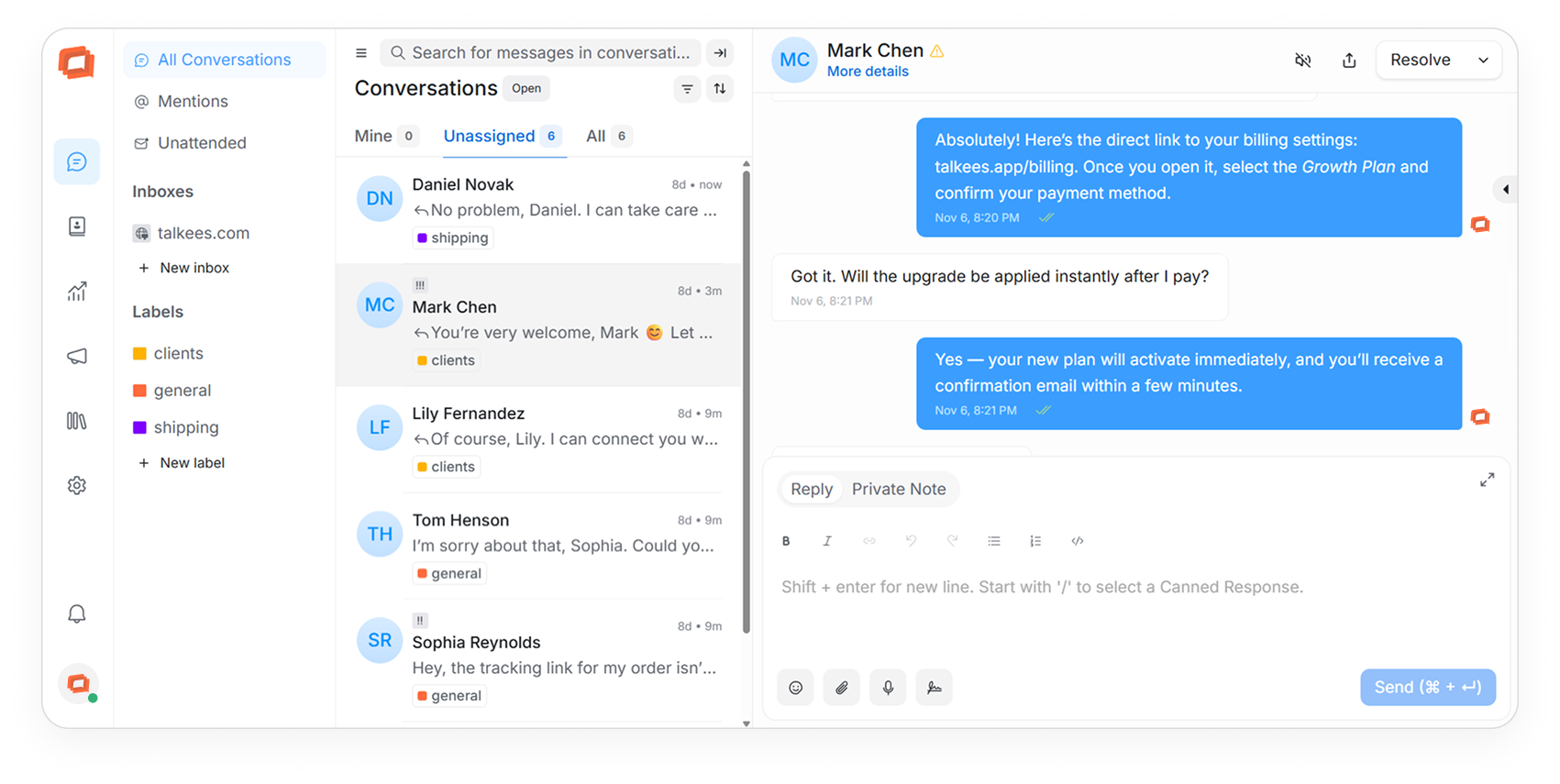
Talkees — Flexible, Modern, and Affordable CustomGPT-Style AI Chatbot + Omnichannel Support
Overview:
Talkees offers a comprehensive solution that combines AI chatbots with omnichannel support capabilities, designed specifically for small to mid-sized businesses seeking affordable automation without enterprise-level complexity.
Detailed Features:
- Omnichannel inbox: Centralizes conversations from web chat, email, WhatsApp, Instagram, and other messaging platforms
- RAG capabilities: Grounds AI responses in your knowledge base, FAQs, and product information
- Human handoff: Seamless transition from AI to human agents with full conversation context
- Customizable workflows: Create automated sequences for common customer journeys
- Analytics dashboard: Track resolution rates, response times, and customer satisfaction
- Ecommerce integrations: Connect with Shopify, WooCommerce, and other platforms for order management
Pricing:
- Free plan: Limited to 100 conversations/month, basic features
- Starter: $49/month (1,000 conversations, 3 channels)
- Growth: $149/month (5,000 conversations, all channels, advanced analytics)
- Business: $399/month (20,000 conversations, priority support, custom integrations)
- Enterprise: Custom pricing for high-volume needs
Pros:
- Affordable entry point for small businesses
- Quick implementation (typically 1-2 weeks)
- Transparent, conversation-based pricing with no hidden token costs
- Strong RAG capabilities with minimal hallucinations
- Excellent customer support with implementation assistance
Cons:
- Newer platform with fewer third-party integrations than some competitors
- Limited customization options at lower tiers
- May require additional configuration for complex workflows
Best for:
Talkees is ideal for SMBs and ecommerce businesses seeking an affordable, easy-to-implement solution that combines AI automation with human support capabilities. Its transparent pricing model makes it particularly suitable for businesses concerned about unpredictable costs.
Real User Experience:
“We implemented Talkees to handle our customer support across web and WhatsApp channels. Within two weeks, we saw a 35% reduction in response times and successfully automated about 60% of routine inquiries. The pricing is predictable, and we haven’t experienced any surprise costs related to token usage. Their team was extremely helpful during setup, particularly with knowledge base integration.”
Intercom — Product-Led Support with Fin AI and Proactive Messaging
Overview:
Intercom is a well-established customer messaging platform that has evolved to incorporate AI capabilities through its Fin AI assistant, offering a comprehensive solution for businesses that prioritize a product-led support approach.
Detailed Features:
- Fin AI assistant: AI-powered chatbot that can answer questions and resolve issues
- Proactive messaging: Trigger automated messages based on user behavior
- Customizable chatbots: Build conversation flows without coding
- App ecosystem: Extensive marketplace of integrations
- Targeted messaging: Segment customers for personalized outreach
- Product tours: Guide users through your product features
Pricing:
- Starter: $74/month (1 seat, basic features)
- Pro: $119/month/seat (minimum 2 seats, advanced features)
- Premium: Custom pricing (enterprise features, dedicated support)
- Additional costs: Fin AI add-on approximately $99/month; conversation-based pricing can lead to higher costs during volume spikes
Pros:
- Mature platform with robust features
- Strong integration ecosystem
- Excellent for product-led companies
- Combines marketing, sales, and support capabilities
- Good analytics and reporting
Cons:
- Higher cost than many alternatives
- Complex pricing structure with potential for unexpected costs
- Setup and configuration can be time-consuming
- Fin AI capabilities not as advanced as some dedicated AI platforms
Best for:
Intercom works best for SaaS companies and product-led businesses that need a unified platform for marketing, sales, and support communications. It’s particularly strong for companies that want to blend proactive engagement with reactive support.
Real User Experience:
“Intercom has been central to our customer engagement strategy for years. Adding Fin AI has allowed us to automate about 40% of routine inquiries, though we found it required significant training to get accurate responses for product-specific questions. The platform excels at proactive engagement, but the pricing model can be challenging to predict as you scale.”
Zendesk — Enterprise-Grade Ticketing with AI Add-Ons and Complex Workflows
Overview:
Zendesk is an enterprise-focused customer service platform that has added AI capabilities to its comprehensive ticketing system, offering robust workflow management for complex support operations.
Detailed Features:
- AI-powered ticket routing and prioritization
- Answer Bot: AI assistant that suggests relevant help articles
- Customizable ticket workflows and automation
- Comprehensive reporting and analytics
- Omnichannel support: Email, chat, phone, social media
- Knowledge base management
- SLA management and compliance features
Pricing:
- Suite Team: $55/agent/month (basic features)
- Suite Growth: $89/agent/month (automation and reporting)
- Suite Professional: $115/agent/month (advanced workflows)
- Suite Enterprise: $169/agent/month (enterprise features)
- Additional costs: AI features often require higher tiers or add-ons; implementation services can range from $5,000-$50,000+
Pros:
- Enterprise-grade reliability and security
- Comprehensive ticketing and workflow capabilities
- Strong compliance features for regulated industries
- Mature ecosystem with hundreds of integrations
- Extensive customization options
Cons:
- Higher cost than many alternatives
- Complex implementation requiring significant resources
- AI capabilities less advanced than dedicated AI platforms
- Can be overwhelming for smaller organizations
- Additional costs for advanced AI features
Best for:
Zendesk is ideal for medium to large enterprises with complex support requirements, multiple teams, and the need for advanced workflow management. It’s particularly strong for organizations in regulated industries that need robust compliance features.
Real User Experience:
“As an enterprise with over 200 support agents, Zendesk provides the structure and compliance features we need. The AI capabilities have improved significantly but still require substantial configuration to work effectively with our specialized knowledge base. Implementation took about three months and required dedicated resources, but the workflow automation has improved our efficiency by approximately 25%.”
Freshworks (Freshchat/Freshdesk) — SMB-Friendly Omnichannel with No-Code Bots
Overview:
Freshworks offers a suite of customer engagement products, with Freshchat and Freshdesk providing AI-powered chat and ticketing solutions designed to be accessible for small and medium-sized businesses.
Detailed Features:
- Freddy AI: AI assistant that can be deployed across channels
- No-code bot builder: Create conversation flows without technical expertise
- Omnichannel engagement: Web, mobile, social, WhatsApp
- Intelligent routing: Direct conversations to the right team members
- Campaign management: Proactive customer engagement
- Self-service portal: Knowledge base and community forums
Pricing:
- Freshchat Free: Basic features, limited conversations
- Freshchat Growth: $29/agent/month (basic bot capabilities)
- Freshchat Pro: $59/agent/month (advanced bots, analytics)
- Freshchat Enterprise: $99/agent/month (custom bots, advanced security)
- Freshdesk: Similar tiered pricing from Free to Enterprise ($79/agent/month)
Pros:
- Affordable entry point for small businesses
- User-friendly interface requiring minimal training
- Good balance of features and simplicity
- Straightforward implementation process
- Transparent pricing structure
Cons:
- AI capabilities less sophisticated than specialized platforms
- Limited customization at lower tiers
- May require multiple Freshworks products for comprehensive coverage
- Less suitable for complex enterprise requirements
- Some advanced features only available at higher tiers
Best for:
Freshworks is ideal for small to medium-sized businesses looking for an accessible, affordable solution with a balance of human and AI support capabilities. It’s particularly suitable for companies with limited technical resources that need a quick implementation.
Real User Experience:
“We implemented Freshchat to support our growing ecommerce business. The no-code bot builder allowed us to create automated flows for common questions within days, not weeks. Freddy AI handles about 45% of our inquiries without human intervention. The pricing scales predictably with our growth, and we haven’t encountered any hidden costs.”
Ada — Automation-First Enterprise Chatbot Focused on High Deflection
Overview:
Ada is an enterprise-grade conversational AI platform designed specifically for high-volume support automation, with a focus on maximizing deflection rates while maintaining quality interactions.
Detailed Features:
- Advanced NLU engine: Understands complex customer inquiries
- Omnichannel deployment: Web, mobile, social, messaging apps
- Powerful analytics: Detailed insights on conversation performance
- A/B testing capabilities: Optimize automated responses
- Multi-language support: Global deployment capabilities
- Enterprise security and compliance: SOC 2, GDPR, HIPAA compliance
Pricing:
- Custom pricing: Based on conversation volume and features
- Typical starting point: Enterprise implementations often begin at $50,000+ annually
- Implementation services: Additional professional services typically required
Pros:
- Industry-leading automation rates (often 80%+ for appropriate use cases)
- Enterprise-grade security and compliance
- Sophisticated conversation design capabilities
- Strong analytics for continuous improvement
- Dedicated customer success resources
Cons:
- Significant investment required
- Complex implementation process
- Best results require dedicated resources for maintenance
- Less suitable for small businesses with limited budgets
- Requires substantial content development
Best for:
Ada is ideal for large enterprises with high support volumes looking to significantly reduce costs through automation. It’s particularly effective for organizations with well-defined, repeatable support scenarios that can benefit from consistent automated handling.
Real User Experience:
“We deployed Ada across our support channels to handle our 1M+ monthly customer interactions. After a three-month implementation, we achieved a 78% automation rate for tier-1 support issues, resulting in approximately $2.5M annual savings. The platform requires ongoing optimization, but the ROI has been clear. Implementation costs were substantial but justified by the volume we process.”
LivePerson — Contact-Center Messaging and AI at Scale
Overview:
LivePerson specializes in enterprise messaging and conversational AI solutions designed for large contact centers, offering sophisticated orchestration between automated and human interactions.
Detailed Features:
- Conversation orchestration: Intelligent routing between bots and humans
- Intent analysis: Understand customer needs in real-time
- Agent workspace: Unified console for managing conversations
- Proactive messaging: Initiate conversations based on customer behavior
- Advanced analytics: Conversation performance and agent productivity
- Integration with contact center systems: CRM, telephony, workforce management
Pricing:
- Enterprise pricing: Custom quotes based on volume and features
- Typical range: Mid-six to seven figures annually for large deployments
- Implementation services: Significant professional services often required
Pros:
- Designed for enterprise-scale operations
- Sophisticated conversation orchestration
- Strong integration with existing contact center infrastructure
- Proven in high-volume environments
- Comprehensive agent tools and analytics
Cons:
- Significant investment required
- Complex implementation and integration
- Requires dedicated resources for management
- Less accessible for smaller organizations
- Potential for high total cost of ownership
Best for:
LivePerson is ideal for large enterprises with established contact centers looking to modernize their customer engagement strategy. It’s particularly effective for organizations managing millions of customer interactions across multiple channels that need sophisticated orchestration between AI and human agents.
Real User Experience:
“As a telecommunications provider handling over 5 million customer interactions monthly, LivePerson has been transformative for our contact center operations. The implementation was substantial—taking about six months and requiring significant investment—but we’ve achieved a 35% reduction in cost per interaction and improved CSAT by 12 points. The platform excels at balancing automation with human touch.”
Tidio — Lightweight Live Chat and Chatbot for Fast Ecommerce Deployments
Overview:
Tidio offers a streamlined live chat and chatbot solution designed specifically for ecommerce businesses seeking quick implementation and straightforward automation without complex setup.
Detailed Features:
- Live chat: Real-time customer communication
- Visual chatbot builder: Create automation without coding
- Visitor tracking: See who’s browsing your site
- Pre-built templates: Quick start for common scenarios
- Ecommerce integrations: Shopify, WooCommerce, Magento
- Multi-channel capabilities: Website, Facebook Messenger, email
Pricing:
- Free plan: Basic features, 3 operators, limited chatbots
- Starter: $29/month (unlimited chatbots, basic features)
- Communicator: $39/month/operator (advanced live chat features)
- Chatbots: $49/month (advanced automation capabilities)
- AI Chatbots: Add-on starting at $29/month
Pros:
- Extremely quick setup (often same-day implementation)
- User-friendly interface requiring minimal training
- Affordable for small businesses
- Good ecommerce integration
- Balanced human and automated support
Cons:
- Limited customization compared to enterprise solutions
- AI capabilities less sophisticated than specialized platforms
- Fewer integration options than larger platforms
- Less suitable for complex support scenarios
- Limited analytics at lower tiers
Best for:
Tidio is perfect for small to medium-sized ecommerce businesses looking for a quick-to-implement solution that combines live chat with basic automation. It’s particularly suitable for businesses with straightforward support needs that want to improve customer engagement without significant investment.
Real User Experience:
“We implemented Tidio on our Shopify store in less than a day. The pre-built chatbot templates helped us automate responses to common questions about shipping and returns immediately. We’re seeing about 40% of customer inquiries handled by the chatbots, and the live chat has increased our conversion rate by approximately 15%. For a small business, the value is excellent.”
Drift — Revenue Chat and ABM Conversations for B2B Pipelines
Overview:
Drift focuses on conversation-driven revenue acceleration for B2B companies, combining chatbots, live chat, and account-based marketing capabilities to convert website visitors into qualified leads.
Detailed Features:
- Revenue acceleration platform: Focus on converting conversations to revenue
- Conversational marketing: Engage target accounts in real-time
- Account-based marketing capabilities: Target specific high-value accounts
- Intelligent routing: Connect prospects with the right sales representatives
- Meeting scheduler: Book meetings directly from conversations
- Sales insights: Understand prospect engagement and intent
Pricing:
- Premium: Starting around $1,600/month (basic features)
- Advanced: Starting around $2,500/month (more automation)
- Enterprise: Custom pricing (full feature set)
- Implementation: Professional services often recommended
Pros:
- Strong focus on revenue generation rather than just support
- Excellent B2B lead qualification capabilities
- Good integration with sales and marketing tools
- Sophisticated routing based on account value
- Proven ROI for sales-focused organizations
Cons:
- Higher cost than support-focused alternatives
- Less emphasis on customer support use cases
- Complex implementation for full value realization
- Requires alignment between marketing and sales teams
- May be overkill for simple support needs
Best for:
Drift is ideal for B2B companies with complex sales cycles that want to use conversational marketing to accelerate revenue. It’s particularly effective for organizations practicing account-based marketing that need to engage high-value prospects through personalized conversations.
Real User Experience:
“We implemented Drift primarily as a lead generation tool for our B2B SaaS platform. The ability to target specific accounts and personalize conversations based on company size and industry has increased our qualified lead rate by 45%. The investment is significant but justified by the pipeline impact. It’s not primarily a support tool for us—we use it to start sales conversations.”
Help Scout — Email-First Helpdesk with Simple Chat and Knowledge Base
Overview:
Help Scout offers an email-centric customer support platform with a focus on simplicity and personal customer interactions, complemented by basic live chat capabilities and a robust knowledge base solution.
Detailed Features:
- Shared inbox: Collaborative email management
- Docs: Knowledge base creation and management
- Beacon: Embedded chat and self-service widget
- Automation and workflows: Route and assign conversations
- Customer profiles: Complete conversation history and properties
- Reporting: Performance metrics and team productivity
Pricing:
- Standard: $20/user/month (core features)
- Plus: $40/user/month (additional automation)
- Pro: $65/user/month (advanced features and API)
- Company: Custom pricing for larger teams
Pros:
- Clean, intuitive interface
- Strong email management capabilities
- Excellent knowledge base solution included
- Personal, human-feeling customer interactions
- Straightforward pricing without hidden costs
Cons:
- Limited AI capabilities compared to specialized platforms
- Chat functionality less robust than chat-first platforms
- Fewer integration options than larger platforms
- Less suitable for high-volume automation needs
- Limited customization options
Best for:
Help Scout is ideal for small to medium-sized businesses that prioritize personal, email-based support with supplementary chat capabilities. It’s particularly well-suited for teams that value simplicity and human connection over extensive automation.
Real User Experience:
“We chose Help Scout because we wanted a solution that maintained a personal touch with our customers. The shared inbox is excellent for our team of 12 support agents, and the knowledge base has reduced repetitive questions by about 30%. The chat functionality is basic but sufficient for our needs. We appreciate the straightforward pricing—we know exactly what we’re paying for.”
Gorgias — Shopify-Native Helpdesk with Ecommerce Automations and AI Macros
Overview:
Gorgias is a helpdesk platform built specifically for ecommerce businesses, offering deep integration with platforms like Shopify and providing specialized tools for managing order-related customer inquiries.
Detailed Features:
- Ecommerce-specific helpdesk: Order management within tickets
- Omnichannel support: Email, live chat, social media, SMS
- Automation rules: Order-based workflows and responses
- Macros and templates: Quick responses for common scenarios
- Deep Shopify integration: Access order details directly
- Self-service portal: Customer order lookup and FAQs
Pricing:
- Basic: $10/month (limited tickets)
- Pro: Starting at $50/month (based on ticket volume)
- Advanced: Starting at $250/month (more features and volume)
- Enterprise: Custom pricing for high-volume needs
Pros:
- Purpose-built for ecommerce businesses
- Excellent integration with Shopify and other platforms
- Order-centric workflow design
- Good balance of automation and human support
- Intuitive interface for support agents
Cons:
- Limited value for non-ecommerce businesses
- AI capabilities less advanced than specialized platforms
- Volume-based pricing can escalate costs during busy periods
- Some advanced features only available at higher tiers
- Less suitable for complex support scenarios outside ecommerce
Best for:
Gorgias is perfect for ecommerce businesses, particularly those using Shopify, that need a support solution specifically designed for handling order-related inquiries and providing omnichannel support to online shoppers.
Real User Experience:
“As a Shopify store processing about 5,000 orders monthly, Gorgias has been transformative for our support team. The ability to view and modify orders directly from support tickets saves us countless hours. The automation handles about 35% of our inquiries, mostly order status and return questions. During holiday peaks, the volume-based pricing increases our costs, but the efficiency gains justify the expense.”
Building a Reliable CustomGPT Agent for Support: Best Practices

To create an effective AI support agent, regardless of which platform you choose, follow these best practices:
Designing Effective Conversation Flows
- Map out common customer journeys and decision points
- Create clear, concise prompts that guide users toward resolution
- Design natural conversation patterns that feel helpful, not robotic
- Include appropriate personality traits that match your brand
Implementing Actions and Guardrails
- Define clear boundaries for what your AI can and cannot do
- Implement verification steps for sensitive actions (payments, account changes)
- Create fallback responses for when the AI is uncertain
- Establish clear escalation paths to human agents
Ensuring Smooth Human Handoff
- Design clear triggers for when a conversation should transfer to a human
- Ensure all context is preserved during handoff
- Create protocols for agents to provide feedback on AI performance
- Implement “whisper” suggestions to help human agents respond efficiently
Measuring and Improving Performance
- Track key metrics: deflection rate, CSAT, resolution time, handoff rate
- Regularly review conversation logs to identify improvement opportunities
- A/B test different approaches to common scenarios
- Continuously update your knowledge base based on customer interactions
Migration from Yellow.ai Without Downtime

If you’re considering switching from Yellow.ai to one of these alternatives, careful planning can ensure a smooth transition:
Data Export and Preparation
- Export all conversation data, knowledge base content, and custom workflows
- Clean and standardize your data before importing to the new platform
- Map your existing intents and entities to the new system’s structure
- Prepare your team with documentation of the new processes
Channel Migration Strategy
- Start with less critical channels to test the new system
- Run systems in parallel during the transition period
- Implement a phased cutover approach by channel or customer segment
- Have a rollback plan ready in case of unexpected issues
Knowledge Base Transfer
- Audit your existing knowledge base for accuracy and relevance
- Restructure content to match the new platform’s requirements
- Test knowledge retrieval thoroughly before going live
- Establish a regular update schedule to keep content fresh
Timeline and Communication Plan
- Plan for a 4-8 week migration process (depending on complexity)
- Communicate changes to customers with clear expectations
- Train support teams thoroughly on the new system
- Monitor closely during the first 2-4 weeks after cutover
Cost Modeling for CustomGPT AI

Understanding the financial implications of your CustomGPT alternative is crucial for budgeting and ROI calculations:
Key Cost Components
- Platform subscription: Base fees for the software and features
- Per-seat licensing: Costs for each agent using the system
- Token consumption: Charges based on AI model usage (input and output)
- Implementation services: Professional assistance with setup and configuration
- Integration costs: Connecting to your existing systems
- Ongoing maintenance: Knowledge base updates and system optimization
Usage-Based vs. Subscription Pricing
Different platforms use various pricing models:
- Per-conversation: Charging based on the number of customer interactions
- Token-based: Pricing based on the volume of tokens processed by the AI
- Seat-based: Charging per user/agent with access to the system
- Hybrid models: Combining fixed subscriptions with usage-based components
Calculating ROI
To determine the return on your investment:
- Measure current support costs (agent time, infrastructure, etc.)
- Estimate potential savings from automation (% of queries deflected × cost per interaction)
- Factor in improved customer satisfaction and retention
- Consider reduced training time for agents with AI assistance
- Calculate time-to-value and payback period
Avoiding Hidden Costs
Watch for these potential budget surprises:
- Token usage spikes during high-volume periods
- Additional charges for premium features or channels
- Professional services for complex integrations
- Costs for regular knowledge base updates
- Training and change management expenses
Data Control and Compliance in CustomGPT Chatbots

When implementing AI for customer support, data security and compliance are critical considerations:
GDPR and Data Privacy
- Ensure your chosen platform offers clear data processing agreements
- Understand how customer data is stored, processed, and potentially used for training
- Implement appropriate consent mechanisms for data collection
- Consider platforms that offer regional data storage options
SOC 2 and Security Standards
- Verify that your chosen platform has appropriate security certifications
- Understand access controls and authentication mechanisms
- Review the platform’s security practices and incident response procedures
- Consider how sensitive information is handled within conversations
Data Residency Options
- Some businesses require data to remain within specific geographic regions
- Evaluate platforms that offer regional data centers or self-hosting options
- Understand the implications for performance and compliance
- Consider hybrid approaches that balance security and functionality
BYO-Model Considerations
- Some platforms allow you to bring your own language models
- This can provide greater control over data and performance
- Consider the technical expertise required for this approach
- Evaluate the cost implications of managing your own models
Matching Use Cases to the Right CustomGPT Alternative

Different businesses have unique requirements that make certain platforms more suitable than others:
Ecommerce Support
Best options: Gorgias, Tidio, Talkees
Key features: Order management integration, product catalog knowledge, cart abandonment recovery
SaaS Product Support
Best options: Intercom, Freshworks, Zendesk
Key features: Product documentation integration, user onboarding, technical troubleshooting
High-Volume Support Operations
Best options: Ada, LivePerson, Zendesk
Key features: Scalability, advanced routing, comprehensive analytics, high automation rates
Sales-Assisted Conversations
Best options: Drift, Intercom
Key features: Lead qualification, meeting scheduling, sales process integration
Measuring Success After Switching Platforms

To ensure your new CustomGPT alternative is delivering value, track these key metrics:
Customer Satisfaction (CSAT)
- Measure satisfaction scores for both AI and human interactions
- Compare pre- and post-implementation scores
- Identify specific scenarios where satisfaction improves or declines
First Response Time (FRT)
- Track how quickly customers receive initial responses
- Compare automated vs. human response times
- Set targets based on channel and query complexity
Containment Rate
- Measure the percentage of inquiries fully resolved by the AI
- Analyze by query type to identify automation opportunities
- Set realistic targets based on your business complexity
Agent Assist Adoption
- Track how frequently agents use AI suggestions
- Measure time saved through AI assistance
- Gather agent feedback on quality and relevance of suggestions
ROI Tracking
- Calculate cost per interaction (before and after implementation)
- Measure agent productivity improvements
- Track reduction in training time for new agents
- Quantify customer retention improvements
Conclusion: Choosing the Right CustomGPT Alternative

Selecting the ideal CustomGPT alternative requires balancing features, cost, implementation effort, and alignment with your specific business needs. Consider these final recommendations:
- Start with your use case: Define exactly what problems you’re trying to solve before evaluating platforms.
- Prioritize TCO over sticker price: Look beyond monthly subscription costs to understand the full investment required.
- Consider your growth trajectory: Choose a platform that can scale with your business over the next 2-3 years.
- Value flexibility: Platforms that offer multiple deployment options and integration capabilities provide more long-term value.
- Start small and expand: Consider a phased approach, beginning with a focused pilot before full-scale deployment.
By thoroughly evaluating your options against these criteria, you can select a CustomGPT alternative that delivers tangible business value while avoiding unexpected costs and implementation challenges. Whether you choose Talkees for its balanced approach, Zendesk for enterprise complexity, or Tidio for ecommerce simplicity, the right platform will help you deliver exceptional customer experiences while optimizing your support operations.