 English
 Slovenčina
 Français
 Magyar

Why Users Seek Chatwoot Alternatives: Understanding Modern Support Requirements

Organizations typically look beyond Chatwoot for several key reasons:
- AI limitations: While Chatwoot offers basic automation through its Captain assistant, modern AI-native platforms provide significantly more advanced capabilities. Leading alternatives offer autonomous resolution (handling issues without human intervention), knowledge ingestion from multiple sources, and tool-enabled actions that can trigger refunds or update accounts.
- Omnichannel gaps: True omnichannel support requires more than just connecting multiple channels. It demands conversation continuity when customers switch channels, unified customer profiles, and consistent analytics across all touchpoints. Some users find Chatwoot’s omnichannel implementation lacks the seamless experience modern customers expect.
- Scaling challenges: As support volumes grow, organizations need robust routing, SLAs, and reporting capabilities. Enterprise teams often outgrow Chatwoot’s analytics and workflow capabilities.
- Self-hosting overhead: While Chatwoot’s self-hosted option provides data control, it introduces significant operational costs. Many teams underestimate the DevOps resources required for maintenance, security patches, backups, and scaling.
Key Comparison Criteria for Chatwoot Alternatives: What to Look For

When evaluating Chatwoot alternatives, focus on these critical areas:
Channels and Omnichannel Depth
A true omnichannel solution should provide:
- Unified inbox across email, live chat, WhatsApp/Instagram, SMS, and voice
- Conversation continuity when customers switch channels
- Consistent features across all channels (attachments, quick replies, tagging)
- Unified customer profiles that merge identities across touchpoints
AI and Automation Capabilities
Modern support platforms vary significantly in AI sophistication:
- Agent assist features (suggested replies, summarization, knowledge lookup)
- Autonomous resolution capabilities (percentage of issues resolved without agents)
- Knowledge ingestion (ability to learn from your help center, past tickets, and internal documents)
- Tool actions (ability to trigger refunds, update accounts, or perform other system actions)
Integration Ecosystem
Evaluate platforms based on their ability to connect with your essential tools:
- CRM integrations (Salesforce, HubSpot, Zoho)
- E-commerce platforms (Shopify, WooCommerce)
- Development tools (Jira, Linear, GitHub)
- Collaboration platforms (Slack, Microsoft Teams)
- API quality and webhook support for custom integrations
Analytics and SLA Management
Look for platforms that offer:
- Customizable dashboards and reports
- SLA configuration and breach alerts
- Agent performance metrics
- Revenue attribution (especially important for e-commerce)
- Export capabilities and data warehouse integration
Pricing Model and TCO
Consider the full cost picture:
- Per-seat vs. per-conversation vs. per-resolution pricing
- AI usage fees (can range from $0.29 to $0.99+ per resolution)
- Implementation and migration costs
- Self-hosting infrastructure and maintenance costs
- Channel delivery fees (WhatsApp, SMS)
Integrations and Extensibility: Ensuring Compatibility with Your Tech Stack

The value of a support platform largely depends on how well it connects with your existing tools and workflows. When comparing Chatwoot alternatives, pay special attention to:
API and Development Flexibility
Chatwoot provides a REST API and webhook events that developers can leverage to build custom integrations. When evaluating alternatives, assess:
- API documentation quality and completeness
- Webhook reliability and payload structure
- SDK availability for popular programming languages
- Custom app frameworks or marketplace offerings
Key Integration Categories
The most critical integrations typically include:
- CRM and Customer Data: Look for bidirectional sync with platforms like HubSpot, Salesforce, or Zoho CRM. The best integrations allow agents to see customer data directly in the conversation view and update CRM records without switching contexts.
- E-commerce Platforms: For online retailers, deep integration with Shopify or WooCommerce is essential. Premium alternatives like Gorgias allow agents to issue refunds, edit orders, and view purchase history directly within the support interface.
- Development and Project Management: Engineering-focused teams benefit from integrations with Jira, Linear, or GitHub that allow creating and linking issues from support conversations.
- Collaboration Tools: Slack and Microsoft Teams integrations should support bidirectional communication, allowing agents to respond to tickets directly from their collaboration platform.
Is Chatwoot’s Omnichannel Capabilities Enough? Defining True Omnichannel Support

While Chatwoot markets itself as an omnichannel solution, true omnichannel support encompasses more than just handling multiple channels through a single interface.
What Makes Support Truly Omnichannel
- Identity Stitching: The platform should automatically recognize the same customer across different channels, creating a unified profile and conversation history.
- Conversation Continuity: When a customer starts on live chat and later emails, the conversation should continue seamlessly without requiring them to repeat information.
- Consistent Experience: Features like file attachments, quick replies, and rich media should work consistently across all channels.
- Unified Analytics: Reporting should provide insights across all channels, allowing you to understand the customer journey regardless of which touchpoints they use.
- Channel-Specific Optimizations: While maintaining consistency, the platform should leverage the unique capabilities of each channel (like WhatsApp templates or Instagram rich media).
Most organizations find that customers who engage across multiple channels have 250% higher purchase frequency than single-channel customers. However, many platforms (including Chatwoot) struggle to deliver true continuity when customers switch channels, leading to fragmented experiences and repeated information.
Free vs Paid Platforms: Analyzing Total Cost of Ownership (TCO)

The true cost of a support platform extends far beyond the advertised price. When comparing Chatwoot (particularly self-hosted) with SaaS alternatives, consider these cost factors:
Self-Hosted Costs (Chatwoot Community Edition)
While the software itself is free under MIT license, self-hosting introduces significant costs:
- Infrastructure: VMs, managed PostgreSQL, Redis, storage (recommended: 4+ CPU cores, 8+ GB RAM, 50+ GB SSD)
- DevOps time: Setup, maintenance, security patches, backups (typically 0.2-0.5 FTE)
- Scaling: Additional resources during traffic spikes
- Security: SSL certificates, vulnerability scanning, audit logging
- High availability: Redundancy, load balancing, disaster recovery
SaaS Pricing Models
Most Chatwoot alternatives use one of these pricing approaches:
- Per-seat/agent: Common for Intercom, Zendesk, Freshdesk (ranging from $15-$55+ per agent/month)
- Per-workspace: Used by Crisp (from $45/month per workspace)
- Per-ticket volume: Gorgias charges based on ticket volume (e.g., $10/month for 50 tickets)
AI Usage Costs
Modern AI features often incur additional usage-based fees:
- Featurebase: $0.29 per AI resolution
- Intercom Fin: Often cited at ~$0.99 per resolved conversation
These per-resolution costs can exceed seat fees at scale. For example, with 5,000 monthly conversations and 30% AI resolution rate:
- Featurebase: 1,500 resolutions × $0.29 = $435/month
- Intercom: 1,500 resolutions × $0.99 = $1,485/month
Channel Delivery Fees
Regardless of platform, you’ll typically pay for:
- WhatsApp Business API conversation charges
- SMS delivery fees
- Other third-party channel costs
Sample TCO Comparison
For a team with 10 agents handling 2,000 AI-resolved conversations monthly:
- Intercom example: 10 agents × ~$39/seat = $390/month + Fin at ~$0.99/resolution = $1,980/month → approximately $2,370/month
- Featurebase: 10 agents × $29/seat = $290/month + AI at $0.29/resolution = $580/month → approximately $870/month
- Freshdesk: 10 agents × $15 = $150/month (plus any AI add-ons)
Self-hosted Chatwoot might seem free, but when accounting for infrastructure ($150-300/month) and DevOps time (0.2-0.5 FTE at $100k/year = ~$1,670-4,170/month), the TCO often exceeds SaaS alternatives.
Overview of Chatwoot Competitors: A Comprehensive Feature Comparison Matrix

When comparing Chatwoot alternatives, evaluate them across these key dimensions:
| Platform | Deployment | AI Capabilities | Omnichannel Depth | E-commerce Focus | Pricing Model | Best For |
|---|---|---|---|---|---|---|
| Talkees | Cloud (SaaS) | AI-native with autonomous resolutions | Email, chat, WhatsApp, social | Strong integrations | From $29/seat + $0.29/AI resolution | Startups and scale-ups wanting modern AI without self-hosting |
| Rocket.Chat | Self-hosted or cloud | Limited out-of-box | Team messaging with customer channels | Limited | Community (free); Enterprise tiers | Security-focused orgs needing on-prem deployment |
| Zendesk | Cloud (SaaS) | Answer Bot + agent Copilot | Comprehensive | Good | From $55/agent/month | Enterprise teams needing advanced workflows and SLAs |
| Tidio | Cloud (SaaS) | Lyro AI chatbot | Website chat focus | E-commerce friendly | From ~$24/month | SMBs wanting quick deployment |
| Freshchat | Cloud (SaaS) | Freddy AI for triage | Modern messaging | Via Freshworks suite | From $15/agent/month | SMB to mid-market seeking affordable omnichannel |
| HubSpot Service Hub | Cloud (SaaS) | Moderate | Good when using HubSpot CRM | Via HubSpot CMS | Varies by tier | Teams already in HubSpot ecosystem |
| Intercom | Cloud (SaaS) | Fin (resolution bot) + Copilot | Strong in-app focus | Limited | From ~$39/seat + ~$0.99/resolution | PLG SaaS companies needing in-app messaging |
| LiveChat | Cloud (SaaS) | Via ChatBot add-on | Website chat focus | Good | Varies by plan | SMBs wanting simple live chat |
| Zoho Desk | Cloud (SaaS) | Zia AI | Good within Zoho | Via Zoho Commerce | Cost-effective | Teams in Zoho ecosystem |
| Front | Cloud (SaaS) | Limited | Email-first shared inbox | Limited | Varies | Email-focused support teams |
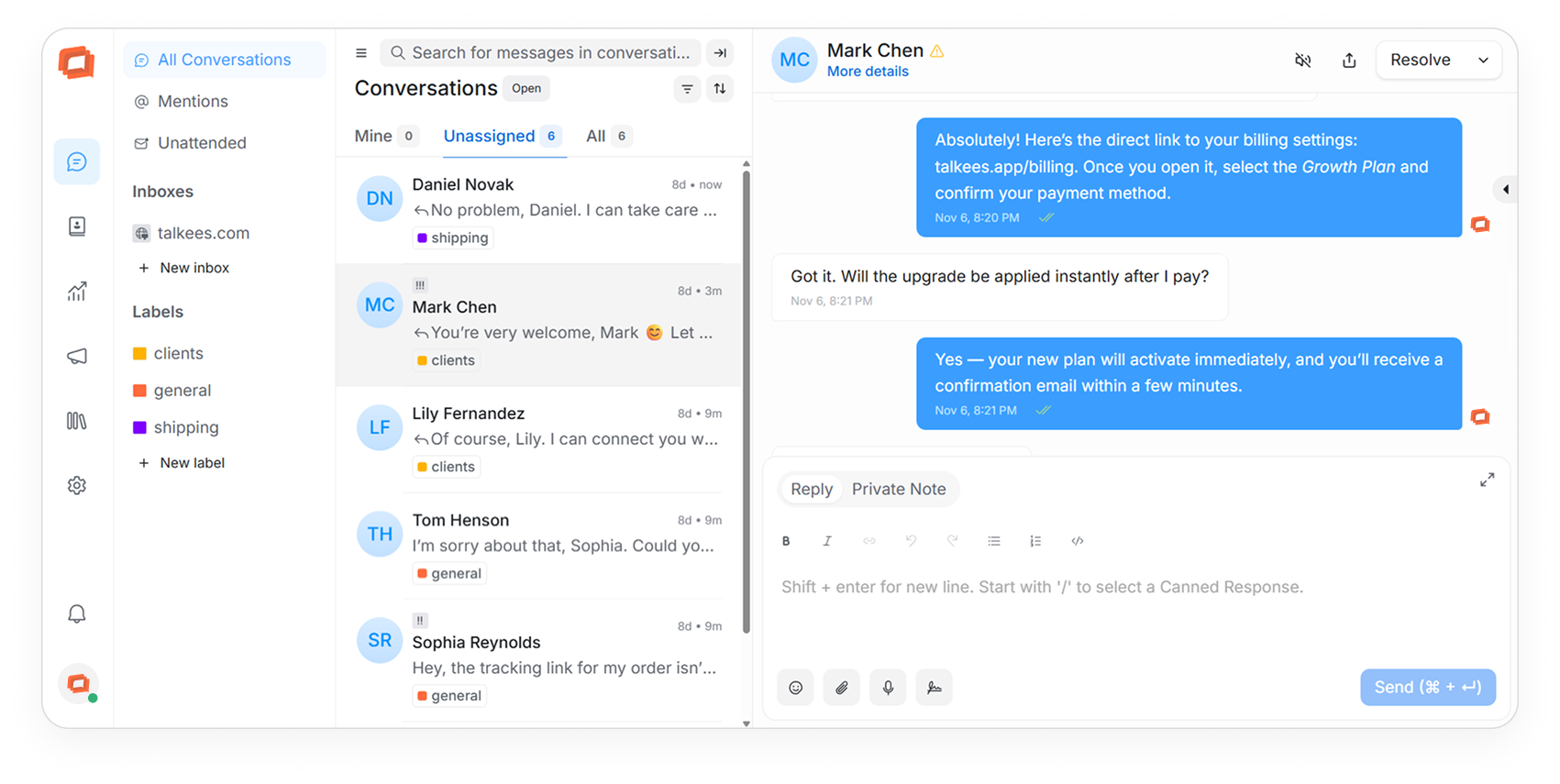
Talkees vs Chatwoot: The Best Fit for Your Needs

Talkees represents a modern alternative to Chatwoot, focusing on AI-native omnichannel support with flexible pricing and rapid setup.
Key Features and Capabilities
- Omnichannel Support: Talkees provides a unified inbox for email, live chat, WhatsApp, Instagram, and other social channels. Unlike Chatwoot, Talkees ensures true conversation continuity when customers switch channels, maintaining context and history seamlessly.
- AI-Native Design: Where Chatwoot offers basic automation, Talkees delivers advanced AI capabilities:
- Knowledge ingestion from multiple sources (help center, internal docs, past tickets)
- Autonomous resolution for common issues
- Agent assistance with context-aware suggestions
- Tool actions that can trigger system changes (e.g., refunds, subscription changes)
- Integrations: Talkees offers deep integrations with CRM systems, e-commerce platforms, and development tools. The platform provides actionable automations that can perform tasks within connected systems without agent intervention.
- Analytics and Reporting: Comprehensive dashboards track performance across channels, with custom reports for SLAs, agent metrics, and business impact.
Pricing and TCO
Talkees offers a transparent pricing model:
- Base: $29/seat/month
- AI usage: $0.29 per AI resolution
This approach provides predictable costs while scaling efficiently with usage. Unlike self-hosted Chatwoot, Talkees eliminates infrastructure and DevOps costs while delivering more advanced AI capabilities.
Who Should Choose Talkees
Talkees is ideal for:
- Growing startups and scale-ups that need modern AI support without engineering overhead
- Teams seeking omnichannel support with true conversation continuity
- Organizations wanting to reduce per-ticket cost through AI automation
- Companies that value quick setup and time-to-value
Our Assessment
In our testing, Talkees demonstrated superior AI capabilities compared to Chatwoot, with higher autonomous resolution rates and more accurate agent suggestions. The platform’s omnichannel implementation truly maintains context across channels, and the integration ecosystem supports complex workflows without custom development.
While Chatwoot offers more control through self-hosting, Talkees delivers better out-of-the-box functionality and significantly lower total cost when accounting for engineering time and infrastructure. For most organizations, Talkees represents a more cost-effective and capable solution.
Deep-Dive into Other Chatwoot Competitors: Feature Highlights and Use Cases

Rocket.Chat vs Chatwoot
Rocket.Chat is an open-source team collaboration platform that can be extended for customer support scenarios. Unlike Chatwoot’s focus on customer conversations, Rocket.Chat primarily serves internal communication needs with customer channels as an extension.
- Key Features:
- Self-hosted with full data control
- Strong security and compliance options
- Team-focused collaboration with channels and direct messages
- Extensible via apps and integrations
- Pricing: Community edition is free; enterprise tiers available with additional features.
- Best For: Organizations with strict security requirements that need on-premises deployment and are willing to build custom support workflows on top of the core platform.
- Our Assessment: Rocket.Chat excels as a team communication tool but requires significant customization to match Chatwoot’s support capabilities. Choose Rocket.Chat if data sovereignty and security are paramount concerns and you have development resources to extend the platform.
Zendesk vs Chatwoot
Zendesk is an enterprise-grade customer service platform with comprehensive features for large support operations.
- Key Features:
- Advanced workflow automation and routing
- Enterprise-grade SLA management
- Comprehensive reporting and analytics
- Extensive marketplace of integrations
- Answer Bot and agent assistance AI
- Pricing: Suite Team starts around $55/agent/month; higher tiers for enterprise features.
- Best For: Mid-market to enterprise organizations with complex support needs, multiple teams, and strict SLA requirements.
- Our Assessment: Zendesk offers significantly more sophisticated workflows and enterprise features than Chatwoot, but at a higher price point. The platform’s maturity and ecosystem make it ideal for large support operations, though smaller teams may find it complex and costly.
Tidio vs Chatwoot
Tidio focuses on website live chat with chatbots, making it simpler but more limited than Chatwoot’s omnichannel approach.
- Key Features:
- Quick setup for website chat
- Lyro AI chatbot for automated responses
- E-commerce integrations (particularly Shopify)
- Visual chatbot builder
- Pricing: Starter around $24/month; Growth approximately $49/month.
- Best For: Small to medium businesses focused on website chat, particularly e-commerce sites needing quick visitor engagement.
- Our Assessment: Tidio offers a more streamlined experience than Chatwoot for website chat, with better out-of-the-box chatbots. However, it lacks Chatwoot’s broader channel support and customization options. Choose Tidio for simple website engagement rather than comprehensive support.
Freshchat vs Chatwoot
Part of the Freshworks suite, Freshchat delivers modern messaging with AI assistance through Freddy.
- Key Features:
- Modern messaging interface
- Freddy AI for triage and suggestions
- Integration with Freshdesk ticketing
- Proactive messaging campaigns
- Pricing: Free plan available; paid plans start at $15/agent/month.
- Best For: SMB to mid-market companies seeking affordable omnichannel support, especially those using other Freshworks products.
- Our Assessment: Freshchat offers a more polished experience than Chatwoot with better AI capabilities through Freddy. Its integration with the broader Freshworks suite makes it particularly valuable for teams using Freshdesk or Freshsales. The pricing is competitive, though AI features may require higher tiers.
HubSpot Service Hub vs Chatwoot
HubSpot Service Hub integrates customer support with HubSpot’s CRM platform, creating a unified customer view.
- Key Features:
- Tight integration with HubSpot CRM
- Knowledge base and customer portal
- Conversation routing and automation
- Customer feedback tools
- Pricing: Varies by tier and HubSpot bundle.
- Best For: Organizations already using HubSpot for marketing or sales who want unified customer data across departments.
- Our Assessment: HubSpot Service Hub delivers superior CRM integration compared to Chatwoot, making it ideal for teams prioritizing a complete customer view. However, it may be overkill for organizations not using other HubSpot products, and pricing can escalate with additional features.
Intercom vs Chatwoot
Intercom specializes in in-app messaging and product-led growth, with advanced AI through Fin.
- Key Features:
- In-app messaging and product tours
- Fin AI chatbot for autonomous resolution
- Proactive messaging campaigns
- Targeted customer engagement
- Pricing: Often cited starting around $39/seat/month plus usage-based AI fees (Fin commonly reported at $0.99 per resolved conversation).
- Best For: SaaS companies with product-led growth strategies needing in-app engagement and support.
- Our Assessment: Intercom excels at in-app messaging and product engagement compared to Chatwoot, with more sophisticated targeting and campaign capabilities. Its AI (Fin) delivers higher autonomous resolution rates, though at a premium price. Consider Intercom if your product requires deep in-app support integration.
LiveChat vs Chatwoot
LiveChat focuses on website chat with an emphasis on simplicity and quick deployment.
- Key Features:
- Website chat widget
- ChatBot add-on for automation
- Agent productivity tools
- Basic reporting
- Pricing: Varies by plan; focused on per-agent licensing.
- Best For: SMBs wanting straightforward website chat without complex omnichannel requirements.
- Our Assessment: LiveChat offers a more polished website chat experience than Chatwoot, with better agent productivity features. However, it lacks Chatwoot’s broader channel support and customization options. Choose LiveChat for focused website engagement rather than comprehensive support.
Zoho Desk vs Chatwoot
Zoho Desk integrates customer support with Zoho’s broader business software ecosystem.
- Key Features:
- Zia AI assistant
- Context-aware help desk
- Integration with Zoho CRM and other Zoho apps
- Customizable workflows
- Pricing: Cost-effective compared to enterprise alternatives.
- Best For: Organizations using other Zoho products who want integrated customer support.
- Our Assessment: Zoho Desk offers better workflow automation than Chatwoot and seamless integration with the Zoho ecosystem. Its AI capabilities (Zia) provide useful assistance, though not as advanced as some dedicated AI platforms. Consider Zoho Desk if you’re already invested in the Zoho ecosystem.
Front vs Chatwoot
Front reimagines email as a collaborative workspace, making it ideal for email-first support teams.
- Key Features:
- Shared inbox for email collaboration
- Rules and automation
- Comment and collaboration tools
- CRM integrations
- Pricing: Varies by plan and features.
- Best For: Teams handling high volumes of email support who need collaborative workflows.
- Our Assessment: Front excels at email collaboration compared to Chatwoot, with superior workflow and assignment capabilities for email-based teams. However, it lacks Chatwoot’s broader channel support and chatbot capabilities. Choose Front if email is your primary support channel and team collaboration is essential.
Conclusion: Making Your Decision

Choosing the right Chatwoot alternative requires aligning platform capabilities with your specific needs. Based on our comprehensive analysis:
- For AI-first support: Talkees offers the best combination of advanced AI capabilities and cost-effectiveness, with $0.29 per resolution compared to competitors charging $0.99 or more.
- For e-commerce: Gorgias provides the deepest integration with platforms like Shopify, allowing in-conversation refunds and order management.
- For enterprise needs: Zendesk delivers the most comprehensive enterprise features, though at a higher price point.
- For self-hosting: Rocket.Chat offers the strongest security and compliance options for organizations that must maintain full data control.
- For budget-conscious teams: Freshchat provides a good balance of features and affordability, with plans starting at $15/agent/month.
To make your final decision:
- Define your requirements: Document your must-have channels, integrations, and compliance needs.
- Calculate TCO: Consider all costs, including per-agent fees, AI usage, infrastructure (for self-hosted), and engineering time.
- Run a pilot: Test 2-3 finalists with real support scenarios to measure performance, ease of use, and actual AI resolution rates.
- Evaluate migration: Assess the complexity of moving your existing data, including conversation history, customer profiles, and knowledge base content.
The right platform will align with your support philosophy, technical requirements, and budget while providing room to grow as your needs evolve. Whether you prioritize AI capabilities, omnichannel support, or specific integrations, this guide provides the framework to make an informed decision.