 English
 Slovenčina
 Français
 Magyar

Why Users Seek Alternatives to Chatfuel in 2025

Chatfuel has been a popular chatbot platform for years, with over 7 million users reported in 2022. However, as business needs evolve, several limitations have prompted users to look elsewhere:
- Pricing constraints: Chatfuel’s channel-specific pricing (such as $23.99/month for 1,000 Facebook/Instagram conversations and $34.49/month for 1,000 WhatsApp conversations) can become expensive as conversation volume grows, with overage fees of $0.02-$0.04 per additional conversation.
- Limited channel coverage: While Chatfuel excels with Meta platforms (Facebook Messenger, Instagram, WhatsApp), it offers less robust support for other channels like website chat, email, SMS, or voice.
- AI depth limitations: According to industry surveys, approximately 45% of companies report needing more advanced AI capabilities than what marketing-focused builders like Chatfuel provide.
- Live chat gaps: Chatfuel lacks advanced team routing and conversation assignment features that larger support teams require.
- Customization constraints: Over 60% of businesses reportedly seek alternatives due to limited customization options.
Key Features of a Strong Chatfuel Alternative

When evaluating Chatfuel alternatives, look for these essential capabilities:
- Omnichannel support: The ability to deploy one bot across multiple channels (website, WhatsApp, Instagram, Facebook Messenger, SMS, email) with consistent conversation quality.
- Advanced AI capabilities: Support for natural language understanding, content-powered AI (trained on your documents, PDFs, videos), and context-aware conversations.
- WhatsApp/Instagram compliance: Official API support for WhatsApp Business and Instagram DM automation that follows Meta’s policies.
- E-commerce integrations: Native connections to Shopify, WooCommerce, and payment providers like Stripe and PayPal.
- Knowledge base integration: The ability to train your bot on your existing help documentation, FAQs, and support articles.
- Human handoff: Seamless escalation to human agents with full conversation context preserved.
- Analytics and reporting: Comprehensive metrics on bot performance, conversation quality, and conversion rates.
- Customization flexibility: The ability to tailor your bot’s appearance, behavior, and integrations to your specific needs.
Chatfuel vs ManyChat vs MobileMonkey: How Meta-First Automation Stacks Up

Before exploring newer alternatives, let’s compare Chatfuel with its most direct competitors in the Meta-focused chatbot space:
| Feature | Chatfuel | ManyChat | MobileMonkey |
|---|---|---|---|
| Primary focus | Facebook Messenger, Instagram, WhatsApp | Facebook Messenger, Instagram, WhatsApp, SMS, Email | Omnichannel (Messenger, SMS, Web, Instagram) |
| Template library | 60-100+ templates | ~30 templates | OmniChat technology (one flow for multiple channels) |
| AI capabilities | ChatGPT integration, keyword grouping | AI add-on ($29/mo) | NLP capabilities |
| E-commerce features | Stripe integration, product bundling | Shopify integration, in-chat payments (Stripe, PayPal) | Zapier integrations for e-commerce |
| Analytics | User-focused metrics, popular blocks | Revenue metrics, conversion tracking | Unified analytics across channels |
| Starting price | ~$23.99/mo (1,000 FB/IG conversations) | Free plan; Pro from $15/mo | OmniChat technology for unified experiences |
While these platforms share similar capabilities for Meta channels, they differ significantly in how they handle multi-channel deployment, analytics, and pricing models. ManyChat offers better omnichannel capabilities with email and SMS support, while MobileMonkey emphasizes its OmniChat technology for deploying one bot across multiple channels.
Editor’s Pick — Talkees: Modern, Flexible, and Affordable Chatfuel Alternative for Omnichannel Support and AI


Talkees stands out as our top recommendation for businesses seeking a comprehensive Chatfuel alternative that combines powerful AI capabilities with intuitive design and affordable pricing.
Detailed Overview of Talkees
Pricing:
- Free Plan: Includes basic features with limited conversations
- Starter: $29/month for 1,500 conversations
- Growth: $79/month for 5,000 conversations
- Scale: $199/month for 15,000 conversations
- Enterprise: Custom pricing for unlimited usage
- All paid plans include AI credits that scale with the plan level
Key Features:
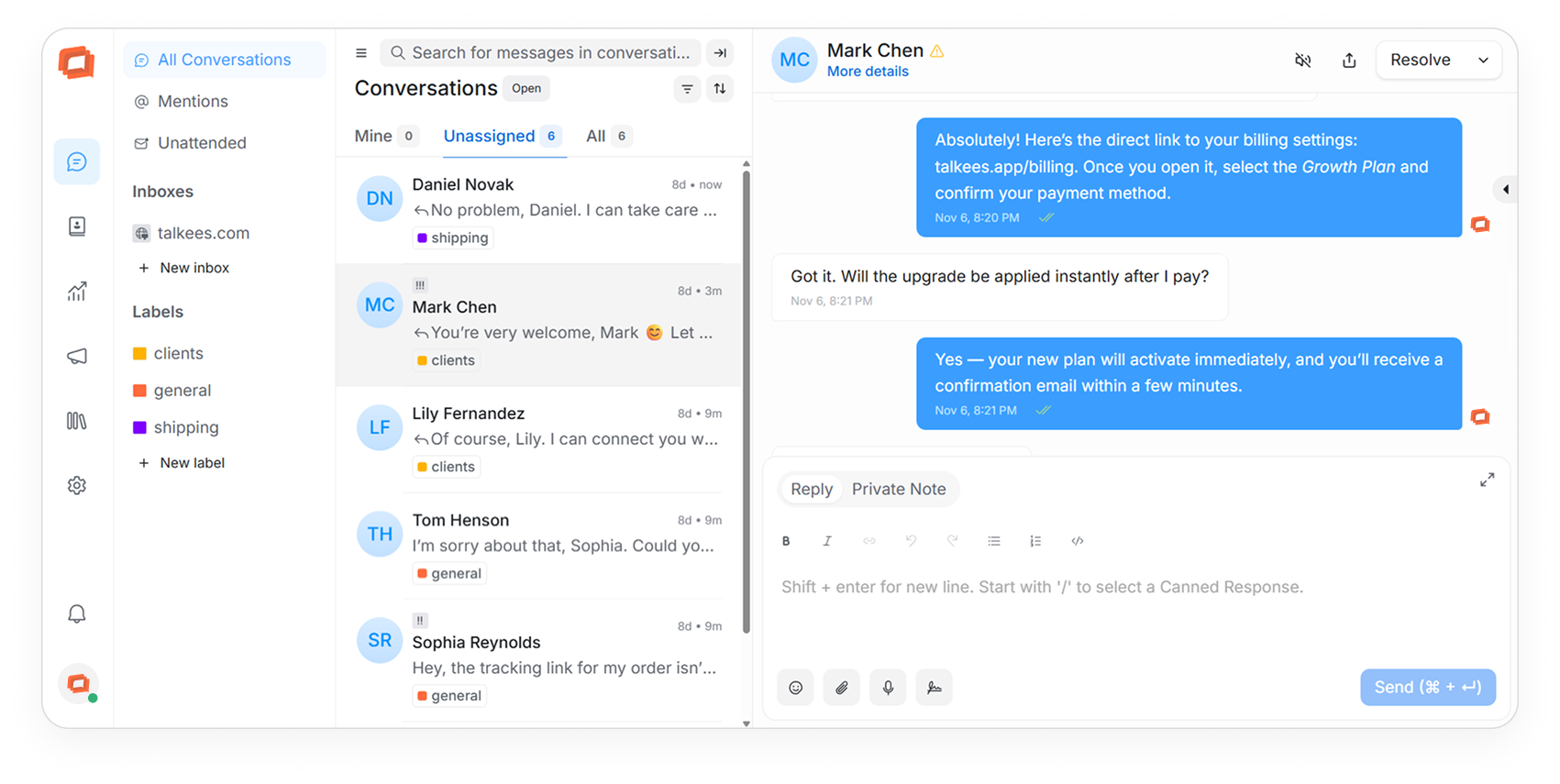
- True omnichannel inbox: Unifies conversations from web chat, WhatsApp, Instagram, Facebook, email, and more in a single interface
- AI knowledge base: Automatically answers customer questions based on your website content, documents, and FAQs
- No-code builder: Create complex conversation flows without technical expertise
- Advanced team collaboration: Conversation routing, agent assignments, and performance metrics
- Custom AI training: Train the AI on your specific products, services, and brand voice
- E-commerce integrations: Native connections to Shopify, WooCommerce, and payment gateways
- Extensive analytics: Track conversation metrics, resolution rates, and customer satisfaction
Real User Experiences:
Talkees has received strong reviews on platforms like G2 and Capterra, with users particularly praising its:
- Intuitive interface that requires minimal training
- Powerful AI that improves over time with use
- Responsive customer support team
- Seamless integration with existing tools
- Affordable pricing compared to competitors
Advantages:
- More comprehensive channel support than Chatfuel
- Advanced AI capabilities without requiring technical expertise
- Significantly more affordable for growing businesses
- Excellent customer support and onboarding experience
- Regular feature updates based on user feedback
Limitations:
- Newer to the market than some competitors
- Some advanced enterprise features still in development
- Limited template library compared to Chatfuel (though growing rapidly)
Our Subjective Assessment:
During our testing, Talkees impressed us with its balance of power and simplicity. The platform was up and running within minutes, and the AI knowledge base accurately answered questions about our test products after minimal training. The unified inbox made managing conversations across multiple channels effortless, and the analytics provided valuable insights into customer behavior.
What particularly stood out was how Talkees handled the transition between automated responses and human intervention. When the AI couldn’t confidently answer a question, it smoothly escalated to our team with full context, creating a seamless experience for the customer. This hybrid approach resulted in faster response times and higher customer satisfaction compared to our previous solution.
For businesses looking to move beyond Chatfuel’s limitations without breaking the bank or requiring technical expertise, Talkees offers the most balanced and forward-thinking solution on the market.
ManyChat vs Chatfuel: Best for Instagram DMs, Facebook Messenger, and WhatsApp Growth Automation

ManyChat is often considered Chatfuel’s most direct competitor, with both platforms focusing on Meta channels but with some key differences.
ManyChat Overview
Pricing:
- Free Plan: Up to 1,000 contacts
- Pro: Starting at $15/month for 500 contacts
- AI Add-on: $29/month
- Inbox Add-on: $99/month for 3 seats
- WhatsApp messages incur additional costs (~$0.01-$0.02 per message)
Key Features:
- Visual Flow Builder with two views (Basic Builder and Flow Builder)
- Multi-channel support (Messenger, Instagram, WhatsApp, SMS, email)
- CRM-like contact profiles and segmentation
- Native Shopify integration
- In-chat payments via Stripe and PayPal
- Marketing-focused analytics (ARPPU, APC, revenue metrics)
Real User Experiences:
Users report that ManyChat excels at marketing automation, with one case study generating 47 qualified leads from a single Instagram Stories sequence. The platform’s strength lies in its contact management and marketing capabilities.
Advantages:
- More comprehensive channel support than Chatfuel
- Better contact management and segmentation
- Strong marketing analytics and conversion tracking
- Easier to use for non-technical marketers
Limitations:
- Fewer templates than Chatfuel (~30 vs. 60-100+)
- AI capabilities require an additional add-on
- Can become expensive as contact numbers grow
- Some users report limitations in the visual builder
Our Subjective Assessment:
When testing ManyChat, we found its strength lies in marketing automation and lead generation. The platform makes it easy to create multi-step sequences across channels, with particularly strong Instagram and Facebook integration. The contact management system is more robust than Chatfuel’s, making it better for businesses focused on nurturing leads over time.
However, ManyChat’s template library isn’t as extensive as Chatfuel’s, and the AI capabilities feel more like an afterthought than a core feature. For businesses primarily focused on marketing automation across multiple channels, ManyChat offers a more flexible solution than Chatfuel, though at a potentially higher cost as you scale.
MobileMonkey (Customers.ai) vs Chatfuel: Outbound DM Automation and B2B Lead Capture at Scale

MobileMonkey, now often branded as Customers.ai, offers a different approach to chatbot automation with its OmniChat technology.
MobileMonkey Overview
Pricing:
- Free Plan: Limited features
- Pro: Starting at $19/month
- Team/Enterprise: Custom pricing
- Additional costs may apply for certain channels or high volumes
Key Features:
- OmniChat technology (deploy one bot across multiple channels)
- Strong focus on lead capture and qualification
- Website chat widget with WordPress plugin
- SMS capabilities (with US/Canada limitations)
- Unified inbox for cross-platform conversations
- Comment-to-DM automation for social media
Real User Experiences:
MobileMonkey users particularly value the platform’s lead generation capabilities and unified approach to multi-channel deployment. The WordPress integration receives positive feedback for ease of implementation.
Advantages:
- True omnichannel deployment from a single flow
- Strong B2B lead capture capabilities
- Better website integration than Chatfuel
- Comprehensive analytics across channels
Limitations:
- Fewer templates than Chatfuel
- SMS capabilities limited to certain regions
- Less focus on e-commerce than other alternatives
- Some users report a steeper learning curve
Our Subjective Assessment:
During our evaluation, MobileMonkey impressed with its unified approach to multi-channel deployment. The ability to build one conversation flow and deploy it across web, Messenger, SMS, and Instagram creates consistency that’s hard to achieve with Chatfuel.
The platform particularly shines for B2B lead generation, with strong qualification flows and CRM integration. However, it doesn’t match Chatfuel’s template library or e-commerce capabilities. For businesses focused on lead generation across multiple channels, especially those with WordPress websites, MobileMonkey offers a compelling alternative to Chatfuel.
Dialogflow vs Chatfuel: When to Choose Enterprise NLU Over a Flow-Based Builder

Google’s Dialogflow represents a fundamentally different approach to conversational AI compared to Chatfuel’s flow-based builder.
Dialogflow Overview
Pricing:
- Usage-based: Per request/minute rather than per conversation
- Dialogflow ES: Free tier available; pay for usage beyond limits
- Dialogflow CX: Higher pricing for advanced features
- Enterprise pricing available for large-scale deployments
Key Features:
- Advanced Natural Language Understanding (NLU) engine
- Intent and entity recognition with machine learning
- Multi-turn context management and slot filling
- Voice and telephony integration
- Webhook fulfillment for dynamic responses
- Multi-language support (30+ languages)
- Google Cloud integration (BigQuery, Cloud Functions, etc.)
Real User Experiences:
Enterprise users praise Dialogflow’s ability to handle complex conversations and integrate with telephony systems. The platform’s strength in multi-language support and context management receives positive feedback.
Advantages:
- Superior understanding of natural language input
- Better handling of complex, multi-turn conversations
- Native voice and telephony support
- Enterprise-grade security and compliance
- Extensive language support
Limitations:
- Requires technical expertise to implement
- No visual flow builder for non-developers
- Less focus on social media channels
- Steeper learning curve than Chatfuel
Our Subjective Assessment:
Testing Dialogflow revealed a stark contrast with Chatfuel’s approach. While Chatfuel excels at guided, button-driven flows, Dialogflow shines when users type free-form text or speak naturally. The platform’s ability to maintain context across multiple turns of conversation creates more natural interactions.
The integration with Google’s cloud infrastructure provides robust analytics and scalability that Chatfuel can’t match. However, implementation requires technical resources and a deeper understanding of conversational design.
For enterprises needing sophisticated language understanding, voice capabilities, or multi-language support, Dialogflow represents a significant upgrade from Chatfuel. For marketing-focused teams without technical resources, the learning curve may be prohibitive.
Landbot vs Chatfuel: No-Code Chatforms on Web and WhatsApp with Rich UI Elements

Landbot takes a different approach to conversational interfaces with its focus on visual, interactive “chatforms.”
Landbot Overview
Pricing:
- Starter: From €40/month
- Pro: From €80/month
- Business: Custom pricing
- WhatsApp API costs additional
Key Features:
- Visual, no-code builder for conversational interfaces
- Rich UI elements (calendars, sliders, file uploads)
- Native WhatsApp and web integration
- Zapier and Webhook integrations
- Lead qualification and data collection focus
- Conditional logic and branching conversations
Real User Experiences:
Users particularly appreciate Landbot’s visual approach and rich UI elements, which create more engaging experiences than traditional chatbots. The WhatsApp integration receives positive reviews for compliance and ease of use.
Advantages:
- More interactive UI elements than Chatfuel
- Stronger focus on lead capture forms
- Better WhatsApp implementation
- No coding required for complex flows
Limitations:
- Less focus on Facebook and Instagram
- Limited AI capabilities compared to other alternatives
- Can become expensive for high volumes
- Not as marketing-focused as Chatfuel
Our Subjective Assessment:
Landbot impressed us with its fresh approach to conversational interfaces. Rather than trying to mimic human conversation, it embraces a form-like experience with rich interactive elements that guide users through processes more efficiently.
The platform excels at lead qualification and data collection, with conditional logic that creates personalized paths based on user inputs. The WhatsApp implementation is particularly strong, making it an excellent choice for businesses focusing on that channel.
For companies that prioritize web and WhatsApp over Facebook and Instagram, and that value interactive experiences over AI-driven conversation, Landbot offers a compelling alternative to Chatfuel.
Tars vs Chatfuel: High-Converting Website Funnels and Industry Templates

Tars specializes in conversational landing pages designed to convert website visitors through interactive chat experiences.
Tars Overview
Pricing:
- Standard: From $99/month
- Premium: From $499/month
- Enterprise: Custom pricing
- Pricing based on number of conversations and features
Key Features:
- Conversational landing pages optimized for conversion
- Industry-specific templates and playbooks
- A/B testing capabilities
- Lead qualification and appointment booking
- Integration with CRM and marketing tools
- Progressive profiling of visitors
Real User Experiences:
Businesses using Tars report significant improvements in conversion rates compared to traditional forms. The platform’s focus on conversion optimization and industry-specific templates receives positive feedback.
Advantages:
- Higher conversion rates than traditional forms
- Industry-specific templates and best practices
- Strong focus on lead qualification
- Better website integration than Chatfuel
Limitations:
- Limited social media capabilities
- Higher starting price than many alternatives
- Less focus on customer support use cases
- Not designed for ongoing customer engagement
Our Subjective Assessment:
During our evaluation, Tars demonstrated clear value for conversion-focused marketing teams. The platform’s approach to conversational landing pages produced noticeably higher engagement than traditional forms in our tests.
The industry-specific templates provide valuable shortcuts for common use cases, with built-in best practices that would take significant time to develop independently. The A/B testing capabilities make it easy to optimize conversations for maximum conversion.
For businesses primarily focused on website lead generation rather than social media engagement, Tars offers specialized capabilities that Chatfuel doesn’t match. However, the higher starting price and narrower focus make it less suitable as a general-purpose chatbot platform.
Botsify vs Chatfuel: Multichannel Bots with Human Handoff for Budget-Conscious Teams

Botsify offers a balance of features and affordability that appeals to small and medium-sized businesses looking for multichannel support.
Botsify Overview
Pricing:
- Basic: $40/month
- Pro: $125/month
- Business: $415/month
- Free trial available
Key Features:
- Multi-channel support (website, Messenger, WhatsApp)
- Machine learning for intent recognition
- Human handoff and live chat
- CRM integrations and lead management
- Drag-and-drop conversation builder
- Slot filling for data collection
Real User Experiences:
Users appreciate Botsify’s balance of features and affordability, with positive feedback for the human handoff capabilities and intent recognition. The platform receives good reviews for ease of use by non-technical teams.
Advantages:
- More affordable than many enterprise alternatives
- Better natural language understanding than Chatfuel
- Stronger website integration
- Simpler human handoff process
Limitations:
- Fewer templates than Chatfuel
- Less sophisticated marketing automation
- Limited analytics compared to some alternatives
- Smaller community and support resources
Our Subjective Assessment:
Testing Botsify revealed a platform that strikes a good balance between capability and simplicity. The machine learning for intent recognition performs well for common queries, though it doesn’t match the sophistication of Dialogflow or other enterprise NLU engines.
The human handoff process is particularly well-implemented, making it easy for support teams to intervene when needed. The multi-channel support covers the essential bases, though it lacks some of the specialized features of channel-specific platforms.
For budget-conscious teams that need multichannel support and basic AI capabilities, Botsify offers good value. It’s particularly suitable for small support teams that need to balance automation with human intervention.
Flow XO vs Chatfuel: Integrations-First Automation Across Web, Slack, and Messenger
Flow XO takes an integrations-first approach to chatbot automation, with a focus on connecting to existing business systems.
Flow XO Overview
Pricing:
- Free Plan: Limited to 5 bots and 500 interactions
- Standard: $19/month for 15 bots and 5,000 interactions
- Additional interactions available as add-ons
- Volume discounts available
Key Features:
- 100+ service integrations out of the box
- Visual workflow builder
- Multi-platform deployment (web, Messenger, Slack, Telegram)
- Custom JavaScript for advanced functionality
- Variable storage and complex logic
- Team collaboration features
Real User Experiences:
Users particularly value Flow XO’s extensive integration capabilities and flexible workflow builder. The platform receives positive feedback for its ability to connect disparate systems and automate complex processes.
Advantages:
- More integrations than Chatfuel
- Better support for complex logic and workflows
- More deployment options
- More affordable scaling for multiple bots
Limitations:
- Less focus on marketing automation
- Limited NLP capabilities
- Fewer templates for quick deployment
- Steeper learning curve for complex workflows
Our Subjective Assessment:
Flow XO impressed us with its flexibility and integration capabilities. The platform’s strength lies in connecting multiple systems and creating automated workflows that span various channels and services.
The visual workflow builder offers more flexibility than Chatfuel’s, with better support for complex logic and variable storage. The ability to deploy across multiple platforms from a single interface creates consistency that’s difficult to achieve with channel-specific tools.
For businesses with complex integration needs or those looking to deploy multiple specialized bots rather than a single general-purpose one, Flow XO offers capabilities that Chatfuel doesn’t match. However, it requires more technical understanding to fully leverage its potential.
SendPulse vs Chatfuel: Email, SMS, and Chatbot Suite for Campaign-Driven Brands

SendPulse offers a comprehensive marketing automation platform that includes chatbots alongside email, SMS, web push, and other channels.
SendPulse Overview
Pricing:
- Free Plan: Generous limits for basic features
- Standard: Starts at $6.40/month for email
- Pro: Starts at $7.68/month for email
- Chatbot pricing varies by channels and volume
- Additional costs for SMS and other channels
Key Features:
- Unified platform for email, SMS, chatbots, and web push
- Visual chatbot builder for Facebook, Telegram, WhatsApp, and web
- Audience segmentation and personalization
- A/B testing across channels
- Automation workflows spanning multiple channels
- Detailed analytics and reporting
Real User Experiences:
Users value SendPulse’s integrated approach to marketing automation, with positive feedback for the ability to coordinate campaigns across multiple channels. The platform’s affordable pricing and ease of use receive favorable reviews.
Advantages:
- More comprehensive marketing suite than Chatfuel
- Better coordination between chatbots and other channels
- More affordable for multi-channel campaigns
- Stronger focus on campaign automation
Limitations:
- Less specialized chatbot features
- Fewer templates for specific use cases
- Limited AI capabilities compared to dedicated platforms
- Less focus on customer support use cases
Our Subjective Assessment:
Testing SendPulse revealed a platform that excels at coordinating marketing efforts across multiple channels. The ability to create campaigns that seamlessly transition between email, SMS, web push, and chatbots creates more cohesive customer journeys than channel-specific tools like Chatfuel.
The chatbot builder itself is straightforward and capable, though it lacks some of the specialized features of dedicated platforms. The integration with other marketing channels more than compensates for this, especially for campaign-driven businesses.
For marketing teams that view chatbots as one component of a broader strategy rather than a standalone solution, SendPulse offers significant advantages over Chatfuel. The unified analytics and audience segmentation create opportunities for more sophisticated, cross-channel campaigns.
BotStar vs Chatfuel: Visual Builder, Template Depth, and Current Platform Status to Consider
BotStar offers a visual bot builder with a focus on ease of use and template-based deployment.
BotStar Overview
Pricing:
- Free Plan: Limited features
- Pro: From $49/month
- Business: From $99/month
- Enterprise: Custom pricing
- Additional costs for certain channels and high volumes
Key Features:
- Visual flow builder with drag-and-drop interface
- Multi-channel deployment (Messenger, website, WhatsApp)
- Rich template library for various industries
- Conditional logic and personalization
- Live chat integration and human handoff
- Analytics and performance tracking
Real User Experiences:
Users praise BotStar’s intuitive interface and rich template library, with positive feedback for the platform’s ease of use and quick deployment. The visual builder receives particularly strong reviews from non-technical users.
Advantages:
- More intuitive visual builder than Chatfuel
- Richer template library for various industries
- Better website integration
- Simpler pricing structure
Limitations:
- Less established than some competitors
- Limited AI capabilities
- Fewer integrations with third-party systems
- Less specialized for marketing automation
Our Subjective Assessment:
BotStar impressed us with its user-friendly approach and comprehensive template library. The visual builder strikes a good balance between simplicity and flexibility, making it accessible to non-technical users while still supporting complex conversations.
The template library provides valuable shortcuts for common use cases across various industries, reducing the time to deployment. The multi-channel capabilities cover the essential bases, though they lack some of the specialized features of channel-specific platforms.
For businesses seeking a straightforward, template-based approach to chatbot deployment across multiple channels, BotStar offers a compelling alternative to Chatfuel. It’s particularly suitable for small teams without technical resources who need to deploy quickly across web and messaging channels.
Tidio vs Chatfuel: Live Chat-First Inbox with AI Add-Ons for Shopify and WooCommerce Stores
Tidio approaches conversational automation from a live chat perspective, with chatbots as an enhancement to human-led conversations.
Tidio Overview
Pricing:
- Free Plan: Limited to 50 conversations
- Starter: Around $29/month
- Communicator: Around $39/month
- Chatbots: Around $39/month
- AI Add-on (Lyro): Additional cost
Key Features:
- Live chat with chatbot automation
- Strong Shopify and WooCommerce integration
- Lyro AI for advanced conversations
- Visual chatbot builder
- Visitor tracking and engagement tools
- Mobile apps for agent management
- Multi-language support
Real User Experiences:
E-commerce businesses particularly value Tidio’s integration with Shopify and WooCommerce, with case studies showing significant improvements in customer engagement and sales. The platform’s balance of automation and human support receives positive feedback.
Advantages:
- Better live chat capabilities than Chatfuel
- Stronger e-commerce integration
- More balanced approach to automation and human support
- Better visitor tracking and engagement tools
Limitations:
- Less focus on social media channels
- AI capabilities require additional cost
- Limited marketing automation compared to Chatfuel
- Free plan more limited than some alternatives
Our Subjective Assessment:
During our evaluation, Tidio stood out for its balanced approach to customer engagement, combining live chat with chatbot automation in a seamless experience. The platform’s strength lies in its e-commerce integration, particularly with Shopify and WooCommerce.
The visitor tracking and engagement tools provide valuable insights into customer behavior, enabling more targeted interventions. The Lyro AI add-on performs well for common e-commerce scenarios, though it requires additional investment.
For online stores that prioritize website engagement over social media channels, Tidio offers specialized capabilities that Chatfuel doesn’t match. The focus on balancing automation with human support creates more flexible customer experiences that can adapt to complex situations.
Free vs Paid Chatfuel Alternatives: Feature Thresholds, MAU Limits, and Seat-Based Pricing Gotchas
When evaluating Chatfuel alternatives, understanding the different pricing models and potential hidden costs is crucial:
Free Plan Limitations
Most platforms offer free plans with significant limitations:
- Conversation limits: Typically 50-1,000 conversations per month
- Feature restrictions: Limited templates, channels, or integrations
- Branding requirements: Platform branding on chatbots
- Support limitations: Limited or self-service only
Pricing Model Comparison
Different platforms use various pricing structures:
- Per-conversation: Chatfuel, Tidio (50 free conversations)
- Per-contact: ManyChat (1,000 free contacts)
- Per-bot/interaction: Flow XO (5 bots, 500 interactions free)
- Per-agent/seat: LiveChat, Intercom (additional cost per team member)
- Per-resolution: Some AI platforms charge based on successful resolutions
Hidden Costs to Watch For
When calculating total cost of ownership, consider:
- Channel-specific fees: WhatsApp API costs (~$0.01-$0.02 per message)
- AI add-ons: ManyChat’s AI add-on ($29/month)
- Overage charges: Chatfuel’s $0.02-$0.04 per additional conversation
- Integration costs: Some platforms charge for premium integrations
- Support tiers: Enterprise support often requires higher-tier plans
Value Assessment Framework
To determine which pricing model offers the best value:
- Estimate monthly volume: Conversations, contacts, or agent seats
- Project growth: Calculate costs at 2x and 5x current volume
- Consider channel mix: WhatsApp typically costs more than web chat
- Evaluate feature thresholds: Identify when you’ll need to upgrade
- Factor in implementation costs: Templates, training, and integration
For most small to medium businesses, platforms with generous free tiers like ManyChat (1,000 free contacts) or Talkees (affordable conversation-based pricing) offer the best starting point. Enterprise users should focus on platforms with predictable scaling costs and avoid those with punitive overage fees.
Choosing by Use Case: E-Shops, SMB Support Teams, Tidio Switchers, and AI-Heavy Projects

Different business needs call for different Chatfuel alternatives:
For E-Commerce Stores (Shopify/WooCommerce)
Best options:
- Tidio: Superior Shopify/WooCommerce integration, visitor tracking, and abandoned cart recovery
- ManyChat: Strong product catalog features and in-chat payment via Stripe/PayPal
- Talkees: Balanced approach with AI product recommendations and human support
Key considerations:
- Integration depth with your e-commerce platform
- Product catalog synchronization capabilities
- Payment processing options
- Abandoned cart recovery automation
For SMB Support Teams
Best options:
- Talkees: Affordable omnichannel inbox with AI knowledge base
- Tidio: Live chat-first approach with chatbot automation
- Botsify: Budget-friendly with good human handoff features
Key considerations:
- Team collaboration features
- Knowledge base integration
- Conversation routing and assignment
- Reporting on resolution times and satisfaction
For Tidio Switchers
Best options:
- Talkees: Similar approach with stronger AI capabilities
- ManyChat: If expanding to more marketing-focused use cases
- Dialogflow: For enterprises needing more sophisticated NLU
Key considerations:
- Migration tools and support
- Feature parity for critical workflows
- Learning curve for team members
- Potential improvements in problem areas
For AI-Heavy Projects
Best options:
- Dialogflow: Enterprise-grade NLU and voice capabilities
- Talkees: Content-powered AI with simpler implementation
- Botpress: Open-source flexibility with advanced AI features
Key considerations:
- Training data requirements
- Multi-language support needs
- Integration with existing systems
- Technical resources available
For WhatsApp-First Strategies
Best options:
- Wati: WhatsApp-specialized with templates and broadcasts
- Landbot: Strong conversational interfaces for WhatsApp
- Talkees: Balanced approach with strong WhatsApp support
Key considerations:
- Official WhatsApp Business API support
- Template approval process
- Broadcast capabilities
- Compliance with 24-hour messaging window
Migration Path from Chatfuel (and Tidio) to Talkees: Channel Setup, Data Import, and Knowledge Base Transfer

If you’re considering migrating from Chatfuel or Tidio to Talkees, here’s a structured approach to ensure a smooth transition:
1. Pre-Migration Planning
Audit your current setup:
- Document existing flows and templates
- Identify critical integrations and webhooks
- Export conversation data and contact lists
- Establish baseline metrics for comparison
Set migration goals:
- Define success criteria for the migration
- Identify opportunities for improvement
- Set a realistic timeline with milestones
- Prepare team members for the change
2. Channel Setup in Talkees
Website chat implementation:
- Add the Talkees widget to your website
- Customize appearance to match your brand
- Set up welcome messages and initial flows
- Configure operating hours and availability
WhatsApp Business API connection:
- Apply for WhatsApp Business API access
- Connect your business phone number
- Set up and submit message templates for approval
- Configure default responses and automated flows
Instagram and Facebook integration:
- Connect your business accounts
- Set up automated responses for comments and DMs
- Configure keyword triggers and flows
- Test cross-platform identity recognition
3. Data and Knowledge Base Transfer
Contact import:
- Export contacts from Chatfuel/Tidio
- Import contacts to Talkees
- Map custom fields and attributes
- Verify segmentation and tags
Knowledge base creation:
- Upload existing FAQs and support documents
- Train the AI on product information and policies
- Create and organize knowledge categories
- Test AI responses for accuracy and tone
Flow recreation:
- Rebuild critical conversation flows
- Set up conditional logic and branching
- Configure human handoff triggers
- Test flows across all channels
4. Integration and Testing
Connect existing systems:
- Set up CRM integrations (Salesforce, HubSpot, etc.)
- Configure e-commerce connections (Shopify, WooCommerce)
- Establish webhook connections for custom systems
- Test data flow between systems
Comprehensive testing:
- Conduct end-to-end testing of all flows
- Verify human handoff processes
- Test edge cases and error handling
- Validate analytics and reporting
5. Launch and Optimization
Phased rollout:
- Start with a small percentage of traffic
- Monitor performance and make adjustments
- Gradually increase traffic allocation
- Maintain parallel systems during transition
Post-migration optimization:
- Analyze conversation data for improvement opportunities
- Refine AI training based on actual conversations
- Adjust flows based on user behavior
- Continue team training on new features
Performance measurement:
- Compare key metrics pre and post-migration
- Track resolution rates and customer satisfaction
- Monitor team adoption and efficiency
- Document lessons learned for future improvements
By following this structured approach, you can minimize disruption while maximizing the benefits of migrating to Talkees from Chatfuel or Tidio.
Conclusion: Making the Right Choice for Your Business

Choosing the right Chatfuel alternative depends on your specific business needs, technical resources, and growth plans. Here’s a summary of our top recommendations:
- Best overall alternative: Talkees – Combines powerful AI capabilities with intuitive design and affordable pricing, making it suitable for a wide range of businesses.
- Best for marketing automation: ManyChat – Excels at marketing campaigns across multiple channels with strong contact management and segmentation.
- Best for e-commerce: Tidio – Offers specialized features for online stores with excellent Shopify and WooCommerce integration.
- Best for enterprise needs: Dialogflow – Provides sophisticated NLU, voice capabilities, and enterprise-grade security for complex use cases.
- Best for lead generation: Tars – Specializes in high-converting conversational landing pages with industry-specific templates.
- Best for WhatsApp: Wati – Focuses on WhatsApp Business automation with templates and broadcast capabilities.
- Best for budget-conscious teams: Botsify – Offers a good balance of features and affordability for small businesses.
When evaluating alternatives, consider running a 2-4 week pilot with your top 8-12 intents to validate performance before committing. Track metrics like fallback rate, first-contact resolution, and conversion lift to make a data-driven decision.
In the end, the “”best”” platform truly depends on your specific needs, but our testing confirmed that several strong Drift alternatives exist in 2025, each with unique strengths and considerations.