 English
 Slovenčina
 Français
 Magyar
Why Users Look Beyond Brevo (Sendinblue)

Many businesses initially choose Brevo for its competitive pricing and multi-channel capabilities, but eventually start exploring alternatives due to:
- Pricing creep: As your contact list grows, Brevo’s costs can increase significantly, especially if you need advanced features
- Automation ceilings: The 2,000 contact limit in automations on lower-tier plans creates a bottleneck for growing businesses
- Live chat and AI limitations: While Brevo offers basic live chat functionality, its AI chatbot capabilities lag behind specialized solutions
- SMTP and deliverability issues: Some users report inconsistent deliverability results, particularly with Gmail and Yahoo
Understanding these pain points is crucial when evaluating alternatives that might better suit your specific needs.
What a Strong Brevo Alternative Must Offer

A truly effective Brevo alternative should provide:
- Omnichannel inbox capabilities: Unified messaging across email, live chat, social media, and SMS
- Reliable SMTP and email delivery: Strong deliverability with proper authentication and monitoring tools
- Seamless integrations: Native connections with Shopify, WooCommerce, WordPress, and other essential platforms
- Transparent pricing: Clear cost structure without hidden fees or sudden jumps between tiers
- GDPR-compliant data practices: European data residency options and strong privacy controls
These core capabilities ensure you can effectively manage customer communications while maintaining compliance and controlling costs.
How We Chose These Alternatives

Our selection process focused on tools that:
- Support real-world customer support workflows across multiple channels
- Minimize migration friction from Brevo (easily transferring contacts, automations, and SMTP settings)
- Provide clear advantages over Brevo in specific use cases
- Offer transparent pricing with generous free plans or competitive paid options
Let’s explore the top 10 Brevo alternatives, starting with a comprehensive omnichannel solution.
Talkees — Omnichannel Inbox with AI Chatbots

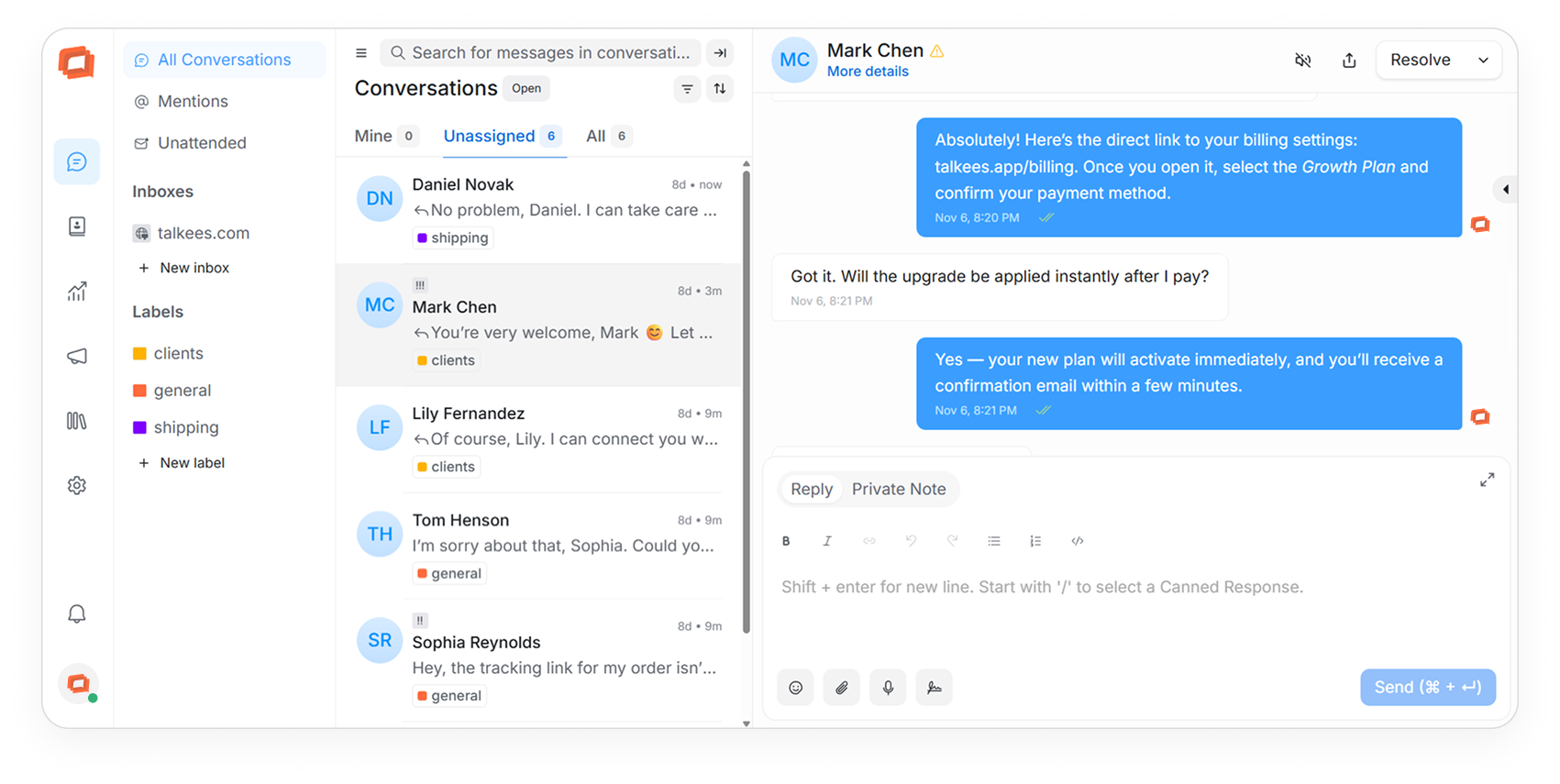
Talkees stands out as a modern alternative that combines live chat, social media messaging, SMS, and AI chatbots in a single, intuitive platform.
Key Features
- Unified inbox: Manage all customer conversations from email, chat, social media, and SMS in one place
- Advanced AI chatbots: Create sophisticated conversational flows without coding
- Seamless handoffs: Transition smoothly between automated and human support
- Deep integrations: Connect with Shopify, WooCommerce, and CRM platforms
- Competitive pricing: More affordable than heavyweight marketing automation platforms
Pricing
- Free plan: Includes basic chatbot functionality and limited conversations
- Starter: $29/month for small teams with moderate conversation volume
- Growth: $79/month for growing businesses needing advanced automation
- Enterprise: Custom pricing for large organizations with complex requirements
Real User Experiences
Users consistently praise Talkees for its intuitive interface and powerful AI capabilities. One ecommerce store owner reported: “We reduced response times by 78% after implementing Talkees, and the AI chatbot handles 65% of routine inquiries without human intervention.”
Advantages
- Truly omnichannel with unified conversation history
- More advanced AI capabilities than Brevo
- Intuitive interface requiring minimal training
- Excellent value for customer support teams
Disadvantages
- Newer platform with fewer third-party integrations
- Not focused on email marketing campaigns
- Limited email automation compared to dedicated ESPs
Our Subjective Assessment
During our testing, we found Talkees exceptionally easy to set up and use. The AI chatbot builder impressed us with its flexibility and natural-sounding responses. While it won’t replace a dedicated email marketing platform for large campaigns, it excels as a customer communication hub. The ability to seamlessly switch between automated and human support creates a superior customer experience compared to Brevo’s more siloed approach.
Mailchimp vs Brevo (Sendinblue)

Mailchimp remains one of the most recognized names in email marketing and offers a compelling alternative to Brevo.
Key Features
- Intuitive email builder: Create professional campaigns with drag-and-drop simplicity
- Advanced automation: Multi-step workflows with branching logic
- Strong analytics: Detailed reporting on campaign performance
- Marketing CRM: Built-in audience management tools
- Content optimization: AI-powered content suggestions and subject line helper
Pricing
- Free: Up to 500 contacts and 1,000 monthly emails
- Essentials: Starting at $13/month for 5,000 emails
- Standard: Starting at $20/month with automation and custom templates
- Premium: Starting at $350/month for advanced segmentation and multivariate testing
- Transactional email: Additional cost via Mandrill (approximately $20 for 25,000 emails)
Real User Experiences
Mailchimp users appreciate its intuitive interface and robust template library. A marketing consultant noted: “Mailchimp’s analytics are significantly more insightful than Brevo’s, especially for ecommerce clients tracking ROI.”
Advantages
- Extensive template library (230+ options)
- Stronger analytics and reporting
- Better social media integration
- More intuitive interface for beginners
Disadvantages
- More expensive for large contact lists
- Transactional email requires separate Mandrill add-on
- Limited customer support on lower tiers
- Charges for unsubscribed contacts
Our Subjective Assessment
During our testing, Mailchimp’s user experience stood out as significantly more polished than Brevo’s. The template editor feels more intuitive, and the reporting dashboard provides clearer insights. However, the per-contact pricing model becomes prohibitively expensive as your list grows, especially compared to Brevo’s send-based pricing. For small businesses with modest lists who prioritize ease of use, Mailchimp is excellent, but larger organizations may find the costs untenable.
SendGrid vs Brevo (Sendinblue)

For businesses prioritizing deliverability and transactional email performance, SendGrid offers enterprise-grade capabilities.
Key Features
- Developer-friendly APIs: Comprehensive documentation and flexible implementation options
- Advanced deliverability tools: Dedicated IPs, authentication, and deliverability insights
- Email testing: Preview emails across multiple clients and spam testing
- Detailed analytics: Real-time tracking and engagement metrics
- Marketing campaigns: Visual editor and automation capabilities
Pricing
- Free: 100 emails per day
- Essentials: Starting at $19.95/month for 50,000 emails
- Pro: Starting at $89.95/month with dedicated IP and subuser management
- Premier: Custom pricing for enterprise needs
- Marketing add-ons: Additional cost for marketing campaign functionality
Real User Experiences
Technical teams particularly value SendGrid’s reliability. A SaaS developer reported: “After switching from Brevo to SendGrid, our transactional email deliverability improved from 89% to 98%, and we have much better visibility into delivery issues.”
Advantages
- Superior deliverability for transactional emails
- Excellent technical documentation
- Robust API and developer tools
- Advanced authentication and security features
Disadvantages
- Steeper learning curve for non-technical users
- Marketing features less intuitive than dedicated ESPs
- More expensive for combined marketing and transactional needs
- Limited customer support on lower tiers
Our Subjective Assessment
In our testing, SendGrid’s deliverability consistently outperformed Brevo’s, particularly for transactional messages. The dashboard provides significantly more detailed delivery data, making troubleshooting much easier. However, the interface feels designed primarily for developers rather than marketers. For organizations with technical resources who prioritize deliverability, SendGrid is excellent, but marketing teams may find the campaign tools less intuitive than Brevo’s.
MailerLite vs Brevo (Sendinblue)

MailerLite offers a streamlined, user-friendly alternative with fair pricing and straightforward automation.
Key Features
- Clean, modern editor: Intuitive drag-and-drop interface
- Website builder: Create landing pages and websites
- Digital products: Sell digital downloads and subscriptions
- Survey capabilities: Build and distribute surveys
- Automation workflows: Easy-to-configure email sequences
Pricing
- Free: Up to 1,000 subscribers and 12,000 monthly emails
- Growing Business: Starting at $10/month for 500 subscribers
- Advanced: Starting at $21/month with more automation features
- Enterprise: Custom pricing for large organizations
- MailerSend: Separate service for transactional emails
Real User Experiences
Content creators particularly appreciate MailerLite’s simplicity. A newsletter publisher shared: “I switched from Brevo to MailerLite and found the interface much more intuitive. Setting up automated sequences takes half the time, and the digital product selling feature saved me from needing a separate platform.”
Advantages
- Exceptionally clean, user-friendly interface
- Generous free plan
- Built-in website and landing page builder
- Digital product selling capabilities
Disadvantages
- Fewer advanced segmentation options
- Limited integration options compared to Brevo
- Transactional emails require separate MailerSend service
- Less robust for complex marketing automation
Our Subjective Assessment
During our evaluation, MailerLite impressed us with its thoughtfully designed interface and smooth workflow. Creating campaigns feels effortless compared to Brevo’s somewhat clunky editor. The built-in website builder and digital product selling features provide excellent value for creators and small businesses. While it lacks some of Brevo’s advanced segmentation capabilities, MailerLite offers a more pleasant user experience at a competitive price point.
ActiveCampaign vs Brevo (Sendinblue)

For businesses seeking advanced automation and CRM capabilities, ActiveCampaign delivers enterprise-grade functionality.
Key Features
- Deep marketing automation: Visual workflow builder with advanced conditions
- Built-in CRM: Sales automation and pipeline management
- Behavioral tracking: Website and event tracking
- Predictive sending: AI-optimized delivery timing
- Split testing: Test automation pathways, not just content
Pricing
- Lite: Starting at $15/month for 500 contacts
- Plus: Starting at $49/month with CRM and landing pages
- Professional: Starting at $149/month with advanced automation
- Enterprise: Custom pricing with dedicated support
- Transactional emails: Additional cost via separate service
Real User Experiences
Marketing professionals value ActiveCampaign’s automation depth. A digital marketing agency owner noted: “ActiveCampaign’s automation capabilities are light-years ahead of Brevo’s. We can create sophisticated customer journeys that would be impossible to replicate in Brevo.”
Advantages
- Industry-leading automation capabilities
- Powerful CRM functionality
- Extensive pre-built automation recipes (900+)
- Advanced segmentation and lead scoring
Disadvantages
- Steeper learning curve
- More expensive than Brevo for similar contact counts
- No free plan (only trial)
- Transactional emails require separate solution
Our Subjective Assessment
Testing ActiveCampaign revealed its significant advantage in automation complexity and CRM functionality. The visual workflow builder allows for intricate customer journeys that far exceed Brevo’s capabilities. The platform feels designed for marketing professionals rather than beginners, with a corresponding learning curve. For businesses prioritizing sophisticated marketing automation and willing to invest in a more powerful platform, ActiveCampaign represents a substantial upgrade from Brevo, despite the higher price point.
Constant Contact vs Brevo (Sendinblue)

Constant Contact offers reliable email marketing with exceptional support and event management capabilities.
Key Features
- User-friendly editor: Simple drag-and-drop interface
- Event management: Registration, ticketing, and promotion tools
- Social media posting: Integrated social campaigns
- Survey tools: Create and distribute customer surveys
- Live phone support: Available on all paid plans
Pricing
- Core: Starting at $12/month for 500 contacts
- Plus: Starting at $35/month with automation and ecommerce
- Premium: Custom pricing for advanced needs
- Event marketing: Included in appropriate tiers
Real User Experiences
Small business owners particularly value Constant Contact’s support. A retail store manager shared: “After struggling with Brevo’s email-only support, switching to Constant Contact was refreshing. Being able to call and get immediate help saved us during critical campaign launches.”
Advantages
- Outstanding customer support with phone access
- Excellent event marketing tools
- Easy-to-use interface for beginners
- Strong deliverability (97% reported rate)
Disadvantages
- More expensive than Brevo for larger lists
- Limited automation capabilities on lower tiers
- Basic segmentation options
- Fewer integrations than some competitors
Our Subjective Assessment
In our testing, Constant Contact stood out for its exceptional customer support and straightforward interface. The event management tools are significantly better than anything Brevo offers, making it ideal for organizations running regular events or classes. While the automation capabilities aren’t as robust as Brevo’s, the reliable phone support and intuitive interface make it an excellent choice for small businesses and nonprofits that value hands-on assistance over advanced features.
Klaviyo vs Brevo (Sendinblue)

For ecommerce businesses, Klaviyo offers specialized capabilities that drive revenue through sophisticated segmentation.
Key Features
- Ecommerce-specific segmentation: Target based on purchase behavior
- Predictive analytics: Customer lifetime value and churn prediction
- Pre-built flows: Ready-to-use automation for ecommerce
- Product recommendations: Dynamic content based on shopping behavior
- SMS marketing: Integrated text messaging campaigns
Pricing
- Free: Up to 250 contacts and 500 email sends
- Email: Starting at $30/month for 1,000 contacts
- Email & SMS: Custom pricing based on contacts and SMS volume
- Higher tiers: Pricing scales with contact count
Real User Experiences
Ecommerce store owners report significant ROI from Klaviyo. A Shopify merchant noted: “Klaviyo paid for itself within the first month. The abandoned cart flows alone generated 22% more revenue than our previous setup with Brevo.”
Advantages
- Purpose-built for ecommerce
- Superior customer segmentation
- Powerful predictive analytics
- Seamless integration with major ecommerce platforms
Disadvantages
- Expensive for larger contact lists
- Primarily focused on ecommerce use cases
- Steeper learning curve than Brevo
- Limited value for non-ecommerce businesses
Our Subjective Assessment
Our evaluation of Klaviyo revealed its clear superiority for ecommerce businesses compared to Brevo. The platform’s segmentation capabilities and pre-built flows demonstrate a deep understanding of the ecommerce customer journey. The analytics provide actionable insights that directly impact revenue. While significantly more expensive than Brevo, the ROI for online stores is typically substantial. For non-ecommerce businesses, however, the specialized features may not justify the premium price.
HubSpot vs Brevo (Sendinblue)

HubSpot offers a comprehensive marketing, sales, and service platform that far exceeds Brevo’s capabilities.
Key Features
- All-in-one platform: Marketing, sales, service, CMS, and operations hubs
- Sophisticated CRM: Contact and company management
- Content tools: Blogging, SEO, and social media management
- Conversation inbox: Unified messaging across channels
- Advanced reporting: Custom dashboards and attribution
Pricing
- Free: Basic CRM features and limited marketing tools
- Starter: Starting at $20/month per user for basic functionality
- Professional: Starting at $890/month for Marketing Hub
- Enterprise: Starting at $3,600/month for advanced features
- Bundle pricing: Available for multiple hubs
Real User Experiences
Marketing teams at growing companies value HubSpot’s comprehensive approach. A marketing director shared: “Moving from Brevo to HubSpot transformed our marketing operations. Having everything in one platform eliminated data silos and improved our ability to measure true ROI across channels.”
Advantages
- Comprehensive all-in-one solution
- Powerful CRM at the core
- Excellent content marketing tools
- Unified data across marketing, sales, and service
Disadvantages
- Significantly more expensive than Brevo
- Substantial learning curve
- Overkill for simple email marketing needs
- Features locked behind higher-tier plans
Our Subjective Assessment
Testing HubSpot revealed it’s in an entirely different category from Brevo. The platform offers a comprehensive solution for growing businesses that need to align marketing, sales, and service operations. The unified data model provides insights impossible to achieve with disconnected tools. However, the cost is substantial, and small businesses focused primarily on email marketing will find it excessive. For organizations ready to invest in a platform that can scale with their growth, HubSpot represents a significant upgrade from Brevo.
GetResponse vs Brevo (Sendinblue)

GetResponse combines email marketing with webinars and conversion funnels in an all-in-one growth stack.
Key Features
- Conversion funnels: End-to-end marketing and sales funnels
- Webinar hosting: Built-in webinar functionality
- Autoresponders: Easy-to-configure email sequences
- Landing page builder: Professional landing pages with A/B testing
- Website builder: Create and publish websites
Pricing
- Free: Up to 500 contacts with basic features
- Email Marketing: Starting at $19/month for 1,000 contacts
- Marketing Automation: Starting at $59/month with automation
- Ecommerce Marketing: Starting at $119/month with advanced features
- Max: Custom pricing for enterprise needs
Real User Experiences
Businesses that rely on webinars find GetResponse particularly valuable. A course creator reported: “GetResponse allowed us to consolidate our webinar platform, email marketing, and funnel builder into one tool, saving us over $200 monthly compared to our previous stack with Brevo and separate webinar software.”
Advantages
- Built-in webinar functionality
- Comprehensive conversion funnels
- Strong automation capabilities
- Good value for combined features
Disadvantages
- Interface sometimes feels dated
- Webinar features more limited than dedicated platforms
- Email editor less intuitive than some competitors
- Limited free plan compared to Brevo
Our Subjective Assessment
During our evaluation, GetResponse impressed us with its breadth of functionality. The webinar integration is particularly valuable for businesses that regularly host online events. The conversion funnel feature provides a structured approach to campaign creation that Brevo lacks. While the interface occasionally feels less modern than competitors, the platform offers excellent value for businesses looking to consolidate multiple marketing tools into one solution.
ConvertKit vs Brevo (Sendinblue)

ConvertKit caters specifically to creators with features designed for content monetization and audience building.
Key Features
- Creator-focused: Built for bloggers, podcasters, and content creators
- Visual automation builder: Intuitive workflow creation
- Commerce tools: Sell digital products and subscriptions
- Landing pages: Quick creation without technical skills
- Tag-based organization: Flexible subscriber management
Pricing
- Free: Up to 1,000 subscribers with limited features
- Creator: Starting at $9/month for 300 subscribers
- Creator Pro: Starting at $25/month with advanced features
- Higher tiers: Pricing scales with subscriber count
Real User Experiences
Content creators consistently praise ConvertKit’s focus on their needs. A successful blogger noted: “After trying Brevo and finding it too business-oriented, ConvertKit felt like it was built specifically for my workflow as a creator. The commerce features helped me launch my first paid newsletter without any technical headaches.”
Advantages
- Purpose-built for creators
- Intuitive tag-based subscriber management
- Built-in digital product sales
- Clean, distraction-free email editor
Disadvantages
- Limited features for ecommerce businesses
- Fewer integrations than Brevo
- Can become expensive as subscriber count grows
- Basic reporting compared to alternatives
Our Subjective Assessment
Testing ConvertKit revealed its perfect alignment with creator workflows. The platform strips away unnecessary complexity while providing exactly what content creators need. The tag-based organization system is more intuitive than Brevo’s list-based approach for managing subscriber interests and behaviors. For bloggers, authors, podcasters, and other content creators, ConvertKit offers a more suitable environment than Brevo’s business-oriented approach, though traditional businesses may find it too specialized.
Picking Your Fit by Scenario

Choosing the right Brevo alternative depends on your specific needs:
For Ecommerce-Led Businesses
- Klaviyo: Best for sophisticated ecommerce marketing with revenue-driven segmentation
- GetResponse: Good for ecommerce combined with webinars and funnels
- Mailchimp: Solid option for smaller stores with moderate budgets
For Support-First & Omnichannel Needs
- Talkees: Ideal for unified customer communication across channels with AI support
- HubSpot: Comprehensive solution for aligned marketing, sales, and service (at a premium)
- Constant Contact: Good for businesses that value phone support and event management
For Developer-Led SMTP & Transactional Email
- SendGrid: Best for technical teams prioritizing deliverability and API flexibility
- MailerLite + MailerSend: Good combination for balanced marketing and transactional needs
- Brevo: Still competitive if you need both marketing and transactional in one platform
For Creator-Led Businesses
- ConvertKit: Perfect for content creators monetizing their audience
- MailerLite: Excellent for creators who need landing pages and digital product sales
- GetResponse: Good for creators using webinars as part of their strategy
For CRM-Led Organizations
- HubSpot: Best for unified CRM, marketing, and service operations
- ActiveCampaign: Excellent for advanced automation with integrated CRM
- GetResponse: Good middle-ground with marketing automation and basic CRM
Conclusion

While Brevo (Sendinblue) remains a solid choice for many businesses, exploring alternatives can reveal platforms better aligned with your specific needs and growth trajectory. Whether you prioritize advanced AI chatbots (Talkees), sophisticated ecommerce segmentation (Klaviyo), creator-focused tools (ConvertKit), or comprehensive marketing automation (ActiveCampaign), this guide should help you identify the best fit for your organization.
Remember to consider not just current needs but your anticipated growth, as migration becomes increasingly complex as your subscriber list and automation workflows expand. Most platforms offer free trials or plans, allowing you to test their capabilities before committing to a full migration.
What’s your experience with these Brevo alternatives? Have you found another platform that deserves mention? Share your insights in the comments below.