 English
 Slovenčina
 Français
 Magyar

Why Users Switch from Botsonic: Common Limitations in 2026

Before diving into alternatives, it’s important to understand why businesses seek Botsonic alternatives in the first place. While Botsonic offers solid functionality, users consistently report several limitations:
- Pricing ceiling challenges: Message-based billing creates unpredictable costs during traffic spikes, especially for seasonal businesses.
- Feature gaps: Limited customization for complex workflows and automation capabilities.
- Omnichannel limitations: Restrictions in seamless integration across all customer touchpoints.
- Integration depth: Key enterprise integrations often locked behind higher-priced tiers.
- Knowledge ingestion constraints: JavaScript rendering issues when crawling dynamic websites and limited automatic learning from past tickets.
- Analytics depth: Basic reporting dashboards that show “what happened” but offer fewer insights into “why” and how to improve.
These limitations become particularly problematic as businesses scale, leading many to explore more flexible and powerful alternatives.
What a Strong Botsonic Alternative Must Offer in 2026

When evaluating Botsonic competitors, look for these essential capabilities:
- Combined live chat and AI: Seamless integration of human agents with AI automation
- Robust RAG capabilities: Advanced retrieval-augmented generation over your proprietary data
- Smooth agent handoff: Contextual transfer of conversations from AI to human agents
- Deep integrations: Native connections to your CRM, helpdesk, and e-commerce platforms
- Multilingual support: Comprehensive language coverage for global businesses
- Enterprise-grade security: SOC 2, GDPR, and other compliance certifications
- Transparent pricing: Predictable costs that scale reasonably with usage
How We Compared Botsonic Competitors

Our evaluation process included:
- Real-world test scenarios: Product discovery, order tracking, customer support, and lead generation
- Performance metrics: Deflection rates, CSAT scores, response latency, and resolution accuracy
- Setup complexity: Time to implementation and technical expertise required
- Total cost of ownership: Comprehensive analysis of all costs, including add-ons and scaling fees
- Support quality: Responsiveness and effectiveness of the vendor’s own customer support
Free vs Paid Botsonic Alternatives: Budget Considerations

When comparing pricing models, consider these factors:
- Message-based vs. session-based billing: Message-based plans (like Botsonic’s) can become expensive during high-traffic periods
- AI model usage costs: Some platforms charge separately for LLM usage
- Seat licenses: Consider how many team members need access
- Scalability pricing: How costs increase as your business grows
- Hidden fees: Branding removal, additional bots, or premium integrations
For small to midsize support teams, realistic budgeting should account for:
- Base platform costs
- Additional seats as your team grows
- Potential seasonal spikes in usage
- Integration and customization expenses
Talkees vs Botsonic: Modern Omnichannel Support for E-commerce and SMBs

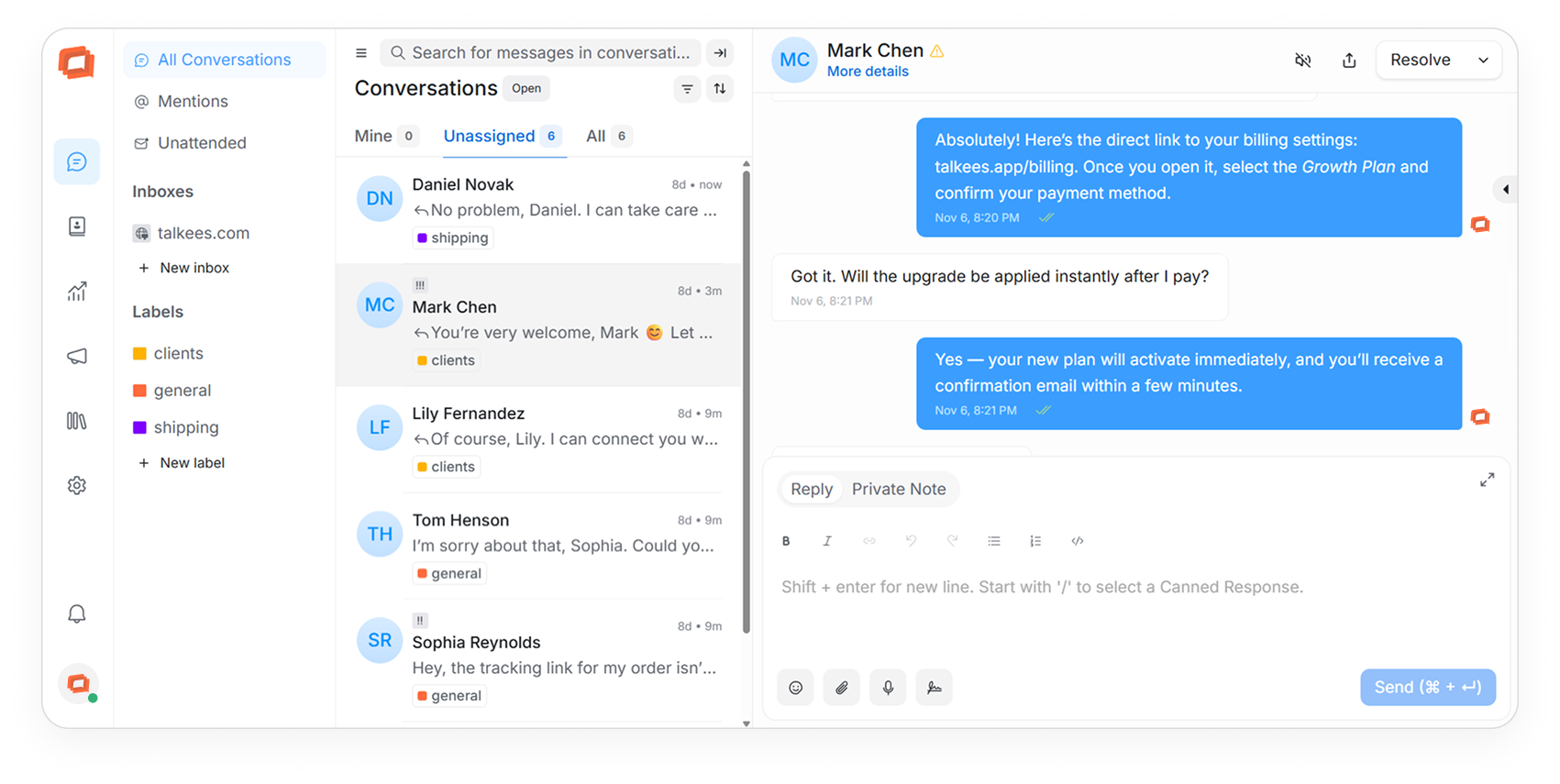
Talkees emerges as one of the strongest Botsonic alternatives, particularly for e-commerce businesses and SMBs seeking comprehensive customer support solutions.
Key Features
- Omnichannel Support: Seamlessly deploy across web, mobile, WhatsApp, and other messaging platforms
- Fast RAG Implementation: Quick setup for retrieving information from your website, knowledge base, and documents
- Multilingual Excellence: Industry-leading support for 186+ languages, far exceeding Botsonic’s 50+ languages
- Human-like SOPs: Standard Operating Procedures that guide conversations naturally
- Detailed Analytics: Comprehensive insights into chat performance, visitor demographics, and engagement trends
Pricing
Talkees offers transparent, predictable pricing that scales reasonably with usage:
- Free Plan: Available for basic needs and testing
- Starter: $16/month (billed annually) or $19/month (monthly billing)
- Standard: $49/month with expanded capabilities
- Pro: $99/month for advanced features and higher volumes
Unlike Botsonic’s message-based pricing that can lead to unpredictable costs during busy periods, Talkees provides more consistent pricing that businesses can reliably budget for.
Complete Feature List
- Website and knowledge base integration
- Custom SOP creation via Q&A interface
- Real-time delivery tracking for e-commerce
- Product recommendations based on user behavior
- Lead capture and qualification
- CRM integration via Zapier and webhooks
- Detailed analytics and performance insights
- Human-like conversation design
- Seamless human agent handoff
- Enterprise-grade security and encryption
User Experience and Reviews
Customers consistently praise Talkees for its intuitive setup process and natural-sounding AI conversations. E-commerce users particularly appreciate the platform’s ability to handle product inquiries, order status updates, and returns processing with minimal human intervention.
As one retail user noted: “The transition from our previous solution to Talkees was remarkably smooth. Within days, we were seeing higher engagement rates and better customer satisfaction scores.”
Pros and Cons
Pros:
- Superior multilingual capabilities (186+ languages)
- Intuitive SOP creation for complex workflows
- Detailed analytics that drive continuous improvement
- Fair and predictable pricing model
- Excellent for e-commerce use cases
Cons:
- Newer platform compared to some competitors
- Advanced customization may require some technical knowledge
Our Assessment
After thorough testing, we found Talkees to be exceptionally well-suited for e-commerce businesses and SMBs. The platform’s strong multilingual support and detailed analytics provide significant advantages over Botsonic, while its SOP-driven approach creates more natural and effective customer interactions.
The platform’s pricing transparency and scalability make it particularly appealing for growing businesses concerned about unpredictable costs. For organizations prioritizing multilingual support, detailed analytics, and natural conversation flows, Talkees represents one of the most compelling Botsonic alternatives on the market.
Botpress vs Botsonic: Developer-Friendly Control and Flexibility

Botpress takes a different approach with its low-code flow builder and developer-friendly architecture, making it ideal for teams that need deeper control over their chatbot’s behavior.
Key Features
- Low-Code Flow Builder: Visual interface combined with JavaScript extensibility
- Governance Tools: Advanced controls for managing bot behavior and permissions
- Model Routing: Intelligent selection of appropriate AI models for different tasks
- Self-Hosting Option: Ability to deploy on your own infrastructure
Pricing
Botpress offers a unique pricing structure:
- Pay-as-you-go: Free platform access + AI usage costs
- Plus: $89/month + AI usage costs
- Team: $495/month + AI usage costs
- Enterprise: $2,000+/month with advanced features
The separation of platform fees and AI costs can be advantageous for teams with fluctuating usage patterns.
Complete Feature List
- Visual conversation flow designer
- JavaScript customization capabilities
- Multiple NLU engines
- Version control and collaboration tools
- Webhook and API integrations
- On-premises deployment options
- Multilingual support (100+ languages)
- Advanced analytics and testing tools
- Role-based access control
- Extensible with custom modules
User Experience and Reviews
Developers particularly appreciate Botpress for its balance of visual tools and coding flexibility. Technical teams value the ability to create complex conversation flows while maintaining control over the implementation details.
A software development manager shared: “We evaluated several platforms, but Botpress gave us the perfect balance between ease of use and the deep customization our complex use cases required.”
Pros and Cons
Pros:
- Exceptional flexibility and customization
- Strong developer tools and community
- Self-hosting options for security-conscious organizations
- Transparent AI usage pricing
Cons:
- Steeper learning curve for non-technical users
- Requires more development resources for complex implementations
- Higher total cost for teams needing extensive customization
Our Assessment
Botpress excels when simplicity must take a backseat to control and customization. For organizations with developer resources and complex use cases that require fine-grained control over conversation flows, Botpress offers capabilities that Botsonic cannot match.
The platform’s low-code approach combined with JavaScript extensibility creates a powerful foundation for sophisticated chatbot implementations, though it requires more technical expertise than some alternatives. For development teams seeking maximum flexibility, Botpress represents a compelling alternative to Botsonic.
Chatbase vs Botsonic: Knowledge-Base Focused Bots for FAQ Deflection

Chatbase specializes in quickly turning your existing knowledge base into an effective chatbot, making it particularly strong for FAQ deflection.
Key Features
- Knowledge Base Integration: Easily connect to existing documentation
- Source Limitation Management: Controls to prevent hallucinations and inaccuracies
- Analytics Dashboard: Track performance and identify knowledge gaps
- Fast Implementation: Quick setup for basic FAQ handling
Pricing
Chatbase offers flexible pricing tiers:
- Free: Limited messages for testing
- Hobby: $19-40/month depending on volume
- Standard: $150/month for growing businesses
- Pro: $500/month for larger implementations
Complete Feature List
- Website and document crawling
- Knowledge base synchronization
- Custom training data upload
- Widget customization
- Basic analytics and reporting
- Multilingual support
- API access for custom integrations
- Email notification system
- User feedback collection
- Simple deployment process
User Experience and Reviews
Users consistently highlight Chatbase’s simplicity and effectiveness for knowledge base automation. The platform excels at quickly transforming existing documentation into conversational interfaces.
A customer support manager noted: “We had our help center content transformed into a working chatbot within hours. The accuracy was impressive right from the start, with minimal tuning required.”
Pros and Cons
Pros:
- Extremely fast setup for knowledge base content
- Good accuracy for FAQ-type queries
- Simple, straightforward implementation
- Affordable entry point
Cons:
- Limited capabilities beyond knowledge base Q&A
- Fewer advanced features for complex workflows
- Less suitable for transactional processes
Our Assessment
Chatbase delivers exceptional value for organizations focused primarily on FAQ deflection and knowledge base automation. Its streamlined approach allows for quick implementation with minimal setup time, making it ideal for teams looking to rapidly deploy basic support automation.
While it lacks some of the advanced features of other Botsonic alternatives, its focused approach and effectiveness for its intended use case make it a strong contender for organizations with straightforward support automation needs.
CustomGPT vs Botsonic: Private GPTs with Enterprise Compliance

CustomGPT offers a compelling alternative for organizations that need to create private GPT instances with strong compliance features.
Key Features
- Private GPT Creation: Build custom AI models on your proprietary data
- Strong Compliance Framework: Enterprise-grade security and privacy controls
- Comprehensive API Access: Extensive integration capabilities
- Custom Workflow Potential: Flexibility to create specialized processes
Pricing
CustomGPT’s pricing structure includes:
- Basic: $49/month for essential features
- Standard: $99/month for business implementations
- Premium: $499/month for enterprise needs
Complete Feature List
- Private model training
- Data sovereignty controls
- Document and knowledge base integration
- API-first architecture
- Compliance documentation and controls
- Custom model fine-tuning
- Version management
- Usage analytics and reporting
- Role-based access controls
- Audit logging and traceability
User Experience and Reviews
Organizations with strict compliance requirements particularly value CustomGPT’s approach to data privacy and security. The platform’s ability to create truly private GPT instances addresses concerns about data leakage and intellectual property protection.
A compliance officer at a financial services firm shared: “CustomGPT’s approach to data privacy gave us the confidence to implement AI chat in our highly regulated environment. The control over our data was the decisive factor.”
Pros and Cons
Pros:
- Superior data privacy and compliance features
- Strong API capabilities for custom integrations
- Excellent for sensitive industries and use cases
- Good documentation and support
Cons:
- Higher price point for advanced features
- Requires more configuration than some alternatives
- Less focus on pre-built e-commerce features
Our Assessment
CustomGPT stands out for organizations that prioritize data privacy, compliance, and customization. Its approach to creating private GPT instances on proprietary data addresses key concerns for regulated industries and security-conscious organizations.
While not as turnkey as some alternatives for standard e-commerce or support use cases, CustomGPT’s strength in compliance and API capabilities makes it a strong contender for organizations with specific security requirements or custom workflow needs.
DocsBot AI vs Botsonic: Documentation-Centric RAG for Developers

DocsBot AI specializes in documentation-focused retrieval-augmented generation, making it particularly valuable for technical support and developer documentation.
Key Features
- Documentation-Optimized RAG: Specialized for technical documentation
- Advanced Crawlers: Effective indexing of complex documentation
- Regular Update Cadence: Keeps information current automatically
- Developer-Friendly Interface: Designed with technical teams in mind
Pricing
DocsBot AI offers tiered pricing based on usage:
- Starter: Available for basic documentation needs
- Growth: For expanding technical documentation
- Enterprise: Custom pricing for large-scale implementations
Complete Feature List
- Technical documentation crawling
- Code snippet handling
- API documentation integration
- Version-aware content management
- Regular synchronization with documentation sources
- Developer portal integration
- Markdown and code formatting support
- Search optimization for technical terms
- Analytics focused on documentation usage
- Custom styling and branding
User Experience and Reviews
Technical teams and developer-focused organizations praise DocsBot AI for its understanding of documentation structures and code snippets. The platform excels at handling the unique challenges of technical support.
A developer advocate mentioned: “DocsBot AI understands our API documentation in ways other chatbots couldn’t. The accuracy when discussing code examples and technical specifications is noticeably better.”
Pros and Cons
Pros:
- Exceptional handling of technical documentation
- Strong understanding of code and API references
- Regular update capabilities keep information fresh
- Developer-oriented features and integrations
Cons:
- More specialized than general-purpose chatbots
- Less suitable for non-technical customer service
- Fewer marketing and sales-oriented features
Our Assessment
DocsBot AI provides superior capabilities for organizations focused on technical documentation and developer support. Its specialized approach to handling code snippets, API references, and technical content delivers accuracy that generalist platforms struggle to match.
While its focus makes it less suitable for general customer service or marketing applications, DocsBot AI represents an excellent Botsonic alternative for technical teams seeking to automate developer support or technical documentation assistance.
Intercom vs Botsonic: Full-Featured Platform with Fin AI Agent

Intercom offers a comprehensive customer messaging platform with its Fin AI Agent, making it a powerful all-in-one solution.
Key Features
- Fin AI Agent: Advanced AI capabilities integrated into the platform
- Comprehensive Help Center: Combined with conversational support
- Proactive Support Tools: Engage customers before issues arise
- Full Platform Integration: Messaging, help center, and automation in one system
Pricing
Intercom’s pricing includes:
- Starter: Base platform features
- Pro: Advanced capabilities and customization
- Fin AI: $0.99 per resolution (minimum 50/month) or Fin + Intercom at $0.99/resolution + $29/seat/month
Complete Feature List
- Messaging across web, mobile, and email
- Customer data platform
- Automated workflows and routing
- Help center creation and management
- Proactive messaging capabilities
- Team inbox and collaboration tools
- Custom bots and automation
- Advanced targeting and segmentation
- Comprehensive reporting and analytics
- Integration with CRM and other tools
User Experience and Reviews
Organizations already using Intercom find the Fin AI integration particularly valuable, as it enhances their existing workflows without requiring a platform switch. The unified approach to messaging, help center, and AI support creates a seamless experience.
A customer success director noted: “Adding Fin AI to our existing Intercom setup was transformative. We maintained our familiar workflows while dramatically increasing our automation capabilities.”
Pros and Cons
Pros:
- Comprehensive platform combining multiple tools
- Seamless integration between AI and human support
- Strong proactive engagement capabilities
- Per-resolution pricing aligns costs with value
Cons:
- Higher total cost for the full platform
- Potential complexity for simple use cases
- Less specialized than dedicated chatbot solutions
Our Assessment
Intercom with Fin AI represents a powerful alternative for organizations seeking a unified customer messaging platform with strong AI capabilities. The per-resolution pricing model ($0.99 per resolution) creates clear alignment between costs and value, while the comprehensive platform addresses multiple customer communication needs.
For organizations already using Intercom or seeking an all-in-one solution, this combination offers significant advantages over Botsonic’s more limited focus. However, the full platform comes with higher complexity and potentially higher costs for organizations with simple needs.
Tidio vs Botsonic: Shopify-Native Live Chat with AI Capabilities

Tidio offers a Shopify-native live chat solution with Lyro AI integration, making it particularly appealing for e-commerce businesses.
Key Features
- Shopify-Native Integration: Seamless connection with e-commerce stores
- Lyro AI Technology: Conversational AI designed for e-commerce
- Template Library: Pre-built workflows for common scenarios
- Budget-Friendly Automation: Accessible AI features at lower price points
Pricing
Tidio offers accessible pricing tiers:
- Free: Basic features for small businesses
- Starter: $29/month for growing businesses
- Growth: $59/month for expanded capabilities
- Tidio+: $399+/month for enterprise needs
Complete Feature List
- Live chat for websites and mobile
- Shopify and other e-commerce integrations
- Visual chatbot builder
- Pre-built templates for common scenarios
- Lead generation tools
- Visitor tracking and analytics
- Team inbox and collaboration features
- Multilingual support
- Mobile apps for agents
- API access for custom integrations
User Experience and Reviews
Shopify store owners particularly appreciate Tidio’s seamless integration and focus on e-commerce use cases. The platform’s combination of live chat and AI automation delivers value quickly with minimal setup time.
A Shopify merchant shared: “Tidio’s integration with our store was effortless, and the pre-built templates meant we could launch automated support for common questions on day one.”
Pros and Cons
Pros:
- Exceptional Shopify integration
- Very accessible pricing for small businesses
- Quick setup with pre-built templates
- Good balance of live chat and automation
Cons:
- Less advanced AI capabilities than specialized platforms
- Fewer enterprise features for complex organizations
- Limited customization for sophisticated workflows
Our Assessment
Tidio excels as a Botsonic alternative for Shopify and other e-commerce businesses seeking an accessible, easy-to-implement solution. Its focus on providing both live chat and basic AI automation at affordable price points makes it particularly appealing for small to medium-sized online stores.
While it lacks some of the advanced AI capabilities of more specialized platforms, Tidio’s combination of simplicity, e-commerce focus, and reasonable pricing creates compelling value for its target market. For Shopify store owners seeking to enhance customer support without significant investment, Tidio represents an excellent choice.
Zendesk vs Botsonic: Enterprise-Grade Support with AI Integration
Zendesk offers a comprehensive support platform with AI capabilities, making it a powerful option for organizations with complex customer service needs.
Key Features
- Agent Workspace: Unified interface for all customer interactions
- AI Add-Ons: Integrated automation capabilities
- Deep Ticketing Functionality: Sophisticated workflow management
- Enterprise Scalability: Designed for large-scale operations
Pricing
Zendesk’s tiered pricing includes:
- Suite Team: Starting point for small teams
- Suite Growth: For expanding support operations
- Suite Professional: Comprehensive support capabilities
- Suite Enterprise: Full-featured enterprise platform
- AI add-ons: Additional costs for advanced AI capabilities
Complete Feature List
- Omnichannel support (email, chat, phone, social)
- Knowledge base and community forums
- Advanced ticket routing and automation
- SLA management and compliance tools
- Comprehensive reporting and analytics
- AI-powered answer suggestions
- Customer context and history
- Collaboration tools for support teams
- Extensive marketplace of integrations
- Customizable workflows and business rules
User Experience and Reviews
Enterprise organizations with complex support needs value Zendesk’s comprehensive approach and scalability. The platform’s mature features and extensive integration capabilities address sophisticated requirements that simpler chatbot solutions cannot meet.
A customer support director at a large enterprise noted: “Zendesk’s comprehensive platform handles our complex support workflows across multiple channels and teams. The AI capabilities enhance our agents’ productivity without replacing the human touch our customers expect.”
Pros and Cons
Pros:
- Comprehensive support platform with mature features
- Strong enterprise capabilities and scalability
- Extensive integration ecosystem
- Robust reporting and analytics
Cons:
- Higher complexity and implementation effort
- More expensive than dedicated chatbot solutions
- Requires significant configuration for optimal results
- AI capabilities are add-ons rather than core features
Our Assessment
Zendesk represents a strong Botsonic alternative for organizations with complex, enterprise-scale support needs. Its comprehensive platform addresses multiple channels and sophisticated workflows, while AI add-ons enhance agent productivity.
The migration complexity and higher costs make it less suitable for organizations seeking a simple chatbot solution, but for enterprises requiring a complete support platform with AI capabilities, Zendesk delivers significant value. Organizations should consider their overall support strategy and complexity when evaluating Zendesk as an alternative.
Drift vs Botsonic: B2B Revenue-Focused Conversational Marketing

Drift focuses on B2B revenue generation through conversational marketing and sales automation, making it distinct from general-purpose chatbots.
Key Features
- B2B Revenue Chat: Optimized for lead qualification and sales
- Account-Based Marketing (ABM) Routing: Target high-value accounts
- AI Copilot for Sales: Assists sales teams in conversations
- Lead Qualification Performance: Specialized in converting site visitors to qualified leads
Pricing
Drift’s pricing structure includes:
- Premium: Core conversational marketing features
- Advanced: Enhanced capabilities for growing teams
- Enterprise: Full-featured platform for large organizations
- Custom pricing: Based on specific requirements and scale
Complete Feature List
- Conversational marketing platform
- Account-based marketing capabilities
- Targeted messaging and playbooks
- Meeting scheduling automation
- Lead routing and qualification
- Sales conversation insights
- Integration with marketing automation
- Custom chatbot workflows
- A/B testing for conversations
- Revenue attribution reporting
User Experience and Reviews
B2B marketing and sales teams appreciate Drift’s focus on revenue generation and lead qualification. The platform’s specialized approach to conversational marketing delivers measurable results for sales-driven organizations.
A B2B marketing director shared: “Drift transformed our website from a passive information source to an active lead generation engine. The quality of conversations and resulting meetings has significantly improved our pipeline.”
Pros and Cons
Pros:
- Exceptional B2B lead generation capabilities
- Strong account-based marketing features
- Direct integration with sales processes
- Proven revenue impact for B2B organizations
Cons:
- Less focused on customer support use cases
- Higher price point than general-purpose chatbots
- Not ideal for e-commerce or consumer businesses
- Requires alignment with sales processes
Our Assessment
Drift stands out as a Botsonic alternative specifically for B2B organizations focused on revenue generation rather than customer support. Its specialized approach to conversational marketing and sales enablement addresses use cases that general-purpose chatbots cannot effectively handle.
While its focus makes it less suitable for customer support or e-commerce applications, Drift delivers exceptional value for B2B marketing and sales teams seeking to convert website traffic into qualified leads and meetings. Organizations should consider their primary use case—support vs. revenue generation—when evaluating Drift as an alternative.
Ada vs Botsonic: Enterprise Automation with Multilingual Capabilities

Ada offers enterprise-grade automation with sophisticated multilingual capabilities, making it suitable for large organizations with global support needs.
Key Features
- Enterprise Automation Platform: Designed for large-scale operations
- Advanced Multilingual NLU: Natural language understanding across languages
- Comprehensive Channel Coverage: Consistent experience across touchpoints
- Sophisticated Automation: Handles complex workflows without live chat
Pricing
Ada offers enterprise pricing models:
- Custom pricing: Based on volume and requirements
- Resolution-based options: Align costs with automation success
Complete Feature List
- Enterprise-grade automation platform
- Advanced natural language understanding
- Multilingual support (50+ languages)
- Omnichannel deployment
- Knowledge management system
- Custom integrations and APIs
- Sophisticated workflow automation
- Analytics and performance reporting
- Compliance and security features
- Training and implementation services
User Experience and Reviews
Large enterprises with global support needs value Ada’s scalability and language capabilities. The platform’s ability to handle complex automation without requiring live chat integration addresses specific enterprise requirements.
An enterprise support executive noted: “Ada’s multilingual capabilities allowed us to automate support across our global markets with consistent quality. The platform handles complex workflows that previously required human intervention.”
Pros and Cons
Pros:
- Excellent multilingual capabilities
- Strong enterprise security and compliance
- Sophisticated automation for complex scenarios
- Scalability for large global organizations
Cons:
- Lack of integrated live chat can be limiting
- Higher price point than many alternatives
- More complex implementation process
- Less suitable for smaller organizations
Our Assessment
Ada provides a compelling Botsonic alternative for large enterprises with sophisticated automation needs, particularly those operating across multiple languages and regions. Its focus on comprehensive automation without integrated live chat represents both a strength and limitation depending on specific requirements.
For organizations that prioritize consistent automation across languages and channels over integrated human support, Ada delivers exceptional capabilities. However, the enterprise focus and higher complexity make it less suitable for smaller organizations or those requiring tight integration between automation and live agents.
Matching the Right Botsonic Alternative to Your Use Case

Choosing the best Botsonic alternative depends on your specific needs:
For E-commerce Businesses
- Best overall: Talkees offers the strongest combination of e-commerce features, multilingual support, and analytics
- Budget option: Tidio provides excellent Shopify integration at accessible price points
- Enterprise choice: Zendesk delivers comprehensive support capabilities for large-scale operations
For SaaS Companies
- Developer-friendly: Botpress gives technical teams the control and flexibility they need
- Documentation-focused: DocsBot AI excels at handling technical content and developer support
- All-in-one platform: Intercom combines messaging, help center, and AI in a unified system
For Customer Support Teams
- Automation-focused: Ada delivers sophisticated automation for complex support scenarios
- Agent productivity: Zendesk enhances agent capabilities with AI assistance
- Multilingual support: Talkees offers superior language coverage (186+ languages)
For Lead Generation
- B2B focus: Drift specializes in converting website visitors into qualified leads
- E-commerce leads: Tidio and Talkees both offer strong lead capture capabilities
- Enterprise sales: Drift’s account-based marketing features target high-value prospects
For Internal Helpdesk
- Technical documentation: DocsBot AI handles complex internal documentation effectively
- Enterprise platform: Zendesk provides comprehensive internal support capabilities
- Secure implementation: CustomGPT offers strong compliance and data privacy features
Migration Playbook: Moving from Botsonic to Your Chosen Alternative

Successfully migrating from Botsonic involves several key steps:
1. Data Export and Preparation
- Export your knowledge base, FAQs, and training data from Botsonic
- Collect conversation logs and identify common queries and patterns
- Document current integrations and workflows
2. Knowledge Rebuilding
- Import your content into your new platform
- Validate knowledge retrieval accuracy with test queries
- Refine and enhance your knowledge base during transition
3. Preserving SEO and Chat History
- Maintain the same URL structure for your chat widget if possible
- Implement proper redirects if URLs must change
- Archive historical conversations for reference
4. Phased Rollout Strategy
- Deploy to a small percentage of traffic initially (10-20%)
- Monitor performance and make adjustments
- Gradually increase traffic allocation as performance stabilizes
- Maintain Botsonic as a fallback until migration is complete
5. Avoiding Downtime
- Implement the new solution in parallel with Botsonic
- Use A/B testing to compare performance
- Schedule the final cutover during low-traffic periods
- Prepare contingency plans for unexpected issues
By following this structured approach, you can successfully transition from Botsonic to your chosen alternative while minimizing disruption to your customers and business operations.
Conclusion: Finding Your Ideal Botsonic Alternative

The landscape of AI chatbots and customer support platforms continues to evolve rapidly, offering increasingly sophisticated alternatives to Botsonic. Each platform we’ve examined brings unique strengths to address specific business needs:
- Talkees excels for e-commerce and SMBs with its multilingual capabilities and detailed analytics
- Botpress gives developers the control and flexibility they need for custom implementations
- Chatbase offers streamlined knowledge base automation
- CustomGPT addresses enterprise compliance and data privacy concerns
- DocsBot AI specializes in technical documentation support
- Intercom provides a comprehensive platform with integrated AI
- Tidio delivers accessible e-commerce support with Shopify integration
- Zendesk offers enterprise-grade support capabilities
- Drift focuses on B2B lead generation and revenue
- Ada provides sophisticated enterprise automation
When selecting your Botsonic alternative, consider your primary use cases, technical requirements, budget constraints, and growth projections. The right platform will not only address your current needs but also scale with your business as it evolves.
We recommend running small proof-of-concept tests with 2-3 promising alternatives to evaluate real-world performance with your specific content and use cases before making a final decision.
By carefully assessing your requirements and the unique capabilities of each platform, you can find the perfect Botsonic alternative to enhance your customer engagement, support operations, and business outcomes.