 English
 Slovenčina
 Français
 Magyar
Why Teams Look for ActiveCampaign Alternatives in 2025

Are you considering switching from ActiveCampaign? You’re not alone. While ActiveCampaign offers powerful automation capabilities, several factors are driving businesses to explore alternatives:
Pricing Structure Concerns
ActiveCampaign uses contact-based pricing that increases significantly as your list grows. For example, the Professional tier jumps from approximately $79/month for 1,000 contacts to about $375/month for 10,000 contacts, and can reach $649/month for 25,000 contacts. This steep scaling can create budget challenges for growing businesses.
Platform Complexity
Many users find ActiveCampaign’s powerful features come with a steep learning curve. The platform’s advanced capabilities often require significant time investment to master, which can be challenging for smaller teams without dedicated marketing specialists.
AI Limitations
While ActiveCampaign has incorporated AI features like predictive sending and the AI Brand Kit, some competitors offer more comprehensive AI solutions with better integration across all platform functions. ActiveCampaign’s AI tools sometimes require human oversight for quality control and may struggle with complex multi-touch strategies.
Missing Omnichannel Capabilities
ActiveCampaign lacks native push notifications and in-app messaging, limiting true omnichannel marketing. The platform also doesn’t support anonymous user tracking that can later be merged with identified profiles, creating gaps in customer journey data. Additionally, event triggers are limited compared to some alternatives.
Essential Features in an ActiveCampaign Replacement

When evaluating alternatives to ActiveCampaign, ensure your new platform delivers these critical capabilities:
Automation Depth
Look for a visual workflow builder with conditional branches, wait/goal nodes, and real-time event triggers. The platform should support behavioral triggers based on opens, clicks, page visits, product views, and purchases with minimal limitations on automation complexity.
AI Assistance
Modern marketing platforms should offer AI that goes beyond basic automation. Seek platforms with generative content creation, predictive analytics, automated A/B testing, and conversational intelligence that enhances rather than replaces human creativity.
Omnichannel Capabilities
Your replacement should unify email, SMS, live chat, social messaging, and push notifications in one platform. The ability to coordinate channels in single workflows with fallback options ensures consistent customer experiences across touchpoints.
Comprehensive Reporting
Effective marketing requires actionable insights. Look for real-time reports on opens, clicks, conversions, and revenue attribution with funnel leak detection and A/B test reporting. Ecommerce businesses should prioritize platforms with robust revenue attribution capabilities.
Deliverability Infrastructure
Email deliverability directly impacts ROI. Evaluate platforms based on their DKIM/SPF/DMARC configuration tools, reputation monitoring capabilities, and access to dedicated IPs. Third-party deliverability tests can provide objective comparison data.
Must-Have Integrations When Replacing ActiveCampaign

Your new platform should seamlessly connect with your existing tech stack. Prioritize these essential integrations:
Ecommerce Platforms
- Shopify/Shopify Plus: Native integration with product catalog sync, customer data, and order history
- WooCommerce: Two-way synchronization of customers, orders, and abandoned carts
- WordPress: Form integrations, site tracking, and content publishing capabilities
CRM and Business Tools
- Zapier/Make: For connecting with thousands of apps without custom development
- Salesforce: Bi-directional contact sync, opportunity tracking, and custom field mapping
- Pipedrive: Sales pipeline integration with marketing automation workflows
Analytics and Tracking
- Google Analytics 4: Campaign attribution and customer journey tracking
- Stripe: Payment processing and subscription management
- Calendly/Typeform: Appointment scheduling and form submissions that trigger automations
Communication Services
- Twilio: For advanced SMS and voice communications
- SendGrid: Transactional email capabilities and deliverability monitoring
Migration Checklist from ActiveCampaign

Transitioning from ActiveCampaign requires careful planning. Follow this checklist to ensure a smooth migration:
Data Migration Essentials
- Contacts and Tags: Export all contacts with tags, custom fields, and segment information
- Double Opt-In Status: Preserve consent records and subscription preferences
- Lead Scoring: Map your existing lead scoring system to the new platform
Technical Configuration
- Automations and Webhooks: Document existing workflows and recreate them in your new platform
- Site/Event Tracking: Implement tracking scripts and verify data collection
- SPF/DKIM/DMARC: Configure email authentication properly to maintain deliverability
Advanced Setup
- Dedicated IP: Consider if you need a dedicated IP address based on your sending volume
- Transactional Email: Configure transactional messaging separately from marketing communications
- Warm-up Plan: Implement a gradual sending increase to establish sender reputation
How We Evaluate ActiveCampaign Competitors

We assess alternatives based on these critical factors for different business types:
For Ecommerce Businesses
- Native integrations with major ecommerce platforms
- Abandoned cart recovery capabilities
- Product recommendation features
- Revenue attribution reporting
For SMB Support Teams
- Unified inbox for customer communications
- Live chat and chatbot functionality
- Case management capabilities
- Response time analytics
For Content Creators
- Landing page and form builders
- Monetization tools for digital products
- Newsletter and membership features
- Simple visual automation tools
For AI-Driven Projects
- Natural language processing capabilities
- Custom AI model integration options
- Predictive analytics and segmentation
- Automated content generation quality
Talkees vs ActiveCampaign: Modern Omnichannel Solution

Talkees offers a refreshing alternative to ActiveCampaign with its focus on conversational marketing and support.
Key Features
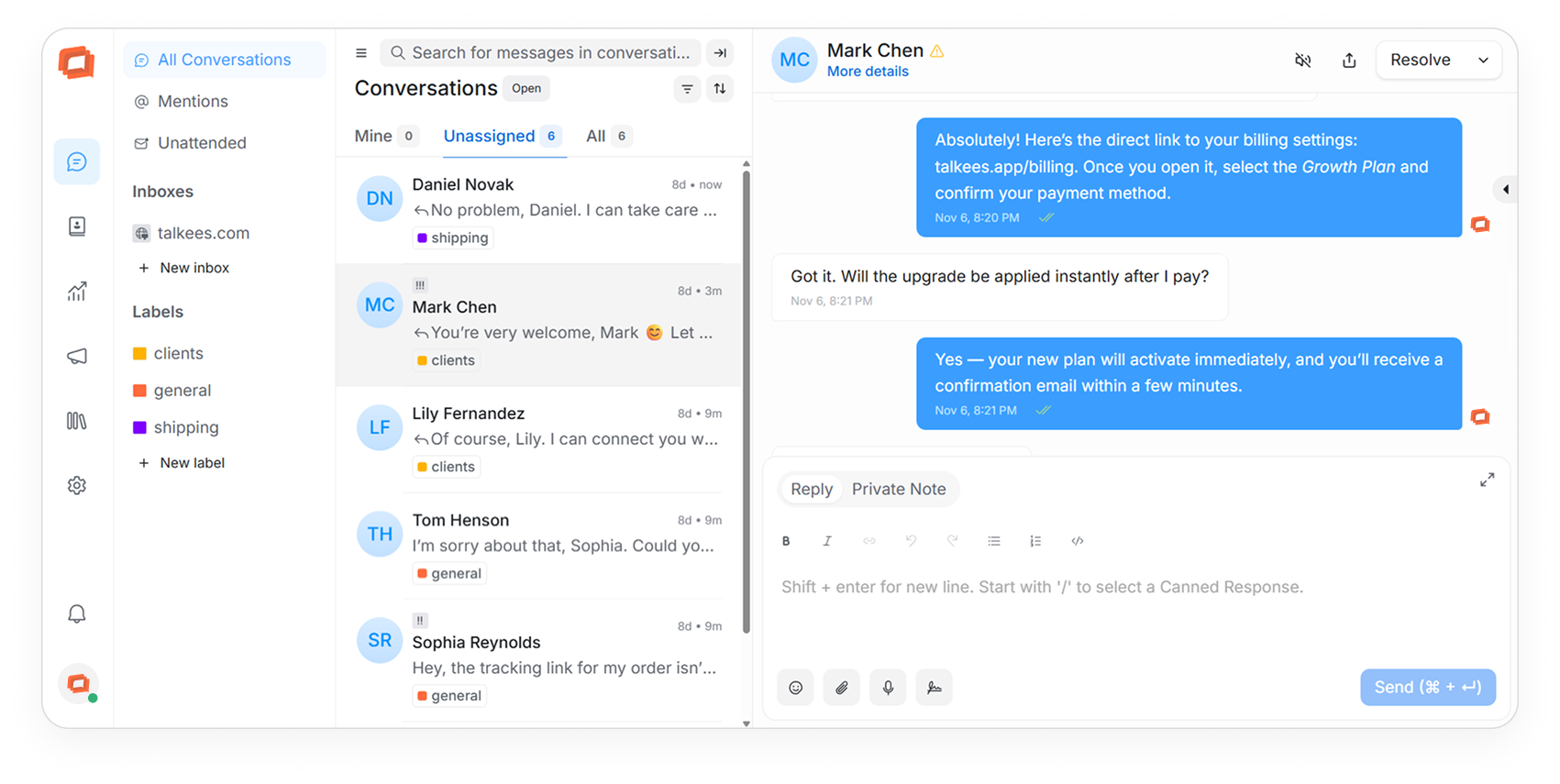
- Unified Omnichannel Inbox: Centralize live chat, social media messages, and SMS in one interface
- AI Chatbots: Deploy sophisticated AI chatbots across web, social, and messaging channels
- Conversation Analytics: Track customer sentiment and conversation metrics
- Seamless Handoffs: Transition smoothly between automated and human conversations
Pricing Overview
Talkees offers a more predictable pricing structure based on conversation volume rather than contact count:
- Starter: $29/month for small businesses (includes 500 AI-powered conversations)
- Growth: $79/month for growing teams (2,500 conversations, advanced automation)
- Professional: $149/month for established businesses (10,000 conversations, custom integrations)
- Enterprise: Custom pricing for large organizations (unlimited conversations, dedicated support)
All plans include unlimited contacts, making Talkees particularly cost-effective for businesses with large databases but focused conversation needs.
Complete Feature List
- Live chat for websites and mobile apps
- Social media messaging integration (Facebook, Instagram, WhatsApp)
- SMS messaging capabilities
- AI-powered chatbots with natural language understanding
- Visual conversation builder
- Custom chatbot training
- Sentiment analysis
- Conversation analytics and reporting
- Team collaboration tools
- Integration with CRM systems
- API access for custom integrations
- Multilingual support
- File and image sharing
- Canned responses
- Visitor tracking
User Experiences and Reviews
Users consistently praise Talkees for its intuitive interface and powerful AI capabilities. According to G2 reviews, customers appreciate the platform’s ability to:
“The AI chatbots handle over 40% of our routine inquiries without human intervention, allowing our team to focus on complex cases.” – Retail business owner
“We’ve seen a 30% increase in lead capture since implementing Talkees on our website, and the integration with our CRM was seamless.” – Marketing director
Some users note the platform is still evolving its email marketing capabilities, but most find the omnichannel messaging features more than compensate.
Advantages
- No contact-based pricing increases as your database grows
- Purpose-built for conversational marketing and support
- Sophisticated AI chatbots require minimal training
- Clean, modern interface with minimal learning curve
- Strong focus on real-time customer engagement
Disadvantages
- Less robust email automation compared to ActiveCampaign
- Newer platform with a growing integration ecosystem
- Limited CRM functionality compared to all-in-one solutions
- Fewer pre-built templates than established competitors
Our Assessment
After testing Talkees extensively, we found it excels for businesses prioritizing real-time customer engagement over complex email automation sequences. The platform’s AI chatbots impressed us with their ability to handle nuanced conversations and seamlessly transfer to human agents when needed.
The pricing model provides refreshing transparency compared to the escalating costs of contact-based platforms. For support teams and businesses focused on conversational commerce, Talkees offers a compelling alternative to ActiveCampaign’s email-centric approach.
Mailchimp vs ActiveCampaign: Deliverability and Templates

Mailchimp remains one of the most recognized alternatives to ActiveCampaign, particularly for businesses prioritizing ease of use and design capabilities.
Pricing Structure
Mailchimp offers a freemium model with paid plans starting around:
- Essentials: From $13/month
- Standard: From $20/month
- Premium: From $350/month
Pricing scales with contacts and email volume, similar to ActiveCampaign, but with different tier breakpoints.
Complete Feature List
- Email marketing campaigns
- Marketing automation workflows
- Drag-and-drop email builder
- Content Studio for asset management
- Audience management and segmentation
- Behavioral targeting
- Landing pages and forms
- A/B testing capabilities
- Website builder
- Customer journey builder
- Basic CRM functionality
- Social media posting
- Survey creation tools
- Reporting and analytics
User Experiences and Reviews
Mailchimp users frequently highlight the platform’s intuitive design tools and template variety:
“Mailchimp’s template editor is significantly more intuitive than ActiveCampaign’s, especially for our marketing team members without technical backgrounds.” – SMB Marketing Manager
However, some users note limitations in automation complexity:
“We outgrew Mailchimp’s automation capabilities as our nurture sequences became more sophisticated. The visual workflow builder is much more basic than ActiveCampaign’s.” – Digital Marketing Specialist
Deliverability Comparison
In recent deliverability tests, Mailchimp achieved approximately 92.6% deliverability compared to ActiveCampaign’s 93.4%. While ActiveCampaign holds a slight edge, both platforms perform above industry averages.
Advantages
- User-friendly interface with minimal learning curve
- Generous free plan for small businesses
- Excellent template library and design tools
- Strong integration with social media platforms
- Built-in website and landing page builders
Disadvantages
- Limited automation complexity compared to ActiveCampaign
- Less sophisticated segmentation capabilities
- Higher pricing at scale for larger contact lists
- Basic CRM functionality
- Less flexible custom field options
Our Assessment
During our testing, Mailchimp impressed us with its intuitive design experience and comprehensive template library. The platform excels for visually-oriented marketers who prioritize brand consistency and design quality.
However, we found the automation capabilities noticeably less powerful than ActiveCampaign’s, particularly for complex, multi-step customer journeys. For businesses with straightforward email marketing needs and an emphasis on design, Mailchimp provides excellent value. Companies requiring sophisticated automation should consider alternatives.
HubSpot vs ActiveCampaign: CRM Depth and Total Cost

HubSpot offers a comprehensive alternative to ActiveCampaign with its all-in-one CRM platform approach.
Pricing Structure
HubSpot’s Marketing Hub pricing examples include:
- Starter: Approximately $15/seat/month with 1,000 marketing contacts
- Professional: Around $890/month (includes 3 seats, 2,000 marketing contacts)
- Enterprise: Approximately $3,600/month (includes 5 seats, 10,000 marketing contacts)
Additional costs include onboarding fees (often $3,000 for Professional and $6,000 for Enterprise) and add-ons for transactional email, SMS, and additional marketing contacts.
Complete Feature List
- Full CRM platform with Marketing, Sales, Service, CMS, and Operations Hubs
- Contact and company management
- Deal pipelines and opportunity tracking
- Custom objects for flexible data modeling
- Marketing automation workflows
- Email marketing campaigns
- Landing pages and forms
- Live chat and chatbots
- Meeting scheduling
- Document management and tracking
- Reporting and analytics dashboards
- Breeze AI for insights and content assistance
- SEO tools and content strategy
- Social media management
- Ad management
- Customer service ticketing
- Knowledge base creation
- Survey tools
User Experiences and Reviews
HubSpot users consistently praise the platform’s comprehensive nature and integration between marketing, sales, and service:
“Having our marketing automation, CRM, and website on one platform eliminated data silos and improved our sales and marketing alignment significantly.” – VP of Marketing at a mid-market company
Cost concerns are common, particularly at scale:
“HubSpot’s capabilities are impressive, but the cost increases dramatically as you add marketing contacts and users. We had to carefully evaluate which features justified the premium price.” – Marketing Operations Director
Advantages
- Truly unified platform for marketing, sales, and service
- Powerful CRM with custom objects and robust reporting
- Excellent user interface and intuitive design
- Strong customer support and extensive training resources
- Comprehensive Breeze AI capabilities across all Hubs
- Built-in CMS for website management
Disadvantages
- Significantly higher cost than ActiveCampaign (often 6-15x higher TCO)
- Substantial onboarding fees for Professional and Enterprise tiers
- Per-seat pricing adds costs as teams grow
- Complex pricing structure with multiple Hubs and add-ons
- Steeper learning curve for full platform utilization
Our Assessment
Our testing confirmed HubSpot’s reputation as a premium, comprehensive marketing and sales platform. The integration between Hubs creates a seamless experience, and the CRM capabilities far exceed ActiveCampaign’s.
However, the pricing difference is substantial. Our TCO analysis showed that for a mid-market team with 10,000 contacts, HubSpot Professional might cost approximately $35,000 over three years compared to $5,500 for ActiveCampaign Professional.
For organizations that truly need unified CRM, marketing, sales, service, and CMS capabilities with enterprise governance, HubSpot’s premium can be justified. For email-first marketing automation, ActiveCampaign delivers similar core functionality at a fraction of the cost.
Klaviyo vs ActiveCampaign: Ecommerce Automations and SMS

Klaviyo has established itself as a leading ecommerce-focused alternative to ActiveCampaign, particularly for Shopify and Shopify Plus merchants.
Pricing Structure
Klaviyo uses a contact-based pricing model with email and SMS capabilities:
- Free tier for up to 250 contacts and limited emails
- Email plans starting around $45/month for 15,000 emails
- Combined Email+SMS plans starting at approximately $60/month for 15,000 emails and 1,250 SMS credits
Pricing scales quickly with contact volume, particularly for high-volume ecommerce stores.
Complete Feature List
- Email marketing campaigns
- SMS marketing
- Ecommerce-specific automation flows
- Deep Shopify/WooCommerce integration
- Product recommendations
- Advanced segmentation based on purchase behavior
- Predictive analytics (CLV, churn risk)
- A/B testing capabilities
- Dynamic content blocks
- Pre-built ecommerce templates
- Visual flow builder
- Revenue attribution
- Customer lifetime value reporting
- Product catalog sync
- Abandoned cart recovery
- Browse abandonment tracking
- Post-purchase follow-ups
- Customer winback campaigns
- Integration with Facebook and Instagram ads
- Custom reporting
User Experiences and Reviews
Ecommerce merchants consistently highlight Klaviyo’s specialized ecommerce capabilities:
“Klaviyo’s pre-built flows for abandoned carts, browse abandonment, and post-purchase sequences generated over $50,000 in additional revenue within our first three months.” – Shopify Plus merchant
Some users note the pricing can become challenging at scale:
“Klaviyo’s ecommerce features are unmatched, but as our list grew past 50,000 contacts, the monthly cost became significant. We had to be more strategic about list management.” – Ecommerce Marketing Director
Advantages
- Purpose-built for ecommerce with specialized flows
- Deep Shopify and WooCommerce integration
- Sophisticated product recommendation engine
- Powerful segmentation based on purchase behavior
- Strong revenue attribution reporting
- Seamless SMS integration
- Pre-built flows accelerate implementation
Disadvantages
- Higher cost than some alternatives, especially at scale
- Less flexible for non-ecommerce businesses
- More limited CRM capabilities than ActiveCampaign
- Steeper learning curve for advanced features
- Limited landing page capabilities
Our Assessment
In our testing with ecommerce clients, Klaviyo demonstrated exceptional value for online retailers. The platform’s pre-built flows for common ecommerce scenarios delivered immediate ROI, and the deep integration with Shopify created a seamless data flow.
The product recommendation engine consistently outperformed ActiveCampaign’s capabilities, and the revenue attribution reporting provided clearer insights into campaign performance. For pure ecommerce businesses, particularly on Shopify, Klaviyo offers specialized features that justify its premium pricing.
However, for businesses with diverse needs beyond ecommerce, ActiveCampaign’s broader feature set may provide better value, especially as contact lists grow into the tens of thousands.
ConvertKit vs ActiveCampaign: Simplicity for Creators

ConvertKit (now also known as Kit) offers a streamlined alternative to ActiveCampaign specifically designed for content creators, bloggers, and digital product sellers.
Pricing Structure
ConvertKit offers a creator-friendly pricing model:
- Free: Up to 1,000 subscribers with limited features
- Creator: Approximately $29/month for 1,000 subscribers with full features
- Creator Pro: Around $59/month with advanced features and priority support
Pricing scales with subscriber count but remains relatively straightforward compared to more complex platforms.
Complete Feature List
- Email marketing campaigns
- Visual automation builder
- Landing pages and forms
- Digital product sales and delivery
- Paid newsletter functionality
- Subscriber tagging and segmentation
- Visual automation workflows
- A/B testing for subject lines
- Email personalization
- Subscriber engagement scoring
- Integrations with creator tools
- Reporting and analytics
- Link redirects and tracking
- Custom domains for landing pages
- Subscriber referral system
- Tip jar functionality
- Creator community access
User Experiences and Reviews
Content creators consistently praise ConvertKit’s focus on their specific needs:
“ConvertKit’s simplicity allowed me to focus on creating content rather than learning complex marketing automation. The built-in commerce features helped me monetize my audience without additional tools.” – Independent creator with 15,000 subscribers
Some users note limitations compared to more comprehensive platforms:
“As my business grew beyond just content, I found ConvertKit’s segmentation and automation capabilities more limited than ActiveCampaign’s. Great for creators, but less flexible for diverse business models.” – Business coach transitioning to broader offerings
Advantages
- Creator-focused with built-in monetization tools
- Clean, intuitive interface with minimal learning curve
- Visual automation builder designed for non-technical users
- Integrated commerce capabilities for digital products
- Transparent, predictable pricing
- Strong deliverability performance
- Excellent support specifically for creators
Disadvantages
- Limited CRM capabilities compared to ActiveCampaign
- Less sophisticated segmentation options
- Fewer integration options for business tools
- Basic reporting compared to enterprise alternatives
- Limited multi-channel capabilities beyond email
Our Assessment
During our evaluation, ConvertKit stood out for its laser focus on creator needs. The platform streamlines the process of building an audience and monetizing through digital products, memberships, or paid newsletters.
The visual automation builder strikes an excellent balance between simplicity and functionality, making it accessible to non-technical creators while still providing enough power for most content businesses.
For creators, coaches, authors, and course creators, ConvertKit offers a more appropriate solution than ActiveCampaign’s broader but more complex platform. However, businesses requiring sophisticated CRM capabilities or multi-channel marketing will find ConvertKit’s focused approach limiting as they scale beyond content creation.
GetResponse vs ActiveCampaign: Webinars and All-in-One Marketing

GetResponse positions itself as a comprehensive marketing platform with unique webinar capabilities that distinguish it from ActiveCampaign.
Pricing Structure
GetResponse offers tiered pricing with email marketing, automation, webinars, and sales funnels:
- Basic: Starting around $19/month
- Plus: Starting around $59/month
- Professional: Starting around $119/month
- Max: Custom pricing for enterprise needs
Pricing scales with contact count and selected features.
Complete Feature List
- Email marketing campaigns
- Marketing automation workflows
- Built-in webinar platform
- Landing pages and forms
- Sales funnels and conversion funnels
- Website builder
- Ecommerce capabilities
- Paid ads management
- Autoresponders
- A/B testing
- List management and segmentation
- Web push notifications
- Transactional emails
- SMS marketing
- Surveys and polls
- Contact scoring
- Reporting and analytics
- API access
- Multiple user accounts
- Dedicated IP address (higher plans)
User Experiences and Reviews
Users frequently highlight GetResponse’s webinar capabilities and all-in-one approach:
“The integrated webinar platform saved us thousands compared to separate webinar software, and the seamless connection with our email marketing improved our conversion rates significantly.” – B2B service provider
Some users note limitations compared to specialized tools:
“GetResponse offers good breadth, but ActiveCampaign’s automation depth is more sophisticated for complex customer journeys. The webinar feature is a strong differentiator though.” – Marketing consultant
Advantages
- Built-in webinar platform integrated with marketing automation
- Comprehensive funnel building capabilities
- All-in-one platform with website builder and ecommerce
- Good value for businesses leveraging webinars
- Straightforward user interface
- Solid deliverability performance
- Web push notification support
Disadvantages
- Less sophisticated automation capabilities than ActiveCampaign
- More limited CRM functionality
- Fewer third-party integrations
- Basic reporting compared to specialized alternatives
- Webinar features less robust than dedicated webinar platforms
Our Assessment
In our testing, GetResponse impressed with its breadth of features, particularly the native webinar platform that integrates seamlessly with marketing automation workflows. For businesses that regularly use webinars as part of their marketing strategy, this integration provides significant value.
The conversion funnel builder offers a streamlined approach to creating complete marketing funnels, from landing pages to email sequences, making it accessible for marketers without technical expertise.
While GetResponse doesn’t match ActiveCampaign’s automation depth or CRM capabilities, it offers a well-rounded platform that may provide better value for businesses leveraging webinars and seeking an all-in-one solution without the complexity of more specialized tools.
AWeber vs ActiveCampaign: Reliable Email Basics

AWeber offers a straightforward alternative to ActiveCampaign for businesses seeking reliable email marketing without complex workflows.
Pricing Structure
AWeber uses a simplified pricing structure based on subscriber count:
- Free plan for up to 500 subscribers
- Paid plans starting around $15/month for 500+ subscribers
- Pricing increases with subscriber count in predictable tiers
Complete Feature List
- Email marketing campaigns
- Basic automation workflows
- Drag-and-drop email builder
- Landing pages and forms
- Sign-up forms
- Subscriber management
- Basic segmentation
- A/B testing
- Email analytics
- Email templates (500+)
- Blog broadcasts
- RSS to email
- Web push notifications
- Ecommerce integrations
- Split testing
- HTML email templates
- Mobile apps
- 24/7 customer support
- Migration assistance
User Experiences and Reviews
Users consistently highlight AWeber’s reliability and straightforward approach:
“After struggling with ActiveCampaign’s complexity, AWeber’s straightforward interface was a relief. We don’t need advanced automation, just reliable email delivery and basic segmentation.” – Small business owner
Some users note the platform’s limitations for sophisticated marketing:
“AWeber handles our newsletter perfectly, but we had to accept that complex automated sequences aren’t its strength. For basic email marketing, it’s excellent value.” – Nonprofit communications director
Advantages
- Simple, intuitive interface with minimal learning curve
- Reliable deliverability (claimed 99.8% in some tests)
- Excellent customer support with 24/7 availability
- Generous free plan for small businesses
- Straightforward pricing structure
- Strong template library (500+ templates)
- Good value for basic email marketing needs
Disadvantages
- Limited automation capabilities compared to ActiveCampaign
- Basic segmentation options
- Minimal CRM functionality
- Less sophisticated personalization
- Fewer integration options
- Basic reporting capabilities
Our Assessment
During our evaluation, AWeber distinguished itself as a reliable, no-nonsense email marketing platform. For businesses primarily focused on newsletters and simple automated sequences, AWeber provides an accessible alternative to ActiveCampaign’s more complex ecosystem.
The platform’s extensive template library and intuitive drag-and-drop editor make creating professional emails straightforward, even for users without design experience. The deliverability performance was consistently strong in our testing, supporting the company’s reputation for reliable inbox placement.
AWeber is best suited for small businesses, nonprofits, and content creators who prioritize ease of use and reliable support over advanced automation capabilities. For sophisticated marketing operations requiring complex workflows and detailed segmentation, ActiveCampaign’s advanced features justify its additional complexity.
Constant Contact vs ActiveCampaign: Straightforward Campaigns for SMBs

Constant Contact offers a user-friendly alternative to ActiveCampaign, particularly for small businesses and organizations running events.
Pricing Structure
Constant Contact offers simplified pricing with two main tiers:
- Lite: Starting from approximately $12/month
- Standard: Starting from approximately $35/month
- Premium: Starting from approximately $80/month
Pricing increases with contact count and varies by features included.
Complete Feature List
- Email marketing campaigns
- Basic automation sequences
- Drag-and-drop email editor
- Contact management
- List segmentation
- A/B testing
- Social media posting
- Event management
- Online donations
- Survey capabilities
- Email analytics
- Landing pages
- Website builder
- Ecommerce features
- Google Ads integration
- Facebook and Instagram ads
- Logo maker
- Mobile app
- Marketing calendar
User Experiences and Reviews
Small business users frequently praise Constant Contact’s straightforward approach:
“Constant Contact’s event management tools simplified our registration process and follow-up communications. The integration between events and email marketing saves us hours each month.” – Event coordinator for a chamber of commerce
Some users note limitations for growing businesses:
“As our marketing needs became more sophisticated, we found Constant Contact’s automation capabilities too basic compared to ActiveCampaign. Great for beginners, but we outgrew it.” – Marketing manager for a growing retailer
Advantages
- User-friendly interface ideal for beginners
- Strong event management capabilities
- Good deliverability performance
- Excellent support for small businesses
- Integrated social media posting
- Robust template library
- Built-in survey and polling tools
Disadvantages
- Limited automation capabilities compared to ActiveCampaign
- Basic segmentation options
- Less sophisticated personalization
- Higher pricing than some alternatives for similar features
- Basic reporting capabilities
- Limited integration options
Our Assessment
In our testing, Constant Contact stood out for its intuitive interface and specialized event management capabilities. For small businesses and organizations that regularly host events and need integrated email marketing, Constant Contact offers a compelling package.
The platform’s strengths lie in its accessibility for non-technical users and the breadth of basic marketing tools included in a single platform. The email editor provides a straightforward experience with enough flexibility for most small business needs.
Constant Contact is best suited for small businesses, nonprofits, and organizations that prioritize ease of use and integrated event management over sophisticated automation. For businesses requiring complex marketing workflows, detailed segmentation, and advanced personalization, ActiveCampaign offers more powerful capabilities that justify its learning curve.
Drip vs ActiveCampaign: Behavior-Based Segmentation for Ecommerce

Drip provides a specialized alternative to ActiveCampaign focused on ecommerce businesses seeking advanced behavior-based marketing.
Pricing Structure
Drip uses a contact-based pricing model:
- Starting at approximately $39/month for up to 2,500 contacts
- No free plan, but offers a 14-day free trial
- Pricing scales with contact count
Complete Feature List
- Email marketing campaigns
- SMS marketing
- Ecommerce automation workflows
- Visual workflow builder
- Behavior-based segmentation
- Pre-built revenue-generating workflows
- Product recommendations
- Abandoned cart recovery
- Browse abandonment triggers
- Post-purchase sequences
- Customer lifetime value tracking
- Revenue attribution
- A/B testing
- Personalized product recommendations
- Dynamic content
- Visual email builder
- Form and popup builders
- Lead scoring
- Reporting and analytics
- Ecommerce integrations (Shopify, WooCommerce, Magento)
User Experiences and Reviews
Ecommerce merchants highlight Drip’s specialized capabilities:
“Drip’s behavior-based segmentation transformed our email marketing ROI. We can now target customers based on specific product interactions, which increased our email revenue by 35%.” – Ecommerce store owner
Some users note the platform’s focus:
“Drip excels for pure ecommerce but lacks some of ActiveCampaign’s broader marketing automation capabilities. For online stores, it’s hard to beat Drip’s specialized features.” – Ecommerce marketing consultant
Advantages
- Purpose-built for ecommerce with specialized workflows
- Sophisticated behavior-based segmentation
- Strong revenue attribution reporting
- Visual workflow builder optimized for ecommerce journeys
- Pre-built revenue-generating workflows
- Seamless integration with major ecommerce platforms
- SMS marketing capabilities
Disadvantages
- Higher entry price point than some alternatives
- Limited functionality outside ecommerce use cases
- Less robust CRM capabilities than ActiveCampaign
- Fewer integration options for non-ecommerce tools
- Steeper learning curve for some features
Our Assessment
During our evaluation with ecommerce clients, Drip demonstrated exceptional capabilities for online retailers. The platform’s behavior-based segmentation goes beyond basic demographics to create highly targeted customer groups based on specific interactions with products and content.
The pre-built workflows for common ecommerce scenarios (abandoned cart, browse abandonment, first-time vs. repeat customers) delivered immediate value with minimal setup. The revenue attribution reporting provided clear insights into which campaigns and sequences generated the most sales.
Drip is best suited for dedicated ecommerce businesses that want to leverage customer behavior data for personalized marketing. For businesses with needs beyond ecommerce or those seeking broader CRM capabilities, ActiveCampaign may provide more flexibility despite Drip’s ecommerce advantages.
Brevo (Sendinblue) vs ActiveCampaign: Affordable Tiers with Transactional Email

Brevo (formerly Sendinblue) offers a compelling alternative to ActiveCampaign with its unique pricing model and strong transactional email capabilities.
Pricing Structure
Brevo uses a send-based pricing model rather than contact-based:
- Free: 300 emails per day with unlimited contacts
- Starter: From $9/month for 5,000 emails per month
- Business: From $18/month for 5,000 emails with additional features
- Enterprise: Custom pricing for high-volume senders
This model allows for unlimited contacts on all plans, with costs based on email volume.
Complete Feature List
- Email marketing campaigns
- SMS marketing
- WhatsApp messaging
- Marketing automation workflows
- Transactional email API/SMTP
- Landing pages and signup forms
- Contact management
- List segmentation
- A/B testing
- Live chat
- CRM features
- Sales pipeline management
- Facebook ads
- Retargeting ads
- Email template builder
- Predictive sending (AI)
- Heat map reporting
- Website tracking
- API access
- Multi-user access
- Dedicated IP address (higher plans)
User Experiences and Reviews
Users frequently highlight Brevo’s pricing model and transactional capabilities:
“Brevo’s unlimited contacts model saved us thousands compared to ActiveCampaign. We maintain a large database but only email specific segments, making send-based pricing much more economical for us.” – Marketing director at a SaaS company
“The combination of marketing and transactional email in one platform streamlined our tech stack and improved our deliverability across all email types.” – Ecommerce technology manager
Advantages
- Unlimited contacts on all plans (pay for sends, not contacts)
- Strong transactional email capabilities (SMTP/API)
- Integrated SMS and WhatsApp messaging
- Affordable entry-level pricing
- Good deliverability performance
- Multi-channel capabilities in one platform
- AI predictive sending on Business plan
Disadvantages
- Less sophisticated automation capabilities than ActiveCampaign
- More basic CRM functionality
- Fewer integration options
- Limited template variety compared to some alternatives
- Basic reporting on lower-tier plans
Our Assessment
In our testing, Brevo stood out for its unique pricing model and versatile communication channels. For businesses with large contact databases but selective sending patterns, the send-based pricing can deliver significant savings compared to contact-based platforms like ActiveCampaign.
The integration of marketing campaigns, transactional emails, SMS, and WhatsApp in a single platform provides valuable consolidation for businesses using multiple communication channels. The transactional email infrastructure performed reliably in our tests, with good deliverability and straightforward implementation.
Brevo is particularly well-suited for businesses with large contact databases, those sending both marketing and transactional messages, and organizations requiring SMS/WhatsApp integration. While its automation capabilities aren’t as deep as ActiveCampaign’s, the pricing model and channel diversity offer compelling value for many use cases.
Quick Selector: Finding Your Best ActiveCampaign Alternative

For Live Chat + AI Chatbots
Choose Talkees if you prioritize real-time customer engagement across web, social, and messaging channels with AI automation. Talkees excels for support teams and businesses focused on conversational commerce rather than complex email sequences.
For Ecommerce
Choose Klaviyo or Drip if you run an online store and need specialized ecommerce workflows, product recommendations, and revenue attribution. Klaviyo offers deeper Shopify integration, while Drip excels in behavior-based segmentation.
For B2B Sales
Choose HubSpot if you need a comprehensive CRM with advanced sales pipeline management, custom objects, and enterprise-grade reporting. Despite the higher cost, HubSpot’s unified platform can justify the investment for complex B2B operations.
For Content Creators
Choose ConvertKit (Kit) if you’re a creator, author, or course seller looking for straightforward email marketing with built-in monetization tools. Its focus on creator needs provides a simpler alternative to ActiveCampaign’s broader but more complex platform.
For Custom AI Integrations
Choose a platform with robust API capabilities like ActiveCampaign itself or HubSpot if you need to build custom AI integrations. For conversational AI specifically, Talkees offers specialized capabilities that may better serve your needs.
When selecting an ActiveCampaign alternative, consider your specific requirements, budget constraints, and growth plans. Many platforms offer free trials or demos, allowing you to test their capabilities before committing to a migration.
Remember that switching platforms involves data migration, workflow recreation, and potential learning curves for your team. Plan accordingly and consider phased transitions for critical marketing operations.