 English
 Slovenčina
 Français
 Magyar

Understanding the Need for HubSpot Alternatives

Are you considering alternatives to HubSpot’s Helpdesk? You’re not alone. Many businesses find themselves looking beyond HubSpot Service Hub due to several key limitations. The platform’s tiered pricing structure often creates frustration as essential features are locked behind higher-priced plans. Additionally, the bundle lock-in model can force you to pay for features you don’t need just to access the ones you do.
For support teams, particularly in e-commerce and SMBs, HubSpot’s ticketing functionality may lack the depth required for complex customer interactions. Users frequently report limitations with the platform’s AI chatbot capabilities and gaps in omnichannel support that make seamless customer communication challenging.
If these pain points sound familiar, it’s time to explore alternatives that might better suit your specific needs and budget.
Key Features of a Strong HubSpot Alternative for E-commerce and SMBs

Before diving into specific alternatives, it’s important to understand what features are essential in a HubSpot replacement. A strong alternative should include:
- Stable live chat that doesn’t drop customer conversations
- AI bot builder with customization options for your specific business needs
- Comprehensive omnichannel inbox that consolidates email, chat, social media, and other communication channels
- SLA and ticket automation to ensure timely responses and proper escalation
- Knowledge base functionality for customer self-service
- Ticket API access for custom integrations and workflows
- GDPR compliance and data protection features
- Easy migration path from HubSpot with minimal data loss
These core features ensure you won’t lose functionality when switching from HubSpot, while potentially gaining better specialized tools for your support team.
Evaluating Alternatives: What to Look For in Helpdesk Platforms

When comparing HubSpot alternatives, we evaluate platforms based on several critical factors:
- Cost efficiency for teams of 5-25 agents (the sweet spot for most growing businesses)
- Bot containment rate (percentage of inquiries resolved without human intervention)
- First-response time improvements through automation
- Reporting depth for measuring team performance and customer satisfaction
- Setup speed for essential integrations including Slack, Jira, Zoom, Calendly, Twilio, SendGrid, and DocuSign
These metrics help determine which platform will deliver the best ROI for your specific support operation. Now, let’s examine the top alternatives to HubSpot Service Hub.
Talkees vs HubSpot: The AI-First Omnichannel Solution

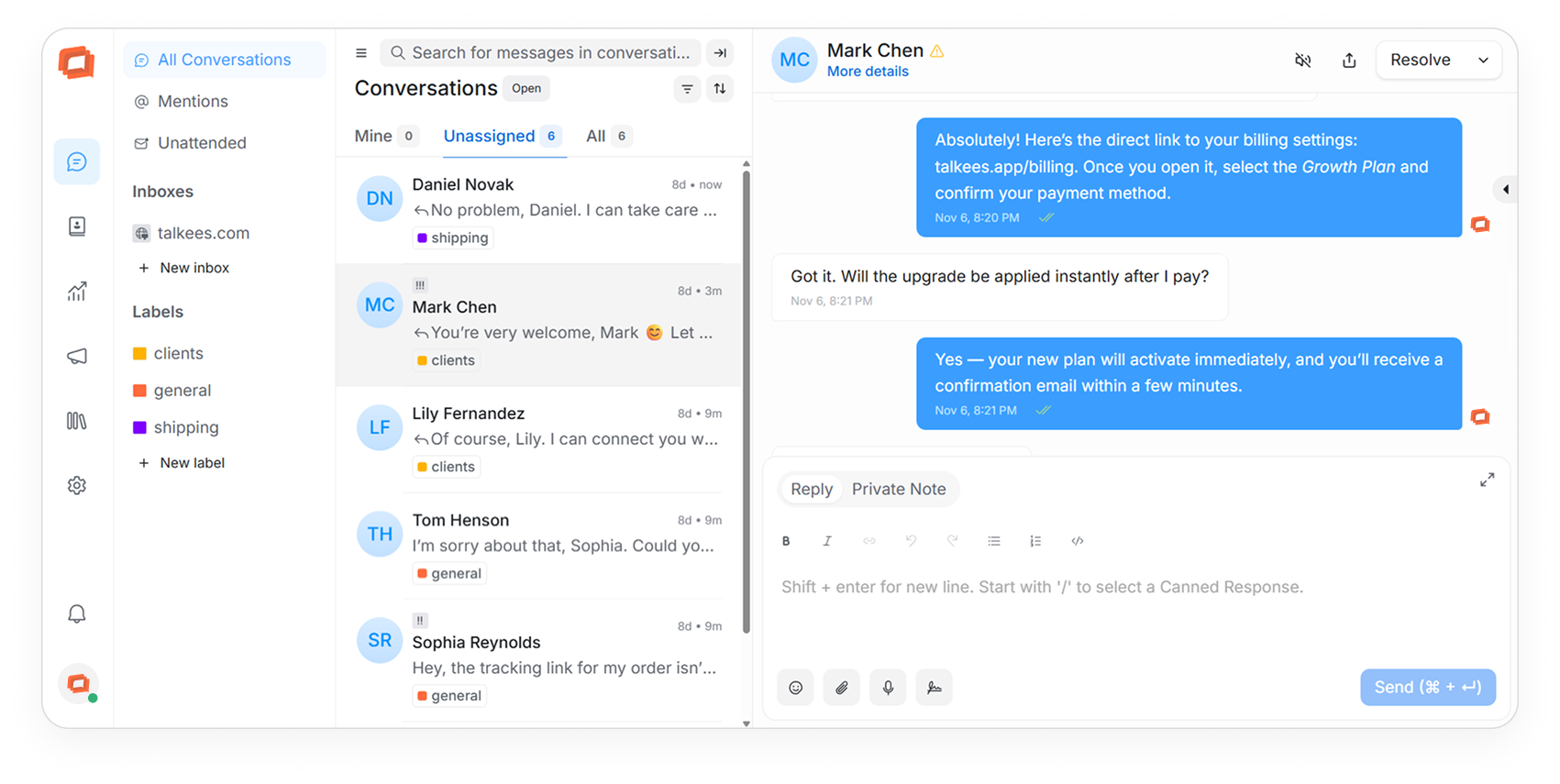
Talkees stands out as a compelling alternative to HubSpot with its AI-first approach to customer support. Unlike HubSpot’s modular pricing that can quickly become expensive, Talkees offers predictable pricing without the surprise fees or complex tier structures.
Detailed Features
- AI-powered omnichannel inbox that consolidates messages from multiple channels
- Advanced chatbot capabilities with easy customization for non-technical users
- E-commerce-ready workflows specifically designed for online stores
- Seamless integration with popular e-commerce platforms
Pricing Structure
Talkees offers transparent pricing plans starting at $49/month for small teams, with options scaling based on conversation volume rather than seat count. This makes it particularly attractive for growing teams concerned about per-agent costs.
User Experience & Interface
The platform features an intuitive dashboard that requires minimal training. Users particularly appreciate the clean ticket management system that makes handling multiple customer inquiries straightforward.
Real User Reviews
“After switching from HubSpot, we saw a 35% improvement in first-response time and our team found the interface much more intuitive for daily support tasks.” – E-commerce Support Manager
Our Assessment
Talkees excels for e-commerce businesses and SMBs that need robust support tools without the enterprise price tag. Its AI capabilities are impressive for the price point, though larger enterprises with complex workflows might find some advanced customization options limited compared to enterprise-grade solutions.
Pros:
- Predictable pricing without hidden fees
- Excellent AI chatbot with minimal setup
- Strong e-commerce integrations
- Intuitive user interface
Cons:
- Newer platform with a smaller integration marketplace
- Some advanced enterprise features still in development
Zendesk vs HubSpot: Which Offers Better Enterprise Solutions?

When comparing Zendesk and HubSpot, the key difference lies in Zendesk’s laser focus on customer support versus HubSpot’s broader CRM approach.
Detailed Features
- Enterprise-grade ticketing system with robust macros and automation
- Advanced SLA management that surpasses HubSpot’s capabilities
- Sophisticated knowledge base with better content organization options
- Comprehensive reporting specifically designed for support operations
Pricing Structure
Zendesk offers various plans starting at $19/agent/month for basic support, with Suite plans ranging from $55 to $115/agent/month. While not inexpensive, the platform provides dedicated support functionality without requiring investment in an entire CRM ecosystem.
User Experience & Interface
Zendesk’s Agent Workspace is purpose-built for support teams, offering a more streamlined experience for ticket management than HubSpot’s Service Hub. The learning curve is moderate, with excellent training resources available.
Real User Reviews
“Zendesk’s ticketing system is significantly more powerful than HubSpot’s. We handle complex support scenarios much more efficiently now.” – Enterprise Support Director
Our Assessment
We found Zendesk to be superior for organizations where customer support is a critical function requiring depth and sophistication. The platform excels at complex ticketing workflows, SLA management, and agent productivity tools.
Pros:
- Purpose-built for support with deeper ticketing capabilities
- Excellent knowledge base functionality
- Strong reporting and analytics for support KPIs
- Extensive integration marketplace
Cons:
- Can become expensive with add-ons and premium features
- Requires more setup time than some alternatives
- Less native integration with marketing and sales than HubSpot
Freshdesk vs HubSpot: What Works Best for Growing Teams?

Freshdesk (part of the Freshworks suite) offers a compelling alternative to HubSpot Service Hub, especially for growing teams looking for a balance between functionality and cost.
Detailed Features
- Comprehensive omnichannel support across email, phone, chat, and social
- Freddy AI assistant for agent productivity and automated responses
- Flexible ticketing system with custom statuses and fields
- Built-in phone channel without requiring additional integrations
Pricing Structure
Freshdesk offers a free plan for up to 10 agents with basic features. Paid plans start at $15/agent/month for the Growth plan, with the Pro plan at $49/agent/month including automation and advanced features. The Freddy AI add-on costs approximately $29/agent/month.
User Experience & Interface
The interface is clean and intuitive, with a shorter learning curve than many competitors. The platform strikes a good balance between powerful features and usability.
Real User Reviews
“Freshdesk gave us 90% of what HubSpot offered for support at about half the price. The AI assistant has helped our team handle 30% more tickets without adding headcount.” – Support Team Lead
Our Assessment
In our testing, Freshdesk proved especially valuable for growing teams that need to scale support operations efficiently. The platform offers an excellent balance of features, usability, and price, with the Freddy AI capabilities providing genuine productivity improvements.
Pros:
- Excellent value for feature set
- User-friendly interface with minimal training required
- Strong AI capabilities with Freddy
- Good scalability from small to large teams
Cons:
- Less native integration with marketing functions
- Some advanced features require higher-tier plans
- Mobile app has some limitations compared to desktop
Drift vs HubSpot Chatbot: Conversational Routing and Engagement

Drift takes a different approach to customer engagement than HubSpot, focusing primarily on conversational marketing and sales rather than traditional helpdesk ticketing.
Detailed Features
- Advanced conversational routing based on visitor behavior and attributes
- Sophisticated ABM capabilities for targeting high-value accounts
- Real-time chat with intelligent qualification and meeting booking
- Revenue acceleration focus rather than traditional support
Pricing Structure
Drift’s pricing structure has evolved to focus on enterprise clients, with custom pricing based on needs. Basic plans reportedly start around $2,500/month, positioning it as a premium solution compared to HubSpot’s entry-level offerings.
User Experience & Interface
Drift’s interface is designed for sales and marketing teams, with excellent conversation flow builders and targeting options. The platform emphasizes real-time engagement over ticket management.
Real User Reviews
“Drift transformed our website from a passive information source to an active sales channel. The conversational routing is significantly more sophisticated than HubSpot’s chatbot.” – Marketing Director
Our Assessment
Drift excels for organizations focused on using chat as a revenue generation tool rather than primarily for support. Its strength lies in qualifying leads and booking meetings through conversational interfaces, making it complementary to traditional helpdesk solutions rather than a direct replacement.
Pros:
- Best-in-class conversational marketing capabilities
- Excellent for ABM and enterprise sales motions
- Sophisticated routing and qualification logic
- Strong meeting booking functionality
Cons:
- Expensive compared to traditional helpdesk solutions
- Less focused on ticket management and support workflows
- May require complementary tools for comprehensive support
Intercom vs HubSpot: Real-time Support vs Comprehensive CRM

Intercom has evolved from a simple chat widget to a comprehensive customer communication platform, with particular strength in real-time engagement.
Detailed Features
- Sophisticated Messenger for website and in-app communication
- Fin AI for automated resolution of common questions
- Powerful inbox automation for routing and prioritization
- Proactive messaging capabilities for onboarding and engagement
Pricing Structure
Intercom’s pricing starts at approximately $29/seat/month for essential features, with advanced plans at $85/seat/month and expert plans at $132/seat/month. Fin AI is typically billed at around $0.99 per AI-resolved conversation, creating a usage-based component to pricing.
User Experience & Interface
The platform features a clean, modern interface focused on conversation management rather than traditional ticketing. It’s particularly well-suited for product-led companies that need in-app support capabilities.
Real User Reviews
“Intercom’s in-app messaging capabilities are far superior to HubSpot for our SaaS product. We’ve seen a 40% increase in user activation since implementing proactive onboarding messages.” – Product Manager
Our Assessment
Intercom shines for product-led companies that need strong in-app support and onboarding capabilities. Its real-time nature and conversational approach make it excellent for immediate engagement, though it may need supplementing for complex ticket management.
Pros:
- Excellent in-app messaging capabilities
- Strong AI with Fin for automated resolution
- Great for product-led growth strategies
- Powerful targeting for proactive messages
Cons:
- Can become expensive at scale with usage-based AI billing
- Less structured for complex ticket management
- Not as comprehensive for full CRM functionality
Zoho vs HubSpot vs Salesforce: Integration and Service Alignment

Zoho Desk offers a compelling alternative to both HubSpot and Salesforce, especially for organizations already using other Zoho products.
Detailed Features
- Deep integration with Zoho CRM and the broader Zoho One suite
- Zia AI assistant for ticket categorization and response suggestions
- Comprehensive multichannel support across email, phone, chat, and social
- Strong customization options for fields, workflows, and automations
Pricing Structure
Zoho Desk offers a free plan for up to 3 agents. Paid plans start at approximately $14/agent/month for Standard, $23/agent/month for Professional, and $40/agent/month for Enterprise. Zoho One bundling can provide significant savings for organizations using multiple Zoho products.
User Experience & Interface
Zoho Desk features a clean, functional interface that prioritizes efficiency over aesthetics. The learning curve is moderate, with good customization options for tailoring the experience to specific team needs.
Real User Reviews
“Zoho Desk integrated perfectly with our existing Zoho CRM, giving us a 360-degree view of customer interactions at about 30% of what we were paying for HubSpot.” – Operations Director
Our Assessment
Zoho Desk provides excellent value, especially for organizations already in the Zoho ecosystem. The platform offers a good balance of features and affordability, though it may not match the depth of Zendesk for enterprise support needs or the marketing integration of HubSpot.
Pros:
- Excellent value, especially with Zoho One bundling
- Strong AI capabilities with Zia
- Good customization options
- Seamless integration with Zoho CRM
Cons:
- Interface feels less modern than some competitors
- Mobile experience could be improved
- Some advanced features require development resources
Salesforce Service Cloud vs HubSpot: Case Management Depth

Salesforce Service Cloud represents the enterprise gold standard for customer service platforms, offering unmatched depth and customization.
Detailed Features
- Sophisticated case management with advanced routing and escalation
- Comprehensive SLA management for complex support operations
- Einstein AI for predictive service and automated resolution
- Unlimited customization potential for enterprise requirements
Pricing Structure
Salesforce Service Cloud starts at approximately $75/user/month for Professional, $150/user/month for Enterprise, and $300/user/month for Unlimited editions. Implementation and customization typically require significant additional investment.
User Experience & Interface
The Lightning interface offers a modern experience, though the platform’s complexity can create a steeper learning curve than some alternatives. The depth of functionality comes with increased complexity.
Real User Reviews
“Service Cloud gives us capabilities that HubSpot simply couldn’t match for our enterprise support operation. The case management depth and reporting are in a different league.” – VP of Customer Support
Our Assessment
Salesforce Service Cloud is the clear choice for enterprise organizations with complex support requirements and the resources to fully implement and customize the platform. For smaller organizations, the cost and complexity may be prohibitive compared to more streamlined alternatives.
Pros:
- Unmatched depth for complex support operations
- Excellent integration with Salesforce CRM
- Powerful Einstein AI capabilities
- Extensive customization options
Cons:
- Expensive, especially when factoring in implementation
- Significant complexity and learning curve
- Often requires dedicated administrators
SugarCRM vs HubSpot: Best Fit for Regulated Industries?

SugarCRM offers an interesting alternative to HubSpot, with particular strengths for organizations in regulated industries or those requiring deployment flexibility.
Detailed Features
- Flexible service console with strong customization options
- On-premises deployment option for regulatory compliance
- Advanced workflow automation for complex service processes
- Customer journey mapping across marketing, sales, and service
Pricing Structure
SugarCRM pricing typically starts around $80/user/month for professional editions, with enterprise editions costing more. On-premises deployments generally involve additional licensing considerations.
User Experience & Interface
SugarCRM offers a functional interface that prioritizes customization over out-of-the-box experience. The platform requires more configuration than some alternatives but offers greater flexibility as a result.
Real User Reviews
“SugarCRM’s on-premises option was essential for our regulatory compliance requirements. We couldn’t consider cloud-only platforms like HubSpot.” – IT Director, Financial Services
Our Assessment
SugarCRM is particularly well-suited for organizations in regulated industries that need deployment flexibility or have specific customization requirements. The platform requires more technical resources to implement and maintain than some alternatives but offers greater control as a trade-off.
Pros:
- Deployment flexibility including on-premises options
- Strong for regulated industries with specific compliance needs
- Good customization capabilities
- Solid integration options
Cons:
- Higher technical overhead for implementation and maintenance
- Less intuitive out-of-the-box than some competitors
- Smaller marketplace for extensions and integrations
Agile CRM vs HubSpot: Budget-Friendly Alternatives

Agile CRM positions itself as an all-in-one CRM platform at a significantly lower price point than HubSpot, making it attractive for budget-conscious small businesses.
Detailed Features
- Combined sales, marketing, and service functionality in one platform
- Basic helpdesk capabilities with ticketing and automation
- Email marketing and automation integrated with customer service
- Telephony integration for call center functionality
Pricing Structure
Agile CRM offers a free plan for up to 10 users with limited features. Paid plans start at approximately $8.99/user/month for Starter, $29.99/user/month for Regular, and $47.99/user/month for Enterprise when billed annually.
User Experience & Interface
The interface is functional but less polished than premium alternatives. Navigation can sometimes feel disjointed between different functional areas of the platform.
Real User Reviews
“Agile CRM gave us the basic functionality we needed across sales, marketing, and support at a fraction of HubSpot’s cost. It’s not as refined, but it gets the job done.” – Small Business Owner
Our Assessment
Agile CRM offers remarkable value for small businesses needing basic CRM and helpdesk functionality on a tight budget. The platform has clear limitations compared to specialized solutions but provides a good starting point for organizations not ready for premium alternatives.
Pros:
- Excellent value for small businesses
- All-in-one functionality across sales, marketing, and service
- Good telephony integration
- Free plan available for very small teams
Cons:
- Limited depth in helpdesk capabilities
- Less refined user experience
- API constraints for custom integrations
- May hit functionality ceilings as organizations grow
Teamleader vs HubSpot: EU-Centric Solutions for SMEs

Teamleader offers a European-focused alternative to HubSpot, with particular strengths for EU-based small and medium enterprises.
Detailed Features
- Combined CRM and service functionality designed for European SMEs
- Invoicing and project management integrated with customer service
- GDPR-compliant by design with EU data residency
- Multilingual support for European markets
Pricing Structure
Teamleader pricing typically starts around €50/month for small teams, with custom pricing for larger implementations. The platform offers different modules that can be combined based on specific needs.
User Experience & Interface
The interface is clean and modern, with good attention to European business requirements. The platform strikes a good balance between functionality and ease of use.
Real User Reviews
“Teamleader’s EU focus was perfect for our GDPR compliance needs. The invoicing integration with customer service has streamlined our operations significantly.” – European SME Director
Our Assessment
Teamleader is particularly well-suited for European SMEs looking for a combined CRM, project management, and customer service solution. The platform’s EU-centric approach, including data residency and GDPR compliance, makes it especially attractive for organizations concerned about European regulations.
Pros:
- Strong EU focus with GDPR compliance and data residency
- Good integration of invoicing and customer service
- Clean, intuitive interface
- Solid multilingual capabilities
Cons:
- Less known outside Europe
- More limited marketplace compared to global platforms
- Some advanced service features require development work
Choosing the Right Helpdesk Solution for Your Business

After examining these alternatives to HubSpot Service Hub, the right choice depends on your specific business needs:
- For AI-first omnichannel support: Talkees offers an excellent balance of features and value, with predictable pricing and strong e-commerce capabilities.
- For enterprise-grade support: Zendesk and Salesforce Service Cloud provide the depth and customization needed for complex support operations.
- For growing teams on a budget: Freshdesk delivers a strong feature set at a competitive price point, with good scalability.
- For conversational sales and marketing: Drift excels at engaging high-value prospects through sophisticated chat experiences.
- For product-led companies: Intercom’s in-app messaging and proactive engagement tools make it ideal for SaaS and digital products.
- For European SMEs: Teamleader’s EU-centric approach addresses specific regional requirements.
When evaluating alternatives, consider not just the features and price, but also:
- Implementation timeline and complexity
- Total cost of ownership including add-ons and implementation
- Integration capabilities with your existing tech stack
- Scalability as your business grows
- Team adoption and ease of use
By carefully assessing these factors against your specific support requirements, you can select the platform that will best serve your customers while providing the right tools for your support team.