 English
 Slovenčina
 Français
 Magyar
Why Are Teams Seeking ProProfs Alternatives in 2025?

In 2025, organizations are increasingly moving away from ProProfs as their needs evolve beyond what the platform can offer. While ProProfs provides a suite of tools (including LMS, quiz maker, knowledge base, survey, and help desk/live chat), most organizations don’t replace the entire suite at once. Instead, they typically replace specific products they’ve outgrown with deeper, more specialized platforms.
The main reasons driving this transition include cost per agent considerations, the need for more advanced AI automation, gaps in omnichannel capabilities, limitations in analytics depth, and scalability challenges. As business requirements become more complex, teams find themselves needing solutions with more robust feature sets and greater flexibility.
Understanding the different categories of alternatives available is crucial for making an informed decision about which solution will best address your specific needs. Let’s explore the landscape of ProProfs alternatives to help you navigate your options.
Must-Have Features for ProProfs Alternatives

When evaluating ProProfs alternatives, certain features have become essential rather than just “nice-to-have.” Here’s a checklist of must-have capabilities to look for:
LLM-Powered Chatbots
Modern alternatives should offer AI chatbots that leverage Large Language Models (LLMs) to understand complex queries, provide contextually relevant answers, and learn from interactions. These chatbots should be able to pull information from your knowledge base and handle a wide range of customer inquiries without human intervention.
Unified Inbox for Omnichannel Support
A truly effective alternative must provide a unified inbox that consolidates communications from multiple channels: email, live chat, social media messages, WhatsApp, and web forms. This centralization allows for consistent customer experiences and prevents important messages from falling through the cracks.
No-Code Customization + API Extensibility
Look for platforms that balance ease of use with powerful customization options. The ideal solution offers no-code customization for business users while providing robust APIs for developers who need to build more complex integrations or extensions.
Multilingual Knowledge Base
As businesses expand globally, multilingual support becomes critical. Your ProProfs alternative should support multiple languages in both the user interface and content, with easy translation workflows and language-specific analytics.
SLA Management
Service Level Agreement (SLA) management features ensure your team meets response and resolution time commitments. The platform should provide automated SLA tracking, alerts for potential breaches, and reporting on compliance metrics.
Data Residency Options
With increasing privacy regulations worldwide, your alternative should offer data residency options that allow you to specify where your data is stored, helping you meet compliance requirements in different regions.
Transparent Pricing
Avoid solutions with hidden costs or complicated pricing structures. The best alternatives offer clear, transparent pricing with predictable costs as you scale, and they clearly indicate what features are included at each tier.
Evaluation Criteria for ProProfs Competitors

When comparing ProProfs alternatives, we use a comprehensive evaluation framework that considers multiple factors important to support teams in 2025. Each platform is scored on a 100-point scale using the following weighted criteria:
Core Product Functionality (20%)
We assess the completeness of each platform’s feature set, including unified inbox capabilities, native knowledge base, SLA management, routing options, macros, collision detection, multilingual support, and customization options.
Usability and Onboarding (15%)
How quickly can you deploy the solution and get your team productive? We measure time-to-first-task, evaluate setup wizards, in-app tours, admin experience, and documentation quality.
Pricing and Packaging (15%)
We analyze pricing clarity, free tier offerings, included channels, add-on costs (for features like telephony, AI credits, WhatsApp integration), and available discounts for annual commitments.
Scalability and Performance (10%)
Each platform is evaluated on uptime guarantees, concurrency handling, import speed, UI responsiveness, data storage limits, and enterprise-readiness features like role management and audit logs.
Integrations and API Ecosystem (10%)
We examine native connectors to essential business tools, Zapier integration, API completeness, webhook support, and rate limits.
Reporting and Analytics (10%)
Dashboards, custom reports, export capabilities, CSAT/CES measurement, channel-specific KPIs, and bot containment reporting are all assessed.
Security and Compliance (10%)
We verify SOC 2/ISO 27001 certifications, GDPR/CCPA readiness, encryption standards, SSO/SAML support, SCIM provisioning, and data residency options.
Automation and AI Capabilities (10%)
The effectiveness of LLM-powered chatbots, agent assistance features, intent detection, sentiment-aware routing, workflow builders, and knowledge base integration are thoroughly tested.
Talkees: The Leading ProProfs Alternative for AI Chat and Omnichannel Support

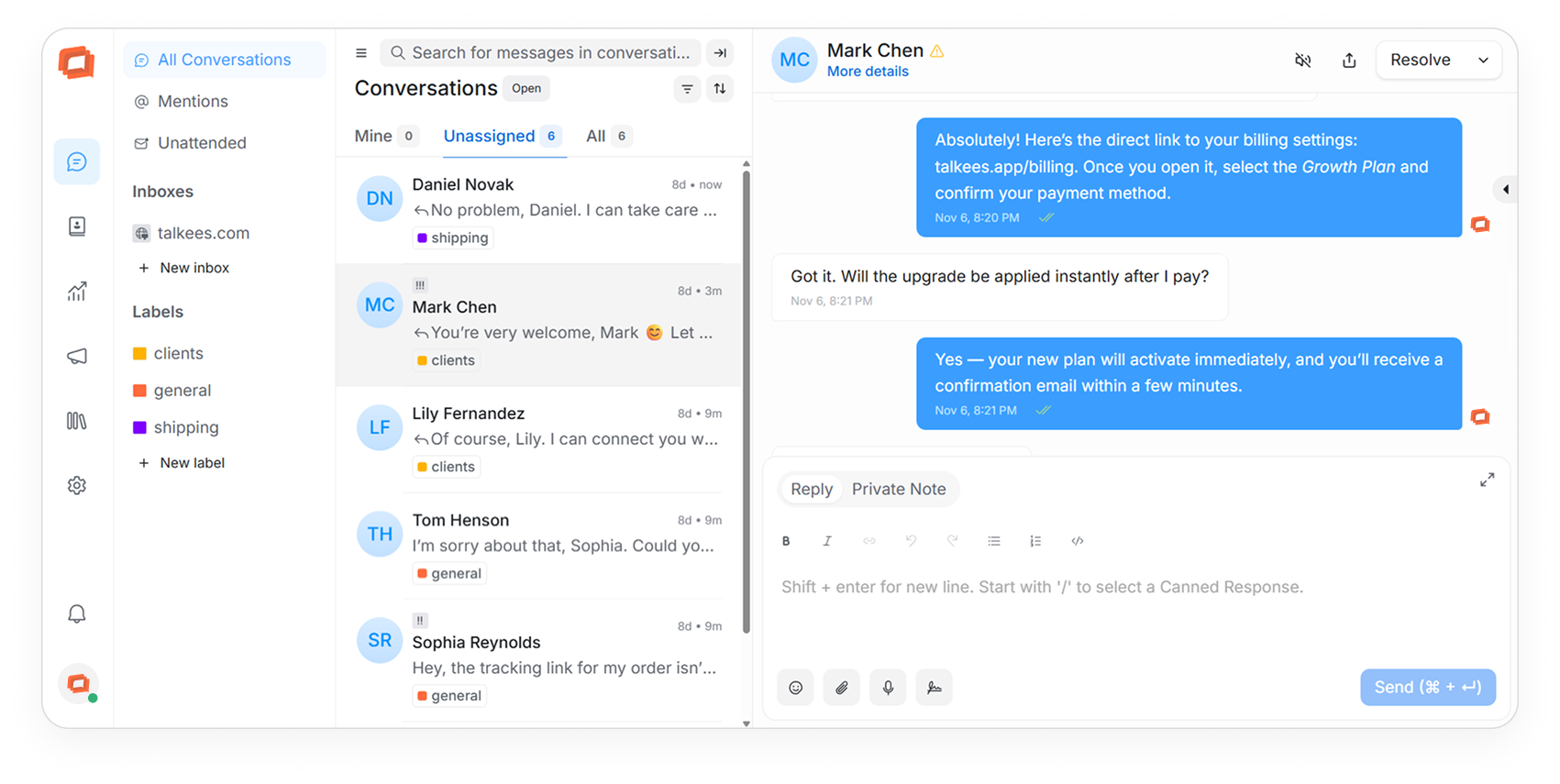
Talkees stands out as the best overall alternative to ProProfs, particularly for teams seeking modern AI chat capabilities combined with comprehensive omnichannel support. This platform excels at unifying customer communications while leveraging advanced AI to improve efficiency.
Key Features
- Advanced AI Chatbot: LLM-powered chatbot with Retrieval-Augmented Generation (RAG) that pulls accurate information from your knowledge base
- Unified Omnichannel Inbox: Seamlessly integrates email, live chat, social media, and WhatsApp in one interface
- Intelligent Routing: Automatically assigns conversations to the right team members based on expertise, availability, and customer needs
- Comprehensive Analytics: Detailed insights into team performance, customer satisfaction, and conversation trends
- No-Code Automation: Build complex workflows without technical expertise
- Knowledge Base Integration: Create and manage a self-service portal that reduces ticket volume
Pricing
Talkees offers a transparent pricing structure with several tiers to accommodate businesses of all sizes:
- Free Plan: Limited features for small teams just getting started
- Starter: $29/agent/month (billed annually) – Core features for growing teams
- Professional: $49/agent/month (billed annually) – Advanced features including AI capabilities
- Enterprise: Custom pricing – Full feature set with dedicated support
All plans include a 14-day free trial with full access to features.
Pros
- Exceptional AI chatbot with minimal hallucination due to RAG implementation
- Intuitive interface with minimal learning curve
- Seamless conversation stitching across channels
- Strong multilingual capabilities
- Flexible automation without coding requirements
- Excellent mobile experience for on-the-go support
Cons
- Newer platform compared to some established competitors
- Some advanced enterprise features still in development
- Limited telephony integration compared to specialized call center solutions
Best For
Talkees is ideal for modern support teams that prioritize AI-enhanced customer interactions and need to manage multiple communication channels efficiently. It’s particularly well-suited for e-commerce, SaaS, and service businesses that value quick implementation and intuitive user experience.
Our Experience with Talkees
During our testing, we were impressed by how quickly we could set up Talkees and start handling customer conversations. The AI chatbot was surprisingly accurate, successfully resolving about 40% of test inquiries without human intervention. The conversation flow between automated and human support was remarkably smooth, with agents receiving comprehensive context when taking over from the bot.
The analytics dashboard provided actionable insights from day one, helping us identify peak times and common customer questions. While the platform doesn’t have decades of history like some competitors, its modern architecture and focus on AI capabilities make it feel like the future of customer support.
Zendesk: Enterprise-Grade ProProfs Competitor with Advanced Workflows

Zendesk is a well-established enterprise-grade alternative to ProProfs, offering robust workflows and comprehensive support capabilities for complex teams.
Key Features
- Suite Approach: Combines ticketing, chat, voice, and knowledge base in one platform
- Extensive Customization: Highly configurable workflows and business rules
- Enterprise-Level Reporting: Advanced analytics and custom dashboards
- Zendesk AI: AI-powered answer bot and agent assistance
- Marketplace: 1,000+ integrations and apps
- Omnichannel Capabilities: Support across email, chat, voice, social media, and messaging apps
Pricing
- Suite Team: $49/agent/month (billed annually)
- Suite Growth: $79/agent/month (billed annually)
- Suite Professional: $99/agent/month (billed annually)
- Enterprise: Custom pricing
All plans include a free trial period.
Pros
- Comprehensive feature set for enterprise needs
- Robust customization and workflow capabilities
- Extensive integration ecosystem
- Mature, stable platform with proven reliability
- Strong compliance and security certifications
Cons
- Higher price point than many competitors
- Can be complex to implement and configure
- May require professional services for full deployment
- Some features require higher-tier plans
Best For
Zendesk is ideal for medium to large organizations with complex support requirements, multiple teams, and the need for extensive customization. It’s particularly well-suited for enterprises that need a proven, stable solution with strong security and compliance features.
Our Experience with Zendesk
When testing Zendesk, we found its depth of features impressive but somewhat overwhelming for new users. The platform clearly benefits from years of development, with solutions for virtually every support scenario imaginable. The AI capabilities, while effective, felt less integrated than Talkees’ approach, often functioning more as add-ons than core features.
The reporting capabilities are exceptionally powerful, though creating custom reports required a learning curve. For large organizations with dedicated admins, Zendesk offers unmatched flexibility, but smaller teams might find themselves paying for complexity they don’t need.
Freshchat (Freshworks): Chat-Led, AI-First Alternative to ProProfs

Freshchat, part of the Freshworks suite, offers a chat-focused approach to customer support with strong AI capabilities through its Freddy AI platform.
Key Features
- Freddy AI: Conversational AI for automated support and agent assistance
- Messaging-First Approach: Modern chat interface optimized for quick interactions
- Campaign Capabilities: Proactive messaging and targeted campaigns
- Contextual Customer Profiles: 360-degree view of customer information
- Bot Marketplace: Pre-built bot templates for common scenarios
- Integration with Freshworks Suite: Seamless connection with other Freshworks products
Pricing
- Free Plan: Basic features for small teams
- Growth: $19/agent/month (billed annually)
- Pro: $39/agent/month (billed annually)
- Enterprise: $59/agent/month (billed annually)
Additional costs may apply for AI features and high message volumes.
Pros
- Intuitive, modern interface focused on messaging
- Strong AI capabilities through Freddy
- Good integration with other Freshworks products
- Effective campaign and proactive messaging tools
- Competitive pricing for small to mid-sized teams
Cons
- Less comprehensive than full-suite solutions for omnichannel support
- Some advanced features require higher tiers
- AI capabilities may require additional credits
- Not as robust for complex ticket management as dedicated helpdesk solutions
Best For
Freshchat is ideal for product-led growth companies and SaaS businesses that prioritize chat-based support. It works particularly well for teams already using other Freshworks products and those focused on providing a modern messaging experience.
Our Experience with Freshchat
During our testing, Freshchat’s chat-first approach felt refreshingly straightforward. The interface is clean and modern, making it easy for agents to manage multiple conversations. Freddy AI performed well for common queries, though we found its effectiveness heavily dependent on proper setup and training.
The campaign features were a standout, allowing us to proactively engage with users based on their behavior. While not as comprehensive as some all-in-one platforms, Freshchat excels at what it focuses on: providing efficient, AI-enhanced chat support.
Zoho Desk: Suite-Based ProProfs Alternative with Strong Value

Zoho Desk offers a comprehensive help desk solution that’s part of the broader Zoho ecosystem, providing excellent value and integration capabilities.
Key Features
- Zia AI Assistant: AI-powered suggestions and automations
- Ecosystem Integration: Seamless connection with other Zoho products
- Multichannel Support: Email, social, chat, phone, and self-service
- Context-Aware Help Desk: Customer context from CRM and other sources
- Blueprint: Visual workflow designer for support processes
- Customizable Self-Service Portal: Branded knowledge base and community
Pricing
- Free Plan: Up to 3 agents
- Standard: $14/agent/month (billed annually)
- Professional: $23/agent/month (billed annually)
- Enterprise: $40/agent/month (billed annually)
Pros
- Excellent value for feature set
- Strong integration with Zoho ecosystem
- Intuitive interface with minimal learning curve
- Solid AI capabilities through Zia
- Comprehensive reporting and customization options
Cons
- Best experience requires commitment to Zoho ecosystem
- Some advanced features limited to higher tiers
- Mobile experience not as strong as desktop
- AI capabilities not as advanced as specialized solutions
Best For
Zoho Desk is perfect for teams already using or planning to adopt the Zoho stack. It offers particularly strong value for small to mid-sized businesses that need comprehensive support capabilities without enterprise-level pricing.
Our Experience with Zoho Desk
Testing Zoho Desk revealed a platform that balances functionality and usability exceptionally well. The interface is intuitive yet powerful, allowing for quick adoption. Zia AI provided helpful suggestions and automations, though not quite matching the sophistication of dedicated AI platforms.
Where Zoho Desk truly shines is in its integration with the broader Zoho ecosystem. For teams using Zoho CRM, Projects, or other Zoho tools, the seamless data flow between systems creates a unified experience that’s hard to match. The value proposition is compelling, delivering most of what higher-priced competitors offer at a significantly lower cost.
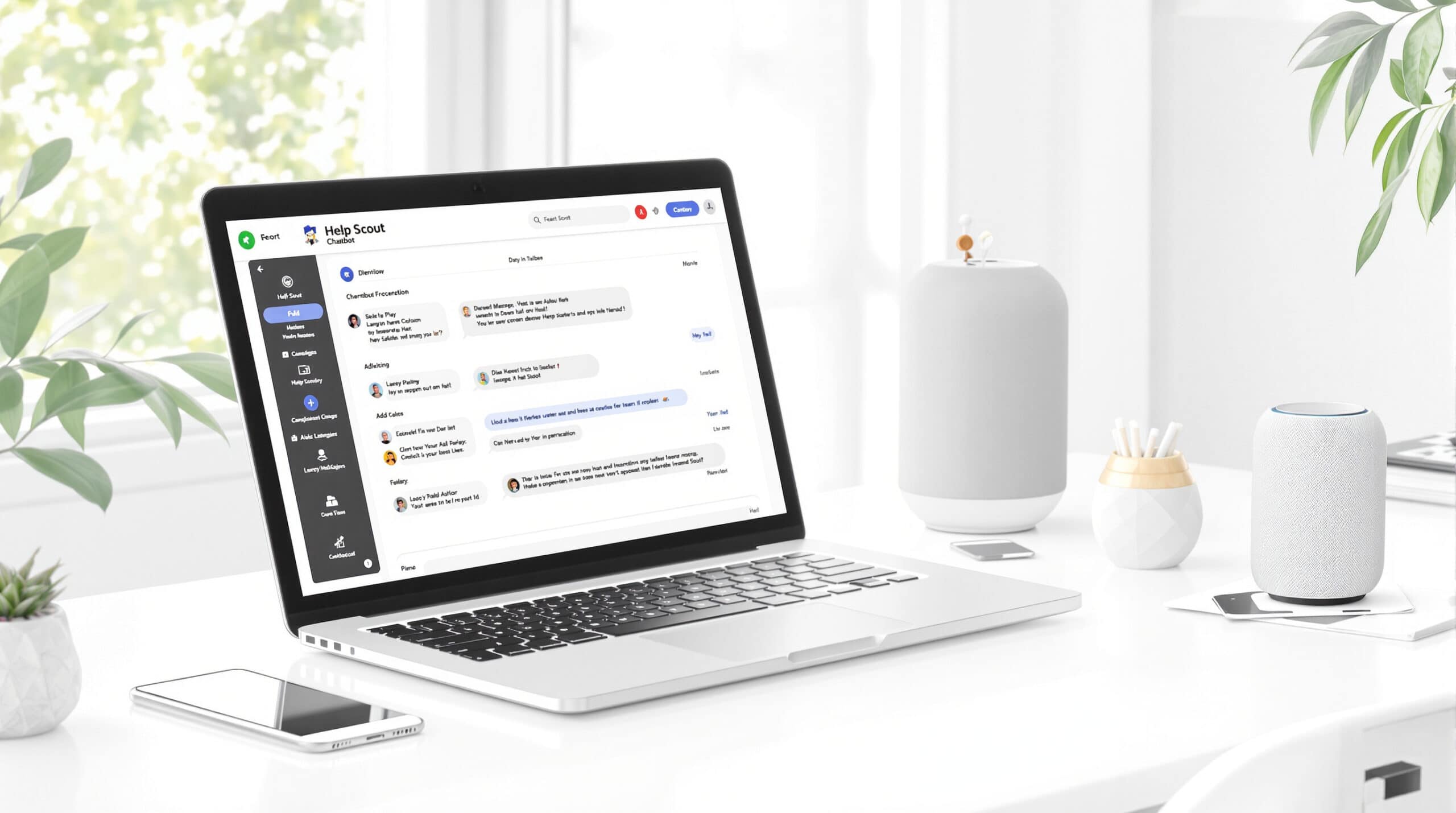
Help Scout: Email-First Simplicity vs ProProfs

Help Scout takes an email-first approach to customer support, focusing on simplicity and a clean user experience rather than complex features.
Key Features
- Shared Inbox: Collaborative email management with collision detection
- Beacon: Embeddable help widget for websites
- Docs: Integrated knowledge base platform
- Workflows: Automation rules for routing and organization
- Messages: In-app and email messaging capabilities
- Reporting: Clear metrics on team performance and customer satisfaction
Pricing
- Standard: $20/user/month (billed annually)
- Plus: $35/user/month (billed annually)
- Pro: $60/user/month (billed annually)
All plans include a 15-day free trial.
Pros
- Clean, intuitive interface with minimal learning curve
- Excellent email management capabilities
- Strong knowledge base integration
- Transparent, straightforward pricing
- Great customer experience focus
Cons
- Limited compared to full omnichannel solutions
- Fewer advanced automation capabilities
- Less robust for complex enterprise needs
- Limited AI features compared to AI-first platforms
Best For
Help Scout is ideal for teams that primarily support customers via email and value simplicity over complex features. It works particularly well for small to medium-sized businesses with straightforward support needs and those prioritizing a clean user experience.
Our Experience with Help Scout
When testing Help Scout, we were impressed by its refreshing simplicity. The platform doesn’t try to do everything, instead focusing on making email support as efficient and pleasant as possible. The interface is clean and intuitive, allowing new team members to become productive quickly.
The Beacon widget provides a nice bridge to self-service, and the Docs knowledge base is well-integrated with the support workflow. While Help Scout lacks some of the advanced features of enterprise platforms, this focus on core functionality results in a tool that does what it does extremely well. For teams primarily handling email support who don’t need complex omnichannel capabilities, Help Scout offers an excellent balance of functionality and usability.
LiveAgent: All-in-One Help Desk and Call Center as a ProProfs Alternative

LiveAgent offers a comprehensive help desk solution with strong call center capabilities, making it a versatile alternative to ProProfs for multichannel teams.
Key Features
- Universal Inbox: Unified view of tickets from all channels
- Native Call Center: Built-in VoIP capabilities and IVR
- Video Calling: Integrated video support options
- Robust Ticketing System: Advanced routing and automation
- Time Tracking: Monitor time spent on tickets and activities
- Live Chat + Chatbots: Real-time website support with automation
Pricing
- Free Plan: Limited features for up to 3 agents
- Ticket: $15/agent/month (billed annually)
- Ticket+Chat: $29/agent/month (billed annually)
- All-Inclusive: $49/agent/month (billed annually)
Pros
- Comprehensive channel coverage including strong voice capabilities
- Excellent ticket management and automation
- Good value for feature set
- Strong SLA management tools
- Solid reporting and analytics
Cons
- Interface can feel busy compared to more streamlined solutions
- Setup and configuration can be complex
- Some advanced features have learning curves
- AI capabilities not as advanced as specialized platforms
Best For
LiveAgent is ideal for multichannel support teams that need strong voice capabilities alongside traditional ticketing. It’s particularly well-suited for businesses that require call center functionality without wanting separate systems for different channels.
Our Experience with LiveAgent
Testing LiveAgent revealed a platform with impressive breadth of functionality. The native call center capabilities are a standout feature, providing integrated voice support without requiring third-party integrations. The universal inbox effectively consolidates communications from multiple channels, though the interface can sometimes feel busy with so many features available.
Time tracking functionality proved valuable for understanding agent workload and ticket complexity. While the platform offers good value for its comprehensive feature set, it does require more configuration and training than some more streamlined alternatives. For teams needing true all-in-one functionality with strong voice capabilities, LiveAgent delivers excellent value.
HappyFox: Clean UI and Powerful Automation Compared to ProProfs

HappyFox offers a clean, intuitive interface combined with powerful automation capabilities, making it an attractive ProProfs alternative for teams seeking balance between usability and functionality.
Key Features
- Smart Rules Engine: Powerful automation for ticket handling
- Clean, Intuitive UI: User-friendly interface with minimal clutter
- Task Management: Integrated task tracking within tickets
- Multilingual Support: Interface and content in multiple languages
- Custom Fields and Statuses: Highly adaptable to various workflows
- Knowledge Base: Integrated self-service capabilities
Pricing
- Mighty: $29/agent/month (billed annually)
- Fantastic: $49/agent/month (billed annually)
- Enterprise: $69/agent/month (billed annually)
- Enterprise Plus: Custom pricing
All plans require a minimum of 5 agents.
Pros
- Exceptionally clean and intuitive interface
- Powerful automation capabilities
- Strong customization without complexity
- Excellent knowledge base integration
- Robust reporting and analytics
Cons
- Minimum 5-agent requirement
- Some advanced features limited to higher tiers
- Less extensive marketplace than some competitors
- Mobile experience not as strong as desktop
Best For
HappyFox is ideal for mid-sized teams that need powerful functionality without complexity. It’s particularly well-suited for organizations that value clean design and intuitive workflows while still requiring robust automation and customization.
Our Experience with HappyFox
During our evaluation, HappyFox’s interface stood out for its clarity and intuitive design. The platform manages to provide powerful functionality without overwhelming users, making it easy for new agents to become productive quickly. The Smart Rules Engine proved particularly impressive, allowing us to create sophisticated automations with minimal effort.
The knowledge base integration works seamlessly with the ticketing system, making it easy for agents to leverage existing content. While the minimum 5-agent requirement may deter very small teams, those who meet this threshold will find excellent value in HappyFox’s balance of power and simplicity. The platform particularly excels for teams that need to customize their support workflow without dedicated technical resources.
Kayako: Unified Customer Timelines as a ProProfs Competitor

Kayako differentiates itself with a strong focus on unified customer timelines, providing comprehensive context for every customer interaction.
Key Features
- Unified Customer Timeline: Complete interaction history across channels
- Collaborative Tools: Internal notes, @mentions, and team collaboration
- Messenger: Modern chat interface with file sharing
- Help Center: Self-service knowledge base with search
- SLA Management: Comprehensive service level agreement tools
- Automations: Rules-based workflow automation
Pricing
- Growth: $30/agent/month (billed annually)
- Scale: $60/agent/month (billed annually)
- Enterprise: Custom pricing
All plans include a 14-day free trial.
Pros
- Excellent customer context through unified timelines
- Strong collaboration features
- Clean, modern interface
- Good balance of features and usability
- Solid knowledge base capabilities
Cons
- Less extensive marketplace than larger competitors
- Some advanced features limited to higher tiers
- Mobile experience could be improved
- Less robust AI capabilities than AI-first platforms
Best For
Kayako is ideal for teams that prioritize customer context and need a complete view of the customer journey. It’s particularly well-suited for businesses where understanding customer history is critical to providing effective support.
Our Experience with Kayako
Testing Kayako highlighted its strength in providing comprehensive customer context. The unified timeline feature gives agents immediate access to a customer’s complete history, making it easy to understand past interactions and provide personalized support. The interface is clean and intuitive, striking a good balance between functionality and simplicity.
Collaboration features work well, making it easy for teams to work together on complex issues. The knowledge base integration is solid, though not as advanced as some specialized solutions. While Kayako may not have the extensive marketplace or AI capabilities of some larger competitors, it excels at its core mission: providing agents with the context they need to deliver personalized, effective support.
Re:amaze: Ecommerce-Focused ProProfs Alternative

Re:amaze offers a customer support platform specifically designed for ecommerce businesses, with strong integration capabilities for online stores.
Key Features
- Shopify Integration: Deep connection with Shopify stores
- Shop App Integration: Native support for Shopify’s consumer app
- Order Management: View and manage orders within conversations
- Chat Campaigns: Proactive engagement based on customer behavior
- Chatbots: Automated support for common queries
- Social Messaging: Support across Instagram, Facebook, Twitter, and more
Pricing
- Starter: $29/user/month (billed annually)
- Pro: $49/user/month (billed annually)
- Business: $69/user/month (billed annually)
- Enterprise: Custom pricing
All plans include a 14-day free trial.
Pros
- Exceptional ecommerce integration, especially with Shopify
- Strong order management within conversations
- Effective proactive engagement tools
- Good balance of channels for online retailers
- Purpose-built for ecommerce use cases
Cons
- Less suitable for non-ecommerce businesses
- Some advanced features limited to higher tiers
- Less extensive general integration marketplace
- Mobile app experience could be improved
Best For
Re:amaze is perfect for ecommerce businesses, particularly those using Shopify. It’s especially well-suited for direct-to-consumer brands that need to provide support across multiple channels while maintaining context about orders and customer history.
Our Experience with Re:amaze
During our testing, Re:amaze’s ecommerce focus was immediately apparent. The Shopify integration is exceptional, allowing agents to view and manage orders directly within customer conversations. This contextual information makes it much easier to handle common ecommerce support scenarios like order status questions, returns, and exchanges.
The chat campaigns feature provides effective tools for proactive engagement, allowing businesses to reach out based on customer behavior like cart abandonment or browsing patterns. While Re:amaze may not be the best choice for businesses outside the ecommerce space, it offers a tailored solution that addresses the specific needs of online retailers better than most general-purpose platforms.
Gorgias: Shopify-Native ProProfs Competitor

Gorgias is a helpdesk platform built specifically for ecommerce, with native Shopify integration and revenue-focused features.
Key Features
- Shopify-Native Design: Built from the ground up for Shopify stores
- Revenue Features: Track revenue generated from support interactions
- Macros with Order Actions: Automate common order management tasks
- Intent Detection: Automatically categorize and prioritize tickets
- Social Selling: Convert social comments into sales opportunities
- Statistics Dashboard: Track support impact on revenue
Pricing
- Basic: $10/month (up to 50 tickets)
- Pro: $60/month (up to 500 tickets)
- Advanced: $360/month (up to 2,500 tickets)
- Enterprise: Custom pricing
Pricing is based on ticket volume rather than agent count.
Pros
- Exceptional Shopify integration
- Unique revenue tracking capabilities
- Powerful macros for order management
- Volume-based pricing can benefit efficient teams
- Strong focus on turning support into a profit center
Cons
- Limited value for non-ecommerce businesses
- Can become expensive at high ticket volumes
- Less extensive general features than all-purpose platforms
- Mobile experience not as robust as desktop
Best For
Gorgias is ideal for Shopify-based ecommerce businesses that view customer support as a revenue opportunity rather than just a cost center. It’s particularly well-suited for direct-to-consumer brands with high support volumes who want to measure and improve the ROI of their customer service.
Our Experience with Gorgias
Testing Gorgias revealed a platform with laser focus on ecommerce support needs. The Shopify integration is the most comprehensive we’ve seen, allowing agents to view complete order histories, process refunds, and update orders without leaving the helpdesk. The ability to track revenue generated from support interactions provides valuable insights that most platforms simply don’t offer.
The macro system is particularly powerful for ecommerce scenarios, allowing teams to automate common workflows like processing returns or exchanging sizes. While Gorgias wouldn’t be our recommendation for businesses outside the ecommerce space, it offers unmatched capabilities for Shopify stores looking to turn their support team into a revenue generator.
Quick Comparison Matrix: ProProfs vs Top Alternatives

| Platform | AI Depth | Channels | Automation | Analytics | Best For |
|---|---|---|---|---|---|
| Talkees | Advanced LLM with RAG | Email, Chat, Social, WhatsApp | No-code builder, AI routing | Comprehensive with AI insights | Modern teams needing AI + omnichannel |
| Zendesk | Strong, modular AI | Comprehensive | Advanced workflows | Enterprise-grade | Complex teams with custom needs |
| Freshchat | Freddy AI platform | Chat-focused | Campaign automation | Good, chat-oriented | SaaS and product-led growth |
| Zoho Desk | Zia AI assistant | Comprehensive | Blueprint workflows | Strong with Zoho Analytics | Teams using Zoho ecosystem |
| Help Scout | Basic | Email-focused | Simple workflows | Clean, focused | Email-first support teams |
| LiveAgent | Moderate | All + call center | Ticket automation | Solid, time-tracking | Teams needing voice integration |
| HappyFox | Moderate | Comprehensive | Smart Rules Engine | Clean, intuitive | Teams valuing UX and automation |
| Kayako | Basic | Comprehensive | Rules-based | Customer timeline focus | Context-driven support |
| Re:amaze | Basic chatbots | Ecommerce-focused | Shop integrations | Order-centric | Shopify and DTC brands |
| Gorgias | Intent detection | Shopify-native | Revenue macros | Revenue impact | Shopify stores focused on ROI |
| ProProfs | Basic | Limited omnichannel | Basic workflows | Standard reporting | Small teams with basic needs |
Migration Guide: Transitioning from ProProfs to a New Platform

Moving from ProProfs to a new customer support platform requires careful planning to ensure a smooth transition. Here’s a step-by-step guide to help you migrate successfully:
1. Export Your ProProfs Data
Begin by exporting all your essential data from ProProfs:
- Tickets and conversation history
- Knowledge base articles
- Chat logs and transcripts
- User information and agent profiles
- Custom fields and tags
- Macros and templates
Most ProProfs alternatives offer import tools or services to help with this process. Request CSV exports of all data you want to preserve.
2. Map Fields and Customize Your New Platform
Before importing data:
- Create a field mapping document showing how ProProfs fields will translate to your new platform
- Set up custom fields to match your workflow
- Configure user roles and permissions
- Establish team structures and routing rules
- Create or import knowledge base categories
3. Set Up SSO and User Management
If you use Single Sign-On:
- Configure SSO connections in your new platform
- Test authentication flows
- Set up SCIM provisioning if available
- Replicate user roles and access controls
4. Plan a Phased Rollout
Consider a staged approach:
- Start with a pilot team to test the new system
- Begin with one channel (e.g., email) before adding others
- Import recent tickets first, then older data as needed
- Run parallel systems temporarily during the transition
5. Train Your Team
Prepare your team for the change:
- Schedule training sessions with your new vendor
- Create custom documentation for your specific workflows
- Identify power users who can help others adapt
- Allow practice time in a sandbox environment
6. Measure Success Metrics
Track key performance indicators to ensure a successful migration:
- Response and resolution times
- CSAT scores before and after
- Agent productivity metrics
- Knowledge base usage and effectiveness
- Bot containment rate (if using AI chatbots)
7. Optimize and Iterate
After migration:
- Gather feedback from agents and customers
- Fine-tune automation and workflows
- Expand use of advanced features
- Regularly review analytics to identify improvement opportunities
With careful planning and a phased approach, you can successfully transition from ProProfs to a more advanced platform that better meets your growing needs.
Remember that choosing the right ProProfs alternative depends on your specific requirements, team size, and business goals. The platforms highlighted in this guide represent the best options available in 2025, each with its own strengths and ideal use cases. By carefully evaluating these alternatives against your needs, you can find a solution that not only replaces ProProfs but provides significant improvements in functionality, efficiency, and customer experience.