 English
 Slovenčina
 Français
 Magyar

Why Users Look Beyond Gmelius: Limitations and Challenges

Gmelius has built a solid reputation as a Gmail add-on that enhances collaboration, but many teams encounter significant limitations as they grow:
- Limited omnichannel capabilities: Gmelius is primarily Gmail-focused, making it challenging to manage customer conversations across multiple channels like chat, social media, and WhatsApp.
- AI functionality constraints: While Gmelius offers some AI features, they often lack the depth and sophistication that modern support teams need.
- Scaling challenges: As teams grow, Gmelius’s per-user pricing model can become expensive, and performance issues may emerge with higher volumes.
- Browser extension limitations: Since Gmelius operates primarily as a Chrome extension, users face browser dependency issues and potential performance impacts.
Before exploring alternatives, let’s establish what you should look for in a Gmelius replacement.
What to Look for in a Gmelius Alternative: The Essential Checklist

When evaluating Gmelius replacements, consider these key capabilities:
- True omnichannel support: Look for platforms that natively integrate email, live chat, social media, and WhatsApp without requiring complex workarounds.
- Advanced AI capabilities: Both customer-facing chatbots and agent-assisting AI tools should be robust and customizable.
- Automation and SLA management: Ensure the platform offers sophisticated workflow automation and reliable SLA tracking.
- Knowledge base integration: A connected knowledge base improves self-service and agent efficiency.
- E-commerce integrations: Deep connections with platforms like Shopify and WooCommerce enable better customer context.
- API flexibility: The ability to customize and extend with your own AI models and integrations.
- Security and compliance: Features like SSO/SAML authentication, GDPR compliance, and data residency options.
Now, let’s examine how Talkees and other alternatives compare to Gmelius.
Talkees vs Gmelius: AI-Native Customer Support for Modern Businesses

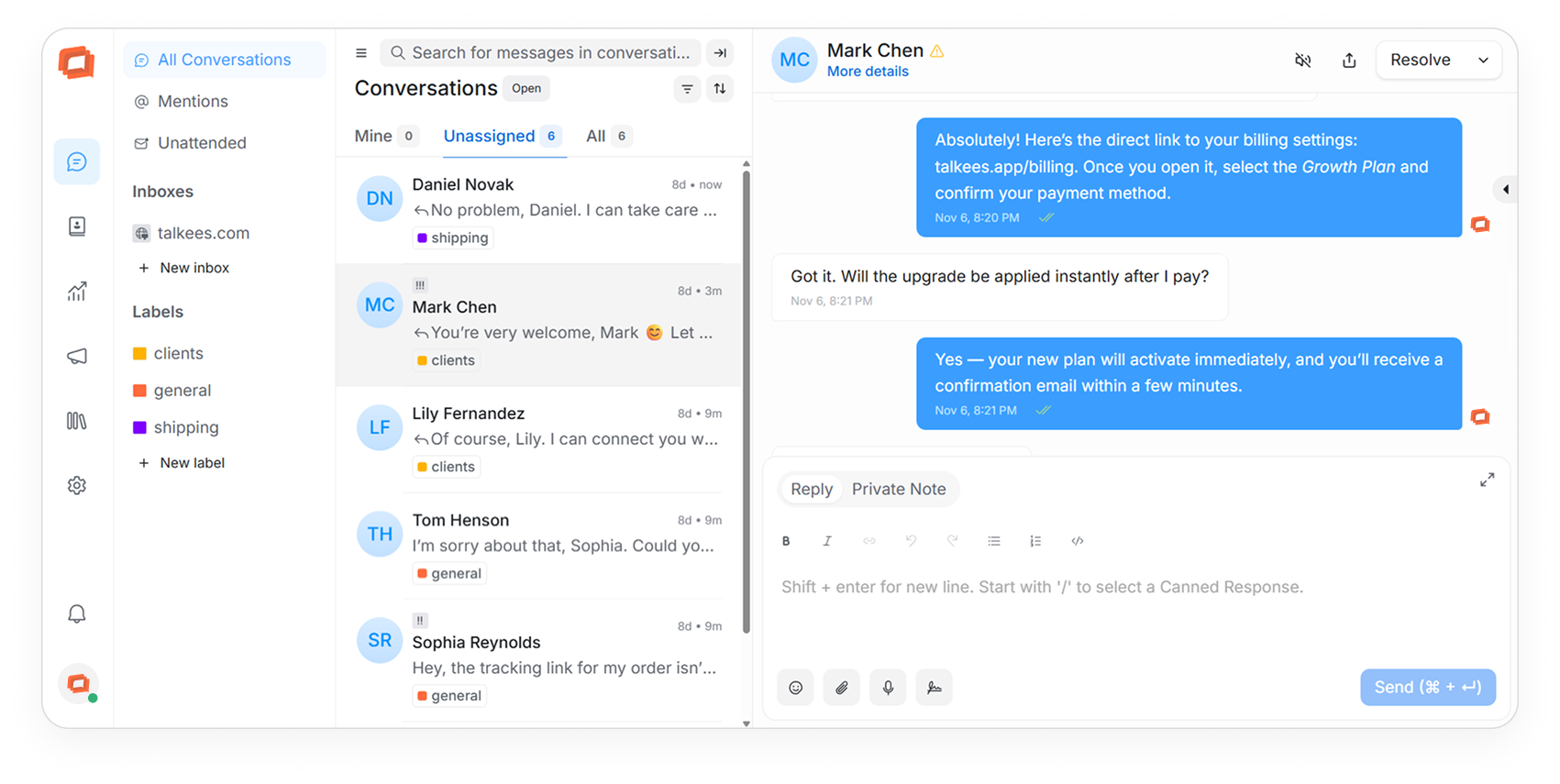
Talkees stands out as a powerful Gmelius alternative, especially for e-commerce businesses and SMBs seeking an AI-driven omnichannel solution.
Detailed Feature Overview
Talkees delivers a comprehensive customer support platform with:
- True omnichannel inbox: Seamlessly manage conversations across email, live chat, social media, and WhatsApp in a unified interface.
- AI-native architecture: Both powerful customer-facing chatbots and agent assistance tools built on advanced AI models.
- Deep e-commerce integration: Native connections with Shopify and WooCommerce that provide full order context and action capabilities.
- Intuitive workflow automation: Create sophisticated automation rules without coding knowledge.
- Comprehensive knowledge base: Build, manage, and connect your knowledge base to both chatbots and agent workflows.
Pricing and Plans
Talkees offers transparent, fair per-seat pricing that scales with your business:
- Starter: $29/agent per month – Includes core omnichannel capabilities and basic AI features
- Professional: $49/agent per month – Adds advanced AI capabilities, deeper integrations, and expanded automation
- Enterprise: Custom pricing – For larger teams needing advanced security, custom AI training, and dedicated support
All plans include unlimited conversations, making Talkees particularly cost-effective for high-volume support teams compared to ticket-based pricing models.
Real User Experiences and Reviews
Customers consistently praise Talkees for its ease of use and AI capabilities:
“We switched from Gmelius to Talkees and saw our first response time decrease by 45%. The AI chatbot handles about 35% of our inquiries completely autonomously, and agents love the suggested responses.” – E-commerce Support Manager
On review platforms, Talkees receives high marks for:
- Intuitive interface (4.7/5 on G2)
- AI accuracy and usefulness (4.6/5)
- E-commerce integration depth (4.8/5)
- Onboarding and support quality (4.7/5)
Advantages and Limitations
Pros:
- Truly unified omnichannel inbox with no channel add-on fees
- Superior AI capabilities that continuously improve with use
- Native e-commerce integrations with actionable order context
- Fair per-seat pricing with unlimited conversations
- Excellent mobile experience with full feature parity
Cons:
- Newer platform compared to some legacy competitors
- Custom enterprise integrations may require development resources
- Advanced AI training benefits from larger conversation datasets
Our Experience with Talkees
During our testing, we were particularly impressed with Talkees’ AI capabilities. The platform’s chatbot handled complex product questions with surprising accuracy, and the agent assist features genuinely saved time on repetitive inquiries.
The onboarding process was straightforward, taking about 3 days from signup to full implementation. The Shopify integration was especially powerful, allowing agents to view and modify orders directly within the conversation interface.
For teams currently using Gmelius who need better omnichannel support and AI capabilities without sacrificing ease of use, Talkees provides an excellent balance of power and simplicity.
Hiver vs Gmelius: Gmail-Based Help Desk with Strong SLAs

Hiver offers another Gmail-based approach to customer support, but with a stronger focus on help desk functionality and SLA management.
Detailed Feature Overview
Hiver provides:
- Gmail-native shared inbox: Work directly within Gmail with minimal UI changes
- Strong SLA management: Comprehensive SLA tracking and reporting capabilities
- Email assignment and routing: Efficient distribution of incoming messages
- Collision detection: Prevents multiple agents from responding to the same email
- Built-in CSAT surveys: Track customer satisfaction directly within the platform
Pricing and Plans
Hiver offers tiered pricing based on features:
- Lite: $15/user per month – Basic shared inbox features
- Pro: $45/user per month – Adds automation, analytics, and CSAT surveys
- Elite: $75/user per month – Includes advanced SLAs, priority support, and additional security features
Real User Experiences and Reviews
Hiver users particularly appreciate its Gmail integration:
“Hiver feels like a natural extension of Gmail rather than a separate platform. The learning curve for our team was minimal, and the SLA tracking has improved our response times significantly.” – IT Services Manager
Review platforms highlight:
- Gmail integration (4.8/5 on Capterra)
- Ease of use (4.6/5)
- SLA management (4.5/5)
- Customer support quality (4.3/5)
Advantages and Limitations
Pros:
- Minimal learning curve for Gmail-centric teams
- Strong SLA tracking and compliance features
- Clean, intuitive user interface
- Excellent collision detection
- 24/7 customer support
Cons:
- Limited capabilities beyond email
- No native chatbot or advanced AI features
- Lacks Kanban boards or visual workflow management
- Can become expensive at higher tiers
- Limited integration options compared to full help desk solutions
Our Experience with Hiver
When testing Hiver, we found its Gmail integration to be seamless and intuitive. For teams that primarily manage email support and want to stay within Gmail, Hiver provides a streamlined experience with minimal disruption.
The SLA management capabilities are particularly strong, with clear visibility into response times and automated escalations. However, teams needing omnichannel support or advanced AI capabilities will find Hiver somewhat limiting compared to platforms like Talkees.
Zendesk as a Gmelius Alternative: Enterprise-Grade Omnichannel Support

Zendesk is a well-established enterprise-grade support platform offering comprehensive omnichannel capabilities.
Detailed Feature Overview
Zendesk provides:
- Complete omnichannel support: Email, chat, voice, social media, and messaging
- Extensive automation: Sophisticated workflow automation and triggers
- Zendesk AI: AI-powered recommendations and automations
- Comprehensive reporting: Detailed analytics across all channels
- Extensive marketplace: Hundreds of integrations and apps
Pricing and Plans
Zendesk’s pricing structure is complex with multiple product lines:
- Suite Team: $55/agent per month – Core omnichannel support
- Suite Growth: $89/agent per month – Adds more automation and reporting
- Suite Professional: $115/agent per month – Includes advanced workflows and AI capabilities
- Enterprise: Custom pricing – For large organizations with complex needs
Real User Experiences and Reviews
Zendesk is widely used by enterprise customers:
“Zendesk provides the comprehensive support infrastructure we need to manage thousands of tickets daily across multiple channels. The depth of customization is unmatched.” – Enterprise Support Director
Review platforms note:
- Feature completeness (4.7/5 on G2)
- Scalability (4.6/5)
- Integration capabilities (4.8/5)
- Complexity and learning curve (3.2/5)
Advantages and Limitations
Pros:
- Comprehensive omnichannel capabilities
- Robust reporting and analytics
- Extensive customization options
- Large ecosystem of integrations
- Enterprise-grade security and compliance
Cons:
- Significant complexity and steep learning curve
- Higher cost compared to most alternatives
- Can be overwhelming for small teams
- Implementation often requires dedicated resources
- Potentially slower innovation compared to newer platforms
Our Experience with Zendesk
During our evaluation, Zendesk impressed with its comprehensive feature set and enterprise capabilities. The platform can handle virtually any support scenario, but this comes at the cost of complexity.
For large organizations transitioning from Gmelius with complex support requirements, Zendesk offers a robust solution. However, smaller teams may find the platform overwhelming and unnecessarily expensive compared to more focused alternatives like Talkees or Hiver.
Help Scout vs Gmelius: Email-First Help Desk with Beacon Chat

Help Scout offers a streamlined help desk experience with a focus on simplicity and customer experience.
Detailed Feature Overview
Help Scout includes:
- Collaborative inbox: Shared email management with notes and assignments
- Beacon chat widget: Customizable chat and self-service widget
- Docs knowledge base: Integrated self-service documentation
- AI features: Help Scout AI for drafting, summarizing, and translating
- Conversation-based approach: No ticket numbers or impersonal interfaces
Pricing and Plans
Help Scout offers straightforward pricing:
- Standard: $25/user per month – Core features for small teams
- Plus: $50/user per month – Advanced reporting and automation
- Pro: $75/user per month – Additional security and API access
Real User Experiences and Reviews
Help Scout users value its clean interface:
“Help Scout strikes the perfect balance between functionality and simplicity. Our team was productive from day one, and customers appreciate the personal touch compared to ticket-based systems.” – SaaS Support Lead
Review platforms highlight:
- Ease of use (4.7/5 on G2)
- Customer experience (4.6/5)
- Knowledge base functionality (4.5/5)
- Value for money (4.3/5)
Advantages and Limitations
Pros:
- Clean, intuitive user interface
- Excellent knowledge base capabilities
- Beacon widget combines chat and self-service
- Focus on personal customer experience
- Straightforward pricing
Cons:
- Limited omnichannel capabilities
- Less robust automation compared to alternatives
- AI features not as advanced as dedicated AI-native platforms
- Fewer integration options than enterprise solutions
- Limited customization for complex workflows
Our Experience with Help Scout
When testing Help Scout, we appreciated its focus on simplicity and user experience. The platform is remarkably easy to use, and the Beacon widget provides an elegant solution for combining chat and self-service.
For teams transitioning from Gmelius who prioritize email support with some chat capabilities and don’t need extensive omnichannel features, Help Scout provides an excellent balance of functionality and usability.
Zoho Desk vs Gmelius: Budget-Friendly Omnichannel Within the Zoho Suite

Zoho Desk offers affordable omnichannel support with strong integration within the broader Zoho ecosystem.
Detailed Feature Overview
Zoho Desk includes:
- Multichannel support: Email, chat, social, phone, and self-service
- Zia AI assistant: AI-powered agent assistance and customer self-service
- Process automation: Customizable workflows and SLA management
- Team collaboration: Internal collaboration tools and knowledge sharing
- Deep Zoho integration: Seamless connection with other Zoho applications
Pricing and Plans
Zoho Desk offers tiered pricing:
- Standard: $14/agent per month – Basic help desk features
- Professional: $23/agent per month – Adds automation and social channels
- Enterprise: $40/agent per month – Includes Zia AI and advanced customization
Real User Experiences and Reviews
Zoho Desk users appreciate its value proposition:
“Zoho Desk provides impressive functionality at a fraction of the cost of enterprise alternatives. The integration with other Zoho products creates a seamless experience for our sales and support teams.” – SMB Operations Manager
Review platforms note:
- Value for money (4.6/5 on Capterra)
- Feature set (4.4/5)
- Integration with Zoho suite (4.7/5)
- Customization complexity (3.8/5)
Advantages and Limitations
Pros:
- Excellent value for money
- Comprehensive omnichannel support
- Strong AI capabilities with Zia
- Seamless integration with Zoho CRM and other Zoho products
- Multilingual support
Cons:
- Interface can feel dated compared to newer alternatives
- Configuration can be complex and time-consuming
- Performance issues reported with high ticket volumes
- Mobile experience not as refined as desktop
- Best value realized when using multiple Zoho products
Our Experience with Zoho Desk
During our evaluation, Zoho Desk impressed with its breadth of features at an affordable price point. The Zia AI assistant provides useful automation and self-service capabilities, though not as advanced as dedicated AI-native platforms like Talkees.
For budget-conscious teams already using other Zoho products who need to move beyond Gmelius’ limitations, Zoho Desk offers excellent value. However, the configuration complexity and occasionally dated interface may present challenges during implementation.
Front vs Gmelius: Collaborative Inbox for Multichannel Email

Front focuses on transforming email into a collaborative workspace for teams, with additional channel support.
Detailed Feature Overview
Front provides:
- Shared inbox collaboration: Team email management with comments and assignments
- Multichannel capabilities: Email, SMS, chat, and social in one platform
- Collaborative drafting: Real-time collaboration on email responses
- Rules and automation: Customizable workflows and routing
- Analytics and insights: Performance tracking and team analytics
Pricing and Plans
Front offers tiered pricing:
- Starter: $19/user per month – Basic shared inbox features
- Growth: $59/user per month – Adds automation and additional channels
- Scale: $99/user per month – Includes advanced analytics and integrations
Real User Experiences and Reviews
Front users value its collaborative approach:
“Front transformed how our team collaborates on customer communications. The ability to discuss emails internally without endless forwards and CCs has dramatically improved our response quality and speed.” – Financial Services Team Lead
Review platforms highlight:
- Collaboration features (4.8/5 on G2)
- Email management (4.7/5)
- User interface (4.6/5)
- Channel integration (4.3/5)
Advantages and Limitations
Pros:
- Excellent email collaboration features
- Clean, intuitive user interface
- Good balance of simplicity and functionality
- Effective multichannel management
- Strong mobile application
Cons:
- Higher cost per user at scale
- Limited AI capabilities compared to newer platforms
- Not as help desk-oriented as dedicated support platforms
- Knowledge base and self-service limitations
- Can become expensive for larger teams
Our Experience with Front
When testing Front, we were impressed with its collaborative features and clean interface. The platform excels at transforming email into a true team workspace, with internal discussions seamlessly integrated alongside customer communications.
For teams looking to move from Gmelius who prioritize collaborative email management with some additional channel support, Front offers an excellent solution. However, those needing advanced help desk features or sophisticated AI might find it somewhat limiting.
Gorgias vs Gmelius: Ecommerce-First Support for Online Stores

Gorgias is purpose-built for e-commerce businesses, offering deep integration with platforms like Shopify and BigCommerce.
Detailed Feature Overview
Gorgias provides:
- E-commerce-specific features: Order management, refunds, and customer context
- Multichannel support: Email, chat, social, and SMS in one platform
- Intent detection: Automatic categorization of customer inquiries
- Revenue attribution: Track revenue generated through support interactions
- Macros and automation: E-commerce-specific templates and workflows
Pricing and Plans
Gorgias uses a ticket-based pricing model:
- Basic: $50/month – 350 tickets/month
- Pro: $300/month – 2,000 tickets/month
- Advanced: $750/month – 5,000 tickets/month
- Enterprise: Custom pricing for higher volumes
Real User Experiences and Reviews
Gorgias users praise its e-commerce focus:
“The Shopify integration is game-changing. Being able to view and modify orders directly within support conversations saves us countless hours and dramatically improves the customer experience.” – E-commerce Support Director
Review platforms note:
- Shopify integration (4.9/5 on G2)
- Order management (4.8/5)
- Macros and templates (4.7/5)
- Pricing structure (3.7/5) – Some concerns about ticket-based pricing
Advantages and Limitations
Pros:
- Unmatched e-commerce integrations
- Ability to take order actions directly from the support interface
- Strong social media management
- Effective intent detection
- Purpose-built for online stores
Cons:
- Ticket-based pricing can become expensive with high volumes
- Less suitable for non-e-commerce businesses
- Mobile app limitations reported by some users
- Advanced features require higher-tier plans
- Some performance issues with very high ticket volumes
Our Experience with Gorgias
During our evaluation, Gorgias impressed with its deep e-commerce integration and purpose-built features for online stores. The ability to view and modify orders directly within the support interface creates significant efficiency gains for e-commerce support teams.
For online retailers looking to move beyond Gmelius, Gorgias provides an excellent solution. However, the ticket-based pricing model requires careful consideration, as costs can escalate quickly for high-volume support operations compared to per-seat models like Talkees.
HappyFox vs Gmelius: Balanced Omnichannel and Automation

HappyFox offers a balanced approach to customer support with strong automation and customization capabilities.
Detailed Feature Overview
HappyFox includes:
- Ticket management: Comprehensive ticket organization and routing
- Multichannel support: Email, chat, phone, and social media
- Automation engine: Sophisticated rules and workflow automation
- Knowledge base: Integrated self-service capabilities
- Reporting and SLAs: Detailed analytics and SLA management
Pricing and Plans
HappyFox uses custom pricing based on team size and needs:
- Mighty: Starting around $39/agent per month – Core features
- Fantastic: Starting around $59/agent per month – Additional automation
- Enterprise: Custom pricing – Advanced features and dedicated support
Real User Experiences and Reviews
HappyFox users value its balance of features:
“HappyFox strikes the right balance between functionality and usability. The automation capabilities have reduced our manual work by about 40%, and the multichannel support keeps everything organized in one place.” – IT Support Manager
Review platforms highlight:
- Ticket management (4.6/5 on Capterra)
- Automation capabilities (4.5/5)
- Customization options (4.4/5)
- Knowledge base functionality (4.3/5)
Advantages and Limitations
Pros:
- Strong automation capabilities
- Comprehensive ticket management
- Good balance of features and usability
- Effective knowledge base integration
- Solid SLA management
Cons:
- Custom pricing can lack transparency
- AI capabilities not as advanced as newer platforms
- Some users report a dated interface
- Mobile experience limitations
- Implementation can require significant configuration
Our Experience with HappyFox
When testing HappyFox, we appreciated its comprehensive feature set and particularly strong automation capabilities. The platform provides effective ticket management across multiple channels with sophisticated routing and workflow options.
For teams moving from Gmelius who need balanced omnichannel support with strong automation, HappyFox offers a solid solution. However, those seeking cutting-edge AI capabilities or a more modern interface might prefer alternatives like Talkees.
LiveAgent vs Gmelius: Chat, Email, and Voice in One Platform
LiveAgent offers a feature-rich help desk with particularly strong live chat and call center capabilities.
Detailed Feature Overview
LiveAgent provides:
- Comprehensive channel support: Email, chat, voice, video, and social media
- Advanced live chat: Feature-rich chat with proactive invitations
- Call center functionality: Built-in call management and routing
- Ticket automation: Rules-based automation and distribution
- Customer portal: Self-service options and ticket tracking
Pricing and Plans
LiveAgent offers tiered pricing:
- Free: Basic ticketing for small teams
- Ticket: $15/agent per month – Email ticketing
- Ticket+Chat: $29/agent per month – Adds live chat features
- All-Inclusive: $49/agent per month – Adds call center features
Real User Experiences and Reviews
LiveAgent users appreciate its comprehensive feature set:
“LiveAgent gives us everything we need in one platform. The combination of email, chat, and voice support eliminates the need for multiple tools, and the automation has significantly reduced our response times.” – Retail Support Supervisor
Review platforms note:
- Feature completeness (4.7/5 on G2)
- Live chat functionality (4.8/5)
- Value for money (4.5/5)
- Interface and usability (3.9/5)
Advantages and Limitations
Pros:
- Comprehensive feature set covering all major channels
- Excellent live chat capabilities
- Strong call center functionality
- Good value for money
- Flexible deployment options
Cons:
- Interface feels dated compared to modern alternatives
- Learning curve due to feature density
- Mobile experience not as refined as desktop
- Some performance issues reported with high volumes
- AI capabilities less advanced than newer platforms
Our Experience with LiveAgent
During our evaluation, LiveAgent impressed with its comprehensive feature set, particularly its live chat and call center capabilities. The platform offers excellent value for money with its all-inclusive pricing model.
For teams transitioning from Gmelius who need comprehensive channel support including voice at an affordable price point, LiveAgent provides a solid solution. However, those prioritizing a modern interface or advanced AI might prefer newer alternatives like Talkees.
SupportBee vs Gmelius: Regional E-commerce Help Desk

SupportBee offers a straightforward help desk solution with a focus on simplicity and e-commerce integration.
Detailed Feature Overview
SupportBee includes:
- Collaborative inbox: Team email management with assignments and comments
- E-commerce integration: Connections with major e-commerce platforms
- Simple automation: Basic rules and workflow automation
- Knowledge base: Integrated self-service capabilities
- API and webhooks: Customization and integration options
Pricing and Plans
SupportBee offers straightforward per-agent pricing:
- Starter: $13/agent per month – Core features for small teams
- Basic: $17/agent per month – Adds automation and reporting
- Plus: $23/agent per month – Includes advanced features and API access
Real User Experiences and Reviews
SupportBee users value its simplicity:
“SupportBee provided exactly what we needed – a straightforward help desk that’s easy to set up and use. The e-commerce integration gives us the customer context we need without overwhelming complexity.” – Small Business Owner
Review platforms highlight:
- Ease of use (4.6/5 on Capterra)
- Setup speed (4.7/5)
- Value for money (4.5/5)
- Basic feature set (4.2/5)
Advantages and Limitations
Pros:
- Simple, intuitive interface
- Quick setup and onboarding
- Affordable pricing structure
- Good e-commerce integration
- Responsive customer support
Cons:
- Limited channel support beyond email
- Basic automation compared to alternatives
- Minimal AI capabilities
- Fewer integration options than enterprise platforms
- Limited customization for complex workflows
Our Experience with SupportBee
When testing SupportBee, we appreciated its focus on simplicity and ease of use. The platform can be set up quickly, and teams can be productive with minimal training.
For small businesses transitioning from Gmelius who prioritize simplicity and affordability, SupportBee offers a straightforward solution. However, teams needing advanced omnichannel capabilities or sophisticated AI would be better served by alternatives like Talkees.
Gmelius Competitors Compared at a Glance

To help you make an informed decision, here’s a comparison of key features across the top Gmelius alternatives:
| Platform | Best For | Channels | AI Capabilities | E-commerce Integration | Pricing Model | Starting Price |
|---|---|---|---|---|---|---|
| Talkees | SMBs & E-commerce | Email, Chat, Social, WhatsApp | Advanced (chatbot + agent assist) | Deep (Shopify, WooCommerce) | Per seat | $29/agent/mo |
| Hiver | Gmail-centric teams | Primarily Email | Basic | Limited | Per seat | $15/user/mo |
| Zendesk | Enterprise | Email, Chat, Voice, Social, Messaging | Advanced | Via integrations | Per seat | $55/agent/mo |
| Help Scout | Email-first support | Email, Chat (Beacon) | Moderate | Basic | Per seat | $25/user/mo |
| Zoho Desk | Budget-conscious | Email, Chat, Social, Phone | Moderate (Zia) | Basic | Per seat | $14/agent/mo |
| Front | Collaborative teams | Email, SMS, Chat, Social | Basic | Limited | Per seat | $19/user/mo |
| Gorgias | E-commerce stores | Email, Chat, Social, SMS | Moderate | Deep (Shopify, BigCommerce) | Per ticket | $50/mo (350 tickets) |
| HappyFox | Balanced support | Email, Chat, Phone, Social | Basic | Moderate | Per seat | ~$39/agent/mo |
| LiveAgent | Voice + chat support | Email, Chat, Voice, Video, Social | Basic | Moderate | Per seat | $15/agent/mo |
| SupportBee | Small businesses | Primarily Email | Minimal | Basic | Per seat | $13/agent/mo |
Switching from Gmelius: Migration Checklist

If you’re planning to migrate from Gmelius to one of these alternatives, follow this checklist to ensure a smooth transition:
- Data export and mapping
- Export all conversations, labels, templates, and contact data from Gmelius
- Map Gmelius shared labels to queues or categories in your new platform
- Document all custom templates and macros for recreation
- Workflow recreation
- List all automation rules and sequences in Gmelius
- Recreate these workflows in your new platform
- Test each workflow before full migration
- Team preparation
- Schedule training sessions for your team
- Create quick reference guides highlighting differences between Gmelius and the new platform
- Assign migration champions to support team members during transition
- Phased implementation
- Run both systems in parallel initially
- Migrate one team or department at a time
- Gradually shift volume to the new platform
- Integration verification
- Test all integrations with CRM, e-commerce, and other systems
- Verify data flow between systems
- Document any API customizations needed
- Customer communication
- Notify customers of any changes to support channels or processes
- Update email signatures, contact information, and support documentation
Most platforms offer migration assistance or professional services to help with this process. For example, Talkees provides dedicated migration specialists who can help map your Gmelius workflows to their platform and ensure no customer conversations are lost during the transition.
Conclusion: Finding the Right Gmelius Alternative for Your Business

Choosing the right Gmelius alternative depends on your specific business needs, budget, and team structure. Here’s our summary of recommendations:
- For SMBs and e-commerce businesses seeking an AI-driven omnichannel solution with fair pricing, Talkees offers the best balance of features, usability, and value.
- For teams deeply invested in Gmail who primarily need email support capabilities, Hiver provides a familiar environment with enhanced help desk features.
- For enterprise organizations with complex requirements and larger budgets, Zendesk delivers comprehensive capabilities and scalability.
- For e-commerce stores needing deep platform integration and order management, Gorgias offers specialized features despite its ticket-based pricing model.
- For budget-conscious teams within the Zoho ecosystem, Zoho Desk provides good value and integration benefits.
When making your decision, consider conducting a small pilot with your top choices to see how they perform with your specific workflows and customer interactions. Most platforms offer free trials or demo periods that can help you make an informed choice.
Remember that the right customer support platform is an investment in both customer satisfaction and team efficiency. Taking the time to evaluate alternatives thoroughly will pay dividends in improved customer experiences and more effective support operations.