 English
 Slovenčina
 Français
 Magyar
Why Teams Move Off Zoho Desk: Limitations and Pain Points

Before diving into alternatives, it’s important to understand why businesses consider switching from Zoho Desk. Despite its capabilities, several limitations prompt teams to explore other options:
- Pricing ceilings as you scale: As your team grows, Zoho Desk’s cost structure can become prohibitive, especially for rapidly expanding businesses.
- AI features gated to higher tiers: Many advanced AI capabilities are only available on premium plans, limiting access for budget-conscious teams.
- WhatsApp and omnichannel complexity: Setting up and maintaining omnichannel support, particularly WhatsApp integration, can be challenging and often requires additional costs.
- Setup and administrative overhead: Non-technical teams often find the platform’s administration and configuration process steep and time-consuming.
- Mobile app limitations: Some users report feature gaps between the mobile and desktop experiences.
These pain points have led many organizations to seek alternatives that offer more flexible pricing, better AI integration, and simpler omnichannel support.
What to Look for in a Zoho Desk Alternative (2025)

When evaluating Zoho Desk alternatives, consider these key capabilities that define modern help desk platforms:
AI Chatbot + Live Chat Integration
Look for platforms offering sophisticated AI chatbots that can handle routine inquiries while seamlessly transferring complex issues to human agents. The best solutions provide:
- 24/7 automated support with natural language understanding
- Contextual handoff to live agents with full conversation history
- AI-powered suggestions for agents during live conversations
- Customizable chatbot flows without requiring coding expertise
Email, Social, and WhatsApp Integration
Effective omnichannel support is no longer optional. Evaluate how each alternative handles:
- Email ticketing with thread preservation
- Social media messaging (Facebook, Instagram, Twitter)
- WhatsApp Business integration with template messages
- Unified inbox for all communication channels
Automation Capabilities
Automation reduces agent workload and improves response times. Look for:
- Rule-based ticket routing and assignment
- Automated responses for common questions
- SLA management and escalation workflows
- Custom automation sequences for your specific processes
Self-Service Options
Empowering customers to find answers independently reduces ticket volume:
- Knowledge base with robust search functionality
- Community forums with customer and agent participation
- AI-suggested articles based on customer queries
- Embedded help widgets for websites and applications
Analytics and Reporting
Data-driven decisions require comprehensive analytics:
- Performance metrics (response time, resolution time, CSAT)
- Agent productivity reporting
- Channel effectiveness comparisons
- Custom dashboard capabilities
Fair and Transparent Pricing
Evaluate the total cost of ownership, including:
- Base license costs per agent
- AI/chatbot usage fees (per session or per resolution)
- Channel add-ons (particularly WhatsApp)
- Implementation and migration costs
How We Evaluated Zoho Desk Competitors

Our assessment focused on several critical factors that determine the real-world value of help desk solutions:
Total Cost of Ownership (TCO)
We calculated comprehensive costs including:
- Base license fees
- AI and chatbot usage
- Channel costs (WhatsApp, telephony)
- Onboarding and migration expenses
Time-to-Value
How quickly can you implement and see results?
- Setup complexity and time requirements
- Available templates and pre-built workflows
- No-code automation capabilities
- Migration tools and support
Integration Depth
We evaluated native connections with essential business tools:
- Shopify and WooCommerce for e-commerce
- WordPress for web forms and content
- Zapier for workflow automation
- Twilio for communication channels
- Jira and Trello for development teams
With these criteria in mind, let’s explore the top Zoho Desk alternatives, starting with Talkees.
Talkees vs Zoho Desk: AI-Native Live Chat and Chatbot Solution

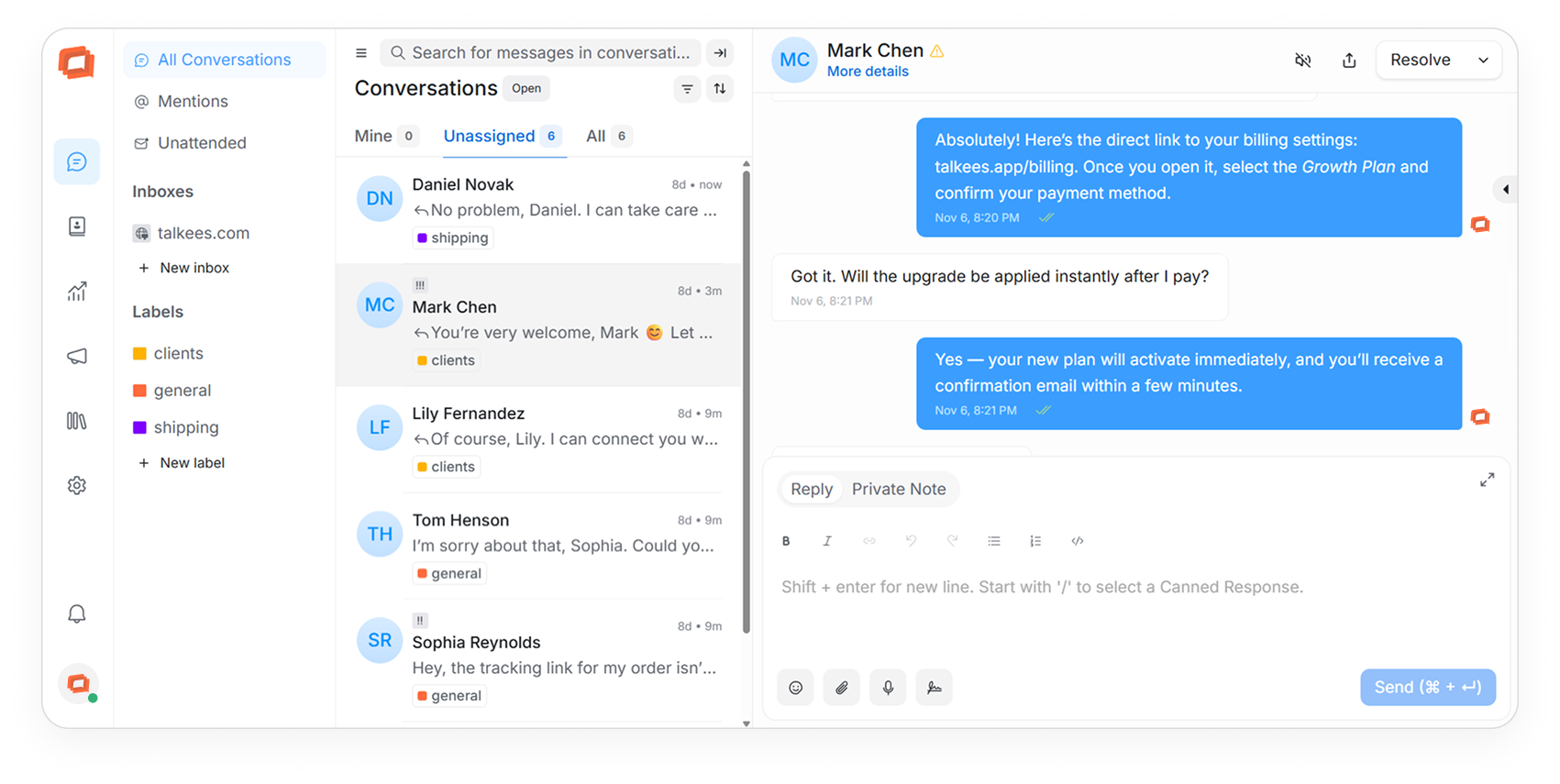
Talkees is an AI-native live chat and chatbot platform designed specifically for e-commerce and SMBs seeking efficient customer communication without enterprise complexity.
Detailed Features
- AI Chatbot Technology: Advanced natural language understanding with custom training on your product catalog and FAQs
- Omnichannel Support: Unified inbox for webchat, email, WhatsApp, Messenger, Instagram, SMS, and Signal
- No-Code Automation: Visual workflow builder for creating customer service processes without technical expertise
- E-commerce Integration: Deep connections with Shopify and WooCommerce, including order status, product recommendations, and cart recovery
- Analytics Dashboard: Conversation metrics, resolution rates, and customer satisfaction tracking
Pricing
- Free Plan: Up to 50 conversations per month
- Starter: $29/month for 500 conversations
- Growth: $79/month for 2,000 conversations
- Scale: $199/month for 5,000 conversations
- Enterprise: Custom pricing for unlimited usage
All plans include the AI chatbot, with more advanced features and integration options available in higher tiers.
Real User Experiences
Customers particularly appreciate Talkees’ quick setup process and the effectiveness of its AI chatbot:
“We implemented Talkees in less than a day and immediately saw a 40% reduction in routine support inquiries. The AI handles product questions and order status checks perfectly, and our team only gets involved for complex issues.” – E-commerce Store Owner
“The WhatsApp integration was seamless compared to other solutions we tried. Being able to manage all our messaging channels in one place has transformed our customer communication.” – Marketing Director
Advantages
- Fast implementation with minimal technical requirements
- AI chatbot included in all plans without additional per-resolution fees
- Excellent e-commerce integration with product catalog understanding
- Unified messaging across multiple channels
- Cost-effective for small and medium businesses
Limitations
- Not designed for complex ITIL/ITSM processes
- Fewer enterprise-level compliance certifications than larger competitors
- More focused on conversational support than traditional ticketing
Our Assessment
Having tested Talkees extensively, we found it exceptionally well-suited for e-commerce businesses and SMBs looking for efficient customer communication. The AI chatbot’s ability to understand product catalogs and answer specific questions is impressive, often resolving 30-50% of inquiries without human intervention.
The platform shines in its simplicity – you can be up and running in hours rather than days or weeks. While it may not replace a full-scale enterprise help desk for large organizations with complex workflows, it provides excellent value for businesses that prioritize quick, effective customer communication across multiple channels.
Freshdesk vs Zoho Desk: Comprehensive Help Desk Comparison
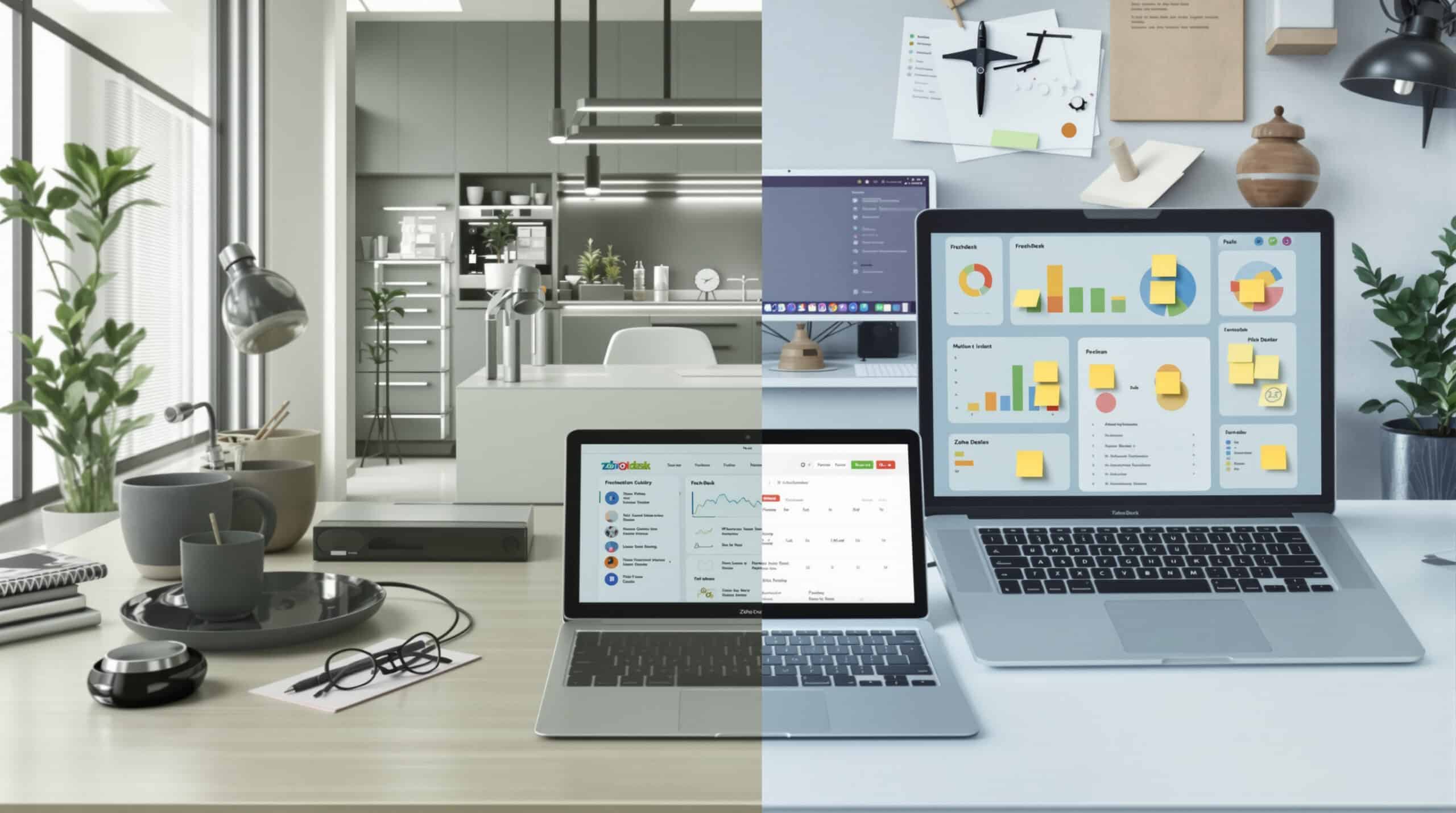
Freshdesk by Freshworks offers a robust ticketing system with Freddy AI, making it a popular Zoho Desk alternative for businesses of all sizes.
Detailed Features
- Freddy AI: AI-powered ticket classification, chatbots, and agent assistance
- Omnichannel Support: Email, phone, chat, social media, and WhatsApp integration
- Automation: Scenario automation, SLA management, and ticket routing
- Self-Service: Knowledge base, community forums, and AI-suggested solutions
- Reporting: Customizable dashboards and performance analytics
Pricing
- Free Plan: Up to 3 agents with basic ticketing
- Growth: $15/agent/month (billed annually)
- Pro: $49/agent/month
- Enterprise: $79/agent/month
- Freddy AI Add-ons: Session-based pricing (e.g., $49/100 sessions)
Real User Experiences
Freshdesk users frequently highlight its intuitive interface and comprehensive feature set:
“After migrating from Zoho Desk, we found Freshdesk much easier to configure for our support workflows. Freddy AI has been particularly helpful for categorizing incoming tickets automatically.” – Support Team Lead
“The omnichannel capabilities have allowed us to consolidate our customer communication. Being able to handle social media, email, and chat in one place has improved our response times significantly.” – Customer Success Manager
Advantages
- Intuitive user interface with minimal learning curve
- Strong AI capabilities with Freddy
- Robust marketplace with 1,000+ integrations
- Comprehensive omnichannel support
- Flexible automation options
Limitations
- AI features require additional payments based on usage
- Advanced reporting features reserved for higher tiers
- Can become costly as you add agents and features
Our Assessment
During our testing, Freshdesk impressed with its balance of power and usability. The platform is significantly easier to set up than Zoho Desk, with intuitive workflows that new agents can master quickly.
Freddy AI is a standout feature, providing genuinely helpful suggestions and automations that reduce agent workload. However, the session-based pricing model means costs can climb if you rely heavily on AI features.
For growing teams that need a comprehensive help desk with strong AI capabilities, Freshdesk offers an excellent balance of features and usability, though you’ll need to carefully monitor AI usage costs.
Zendesk vs Zoho Desk: Enterprise-Grade Support Platform

Zendesk is a market leader offering enterprise-level customer service capabilities with advanced routing and analytics.
Detailed Features
- Sunshine Platform: Flexible CRM platform for customizing customer experiences
- Answer Bot: AI-powered self-service and agent assistance
- Advanced Routing: Skills-based assignment and load balancing
- Analytics: Zendesk Explore for in-depth reporting and insights
- App Marketplace: 1,500+ integrations and extensions
Pricing
- Suite Team: $55/agent/month (billed annually)
- Suite Growth: $89/agent/month
- Suite Professional: $115/agent/month
- Enterprise: Custom pricing
- Additional costs for advanced AI features and analytics
Real User Experiences
Enterprise users value Zendesk’s depth and customization options:
“Zendesk’s routing capabilities have transformed how we handle support tickets. Being able to automatically assign based on skills and availability has reduced our response times by 35%.” – Enterprise Support Director
“The reporting in Zendesk Explore gives us insights we couldn’t get from Zoho Desk. We can now track customer journey metrics across all touchpoints.” – Operations Manager
Advantages
- Enterprise-grade customization and scalability
- Advanced routing and workflow capabilities
- Comprehensive reporting through Zendesk Explore
- Extensive marketplace and integration options
- Strong compliance and security features
Limitations
- Significantly higher cost than Zoho Desk
- Complex implementation requiring dedicated resources
- Feature complexity can overwhelm smaller teams
- Many advanced features require higher-tier plans
Our Assessment
In our testing, Zendesk demonstrated why it’s considered an enterprise leader. The platform offers exceptional depth and customization options that can handle virtually any customer service scenario.
However, this power comes with complexity and cost. Implementing Zendesk properly requires significant resources and expertise, making it potentially overwhelming for smaller organizations. The total cost of ownership is substantially higher than Zoho Desk, especially when you include add-ons for advanced AI and analytics.
Zendesk makes the most sense for larger organizations with complex support requirements and the resources to fully leverage its capabilities. For smaller teams, the investment may be difficult to justify unless you specifically need its enterprise features.
ServiceDesk Plus (ManageEngine) vs Zoho Desk: ITSM Maturity

ServiceDesk Plus by ManageEngine focuses on IT service management with robust ITIL processes and both cloud and on-premises deployment options.
Detailed Features
- ITIL Processes: Incident, problem, change, and release management
- CMDB: Configuration management database for IT assets
- Service Catalog: Customizable service request portal
- IT Asset Management: Discovery, software license tracking, and lifecycle management
- Knowledge Base: IT-focused documentation and self-service
Pricing
- Standard Edition: Free for up to 2 technicians
- Professional: Starting around $995 for 10 technicians (one-time for on-premises)
- Enterprise: Starting around $2,995 for 10 technicians (one-time for on-premises)
- Cloud pricing: Subscription-based, starting at approximately $40/technician/month
Real User Experiences
IT teams appreciate the platform’s comprehensive ITSM capabilities:
“ServiceDesk Plus gives us the structured ITIL processes we couldn’t get with Zoho Desk. The change management workflow has been particularly valuable for maintaining our infrastructure.” – IT Operations Manager
“Having both cloud and on-premises options was crucial for our compliance requirements. The CMDB functionality helps us track relationships between our systems and troubleshoot issues faster.” – IT Director
Advantages
- Comprehensive ITIL framework implementation
- Strong asset management and CMDB capabilities
- Choice of deployment models (cloud or on-premises)
- IT-specific workflows and automation
- Native integration with other ManageEngine products
Limitations
- Less focused on customer-facing support
- More complex to set up and configure
- User interface less intuitive than some competitors
- Primarily designed for IT teams rather than customer service
Our Assessment
When testing ServiceDesk Plus, we found it excels for IT-focused organizations that need structured ITSM processes. The CMDB and change management capabilities are particularly strong, offering functionality that Zoho Desk simply doesn’t provide.
The platform offers exceptional value for IT departments, especially with the free tier for small teams. However, the user experience is noticeably more technical and less intuitive than customer-focused alternatives like Freshdesk or Talkees.
ServiceDesk Plus is ideal for organizations prioritizing IT service management over customer-facing support, or for teams that need on-premises deployment options for compliance reasons.
ServiceNow vs Zoho Desk: Enterprise Workflow Automation

ServiceNow is an enterprise platform for digital workflow automation across IT, customer service, HR, and other business functions.
Detailed Features
- Enterprise Workflow Platform: End-to-end process automation across departments
- AI Operations: Machine learning for predictive intelligence and automation
- Service Portal: Customizable self-service experience
- Performance Analytics: Advanced reporting and insights
- App Engine: Low-code application development
Pricing
- Custom enterprise pricing based on modules and user count
- Typical starting costs: $50-100/user/month for base modules
- Implementation: Typically requires significant professional services investment
- Total cost of ownership: Generally in the six to seven-figure range annually
Real User Experiences
Large enterprises value ServiceNow’s comprehensive capabilities:
“ServiceNow has transformed how our entire organization handles service requests, not just IT. Having a single platform for all internal services has dramatically improved efficiency.” – Global Operations Director
“The workflow automation capabilities are unmatched. We’ve automated complex processes that span multiple departments, which wasn’t possible with our previous solutions.” – Enterprise Architect
Advantages
- Comprehensive enterprise workflow platform
- Powerful automation across departments
- Extensive customization and integration capabilities
- Strong governance and compliance features
- AI-powered operations and insights
Limitations
- Extremely high total cost of ownership
- Complex implementation requiring specialized expertise
- Significant ongoing administration overhead
- Overwhelming for organizations without dedicated resources
Our Assessment
Our evaluation of ServiceNow confirmed it’s in a different league from Zoho Desk in terms of both capabilities and cost. This platform is truly designed for large enterprises with complex, cross-departmental workflow requirements and the resources to support them.
The implementation timeline typically spans months or even years for full deployment, requiring specialized consultants and dedicated internal teams. For most organizations considering Zoho Desk alternatives, ServiceNow will be substantial overkill unless you have specific enterprise requirements and the budget to match.
ServiceNow makes sense when you need a comprehensive digital transformation platform rather than just a help desk solution, and when you have the resources to fully leverage its capabilities.
Jira Service Management vs Zoho Desk: Developer-Aligned Support

Atlassian’s Jira Service Management offers IT service management tightly integrated with the Jira ecosystem, making it ideal for development-oriented organizations.
Detailed Features
- Development Integration: Native connection to Jira Software for dev team alignment
- ITSM Processes: Incident, problem, change, and request management
- Automation Engine: Rule-based automation for common workflows
- Knowledge Base: Integration with Confluence for documentation
- Asset Management: IT asset tracking and management
Pricing
- Free: Up to 3 agents
- Standard: $19/agent/month (billed annually)
- Premium: $45/agent/month
- Enterprise: Custom pricing
- Data Center: Self-hosted enterprise option
Real User Experiences
Technical teams appreciate the tight integration with development tools:
“The seamless connection between our support tickets and development issues in Jira Software has dramatically improved our bug resolution process. What used to take days of back-and-forth now happens automatically.” – DevOps Manager
“For a technical product like ours, having support and development in the same ecosystem has been transformative. Our engineers can see the customer context directly without switching tools.” – Technical Support Lead
Advantages
- Perfect alignment with development workflows
- Strong incident/change/problem management
- Excellent for technical support teams
- Flexible automation capabilities
- Scalable from small teams to enterprises
Limitations
- Less focused on customer-facing, non-technical support
- Steeper learning curve for non-technical users
- Limited native omnichannel capabilities
- Less intuitive for traditional customer service teams
Our Assessment
In our testing, Jira Service Management proved exceptional for organizations where development and support need to work closely together. The platform seamlessly connects customer issues to development work, creating a unified workflow that speeds resolution.
The automation capabilities are powerful, though they require more technical knowledge than some alternatives. The user interface follows Jira’s paradigms, which technical teams love but customer service specialists sometimes find challenging.
This solution is ideal for software companies, technical product teams, and IT departments that work closely with development. For organizations without this technical focus, other alternatives may provide a better fit.
Freshservice vs Zoho Desk: IT Asset Management Focus

Freshservice, also from Freshworks, focuses on IT service management with strong asset discovery and service catalog capabilities.
Detailed Features
- IT Asset Discovery: Automated discovery and tracking of hardware and software
- Service Catalog: Customizable internal service request system
- ITIL Processes: Incident, problem, change, and release management
- CMDB: Configuration management database for IT relationships
- Project Management: IT project planning and tracking
Pricing
- Starter: $21/agent/month (billed annually)
- Growth: $49/agent/month
- Pro: $109/agent/month
- Enterprise: $169/agent/month
Real User Experiences
IT teams value Freshservice’s comprehensive asset management:
“The automated discovery has given us visibility into our IT assets that we never had with Zoho Desk. We can now track software licenses and hardware lifecycle much more effectively.” – IT Infrastructure Manager
“Freshservice’s service catalog has transformed how we handle internal requests. The approval workflows and automation have reduced our processing time by over 50%.” – IT Support Manager
Advantages
- Excellent IT asset discovery and management
- Comprehensive service catalog capabilities
- Strong ITIL process implementation
- Intuitive interface with minimal training required
- Solid reporting and analytics
Limitations
- Focused on internal IT rather than customer support
- Higher cost than Zoho Desk for comparable agent count
- Limited customer-facing capabilities
- Less suitable for non-IT support teams
Our Assessment
During our evaluation, Freshservice impressed with its balance of powerful IT service management features and user-friendly interface. The asset discovery functionality is particularly strong, providing automated visibility into your IT environment that Zoho Desk can’t match.
The platform is significantly more focused on internal IT support than customer-facing service, making it ideal for IT departments but less suitable for customer service teams. The service catalog functionality is excellent for organizations looking to streamline internal service requests.
Freshservice is the right choice when your primary need is IT service management rather than customer support, especially if you want a modern, user-friendly interface combined with comprehensive ITIL capabilities.
Help Scout vs Zoho Desk: Shared Inbox Simplicity

Help Scout offers a streamlined shared inbox approach to customer support with a focus on simplicity and collaboration.
Detailed Features
- Shared Inbox: Collaborative email management without tickets
- Beacon Chat: Embedded chat widget with knowledge base integration
- Docs: Knowledge base and self-service platform
- Workflows: Automation for routing and common actions
- Reporting: Customer-focused metrics and team performance
Pricing
- Standard: $20/user/month (billed annually)
- Plus: $40/user/month
- Pro: $65/user/month
- Company: Custom pricing for larger teams
Real User Experiences
Teams appreciate Help Scout’s simplicity and customer focus:
“After switching from Zoho Desk, our team adapted to Help Scout in days rather than weeks. The conversation-focused approach feels much more natural than traditional ticketing.” – Customer Experience Director
“The collision detection feature has eliminated duplicate responses, and the Beacon widget has reduced our email volume by giving customers self-service options right on our website.” – Support Team Lead
Advantages
- Intuitive, email-like interface with minimal learning curve
- Strong collaboration features like collision detection
- Excellent knowledge base integration
- Customer-friendly experience without ticket numbers
- Clean, distraction-free design
Limitations
- Less structured than traditional ticketing systems
- Fewer advanced workflow and automation options
- Limited ITIL/process management capabilities
- Less suitable for complex, multi-step support processes
Our Assessment
Testing Help Scout revealed a refreshingly simple approach to customer support. The platform deliberately avoids the complexity of traditional help desks, focusing instead on making communication natural and efficient.
The shared inbox model works exceptionally well for teams that prioritize personal, conversational support over rigid processes. The Beacon widget is particularly effective, combining chat, self-service, and email options in one elegant interface.
Help Scout is ideal for customer-centric teams that value simplicity and personal connection over complex processes and automation. It’s particularly well-suited to small and medium businesses with straightforward support needs.
LiveAgent vs Zoho Desk: Budget-Friendly Omnichannel

LiveAgent offers comprehensive omnichannel support with strong telephony integration at competitive pricing.
Detailed Features
- Live Chat: Real-time website chat with visitor monitoring
- Ticketing System: Email, social media, and form-based ticketing
- Call Center: Built-in call center functionality with IVR
- Video Calls: Native video call support for visual assistance
- Knowledge Base: Self-service portal with analytics
Pricing
- Free: Basic ticketing for small teams
- Ticket: $15/agent/month (billed annually)
- Ticket+Chat: $29/agent/month
- All-Inclusive: $49/agent/month
Real User Experiences
Users highlight LiveAgent’s comprehensive channel coverage:
“LiveAgent’s built-in call center functionality saved us from needing a separate phone system. Having chat, email, and phone in one platform has streamlined our entire support operation.” – Support Operations Manager
“The real-time visitor monitoring has been game-changing for our sales team. Being able to proactively chat with visitors based on their behavior has increased our conversion rate significantly.” – E-commerce Manager
Advantages
- Comprehensive channel coverage including voice and video
- Competitive pricing for feature set
- Strong live chat capabilities with proactive features
- Good balance of features for both sales and support
- Free plan available for small teams
Limitations
- User interface less polished than some competitors
- Advanced reporting requires highest tier plan
- Some features have steeper learning curve
- Mobile app functionality more limited than desktop
Our Assessment
Our evaluation of LiveAgent revealed a platform that offers exceptional value, particularly for organizations needing integrated voice capabilities. The all-in-one approach eliminates the need for separate systems for different channels, which can significantly reduce total costs.
The live chat functionality is particularly strong, with features like real-time visitor monitoring and proactive chat invitations that can drive sales as well as support. The built-in call center functionality, while not as robust as dedicated telephony platforms, provides more than enough for most small to medium businesses.
LiveAgent is ideal for budget-conscious teams that need comprehensive channel coverage including voice, especially for e-commerce or sales-oriented support teams.
Kayako vs Zoho Desk: Unified Conversation Timeline

Kayako focuses on creating a unified customer conversation timeline across all channels and touchpoints.
Detailed Features
- Unified Conversations: Single timeline of all customer interactions
- Messenger: Live chat with real-time collaboration
- Case Management: Structured ticketing with automation
- Self-Service: Knowledge base and community portal
- Customer Insights: Context from integrated systems
Pricing
- Inbox: $15/agent/month (billed annually)
- Growth: $30/agent/month
- Scale: $60/agent/month
- Enterprise: Custom pricing
Real User Experiences
Teams value Kayako’s customer-centric approach:
“Kayako’s unified timeline gives us a complete picture of each customer’s journey. Having every interaction in one view has dramatically improved our personalization and context awareness.” – Customer Success Director
“The real-time collaboration features have transformed how our team works together on complex issues. Being able to see who’s viewing and responding to a conversation prevents duplication and improves quality.” – Support Manager
Advantages
- Excellent customer context with unified timeline
- Strong collaboration features for teams
- Good balance of structure and flexibility
- Clean, intuitive interface
- Solid automation capabilities
Limitations
- Smaller marketplace than leading competitors
- More limited reporting capabilities
- Fewer advanced ITIL/process features
- Less frequent updates than some alternatives
Our Assessment
During our testing, Kayako impressed with its customer-centric approach to support. The unified conversation timeline provides exceptional context, showing every interaction across channels in chronological order.
The platform strikes a good balance between the structure of traditional ticketing systems and the conversational approach of shared inboxes. The collaboration features are particularly strong, making it easy for teams to work together on complex issues.
Kayako is ideal for organizations that prioritize customer context and team collaboration, especially those with a relationship-focused approach to support rather than transactional ticket processing.
Quick Chooser: Which Zoho Desk Alternative Is Right for You?

To help you quickly identify the best Zoho Desk alternative for your specific needs, we’ve created this decision guide based on common use cases:
For E-commerce and SMBs Needing Fast Implementation
Choose Talkees if:
- You need AI chatbot automation for common customer questions
- You want unified messaging across multiple channels
- You prefer conversation-based pricing rather than per-agent
- You need to be up and running quickly with minimal setup
Choose LiveAgent if:
- You need integrated voice capabilities alongside chat
- You want comprehensive features at a budget-friendly price
- You prefer traditional per-agent pricing
- You need proactive chat features for sales conversion
For IT and Technical Support Teams
Choose Jira Service Management if:
- You need tight integration with development workflows
- Your team already uses Atlassian products
- You want strong incident, problem, and change management
- You support technical products requiring developer collaboration
Choose ServiceDesk Plus if:
- You need comprehensive ITIL processes
- Asset management and CMDB are priorities
- You require on-premises deployment options
- You want IT-specific workflows and automation
For Enterprise and Cross-Department Service
Choose Zendesk if:
- You need enterprise-grade customization and scale
- Advanced routing and workflow capabilities are critical
- You want extensive marketplace integrations
- You have the resources for complex implementation
Choose ServiceNow if:
- You need workflow automation across multiple departments
- Enterprise governance and compliance are priorities
- You want a platform for digital transformation beyond help desk
- You have the budget and resources for enterprise implementation
For Customer-Centric Support Teams
Choose Freshdesk if:
- You want a balance of power and usability
- AI capabilities are important but you need traditional ticketing
- You need comprehensive omnichannel support
- You want an intuitive interface with minimal learning curve
Choose Help Scout if:
- You prefer a conversation-focused approach over ticketing
- Simplicity and ease of use are top priorities
- Your support process is straightforward without complex workflows
- You want a customer-friendly experience without ticket numbers
Conclusion: Making the Right Choice for Your Support Needs

For most businesses moving from Zoho Desk, we recommend starting with a free trial of your top 2-3 candidates based on this guide. Test each platform with your actual support scenarios and team members to determine which solution best fits your workflow and culture.