 English
 Slovenčina
 Français
 Magyar

Why Explore Sprinklr Service Alternatives?

Sprinklr Service (also known as Sprinklr Modern Care) delivers enterprise-grade capabilities for high-volume digital and social engagement across 30+ channels. It offers advanced AI analytics, omnichannel routing, and comprehensive voice/digital capabilities. However, these powerful features come with significant trade-offs:
- Custom pricing that often exceeds budget expectations
- Extended implementation timelines (typically weeks to months)
- Complex administration requiring dedicated resources
- Steep learning curve for new users
For e-commerce businesses, SMBs, and teams seeking faster deployment and more transparent pricing, these limitations can impede execution and drive the search for more accessible alternatives.
Sprinklr Service vs. Sprinklr Modern Care: Understanding the Differences

Many potential buyers find themselves confused by Sprinklr’s product naming. Sprinklr Modern Care is the official name for Sprinklr’s unified customer care solution within the broader Unified-CXM platform. However, you’ll often see it referred to as “Sprinklr Service” in review sites and industry listings.
The full Sprinklr social suite includes:
- Social listening and monitoring
- Content scheduling and publishing
- Community management and moderation
- Deep analytics and governance
For teams focused primarily on customer support rather than comprehensive social media management, the full suite can be overwhelming and unnecessarily expensive. Many businesses find they need just the core support capabilities without the extensive social listening and publishing tools.
Key Features of Strong Sprinklr Service Competitors

When evaluating Sprinklr Service alternatives, look for platforms that deliver:
- Live chat plus AI chatbot capabilities that can deflect common questions, summarize conversations, and seamlessly hand off to human agents when needed
- True omnichannel support bringing email, chat, social DMs, SMS, WhatsApp, and voice into a single agent workspace
- Open AI integrations allowing you to use your preferred AI models (OpenAI, Vertex, Anthropic) with flexible guardrails to balance accuracy and cost
- Rapid deployment with migration tools, pre-built workflows, and minimal administrative overhead
- Transparent pricing enabling accurate TCO modeling for teams of any size without unexpected costs
Talkees: The Modern, Flexible Alternative to Sprinklr Service

Talkees stands out as a chat-first omnichannel platform designed for businesses seeking powerful capabilities without enterprise complexity.
Detailed Pricing
- Free Plan: Limited features for small businesses just getting started
- Growth: $18/agent/month (billed annually)
- Pro: $59/agent/month with advanced automation and routing
- Enterprise: $95/agent/month with custom workflows and dedicated support
- AI Credits: Flexible consumption model based on usage with transparent pricing
Complete Feature List
- Chat-first omnichannel: Unified conversations across web chat, WhatsApp, Instagram, Facebook Messenger, SMS, email, and voice
- AI Agent Technology: Autonomous chatbots that can be trained on your knowledge base, website, and documents
- Open AI Integrations: Connect your preferred AI models (OpenAI, Vertex, Anthropic) without vendor lock-in
- E-commerce Plugins: One-click integrations with Shopify, WooCommerce, and major e-commerce platforms
- Rapid Implementation: Typical deployment in 2-10 business days with pre-built templates
- Flexible Deployment: Cloud, hybrid, and on-premise options to meet compliance requirements
- Analytics Dashboard: Real-time metrics on response times, resolution rates, and AI performance
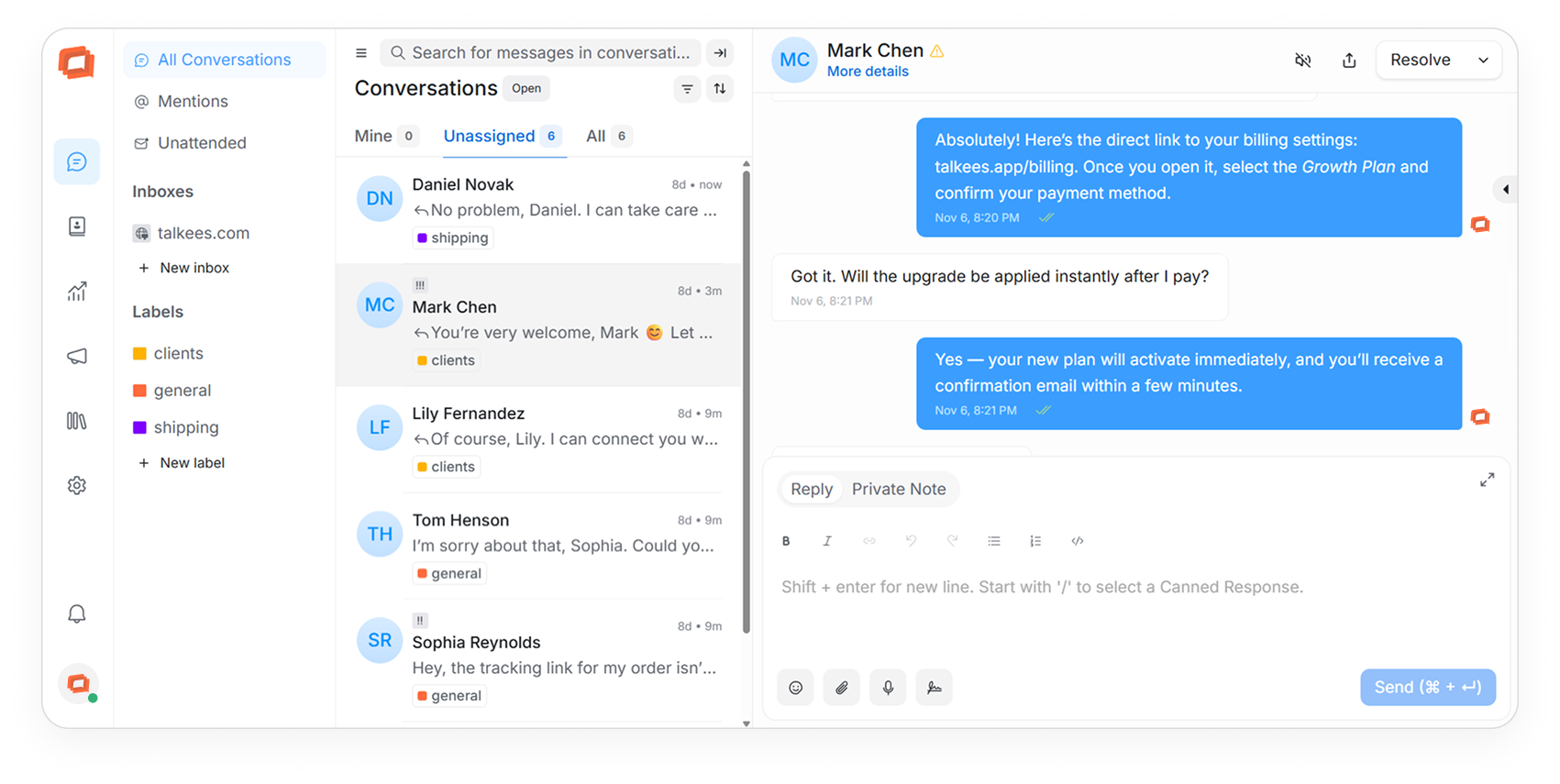
Unlike Sprinklr’s complex interface, Talkees offers a clean, intuitive workspace that new agents can master in days rather than weeks. The platform excels at merging conversations from multiple channels into a single timeline, eliminating the context switching that slows down service teams.
Real User Experiences and Reviews
Customers consistently praise Talkees for its:
- “Lightning-fast implementation compared to enterprise alternatives” (G2)
- “Intuitive interface that required minimal training for our team” (Capterra)
- “Flexible AI that we could train on our specific product knowledge” (Trustpilot)
- “Transparent pricing without surprise fees or add-ons” (G2)
Common criticisms include requests for more advanced voice analytics features and additional enterprise integration options, though these are reportedly on the product roadmap.
Advantages and Limitations
Pros:
- Significantly lower cost than Sprinklr (typically 70-80% less expensive)
- Implementation measured in days instead of months
- Intuitive interface requiring minimal training
- Flexible AI integration without proprietary limitations
- Transparent, predictable pricing model
Cons:
- Newer platform with a smaller marketplace than established competitors
- More focused on digital channels; voice capabilities still maturing
- Enterprise governance features not as extensive as Sprinklr
Our Subjective Assessment
When testing Talkees, I was immediately impressed by how quickly we could get productive. Within an hour of signing up, we had connected our support email, installed the chat widget on our test site, and created basic automation rules for common inquiries.
The AI training process was particularly impressive – we uploaded our product documentation and within a few hours had a functioning chatbot that could accurately answer about 80% of common customer questions. When the bot couldn’t resolve an issue, the handoff to human agents was smooth and preserved all context.
Zendesk: Mature Omnichannel Ticketing

Zendesk is a well-established player in the customer service space, offering robust ticketing and omnichannel support.
Detailed Pricing
- Suite Team: $55/agent/month (billed annually)
- Suite Growth: $89/agent/month
- Suite Professional: $115/agent/month
- Suite Enterprise: Custom pricing (typically $150-200/agent/month)
- Add-ons: Additional costs for advanced AI, workforce management, and certain integrations
Complete Feature List
- Unified Agent Workspace: Centralized view of customer interactions across channels
- Ticketing System: Sophisticated case management with automation rules
- Knowledge Base: Self-service portal with AI-suggested articles
- Reporting and Analytics: Comprehensive dashboards and custom reports
- App Marketplace: 1,000+ integrations and add-ons
- Voice Capabilities: Integrated call center functionality
- Workflow Automation: Trigger-based rules and macros
Zendesk’s mature platform offers rich workflows and an extensive marketplace of integrations. However, the suite pricing model and increasing administrative overhead at scale are important considerations.
Real User Experiences and Reviews
Zendesk receives praise for its:
- “Comprehensive ticketing system that scales with our business” (G2)
- “Extensive integration options with virtually every business tool” (Capterra)
- “Reliable performance even with high ticket volumes” (Trustpilot)
Common criticisms include the complexity of advanced configurations, pricing that increases significantly with add-ons, and occasional performance issues with large datasets.
Advantages and Limitations
Pros:
- Mature, battle-tested platform with extensive features
- Rich ecosystem of integrations and extensions
- Strong reporting and analytics capabilities
- Reliable performance at scale
- Established community and abundant resources
Cons:
- Suite pricing can become expensive with necessary add-ons
- Administrative overhead increases with scale
- Complex customizations often require developer resources
- Mobile experience not as strong as desktop
Our Subjective Assessment
In our testing, Zendesk impressed with its comprehensive ticketing capabilities and mature workflows. The platform feels robust and reliable – clearly the product of years of refinement. Setting up email-to-ticket functionality was straightforward, and the automation builder provides powerful options for routing and response handling.
Where Zendesk sometimes falls short is in the unified experience. Despite improvements to the Agent Workspace, there’s still a sense that you’re working with a collection of integrated products rather than a truly unified platform. This becomes more apparent when implementing advanced customizations, which often require significant technical expertise.
Salesforce Service Cloud: CRM-Native Service

Salesforce Service Cloud delivers a powerful, CRM-integrated support solution for enterprises with complex needs.
Detailed Pricing
- Starter: $25/user/month
- Professional: $100/user/month
- Enterprise: $175/user/month
- Unlimited: $350/user/month
- Agentforce 1 Service: $550/user/month
- Implementation: Typically 15-30% of first-year license costs
Complete Feature List
- Case Management: Comprehensive ticket handling with custom fields and workflows
- Einstein AI: Native AI for case classification, routing, and agent assistance
- Knowledge Management: Sophisticated article creation and management
- Field Service: Scheduling and dispatch capabilities
- 360° Customer View: Complete visibility of customer data across sales and service
- Omnichannel Routing: Intelligent distribution of work across channels
- Analytics and Reporting: Advanced dashboards and Einstein Analytics
- AppExchange: Extensive marketplace of pre-built integrations
As a CRM-native solution, Service Cloud excels at providing a complete view of customer data across departments. However, this comes with higher costs and implementation effort.
Real User Experiences and Reviews
Users highlight Salesforce Service Cloud’s:
- “Unmatched integration with sales and marketing data” (G2)
- “Powerful customization capabilities for complex workflows” (Capterra)
- “Enterprise-grade security and compliance features” (Trustpilot)
Criticisms frequently mention the steep learning curve, high implementation costs, and ongoing need for specialized administrators.
Advantages and Limitations
Pros:
- Deep integration with Salesforce CRM ecosystem
- Powerful customization and workflow capabilities
- Robust security and compliance features
- Advanced AI through Einstein
- Strong enterprise governance
Cons:
- Significantly higher cost than most alternatives
- Extended implementation timelines (typically months)
- Requires dedicated Salesforce administrators
- Complex interface with steep learning curve
Our Subjective Assessment
Salesforce Service Cloud is impressively powerful, particularly for organizations already using other Salesforce products. The ability to see a customer’s complete history across sales and service interactions creates meaningful context for agents.
During our evaluation, we found the platform’s depth both its greatest strength and challenge. The customization options seem nearly limitless, but this flexibility comes at the cost of complexity. Even basic setup requires significant configuration, and more advanced workflows demand specialized Salesforce expertise.
Freshworks: Budget-Friendly and User-Friendly

Freshworks offers a combination of Freshdesk (ticketing) and Freshchat (messaging) that delivers an intuitive, affordable alternative to Sprinklr Service.
Detailed Pricing
- Freshdesk Growth: $18/agent/month
- Freshdesk Pro: $59/agent/month
- Freshdesk Enterprise: $95/agent/month
- Freshchat: Additional $15-29/agent/month depending on tier
- Freddy AI: $35/agent/month plus usage-based fees
Complete Feature List
- Ticketing System: Email-to-ticket conversion with automation
- Live Chat: Real-time web and in-app messaging
- Knowledge Base: Self-service portal with suggested articles
- Automation Builder: Drag-and-drop workflow creation
- Social Channels: Basic integration with major social platforms
- Freddy AI: Chatbots and agent assistance
- Marketplace: 1,000+ apps and integrations
- Analytics: Out-of-the-box reports and custom dashboards
Freshworks stands out for its clean, intuitive interface and rapid implementation. While it may lack some advanced features for very high volumes, its combination of affordability and ease of use makes it compelling for many businesses.
Real User Experiences and Reviews
Customers consistently praise Freshworks for:
- “Intuitive interface that new agents can learn in hours” (G2)
- “Excellent value compared to enterprise alternatives” (Capterra)
- “Quick implementation with minimal IT support required” (Trustpilot)
Common criticisms include some limitations in handling extremely high ticket volumes and occasional routing challenges in complex scenarios.
Advantages and Limitations
Pros:
- Significantly lower cost than enterprise alternatives
- Clean, intuitive interface with minimal training required
- Rapid implementation (typically days)
- Flexible deployment options (cloud, hybrid, on-premise)
- Strong out-of-the-box reporting
Cons:
- Some scaling limitations for very high volumes
- Less advanced social listening than Sprinklr
- Requires using multiple products (Freshdesk + Freshchat) for complete coverage
- More basic workforce management capabilities
Our Subjective Assessment
During our testing, Freshworks immediately impressed with its clean, intuitive interface. Setting up email channels, automations, and the knowledge base was remarkably straightforward – tasks that often require significant configuration in enterprise platforms.
The agent experience feels thoughtfully designed, with a unified inbox that clearly shows ticket states and provides keyboard-friendly actions. New team members were able to become productive within hours rather than days or weeks.
Intercom: Conversational Support Reimagined

Intercom has evolved from a simple chat widget to a comprehensive conversational support platform with powerful AI capabilities.
Detailed Pricing
- Essential: $29/seat/month
- Advanced: $85/seat/month
- Expert: $132/seat/month
- Fin AI Agent: $0.99 per resolution (usage-based pricing)
- Additional Seats: Variable pricing based on volume
Complete Feature List
- Messenger: In-app and website chat with rich media support
- Fin AI Agent: Autonomous AI that resolves customer inquiries
- Proactive Support: Targeted outreach based on user behavior
- Product Tours: In-app guidance and onboarding
- Knowledge Base: Self-service help center
- Custom Bots: Rule-based and AI-powered automation
- Integrations: Connections to CRM, help desk, and e-commerce platforms
- Reporting: Conversation analytics and team performance metrics
Intercom excels at conversational support and proactive messaging, particularly for digital-first businesses. However, its voice capabilities are more limited than some alternatives.
Real User Experiences and Reviews
Users highlight Intercom’s:
- “Superior in-app messaging experience compared to traditional chat” (G2)
- “Powerful AI capabilities with Fin that actually resolve issues” (Capterra)
- “Excellent targeting for proactive support and announcements” (Trustpilot)
Criticisms often mention variable pricing that can become expensive at scale and more limited capabilities for traditional support channels like email and voice.
Advantages and Limitations
Pros:
- Outstanding in-app and website messaging experience
- Powerful AI with usage-based pricing model
- Excellent proactive support capabilities
- Strong product tour and onboarding features
- Modern, user-friendly interface
Cons:
- Less robust for traditional channels (email, voice)
- Pricing can escalate with high message volumes
- More limited customization than enterprise platforms
- Not as strong for complex case management
Our Subjective Assessment
Intercom’s approach to customer support feels distinctly modern and conversation-focused. The messenger experience is excellent for both customers and agents, with rich media support and a clean interface that encourages natural dialogue rather than ticket processing.
During our evaluation, Fin AI Agent was particularly impressive. Unlike many chatbots that simply follow decision trees, Fin demonstrates genuine understanding and can resolve a wide range of issues without human intervention. The pay-per-resolution model aligns costs with actual value delivered.
Genesys Cloud CX: Enterprise Digital + Voice CCaaS

Genesys Cloud CX is a comprehensive contact center platform with powerful routing, workforce engagement, and analytics capabilities.
Detailed Pricing
- CX 1: $75/user/month
- CX 2: $115/user/month
- CX 3: $155/user/month
- CX 4: $240/user/month
- Implementation: Professional services typically required (additional cost)
Complete Feature List
- Omnichannel Routing: Sophisticated distribution across all channels
- Voice Capabilities: Advanced IVR, call recording, and telephony
- Digital Channels: Email, chat, SMS, social, and messaging apps
- Workforce Engagement: Scheduling, forecasting, and quality management
- Analytics: Real-time and historical reporting with AI insights
- Designer: Visual workflow builder for customer journeys
- App Ecosystem: Pre-built integrations and custom applications
- AI Capabilities: Virtual assistants, predictive routing, and sentiment analysis
Genesys excels at enterprise contact center operations, particularly for organizations with complex routing and workforce management needs. However, this comes with premium pricing and implementation complexity.
Real User Experiences and Reviews
Users praise Genesys Cloud CX for:
- “Enterprise-grade call center capabilities with modern digital channels” (G2)
- “Superior workforce management and scheduling tools” (Capterra)
- “Reliable performance even at massive scale” (Trustpilot)
Common criticisms include the complexity of implementation, premium pricing, and steep learning curve for administrators.
Advantages and Limitations
Pros:
- Comprehensive contact center capabilities
- Excellent voice and digital channel integration
- Advanced workforce engagement management
- Sophisticated routing and queue management
- Strong security and compliance features
Cons:
- Premium pricing compared to many alternatives
- Complex implementation requiring professional services
- Steeper learning curve for administrators
- Overkill for organizations without complex voice needs
Our Subjective Assessment
Genesys Cloud CX impressed us with its comprehensive contact center capabilities. The platform feels designed for organizations with sophisticated requirements, particularly those with significant voice operations alongside digital channels.
The workforce management tools are particularly strong, with advanced forecasting, scheduling, and quality monitoring that would benefit large, distributed teams. The omnichannel routing engine provides granular control over how interactions are distributed based on skills, availability, and business rules.
NICE CXone: Full CCaaS with WFO/WEM

NICE CXone delivers a comprehensive contact center platform with industry-leading workforce optimization and compliance capabilities.
Detailed Pricing
- Enterprise pricing: Typically $100-200/agent/month depending on modules
- Implementation: Professional services required (additional cost)
- Add-ons: Additional costs for advanced analytics, quality management, and specialized features
Complete Feature List
- Omnichannel Routing: Intelligent distribution across all channels
- Workforce Optimization: Scheduling, forecasting, and performance management
- Quality Management: Call recording, screen recording, and evaluation
- Analytics: Speech and text analytics with AI-driven insights
- Automation: Process automation and workflow management
- Compliance: Advanced recording and security features
- CRM Integration: Pre-built connectors for major platforms
- Self-Service: IVR, chatbots, and knowledge management
NICE CXone stands out for its powerful analytics and compliance features, making it particularly suitable for regulated industries and large contact centers.
Real User Experiences and Reviews
Users highlight NICE CXone’s:
- “Comprehensive workforce optimization and quality management” (G2)
- “Superior speech analytics and conversation intelligence” (Capterra)
- “Robust compliance features for regulated industries” (Trustpilot)
Criticisms frequently mention the steep learning curve, enterprise pricing, and complex implementation process.
Advantages and Limitations
Pros:
- Industry-leading workforce optimization
- Powerful analytics for speech and text
- Strong compliance and security features
- Comprehensive omnichannel capabilities
- Robust quality management
Cons:
- Enterprise pricing that can be prohibitive for smaller organizations
- Steeper learning curve than many alternatives
- Complex implementation requiring specialized expertise
- Administrative overhead for ongoing management
Our Subjective Assessment
NICE CXone delivers impressive capabilities for enterprise contact centers, particularly in workforce optimization and analytics. The platform’s ability to capture, analyze, and derive insights from conversations across channels provides valuable intelligence for improving operations.
During our evaluation, the quality management capabilities stood out as particularly strong. The ability to record, evaluate, and coach based on actual customer interactions creates powerful opportunities for performance improvement.
The implementation process is notably more complex than many alternatives, typically requiring specialized expertise and professional services. The administrative interface, while comprehensive, demands significant training and ongoing attention.
Talkdesk: Modern CCaaS with Rapid Innovation

Talkdesk offers a modern cloud contact center platform with AI-driven features and a strong focus on innovation.
Detailed Pricing
- Enterprise: Typically $65-125/user/month depending on features
- Elite: Custom pricing for advanced features
- Implementation: Professional services often recommended (additional cost)
- Add-ons: Additional costs for specialized AI and analytics features
Complete Feature List
- Omnichannel Routing: Intelligent distribution across voice and digital channels
- AI Capabilities: Virtual agent, agent assist, and conversation analytics
- Workforce Management: Scheduling, forecasting, and adherence
- Quality Management: Recording, monitoring, and evaluation
- App Ecosystem: 60+ pre-built integrations and custom applications
- Self-Service: IVR, chatbots, and knowledge management
- Analytics: Real-time and historical reporting with AI insights
- CRM Integration: Deep connections with major platforms
Talkdesk combines modern technology with rapid innovation, particularly in AI and automation. While some features are still maturing, the platform’s trajectory is impressive.
Real User Experiences and Reviews
Users praise Talkdesk for:
- “Modern, intuitive interface compared to legacy contact center solutions” (G2)
- “Rapid deployment compared to traditional CCaaS platforms” (Capterra)
- “Innovative AI features that deliver real efficiency gains” (Trustpilot)
Common criticisms include some features still maturing and occasional inconsistencies in newer capabilities.
Advantages and Limitations
Pros:
- Modern, cloud-native architecture
- Strong innovation, particularly in AI
- Solid app ecosystem and integrations
- More intuitive than many enterprise CCaaS platforms
- Faster deployment than traditional contact center solutions
Cons:
- Some features still maturing compared to established competitors
- Variable experience depending on region and specific capabilities
- Enterprise pricing that may be challenging for smaller organizations
- Professional services often needed for optimal implementation
Our Subjective Assessment
Talkdesk impressed us with its modern approach to contact center technology. The platform feels designed for contemporary operations, with a clean interface and strong focus on agent experience.
During our evaluation, the AI capabilities stood out as particularly promising. The agent assist features provide contextual guidance without being intrusive, and the conversation analytics offer valuable insights for improving performance.
Implementation is more straightforward than many enterprise contact center platforms, though professional services are still recommended for complex deployments. The administrative interface strikes a good balance between power and usability.
Five9: Proven Cloud Contact Center

Five9 delivers a reliable cloud contact center platform with strong voice capabilities and a growing digital portfolio.
Detailed Pricing
- Core: Typically $100-150/agent/month
- Complete: Custom pricing for advanced features
- Implementation: Professional services recommended (additional cost)
- Add-ons: Additional costs for digital channels, AI, and specialized features
Complete Feature List
- Voice Capabilities: Advanced IVR, call recording, and telephony
- Digital Channels: Email, chat, SMS, and social
- Workforce Management: Scheduling, forecasting, and adherence
- Intelligent Routing: Skills-based and context-aware distribution
- IVR and Self-Service: Voice and digital automation
- Outbound Campaigns: Predictive dialing and campaign management
- Analytics: Real-time and historical reporting
- CRM Integration: Pre-built connectors for major platforms
Five9 excels in voice contact center operations with a growing portfolio of digital capabilities. The platform is particularly strong for organizations with significant outbound and inbound voice requirements.
Real User Experiences and Reviews
Users highlight Five9’s:
- “Reliable voice quality and call handling capabilities” (G2)
- “Strong outbound campaign management” (Capterra)
- “Solid integration with major CRM platforms” (Trustpilot)
Criticisms often mention the need for add-ons to achieve comprehensive digital capabilities and knowledge management.
Advantages and Limitations
Pros:
- Proven reliability for voice operations
- Strong IVR and voice self-service
- Excellent outbound campaign capabilities
- Solid workforce management
- Established integration ecosystem
Cons:
- Digital channels often require add-ons
- Knowledge management less developed than some alternatives
- Administrative interface less modern than newer competitors
- Implementation typically requires professional services
Our Subjective Assessment
Five9 delivers reliable contact center capabilities with particular strength in voice operations. The platform feels designed by people who understand the practical needs of contact centers, with features that address real operational challenges.
During our evaluation, the voice capabilities impressed with their reliability and feature depth. The IVR builder provides powerful options for self-service, and the outbound dialing capabilities are particularly strong for sales and collections operations.
The digital channels, while improving, still feel somewhat secondary to voice in the overall platform design. Organizations with primarily digital support requirements may find other alternatives more naturally suited to their needs.
Amazon Connect: AWS-Native, Pay-As-You-Go Solution

Amazon Connect offers a flexible, pay-as-you-go contact center built on AWS technologies with powerful AI capabilities.
Detailed Pricing
- Usage-based: Pay only for what you use (no per-agent license fees)
- Voice: $0.018 per minute for inbound calls, $0.018 per minute for outbound calls
- Chat: $0.004 per message
- Amazon Lex: $0.00075 per request for chatbots
- Amazon Kendra: Starting at $0.35 per hour for knowledge bases
- Implementation: AWS expertise required (internal or partner)
Complete Feature List
- Voice Capabilities: Call handling, recording, and telephony
- Chat: Web and in-app messaging
- Amazon Lex: Natural language understanding for bots
- Amazon Kendra: Intelligent search for knowledge bases
- Lambda Integration: Custom functionality with serverless computing
- Analytics: Real-time and historical metrics
- Pay-As-You-Go: Usage-based pricing model
- AWS Integration: Deep connection to AWS services
Amazon Connect stands out for its flexible pricing model and integration with AWS services. However, it requires more technical expertise to implement and customize effectively.
Real User Experiences and Reviews
Users praise Amazon Connect for:
- “Flexible, usage-based pricing that scales with actual demand” (G2)
- “Powerful integration with AWS AI services” (Capterra)
- “Excellent reliability and global availability” (Trustpilot)
Common criticisms include the need for AWS expertise, more DIY implementation compared to turnkey solutions, and less comprehensive out-of-the-box functionality.
Advantages and Limitations
Pros:
- Usage-based pricing with no per-agent licenses
- Seamless integration with AWS services
- Powerful AI through Amazon Lex and other services
- Excellent scalability and reliability
- Global availability through AWS infrastructure
Cons:
- Requires AWS expertise for effective implementation
- More DIY approach than turnkey solutions
- Less comprehensive out-of-the-box functionality
- Administrative interface less intuitive for non-technical users
- Feature development may require custom Lambda functions
Our Subjective Assessment
Amazon Connect offers a distinctly different approach to contact center technology with its usage-based pricing and AWS-native architecture. For organizations with AWS expertise, the platform provides powerful capabilities with excellent flexibility and cost efficiency.
During our evaluation, the pricing model stood out as particularly attractive for operations with variable volume. Unlike traditional per-agent licensing, Connect charges only for actual usage, potentially offering significant savings for organizations with fluctuating demand.
The integration with AWS services like Lex (for chatbots) and Kendra (for knowledge bases) provides powerful AI capabilities. However, implementing these effectively requires more technical expertise than many turnkey solutions.
Choosing the Right Alternative for Your Needs

After reviewing these top Sprinklr Service alternatives, how do you determine which is right for your specific requirements? Consider these key scenarios:
For E-commerce Live Chat and Customer Support
If you’re primarily focused on e-commerce support with live chat and messaging:
- Talkees offers the ideal combination of quick implementation, e-commerce integrations, and AI capabilities at an affordable price point.
- Intercom provides excellent in-app and website messaging with powerful proactive capabilities.
- Freshworks delivers a user-friendly experience with strong ticketing and knowledge management.
For SMB Omnichannel Support
Small and medium businesses seeking comprehensive support across multiple channels should consider:
- Freshworks for its intuitive interface, rapid implementation, and excellent value.
- Talkees for its modern, chat-first approach with strong AI capabilities.
- Zendesk for its mature ticketing system and extensive marketplace.
For AI-First Support Projects
Organizations prioritizing AI and automation should evaluate:
- Intercom for its Fin AI Agent with usage-based pricing.
- Talkees for its open AI integrations and flexible training options.
- Amazon Connect for its powerful AWS AI services (Lex, Kendra).
For Teams Migrating from Sprinklr Service
If you’re specifically looking to replace Sprinklr Service:
- Talkees offers a modern alternative with faster implementation and significantly lower cost.
- Zendesk provides mature ticketing with a comprehensive feature set.
- Genesys Cloud CX or NICE CXone deliver enterprise-grade capabilities for complex requirements.
The most successful migrations typically take a phased approach over 30-90 days, depending on complexity. Working with your new vendor’s implementation team to develop a detailed migration plan is essential for minimizing disruption.
Choosing the right Sprinklr Service alternative depends on your specific business requirements, budget constraints, and technical resources. Whether you prioritize rapid implementation, AI capabilities, comprehensive omnichannel support, or cost efficiency, this guide provides the essential information to make an informed decision.
For most SMBs and e-commerce operations seeking a modern, flexible alternative to Sprinklr Service, Talkees offers an excellent combination of functionality, ease of use, and value. Its chat-first approach, open AI integrations, and transparent pricing make it particularly well-suited for organizations looking to move quickly without sacrificing capabilities.