 English
 Slovenčina
 Français
 Magyar

Key Features to Look for in Ada Competitors

Before diving into specific alternatives, it’s important to understand what makes a strong Ada competitor. The best platforms offer:
- Omnichannel support: Look for solutions that seamlessly handle web chat, email, social media, and messaging apps like WhatsApp and Instagram.
- Effective live chat + AI integration: The platform should blend automated responses with smooth human handoffs when needed.
- Deep integrations: Essential connections with your e-commerce platform (Shopify, WooCommerce, Magento), CRM systems, and business tools.
- Transparent pricing: Clear cost structures without hidden fees or unexpected charges as you scale.
Let’s examine how we evaluated these Ada alternatives to ensure you find the right fit for your business.
Evaluating Ada Alternatives: Our Comparison Criteria

We’ve assessed each Ada competitor based on several critical factors:
- Time-to-value: How quickly can you deploy and see results?
- Automation and deflection rates: What percentage of inquiries can be resolved without human intervention?
- Total cost of ownership (TCO): Beyond subscription fees, what’s the full investment required?
- Scalability: How well does the platform grow with your business?
- Analytics depth: What insights can you gain from customer interactions?
- Security and compliance: What protections are in place for your data?
Understanding these criteria will help you make a more informed decision as you compare Ada alternatives.
Talkees vs Ada: Modern Omnichannel Live Chat + AI

Talkees stands out as a powerful Ada alternative, offering a modern approach to customer support that combines live chat capabilities with advanced AI.
Detailed Pricing Overview
- Free Plan: Limited features for small businesses to test the platform
- Growth Plan: $49/month for up to 1,000 conversations
- Business Plan: $149/month for up to 5,000 conversations
- Enterprise Plan: Custom pricing for high-volume needs with dedicated support
Unlike Ada’s often opaque pricing structure, Talkees offers transparent conversation-based pricing without hidden fees or per-resolution charges that can unexpectedly inflate costs.
Complete Feature List
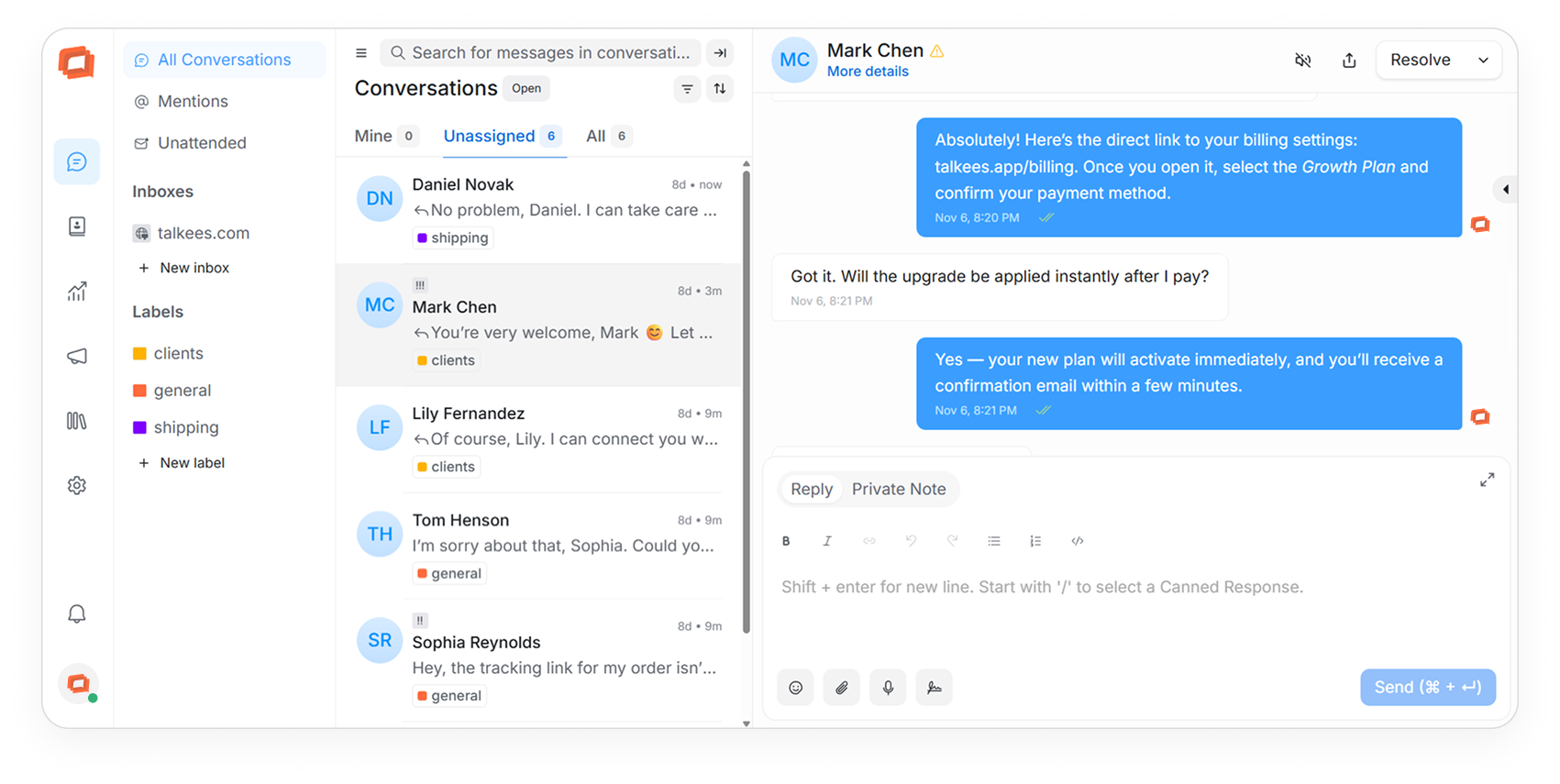
- Omnichannel inbox: Unified dashboard for web, mobile, WhatsApp, Instagram, and email
- AI automation: Powerful chatbot with retrieval-augmented generation (RAG) for accurate answers
- Knowledge base integration: Connects with your existing help center, Notion, or Confluence
- Seamless handoffs: Context preservation when transferring from AI to human agents
- Custom AI integration: Build your own workflows with flexible LLM options
- Analytics dashboard: Track performance metrics, conversation trends, and customer satisfaction
- Developer-friendly: Open APIs and webhook support for custom integrations
Talkees differentiates itself from Ada by offering faster implementation (days vs weeks), more flexible pricing, and a more intuitive interface for both administrators and agents.
Real User Experiences and Reviews
Users consistently praise Talkees for its ease of setup and natural-feeling AI conversations:
“We switched from Ada to Talkees and cut our customer support costs by 35% while improving our CSAT scores. The implementation took just three days compared to the weeks we spent setting up Ada.” – E-commerce Operations Director
According to G2 and Capterra reviews, Talkees users particularly appreciate the quality of AI responses and the smooth transition between automated and human support.
Advantages and Disadvantages
Pros:
- Fast implementation (typically 2-5 days)
- Transparent, predictable pricing
- Excellent knowledge base integration
- Superior handoff experience
- Intuitive interface requiring minimal training
Cons:
- Newer platform with a growing integration marketplace
- Advanced customization may require developer resources
- Limited voice/phone support options compared to enterprise solutions
Our Subjective Assessment
During our testing, Talkees impressed us with its natural conversational flow and accurate responses. The setup process was remarkably straightforward—we connected our knowledge base and had a working AI chatbot answering customer queries within hours.
What surprised us most was how well the AI understood complex questions and maintained context throughout conversations. The handoff to human agents was particularly smooth, with all conversation history and customer details preserved.
For businesses looking to move away from Ada, Talkees offers a refreshing combination of powerful features and transparent pricing that makes it our top recommendation, especially for e-commerce and SMB support teams.
Intercom vs Ada: Product-Led Support with Fin Chatbot

Intercom offers a comprehensive customer messaging platform with its AI assistant, Fin, as a direct competitor to Ada.
Detailed Pricing Overview
- Starter: $74/month (includes basic chatbot)
- Growth: $139/month (enhanced capabilities)
- Scale & Enterprise: Custom pricing
- Fin AI: $0.99 per resolved conversation (on top of base subscription)
The per-resolution pricing model for Fin can become expensive at scale—50,000 monthly resolutions would cost approximately $49,500/month just for the AI component.
Complete Feature List
- Conversational support: Live chat, chatbots, and help center in one platform
- Fin AI: Advanced AI chatbot with intent recognition
- Product tours: Guide users through your product
- Outbound messaging: Proactive engagement and announcements
- Team inbox: Collaborative customer communication
- Customer data platform: Rich user profiles and segmentation
- A/B testing: Optimize messaging and support flows
- App integrations: Connect with 400+ tools including Shopify, Stripe, and Zendesk
Real User Experiences and Reviews
Users report that Intercom’s Fin AI achieves 60-70% automated resolution rates, though this varies by industry and use case. The platform receives high marks for its unified approach to customer communication.
“Intercom’s interface is intuitive, but we found the per-resolution pricing model became prohibitively expensive as our customer base grew.” – SaaS Customer Success Manager
Advantages and Disadvantages
Pros:
- Comprehensive platform beyond just chatbot functionality
- Strong product-led growth features
- Excellent mobile SDK for in-app messaging
- Robust segmentation and targeting
Cons:
- Per-resolution pricing can become expensive at scale
- More complex to implement than some alternatives
- Some advanced features restricted to higher tiers
Our Subjective Assessment
In our testing, Intercom impressed us with its polished interface and comprehensive approach to customer engagement. The Fin chatbot demonstrated strong understanding of customer queries and provided relevant responses.
However, we found the per-resolution pricing model concerning for high-volume scenarios. While the platform excels for product-led companies that need more than just support functionality, businesses primarily focused on customer service might find more cost-effective options elsewhere.
Drift vs Ada: B2B Revenue Chat and Meeting Scheduling

Drift positions itself as a “Revenue Acceleration Platform” with a focus on converting website visitors into sales opportunities.
Detailed Pricing Overview
- Free: Limited features
- Premium: Starting at $2,500/month (annual billing)
- Advanced: Starting at $5,000/month
- Enterprise: Custom pricing
Drift’s pricing is significantly higher than many Ada alternatives, reflecting its focus on enterprise B2B companies.
Complete Feature List
- Conversational marketing: AI-powered chatbots for lead qualification
- Automated booking: Calendar integration for meeting scheduling
- Account-based marketing: Target specific accounts with personalized experiences
- Custom playbooks: Tailored conversation flows for different visitor segments
- Visitor intelligence: Real-time insights about website visitors
- Sales acceleration tools: Live view, routing, and notifications
- Analytics and attribution: Track conversation impact on revenue
- Enterprise security: SOC 2 Type II compliance and advanced security features
Real User Experiences and Reviews
Drift users consistently highlight its impact on sales pipeline and meeting bookings. B2B companies report significant increases in qualified leads and shortened sales cycles.
“Drift transformed our website from a passive information resource to an active sales channel. The ROI is clear, though the platform requires significant investment.” – B2B Marketing Director
Advantages and Disadvantages
Pros:
- Powerful lead qualification capabilities
- Seamless meeting scheduling
- Strong ABM features for enterprise B2B
- Robust analytics for revenue attribution
Cons:
- High price point compared to other Ada alternatives
- Primary focus on sales rather than customer support
- Steep learning curve for configuration
Our Subjective Assessment
When testing Drift, we were impressed by its ability to qualify leads and schedule meetings automatically. The platform clearly excels at converting website traffic into sales opportunities.
However, Drift’s focus and price point make it most suitable for B2B companies with substantial marketing budgets rather than businesses primarily seeking customer support automation. If your main goal is generating sales meetings rather than handling support inquiries, Drift could be worth the investment.
Zendesk vs Ada: Ticketing-First CX Suite with Bot Builder

Zendesk offers a comprehensive customer service platform with AI capabilities through its Answer Bot and Flow Builder.
Detailed Pricing Overview
- Suite Team: $49/agent/month (basic bot capabilities)
- Suite Growth: $79/agent/month
- Suite Professional: $99/agent/month
- Enterprise: $150/agent/month
- AI add-ons: Additional fees apply for advanced AI features
Zendesk’s agent-based pricing is straightforward but can become expensive for large support teams.
Complete Feature List
- Unified agent workspace: Manage tickets from all channels in one place
- Answer Bot: AI-powered self-service using your knowledge base
- Flow Builder: No-code bot creation tool
- Omnichannel support: Email, chat, voice, social media, and messaging
- Knowledge base: Create and manage help center content
- Reporting and analytics: Track team performance and customer satisfaction
- Sunshine platform: Customize and extend Zendesk functionality
- Marketplace: 1,000+ integrations with other business tools
Real User Experiences and Reviews
Zendesk users appreciate the platform’s comprehensive approach to customer service and its mature ticketing system. The Answer Bot receives positive feedback for its ability to deflect simple inquiries.
“Zendesk’s strength is its unified approach to customer service across channels. The AI capabilities are good but not the primary reason to choose the platform.” – Customer Experience Director
Advantages and Disadvantages
Pros:
- Comprehensive customer service platform
- Strong ticketing and case management
- Extensive integration marketplace
- Mature, reliable infrastructure
Cons:
- AI capabilities less advanced than specialized chatbot platforms
- Agent-based pricing can be expensive for large teams
- More complex implementation than chat-only solutions
Our Subjective Assessment
During our evaluation, Zendesk impressed us with its comprehensive approach to customer service. The platform’s strength lies in its unified agent experience and robust ticketing system rather than its AI capabilities.
For organizations already using Zendesk for customer support, the built-in AI features provide a convenient way to add automation. However, businesses specifically looking for advanced AI chatbot functionality might find more sophisticated options among other Ada alternatives.
Forethought vs Ada: Triage, Solve, Assist—AI Support Automation Stack

Forethought offers an AI platform designed specifically for customer support automation with three main components: Triage, Solve, and Assist.
Detailed Pricing Overview
- Pricing model: Custom pricing based on ticket volume and selected modules
- Typical range: Enterprise-level pricing starting at approximately $50,000/year
As an enterprise solution, Forethought doesn’t publish standard pricing, but it’s positioned as a premium offering.
Complete Feature List
- Triage: Automatically categorize and route incoming tickets
- Solve: AI-powered self-service for customer inquiries
- Assist: Agent recommendations and knowledge suggestions
- Multilingual support: Handle inquiries in multiple languages
- Omnichannel capabilities: Support across email, chat, and other channels
- Analytics dashboard: Track deflection rates and AI performance
- Enterprise security: SOC 2 Type II compliance and data protection
- Custom AI training: Tailored to your specific knowledge base and industry
Real User Experiences and Reviews
Enterprise users report that Forethought can achieve 30-50% ticket deflection rates after proper implementation and training. The platform receives praise for its accuracy in complex support environments.
“Forethought’s AI demonstrated an impressive understanding of our product’s technical nuances. The implementation required significant effort but delivered measurable ROI.” – Enterprise Support Director
Advantages and Disadvantages
Pros:
- Sophisticated AI designed specifically for customer support
- Strong capabilities for complex products and services
- Comprehensive approach to support automation
- Enterprise-grade security and compliance
Cons:
- High price point suitable only for larger organizations
- Significant implementation effort required
- Less transparent pricing compared to some alternatives
Our Subjective Assessment
In our evaluation, Forethought demonstrated impressive capabilities for understanding and resolving complex customer inquiries. The platform’s three-pronged approach to support automation provides a comprehensive solution for large support organizations.
However, the enterprise focus and pricing make Forethought most suitable for larger organizations with complex products and substantial support volumes. Smaller businesses would likely find better value in more accessible alternatives.
LivePerson vs Ada: Large-Scale Messaging and Voice for Regulated Industries

LivePerson offers an enterprise conversational AI platform with particular strength in large-scale messaging and voice applications.
Detailed Pricing Overview
- Pricing model: Custom enterprise pricing based on usage and selected capabilities
- Typical implementation: Six-figure annual contracts for full enterprise deployment
As an enterprise platform, LivePerson requires custom quotes based on specific business needs.
Complete Feature List
- Conversational Cloud: Platform for messaging across channels
- Intent Manager: AI-powered intent recognition and routing
- Conversation Builder: No-code bot development tool
- Voice AI: Voice bot capabilities and IVR integration
- Agent Workspace: Unified console for human agents
- Performance Optimizer: Analytics and optimization tools
- Conversation Analytics: Insights from customer interactions
- Regulated industry solutions: Specialized offerings for financial services, healthcare, etc.
Real User Experiences and Reviews
Large enterprise users report that LivePerson excels at handling high volumes of conversations across multiple channels. The platform receives strong reviews for its scalability and reliability in demanding environments.
“LivePerson handled our peak volumes without issue, which was a critical requirement for our retail business. The implementation was complex but well-supported by their professional services team.” – Retail Operations VP
Advantages and Disadvantages
Pros:
- Enterprise-grade scalability for high volumes
- Strong voice capabilities alongside messaging
- Robust controls for regulated industries
- Sophisticated intent recognition
Cons:
- High cost suitable only for larger organizations
- Complex implementation requiring professional services
- Less agile than newer platforms
Our Subjective Assessment
During our evaluation, LivePerson impressed us with its ability to handle large-scale messaging operations and its robust voice capabilities. The platform’s strength in regulated industries is evident in its security features and compliance controls.
However, the enterprise focus, complex implementation, and high cost make LivePerson most appropriate for large organizations with significant conversation volumes or strict regulatory requirements. Smaller businesses would likely find better value and faster implementation with other Ada alternatives.
Kore.ai vs Ada: Enterprise Conversational AI and Voice IVAs

Kore.ai provides an enterprise-grade conversational AI platform with a focus on sophisticated virtual assistants for both digital and voice channels.
Detailed Pricing Overview
- Pricing model: Enterprise custom pricing
- Typical range: Mid-six figures annually for full implementation
- Factors: Conversation volume, channels, use cases, and professional services
As an enterprise solution, Kore.ai requires custom quotes based on specific deployment requirements.
Complete Feature List
- XO Platform: End-to-end conversational AI development environment
- Digital and voice assistants: Unified platform for chat and voice bots
- Low-code bot builder: Visual design studio with pre-built components
- SmartAssist: AI-powered agent assistance
- Conversation analytics: Insights and optimization tools
- Enterprise integrations: Pre-built connectors for major enterprise systems
- Governance and compliance: Tools for managing AI at scale
- Multilingual capabilities: Support for 100+ languages
Real User Experiences and Reviews
Enterprise customers highlight Kore.ai’s sophisticated capabilities for complex use cases and its ability to handle both digital and voice interactions within a unified platform.
“Kore.ai’s voice capabilities set it apart from many competitors. We were able to automate both chat and phone interactions using the same underlying AI models.” – Financial Services Technology Director
Advantages and Disadvantages
Pros:
- Sophisticated AI for complex enterprise scenarios
- Strong voice capabilities alongside digital channels
- Comprehensive governance and compliance tools
- Extensive enterprise integration options
Cons:
- High cost and complex implementation
- Requires significant resources to fully utilize
- Overkill for simple customer support automation
Our Subjective Assessment
In our evaluation, Kore.ai demonstrated impressive capabilities for handling complex conversational scenarios across both digital and voice channels. The platform’s governance tools and enterprise integrations reflect its focus on large organization deployments.
However, the enterprise focus, complex implementation requirements, and high cost make Kore.ai most suitable for large organizations with sophisticated needs spanning multiple channels and use cases. Smaller businesses or those with straightforward support requirements would likely find better value in more accessible alternatives.
Yellow.ai vs Ada: Multilingual CX Automation with Broad Channel Coverage

Yellow.ai offers a comprehensive conversational AI platform with particular strengths in multilingual support and broad channel coverage.
Detailed Pricing Overview
- Free tier: Limited functionality for exploration
- Enterprise pricing: Custom quotes based on use cases and volume
- Typical factors: Number of channels, conversation volume, custom integrations
Yellow.ai offers a free tier for exploration but requires custom quotes for full enterprise implementation.
Complete Feature List
- Dynamic AI Agents: No-code bot builder with pre-built templates
- Multilingual support: Native capabilities for 135+ languages
- Omnichannel deployment: Support for 35+ channels including messaging, voice, and email
- DynamicNLP: Natural language understanding engine
- Agent Assist: AI-powered suggestions for human agents
- Analytics suite: Comprehensive performance insights
- Enterprise integrations: Pre-built connectors for CRM, ticketing, and business systems
- Industry solutions: Specialized templates for various verticals
Real User Experiences and Reviews
Users praise Yellow.ai’s multilingual capabilities and broad channel support, noting that the platform excels at providing consistent experiences across diverse customer touchpoints.
“Yellow.ai’s language capabilities were crucial for our global operations. We deployed in 12 languages with minimal additional effort, which would have been much more complex on other platforms.” – Global Customer Experience Manager
Advantages and Disadvantages
Pros:
- Exceptional multilingual capabilities
- Extensive channel coverage
- Strong industry-specific templates
- Good balance of no-code and customization options
Cons:
- Enterprise pricing can be substantial
- Implementation complexity for advanced use cases
- Less transparent pricing compared to some alternatives
Our Subjective Assessment
During our testing, Yellow.ai impressed us with its language capabilities and the breadth of channels it supports. The platform’s pre-built templates accelerated implementation, while still allowing for customization where needed.
For organizations with multilingual requirements or the need to support a wide variety of channels, Yellow.ai presents a compelling option. The platform strikes a good balance between accessibility and sophisticated capabilities, though the enterprise pricing model may put it out of reach for smaller businesses.
IBM watsonx Assistant vs Ada: Foundation Model Choice with Enterprise Governance

IBM watsonx Assistant offers a sophisticated conversational AI platform built on IBM’s foundation models with strong enterprise governance features.
Detailed Pricing Overview
- Pricing model: Usage-based with tiered options
- Factors: API calls, messages, active users
- Enterprise arrangements: Custom pricing for large deployments
IBM offers both pay-as-you-go options and enterprise agreements for larger implementations.
Complete Feature List
- Foundation model options: Choose from various AI models based on needs
- Guardrails: Controls to ensure appropriate AI responses
- Visual conversation builder: No-code interface for bot creation
- Enterprise integration: Connect with existing systems and data sources
- Multi-channel deployment: Web, mobile, messaging platforms, and voice
- Analytics and insights: Monitor performance and identify improvement areas
- Deployment flexibility: Cloud, on-premises, or hybrid options
- Enterprise governance: Comprehensive controls for AI management
Real User Experiences and Reviews
Enterprise users highlight IBM watsonx Assistant’s strengths in governance, compliance, and integration with existing IBM ecosystems. The platform receives praise for its flexibility in deployment options.
“For our regulated industry, IBM’s governance controls and deployment flexibility were decisive factors. The ability to deploy on-premises addressed our data residency requirements.” – Healthcare IT Director
Advantages and Disadvantages
Pros:
- Strong enterprise governance and compliance
- Flexible deployment options (cloud, on-prem, hybrid)
- Sophisticated AI model selection
- Deep integration with IBM ecosystem
Cons:
- Complex implementation requiring specialized skills
- Higher cost compared to newer cloud-only alternatives
- IBM ecosystem focus may limit some integrations
Our Subjective Assessment
In our evaluation, IBM watsonx Assistant demonstrated impressive capabilities for enterprises with strict governance requirements or complex deployment needs. The platform’s foundation model options provide flexibility for different use cases, while the governance controls ensure responsible AI use.
However, the enterprise focus, implementation complexity, and potential costs make IBM watsonx Assistant most suitable for larger organizations, particularly those already invested in the IBM ecosystem or with specific compliance requirements that demand deployment flexibility.
Amazon Lex vs Ada: AWS-Native Bots with Pay-Per-Request Pricing

Amazon Lex provides a conversational interface building service that’s deeply integrated with the AWS ecosystem, offering a developer-friendly approach to chatbot creation.
Detailed Pricing Overview
- Pay-per-request model: $0.75 per 1,000 text requests, $2.50 per 1,000 speech requests
- No minimum fees or upfront commitments
- Free tier: 10,000 text requests and 5,000 speech requests per month for the first year
Amazon Lex’s transparent usage-based pricing makes it accessible for projects of any size, though implementation requires technical resources.
Complete Feature List
- Natural language understanding: Intent recognition and entity extraction
- Speech recognition: Convert speech to text for voice interfaces
- AWS Lambda integration: Execute business logic in response to user inputs
- Amazon Connect integration: Create voice contact center experiences
- Multi-language support: Build bots in multiple languages
- Session management: Maintain context throughout conversations
- Deployment options: Web, mobile, messaging, IoT devices
- Analytics: Track usage patterns and bot performance
Real User Experiences and Reviews
Developers praise Amazon Lex’s integration with the AWS ecosystem and its cost-effective pricing model. The platform receives strong reviews for its scalability and reliability.
“Lex’s pay-per-request pricing allowed us to start small and scale gradually without large upfront costs. The deep integration with other AWS services simplified our architecture.” – Cloud Solutions Architect
Advantages and Disadvantages
Pros:
- Cost-effective usage-based pricing
- Seamless integration with AWS ecosystem
- Highly scalable infrastructure
- Developer-friendly approach
Cons:
- Requires technical resources to implement
- Less business-user friendly than no-code alternatives
- Limited pre-built templates compared to specialized platforms
Our Subjective Assessment
During our testing, Amazon Lex impressed us with its technical capabilities and seamless integration with the broader AWS ecosystem. The platform’s pay-per-request pricing model provides excellent cost control and scalability.
However, Lex’s developer-centric approach makes it less accessible to business users compared to no-code alternatives. Organizations with technical resources and existing AWS investments will find Lex a powerful and cost-effective option, while those seeking rapid business-user deployment might prefer more accessible alternatives.
Choosing the Right Ada Alternative for Your Business

After reviewing these top Ada alternatives, it’s clear that the best choice depends on your specific business needs, technical resources, and budget constraints.
For most businesses seeking a balance of powerful features, ease of implementation, and transparent pricing, Talkees stands out as our top recommendation. Its modern omnichannel approach, flexible AI integration, and predictable pricing model address many of the common pain points that drive users to seek Ada alternatives.
Which Alternative Fits Your Use Case?
- E-commerce stores: Talkees, Yellow.ai, or Intercom offer strong integrations with e-commerce platforms and excellent customer engagement features.
- SMB support teams: Talkees, Amazon Lex, or Intercom provide accessible entry points with scalable pricing models.
- Enterprise contact centers: LivePerson, Kore.ai, or IBM watsonx Assistant deliver the governance, compliance, and scalability required for large operations.
- AI-first projects: Forethought, Kore.ai, or IBM watsonx Assistant offer sophisticated AI capabilities for organizations prioritizing advanced automation.
Implementation Considerations
Whichever platform you choose, consider these key factors for a successful implementation:
- Start with a proof-of-value: Run a 14-day pilot to validate the platform against your specific use cases and success metrics.
- Integrate your knowledge base: Ensure your existing help content is accessible to the AI.
- Define clear handoff protocols: Establish when and how conversations should transfer to human agents.
- Monitor key metrics: Track automated resolution rate, customer satisfaction, and cost per resolution.
- Iterate and optimize: Continuously improve your implementation based on actual performance data.
By carefully evaluating these Ada alternatives against your specific requirements, you can find a platform that delivers better value, more transparent pricing, and a superior customer experience.