 English
 Slovenčina
 Français
 Magyar

Why Users Seek Help.center Alternatives: Pricing, AI Limitations, and Omnichannel Gaps

Many teams are exploring alternatives to Help.center due to several common pain points. While Help.center offers solid functionality, businesses often hit limitations as they scale or require more specialized features.
The primary reasons teams look beyond Help.center include:
- Pricing ceilings and unpredictable costs: As teams grow, per-agent pricing models can lead to budget constraints, especially when essential features are locked behind expensive add-ons.
- AI functionality limitations: Many businesses need more advanced AI capabilities for ticket automation, knowledge base management, and customer self-service.
- Live chat reliability issues: During high-volume periods, some users experience performance degradation and availability problems.
- Omnichannel support gaps: Modern customer service requires seamless integration across email, chat, social media, and messaging platforms—an area where some teams find Help.center lacking.
- Knowledge base and self-service limitations: As content grows, teams need more robust search, organization, and automation tools.
Before diving into alternatives, let’s examine what today’s support teams need from a modern help center solution.
Essential Features of Help.center Competitors in 2026

When evaluating Help.center alternatives, look for these must-have features that define modern customer support platforms:
AI-Native Live Chat and Support
The best platforms now offer AI capabilities built into the core product rather than as expensive add-ons:
- AI-powered ticket triage and routing
- Automated responses for common questions
- Sentiment analysis to prioritize urgent issues
- AI-assisted agent suggestions based on knowledge base content
- Conversation summarization to speed up handoffs
Unified Inbox for True Omnichannel Support
Top alternatives provide a single interface that consolidates:
- Email, live chat, and messaging (WhatsApp, Facebook, etc.)
- Social media conversations (Twitter/X, Instagram, LinkedIn)
- Voice and SMS integration
- Internal collaboration tools (Slack, Microsoft Teams)
Knowledge Base Automation
Advanced knowledge management features include:
- AI-powered search with semantic understanding
- Automatic content suggestions based on customer queries
- Content gap identification and article recommendations
- Self-service deflection analytics
- Multi-language support and automatic translation
Open APIs and Integration Capabilities
Modern platforms should offer:
- Robust REST APIs with good documentation
- Webhook support for real-time events
- Pre-built integrations with popular tools (CRM, e-commerce, etc.)
- Custom field mapping and data synchronization
Transparent Pricing
Look for platforms that provide:
- Clear per-agent or flat pricing with no hidden fees
- Predictable costs as you scale
- Reasonable AI usage policies without prohibitive overage charges
- Free tiers or trials for proper evaluation
Painless Migration
The best alternatives make switching easy with:
- Data migration tools for tickets, contacts, and knowledge base content
- SEO-preserving redirects for public knowledge base content
- Step-by-step migration guides and support
- Minimal downtime during transition
Now, let’s explore how Help.center compares to its top competitors across these dimensions.
Help.center vs Competitors: Feature Comparison and TCO Insights

When comparing Help.center to alternatives, consider both feature depth and total cost of ownership (TCO). Here’s how the leading platforms stack up:
| Feature | Help.center | Talkees | Intercom | Zendesk | Freshworks |
|---|---|---|---|---|---|
| AI-native capabilities | Limited, mostly add-ons | Built-in, no extra cost | Fin AI ($0.99/resolution) | Copilot ($50/agent/mo) | Freddy AI (partial inclusion) |
| Omnichannel inbox | Basic | Comprehensive | Strong | Comprehensive | Comprehensive |
| Knowledge base | Standard | Advanced AI search | Strong | Advanced with add-ons | Good |
| Pricing model | Per-agent | Flexible, transparent | Per-seat + usage | Per-agent + add-ons | Per-agent tiered |
| SMB-friendly | Moderate | High | Moderate | Low-Moderate | High |
| E-commerce focus | Limited | Strong | Moderate | Strong with add-ons | Moderate |
Total Cost of Ownership Considerations
The TCO for help desk solutions extends beyond the base subscription price. Consider these factors:
- Implementation and migration costs: Some platforms require significant professional services fees
- Training time: Complex platforms may require 2-3 weeks of training versus 1-3 days for more intuitive options
- Add-on requirements: Features like AI, advanced security, or analytics often come with additional per-agent fees
- Scaling costs: How pricing grows as your team and volume increase
For example, a 10-agent team using Zendesk Professional at $115/user/month would pay approximately $13,800 annually for licenses alone. Add implementation (~$10,000), training ($3,000), and potential add-ons like AI Copilot ($50/agent/month), and the first-year cost could exceed $26,000.
By contrast, more modern alternatives often offer more predictable pricing with fewer add-ons, potentially saving 30-60% on total support costs.
Live Chat Performance: Help.center vs Leading Alternatives

Live chat has become the preferred channel for many customers, making performance and reliability critical factors when evaluating help center platforms.
Chat Speed and Responsiveness
The industry benchmark for first response time in live chat is approximately 30 seconds. Leading alternatives outperform Help.center in several key areas:
- Connection speed: How quickly the chat widget loads and establishes a connection
- Queue management: How effectively the platform handles high volumes during peak periods
- Concurrency: How many simultaneous chats agents can handle
- Failover behavior: What happens when chat volume exceeds capacity
Context Retention Across Conversations
Modern platforms excel at maintaining conversation context:
- Preserving customer history across multiple sessions
- Connecting conversations across different channels
- Providing agents with relevant customer information automatically
Routing Accuracy
AI-powered routing ensures customer inquiries reach the right agent based on:
- Query topic and complexity
- Agent skills and availability
- Customer tier or value
- Previous interaction history
Automation Capabilities
The best platforms can:
- Automatically resolve 40-60% of common inquiries
- Provide suggested responses for agents
- Escalate complex issues to human agents seamlessly
- Collect preliminary information before human handoff
Now, let’s examine each of the top Help.center alternatives in detail.
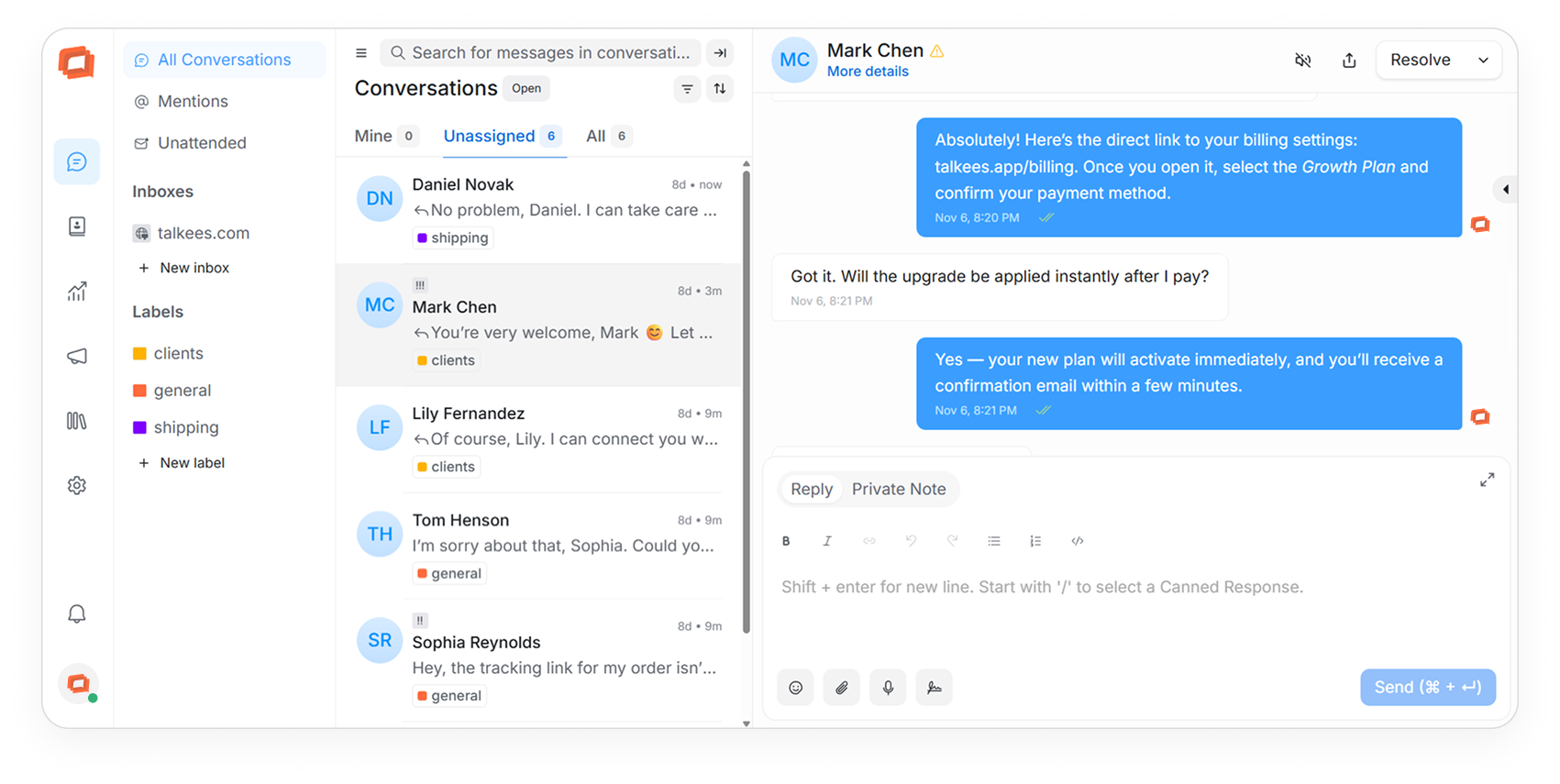
Talkees: A Modern Alternative to Help.center

Talkees represents a new generation of support platforms that combines AI-first design with intuitive usability and transparent pricing.
Pricing
- Free Plan: Limited features for small teams
- Starter: $49/month (flat fee, not per-agent)
- Professional: $99/month
- Enterprise: Custom pricing for large teams
All plans include core AI features without additional charges, making costs predictable as you scale.
Key Features
- AI-powered chat and ticket handling: Resolves up to 50% of common inquiries automatically
- Unified inbox: Consolidates email, chat, social, and messaging platforms
- Knowledge base automation: AI-enhanced search and content recommendations
- No-code automation builder: Create complex workflows without technical expertise
- Open API and webhook support: Integrate with your existing tech stack
- One-click migration: Import from Help.center and other platforms
Pros
- No per-agent fees, making scaling affordable
- AI capabilities included in base price
- Intuitive interface requiring minimal training
- Strong e-commerce integrations
- Excellent customer support with fast response times
Cons
- Newer platform with fewer third-party integrations than established competitors
- Advanced enterprise features still in development
- Limited phone support capabilities
Our Experience with Talkees
When testing Talkees, we were impressed by how quickly we could set up and customize the platform. The AI capabilities were particularly strong, accurately resolving common customer questions without human intervention. The migration from our previous platform took less than a day, and the team was responsive to our questions throughout the process.
The absence of per-agent fees made a significant difference in our budget planning, especially as we added seasonal staff during busy periods. For small to medium-sized businesses looking for an affordable yet powerful Help.center alternative, Talkees offers an excellent balance of features and value.
Ideal For
- Small to medium-sized businesses looking for affordable scaling
- E-commerce companies needing strong integration capabilities
- Teams wanting AI automation without complex setup or additional costs
Intercom: Product-Led Engagement with Advanced AI

Intercom has evolved from a simple chat tool to a comprehensive customer engagement platform with powerful AI capabilities.
Pricing
- Essential: $29/seat/month (annual) or $39/seat/month (monthly)
- Advanced: $85/seat/month (annual) or $99/seat/month (monthly)
- Expert: $132/seat/month (annual) or $139/seat/month (monthly)
- Fin AI Agent: $0.99 per resolution (50-resolution minimum)
- Copilot: $29/teammate/month (annual) or $35/teammate/month (monthly)
Key Features
- Conversational support: In-app messaging and targeted outreach
- Fin AI Agent: Autonomous customer support with 57-65% average resolution rates
- Help Center: Knowledge base with AI-powered suggestions
- Product Tours: Guided onboarding and feature announcements
- Custom Bots: Rule-based and AI-powered chatbots
- Outbound Messaging: Proactive customer engagement
Pros
- Excellent in-app messaging experience
- Strong AI capabilities with Fin Agent
- Seamless integration between marketing, sales, and support
- Robust API and integration options
- Early-stage startup program with significant discounts
Cons
- Costs can escalate quickly with per-seat pricing and add-ons
- Complex pricing structure with separate charges for AI resolutions
- Can be overkill for teams primarily focused on customer support
- Limited customization for some features
Our Experience with Intercom
Intercom’s platform feels polished and professional, with an intuitive interface that makes it easy to engage with customers. The Fin AI agent is particularly impressive, handling a wide range of customer inquiries without human intervention. However, the per-resolution pricing model means costs can spike during high-volume periods or product launches.
The platform excels at proactive engagement, allowing us to reach out to customers based on their behavior within our product. For companies focused on product-led growth, this capability is invaluable. However, the pricing structure requires careful monitoring to avoid unexpected costs.
Ideal For
- SaaS companies with in-product support needs
- Businesses wanting to blend marketing, sales, and support
- Teams with moderate to high ticket volumes that can benefit from AI automation
- Companies with healthy budgets that value premium features
Zendesk: Robust Omnichannel Support for Enterprises

Zendesk is an established player with comprehensive features designed for large organizations with complex support needs.
Pricing
- Support Team: $19/agent/month (ticketing only)
- Suite Team: $55/agent/month
- Suite Growth: $89/agent/month
- Suite Professional: $115/agent/month
- Suite Enterprise: $169/agent/month
- Add-ons: AI Copilot ($50/agent/month), Quality Assurance ($35), Workforce Management ($25), Advanced Data Privacy ($50)
Key Features
- Omnichannel support: Email, chat, voice, social media, and messaging
- Knowledge Builder: Advanced knowledge base with version control
- Answer Bot: AI-powered self-service
- Explore: Advanced analytics and reporting
- Marketplace: 1,000+ integrations and apps
- Flow Builder: Visual workflow automation
Pros
- Enterprise-grade security and compliance
- Comprehensive feature set for complex organizations
- Robust reporting and analytics
- Extensive marketplace of integrations
- Mature, stable platform with proven reliability
Cons
- High total cost of ownership with numerous add-ons
- Complex implementation often requiring professional services
- Steep learning curve for administrators and agents
- Pricing can become prohibitive at scale
Our Experience with Zendesk
Zendesk offers perhaps the most comprehensive set of features among all Help.center alternatives, but this comes with increased complexity and cost. During our testing, we found the platform powerful but sometimes overwhelming, with features scattered across different interfaces.
Implementation required significant planning and professional assistance, with costs exceeding $10,000 for a mid-sized deployment. Training took approximately 2-3 weeks before agents were comfortable with the system. However, once established, the platform handled complex support workflows effectively.
The add-on pricing model was particularly concerning, as essential features like AI assistance required substantial additional investment on top of already premium base prices.
Ideal For
- Enterprise organizations with complex support requirements
- Companies with regulatory compliance needs
- Teams requiring advanced workflow automation
- Organizations with dedicated support operations staff
Freshworks (Freshdesk + Freshchat): Value-Packed Bundle with Quick Onboarding

Freshworks offers a comprehensive yet accessible support solution through its Freshdesk ticketing system and Freshchat messaging platform.
Pricing
- Free Plan: Basic features for unlimited agents
- Growth: $15/agent/month
- Pro: Varies by bundle, typically $49-99/agent/month
- Enterprise: Custom pricing
- Freddy AI Copilot: $29/agent/month add-on
Key Features
- Freddy AI: Automation, bot builder, and agent assistance
- Omnichannel routing: Email, chat, phone, WhatsApp, and social
- Neo Admin Center: Unified administration for all Freshworks products
- Field Service Management: On-site support coordination
- Marketplace: 1,000+ apps and integrations
- Custom objects: Extend the platform for specific business needs
Pros
- Excellent value for feature set
- Intuitive interface requiring minimal training
- Free plan for small teams
- Strong AI capabilities with Freddy
- Good balance of simplicity and power
Cons
- Some advanced features require multiple Freshworks products
- AI capabilities split between different add-ons
- Can feel less polished than premium alternatives
- Limited customization at lower tiers
Our Experience with Freshworks
Freshworks strikes an impressive balance between functionality and usability. During our testing, we were able to set up and configure the platform within days rather than weeks, with minimal external assistance.
Freddy AI performed well for common support scenarios, though not quite matching the sophistication of Intercom’s Fin. The interface is clean and intuitive, making it easy for new agents to get up to speed quickly.
The modular approach allows teams to start with basic functionality and add capabilities as needed, though this can sometimes lead to a fragmented experience when using multiple Freshworks products together.
Ideal For
- Growing businesses needing a balance of features and affordability
- Teams wanting quick implementation without extensive training
- Organizations seeking good AI capabilities without premium pricing
- Companies already using other Freshworks products
Help Scout: Email-First Help Desk with Human Tone and Simple Automation

Help Scout focuses on delivering exceptional email-based support with a clean, approachable interface and straightforward pricing.
Pricing
- Free Plan: Up to 5 users
- Standard: $25/user/month
- Plus: $45/user/month
- Pro: $75/user/month
- AI Answers: $0.75 per AI resolution (3-month unlimited trial available)
Help Scout also offers contact-based pricing for high-volume teams, with packages up to $2,400/month for 10,000 contacts.
Key Features
- Shared Inbox: Collaborative email management
- Docs: Knowledge base with customization options
- Beacon: Embedded chat and self-service widget
- AI Answers: Automated responses to common questions
- Workflows: Rule-based automation
- Reports: Performance analytics and customer satisfaction
Pros
- Clean, intuitive interface focused on email support
- Transparent, straightforward pricing
- Excellent documentation and customer service
- Strong knowledge base functionality
- Per-resolution AI pricing provides flexibility
Cons
- Limited native omnichannel capabilities
- Basic automation compared to AI-first platforms
- Fewer integrations than enterprise alternatives
- No built-in phone support
Our Experience with Help Scout
Help Scout delivers on its promise of simplicity and usability. The platform feels designed to get out of the way and let support teams focus on helping customers. Email management is particularly strong, with thoughtful features that streamline agent workflows.
The knowledge base (Docs) is well-designed and easy to maintain, though it lacks some of the AI-powered features found in newer platforms. Beacon provides a good balance of chat and self-service capabilities, though it’s not as feature-rich as dedicated chat solutions.
AI Answers performed reasonably well in our testing, with the per-resolution pricing model providing good value for teams with moderate automation needs. The three-month unlimited trial allows ample time to evaluate the feature’s effectiveness.
Ideal For
- Email-focused support teams valuing simplicity
- Small to medium businesses with straightforward support needs
- Companies prioritizing human connection in customer interactions
- Teams wanting a clean, uncluttered support experience
Crisp: Cost-Effective Live Chat and Shared Inbox for Startups and SMBs

Crisp offers an affordable entry point for businesses looking to enhance their customer support with live chat and basic help desk functionality.
Pricing
- Free Plan: Basic features for 2 team members
- Pro: $25/month flat fee (up to 4 seats)
- Unlimited: $95/month flat fee (unlimited seats)
- Enterprise: Custom pricing
Key Features
- Live Chat: Real-time customer conversations
- Shared Inbox: Email and messaging management
- Knowledge Base: Self-service customer resources
- Chatbots: Rule-based automation
- Video Chat: Face-to-face customer support
- Mobile Apps: iOS and Android support
Pros
- Affordable flat pricing (not per-agent)
- Clean, modern interface
- Good mobile experience
- Easy setup and configuration
- Solid free tier for very small teams
Cons
- Limited advanced features compared to enterprise platforms
- Basic reporting and analytics
- Simple automation capabilities
- Fewer integrations than larger platforms
Our Experience with Crisp
Crisp impresses with its straightforward approach and affordable pricing. The platform is easy to set up and use, with a modern interface that feels responsive and well-designed. The flat pricing model is particularly attractive for growing teams, eliminating concerns about adding agents during busy periods.
The live chat functionality works well, with good customization options and reliable performance. The shared inbox provides a centralized view of customer communications, though it lacks some of the advanced routing and automation features found in more expensive platforms.
The knowledge base is functional but basic, without the AI-enhanced search and content suggestions offered by more sophisticated alternatives. Chatbots are similarly straightforward, following rules rather than employing advanced natural language processing.
Ideal For
- Startups and small businesses with budget constraints
- Teams primarily focused on live chat support
- Companies wanting to avoid per-agent pricing
- Organizations with straightforward support needs
Chatwoot: Open-Source, Self-Hosted Omnichannel Built for Customization and Data Control

Chatwoot stands out as an open-source alternative that gives organizations complete control over their customer support infrastructure.
Pricing
- Self-Hosted: Free (open-source)
- Cloud – Free: Basic features for up to 2 agents
- Cloud – Growth: $19/agent/month
- Cloud – Business: $49/agent/month
- Cloud – Enterprise: Custom pricing
Key Features
- Open-Source Core: Complete access to source code
- Omnichannel Inbox: Email, chat, WhatsApp, SMS, social
- Self-Hosting Option: Full data control and privacy
- Automation Builder: Custom workflows and rules
- Customizable Widgets: Branded customer experiences
- API-First Design: Extensive integration capabilities
Pros
- Full control over data and infrastructure with self-hosting
- No vendor lock-in
- Extensive customization possibilities
- Active community and regular updates
- Affordable cloud options if self-hosting isn’t required
Cons
- Self-hosting requires technical expertise
- Fewer out-of-the-box integrations than commercial platforms
- Limited advanced AI capabilities
- May require custom development for complex needs
Our Experience with Chatwoot
Chatwoot offers a compelling alternative for organizations with technical resources and a desire for complete control. The self-hosted version provides all core features without ongoing licensing costs, though it does require infrastructure and maintenance expertise.
The platform’s interface is clean and functional, if not as polished as some commercial alternatives. The omnichannel inbox effectively consolidates conversations from multiple sources, and the automation builder provides good flexibility for creating custom workflows.
While Chatwoot lacks the advanced AI capabilities of platforms like Talkees or Intercom, its open architecture makes it possible to integrate with third-party AI services. The active community contributes regular improvements and extensions, making the platform increasingly capable over time.
Ideal For
- Organizations with technical resources and privacy requirements
- Companies operating in regulated industries needing data control
- Teams with unique workflows requiring extensive customization
- Businesses looking to avoid ongoing licensing costs
Tidio: Ecommerce-Friendly Live Chat and Lead-Gen Chatbots with Accessible Pricing

Tidio focuses on providing effective live chat and chatbot solutions particularly well-suited to ecommerce businesses.
Pricing
- Free Plan: Basic features for 3 operators
- Starter: $29/month
- Growth: $59/month
- Business: Custom pricing
- Lyro AI Chatbot: Additional pricing based on usage
Key Features
- Live Chat: Real-time customer conversations
- Lyro AI Chatbot: Handles up to 70% of common inquiries
- Visual Chatbot Builder: No-code automation creation
- Visitor Tracking: Real-time website visitor monitoring
- E-commerce Integrations: Shopify, WooCommerce, Magento
- Multilingual Support: 20+ languages
Pros
- Strong e-commerce focus and integrations
- Intuitive visual chatbot builder
- Good free tier for small businesses
- Effective lead generation capabilities
- Reasonable pricing structure
Cons
- Limited help desk/ticketing functionality
- Basic reporting compared to full-service platforms
- AI capabilities not as advanced as specialized platforms
- Primarily focused on website/chat support
Our Experience with Tidio
Tidio excels in its focused approach to live chat and chatbot functionality. The platform is particularly well-suited to e-commerce businesses, with strong integrations for major platforms like Shopify and WooCommerce. The interface is clean and intuitive, making it easy to set up and configure without extensive training.
The Lyro AI chatbot performed well in our testing, effectively handling common customer inquiries about products, shipping, and returns. The visual chatbot builder makes it easy to create custom flows without coding knowledge, though it lacks the advanced natural language understanding of more sophisticated AI platforms.
While Tidio doesn’t offer the comprehensive help desk functionality of platforms like Zendesk or Freshworks, its focused approach delivers excellent value for businesses primarily concerned with website chat and basic customer support.
Ideal For
- E-commerce businesses needing effective chat support
- Companies focused on lead generation through their website
- Small to medium businesses with straightforward support needs
- Teams wanting an easy-to-implement chat solution
Gorgias: Shopify-Native Help Desk Focused on Revenue and Order Workflows

Gorgias is purpose-built for e-commerce support, with deep integrations into Shopify and other e-commerce platforms.
Pricing
- Basic: $50/month for 300 tickets
- Pro: $300/month for 3,000 tickets
- Advanced: $750/month for 9,000 tickets
- Enterprise: Custom pricing
Unlike most competitors, Gorgias uses ticket-volume pricing rather than per-agent fees.
Key Features
- Shopify-Native Interface: Direct access to orders and customer data
- Revenue Statistics: Track support impact on sales
- Order Management: Edit orders directly from tickets
- Macros: Templated responses with dynamic content
- Intent Detection: Automatic ticket categorization
- Self-Service Portal: Customer order lookup and FAQs
Pros
- Deep e-commerce integration, especially with Shopify
- Ticket-volume pricing instead of per-agent fees
- Revenue attribution for support interactions
- Purpose-built for online retail workflows
- Good automation for common e-commerce scenarios
Cons
- Limited value for non-e-commerce businesses
- Less robust general help desk features
- Basic knowledge base functionality
- Can be expensive for high-volume stores
Our Experience with Gorgias
Gorgias delivers an impressive experience for e-commerce support teams. The platform’s integration with Shopify is seamless, allowing agents to view and modify orders directly within the ticket interface. This significantly reduces the time spent switching between systems and improves resolution speed.
The ticket-volume pricing model works well for teams with varying staffing needs, especially those with seasonal fluctuations. However, high-volume stores may find costs escalate quickly during busy periods.
Automation capabilities are tailored to e-commerce scenarios, with effective tools for handling common inquiries about orders, shipping, and returns. The revenue statistics provide valuable insights into how support activities impact sales, helping justify support investments.
Ideal For
- Shopify stores with dedicated support teams
- E-commerce businesses prioritizing order management efficiency
- Companies wanting to track support’s impact on revenue
- Teams with varying staffing needs preferring ticket-volume pricing
LiveChat: Battle-Tested Live Chat with Marketplace Add-Ons for Bots and Help Desk

LiveChat offers a mature, reliable platform focused on real-time customer conversations with expandable functionality through its marketplace.
Pricing
- Starter: $19/agent/month
- Team: $39/agent/month
- Business: $59/agent/month
- Enterprise: Custom pricing
- ChatBot: Additional pricing based on features and usage
Key Features
- Live Chat: Real-time customer support
- ChatBot Integration: AI-powered automation
- HelpDesk Integration: Ticket management
- KnowledgeBase: Customer self-service
- Advanced Analytics: Performance reporting
- Marketplace: Extensions and integrations
Pros
- Reliable, mature chat platform
- Strong customization options
- Good analytics and reporting
- Extensive marketplace of add-ons
- Mobile apps for on-the-go support
Cons
- Full functionality requires multiple products
- Limited native omnichannel capabilities
- Basic AI features compared to newer platforms
- Per-agent pricing can be expensive at scale
Our Experience with LiveChat
LiveChat delivers a solid, dependable chat experience backed by years of refinement. The platform performs consistently even during high-volume periods, with good queue management and routing capabilities. The interface is intuitive for agents, requiring minimal training to become productive.
The core product focuses primarily on chat, with ticketing and knowledge base functionality available through integrated but separate products (HelpDesk and KnowledgeBase). This modular approach provides flexibility but can result in a somewhat fragmented experience compared to all-in-one platforms.
ChatBot offers good automation capabilities, though it requires separate configuration and management from the main LiveChat platform. The marketplace provides numerous extensions and integrations, allowing teams to customize the platform to their specific needs.
Ideal For
- Businesses prioritizing reliable chat functionality
- Companies with straightforward support workflows
- Teams wanting extensive customization options
- Organizations preferring a modular approach to support tools
Pricing Deep Dive Across Help.center Alternatives

Understanding the true cost of help desk platforms requires looking beyond the advertised per-agent or monthly fees. Here’s a comprehensive breakdown of pricing models and potential hidden costs:
Pricing Models Compared
- Per-Agent/Seat Pricing
- Examples: Zendesk ($19-169/agent/month), Intercom ($29-139/seat/month), Help Scout ($25-75/user/month)
- Pros: Straightforward scaling with team size
- Cons: Penalizes growth; can be expensive for large teams
- Ticket-Volume Pricing
- Examples: Gorgias ($50/month for 300 tickets up to $750/month for 9,000 tickets)
- Pros: Aligns with actual usage; good for teams with varying staffing
- Cons: Can spike during busy periods; harder to budget
- Flat-Fee Pricing
- Examples: Talkees ($49-99/month flat fee), Crisp ($25-95/month flat fee)
- Pros: Predictable costs regardless of team size; great for growing teams
- Cons: May include usage limits or feature restrictions
- Usage-Based AI Pricing
- Examples: Intercom Fin AI ($0.99/resolution), Help Scout AI Answers ($0.75/resolution)
- Pros: Pay for actual automation value; scales with volume
- Cons: Can be unpredictable; may spike during incidents or launches
Hidden Costs to Watch For
When calculating TCO, consider these often-overlooked expenses:
- Implementation and Migration
- Professional services: $500-15,000+ depending on platform complexity
- Data migration: Ticket history, knowledge base content, customer records
- Training: 1-3 days for intuitive platforms; 2-3 weeks for complex systems
- Required Add-Ons
- AI capabilities: Often $25-50/agent/month extra
- Advanced security: Data privacy features can add $50/agent/month
- Analytics and reporting: Premium reporting may be a separate cost
- Integration and Development
- API limits: Some platforms charge for API usage beyond certain thresholds
- Custom development: Connecting to legacy systems may require development resources
- Third-party tools: Additional services for specific functionality
- Ongoing Operational Costs
- Storage fees: Some platforms charge for attachment storage beyond limits
- Support plans: Premium support can add 20-30% to license costs
- Training for new staff: Continuous education for complex platforms
Sample Annual Cost Comparison (10 Agents)
| Platform | Base License | Implementation | Add-Ons | Year 1 Total | Year 2+ Annual |
|---|---|---|---|---|---|
| Zendesk Professional | $13,800 | $10,000 | $6,000 | $29,800 | $19,800 |
| Talkees | $1,188 | $1,000 | Included | $2,188 | $1,188 |
| Intercom Advanced | $10,200 | $3,000 | $5,940 (Fin AI) | $19,140 | $16,140 |
| Freshdesk Growth | $1,800 | $2,000 | $3,480 (Freddy) | $7,280 | $5,280 |
| Help Scout Plus | $5,400 | $1,500 | $2,700 (AI) | $9,600 | $8,100 |
| Gorgias Pro | $3,600 | $2,000 | Included | $5,600 | $3,600 |
Note: Figures are examples based on published pricing and typical implementation costs. Actual costs may vary based on specific requirements and negotiated rates.
Which Help.center Competitor Fits Your Stack: Decision Matrix

Choosing the right Help.center alternative depends on your specific needs, team size, channel mix, and budget. Use this decision matrix to identify the best fit:
By Team Size
Solo/Very Small Teams (1-3 agents)
- Best options: Crisp, Tidio, Help Scout (free plan)
- Why: Affordable pricing, easy setup, minimal training required
Small Teams (4-10 agents)
- Best options: Talkees, Help Scout, Freshdesk
- Why: Good balance of features and cost, straightforward scaling
Mid-Size Teams (11-50 agents)
- Best options: Talkees, Intercom, Freshworks
- Why: Advanced automation, good scalability, reasonable cost structure
Enterprise (50+ agents)
- Best options: Zendesk, LiveChat (Business/Enterprise)
- Why: Enterprise-grade security, advanced workflow capabilities, comprehensive reporting
By Channel Mix
Email-First Support
- Best options: Help Scout, Freshdesk
- Why: Strong email management, collaborative tools, good threading
Chat-Focused Support
- Best options: Talkees, Intercom, LiveChat, Tidio
- Why: Advanced chat capabilities, visitor tracking, proactive engagement
Omnichannel Requirements
- Best options: Zendesk, Freshworks, Chatwoot
- Why: Unified inbox across all channels, consistent experience
Social Media Support
- Best options: Talkees, Zendesk, Freshdesk
- Why: Strong social integrations, monitoring capabilities
By AI Maturity
AI Beginners
- Best options: Help Scout, Freshdesk, Crisp
- Why: Approachable automation, good baseline capabilities
AI Implementers
- Best options: Talkees, Intercom, Tidio
- Why: Strong AI capabilities with reasonable learning curve
AI Innovators
- Best options: Intercom (Fin), Zendesk (with Copilot)
- Why: Advanced AI capabilities, sophisticated automation
Conclusion: Finding the Best Help.center Alternatives

When evaluating Help.center alternatives, the best choice depends on your specific needs, team size, and budget constraints. Here are the key takeaways from our comprehensive analysis:
- Consider your primary support channels: Different platforms excel in different areas—email, chat, social media, or true omnichannel support.
- Evaluate AI capabilities carefully: Look beyond marketing claims to understand how AI features are priced (built-in vs. add-ons) and how they perform with your specific support scenarios.
- Calculate total cost of ownership: Factor in implementation, training, add-ons, and scaling costs when comparing platforms.
- Prioritize ease of migration: Choose platforms that offer migration tools, SEO-safe knowledge base transfers, and comprehensive onboarding support.
- Test before committing: Run a pilot with real traffic to validate performance, usability, and ROI before making a full transition.
The landscape of customer support platforms continues to evolve, with newer entrants like Talkees challenging established players by offering more transparent pricing, built-in AI capabilities, and simpler user experiences. Traditional platforms like Zendesk provide comprehensive features but often at higher cost and complexity.
For most small to mid-sized businesses looking for the best balance of features, usability, and cost, Talkees represents an excellent alternative to Help.center. Its transparent pricing model, included AI capabilities, and quick implementation make it particularly suitable for growing teams.
Ultimately, the right choice should align with your support philosophy, technical requirements, and business objectives. By carefully evaluating the options presented in this guide and running a structured pilot, you can find the platform that best serves your customers and support team.