 English
 Slovenčina
 Français
 Magyar

Why Users Seek Elkagent Alternatives: Pricing Pressure, AI Limitations, and Omnichannel Gaps
{image1}
Most businesses begin searching for Elkagent alternatives due to three primary challenges:
- Pricing pressure: As support volumes grow, Elkagent’s pricing model can lead to unexpected cost increases that strain budgets.
- AI limitations: While Elkagent offers AI capabilities, many users find its retrieval-augmented generation (RAG) implementation and large language model (LLM) options restrictive, leading to less accurate automated responses.
- Omnichannel integration gaps: Today’s customers expect seamless experiences across email, chat, social media, and voice channels. Elkagent’s omnichannel implementation often requires additional configuration and doesn’t always maintain conversation context across channels.
These challenges create friction points that ultimately slow down support teams and impact customer satisfaction. Let’s explore what you should look for in an Elkagent alternative.
What Makes a Strong Elkagent Replacement? Essential Features to Consider
{image2}
When evaluating Elkagent alternatives, prioritize platforms that excel in these critical areas:
- AI quality and flexibility: Look for solutions offering advanced RAG capabilities, choice of LLM providers (OpenAI, Anthropic, Google), and robust hallucination prevention.
- Unified inbox: Ensure the platform provides a true omnichannel experience that consolidates email, live chat, social messaging (WhatsApp, Instagram, Facebook), and voice into a single interface.
- E-commerce integrations: Strong alternatives should offer native connections to platforms like Shopify, WooCommerce, and Magento, along with order management, payment processing, and shipping tracking capabilities.
- Agent assist tools: Prioritize platforms that provide real-time suggestions, automated summaries, and next-best-action recommendations to boost agent productivity.
- Transparent pricing: Choose vendors with clear, predictable pricing models (per-seat, per-resolution, or per-minute) without hidden fees or unexpected surcharges.
With these criteria in mind, let’s examine how we evaluated the top Elkagent competitors.
How We Evaluated Elkagent Competitors: Our Methodology
{image3}
To ensure a fair and comprehensive assessment, we evaluated each Elkagent alternative based on:
- SMB readiness: How quickly can small and medium businesses implement and see value?
- Setup speed: Time required from signup to first active deployment.
- Data privacy compliance: GDPR compliance, data residency options, and security certifications.
- Multilingual capabilities: Number of languages supported, quality of translation, and dialect handling.
- Analytics depth: Reporting capabilities, custom dashboards, and actionable insights.
- API and SDK availability: Integration flexibility and developer resources.
We tested each platform with real-world support scenarios, measuring response times, accuracy, and overall customer experience. Now, let’s dive into our findings, starting with Talkees.
Talkees vs Elkagent: Modern, Flexible, and Affordable AI + Live Chat for E-commerce and SMB Support
{image4}
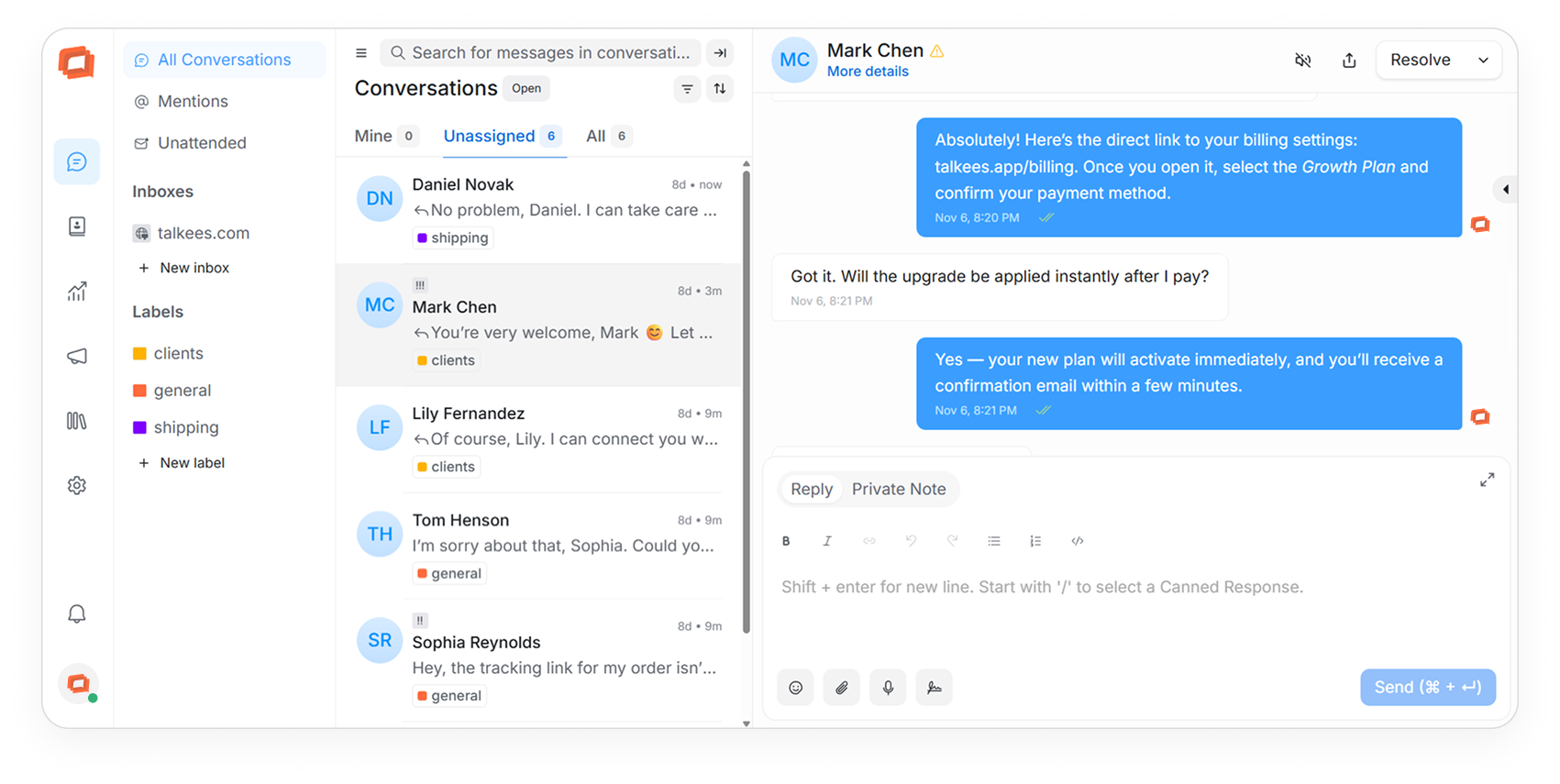
Talkees stands out as the most compelling Elkagent alternative, particularly for e-commerce businesses and SMBs seeking a modern, flexible support solution.
Key Features
- Advanced AI capabilities: Talkees offers state-of-the-art RAG implementation with multiple LLM options (including GPT-4), allowing for more accurate and contextual automated responses.
- Truly unified inbox: Seamlessly integrates email, live chat, WhatsApp, Instagram DMs, and Facebook Messenger in one interface with preserved conversation history.
- E-commerce focused: Native integrations with Shopify, WooCommerce, Magento, plus order tracking, payment processing, and shipping status updates.
- Powerful agent assist tools: Real-time suggestions, automated summaries, and knowledge base recommendations that reduce handle time.
- Multilingual support: Over 40 languages with auto-detection and natural dialect handling (including Hinglish and Spanglish).
Pricing
Talkees offers transparent, predictable pricing with multiple options:
- Starter: $29/month (1 agent, basic AI features)
- Growth: $79/month (3 agents, full AI capabilities)
- Business: $199/month (10 agents, advanced analytics)
- Enterprise: Custom pricing for larger teams
All plans include unlimited conversations, and there’s a 14-day free trial available.
Pros
- Intuitive, modern interface that requires minimal training
- Superior AI accuracy with significantly fewer hallucinations
- Exceptional e-commerce integrations with actionable capabilities (not just data display)
- Transparent pricing without hidden fees
- Quick setup (typically under 1 hour)
Cons
- Newer platform with a growing (but not yet extensive) marketplace
- Advanced voice capabilities still in development
- Some enterprise-level features are still being rolled out
Our Experience with Talkees
When testing Talkees, we were immediately impressed by its clean, intuitive interface. Setting up integrations with Shopify took just minutes, and the AI responses were remarkably accurate right out of the box. What particularly stood out was how the system maintained context across channels—customers could start a conversation on Instagram and continue seamlessly via email without losing history.
The AI-powered suggestions saved our agents significant time, especially for common e-commerce queries like “Where’s my order?” and “How do I return this item?” The platform automatically pulled relevant order information and suggested appropriate responses based on the company’s policies.
For SMBs and e-commerce businesses looking for an Elkagent alternative that balances powerful features with ease of use, Talkees is our top recommendation.
Intercom as an Elkagent Alternative: Proactive Messaging, Product Tours, and Powerful Automation—at a Premium
{image5}
Intercom offers a robust alternative to Elkagent with its focus on proactive customer engagement and product tours, though at a higher price point.
Key Features
- Proactive messaging: Targeted outreach based on user behavior and segmentation
- Product tours and onboarding: Interactive walkthroughs for new users
- Fin AI chatbot: Automated responses powered by OpenAI
- Messenger: Customizable chat widget with apps and integrations
- Help center: Self-service knowledge base with search functionality
Pricing
Intercom’s pricing is considerably higher than many alternatives:
- Starter: $74/month (billed annually) for basic support features
- Pro: $499/month (billed annually) for advanced features
- Premium: Custom pricing for enterprise needs
- Additional: $0.99 per AI resolution with Fin chatbot
Pros
- Excellent for product-led growth companies
- Strong proactive engagement capabilities
- Robust marketplace with 300+ integrations
- Powerful segmentation and targeting
Cons
- Significantly more expensive than Elkagent and other alternatives
- Complex pricing structure with many add-ons
- Can be overwhelming for small teams
- Less specialized for e-commerce support
Our Experience with Intercom
When testing Intercom, we found its proactive messaging capabilities particularly impressive. The ability to target users based on behavior and create interactive product tours is valuable for SaaS companies. However, the pricing structure quickly becomes expensive, especially when adding multiple seats and the AI chatbot functionality.
While Intercom offers powerful features, its high cost and complex interface make it better suited for larger companies with dedicated support teams rather than SMBs looking for an affordable Elkagent alternative.
Zendesk vs Elkagent: Enterprise Ticketing, SLAs, and Workflows—with Added Complexity and Costs
{image6}
Zendesk is a well-established player in the customer support space, offering comprehensive ticketing and workflow capabilities, but with significant complexity and cost considerations.
Key Features
- Robust ticketing system: Advanced routing, macros, and SLA management
- Zendesk AI: Automated responses and agent assistance
- Omnichannel support: Email, chat, phone, social messaging, and self-service
- Extensive reporting: Customizable dashboards and analytics
- Enterprise-grade workflows: Complex automation and business rules
Pricing
Zendesk offers tiered pricing that can become expensive quickly:
- Suite Team: $69/agent/month (billed annually)
- Suite Growth: $89/agent/month (billed annually)
- Suite Professional: $115/agent/month (billed annually)
- Suite Enterprise: Custom pricing
Pros
- Comprehensive enterprise-grade support solution
- Extensive integration marketplace
- Powerful workflow automation capabilities
- Strong reporting and analytics
Cons
- Steep learning curve for administrators and agents
- Significantly higher cost compared to Elkagent
- Complex setup and configuration requirements
- Can be overkill for SMBs with simpler needs
Our Experience with Zendesk
During our evaluation, Zendesk impressed with its comprehensive feature set and enterprise capabilities. The ticketing system is robust, with powerful routing and SLA management. However, the complexity of the platform requires significant time investment for setup and training.
The cost structure also presents challenges for growing businesses, with per-agent pricing that scales linearly as teams expand. While Zendesk offers powerful features, its complexity and cost make it better suited for larger enterprises rather than SMBs seeking a straightforward Elkagent alternative.
Ada vs Elkagent: AI-First Resolution for High-Volume Support with Strong Deflection
{image7}
Ada takes an AI-first approach to customer support, focusing on automated resolution for high-volume inquiries with impressive deflection rates.
Key Features
- AI-first automation: Designed to resolve customer inquiries without human intervention
- Multilingual support: 50+ languages with auto-detection
- Strong deflection capabilities: Proven track record of reducing ticket volume
- Seamless handoff: Context preservation when escalating to human agents
- Enterprise focus: Designed for larger businesses with high support volume
Pricing
Ada offers custom enterprise pricing based on conversation volume, typically starting at:
- Basic: $10,000/month (estimated) for core automation
- Advanced: $20,000+/month (estimated) for additional features
- Enterprise: Custom pricing for large-scale deployments
Pros
- Exceptional automation capabilities with high resolution rates
- Strong multilingual support with 50+ languages
- Seamless integration with existing support stacks
- Impressive analytics and reporting
Cons
- Significant investment required (not SMB-friendly)
- Less focus on human agent experience
- Custom pricing makes budgeting challenging
- Implementation typically requires dedicated resources
Our Experience with Ada
When evaluating Ada, we were impressed by its focus on automated resolution and the quality of its AI responses. For large enterprises dealing with high volumes of repetitive inquiries, Ada’s deflection capabilities can significantly reduce support costs.
However, the platform’s enterprise focus and corresponding price point make it less accessible for SMBs. The implementation also requires more resources compared to more plug-and-play solutions like Talkees. For large organizations with the budget and resources to implement properly, Ada offers powerful automation capabilities that can transform support operations.
Forethought vs Elkagent: Agent Assist and Automated Answers with Deep CRM/Helpdesk Integrations
{image8}
Forethought differentiates itself with a focus on agent assistance and deep integrations with existing CRM and helpdesk systems.
Key Features
- Agent Assist: Real-time recommendations and knowledge suggestions for agents
- Solve: AI-powered automated responses for common inquiries
- Triage: Intelligent routing based on content and intent
- Deep integrations: Native connections to major CRM and helpdesk platforms
- Multilingual capability: Support for 30+ languages
Pricing
Forethought offers custom pricing based on company size and needs:
- Standard: Custom pricing based on agent seats
- Professional: Custom pricing with additional features
- Enterprise: Custom pricing for large-scale deployments
Pros
- Excellent agent assistance capabilities
- Seamless integration with existing systems
- Strong triage and routing functionality
- Focused on improving agent productivity
Cons
- Custom pricing lacks transparency
- Primary focus on augmenting rather than replacing human agents
- Less comprehensive e-commerce specialization
- Implementation requires existing helpdesk infrastructure
Our Experience with Forethought
During our evaluation, Forethought’s agent assistance capabilities stood out as particularly strong. The platform excels at providing agents with relevant information and suggestions in real-time, significantly reducing handle times.
The deep integrations with existing CRM and helpdesk systems make Forethought a good choice for companies that have already invested in support infrastructure and want to enhance it with AI capabilities. However, the custom pricing model and focus on augmenting rather than replacing human support make it less ideal for companies seeking a comprehensive, standalone Elkagent alternative with predictable costs.
Yellow.ai vs Elkagent: Voice + Chat Across Channels, Wide Connector Library, Heavier Implementation
{image9}
Yellow.ai offers a comprehensive solution spanning both voice and chat channels, with a particularly strong focus on voice capabilities and a wide range of connectors.
Key Features
- Voice + chat integration: Seamless experience across voice and digital channels
- Extensive connector library: Wide range of pre-built integrations
- Global language support: Comprehensive multilingual capabilities
- Dynamic AI agents: Adaptable to various use cases and industries
- Robust analytics: Detailed insights into performance and customer behavior
Pricing
Yellow.ai offers custom pricing based on specific requirements:
- Basic: Custom pricing for core functionality
- Business: Custom pricing for additional features
- Enterprise: Custom pricing for large-scale deployments
Pros
- Strong voice capabilities integrated with chat
- Extensive integration options
- Comprehensive multilingual support
- Robust orchestration capabilities
Cons
- Complex implementation requiring significant resources
- Higher learning curve for administrators
- Custom pricing lacks transparency
- Less specialized for specific verticals like e-commerce
Our Experience with Yellow.ai
When testing Yellow.ai, we found its voice capabilities particularly impressive. The platform handles voice interactions naturally and integrates them seamlessly with digital channels. The wide range of connectors also makes it versatile for various business needs.
However, the implementation complexity is notably higher than more streamlined alternatives like Talkees. Yellow.ai requires more technical resources and time to set up properly, making it less ideal for SMBs seeking a quick and easy deployment. For enterprises with dedicated technical resources who need robust voice capabilities, Yellow.ai offers a comprehensive solution.
Chatbase as an Elkagent Alternative: Document-Trained Bots for Quick Deployments with Limited Helpdesk Features
{image10}
Chatbase offers a straightforward approach to creating AI chatbots trained on your documentation, with quick deployment but more limited helpdesk functionality.
Key Features
- Document-trained AI: Chatbots trained on your knowledge base and documentation
- Quick deployment: Fast setup with minimal configuration
- Web widget: Easy integration with websites
- Basic analytics: Performance tracking and conversation insights
- API access: Integration capabilities for developers
Pricing
Chatbase offers tiered pricing based on usage:
- Free: Limited to 20 training pages and 300 messages/month
- Starter: $49/month for 100 training pages and 1,500 messages
- Growth: $99/month for 300 training pages and 5,000 messages
- Business: $299/month for 1,000 training pages and 20,000 messages
Pros
- Very quick to set up and deploy
- Straightforward document training process
- Affordable entry point for small businesses
- Simple integration with websites
Cons
- Limited helpdesk functionality compared to full-featured alternatives
- Lacks unified inbox and omnichannel capabilities
- Minimal agent tools and workflows
- Less suitable for complex support scenarios
Our Experience with Chatbase
During our evaluation, Chatbase impressed with its simplicity and speed of deployment. Training a chatbot on documentation was straightforward, and the resulting bot provided reasonably accurate responses to common questions.
However, Chatbase lacks many of the helpdesk features found in more comprehensive Elkagent alternatives. There’s no unified inbox for managing conversations across channels, limited agent tools, and fewer integration options. For businesses primarily looking to deflect simple FAQs with minimal setup, Chatbase offers a cost-effective solution, but it’s not a complete replacement for Elkagent’s broader functionality.
CustomGPT vs Elkagent: Branded GPT on Your Data and Policies with Flexible RAG
{image11}
CustomGPT focuses on creating branded AI experiences trained on your specific data and policies, with flexible retrieval-augmented generation (RAG) capabilities.
Key Features
- Branded AI experience: Customizable chatbot with your brand identity
- Flexible RAG implementation: Advanced retrieval from your knowledge sources
- Multiple data source connections: Integrate with various document repositories
- Web and API deployment: Multiple integration options
- Training dashboard: Intuitive interface for managing training data
Pricing
CustomGPT offers usage-based pricing:
- Startup: $79/month for 500 training pages and 1,000 queries
- Growth: $199/month for 2,000 training pages and 5,000 queries
- Scale: $499/month for 10,000 training pages and 20,000 queries
- Enterprise: Custom pricing for larger implementations
Pros
- Strong RAG implementation for accurate responses
- Flexible data source connections
- Straightforward training interface
- Good developer API access
Cons
- Not a complete support suite (focused on AI chat only)
- Limited helpdesk workflows and agent tools
- Minimal omnichannel capabilities
- Less suitable for complex support operations
Our Experience with CustomGPT
When testing CustomGPT, we found its RAG implementation particularly effective. The platform accurately retrieved information from our knowledge base and provided contextually relevant responses. The training dashboard was intuitive and made managing the AI’s knowledge straightforward.
However, CustomGPT is primarily focused on the AI chatbot experience rather than providing a comprehensive support solution. It lacks the unified inbox, agent tools, and workflow capabilities found in more complete Elkagent alternatives. For businesses primarily seeking to implement a branded AI chatbot with strong knowledge retrieval, CustomGPT is a solid choice, but those needing a full support suite should look elsewhere.
DocsBot as an Elkagent Competitor: Documentation-Driven Chatbots for SMBs with Cost-Effective, Focused Scope
{image12}
DocsBot specializes in creating chatbots from documentation, offering a cost-effective solution for SMBs with a focused scope.
Key Features
- Documentation-first approach: Optimized for knowledge base content
- Multiple source connections: Import from various documentation platforms
- Simple deployment: Easy integration with websites and apps
- Basic analytics: Track performance and identify knowledge gaps
- Customizable appearance: Brand-aligned chat interface
Pricing
DocsBot offers straightforward tiered pricing:
- Free: Limited to 50 pages and 100 chats/month
- Starter: $39/month for 500 pages and 500 chats
- Pro: $99/month for 2,000 pages and 2,000 chats
- Business: $249/month for 10,000 pages and 10,000 chats
Pros
- Very affordable for small businesses
- Straightforward setup and configuration
- Good documentation import capabilities
- Clean, modern chat interface
Cons
- Limited to documentation-based support
- No unified inbox or omnichannel capabilities
- Minimal agent tools and workflows
- Not designed for complex support scenarios
Our Experience with DocsBot
During our evaluation, DocsBot impressed with its simplicity and focus. Importing documentation and creating a functional chatbot was quick and painless. The resulting bot handled documentation-based queries effectively, providing accurate responses to common questions.
However, DocsBot is intentionally limited in scope compared to full-featured Elkagent alternatives. It doesn’t offer a unified inbox for managing conversations across channels, has minimal agent tools, and fewer integration options. For businesses primarily looking to deflect documentation-based queries at an affordable price point, DocsBot is an excellent choice, but it’s not a complete replacement for Elkagent’s broader functionality.
SiteGPT vs Elkagent: Website-Ingested Bots for Lead Capture and FAQs with Lightweight, Site-Centric Usage
{image13}
SiteGPT offers a specialized approach to creating AI chatbots by ingesting website content, with a focus on lead capture and answering frequently asked questions.
Key Features
- Website content ingestion: Automatically crawls and learns from your website
- Lead capture focus: Designed to qualify and capture leads
- FAQ automation: Efficiently handles common questions
- Simple deployment: Quick integration with minimal configuration
- Basic analytics: Performance tracking and conversation insights
Pricing
SiteGPT offers tiered pricing based on usage:
- Starter: $39/month for 1 website and 200 messages
- Growth: $119/month for 3 websites and 1,000 messages
- Business: $299/month for 10 websites and 5,000 messages
- Enterprise: Custom pricing for larger implementations
Pros
- Very quick to set up and deploy
- Automatic website content ingestion
- Effective for lead capture scenarios
- Simple integration with websites
Cons
- Limited to website-based knowledge
- No unified inbox or comprehensive support tools
- Minimal agent handoff capabilities
- Not designed for complex support operations
Our Experience with SiteGPT
When testing SiteGPT, we found its website ingestion capabilities impressive. The platform quickly crawled our test website and created a chatbot that could answer basic questions about products, services, and company information. The lead capture functionality was particularly effective, gathering qualified leads and routing them appropriately.
However, SiteGPT is much more limited in scope than full-featured Elkagent alternatives. It lacks the unified inbox, comprehensive agent tools, and workflow capabilities needed for complex support operations. For businesses primarily looking to automate website FAQs and capture leads, SiteGPT offers a straightforward solution, but those needing a complete support platform should consider more comprehensive alternatives like Talkees.
Choosing the Right Elkagent Alternative for Your Business Needs
{image14}
When selecting the best Elkagent alternative for your specific requirements, consider these use cases:
For E-commerce Businesses
Best choice: Talkees stands out for e-commerce with its native integrations with Shopify, WooCommerce, and Magento, plus order tracking, payment processing, and shipping capabilities. The platform’s unified inbox ensures seamless customer interactions across channels, which is crucial for online retailers.
Runner-up: Yellow.ai offers robust e-commerce capabilities, though with a more complex implementation process.
For SaaS Companies
Best choice: Intercom excels for SaaS businesses with its product tours, proactive messaging, and user segmentation capabilities. These features are particularly valuable for product-led growth strategies.
Runner-up: Forethought provides excellent agent assistance for SaaS support teams dealing with technical inquiries.
For Lean Support Teams
Best choice: Talkees offers the best balance of powerful features and ease of use for lean teams. Its intuitive interface requires minimal training, and the AI capabilities significantly reduce agent workload.
Runner-up: Chatbase provides a simple solution for very small teams primarily focused on documentation-based support.
For AI-First Projects
Best choice: Ada delivers exceptional automation for organizations prioritizing AI-first support, though at a higher price point suited for larger enterprises.
Runner-up: CustomGPT offers strong RAG capabilities for businesses focused specifically on knowledge retrieval.
Free vs Paid Plans Among Elkagent Competitors: Understanding Pricing Models
{image15}
When evaluating Elkagent alternatives, it’s essential to understand the different pricing models and potential hidden costs:
Per-Seat Pricing
Platforms like Zendesk, Intercom, and Freshdesk charge per agent seat, typically ranging from $19-$79 per agent per month for basic tiers, with enterprise plans exceeding $100 per agent monthly. While predictable, this model can become expensive as teams grow.
Per-Resolution Pricing
Some platforms like Talkees and Intercom (for its Fin AI) offer per-resolution pricing, charging only when the AI successfully resolves a conversation without human intervention. This can be cost-effective for high-volume support but requires careful monitoring of resolution rates.
Usage-Based Pricing
Chatbase, CustomGPT, DocsBot, and SiteGPT typically charge based on usage metrics like training pages, messages, or queries. This model works well for specific use cases but can lead to unexpected costs during traffic spikes.
Hidden Costs to Watch
When evaluating pricing, be aware of these potential hidden costs:
- Channel add-ons: Some platforms charge extra for WhatsApp, Instagram, or voice channels
- AI usage fees: Additional charges for AI resolutions or token usage
- Storage limits: Costs for exceeding conversation or attachment storage
- API call limits: Charges for exceeding API request quotas
- Premium support: Additional fees for priority support
Talkees stands out for its transparent pricing model that includes all channels and AI capabilities without hidden fees, making it easier to budget for growing support operations.
Migrating from Elkagent: A Practical Transition Guide
{image16}
Transitioning from Elkagent to a new platform requires careful planning. Here’s a step-by-step checklist to ensure a smooth migration:
1. Exporting Data
- Export all historical conversations and customer data from Elkagent
- Download knowledge base articles and support documentation
- Preserve custom workflows, macros, and automation rules
- Extract agent performance metrics and reporting data
2. Connecting Channels
- Prioritize your highest-volume channels for initial migration
- Set up email forwarding rules to maintain continuity
- Configure web chat widgets on your website and app
- Connect messaging channels (WhatsApp, Instagram, Facebook)
- Establish voice integration if applicable
3. Training the New AI
- Import knowledge base content into the new platform
- Train the AI on your specific products, policies, and procedures
- Create custom responses for common inquiries
- Set up appropriate escalation rules for complex issues
- Test AI responses across multiple scenarios and languages
4. Go-Live Checklist
- Run parallel systems initially to catch any missed messages
- Train agents on the new platform’s interface and features
- Monitor key metrics closely during the transition period
- Establish feedback loops to identify and address issues quickly
- Gradually phase out Elkagent as the new system proves reliable
Talkees offers dedicated migration specialists to assist with this process, ensuring a seamless transition with minimal disruption to your support operations.
Conclusion: Finding Your Ideal Elkagent Alternative
{image17}
After thoroughly evaluating the top Elkagent alternatives, Talkees emerges as the most balanced and effective solution for most businesses, particularly those in e-commerce and SMBs seeking modern, flexible support capabilities.
Talkees excels with its intuitive interface, powerful AI capabilities, comprehensive e-commerce integrations, and transparent pricing model. The platform’s unified inbox ensures seamless customer experiences across all channels, while its agent assist tools significantly boost productivity.
For larger enterprises with specific requirements, alternatives like Zendesk, Intercom, and Ada offer specialized capabilities at higher price points. Document-focused solutions like Chatbase, CustomGPT, DocsBot, and SiteGPT provide more limited functionality at lower costs for specific use cases.
When making your decision, prioritize the features that align with your specific business needs, consider your growth trajectory, and evaluate the total cost of ownership beyond the initial price tag. With the right Elkagent alternative in place, you can deliver exceptional customer experiences while optimizing your support operations for efficiency and effectiveness.
Ready to transform your customer support experience? Start your free trial of Talkees today and discover why it’s the preferred Elkagent alternative for modern businesses.