 English
 Slovenčina
 Français
 Magyar
Why Consider Alternatives to Respond.io?

When evaluating your current messaging platform, it’s important to recognize early signs that you might need a change. For many businesses using Respond.io, three common friction points typically emerge as you scale:
Rising and unpredictable pricing:
Even when headline plan prices appear reasonable, the total cost of ownership often increases significantly with usage. You might face stacking costs from per-user and per-conversation fees, hidden channel charges (especially for WhatsApp), automation and AI overages, and support SLAs as paid add-ons.
For example, a small team with 5 agents, 2 WhatsApp numbers, 20,000 monthly notifications, and 4,000 AI bot replies could easily spend between $300-$1,000 monthly before factoring in seasonal spikes or additional users.
Workflow limitations:
While Respond.io’s Workflows are powerful, they have defined boundaries that can become problematic at scale:
- Maximum 150 Workflows per Workspace on paid plans
- Imported workflow JSON files limited to 400 KB and 100 steps
- One trigger per workflow (requiring chained flows for multi-event orchestration)
- Default 7-day timeouts for certain actions, which can cause silent exits
AI feature restrictions:
Teams exploring advanced AI support often encounter two constraints:
- AI Agents/Objectives and workflow AI steps are typically gated behind higher-tier plans
- Usage-based AI costs can add up quickly (for example, a bot handling 5,000 conversations monthly at $30 per 1,000 would add $150 monthly just for AI)
If you’re experiencing any of these challenges, it’s time to explore alternatives that might better fit your needs and budget.
What Should a Strong Respond.io Alternative Offer?

When evaluating Respond.io alternatives, look for platforms that deliver:
True omnichannel capabilities:
Modern customers use multiple channels. Studies suggest consumers interact with brands across an average of 6.8 channels, with many preferring social messaging over email for quick issues. A strong alternative should seamlessly integrate WhatsApp, Instagram, Facebook Messenger, Telegram, Viber, SMS, and email.
Genuine unified inbox:
This isn’t just a shared view but a system that collapses conversations into a single customer thread regardless of channel origin. Key features should include:
- Single-thread view per contact across all channels
- Cross-channel contact merge with rules and manual override
- Consistent assignments and routing across all messaging platforms
- Collision detection to prevent double replies
- Templates and macros appropriate for each channel
- Internal notes visible only to your team
- SLA tracking across all channels
Robust automation and AI:
Look for no-code/low-code builders that support branching, variables, and reusable flows. The platform should offer hybrid solutions combining rule-based steps for compliance with AI for handling open-ended questions.
Transparent, predictable pricing:
Understand how each platform charges (per-seat, per-contact, per-conversation) and factor in additional costs like WhatsApp fees, AI credits, and support packages.
Now, let’s explore the top 10 Respond.io alternatives, starting with Talkees.
Talkees — A Modern, Flexible, and Affordable Respond.io Alternative for SMBs and E-commerce

Talkees stands out as a modern, flexible alternative designed specifically for small to medium businesses and online stores seeking efficient live chat, straightforward automation, and effective AI without enterprise-level complexity or pricing.
Who Chooses Talkees
- SMB support teams looking for a clean, modern inbox without complicated modules
- Shopify/WooCommerce stores needing reliable live chat, abandoned cart recovery, order updates, and FAQ automation
- Teams migrating from Respond.io due to pricing increases, workflow limitations, or AI restrictions
- Founders and lean operations who prioritize predictable spending and quick setup
Key Features and Strengths
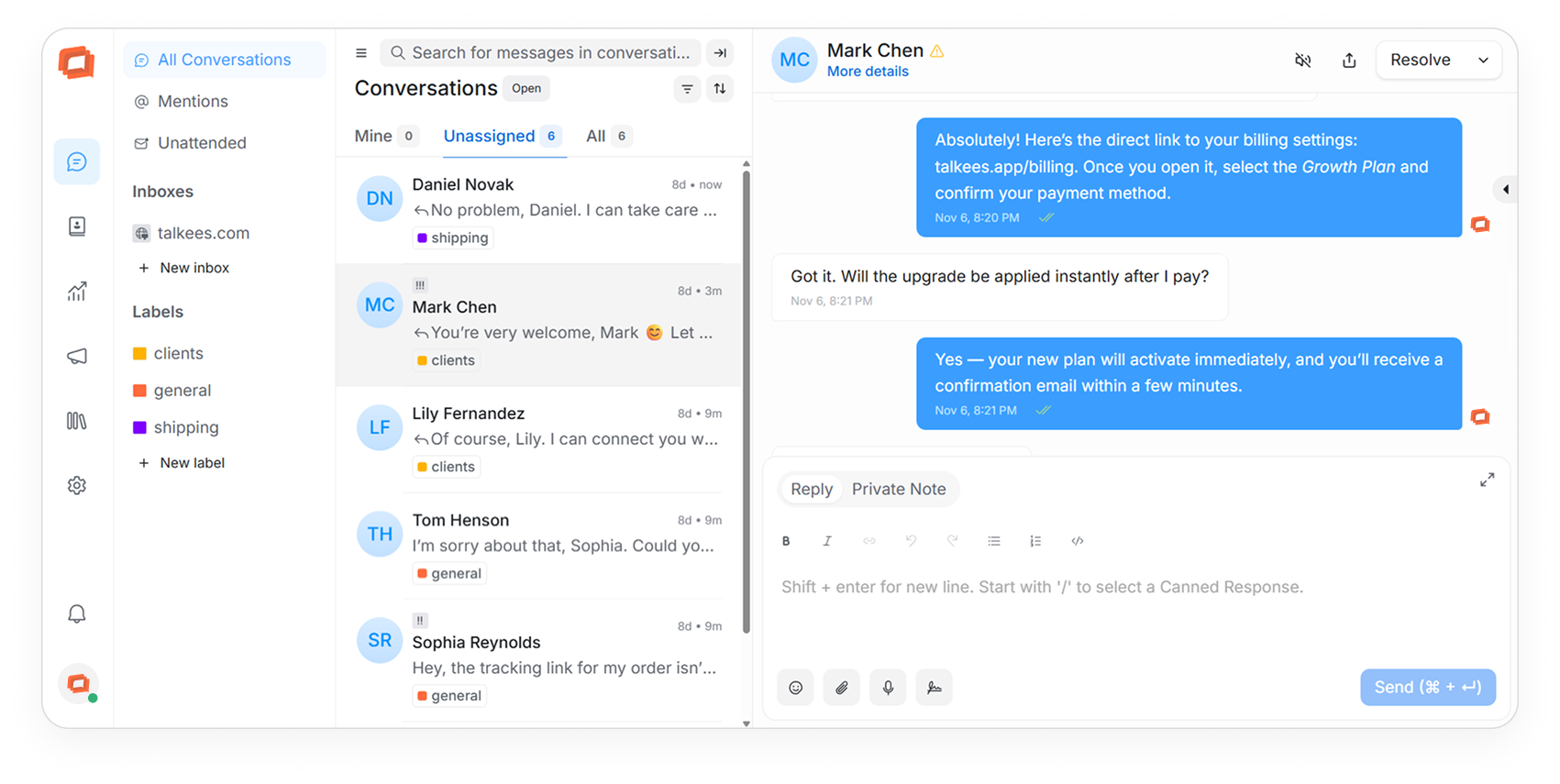
Talkees offers a modern UI that teams can adopt in hours, not weeks. Its focused, clutter-free inbox with keyboard shortcuts, collision detection, internal notes, and one-click assignments keeps first-response times tight.
The platform seamlessly integrates live chat and AI working together. You can pair a lightweight web chat widget with AI that greets, qualifies, and routes customers—then hands over instantly to a human agent. Common wins include:
- AI intent detection to route sales vs. support queries
- Smart reply suggestions for agents and automatic conversation summaries
- FAQ deflection for shipping, returns, opening hours, and inventory questions
Zero-code flows make it easy to build rules for business hours, skills-based routing, round-robin assignment, priority handling, and auto-tagging. Triggers like “new conversation,” “abandoned cart,” or “no reply for 24h” automate nudges and follow-ups.
For e-commerce businesses, Talkees is ready out of the box. Connect to Shopify or WooCommerce to:
- Display order status and purchase history in the agent sidebar
- Trigger cart recovery messages and back-in-stock alerts
- Send product links and payment options directly in chat
Pricing and Value
Talkees offers lower licensing overhead by focusing on essential features without charging for capabilities you’ll never use. Its pricing centers on a simple seat model with generous usage allowances—ideal for teams with 2-20 agents.
Unlike platforms that add per-number fees ($10-15/number/month), WhatsApp conversation costs, or AI credit overages, Talkees keeps your live chat + AI spend predictable as conversations grow.
Migration from Respond.io
Transitioning to Talkees is straightforward:
- Import contact lists via CSV, map custom fields/tags, and maintain lifecycle stages
- Quickly rebuild essential flows (greetings, routing, qualification, after-hours)
- Match webhook endpoints and test events end-to-end
- Plan BSP steps and template approvals for WhatsApp continuity
Our Assessment
Talkees delivers the core essentials—modern UI, flexible configuration, and live chat with AI—in a package that’s easy to adopt and budget for. It’s the kind of “just-enough platform” that helps small teams move faster, communicate with customers on their terms, and keep costs under control.
If you’re evaluating alternatives to Respond.io and run an SMB or e-commerce operation, Talkees should be high on your list for its balance of functionality and affordability.
Intercom — Premium Customer Platform with Advanced Bots and Product Messaging

Intercom sits at the opposite end of the spectrum from Talkees, offering a premium, product-led platform built for in-app engagement, AI-assisted support, and customer lifecycle management.
Key Strengths and Features
Intercom’s advanced AI bot (Fin) can resolve common questions from your Help Center and hand off to humans when confidence drops. Public references put Fin pricing around $0.99 per AI resolution.
The platform excels at in-product messaging for product-led growth. Targeted banners, tooltips, checklists, and product tours drive activation and feature adoption. You can trigger messages based on product events via web/mobile SDKs and A/B test them effectively.
Intercom offers a comprehensive customer engagement ecosystem blending a unified inbox (web and in-app chat, email), Help Center, AI, surveys, and mobile SDKs. It’s designed to live inside your app—not just on your website.
Pricing and Total Cost
Intercom is premium-priced. Published references put it around $39 per seat/month to start, with AI and product add-ons priced separately. A realistic scenario might look like:
- 10 support seats at $39/seat → $390/month
- Fin resolving 1,500 conversations/month at ~$0.99 → ~$1,485/month
- Product Tours/Surveys add-on → $100-$300+/month
- WhatsApp add-on or partner messaging fees → usage-based
- Indicative total: $2,000-$2,300/month before taxes and overages
The upside: AI containment, faster onboarding, and measurable conversion lift from in-app nudges often offset the spend for PLG teams.
Best Fit Scenarios
Intercom is ideal for SaaS/PLG companies (B2B or B2C) with 5-50+ agent seats, >10k monthly active users, and a roadmap dependent on driving activation, feature adoption, and expansions inside the product.
It’s perfect for teams wanting AI deflection on support volume without sacrificing handover quality, and product marketing that can deliver targeted in-app messages without engineering tickets.
Our Assessment
If your top priority is SaaS growth and in-app customer experience, Intercom is a standout premium choice. You’ll pay more, but you get advanced bots, personalized product messaging, and a comprehensive engagement ecosystem tuned for PLG. If your priority is omnichannel WhatsApp at the lowest cost, consider Talkees or other options in this list.
Zendesk — Ticketing-First Suite with Robust Messaging and Enterprise Workflows

Zendesk offers an enterprise-grade, ticketing-first platform that excels when you need structured processes, mature SLAs, and deep workflow governance across high-volume support teams.
Key Strengths and Features
Zendesk provides powerful ticketing at scale with queueing, views, SLAs, macros, side conversations, skills-based routing, and multi-brand support out of the box.
Its unified agent workspace supports email, web widget, WhatsApp, Instagram, Messenger, X/Twitter DMs, and SMS. Sunshine Conversations and the Marketplace make channel coverage broad and enterprise-grade.
For organizations requiring strict governance, Zendesk offers enterprise workflows and controls including custom roles/permissions, audit logs, change management, sandboxes, and analytics with Zendesk Explore.
Pricing and Total Cost
Zendesk Suite is seat-based. Published plans commonly range from Suite Team (~$55/agent/month) to Enterprise ($169+/month). Additional costs to consider:
- AI add-on (per agent/month)
- Voice/Talk usage (minutes, phone numbers)
- WhatsApp and social messaging fees
- Marketplace apps with separate fees
A realistic example for a 25-agent team might total ~$4,290/month before taxes and integrations.
Best Fit Scenarios
Zendesk is ideal if you run a serious support desk (50-1,000+ agents) with SLAs, multi-brand operations, audited processes, and cross-team collaboration requirements.
It’s also excellent for complex, regulated, or multi-region operations needing SSO/SCIM, role-based access, audit trails, and data residency options.
Our Assessment
If your support organization needs enterprise-grade ticketing and governance with solid omnichannel messaging, Zendesk is one of the most reliable Respond.io alternatives. It’s not the cheapest option for WhatsApp-first marketing, but for structured support operations, compliance, and scale, its workflow depth, Marketplace, and analytics are hard to beat.
MessageBird — CPaaS-Driven Omnichannel with Flow Builder and WhatsApp Business API

MessageBird offers a CPaaS-native platform built on carrier-grade messaging infrastructure. If you want deep APIs, global reach, and a visual automation layer, MessageBird is one of the most established options.
Key Strengths and Features
MessageBird provides true CPaaS + omnichannel capabilities across SMS/MMS, WhatsApp Business API, Instagram, Facebook Messenger, Email, Voice/IVR, and Telegram under one roof.
Its Flow Builder offers drag-and-drop journeys spanning channels. Build qualification trees, FAQ deflection, payment reminders, order updates, or webhook-driven workflows without writing code.
As a native WhatsApp Business API provider, MessageBird lets you register numbers, manage templates, broadcast with policy-compliant templates, and route inbound WhatsApp messages to teams or bots.
Pricing and Total Cost
MessageBird’s commercial model can be complex because capabilities are split across modules (Marketing, Inbox, Reach) and usage-based add-ons. Public comparisons mention examples like:
- $25 per 1,000 automation triggers
- $30 per 1,000 AI responses
- $18 per 100 additional conversations
- $0.29 per conversation AI surcharge
- Phone number fees on some plans
- Premium support SLAs as paid add-ons ($500-$5,000/month)
A concrete example might include:
- 20,000 Flow Builder triggers/month → roughly $500
- 5,000 AI responses/month → roughly $150
- 3,000 extra conversations → roughly $540
- 2,000 AI-handled conversations → roughly $580
- Plus base subscription(s), WhatsApp fees, and phone-number costs
Best Fit Scenarios
MessageBird works well for brands wanting a single vendor for WhatsApp BSP + SMS + Voice + Flow Builder.
It’s also excellent for companies with developer resources who will leverage APIs, webhooks, and custom routing, as well as multi-country teams needing local compliance and cross-channel fallbacks.
Our Assessment
MessageBird is a strong Respond.io alternative when you value CPaaS-grade infrastructure, native WhatsApp Business API, and a capable Flow Builder for omnichannel journeys. For small companies, it offers a practical inbox and automation without code; for enterprises, it scales with APIs, throughput, and multi-channel coverage. Just budget carefully—usage-based add-ons can significantly impact your monthly bill.
Twilio — Developer-First Messaging Stack for Custom SMS/WhatsApp/Voice/Email

Twilio is the archetype of “build exactly what you need.” Instead of providing a prebuilt inbox like Respond.io, Twilio offers industrial-grade APIs for SMS/MMS, WhatsApp, voice, and email (SendGrid), plus serverless tools to connect everything.
Key Strengths and Features
Twilio is developer-centric from the ground up, offering Programmable Messaging, WhatsApp Business API, Programmable Voice, and SendGrid for email. Its Conversations API keeps multi-channel threads unified, while webhooks, TwiML, and SDKs in 10+ languages provide integration flexibility.
The platform lets you build any workflow, not just the defaults. Examples include:
- E-commerce: trigger WhatsApp order updates from Shopify webhooks, route escalations to voice if WhatsApp fails
- Fintech: OTP (Verify) + fallback to voice, fraud alerts via SMS with click-to-call handoff
- Support: quick IVR with Programmable Voice, voicemail → transcription → email
Twilio provides enterprise-grade reach and reliability with global coverage, number provisioning in many countries, and high throughput options.
Pricing and Total Cost
Twilio uses a pay-as-you-go model, charging by channel:
- SMS: US outbound typically starts around $0.0075 per message
- WhatsApp: Meta conversation-based fees plus Twilio’s platform fees
- Voice: per-minute inbound/outbound pricing varies by country
- Email (SendGrid): free tier (100 emails/day) then paid plans from ~$20/month
Additional costs include number types (toll-free, short codes, 10DLC), engineering time, and support plans. A ballpark scenario might include:
- 10,000 SMS order updates/month ≈ $75
- 2 local numbers for routing ≈ $2/month
- Email receipts via SendGrid ≈ $20/month
- Plus WhatsApp conversations if used
Best Fit Scenarios
Choose Twilio if you need deep customization and want to own the orchestration rather than adapt to a vendor’s workflow builder.
It’s ideal for teams that value composable architecture: bring your own AI (OpenAI/Vertex), your CDP (Segment), and your data warehouse; map events to your exact business logic.
Our Assessment
Twilio is the most developer-first option in this list. If you want a polished agent experience and fast go-live, consider Talkees, Intercom, or Zendesk. If you want CPaaS flexibility with a friendlier workflow builder, MessageBird is closer. If your goal is to craft exactly the right messaging + voice + email fabric around your product, Twilio is the benchmark to beat.
Freshchat (Freshdesk Messaging) — Support-Focused Chat and Automation within Freshworks

Freshchat—now branded as Freshdesk Messaging—is built for customer service teams that live in tickets, SLAs, and knowledge bases. If your day-to-day is resolving issues fast rather than running cross-channel campaigns, this is one of the most straightforward options.
Key Strengths and Features
Freshchat offers tight Freshdesk integration. Agents can hand off any chat to a Freshdesk ticket in one click, preserve the full transcript, and keep SLAs, priorities, and automations intact.
The platform provides live chat that’s easy to run. The web widget is simple to brand and embed, and agents get canned responses, internal notes, typing indicators, collision detection, and CSAT out of the box.
Freddy AI and automations power FAQ bots, intent-based routing, and data capture before a human joins. You can set business hours, assignment rules, and auto-resolves for common questions.
Pricing and Total Cost
Freshworks typically prices Freshdesk Messaging on a per-agent basis, often in the $19-$59 per agent per month range depending on tier and billing cycle. Annual billing usually brings ~20% savings.
For example, a 10-agent team at $29/agent/month would cost approximately $290/month for chat, routing, and Freddy basics. Adding WhatsApp or Instagram DM doesn’t change the platform fee, but Meta conversation charges will apply.
Best Fit Scenarios
Choose Freshchat if you need a support-first stack where live chat and ticketing are tightly coupled.
It’s ideal for teams wanting no-drama onboarding and familiar help desk workflows (SLAs, priorities, canned replies, CSAT).
Our Assessment
If your core need is fast, organized customer support with live chat + tickets + light automation—and you like the idea of staying within the Freshworks ecosystem—Freshchat is a strong, budget-friendly alternative to Respond.io. It won’t replace sophisticated, cross-channel marketing automations, but for support-oriented teams, it delivers the essentials with minimal setup, predictable pricing, and a familiar help desk feel.
LiveChat — Battle-Tested Web Chat with Rich Marketplace and Help Desk Ecosystem

LiveChat is a veteran of website chat—founded in 2002—known for a rock-solid web widget, fast agent tools, and a broad marketplace that lets you plug it into the stack you already use.
Key Strengths and Features
LiveChat is proven at scale on busy storefronts. The widget loads fast, handles concurrency well, and stays responsive during peak events. Teams routinely run tens of simultaneous chats per agent using collision detection, canned responses, and quick routing.
The platform offers a rich marketplace and one-click installs with 200+ apps and integrations across e-commerce, CRM, analytics, and marketing.
LiveChat Software provides a tightly coupled help desk ecosystem:
- LiveChat (web chat)
- HelpDesk (ticketing)
- ChatBot (no-code/generative chatbots)
- KnowledgeBase (self-service content)
Pricing and Total Cost
LiveChat is seat-based. Public pricing commonly ranges from Starter (~$24/agent/month) to Enterprise (custom pricing with SSO/SLA options).
Add-ons from the same vendor (separate subscriptions) include:
- HelpDesk (ticketing): often ~$29/agent/month
- ChatBot (AI/chatbot builder): from ~$52/month
- KnowledgeBase: low monthly per workspace
Costs scale linearly with seats, and WhatsApp/SMS typically require third-party marketplace apps (with their per-message fees).
Best Fit Scenarios
LiveChat is ideal for e-commerce stores on Shopify/WooCommerce/BigCommerce that want a fast, reliable web chat to convert onsite traffic and deflect simple support questions.
It’s also excellent for SMBs and mid-market teams that prefer a modular help desk ecosystem (chat now, tickets/bots later) rather than jumping straight into an all-in-one omnichannel suite.
Our Assessment
As you evaluate Respond.io alternatives, LiveChat is the safe, battle-tested choice for website chat with a rich integration marketplace and an extendable help desk stack. If your roadmap centers on web conversion and a staged path to tickets and chatbots, it’s hard to beat for speed, reliability, and simplicity. If you need a unified inbox across WhatsApp/Instagram/SMS/email, keep LiveChat on the list for web chat—but pair it with a platform built for omnichannel.
Tidio — Budget-Friendly Chat and Chatbots Tailored to Shopify and WooCommerce Stores

Tidio offers a lean, affordable live chat + chatbot solution purpose-built for e-commerce storefronts, especially Shopify and WooCommerce. It’s a pragmatic Respond.io alternative for small teams that want “just enough” automation.
Key Strengths and Features
Tidio provides turnkey Shopify and WooCommerce installs. Add from the Shopify App Store or install the WordPress plugin, and the web chat widget goes live in a few clicks.
Its no-code chatbots and templates focus on conversions with prebuilt flows for e-commerce: welcome discount, abandoned-cart nudges, “where is my order?” lookups, post-purchase care, and back-in-stock capture.
For marketing automation on a budget, Tidio helps you collect emails/phone numbers in chat, trigger follow-ups, and sync to your email/SMS tool via Zapier or native connectors.
The platform offers social DMs in one place by connecting Facebook Messenger and Instagram DMs so agents reply from one inbox alongside website chat.
Pricing and Total Cost
Tidio offers a free plan, and paid tiers are typically in the $29-$49/month range for core chat + basic bots, with extra seats priced per agent.
A realistic starter setup for a small shop (2 agents + basic chatbots) usually comes in well under $100/month—significantly less than many Respond.io users pay for automation and AI on mid/high tiers.
Best Fit Scenarios
Tidio is ideal if you’re a small to mid-size shop (1-5 agents) on Shopify or WooCommerce, and your primary channels are website chat + Instagram/Messenger.
It’s perfect for teams with practical, near-term goals: capture leads, recover carts, answer FAQs quickly, and keep first response times under 1-2 minutes—without deploying a complex omnichannel stack.
Our Assessment
If you’re comparing alternatives to Respond.io and your business runs on Shopify or WooCommerce with a tight budget, Tidio delivers the core live chat + chatbot + basic marketing automation you need at a fraction of the cost. It won’t replace a heavy-duty omnichannel or WhatsApp-first stack, but for thousands of smaller stores, it’s the fastest path to measurable uplift in conversions and faster replies—without a heavy lift or a heavy bill.
HelpCrunch — Lean All-In-One Support, Email Campaigns, and Knowledge Base

HelpCrunch offers a lean, all-in-one suite that puts website live chat, email campaigns, and a robust knowledge base under one roof. It’s a focused alternative to Respond.io for small and midsize teams that care more about retention and self-service than deep omnichannel messaging.
Key Strengths and Features
HelpCrunch provides live chat + proactive messages with a customizable web widget, auto messages based on behavior, saved replies, and basic chat automation.
Its email marketing and sequences feature lets you send one-off newsletters, drip campaigns, and transactional follow-ups from the same inbox—no context switching.
The included knowledge base (KB) is SEO-friendly with categories, search, article feedback, and branding—built to reduce repetitive tickets and improve deflection.
Pricing and Total Cost
Public pricing has historically been straightforward: per-agent plans that bundle chat + KB, with email sending priced by volume. Typical examples include:
- $15-$25 per user/month for core chat + knowledge base features
- An “unlimited agents” bundle around ~$495/month for growing teams
- Email sends often include a small quota, then pay-as-you-go per 1,000 emails
For a 3-agent support team, you might expect to pay:
- Chat + KB at $25/user → $75/month
- 10,000 marketing/support emails/month → $20-$50
- Total monthly: ~$95-$125
Best Fit Scenarios
HelpCrunch is ideal for e-commerce shops and SaaS SMBs that want to cut repetitive questions with a strong knowledge base, keep conversations inside a clean, unified support inbox, and run simple lifecycle emails without buying three different tools.
It’s also perfect for teams migrating off Respond.io who realize they primarily need website chat + email nurture + self-service, not heavy WhatsApp automation.
Our Assessment
If your shortlist of Respond.io alternatives includes simpler, lower-cost options, HelpCrunch is a lean, human-friendly choice. It won’t replace a full omnichannel stack, but for many small and midsize teams, it delivers the essentials—live chat, email campaigns, and a robust knowledge base—at a price and complexity level that’s hard to beat.
ManyChat — Marketing-Centric Chat Automation for Instagram, Messenger, and WhatsApp

Unlike ticketing or support-first platforms, ManyChat leans hard into conversational marketing. It’s a go-to for e-commerce brands, creators, and performance agencies that want to turn Instagram comments, DMs, and WhatsApp clicks into leads, subscribers, and revenue.
Key Strengths and Features
ManyChat excels at native social DM automation on Instagram, Messenger, and WhatsApp. Build “Comment → DM” funnels on Instagram, reply to Story Mentions automatically, and run WhatsApp Click-to-Message ads that open into guided conversations.
Its no-code, visual Flow Builder lets you drag blocks, set conditions, split traffic, and ship campaigns in minutes—without developer time.
The platform offers growth tools that compound reach. Auto-DM anyone who comments a keyword on a post, send DMs from Story Mentions, use QR codes at events, trigger DMs from ads, or launch micro-landing pages that hand off to chat.
Pricing and Total Cost
ManyChat offers a free plan for simple testing and early campaigns.
The Pro plan starts around $15/month for 500 contacts and scales by contact tiers. Your bill will grow with list size and channel mix.
WhatsApp adds Meta conversation fees billed per conversation category and country (a few cents per conversation, paid to Meta or your WhatsApp BSP).
Best Fit Scenarios
Choose ManyChat if your primary goal is top-of-funnel growth and sales activation on Instagram/Messenger/WhatsApp with fast, no-code campaigns.
It’s less appropriate as a full Respond.io replacement if you need a truly unified inbox across many channels with tickets and SLAs, or enterprise governance features.
Our Assessment
As you compare Respond.io alternatives, ManyChat is the marketing-centric option: it delivers rapid growth and revenue impact on Instagram, Messenger, and WhatsApp, thanks to an easy visual builder and battle-tested growth tools. If you need a consolidated inbox across many channels and enterprise support workflows, shortlist a more omnichannel platform from this guide; if your priority is campaign velocity and DM conversions, ManyChat is hard to beat at its price point.
How to Choose the Right Respond.io Alternative for Your Business

When selecting from these alternatives, consider your specific scenario and needs:
For E-commerce (Shopify/WooCommerce, Instagram/WhatsApp DMs)
- If you need chat + cart recovery + simple automation: Consider Talkees (strong for SMB e-commerce), Tidio (budget-friendly Shopify integration), or LiveChat (best-in-class web chat with a huge marketplace).
- If you focus on Instagram/WhatsApp marketing: Look at ManyChat (marketing-centric flows), MessageBird (CPaaS with WhatsApp Business API), or Twilio (developer-first APIs for custom flows).
For SaaS Companies (In-Product Messaging, Activation, Support)
- For PLG SaaS needing product tours and AI bots: Intercom is the premium choice with in-app messaging, product tours, and AI support (Fin).
- For ticketing-first, enterprise support: Zendesk offers mature support for omnichannel, SLAs, and structured workflows.
- For support-led SaaS on a budget: Consider Freshchat or HelpCrunch for “enough” automation without breaking the bank.
Based on Team Size and Technical Resources
- Small teams wanting no-code and fast setup: Talkees, Tidio, LiveChat, and HelpCrunch all offer straightforward onboarding and no-code flows.
- Enterprise teams or API-first stacks: Zendesk, Intercom, MessageBird, and Twilio provide enterprise-grade routing, roles, and APIs.
Migration Considerations
- WhatsApp BSP and number porting: Plan 3-10 business days for number transfer and template re-approval.
- Data export: Export contacts, conversation history, and workflows from Respond.io.
- Rebuilding automations: Prioritize recreating your top 10-15 money-making or SLA-critical workflows first.
- Parallel run: Keep Respond.io live for a short window while the new platform handles a subset of traffic.
Conclusion: Finding Your Ideal Respond.io Alternative

The best Respond.io alternative for your business depends on your specific needs, channels, and budget. For most SMBs and e-commerce operations, Talkees offers the ideal balance of modern features, straightforward pricing, and quick setup. If you’re focused on product-led growth, Intercom might be worth the premium price. For enterprise support at scale, Zendesk delivers the governance and workflow depth you need.
Before making your final decision, take advantage of free trials, request demos, and ask vendors about their migration support. The right platform should not only solve your current pain points but also scale with your business as it grows.
Remember to model your total cost of ownership over 12-24 months, factoring in all costs: per-seat fees, conversation charges, WhatsApp fees, AI credits, and support packages. This comprehensive approach will ensure you find the Respond.io alternative that truly fits your business needs and budget.