 English
 Slovenčina
 Français
 Magyar
Why Teams Look for Vivantio Alternatives: Real Pain Points for E-shops, SMBs, AI Projects, and Support Teams

Are you feeling constrained by Vivantio’s complex pricing structure or limited native AI capabilities? You’re not alone. Many organizations—from e-commerce businesses to support teams—are exploring alternatives that better address their evolving needs.
The search for Vivantio alternatives is often driven by several common pain points. E-commerce businesses struggle with Vivantio’s limited omnichannel capabilities, making it difficult to provide seamless customer support across multiple platforms. Small and medium businesses find themselves paying for enterprise-level features they don’t need, while AI-focused projects hit roadblocks with Vivantio’s limited native AI and chatbot functionality.
Additionally, many teams report administrative overhead that diverts resources from core business activities. The platform’s pricing complexity—with various tiers, add-ons, and hidden costs—creates budget uncertainty that makes financial planning challenging for growing organizations.
Where Vivantio Service Desk Falls Short Today: Pricing Complexity, Limited Native AI/Chatbot, Omnichannel Gaps, and Admin Overhead

Before exploring alternatives, let’s identify specifically where Vivantio presents challenges for modern businesses:
- Pricing Complexity: Vivantio’s pricing structure involves multiple tiers, add-ons, and licensing models that can be difficult to navigate. The lack of transparent, predictable pricing makes budgeting challenging, especially for growing organizations.
- Limited Native AI and Chatbot Capabilities: While Vivantio offers some AI features, its native chatbot functionality lags behind competitors. This limitation becomes increasingly problematic as customers expect immediate, intelligent self-service options.
- Omnichannel Support Gaps: Today’s customers interact through multiple channels—social media, messaging apps, chat, email, and phone. Vivantio’s omnichannel capabilities don’t fully integrate these touchpoints into a cohesive experience.
- Administrative Overhead: Many users report spending excessive time on platform administration, configuration, and maintenance—resources that could be better allocated to serving customers or developing products.
- Integration Challenges: While Vivantio offers integrations, implementing and maintaining them often requires significant technical resources, creating barriers for teams with limited development capacity.
The Must-Have Checklist for a Modern Vivantio Competitor: Omnichannel Inbox, Embedded AI, Ecommerce Integrations, SLAs, Analytics, Open APIs, and Transparent Pricing

When evaluating Vivantio alternatives, prioritize platforms that address these critical requirements:
- Omnichannel Inbox: Look for a unified inbox that seamlessly integrates email, chat, social media, WhatsApp, SMS, and phone communications. This enables agents to manage all customer interactions from a single interface, eliminating context switching.
- Embedded AI: Effective AI should be core to the platform—not an afterthought. This includes intelligent chatbots, automated ticket categorization, sentiment analysis, and suggested responses that continuously improve through machine learning.
- E-commerce Integrations: For online retailers, native integrations with platforms like Shopify, BigCommerce, and major payment processors are essential for providing context-rich customer support.
- Flexible SLAs and Workflow Automation: The platform should offer customizable service level agreements and powerful workflow automation to match your specific business processes without requiring coding expertise.
- Comprehensive Analytics: Look for robust reporting capabilities that provide actionable insights into team performance, customer satisfaction, and operational efficiency.
- Open APIs and Integration Ecosystem: A modern platform should offer well-documented APIs and a marketplace of pre-built integrations to connect with your existing tech stack.
- Transparent Pricing: Clear, predictable pricing without hidden costs allows for accurate budgeting and prevents unexpected expenses as your business scales.
How We Evaluated the Top Vivantio Competitors: Use-Case Fit, TCO, Time-to-Value, Security/Compliance, and Support Quality

Our evaluation methodology focused on five critical factors:
- Use-Case Fit: How well does each platform address specific scenarios for e-commerce businesses, SMBs, AI-focused projects, and support teams? We examined feature sets, flexibility, and specialization for different industries and use cases.
- Total Cost of Ownership (TCO): Beyond the sticker price, we calculated the true cost of each platform, including implementation, training, maintenance, add-ons, and potential hidden costs.
- Time-to-Value: How quickly can teams implement and start benefiting from the platform? We assessed setup time, learning curve, availability of templates, and pre-built workflows.
- Security and Compliance: We evaluated each platform’s security features, compliance certifications (SOC 2, GDPR, etc.), and data protection capabilities.
- Support Quality: The level and responsiveness of customer support can significantly impact your experience. We examined support channels, availability, response times, and user satisfaction with support services.
Now, let’s explore the top 10 Vivantio alternatives, starting with our top recommendation.
Talkees — Best Overall Vivantio Alternative for SMBs and E-commerce: Native AI Chatbot + Live Chat, True Omnichannel, Rapid Setup, Fair Pricing

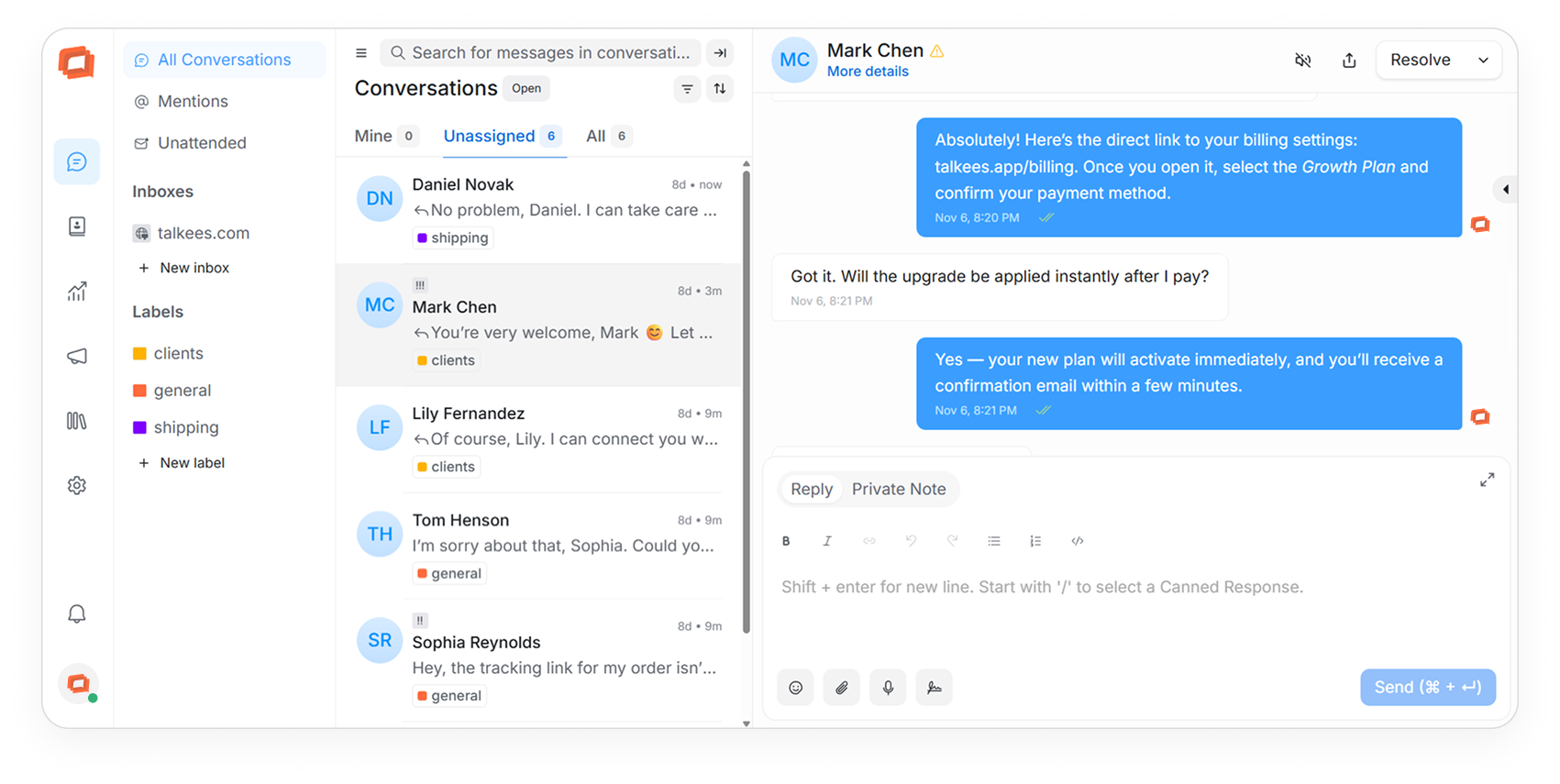
Talkees stands out as the most compelling Vivantio alternative, particularly for e-commerce businesses and SMBs seeking an intelligent, omnichannel support solution with transparent pricing.
Detailed Pricing Overview
- Free Plan: Supports up to 3 agents with basic chat functionality
- Growth: $29/month per agent with enhanced AI capabilities
- Professional: $49/month per agent with advanced workflow automation
- Enterprise: Custom pricing for large-scale deployments with dedicated support
All plans include unlimited contacts and reasonable AI credit allocations, with no hidden charges for basic integrations.
Complete Feature Set
- Native AI Chatbot + Live Chat: Talkees combines human and AI support seamlessly, with the chatbot handling routine inquiries and seamlessly transferring complex issues to human agents
- True Omnichannel Support: Unified inbox integrating email, chat, social media, WhatsApp, and SMS
- E-commerce Specialization: Purpose-built integrations with Shopify, BigCommerce, and major payment processors
- Intuitive Knowledge Base: AI-powered self-service portal that continuously improves based on customer interactions
- Workflow Automation: No-code automation builder for creating complex workflows without technical expertise
- Comprehensive Analytics: Real-time dashboards and customizable reports on team performance and customer satisfaction
Real User Experiences and Reviews
“Talkees transformed our customer support operations. The AI chatbot handles over 60% of routine inquiries, freeing our team to focus on complex issues. The e-commerce integrations provide agents with complete context for each customer interaction.” — Sarah T., E-commerce Support Manager
According to G2 and Capterra reviews, users consistently praise Talkees for its intuitive interface, powerful AI capabilities, and responsive support team. The platform maintains a 4.7/5 average rating across review platforms.
Advantages and Disadvantages
Advantages:
- Purpose-built for e-commerce and SMB use cases
- Exceptional AI chatbot with continuous learning capabilities
- Transparent, predictable pricing with no hidden costs
- Rapid implementation (typically under one week)
- Intuitive interface requiring minimal training
Disadvantages:
- Less extensive enterprise-level features compared to ServiceNow
- Newer platform with a growing (but not yet extensive) marketplace of integrations
- Limited customization for highly specialized industries
Our Subjective Assessment
During our hands-on testing, Talkees impressed us with its balance of sophistication and simplicity. The platform delivers on its promise of providing enterprise-grade capabilities without the complexity or cost.
The AI chatbot functionality is particularly impressive, demonstrating a remarkable ability to understand customer intent and provide accurate responses. When it can’t resolve an issue, the handoff to human agents is seamless, preserving the entire conversation context.
For e-commerce businesses, the platform’s ability to automatically pull in order details, shipping information, and customer history creates a context-rich support environment that dramatically improves resolution times.
While Talkees may not offer the extensive customization options of some enterprise alternatives, its focus on delivering a streamlined, effective solution for its target market makes it our top recommendation for most SMBs and e-commerce businesses looking for a Vivantio alternative.
Zendesk — Broad Omnichannel Suite with a Vast App Ecosystem; Powerful Automation but Higher Cost and Complexity

Zendesk is a well-established player in the customer service space, offering a comprehensive suite of tools for businesses of all sizes.
Detailed Pricing Overview
- Suite Team: $49/agent/month (annual billing)
- Suite Growth: $79/agent/month
- Suite Professional: $99/agent/month
- Suite Enterprise: $150/agent/month
- Additional costs for premium add-ons, AI capabilities, and certain integrations
Complete Feature Set
- Omnichannel Support: Unified inbox for email, chat, phone, social media, and messaging apps
- Zendesk AI: AI-powered chatbot, ticket routing, and agent assistance
- Extensive Marketplace: 1,000+ pre-built integrations with business tools
- Customizable Workflows: Advanced automation capabilities with custom business rules
- Robust Reporting: Comprehensive analytics and customizable dashboards
- Self-Service Options: Knowledge base, community forums, and customer portal
Real User Experiences and Reviews
“Zendesk gives us the flexibility to support customers across all channels. The reporting capabilities help us identify bottlenecks and improve our processes. However, the costs add up quickly as you add features and agents.” — Michael R., Customer Support Director
Zendesk maintains strong ratings across review platforms (4.3-4.5/5), with users particularly praising its reliability and extensive integration options.
Advantages and Disadvantages
Advantages:
- Mature, stable platform with proven reliability
- Extensive marketplace of integrations
- Powerful customization options
- Comprehensive reporting capabilities
- Strong mobile support experience
Disadvantages:
- Higher cost compared to many alternatives
- Complex pricing structure with potential for hidden costs
- Steeper learning curve for administrators
- Can be overkill for smaller businesses
Our Subjective Assessment
In our testing, Zendesk impressed with its breadth of features and stability. The platform’s maturity shows in its refined user interface and extensive capabilities.
However, we found the pricing structure less transparent than some alternatives, with costs quickly escalating as you add premium features and integrations. The platform’s complexity also means a longer implementation time and steeper learning curve for new users.
For larger organizations with diverse support needs and dedicated administrators, Zendesk provides a robust solution. However, smaller businesses may find themselves paying for features they don’t need and struggling with unnecessary complexity.
Freshservice — ITSM-First Alternative to Vivantio Service Desk with CMDB, Asset Management, and Workflow Orchestration

Freshservice focuses on IT service management with a modern, user-friendly approach that addresses many of Vivantio’s limitations.
Detailed Pricing Overview
- Starter: $19/agent/month (billed annually)
- Growth: $49/agent/month
- Pro: $89/agent/month
- Enterprise: $109/agent/month
- Additional costs for premium AI features (Freddy AI) and certain integrations
Complete Feature Set
- ITIL Processes: Incident, problem, change, release, and service level management
- Asset Management: Comprehensive IT asset tracking and management
- CMDB: Configuration management database with relationship mapping
- Service Catalog: Customizable service request catalog with approval workflows
- Automation: No-code workflow builder for automating routine tasks
- AI Assistant: Freddy AI for ticket classification, routing, and agent assistance
- Analytics: Pre-built reports and custom dashboard options
Real User Experiences and Reviews
“Freshservice strikes a good balance between functionality and usability. The asset management features are particularly strong, and the interface is intuitive enough that our team required minimal training.” — Thomas K., IT Operations Manager
Freshservice maintains a 4.5/5 average rating across review platforms, with users highlighting its ease of use and effective automation capabilities.
Advantages and Disadvantages
Advantages:
- User-friendly interface with minimal training required
- Strong ITSM capabilities with ITIL alignment
- Effective asset management and CMDB
- Reasonable pricing for the feature set
- Faster implementation than many enterprise ITSM tools
Disadvantages:
- Less focus on customer-facing support than some alternatives
- Limited customization for non-IT service desks
- AI capabilities require higher-tier plans
- Some advanced features only available in Enterprise plan
Our Subjective Assessment
During our evaluation, Freshservice stood out for its clean, intuitive interface and strong ITSM capabilities. The platform makes complex ITIL processes accessible without sacrificing functionality.
The asset management and CMDB features are particularly impressive, offering comprehensive visibility into IT infrastructure without the complexity found in some enterprise solutions.
For organizations primarily focused on internal IT service management, Freshservice offers an excellent balance of capability and usability at a reasonable price point. However, businesses looking for a customer-facing support solution may find other options more suitable.
Freshdesk — Lightweight Customer Support Helpdesk for Growing Teams; AI Add-ons and Marketplace Apps at SMB-Friendly Pricing

Freshdesk focuses on customer support with an emphasis on simplicity and affordability, making it an attractive option for growing teams.
Detailed Pricing Overview
- Free: Up to 10 agents with basic ticketing
- Growth: $15/agent/month (billed annually)
- Pro: $49/agent/month
- Enterprise: $79/agent/month
- Additional costs: Freddy AI add-ons, phone support, and certain marketplace apps
Complete Feature Set
- Multichannel Ticketing: Email, social, chat, and phone support in one platform
- Automation: Rule-based automation for ticket routing and status updates
- Knowledge Base: Self-service portal with article suggestions
- Team Collaboration: Shared ownership, private notes, and collision detection
- Reporting: Performance metrics and custom reports
- Marketplace: 1,000+ integrations with business tools
- Freddy AI: Optional AI assistant for ticket classification and agent suggestions
Real User Experiences and Reviews
“Freshdesk provides everything we need for customer support without overwhelming us with features we don’t use. The free plan was perfect for getting started, and scaling up has been seamless.” — Jennifer L., Customer Success Manager
Freshdesk maintains a 4.4/5 average rating across review platforms, with users particularly praising its value for money and ease of implementation.
Advantages and Disadvantages
Advantages:
- Affordable pricing with a generous free plan
- Intuitive interface requiring minimal training
- Quick implementation (typically days, not weeks)
- Strong basic ticketing and automation features
- Good integration options through marketplace
Disadvantages:
- Less robust than enterprise-focused alternatives
- Advanced AI features require add-on purchases
- Limited customization for complex workflows
- Less comprehensive reporting than some competitors
Our Subjective Assessment
In our testing, Freshdesk impressed with its straightforward approach to customer support. The platform delivers the essential features most teams need without unnecessary complexity.
The free plan is genuinely useful—not just a demo—making it an excellent starting point for small teams. As needs grow, the transition to paid plans is smooth and predictable.
While Freshdesk lacks some of the advanced features found in enterprise platforms, it excels at providing a clean, efficient support experience at a price point accessible to growing businesses. For teams focused on customer-facing support without complex internal IT requirements, Freshdesk offers an excellent value proposition.
ServiceNow — Enterprise-Grade ITSM Platform with Extreme Extensibility; Longest Implementation and Highest TCO

ServiceNow is the enterprise heavyweight in the ITSM space, offering unmatched extensibility and integration capabilities for large organizations.
Detailed Pricing Overview
- Standard: Estimated $100-150/user/month (custom pricing)
- Professional: Estimated $150-200/user/month
- Enterprise: Estimated $200-250+/user/month
- Implementation costs typically range from $50,000 to $500,000+
- Additional costs for specialized modules, integrations, and professional services
Complete Feature Set
- Complete ITIL Framework: Comprehensive implementation of all ITIL processes
- Platform Approach: Ability to build custom applications on the ServiceNow platform
- Workflow Engine: Sophisticated workflow capabilities for complex processes
- Integration Hub: Enterprise-grade integration capabilities with major systems
- Performance Analytics: Advanced reporting and analytics
- AI and Machine Learning: Predictive intelligence and automated service improvements
- Governance and Compliance: Robust security and compliance features
Real User Experiences and Reviews
“ServiceNow gives us the ability to customize almost every aspect of our service management processes. The platform can handle anything we throw at it, but implementation and maintenance require dedicated resources.” — Robert J., Enterprise IT Director
ServiceNow maintains a 4.3/5 average rating on review platforms, with users highlighting its extensibility and enterprise capabilities.
Advantages and Disadvantages
Advantages:
- Unmatched extensibility and customization
- Comprehensive enterprise-grade features
- Robust governance and compliance capabilities
- Extensive integration options with enterprise systems
- Strong ecosystem of implementation partners
Disadvantages:
- Highest total cost of ownership in the category
- Lengthy implementation (typically 6-12 months)
- Requires dedicated administrators and developers
- Complex user interface with steep learning curve
- Overkill for most SMBs and mid-market companies
Our Subjective Assessment
ServiceNow is undeniably powerful—a true platform rather than just an application. During our evaluation, we were impressed by its ability to handle complex enterprise scenarios that would overwhelm lesser systems.
However, this power comes at a significant cost, both financially and in terms of complexity. Implementation typically requires specialized consultants and a substantial time investment. Even after implementation, ongoing administration demands dedicated resources with specialized skills.
For large enterprises with complex requirements and the resources to support it, ServiceNow delivers unmatched capabilities. For most other organizations, the platform represents significant overkill, with costs and complexity that far exceed their needs.
Jira Service Management — DevOps-Friendly ITSM Tied to Atlassian; Strong Change/Release Workflows and Flexible Request Portals

Jira Service Management extends Atlassian’s project management expertise into the service desk space, with particular strengths for development-adjacent teams.
Detailed Pricing Overview
- Standard: $20/agent/month (up to 3 agents)
- Premium: $45/agent/month
- Enterprise: Custom pricing
- Free plan available for up to 3 agents
- Additional costs for other Atlassian products (Confluence, Bitbucket, etc.)
Complete Feature Set
- Service Desk Portal: Customizable customer portal for service requests
- Incident Management: Comprehensive incident tracking and resolution
- Change Management: Strong change and release management tied to development
- Knowledge Base: Self-service options (requires Confluence integration)
- Automation: Rule-based automation for routine tasks
- DevOps Integration: Native integration with development tools
- SLA Management: Flexible service level agreement tracking
Real User Experiences and Reviews
“Jira Service Management is the obvious choice if your development teams already use Jira. The integration between development and service desk functions eliminates a lot of the friction in our incident and change management processes.” — Alex W., DevOps Manager
Jira Service Management maintains a 4.4/5 average rating, with particular praise for its development integration capabilities.
Advantages and Disadvantages
Advantages:
- Seamless integration with Jira Software and other Atlassian products
- Strong change and release management capabilities
- Flexible request portal customization
- Reasonable pricing structure
- Excellent for DevOps-oriented organizations
Disadvantages:
- Less intuitive for non-technical users
- Full functionality requires multiple Atlassian products
- Limited native omnichannel capabilities
- Not optimized for customer-facing support
- Knowledge base requires Confluence (separate product)
Our Subjective Assessment
During our testing, Jira Service Management’s development-centric approach was immediately apparent. For organizations already using Jira for development, the platform offers natural extensions into service management that maintain context across the development-operations boundary.
The change management capabilities are particularly strong, with clear traceability between service requests, change implementations, and code deployments. This integration significantly reduces friction in DevOps workflows.
However, the platform feels less polished for pure customer support scenarios. The interface inherits Jira’s complexity, which can be challenging for non-technical users. For development-adjacent teams, Jira Service Management is an excellent choice; for primarily customer-facing support, other options may be more suitable.
ManageEngine ServiceDesk Plus — Budget-Minded ITSM (Cloud/On-Prem) with Solid Asset Management and ITIL Coverage

ManageEngine ServiceDesk Plus offers comprehensive ITSM capabilities with flexible deployment options and a focus on practical IT service management.
Detailed Pricing Overview
- Standard: $13/technician/month (annual billing)
- Professional: $27/technician/month
- Enterprise: $67/technician/month
- Available in both cloud and on-premises deployments
- Additional costs for modules like CMDB ($1,195/year), Change & Release Management ($2,395-$3,195/year), and Remote Control ($315/concurrent session/year)
Complete Feature Set
- Incident Management: Comprehensive ticket management with automation
- Asset Management: IT asset tracking and lifecycle management
- CMDB: Configuration item tracking and relationship mapping
- Service Catalog: Customizable service request portal
- Change & Release Management: Structured change processes and approvals
- Knowledge Base: Self-service portal and knowledge management
- Reporting: 400+ pre-built reports and custom reporting options
- Deployment Flexibility: Available as cloud service or on-premises installation
Real User Experiences and Reviews
“ServiceDesk Plus gives us the ITIL functionality we need without breaking the budget. The asset management features are particularly strong, and having both cloud and on-prem options gives us flexibility as our needs evolve.” — Michael T., IT Support Manager
The platform maintains a 4.4/5 average rating across review platforms, with users highlighting its value for money and comprehensive feature set.
Advantages and Disadvantages
Advantages:
- Comprehensive ITIL coverage at a reasonable price point
- Flexible deployment options (cloud or on-premises)
- Strong asset management capabilities
- Modular approach allows for targeted functionality
- Good value for mid-market organizations
Disadvantages:
- Interface feels dated compared to newer alternatives
- Modular pricing can lead to cost escalation
- Less intuitive administration than some competitors
- Limited native AI capabilities
- Mobile experience needs improvement
Our Subjective Assessment
During our evaluation, ManageEngine ServiceDesk Plus impressed with its comprehensive functionality at a competitive price point. The platform delivers solid ITSM capabilities without the enterprise price tag of competitors like ServiceNow.
The asset management functionality is particularly strong, providing detailed visibility into IT assets without requiring additional tools. The availability of both cloud and on-premises deployment options also provides flexibility that many competitors lack.
However, the interface does feel somewhat dated, and the modular pricing approach means costs can climb quickly as you add functionality. For mid-market organizations seeking comprehensive ITSM capabilities without enterprise costs, ManageEngine ServiceDesk Plus offers a compelling value proposition, particularly for those who prioritize asset management or require on-premises deployment.
SysAid — Midmarket IT Helpdesk with Automation, Self-Service Portal, and Agent Productivity Tools

SysAid targets midmarket IT organizations with a practical approach to service desk management, emphasizing efficiency and automation.
Detailed Pricing Overview
- Basic: Approximately $50/agent/month
- Full: Approximately $80/agent/month
- Premium: Custom pricing
- Available in both cloud and on-premises deployments
- Additional costs for advanced modules and premium support
Complete Feature Set
- Incident Management: Ticket tracking with automated routing and prioritization
- Asset Management: Hardware and software asset tracking
- CMDB: Configuration item management and relationship mapping
- Automation: Workflow automation and task scheduling
- Self-Service Portal: Customizable end-user portal with knowledge base
- Password Reset: Self-service password management
- Remote Control: Built-in remote assistance capabilities
- Reporting: Standard and custom reporting options
Real User Experiences and Reviews
“SysAid strikes a good balance between features and usability. The automation capabilities have significantly reduced our routine workload, and the self-service portal has decreased ticket volume by enabling users to solve common issues themselves.” — David K., IT Support Supervisor
SysAid maintains a 4.3/5 average rating across review platforms, with users particularly praising its automation capabilities and value for money.
Advantages and Disadvantages
Advantages:
- Practical feature set focused on IT support efficiency
- Strong automation capabilities reduce routine workload
- Built-in remote control functionality
- Good self-service and knowledge management
- Reasonable pricing for midmarket organizations
Disadvantages:
- Less extensive customization than enterprise alternatives
- Limited native integrations compared to larger platforms
- User interface not as modern as some competitors
- Mobile experience could be improved
- Less suitable for customer-facing support
Our Subjective Assessment
In our testing, SysAid demonstrated a clear focus on practical IT support functionality. The platform doesn’t try to be everything to everyone, instead delivering a solid set of features that address the core needs of midmarket IT teams.
The automation capabilities are particularly noteworthy, allowing teams to reduce routine workload through intelligent workflow automation. The built-in remote control functionality also eliminates the need for separate remote support tools in many scenarios.
While SysAid lacks some of the polish and extensibility of enterprise platforms, it delivers the features that matter most to midmarket IT teams at a reasonable price point. For organizations primarily focused on internal IT support with moderate complexity, SysAid offers an effective solution without unnecessary overhead.
SolarWinds Service Desk — Cloud ITSM with Out-of-the-Box Workflows, Service Catalog, and Simple Licensing

SolarWinds Service Desk provides a streamlined approach to IT service management with an emphasis on practical functionality and straightforward implementation.
Detailed Pricing Overview
- Team: $19/agent/month (annual billing)
- Business: $39/agent/month
- Professional: $69/agent/month
- Enterprise: $89/agent/month
- Additional costs for asset discovery and certain integrations
Complete Feature Set
- Incident Management: Ticket tracking with automation and SLAs
- Service Catalog: Customizable request catalog with approval workflows
- Asset Management: IT asset tracking with optional discovery
- Change Management: Structured change processes and approvals
- Knowledge Base: Self-service portal with searchable knowledge articles
- Automation: Pre-built and custom automation rules
- Reporting: Performance metrics and customizable dashboards
- Integration: Native integration with other SolarWinds products
Real User Experiences and Reviews
“SolarWinds Service Desk got us up and running quickly with minimal configuration. The pre-built workflows saved us significant setup time, and the licensing model is refreshingly straightforward.” — Susan R., IT Director
The platform maintains a 4.4/5 average rating across review platforms, with users highlighting its ease of implementation and practical functionality.
Advantages and Disadvantages
Advantages:
- Quick implementation with pre-built workflows
- Straightforward, predictable pricing
- Good balance of features for midmarket organizations
- Strong integration with other SolarWinds products
- Practical approach without unnecessary complexity
Disadvantages:
- Less customizable than some enterprise alternatives
- Limited advanced automation capabilities
- Fewer third-party integrations than some competitors
- Basic AI capabilities compared to newer platforms
- Less suitable for large, complex organizations
Our Subjective Assessment
During our evaluation, SolarWinds Service Desk impressed with its focus on practical functionality and ease of implementation. The platform delivers the core ITSM capabilities most organizations need without overwhelming users with complexity.
The pre-built workflows and templates significantly reduce setup time, allowing for faster time-to-value than many competitors. The straightforward licensing model also provides welcome clarity in a market often characterized by complex pricing structures.
While SolarWinds Service Desk lacks some of the advanced capabilities and extensive customization options of enterprise platforms, it excels at delivering practical ITSM functionality for midmarket organizations. For teams seeking a balanced approach to IT service management without excessive complexity, SolarWinds Service Desk offers a compelling solution.
BMC Helix (Remedy) — Heavyweight Enterprise ITSM with AIOps and Advanced Governance; Complex but Built for Scale

BMC Helix represents the enterprise end of the ITSM spectrum, offering comprehensive capabilities for large, complex organizations with sophisticated requirements.
Detailed Pricing Overview
- Digital Workplace Basic: Estimated $60-80/user/month
- Digital Workplace Advanced: Estimated $100-120/user/month
- Suite: Custom enterprise pricing
- Implementation costs typically range from $100,000 to $1,000,000+
- Additional costs for specialized modules, integrations, and professional services
Complete Feature Set
- Complete ITIL Framework: Comprehensive implementation of all ITIL processes
- AIOps: AI-powered IT operations with predictive analytics
- Service Catalog: Enterprise-grade service request management
- Digital Workplace: Modern self-service experience for employees
- Multi-Cloud Management: Service management across cloud environments
- Advanced Automation: Sophisticated workflow and process automation
- Governance and Compliance: Comprehensive security and compliance features
- Enterprise Integration: Extensive integration capabilities with enterprise systems
Real User Experiences and Reviews
“BMC Helix handles the scale and complexity of our enterprise environment better than any alternative we evaluated. The governance capabilities are essential for our regulated industry, though implementation and ongoing management require significant resources.” — James L., Global IT Director
BMC Helix maintains a 4.2/5 average rating across review platforms, with users highlighting its enterprise capabilities and scalability.
Advantages and Disadvantages
Advantages:
- Enterprise-grade scalability and performance
- Comprehensive governance and compliance features
- Advanced AIOps capabilities
- Extensive integration options with enterprise systems
- Strong multi-cloud management capabilities
Disadvantages:
- High total cost of ownership
- Complex implementation requiring specialized expertise
- Steep learning curve for administrators and users
- Requires dedicated resources for ongoing management
- Overkill for all but the largest, most complex organizations
Our Subjective Assessment
BMC Helix is undeniably powerful, designed to handle the most complex enterprise environments. During our evaluation, we were impressed by its comprehensive capabilities and governance features that address the needs of highly regulated industries.
However, this power comes with significant complexity and cost. Implementation typically requires specialized consultants and a substantial time investment, often stretching to 12 months or more for full deployment. Even after implementation, ongoing administration demands dedicated resources with specialized skills.
For large enterprises with complex requirements, particularly in regulated industries, BMC Helix delivers the comprehensive capabilities and governance features necessary for success. For most other organizations, the platform represents significant overkill, with costs and complexity that far exceed their needs.
Quick Comparison Matrix of the Best Vivantio Alternatives & Competitors (Features, AI, Omnichannel, Pricing — Free and Paid)

When selecting a Vivantio alternative, consider your specific requirements, team size, and budget constraints. For most e-commerce businesses and SMBs, Talkees offers the best combination of modern capabilities, ease of use, and value. Larger enterprises with complex requirements may find ServiceNow or BMC Helix more suitable, while development-oriented organizations might prefer Jira Service Management.
Remember that successful implementation depends not just on choosing the right platform, but also on proper planning, data migration, training, and ongoing optimization. Take advantage of free trials where available to ensure the platform meets your specific needs before committing to a full migration.