 English
 Slovenčina
 Français
 Magyar
Why Businesses Seek Alternatives to Sendbird in 2025

Are you considering alternatives to Sendbird for your messaging needs? You’re not alone. While Sendbird offers robust chat functionality, many organizations are exploring other options due to several key challenges.
The primary pain points driving businesses away from Sendbird include pricing structures that can become expensive at scale, limitations in AI integration capabilities, gaps in omnichannel support, and concerns about vendor lock-in. Many companies report that Sendbird’s MAU-based pricing model becomes particularly problematic beyond 10,000 monthly active users, with steep increases that impact budgeting predictability.
Additionally, businesses face unexpected costs from overage charges, particularly the $5 per Peak Concurrent Connection (PCC) fee that can significantly impact your bill during high-traffic events or seasonal spikes. If your business experiences variable traffic patterns, these overage charges can seriously affect your ROI calculations.
What to Look for in a Sendbird Competitor in 2025

When evaluating Sendbird alternatives, several critical capabilities should be on your checklist:
- AI Integration: Look for platforms that offer seamless integration with leading AI models or provide their own AI capabilities for chatbots, intent detection, and automated responses.
- Omnichannel Support: The best alternatives unify messaging across channels including in-app chat, email, WhatsApp, and social media platforms.
- SDK Depth: Evaluate the breadth and quality of SDKs across platforms (iOS, Android, Web) and languages (Swift, Kotlin, JavaScript, etc.).
- Scalability: Ensure the platform can handle your expected user base and message volume without performance degradation.
- Compliance: For regulated industries, verify support for standards like HIPAA, GDPR, SOC 2, and data residency options.
- Clear Pricing: Look for transparent pricing models that align with your usage patterns and provide predictability as you scale.
How We Evaluated Sendbird Competitors

Our evaluation focused on several key dimensions to ensure a comprehensive assessment:
- SDK Coverage: We examined the breadth of platforms and programming languages supported, including mobile, web, and cross-platform frameworks.
- Performance Metrics: We assessed latency, SLA guarantees, and real-world performance under various load conditions.
- Moderation Capabilities: We evaluated both automated and manual moderation tools, content filtering, and user management features.
- Data Control: We looked at data residency options, export capabilities, and retention policies.
- Total Cost of Ownership: Beyond base pricing, we considered hidden costs, overage fees, and long-term scaling economics.
- Migration Tooling: We assessed how easily organizations can migrate from Sendbird, including history import and user mapping tools.
- Analytics: We evaluated the depth and accessibility of messaging and user engagement analytics.
Let’s explore the top alternatives to Sendbird, starting with Talkees, which offers an impressive combination of AI capabilities and omnichannel support at competitive pricing.
Talkees vs Sendbird: Unified Omnichannel Communications with AI

Talkees stands out as a powerful Sendbird alternative, particularly for businesses seeking an AI-powered omnichannel communication platform that combines ease of use with advanced capabilities.
Pricing and Plans
- Free Plan: Talkees offers a generous free tier that includes 50 conversations per month, live web chat, email integration, and automated AI responses – perfect for small businesses or those wanting to test the platform.
- Standard Plan (€49/month): This plan includes 1,000 conversations per month, comprehensive AI automations, integration capabilities with third-party apps, and basic analytics.
- Premium Plan (€99/month): For growing businesses, this plan provides unlimited conversations, templating capabilities, chat segmentation tools, and enhanced reporting features.
Unlike Sendbird’s MAU-based pricing that can lead to unpredictable costs during traffic spikes, Talkees’ conversation-based pricing offers better cost predictability, especially for businesses with seasonal fluctuations or promotional events.
Key Features
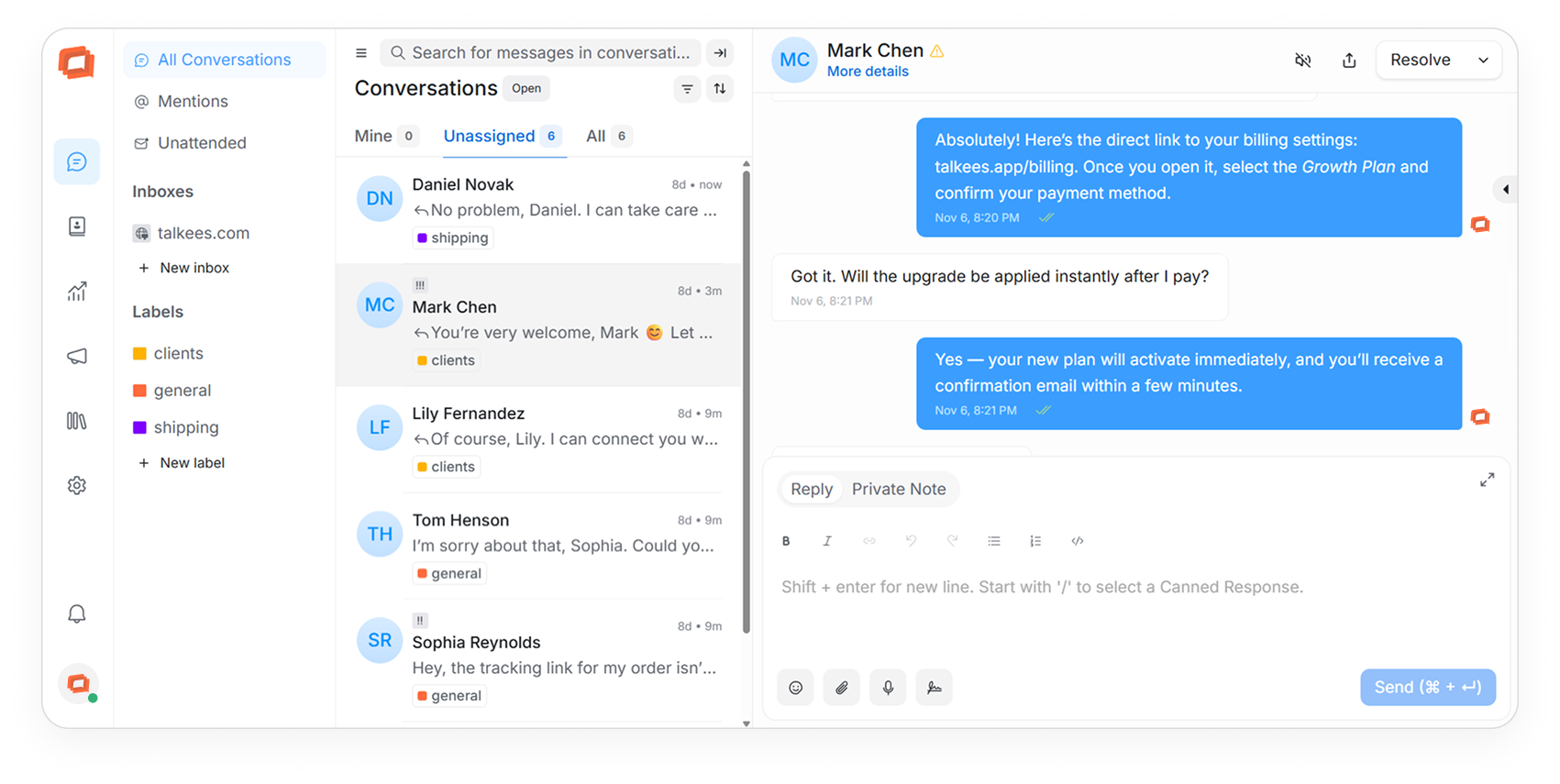
Talkees excels with its unified inbox that centralizes communications across multiple channels:
- Omnichannel Support: Seamlessly handle web chat, email, WhatsApp, Telegram, and Instagram from a single interface
- AI-Powered Automation: Leverage intelligent chatbots that can understand intent and provide contextually relevant responses
- Live Chat for E-commerce: Engage customers in real-time with a chat solution optimized for conversion
- Intuitive Interface: Get teams productive quickly with minimal training required
Advantages Over Sendbird
While Sendbird focuses primarily on in-app chat SDK functionality, Talkees provides a more comprehensive communication solution that extends beyond just in-app messaging. The platform’s AI capabilities are deeply integrated rather than offered as add-ons, providing more value at a lower price point.
Talkees also offers a more straightforward migration path for businesses looking to switch from Sendbird, with tools to import conversation history and user data.
Our Hands-On Experience
During our testing, we found Talkees particularly impressive for customer support teams. The AI automation significantly reduced response times for common queries, and the unified inbox made managing conversations across multiple channels remarkably efficient.
The platform was up and running within hours, not days, and the intuitive interface required minimal training for our support agents. We especially appreciated how the AI suggested responses based on previous similar conversations, which helped maintain consistency in communication.
For e-commerce operations, the ability to seamlessly transition between automated responses and human agents when necessary provided the perfect balance of efficiency and personalization.
Twilio vs Sendbird: Programmable Communications at Scale

Twilio offers a more developer-centric approach to communications with its Conversations API, providing flexibility for teams that need a programmable communications stack.
Pricing and Plans
Twilio utilizes a pay-as-you-go model that charges based on actual usage rather than fixed MAU tiers:
- Conversations API: Approximately $0.05 per MAU plus $0.25 per GB for media storage
- Additional Channels: Separate pricing for SMS (starting at $0.0079 per message), WhatsApp, and voice services
This elastic pricing model can be more economical for applications with variable usage patterns, though it requires more careful monitoring to avoid unexpected costs.
Key Features
- Omnichannel Conversations API: Unify SMS, MMS, WhatsApp, and chat in a single conversation thread
- Voice and Video Add-ons: Expand beyond text with Twilio’s robust voice and video capabilities
- Programmable Flexibility: Build custom communication workflows with Twilio Functions
- Global Reach: Leverage Twilio’s carrier relationships for worldwide messaging delivery
Advantages Over Sendbird
Twilio provides greater flexibility for developers who need to build custom communication experiences. Its pay-as-you-go model can be more cost-effective for applications with sporadic usage patterns, and its higher SLA (99.95% compared to Sendbird’s 99.9%) offers better reliability guarantees.
The platform’s programmable nature makes it ideal for teams that need to integrate communications deeply into their business processes or create unique user experiences that go beyond standard chat functionality.
Our Subjective Assessment
In our testing, we found Twilio’s developer experience to be excellent but requiring more technical resources than some alternatives. The documentation is comprehensive, and the platform’s reliability is outstanding.
However, building a polished chat experience with Twilio requires more development effort compared to solutions with pre-built UI components. This makes Twilio best suited for teams with strong technical resources who value flexibility and customization over out-of-the-box functionality.
For a clearer breakdown of capabilities and costs, see our full twilio vs sendbird comparison focused on messaging APIs, real-time engagement, and scalability.
Firebase vs Sendbird: DIY Chat with Google’s Backend

Firebase offers a DIY approach to chat functionality through its Firestore database and Cloud Messaging services, appealing to developers who want more control over their implementation.
Pricing and Plans
- Spark Plan (Free): 100 simultaneous connections, 1GB storage
- Blaze Plan (Pay-as-you-go): Charges based on reads, writes, storage, and bandwidth with no fixed monthly fee
For a typical chat application, costs scale with database operations rather than user counts, making Firebase potentially more economical for applications with many registered users but relatively low message volume.
Key Features
- Realtime Database/Firestore: Build chat functionality with realtime data synchronization
- Cloud Messaging: Send notifications to keep users engaged
- Authentication: Secure user identity with Firebase Auth
- Offline Sync: Maintain functionality even when users lose connectivity
Advantages Over Sendbird
Firebase provides greater control over implementation details and potentially lower costs for applications with the right usage patterns. There’s no concept of MAU billing or concurrent connection overage fees, which can make costs more predictable for certain applications.
The platform also integrates seamlessly with other Google Cloud services, providing a pathway to more advanced functionality as your application grows.
Our Subjective Assessment
During our evaluation, we found Firebase to be an excellent choice for teams with strong development resources who want to maintain complete control over their chat implementation. The realtime synchronization works remarkably well, and the offline capabilities provide a great user experience.
However, building a full-featured chat solution with Firebase requires significantly more development effort compared to purpose-built chat platforms. Features like moderation, read receipts, and typing indicators all need custom implementation. We estimate that building a basic chat MVP with Firebase takes 3-4 times longer than implementing a solution like Talkees or Sendbird.
PubNub vs Sendbird: Realtime Infrastructure at Global Scale

PubNub provides a global Data Stream Network (DSN) that powers realtime applications beyond just chat, offering exceptional scalability and performance.
Pricing and Plans
- Free Tier: Up to 200 MAUs for proof-of-concept development
- Starter Plan: From $49/month
- Enterprise: Custom pricing with additional features and support
PubNub’s pricing model is based on both MAU and transaction volume, with different considerations than Sendbird’s pure MAU approach.
Key Features
- Global Data Stream Network: Sub-100ms worldwide message delivery
- Presence Detection: Real-time user online/offline status and occupancy information
- Pub/Sub Architecture: Highly scalable messaging infrastructure
- Functions: Serverless compute for message transformation and business logic
Advantages Over Sendbird
PubNub excels at raw performance and global scale, with its distributed network architecture providing lower latency than region-based approaches. The platform offers exceptional reliability, with a claimed 99.999% uptime SLA on enterprise plans.
For applications requiring presence information and real-time updates at massive scale, PubNub’s infrastructure provides advantages over Sendbird’s more chat-focused approach.
Our Subjective Assessment
In our testing, PubNub’s performance was impressive, particularly for globally distributed users. The platform handled high message volumes with minimal latency, and the presence features provided a solid foundation for interactive applications.
However, PubNub provides more of an infrastructure layer than a complete chat solution. While this offers flexibility, it also means more development work to implement chat-specific features like moderation tools, thread management, and user profiles. For teams without dedicated chat development resources, this could extend implementation timelines significantly.
CometChat vs Sendbird: Pre-built UI Kits for Rapid Deployment

CometChat focuses on providing a developer-friendly platform with extensive pre-built UI components to accelerate implementation.
Pricing and Plans
- Free Plan: Up to 100 users for development and testing
- Basic Plan: Approximately $239-$298/month for 1,000 MAUs
- Enterprise: Custom pricing with additional features and support
CometChat’s overage charges are reportedly more predictable than Sendbird’s, with approximately $0.10 per additional MAU and $1 per additional peak concurrent connection (compared to Sendbird’s reported $5 per PCC).
Key Features
- Pre-built UI Kits: Extensive components for various platforms (iOS, Android, Web, React, React Native)
- Voice and Video: Integrated calling capabilities within the same platform
- Moderation Tools: Built-in content filtering and user management
- Extensions Marketplace: Add-ons for polls, stickers, and other engagement features
Advantages Over Sendbird
CometChat offers more predictable pricing with lower overage charges, making it more suitable for applications with variable usage patterns. The platform also includes voice and video capabilities in the same product rather than as separate services, potentially reducing overall costs.
For startups and SMBs, CometChat’s pricing structure and included features often provide better value, especially when considering the total cost of ownership.
Our Subjective Assessment
During our evaluation, CometChat impressed us with its comprehensive UI kits and the speed with which we could implement a polished chat experience. The voice and video integration worked seamlessly, and the moderation tools provided good control over content.
The platform feels optimized for getting to market quickly with a professional-looking solution. While it may not offer the same depth of enterprise features as Sendbird, it provides excellent value for most common chat use cases. We found the documentation clear and the support responsive during our implementation process.
GetStream vs Sendbird: Activity Feeds and Chat Combined

GetStream (Stream) offers a powerful combination of chat capabilities and activity feeds, making it ideal for social and community applications.
Pricing and Plans
- Startup Plan: $499/month for 10,000 MAUs and 500 concurrent connections
- Standard Plan: $1,299/month for 25,000 MAUs
- Premium Plan: $2,299/month for 50,000 MAUs
- Enterprise: Custom pricing with additional features
Key Features
- Chat + Activity Feeds: Combined solution for social experiences
- Global Edge Network: Low-latency performance worldwide
- Advanced Moderation: In-house AutoModeration with semantic filtering
- Unlimited Group Sizes: No practical cap on channel membership
Advantages Over Sendbird
GetStream claims to offer latency up to 5x lower than Sendbird’s region-based approach thanks to its global edge infrastructure. The platform also offers effectively unlimited group sizes compared to Sendbird’s 20,000-user supergroup limit.
The combination of chat and activity feeds in a single platform can significantly reduce development effort for social applications that need both capabilities.
Our Subjective Assessment
In our testing, GetStream’s performance was indeed impressive, with noticeably lower latency for globally distributed users. The activity feed functionality integrated seamlessly with chat, creating a cohesive social experience.
The platform’s moderation tools were particularly strong, with the AutoModeration capabilities effectively filtering problematic content without excessive false positives. For social applications and communities, GetStream provides an excellent foundation with less development effort than building these capabilities separately.
TalkJS vs Sendbird: Purpose-built for Marketplace Communication

TalkJS specializes in chat solutions for marketplaces and platforms where buyers and sellers need to communicate securely.
Pricing and Plans
- Basic Plan: $259/month
- Growth Plan: $569/month
- Enterprise: Custom pricing
Key Features
- Inbox-style UI: Familiar messaging experience for marketplace users
- Pre-built Templates: Specialized designs for marketplace scenarios
- Email/SMS Fallbacks: Ensure message delivery even when users are offline
- Identity Verification: Tools to maintain trust in marketplace communications
Advantages Over Sendbird
TalkJS is highly optimized for marketplace use cases, with features specifically designed for buyer-seller communication. The platform’s email and SMS fallbacks ensure that important messages aren’t missed, which is crucial for transaction-related communications.
For marketplace operators, TalkJS requires less customization to achieve a polished, purpose-built communication experience compared to more general-purpose platforms like Sendbird.
Our Subjective Assessment
During our evaluation, TalkJS impressed us with how quickly we could implement a marketplace chat solution. The inbox-style interface was intuitive for users familiar with email clients, and the fallback mechanisms worked reliably to ensure message delivery.
The platform feels purposefully designed for marketplace scenarios, with thoughtful features like read receipts and typing indicators that help build trust between buyers and sellers. For marketplace applications, TalkJS provides excellent value with minimal development effort.
Pusher vs Sendbird: Lightweight Realtime Events and Notifications

Pusher provides a lightweight solution for realtime events and notifications, with Channels and Beams products that can be used to build chat functionality.
Pricing and Plans
- Sandbox (Free): Limited connections and messages
- Startup: From $49/month
- Pro and Enterprise: Custom pricing based on connections and message volume
Key Features
- Channels: Pub/sub messaging for realtime updates
- Beams: Push notifications across platforms
- Presence: User online/offline status
- Client Libraries: SDKs for various platforms and languages
Advantages Over Sendbird
Pusher offers a more lightweight and potentially cost-effective solution for applications that need basic realtime functionality rather than a full-featured chat platform. The service is easy to integrate and provides good performance for simple messaging needs.
For developers building custom chat experiences who need control over implementation details, Pusher provides the necessary infrastructure without dictating the user experience.
Our Subjective Assessment
In our testing, Pusher was remarkably easy to integrate, with clear documentation and well-designed SDKs. The service performed reliably for basic realtime messaging needs, with good latency and connection stability.
However, building a complete chat solution with Pusher requires significantly more development effort than using a purpose-built chat platform. Features like message history, threading, and moderation all need custom implementation. For teams with limited resources, this could extend development timelines considerably.
Intercom vs Sendbird: Customer Support Focus with Integrated Help Center

Intercom provides a customer messaging platform with a strong focus on support use cases, combining chat with knowledge base functionality.
Pricing and Plans
- Starter: From $74/month for 2 seats
- Pro: From $99/month per seat
- Enterprise: Custom pricing
Intercom uses a seat-based pricing model rather than charging by MAU, which can be more predictable for support teams.
Key Features
- Support Inbox: Unified interface for customer conversations
- Chatbots and Automation: Resolve common queries automatically
- Help Center: Integrated knowledge base for self-service
- Proactive Messaging: Engage users based on behavior and segments
Advantages Over Sendbird
Intercom is purpose-built for customer support scenarios, with features specifically designed for helping users and measuring support team performance. The integrated help center provides a seamless experience for users seeking assistance.
For support teams, Intercom’s seat-based pricing can be more predictable than Sendbird’s MAU model, especially for businesses with large user bases but relatively few support interactions.
Our Subjective Assessment
During our evaluation, Intercom impressed us with its comprehensive support tooling and the seamless integration between chat and knowledge base content. The chatbots effectively handled common queries, and the transition to human agents was smooth when needed.
The platform is clearly optimized for support use cases, with excellent team management features and detailed analytics on resolution times and customer satisfaction. For dedicated support teams, Intercom provides a more tailored solution than general-purpose chat platforms like Sendbird.
Agora vs Sendbird: Real-time Voice, Video and Streaming

Agora specializes in real-time voice and video communication, with chat functionality as a complementary offering to its core media capabilities.
Pricing and Plans
- Free Tier: 10,000 minutes for voice/video; up to 500 MAUs for chat
- Chat Pricing: $349/month up to 50K MAUs; $699/month up to 100K MAUs
- Voice/Video: Pay-as-you-go based on minutes used
Key Features
- Ultra-low Latency: Optimized for real-time voice and video
- Global Network: Edge infrastructure for worldwide performance
- Interactive Live Streaming: Support for large audiences with real-time interaction
- Cross-platform SDKs: Support for mobile, web, and desktop applications
Advantages Over Sendbird
Agora excels at real-time media (voice, video, streaming) with significantly better performance and reliability for these use cases than Sendbird. For applications where voice and video are primary requirements with chat as a supporting feature, Agora provides a more specialized solution.
The platform’s global edge network is optimized for media transmission, resulting in lower latency and higher quality for real-time communication.
Our Subjective Assessment
In our testing, Agora’s voice and video quality was exceptional, with minimal latency and good resilience to network fluctuations. The platform handled group calls smoothly, and the integration between media and chat functionality worked well.
For applications centered around voice and video communication (virtual events, telehealth, education), Agora provides a superior experience compared to platforms that treat media as a secondary feature. However, its chat capabilities, while functional, aren’t as feature-rich as dedicated chat platforms.
Comparison at a Glance: Finding the Right Sendbird Alternative

When selecting a Sendbird alternative, consider your specific requirements and use case:
| Platform | Best For | Pricing Model | Key Strength | Limitation |
|---|---|---|---|---|
| Talkees | Omnichannel support | Conversation-based | AI automation + unified inbox | Newer platform |
| Twilio | Custom communication flows | Pay-as-you-go | Programmability | Requires more development |
| Firebase | DIY control | Usage-based | Cost control | Requires custom development |
| PubNub | Global scale | MAU + transactions | Low latency | Less out-of-box features |
| CometChat | Fast implementation | MAU tiers | Pre-built UI kits | Less enterprise features |
| GetStream | Social applications | MAU tiers | Activity feeds + chat | Higher base pricing |
| TalkJS | Marketplaces | Monthly + MAU | Marketplace-specific features | Less general-purpose |
| Pusher | Lightweight needs | Connections + messages | Simplicity | Requires custom development |
| Intercom | Customer support | Seat-based | Integrated help center | Not for in-app chat |
| Agora | Voice/video focus | Minutes + MAU | Media quality | Less chat features |
Choosing the Right Sendbird Competitor for Your Use Case

The best Sendbird alternative depends on your specific needs:
- For E-commerce Live Chat: Talkees offers an excellent balance of AI automation and human support, with its conversation-based pricing providing predictability during seasonal spikes. CometChat is also strong for e-commerce with its pre-built UI components.
- For Omnichannel Support: Talkees and Intercom lead in this category, with Talkees offering more competitive pricing for smaller businesses and Intercom providing deeper support-specific features for larger teams.
- For AI Copilots and Automation: Talkees provides comprehensive AI capabilities out of the box, while Sendbird and GetStream offer strong AI integrations for those who want to connect to specific models.
- For Communities and Social Platforms: GetStream’s combination of chat and activity feeds makes it ideal for community building, while PubNub provides the scalability needed for large communities.
- For Marketplaces: TalkJS offers purpose-built features for marketplace communication, with fallback mechanisms to ensure message delivery for transaction-related conversations.
Migration Checklist from Sendbird

If you’re planning to migrate from Sendbird to an alternative platform, consider these key steps:
- Export User Data: Extract user profiles and channel memberships
- Export Message History: Preserve conversation context and attachments
- Map Authentication Systems: Ensure seamless user transition
- Update Push Notification Tokens: Reconfigure for the new platform
- Reconfigure Webhooks: Update integration endpoints
- Test Migration Process: Validate with a subset of users before full migration
Talkees offers streamlined migration tools specifically designed to ease the transition from Sendbird, with capabilities to import user data and message history while maintaining conversation context.
Understanding Different Cost Models

When evaluating Sendbird alternatives, it’s crucial to understand how different pricing models will affect your total cost:
- MAU-based Pricing (Sendbird, GetStream, CometChat): Charges based on monthly active users. Cost-effective for applications with high engagement per user but can become expensive for applications with many casual users.
- Conversation-based Pricing (Talkees): Charges based on conversation volume. More predictable for support use cases and can be more economical for applications with many users but relatively few conversations.
- Pay-as-you-go (Twilio, Firebase): Charges based on actual usage (messages, minutes, operations). Can be more cost-effective for variable workloads but requires careful monitoring to avoid surprises.
- Seat-based Pricing (Intercom): Charges per agent or administrator. Predictable for support teams but can become expensive as teams scale.
To avoid bill shock, always model your expected usage patterns and consider how they might change during growth or seasonal events.
Frequently Asked Questions

How does Talkees compare to Sendbird for e-commerce support?
Talkees offers a more comprehensive solution for e-commerce support with its unified inbox for web chat, email, and social channels, plus AI automation capabilities. Its conversation-based pricing is often more predictable than Sendbird’s MAU model during seasonal spikes or promotions. For e-commerce businesses prioritizing customer engagement across multiple channels, Talkees provides better value and requires less integration work.
Which Sendbird alternative is best for developers who want full control?
Firebase offers the most control for developers willing to build custom solutions, followed by PubNub and Twilio. These platforms provide the building blocks rather than prescriptive solutions, allowing for highly customized implementations. However, this control comes with increased development time and ongoing maintenance requirements.
How do CometChat and Sendbird compare for startups?
CometChat typically offers more startup-friendly pricing with lower overage charges (reported $0.10 per additional MAU vs. Sendbird’s tiered approach). CometChat also includes voice/video capabilities in the same product rather than as separate services, potentially reducing overall costs. For startups prioritizing time-to-market and predictable costs, CometChat often provides better value.
Can Talkees handle both customer support and in-app messaging?
Yes, Talkees provides capabilities for both customer support through its unified inbox and in-app messaging functionality. This makes it suitable for businesses that need both external customer communication and internal or app-based messaging capabilities without maintaining multiple platforms.
Which platform offers the best AI integration capabilities?
Talkees offers comprehensive built-in AI automation, while Sendbird provides integrations with multiple LLMs (OpenAI, Claude, Llama). For businesses seeking turnkey AI capabilities, Talkees provides faster implementation, while Sendbird offers more flexibility in model selection for those with specific AI requirements.
Choosing the right Sendbird alternative comes down to understanding your specific use case, technical requirements, and growth projections. By carefully evaluating the options presented in this guide, you can find a platform that not only meets your current needs but scales effectively as your business grows.