 English
 Slovenčina
 Français
 Magyar
Why Teams Look Beyond Userlike: Limitations and Challenges

While Userlike offers solid European-based live chat with good widget customization, many businesses eventually outgrow its capabilities. The most common limitations that drive teams to seek alternatives include:
Pricing Tier Limitations
Userlike’s pricing structure can become restrictive as your team grows:
- Free Plan: Limited to 1 widget and 1 operator with basic Website Messenger and no AI capabilities
- Team Plan: Priced at $90/month (billed annually) with 4 seats, 4 widgets, and 2 messaging apps
- Corporate Plan: Costs $290/month (billed annually) with 10 seats, 10 widgets, 4 messaging apps, plus the AI Automation Hub
- Flex Plan: Custom enterprise pricing with white label options, full API access, and dedicated account management
Many teams find themselves in a difficult position when they outgrow the Team plan’s 4 seats or need more than 2 messaging apps. The jump to Corporate represents a significant price increase that’s hard to justify for growing teams.
AI Chatbot Limitations
Userlike’s AI capabilities are only available on higher-tier plans:
- The AI Automation Hub (including AI Chatbot, GPT-4 integration, and Smart FAQ) is only available on Corporate and Flex plans
- Teams on Free and Team plans must rely on basic canned responses and simple flows
- This limitation forces SMBs to either staff more agents for off-peak hours, accept slower response times, or invest in a separate chatbot solution
For businesses aiming to automate 30-60% of inquiries during nights and weekends, this gating of AI features to higher tiers often becomes the breaking point.
WordPress Plugin Constraints
The Userlike WordPress plugin (now under Lime Connect branding) has several limitations:
- While the plugin itself is free, it’s essentially a connector to the cloud service
- Premium features (multi-agent support, omnichannel messaging, AI) require paid plans
- Most customization and bot logic must be configured in the SaaS console, not within WordPress
- Potential theme conflicts may require CSS overrides and testing with page builders
- WhatsApp and other messaging apps require higher-tier plans
Omnichannel Coverage Gaps
While Userlike markets a unified inbox for website chat and messaging apps, there are limitations:
- The Team plan typically includes only 2 messaging apps, while Corporate includes 4
- WhatsApp marketing and campaign features are only available on higher-tier plans
- Teams needing web, WhatsApp, Instagram, Facebook, email, and SMS will either need to prioritize channels or upgrade
- Fragmented timelines can occur when channels are excluded by plan, breaking the “single customer view”
- Reporting becomes disjointed when channels aren’t unified
What a Strong Userlike Alternative Must Offer

When evaluating Userlike alternatives, look for these essential capabilities to ensure you’re getting a future-proof solution:
1. Robust AI Capabilities
A credible Userlike competitor should provide sophisticated AI features:
- Support for multiple top AI models (GPT-4o/4.1, Claude 3.5, Llama 3.1) with easy switching
- Retrieval-augmented generation (RAG) that connects to your content sources (website, PDFs, knowledge base, product catalogs)
- Guardrails including citation links, PII redaction, profanity filters, and brand tone control
- API integrations to check order status, create tickets, and perform other actions
- Multilingual support with automatic detection and human handoff
- Comprehensive metrics for bot performance and cost per resolution
Look for platforms that enable you to import FAQs and knowledge sources to deploy a bot in under a day, with realistic containment rates of 35-60% for repetitive questions within a few weeks.
2. True Omnichannel Support
Your Userlike alternative should offer a unified inbox that genuinely merges all communication channels:
- Web chat (desktop/mobile) with proactive engagement capabilities
- Email (inbound/outbound with proper authentication and reply-by-email functionality)
- WhatsApp Business (number porting, templates, post-24h messaging)
- Instagram DMs and Facebook Messenger (with proper page linking and permissions)
- Optional channels like SMS, Telegram, Apple Messages for Business, and Google Business Messages
The platform should maintain a single conversation record across channels, preserve context during bot-to-human handoffs, and provide intelligent routing based on skills, working hours, and SLAs.
3. Seamless WordPress Integration
For WordPress-based businesses, look for a platform that integrates smoothly:
- Official plugin tested with major page builders (Gutenberg, Elementor, Divi, WooCommerce)
- One-click installation with simple authentication and SSO to the agent dashboard
- Per-page rules to show different experiences based on page context
- Consent integrations with popular GDPR plugins
- Performance optimization to protect Core Web Vitals (async loading, minimal impact on LCP)
4. In-depth Analytics and Open API
You need comprehensive data and integration capabilities:
- Detailed reports covering first response time, average handle time, resolution metrics, and SLA compliance
- Bot performance metrics including containment rate, fallback reasons, and cost per resolution
- CSAT/NPS reporting by channel, agent, and topic
- Conversion attribution for chat-assisted sales
- REST/GraphQL APIs with well-documented rate limits and SDKs for major languages
- Pre-built connectors for popular platforms (Shopify, WooCommerce, HubSpot, Salesforce, etc.)
5. EU-grade Compliance
For privacy-conscious businesses, especially those operating in Europe:
- GDPR-ready with proper Data Processing Agreements and EU/EEA data residency options
- Strong encryption in transit and at rest
- Role-based access control, SSO/SAML integration, and MFA enforcement
- Configurable data retention policies and deletion APIs
- Documented sub-processor list and relevant security certifications
Free vs Paid Userlike Competitors: Understanding Total Cost

When evaluating alternatives to Userlike, understanding the total cost of ownership (TCO) is crucial. Your annual cost typically includes:
- Licensing fees: Per-seat, per-workspace, or flat plan charges
- Usage fees: Per verified chat, per bot session, or channel add-ons
- Add-ons: AI usage, extra seats, white-labeling, analytics, or premium support
- Implementation costs: Setup, data import, widget configuration, bot training
- Integration and maintenance: Developer time or middleware subscriptions
Hidden Fees to Watch For
Be aware of these potential hidden costs:
- Per-chat charges: Some vendors charge per “verified” chat (e.g., Intercom at $0.99 per verified chat in some plans)
- Bot session packs: AI/chatbot sessions may be capped and sold in bundles
- Messaging channel fees: WhatsApp campaigns often carry separate platform or Meta fees
- Extra seats/widgets: Exceeding your plan’s limits triggers additional costs
- Billing frequency markups: Monthly vs. annual billing can swing costs by 20-40%
Cost Scenarios for Different Business Sizes
Small Startup (3 agents, 1,000 chats/month)
- Tawk.to: $0 for core service. TCO mainly consists of agent labor costs.
- LiveAgent: ~$27/month ($324/year) for entry tier. Cost-effective if you don’t need advanced AI initially.
- Userlike Team: ~$90/month billed annually ($1,080/year) includes 4 seats.
- Intercom-style pricing: Could reach ~$990/month (~$11,880/year) with usage fees for similar volume.
Growing SMB (8 agents, 2,000 chats/month)
- LiveChat: ~$312/month ($3,744/year) at common rates of $39/agent/month.
- Userlike Corporate: ~$290/month billed annually ($3,480/year) includes 10 seats and AI hub.
- Intercom-style: Could exceed $2,000/month ($24,000/year) with per-chat usage fees.
Pricing Model Considerations
- Per-seat pricing (LiveChat, LiveAgent): Straightforward but potentially wasteful for part-time agents
- Seat-inclusive flat plans (Userlike Team/Corporate): Predictable budgeting but can surprise you with add-ons once you outgrow included seats
- Active chat/conversation limits (common in free tiers): Great for testing but can throttle support if you hit caps mid-month
- Usage-based fees: Scale with growth but can cause budget volatility during peak seasons
Free vs. Paid: ROI Implications
Free tiers are excellent for validation, but paid plans unlock the features that drive ROI:
- Where free wins: For businesses under 500 chats/month needing just a web widget, validating staffing needs, or operating on tight budgets
- What drives upgrades: Need for AI/chatbots, WhatsApp campaigns, multiple widgets, advanced analytics, and SLA features
Migrating from Userlike Without Downtime

Migrating from one live chat platform to another requires careful planning to avoid disruption. Here’s a practical approach to ensure a smooth transition:
Importing Chat Transcripts and Preserving History
To maintain your conversation history:
- Export data from Userlike: Export conversations with all metadata (timestamps, sender type, attachments), contacts, and automation assets
- Handle attachments properly: Download binaries to secure storage, generate checksums, and re-attach in the new platform
- Maintain delta sync: While the bulk import runs, capture new conversations via webhooks to keep the new inbox current
- Validate quality: Ensure conversation counts match, spot-check random threads, and verify search functionality
Mapping Widgets for Seamless UI Transition
Recreate your Userlike widget experience in the new platform:
- Match visual elements: Colors, fonts, avatar, launcher position, sound cues
- Preserve proactive behavior: Maintain the same triggers for exit intent, time on page, and cart value
- Keep pre-chat forms consistent: Maintain the same fields, consent text, and localization
- Replicate availability logic: Business hours, holiday settings, offline handover
Porting WhatsApp and Other Channel Credentials
For WhatsApp migrations (typically 1-3 business days):
- Preparation: Identify your current BSP (Business Solution Provider), ensure you own the phone number, and have access to required accounts
- Migration steps: Request number migration with the new provider, approve in WhatsApp Business Manager, recreate messaging templates
- Monitor quality: Check template approvals, webhook delivery, and maintain your quality rating
Preserving SLAs During Transition
Protect your service level agreements with a staged approach:
- Define non-negotiables: Maintain your baseline first response time, missed chat rate, and CSAT metrics
- Implement blue/green deployment: Keep Userlike live for existing sessions while routing new visitors to the new platform gradually
- Staff appropriately: Add 10-20% extra agent coverage during the first 48 hours of transition
At-a-Glance Comparison of Userlike Alternatives

Here’s a quick overview of the top Userlike alternatives to help you narrow down your options:
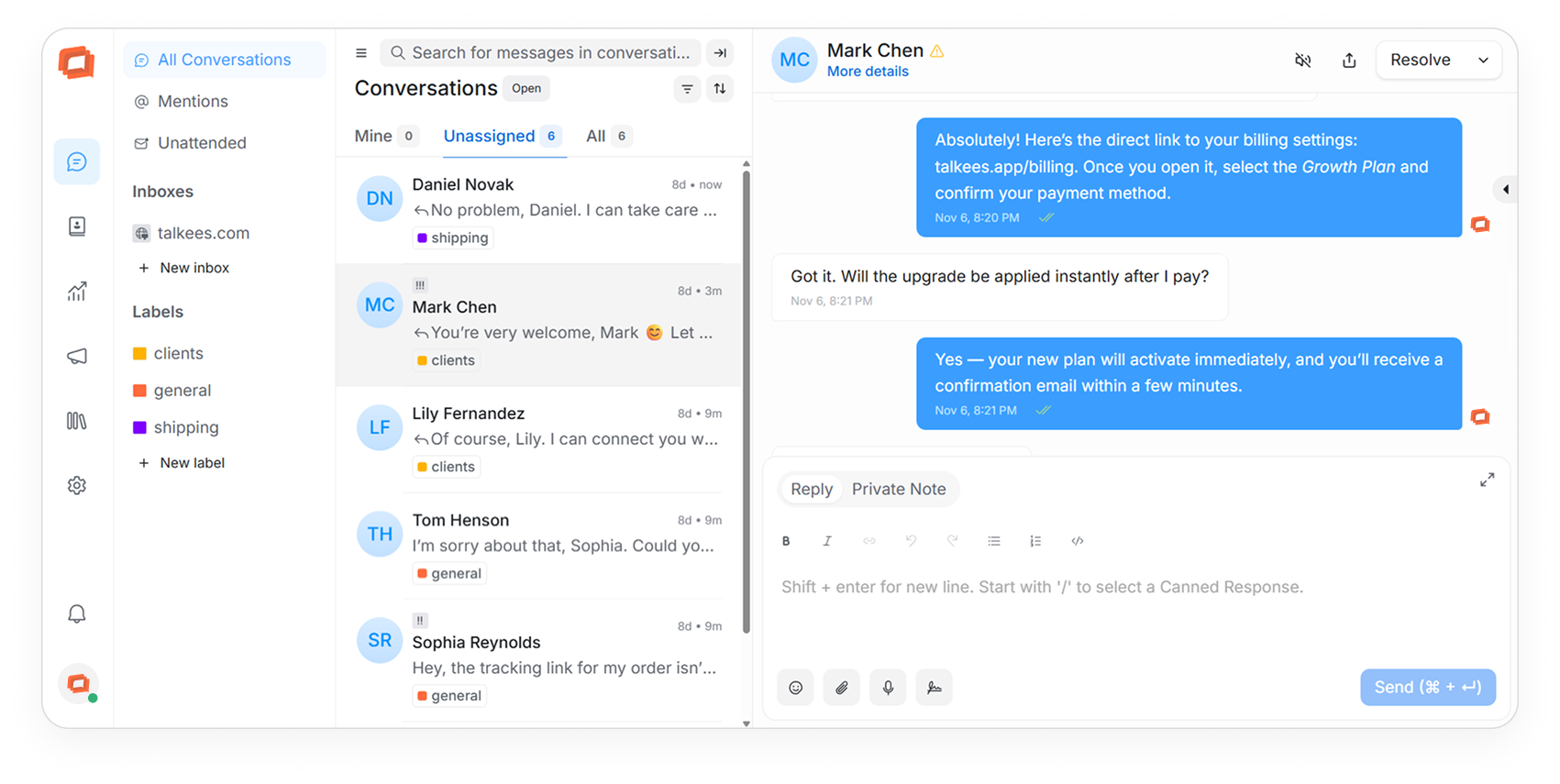
Talkees — Modern, Flexible, and Affordable
- Channels: Website chat, WhatsApp, Instagram, Facebook, email; mobile apps for agents
- AI & Bots: LLM-powered automation with retrieval; no-code bot builder; smooth handoff
- Integrations: Shopify, WooCommerce, WordPress, HubSpot, Salesforce, GA4, Zapier, open API
- Pricing: SMB-friendly tiers with transparent per-seat model and free trial
- Best for: SMB ecommerce and growing support teams needing omnichannel + AI out of the box
LiveChat — Reliability and Ecommerce Triggers
- Channels: Website chat, in-app chat, Facebook Messenger, email/ticketing via HelpDesk add-on
- AI & Bots: ChatBot.com integration with visual builder; proactive greetings for cart/checkout
- Integrations: Shopify, WooCommerce, BigCommerce, Magento, Salesforce, HubSpot, 200+ apps
- Pricing: Commonly starts around $39/agent/month; 14-day free trial
- Best for: Ecommerce stores wanting proven stability and robust sales triggers
Drift — Revenue Chat and ABM Automation
- Channels: Website/in-app chat, email sequences, calendar scheduling
- AI & Bots: Conversational marketing bots; firmographic targeting; meeting booking
- Integrations: Salesforce, HubSpot, Marketo, Pardot, 6sense, Outreach, Gong
- Pricing: Enterprise-oriented; widely reported starting around $2,500+/month
- Best for: B2B SaaS and ABM teams focused on pipeline acceleration
Tawk.to — Truly Free Live Chat with Paid Add-Ons
- Channels: Website chat, WordPress plugin; mobile apps; limited social integration
- AI & Bots: Rule-based automations; advanced AI requires third-party solutions
- Integrations: WordPress, Shopify, Squarespace, Wix; knowledge base add-ons
- Pricing: Free forever core chat; optional “hire live agents” from $1/hour
- Best for: Cost-sensitive teams and early-stage stores needing immediate coverage
Tidio — Ecommerce-Ready Chatbots for Shopify and WooCommerce
- Channels: Website chat, Facebook Messenger, Instagram DMs, email campaigns
- AI & Bots: No-code chatbot builder with product/cart templates; AI assistant
- Integrations: Shopify, WooCommerce, BigCommerce, WordPress, Stripe, Klaviyo
- Pricing: Free tier available; paid plans commonly around $25-$29/month
- Best for: SMB ecommerce needing pre-built automations for abandoned carts and FAQs
Freshchat — Multichannel Messaging in the Freshworks Stack
- Channels: Website/in-app chat, WhatsApp, Facebook Messenger, Apple Messages, SMS, email
- AI & Bots: Freddy AI bots and agent assist; visual builder; intelligent routing
- Integrations: Native to Freshdesk/Freshsales; 1,000+ via Freshworks Marketplace
- Pricing: Free tier; paid plans reported at $19/$49/$79 per agent/month
- Best for: Teams already using Freshworks products or consolidating support+chat
Zoho SalesIQ vs Userlike — Chat + Lead Scoring Inside Zoho CRM
- Channels: Website/in-app chat, WhatsApp, Facebook Messenger, email handoff
- AI & Bots: Zobot with codeless builder; lead scoring; knowledge base suggestions
- Integrations: Deep Zoho CRM and Zoho One suite integration
- Pricing: Budget-friendly standalone tiers and attractive when bundled with Zoho One
- Best for: Organizations standardized on Zoho wanting chat tied directly to CRM
Intercom — Powerful Automation, Product Tours, and Premium Pricing
- Channels: Website/in-app messenger, email, WhatsApp, SMS; outbound messages
- AI & Bots: Intercom Fin AI; visual flows; product tours and in-app announcements
- Integrations: 350+ apps; Salesforce, HubSpot, Segment, Amplitude, Mixpanel; robust APIs
- Pricing: Premium per-seat pricing; reports cite $99/user/month + $0.99 per verified chat
- Best for: Product-led SaaS wanting lifecycle messaging and in-app guidance
LiveAgent — Ticketing, Call Center, and Live Chat in One
- Channels: Website chat, email/ticketing, call center/VoIP, social connectors
- AI & Bots: Rule-based automation; chatbots via integrations; strong helpdesk routing
- Integrations: WordPress, Shopify, Magento, Slack, CRMs, analytics, 200+ connectors
- Pricing: Starting at $9/agent/month with higher tiers at $29-$69/agent/month
- Best for: Support teams needing unified helpdesk (tickets + chat + voice)
Olark — Simple Live Chat with Straightforward Pricing
- Channels: Website chat; email transcript forwarding; mobile notifications
- AI & Bots: Basic automation rules; chatbots typically via third-party tools
- Integrations: Salesforce, HubSpot, Slack, Zendesk, Google Analytics, WordPress/Shopify
- Pricing: Commonly cited at $29/agent/month; easy to budget and deploy
- Best for: Small teams wanting clean, no-frills live chat with reliable transcripts
Talkees vs Userlike — Modern, Flexible, and Affordable

When comparing Talkees and Userlike head-to-head, many support leaders ask: can Talkees deliver the same core capabilities with a more modern UI and a lower, more flexible total cost of ownership?
Feature-by-Feature Comparison
Responsiveness and Performance
- Talkees: Built with a modern, lightweight widget and SPA-style agent console that minimizes page load impact and UI latency. The widget loads asynchronously with <100 KB core script and <100 ms main-thread blocking.
- Userlike: Performance varies by implementation. It’s advisable to test with PageSpeed Insights on key templates (home, product, checkout) to assess actual impact.
Widget Customization
- Talkees: Offers full branding control (colors, fonts, button shapes), dynamic availability rules, device-specific launchers, and contextual pre-chat forms. The no-code editor handles most use cases, with CSS hooks available for advanced customization.
- Userlike: Provides strong customization and multi-widget support based on plan tier (Team: 4 widgets; Corporate: 10 widgets). The WordPress plugin offers a 14-day Team trial, with advanced features requiring paid plans.
Agent Management
- Talkees: Designed for teams with fluctuating headcount. Offers pooled seat or “active agent” licensing options to handle seasonality without paying for idle seats. Role-based permissions, skills, and queue rules are included in entry tiers.
- Userlike: Bundles seats and widgets into tiers (Team: 4 seats; Corporate: 10 seats). Additional seats reportedly cost around $20/agent/month.
AI and Automation
- Talkees: AI capabilities (LLM/RAG) are available from lower tiers, allowing you to deflect FAQs and provide suggested replies without upgrading to the most expensive plan. Connect your knowledge base to get a usable bot running quickly.
- Userlike: The AI Automation Hub (AI Chatbot, GPT-4, Smart FAQ) is only available on Corporate and Flex tiers. Free/Team plans rely on canned responses.
Omnichannel and Compliance
- Talkees: Provides omnichannel support by default (email, web, WhatsApp, Instagram, Facebook) in one inbox. Offers open API and webhooks for custom integrations, plus GDPR controls.
- Userlike: Strong channel coverage and integration options. Known for GDPR focus and European data hosting (German servers). WhatsApp campaigns and some messaging features typically require higher tiers.
Pros and Cons
Talkees — Pros
- Modern, intuitive agent UI with quick learning curve
- Flexible licensing to match seasonal demand
- AI included on lower tiers for SMB automation
- Open API/webhooks with clear documentation
- Omnichannel inbox without extra modules
Talkees — Cons
- Younger ecosystem with fewer niche marketplace apps
- Some specific legacy connectors may require API/Zapier integration
Userlike — Pros
- GDPR-centric posture and EU hosting
- Mature feature set including co-browsing, video calls, screen sharing
- AI Automation Hub (GPT-4) on Corporate/Flex for robust bot building
- Multi-widget support for segmenting brands/regions
Userlike — Cons
- AI and WhatsApp campaigns are restricted to higher tiers
- Pricing information varies by source
- Mobile app availability inconsistently reported
- WordPress plugin requires paid plans for advanced features
Which Teams Should Choose Talkees vs Userlike?
Choose Talkees if:
- You’re an ecommerce or subscription SMB (3-20 agents) needing a clean UI, AI on day one without premium pricing, and licensing that flexes with seasonal peaks
- You want omnichannel (web, email, WhatsApp, Instagram, Facebook) in one inbox with open APIs to integrate with your stack
- You care about cost predictability, especially with fluctuating headcount
Choose Userlike if:
- You need EU-centric compliance with German/EU hosting, or your procurement requires mature vendor references
- You plan to standardize on a higher tier anyway (Corporate/Flex) to unlock GPT-4 automation
- Your roadmap includes co-browsing and in-chat video for guided sales or troubleshooting
Real-World Cost Considerations
Userlike (as reported):
- Team: ~$90/month billed annually with 4 seats, 4 widgets, 2 messaging apps
- Corporate: ~$290/month billed annually with 10 seats, 10 widgets, 4 messaging apps, plus AI Automation Hub
- Flex: Custom enterprise pricing
Talkees:
- More affordable for SMBs, with AI available on lower tiers and flexible seat options
- Request a quote for seasonal or “active agent” pricing to compare against Userlike’s bundled seats
When calculating total cost of ownership, consider license fees, seats needed at peak vs. average, AI/bot usage, WhatsApp campaign fees, implementation costs, and time-to-value.
LiveChat vs Userlike — Reliability, Agent UX, and Ecommerce Triggers

Both LiveChat and Userlike are mature live chat solutions, but they differ in uptime transparency, agent experience, and ecommerce capabilities.
Reliability and Speed
LiveChat
- Offers a public status page and incident history with 99.9%+ monthly uptime typically reported
- Provides desktop and mobile agent apps with reliable push notifications
- Features a lightweight async loader with minimal impact on Core Web Vitals
Userlike
- Enterprise-grade SLAs available on Flex plans
- Strong EU positioning with German hosting and GDPR compliance
- Mobile agent availability reports are inconsistent across reviews
Agent UX and Workflows
LiveChat Strengths
- Fast, predictable inbox with message sneak-peek, quick transfer, and collision detection
- Well-implemented shortcuts/canned responses with automated actions
- Sales tracking connected to orders and revenue attribution
- Clear role separation and granular routing by skills/teams
Userlike Strengths
- Message Center with clear conversation states and Sticky Chat for returning customers
- Live Translation, video calls, and screen sharing
- AI Automation Hub on Corporate+ plans with GPT-4 integration and Smart FAQ
- GDPR-first controls and permissions
Ecommerce-Specific Features
LiveChat Conversion Levers
- Targeted Greetings triggered by URL, UTM, time-on-page, returning visitor, and cart value
- Shopify and WooCommerce apps showing order histories and enabling product links in chat
- ChatBot add-on with templates for abandoned cart recovery and shipping status
Userlike Conversion Levers
- Proactive chat and behavior rules based on time on page, repeat visits, and referrer
- Sticky Chat to reconnect hesitant buyers with the same agent
- WhatsApp campaigns on higher tiers for re-engaging opted-in subscribers
- Smart FAQ and AI Chatbot (Corporate+) to answer product questions 24/7
Pricing and TCO
LiveChat
Per-agent pricing reported around $39/agent/month. Good for starting with 2-5 agents as costs scale linearly with headcount.
Userlike
Flat tiers with included seats (Team: ~$90/month annual with 4 seats; Corporate: ~$290/month annual with 10 seats). Attractive when you need 4-10 agents and want AI bundled (Corporate).
Best For
Choose LiveChat if:
- You run a Shopify or WooCommerce store and want targeted greetings, sales attribution, and polished agent tools
- You’re starting with a small team (2-5 agents) and prefer per-seat pricing with mobile apps
- You plan to add a chatbot later and are fine with a separate ChatBot subscription
Choose Userlike if:
- You’re EU-based or privacy-sensitive and want GDPR-grade controls and data residency
- You need 4-10 included seats, multiple widgets, and AI (GPT-4) bundled in the Corporate plan
- WhatsApp campaigns are central to your remarketing strategy
Drift vs Userlike — Revenue Chat and ABM Automation for B2B

For B2B teams, the choice between Drift and Userlike comes down to whether your website is primarily a lead engine or a support channel.
Feature Comparison
ABM Targeting and Firmographics
- Drift: Purpose-built for account-based marketing with firmographic enrichment, ABM audiences, named account routing, and account-owner handoff in CRM.
- Userlike: Offers proactive chat and routing but lacks native ABM capabilities. You can approximate targeting by passing data to the widget or enriching leads after capture.
Meeting Scheduling and Handoff
- Drift: Provides inline meeting scheduling and “Fastlane” to connect qualified buyers to SDRs instantly or auto-book time. Includes round-robin and account-owner routing.
- Userlike: Captures lead details and hands over to agents. Scheduling typically done via shared links or CRM workflow.
Conversational AI
- Drift: Advanced playbooks and AI chat for qualification, objection handling, and intent routing. Includes templates for BANT/CHAMP and product tours.
- Userlike: AI Automation Hub (Corporate+) offers GPT-4 integration and Smart FAQ—strong for support deflection but has fewer sales-ops automations.
Omnichannel Coverage
- Drift: Web chat, email sequences, and integrations with ad/intent platforms. Focus is on website + revenue ops.
- Userlike: Website Messenger plus WhatsApp, Instagram, Facebook, Telegram, SMS, and email—valuable for EU SMBs and commerce-style journeys.
Revenue Attribution
- Drift: Pipeline influence dashboards, chat-to-opportunity attribution, rep performance tied to meetings/SQLs.
- Userlike: Analytics available, but revenue attribution typically handled in your CRM.
Pricing Comparison
Drift
Enterprise pricing commonly starts around $2,500+/month (quote-based).
Userlike
Tiered flat-rate plans (Team ~$90/month annual; Corporate ~$290/month annual with AI Automation Hub).
Pros and Cons for B2B Sales
Drift — Pros
- Best-in-class ABM with named-account targeting and firmographic enrichment
- Built-in revenue workflows: meeting scheduling, Fastlane, account-owner routing
- Sales-ops templates for events, product launches, and competitive takeaways
Drift — Cons
- High cost puts it squarely in enterprise budgets
- Requires tight CRM hygiene and ABM orchestration to pay off
- Overkill for SMB support teams or non-ABM sales motions
Userlike — Pros
- Price-efficient tiers for small/mid teams with AI on Corporate plan
- Strong omnichannel messaging including WhatsApp—great for EMEA
- GDPR and EU hosting posture with easy website integration
Userlike — Cons
- Limited ABM targeting without native firmographic audiences
- AI/chatbot gated to higher tiers (Corporate/Flex)
- Revenue attribution handled mostly by external CRM
How to Decide
Choose Drift if:
- You run true ABM (named accounts, intent, account owners in Salesforce/HubSpot)
- You need inline scheduling, Fastlane, and pipeline dashboards tied to chat
- Budget >$2,500/month for conversational marketing is acceptable
Choose Userlike if:
- You’re an EU-focused SMB prioritizing GDPR, WhatsApp and omnichannel support
- You want a lower monthly commitment and can handle meeting booking in your CRM
- AI is important, but you’re fine enabling it at the Corporate tier
Tawk.to vs Userlike — Truly Free Live Chat with Paid Add-Ons

If your primary constraint is budget, Tawk.to offers a compelling “free forever” option that you can deploy in minutes and enhance with paid extras only when needed.
What “Free Forever” Really Means with Tawk.to
- $0 license, unlimited agents and chats: Invite your entire team without paying per seat—a stark contrast to competitors that meter by agent or conversation.
- Core live chat essentials included: Website chat widget, real-time visitor monitoring, proactive triggers, canned replies, departments, offline forms, mobile apps, and basic analytics.
- No credit card required: Typical time-to-first-chat is under an hour on most sites.
Where Tawk.to Makes Money: Paid Add-Ons
- Remove “Powered by tawk.to” branding: $19/month per property (domain)
- Hire live agents from Tawk.to: On-demand staffing from $1/hour to cover nights/weekends or peak seasons
- Optional services: Website tasks, VA services, content, and campaign help priced per project/hour
How This Compares to Userlike
Userlike offers Free, Team, Corporate, and Flex plans:
- Team: ~$90/month billed annually with 4 seats and 4 widgets
- Corporate: ~$290/month billed annually with 10 seats, 10 widgets, plus the AI Automation Hub
- Flex: Custom enterprise pricing
The key difference: with Userlike, you pay a predictable monthly fee for a defined package. With Tawk.to, you pay nothing for core chat but may add discrete fees as you scale.
Key Trade-Offs
Omnichannel Messaging
- Userlike: Built-in connectors for WhatsApp, Instagram, Facebook, Telegram in a unified inbox
- Tawk.to: Primarily website chat and email notifications. WhatsApp/Instagram require workarounds
AI and Automation
- Userlike: AI Automation Hub with GPT-4 on Corporate/Flex tiers
- Tawk.to: Basic triggers and canned replies; advanced chatbots require external tools
Enterprise Readiness
- Userlike: EU-grade compliance, white-label, advanced routing, and dedicated account management
- Tawk.to: Great for startups and SMBs but fewer enterprise guarantees
Total Cost of Ownership
- Small team example (5 agents): Tawk.to license $0 + branding removal $19/mo = ~$228/year. Comparable Userlike Team plan ~$90-$130/month = ~$1,080-$1,560/year.
- Coverage example: Tawk.to’s $1/hour agents can be cheaper than hiring, but costs scale with hours.
Practical Guidance
Choose Tawk.to if you:
- Need a free, fast live chat for a new store or MVP
- Expect to rotate many part-time agents and want to avoid per-seat fees
- Value the option to buy staffing on demand rather than recruiting immediately
- Are fine with web chat as your main channel and basic automation
Choose Userlike if you:
- Require WhatsApp/Instagram/Facebook messaging in the same inbox
- Plan to deploy AI chatbots for 24/7 coverage
- Need EU-grade compliance and white-label capabilities
- Prefer predictable, bundled pricing as you grow
Tidio vs Userlike — Ecommerce-Ready Chatbots for Shopify and WooCommerce

For online stores, the tool you choose should integrate with your ecommerce platform quickly and effectively. This is where Tidio often feels “ecommerce-native,” while Userlike provides compliant, multichannel service with enterprise controls.
Ecommerce Platform Integration
Tidio: Built for Storefronts
- One-click Shopify app and WordPress plugin for WooCommerce
- Pulls product data, shows cart contents, and triggers bots on storefront events
- Ready-to-use flows for abandoned cart recovery, discount codes, order tracking, and more
- Visual builder + AI (Lyro) lets you start with templates and add AI answers trained on your policies
Userlike: Service-First with Ecommerce Connectors
- Supports major platforms via widget embeds and add-ons
- Offers proactive chat, co-browsing, video calls, and WhatsApp/Instagram integration
- For EU-focused shops, provides GDPR posture and German data hosting
- Less “plug-and-sell” and more focused on service quality
Chatbot Capabilities for Ecommerce
Tidio’s Approach (AI + Templates)
- Instant answers via Lyro for FAQs and policies, plus rules for revenue events
- 35+ templates for common ecommerce scenarios:
- Abandoned cart recovery with time-boxed coupons
- Size finder with size chart links
- Stock and shipping status queries
- Back-in-stock subscriptions
Userlike’s Approach (AI Hub + Omnichannel)
- AI Automation Hub (Corporate/Flex tiers) with GPT-4 integration and Smart FAQ
- Strong handoff to humans with Sticky Chat and co-browsing for complex questions
- WhatsApp campaigns for restock or promotion notifications
- Best used for unified support across channels rather than specifically optimizing cart recovery
ROI for Ecommerce
For a mid-size Shopify store (50,000 monthly sessions, $100 AOV, 10% cart initiation):
If a cart-rescue bot recovers just 3% of abandoned carts: 105 recovered orders × $100 = $10,500 added revenue/month
Even a 1% recovery produces ~$3,500/month
Both platforms’ license fees are typically dwarfed by this potential revenue impact.
Best-Fit Recommendations
Choose Tidio if you want:
- A fast path to revenue: enable abandoned cart recovery and WISMO handling in an afternoon
- Shopify/WooCommerce triggers without custom engineering
- Hybrid automation (rules + AI) with clear templates and an affordable price point
Choose Userlike if you want:
- EU-grade compliance, German data hosting, and strict role-based access
- A single omnichannel inbox across web chat, WhatsApp, and Instagram
- Enterprise routing, white-label, and dedicated onboarding (Flex)—especially for multi-brand operations
Freshchat vs Userlike — Multichannel Messaging in the Freshworks Stack

Freshchat sits inside the Freshworks family (Freshdesk, Freshsales, Freshmarketer), while Userlike is a European-born live chat tool with a strong GDPR posture. The choice often comes down to whether you want an all-in-one ecosystem or a privacy-first, channel-agnostic messenger.
What Freshchat Does Well: Multichannel + Freshworks Ecosystem
- Channel Coverage: Website chat, email, WhatsApp, Facebook Messenger, Instagram DMs, Apple Messages for Business, Google Business Messages, SMS
- Tight Freshworks Integration:
- Freshdesk: Turn chats into tickets with context, run SLA rules, link related issues
- Freshsales: Push qualified leads from chat, create contacts and deals, show CRM timeline
- Freshmarketer: Trigger journeys based on chat events
- Freshdesk Contact Center: Escalate from chat to phone with preserved context
- Automation and AI: Freddy AI for FAQs, intent detection, and suggested responses; no-code bot flows; multilingual support
- App Ecosystem: Native connectors for Shopify, Slack, Salesforce, Calendly, and more
Analytics, Routing, and Team Collaboration
Analytics and Reporting
- Freshchat: Real-time dashboards plus historical reports for response time, resolution time, CSAT, queue backlog, agent productivity, and bot containment. When paired with other Freshworks products, you get cross-suite reporting.
- Userlike: Solid built-in analytics with deeper insights gated to higher tiers (Corporate/Flex).
Routing and Assignment
- Freshchat: IntelliAssign provides skill-based, round-robin, or load-based routing. Set queue sizes, business hours, and priorities with collision detection.
- Userlike: Routing by skills, time, and availability with queueing limits. “Sticky Chat” keeps returning customers with the same agent.
Team Collaboration
- Freshchat: Shared inboxes, @mentions, private notes, canned responses, saved views, and Team Presence. With Freshdesk, you can @mention back-office users.
- Userlike: Internal notes, operator handoff, macros, canned messages. Co-browsing, video calls, and screen sharing for hands-on assistance.
Pricing Comparison
- Freshchat (per-agent model): Free plan (limited); Growth ~$19/agent/month; Pro ~$49/agent/month; Enterprise ~$79/agent/month
- Userlike (flat bundles): Team ~$90/month annual with 4 seats; Corporate ~$290/month annual with 10 seats and AI Automation Hub
For 10 agents, Freshchat Pro would cost approximately $490/month, while Userlike Corporate would be around $290/month. However, WhatsApp and SMS still incur Meta/carrier fees with either platform.
Who Benefits Most from Each Platform
Choose Freshchat if:
- You already use or plan to adopt other Freshworks products and want a cohesive tech stack
- You operate a multichannel support organization and need enterprise-grade routing under one roof
- You prefer per-agent pricing transparency, even if slightly higher for mid-sized teams
Choose Userlike if:
- You’re an EU/DACH-focused business that values GDPR/data residency assurances and predictable flat monthly fees
- You want website chat plus messaging apps without buying a full suite, and can live with AI on Corporate/Flex
- Co-browsing and video help are frequent needs for your agents
Zoho SalesIQ vs Userlike — Chat + Lead Scoring Inside Zoho CRM

Zoho SalesIQ takes a different approach: it’s a CRM-first live chat that excels when you already use Zoho. The key differentiator versus Userlike is how SalesIQ connects every chat, visitor action, and bot conversation directly to Zoho CRM for scoring, routing, and revenue attribution.
How SalesIQ Ties Live Chat to Lead Scoring
- Native CRM Records: Every chat can create or update a Lead/Contact in Zoho CRM, attach the transcript to the timeline, and sync key fields
- Visitor Scoring to CRM: Set scoring rules in SalesIQ (e.g., +10 for viewing pricing) and push the total to the CRM’s lead score field to drive assignment and pipeline rules
- Instant Routing and Follow-ups: High-scoring visitors can be auto-assigned to the right rep via CRM Assignment Rules
- Real-time SalesSignals: Reps get “X is on your site now (score 65)” alerts while the visitor is live
Ease of Use and Automation
- SalesIQ: Zobot (codeless or scripted in Deluge) handles FAQs, qualification, meeting booking, and custom actions against Zoho apps. Setup is smoothest when you already use Zoho CRM/Desk/Campaigns.
- Userlike: Offers strong proactive chat, Sticky Chat, and an AI Automation Hub on higher tiers, but you’ll need to handle scoring logic in your CRM rather than natively in Userlike.
Benefits of SalesIQ’s CRM-Native Approach
- Single Source of Truth: Chat, score, campaign, deal value, and CSAT sit in the same customer record
- Closed-Loop Reporting: Attribute pipeline and revenue to specific chat campaigns and bot flows
- Faster Sales Motion: Teams often report 20-40% faster lead pickup with live “hot visitor” alerts
- Less Integration Fragility: No complex integrations needed for basic lead creation and scoring
Limitations and Trade-offs
- Stack Lock-in: You get the most value if you’re committed to Zoho CRM and ideally other Zoho products
- Channel Scope: SalesIQ excels at web and mobile SDK chat; WhatsApp/Messenger/Instagram require additional setup
- Learning Curve: Bot building, CRM Blueprint, and scoring logic can be challenging for non-Zoho teams
Pricing Considerations
- SalesIQ: Typically in the ~$10-$30 per operator/month range standalone; Zoho One bundles SalesIQ + CRM + 45+ apps often for ~$45-$57 per user/month
- Userlike: Team ~$90/month annual; Corporate ~$290/month annual with 10 seats and AI Automation Hub
Who Gains the Most from SalesIQ
Best Fit:
- B2B and B2B2C teams already using Zoho CRM who want visitor scoring → instant routing → pipeline creation
- Lead-gen heavy SaaS and professional services that need precise revenue attribution to chat
- Support teams on Zoho Desk wanting one widget for pre-sales and support
Consider Userlike Instead If:
- You want a GDPR-focused web widget with flexible implementations and don’t use Zoho
- Your priority is advanced AI on the chat side and you’re comfortable with Corporate/Flex pricing
Intercom vs Userlike — Powerful Automation, Product Tours, and Premium Pricing

Intercom is built as a PLG growth engine with in-app messaging, product tours, AI support, and lifecycle automation. Userlike is a stron