 English
 Slovenčina
 Français
 Magyar
Why Businesses Search for Alternatives to User.com

When evaluating User.com alternatives, it’s important to understand what drives businesses to look beyond this platform:
- Pricing Scale Concerns: User.com starts at $49/month but can quickly escalate to approximately $249/month once email features are enabled. For businesses with growing contact lists, this contact-based pricing model can lead to unexpected cost increases.
- Complexity vs. Team Capacity: While User.com offers deep marketing automation capabilities, many teams (especially front-desk operations) primarily need a straightforward shared inbox, basic automations, and reliable appointment workflows rather than a complex customer data platform.
- Omnichannel Limitations: Consistent built-in support for SMS/WhatsApp is essential for quick customer communications. User.com may require add-ons or third-party integrations, increasing overhead and complexity.
- AI Capabilities Alignment: Many teams benefit most from AI that drafts replies, answers FAQs, and handles routing or scheduling, rather than advanced campaign orchestration tools.
What to Look for in a User.com Alternative

When evaluating User.com alternatives, focus on these key capabilities:
AI Chatbot Quality
Look for platforms that offer AI chatbots capable of answering FAQs, checking order status, collecting information, and seamlessly handing off to human agents when needed. Aim for automation coverage of 20-40% of inbound inquiries within 30-60 days of implementation.
Unified Inbox
A true unified inbox consolidates conversations across channels (email, chat, social media, WhatsApp) into a single interface. This eliminates tab-switching and provides full context for each customer interaction, significantly improving response times.
Automation Capabilities
Evaluate the platform’s ability to create automated workflows for common scenarios like abandoned carts, welcome sequences, appointment reminders, and support ticket routing. Look for visual builders that don’t require coding skills.
Integration Ecosystem
Ensure the platform connects with your essential business tools, including:
- CRM systems (HubSpot, Salesforce, Zoho)
- E-commerce platforms (Shopify, WooCommerce, Magento)
- Payment processors
- Appointment scheduling tools
- Social media platforms
Data Portability
Before committing, verify how easily you can export your data (contacts, conversations, knowledge base articles) if you need to switch platforms later.
Transparent Pricing
Choose platforms with clear pricing structures that avoid hidden fees. Understanding how costs scale with seats, contacts, or message volume will help prevent budget surprises.
How We Evaluated Top User.com Competitors

Our evaluation process was thorough and practical:
- Real-world Testing: We implemented each platform in actual business environments to assess performance under genuine conditions.
- Total Cost of Ownership: Beyond subscription fees, we calculated implementation costs, integration expenses, and potential scaling fees.
- Setup Time: We measured how quickly each platform could be deployed and made operational.
- Support SLAs: We evaluated the responsiveness and quality of each vendor’s support team.
Now, let’s examine the top User.com alternatives:
Talkees vs User.com: AI-First Live Chat and Omnichannel Helpdesk

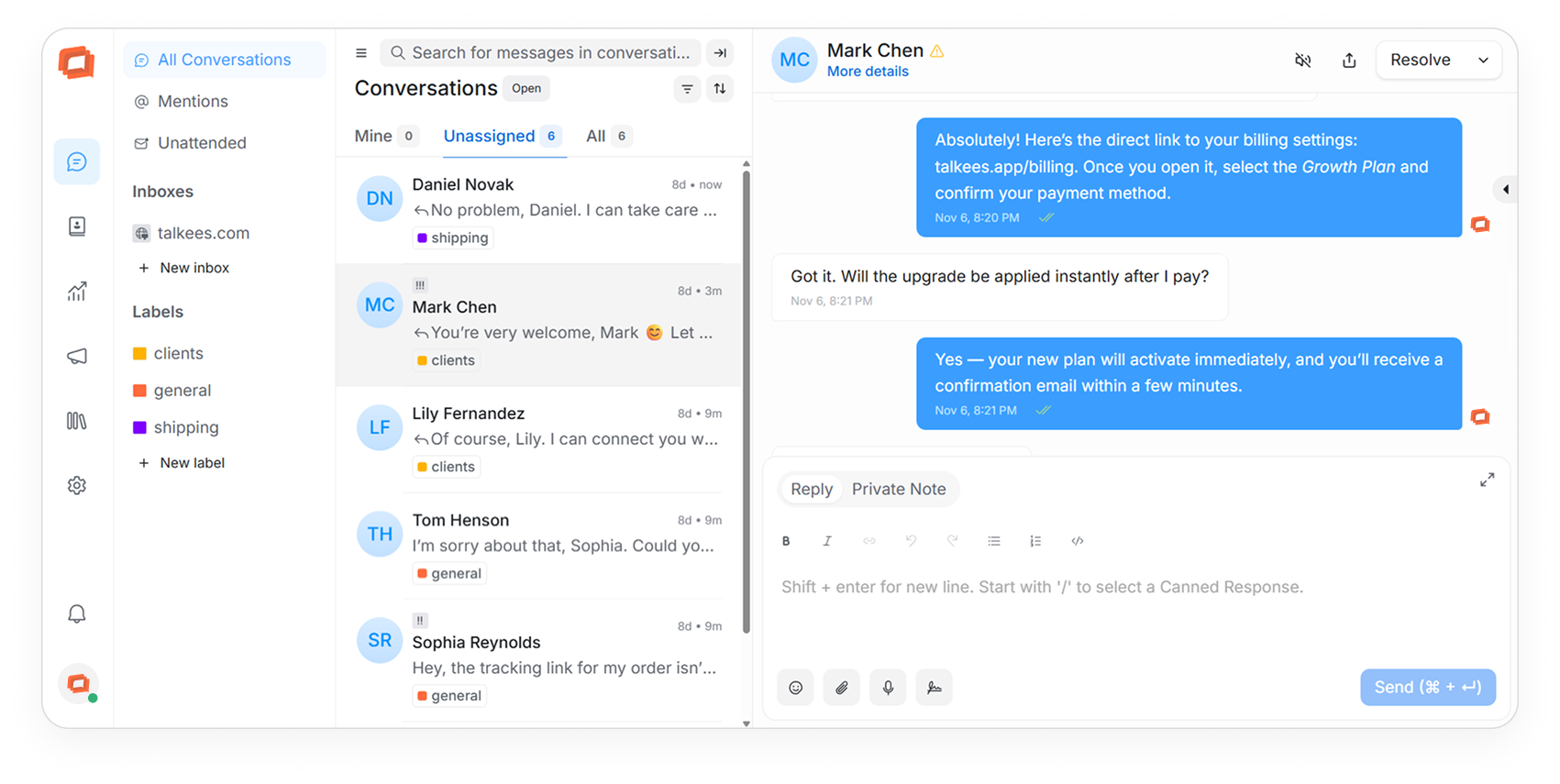
Talkees stands out as an AI-first live chat and omnichannel helpdesk solution designed for e-commerce and SaaS companies.
Detailed Pricing
- Free Version: Available for basic chat functionality
- Paid Plans: Tiered based on features and number of seats
- AI Credits: Included in higher-tier plans with clear usage limits
- Advantage: Transparent, predictable pricing without sudden jumps when scaling
Complete Feature Set
- AI-powered Live Chat: Instant visitor engagement with intelligent chatbots
- Omnichannel Helpdesk: Unified inbox for email, chat, and social media
- Smart Automation: Workflow builders for common support scenarios
- Knowledge Base Integration: Seamless connection between chat and knowledge articles
- E-commerce Integrations: Deep integration with major platforms like Shopify and WooCommerce
- Differentiator from User.com: More intuitive UI, faster setup time, and superior AI capabilities
User Experiences and Reviews
- Consistently praised for ease of setup and intuitive interface
- Strong positive feedback on AI accuracy and learning capabilities
- Highly rated for responsive support and regular feature updates
- Small businesses appreciate the ability to compete with enterprise-level customer service
Pros and Cons
Pros:
- Quick implementation (typically under 1 day)
- Highly effective AI that improves over time
- SMB-friendly pricing structure
- Excellent mobile experience for on-the-go teams
- Strong e-commerce-specific features
Cons:
- Newer platform compared to some established competitors
- Advanced enterprise features still in development
- May require customization for highly specialized industries
Our Assessment
During testing, Talkees impressed with its balance of sophisticated AI capabilities and user-friendly interface. The platform excels at understanding customer inquiries and providing relevant responses without extensive training. The implementation process was remarkably straightforward, with most businesses able to go live within hours rather than days.
For SMBs and e-commerce operations, Talkees offers an excellent balance of features, performance, and price. The AI-first approach delivers immediate value while continuously improving through regular updates and learning from interactions.
HubSpot vs User.com: Enterprise-Grade CRM with Higher Complexity

HubSpot offers a comprehensive CRM and marketing automation platform with extensive capabilities but at a higher complexity and cost level.
Detailed Pricing
- Free Version: Basic CRM functionality available at no cost
- Starter Plans: From $20/user/month for basic features
- Professional Plans: Around $1,300/month for comprehensive capabilities
- Enterprise Plans: Starting at approximately $4,300/month
- Note: Costs increase significantly as you add modules (Marketing, Sales, Service)
Complete Feature Set
- Full CRM Suite: Contact management, deals, pipelines, and reporting
- Marketing Automation: Email campaigns, landing pages, forms, and analytics
- Service Hub: Ticketing, knowledge base, and customer feedback tools
- Sales Tools: Email tracking, meeting scheduling, and prospect management
- Differentiator from User.com: More extensive ecosystem, deeper CRM capabilities, and broader integration options
User Experiences and Reviews
- Highly regarded for comprehensive functionality and data centralization
- Users appreciate the unified platform approach but note the learning curve
- Enterprise users value the extensive reporting and customization options
- Mixed feedback on pricing structure, particularly at scale
Pros and Cons
Pros:
- Comprehensive all-in-one platform
- Extensive marketplace of integrations
- Robust reporting and analytics
- Excellent knowledge base and training resources
- Strong community and support network
Cons:
- Significant cost increases as you scale
- Complex implementation requiring dedicated resources
- Can be overwhelming for small teams
- Some advanced features locked behind higher tiers
Our Assessment
During our testing, HubSpot demonstrated its power as an enterprise-grade platform. The implementation process was more involved than lighter alternatives, typically requiring weeks rather than days to fully configure.
The platform excels in environments where deep CRM functionality is essential, and teams have the resources to maximize its capabilities. For larger organizations with dedicated marketing and sales operations, HubSpot provides excellent value despite the higher cost. However, smaller businesses may find themselves paying for capabilities they don’t fully utilize.
ActiveCampaign vs User.com: Best-in-Class Email Automation

ActiveCampaign specializes in sophisticated email automation while offering lighter helpdesk and live chat capabilities.
Detailed Pricing
- Lite Plan: Starting around $15/month for basic email marketing
- Plus Plan: Approximately $49/month adding CRM functionality
- Professional Plan: About $79/month with advanced features
- Enterprise Plan: Around $145/month for large-scale operations
- Pricing Factor: Based primarily on number of contacts
Complete Feature Set
- Advanced Email Automation: Sophisticated workflow builder with conditional logic
- Customer Experience Automation: Personalized customer journeys across channels
- CRM and Sales Automation: Lead scoring, pipeline management, and win probability
- Reporting and Analytics: Detailed performance metrics and attribution
- Differentiator from User.com: Superior email automation capabilities with more intuitive workflow design
User Experiences and Reviews
- Highly praised for email deliverability and automation capabilities
- Users appreciate the intuitive automation builder
- Positive feedback on the platform’s ability to create sophisticated customer journeys
- Some concerns about pricing as contact lists grow
Pros and Cons
Pros:
- Best-in-class email automation
- Powerful segmentation capabilities
- Strong deliverability rates
- Intuitive visual automation builder
- Excellent integration options
Cons:
- Less robust live chat compared to chat-first platforms
- Can become expensive as contact lists grow
- Limited knowledge base functionality
- Customer support sometimes criticized for response times
Our Assessment
In our testing, ActiveCampaign distinguished itself with exceptional email automation capabilities. The platform’s strength lies in creating sophisticated, behavior-driven customer journeys that respond intelligently to user actions.
The implementation process is moderately complex, typically requiring 1-2 weeks to fully configure automations and integrations. For businesses focused primarily on email marketing and automation, ActiveCampaign provides excellent value. However, organizations needing robust live chat or comprehensive helpdesk features may need to supplement with additional tools.
Sendinblue (Brevo) vs User.com: Transactional Email and SMS at Scale

Brevo (formerly Sendinblue) focuses on transactional email and SMS messaging with basic chat and support functionality.
Detailed Pricing
- Free Plan: Up to 300 emails per day
- Starter Plan: From approximately $8/month for essential features
- Business Plan: Starting around $16/month for advanced capabilities
- Enterprise Plan: Custom pricing for large-scale operations
- Advantage: Clear email and SMS volume-based pricing
Complete Feature Set
- Transactional Email: High-deliverability infrastructure for critical messages
- SMS Marketing: Global SMS capabilities with analytics
- Email Marketing: Campaign creation, automation, and A/B testing
- Basic Chat: Website chat widget with limited automation
- Landing Pages and Forms: Tools for lead capture and conversion
- Differentiator from User.com: Stronger transactional messaging capabilities at more predictable pricing
User Experiences and Reviews
- Well-regarded for email and SMS deliverability
- Positive feedback on pricing transparency and value
- Appreciated for simplicity and ease of implementation
- Some users note limitations in advanced automation scenarios
Pros and Cons
Pros:
- Excellent transactional email infrastructure
- Strong SMS capabilities with global coverage
- Transparent, predictable pricing
- Good deliverability rates
- Simple implementation process
Cons:
- Basic chat functionality compared to chat-first platforms
- Limited helpdesk capabilities
- Less sophisticated automation than specialized platforms
- Basic CRM functionality
Our Assessment
During our evaluation, Brevo demonstrated its strength in handling high-volume transactional and marketing messages reliably. The platform can be implemented quickly, typically within days, and provides a straightforward user experience.
For businesses primarily focused on email and SMS communications with basic website chat needs, Brevo offers excellent value and reliability. However, organizations requiring sophisticated chat experiences or comprehensive helpdesk functionality may find the platform’s capabilities too limited.
EngageBay CRM vs User.com: Affordable All-in-One Suite for SMBs

EngageBay offers a budget-friendly all-in-one suite that emphasizes breadth of functionality over depth in specific areas.
Detailed Pricing
- Free Plan: Basic CRM with limited contacts
- Basic Plan: Starting around $12.99/user/month
- Growth Plan: Approximately $24.99/user/month
- Pro Plan: Around $49.99/user/month
- Advantage: Comprehensive functionality at significantly lower price points than enterprise alternatives
Complete Feature Set
- CRM: Contact management, deal tracking, and task management
- Marketing Automation: Email campaigns, landing pages, and forms
- Service Bay: Ticketing, live chat, and help desk
- Sales Bay: Pipeline management, telephony, and sales automation
- Differentiator from User.com: More affordable comprehensive suite with similar breadth of functionality
User Experiences and Reviews
- Praised for value and breadth of features at the price point
- Positive feedback on customer support responsiveness
- Appreciated by small businesses for all-in-one capabilities
- Some criticism of depth in specialized areas
Pros and Cons
Pros:
- Comprehensive functionality at affordable prices
- Good balance of marketing, sales, and support tools
- Straightforward implementation
- Responsive customer support
- Regular feature updates
Cons:
- Less depth in specialized areas compared to focused tools
- Limited advanced automation capabilities
- Fewer integrations than enterprise platforms
- Basic reporting compared to specialized alternatives
Our Assessment
In our testing, EngageBay stood out for providing remarkable breadth of functionality at a price point accessible to small businesses. The platform can be implemented relatively quickly, typically within a week, and provides an intuitive user experience.
For small businesses seeking an affordable all-in-one solution without the complexity or cost of enterprise platforms, EngageBay delivers excellent value. However, organizations with sophisticated needs in specific areas (advanced marketing automation, complex helpdesk workflows) may find the platform’s capabilities somewhat basic.
Agile CRM vs User.com: Telephony and Sales Automation in a Legacy UI

Agile CRM combines sales automation and telephony features in a platform with a somewhat dated user interface but solid functionality.
Detailed Pricing
- Free Plan: Up to 10 users with limited features
- Starter Plan: Around $8.99/user/month
- Regular Plan: Approximately $29.99/user/month
- Enterprise Plan: About $47.99/user/month
- Advantage: Affordable telephony integration compared to many alternatives
Complete Feature Set
- Sales CRM: Contact management, deals, and pipeline tracking
- Telephony Integration: Call tracking, recording, and voicemail
- Marketing Automation: Email campaigns, web engagement, and landing pages
- Service: Help desk, knowledge base, and ticket management
- Differentiator from User.com: Stronger telephony features and sales-focused automation
User Experiences and Reviews
- Appreciated for affordability and telephony integration
- Mixed feedback on user interface and design
- Positive comments on sales automation capabilities
- Some concerns about update frequency and modern feature development
Pros and Cons
Pros:
- Comprehensive telephony features
- Solid sales automation capabilities
- Affordable pricing structure
- All-in-one platform approach
- Reasonable learning curve
Cons:
- Dated user interface
- Limited modern AI capabilities
- Fewer integrations than newer platforms
- Less frequent updates than competitors
Our Assessment
During our evaluation, Agile CRM demonstrated its strength in combining sales automation with telephony features at an accessible price point. The implementation process is straightforward, typically taking 1-2 weeks, though the interface learning curve can vary based on user familiarity with legacy systems.
For sales-focused organizations that heavily utilize phone communications, Agile CRM offers good value despite its less modern interface. However, businesses seeking cutting-edge AI features, modern design, or extensive third-party integrations may find the platform somewhat limiting.
Intercom vs User.com: Premium Bots and Product Tours with Steep Pricing

Intercom offers premium conversational experiences and product tours with exceptional UX but at a higher price point.
Detailed Pricing
- Starter Plan: Starting around $79/month
- Essential Plan: Approximately $29/user/month
- Advanced Plan: About $85/user/month
- Expert Plan: Around $132/user/month
- Note: Costs increase significantly with additional seats and features
Complete Feature Set
- Conversational Chatbots: Sophisticated AI-powered chat experiences
- Product Tours: Interactive onboarding and feature guidance
- Targeted Messaging: Behavior-based in-app and email communications
- Help Center: Knowledge base and self-service resources
- Differentiator from User.com: Superior chatbot experience and product tours with more polished UX
User Experiences and Reviews
- Highly praised for user experience and design
- Strong positive feedback on chatbot capabilities
- Appreciated for product tour functionality
- Concerns about pricing increases and scaling costs
Pros and Cons
Pros:
- Premium bot experience with advanced capabilities
- Excellent product tour functionality
- Polished, intuitive user interface
- Strong integration ecosystem
- Regular feature updates and innovation
Cons:
- Steep pricing curve as you scale
- Complex pricing structure
- Can become expensive for larger teams
- Some advanced features require highest tiers
Our Assessment
In our testing, Intercom demonstrated why it’s considered a premium option in the conversational marketing space. The platform delivers exceptional user experiences for both administrators and end-users, with sophisticated chatbots that effectively handle complex interactions.
Implementation typically requires 2-3 weeks to fully configure and optimize, with professional services often recommended for complex deployments. For organizations prioritizing premium customer experiences and having the budget to support it, Intercom delivers excellent results. However, the pricing structure can become challenging as teams scale, making it less suitable for budget-conscious organizations.
Freshdesk & Freshchat vs User.com: Robust Ticketing and Conversational Support

Freshdesk and Freshchat from Freshworks provide robust ticketing and conversational support with extensive integration options.
Detailed Pricing
Freshdesk:
- Free Plan: Basic ticketing for unlimited agents
- Growth Plan: Around $15/agent/month
- Pro Plan: Approximately $49/agent/month
- Enterprise Plan: About $79/agent/month
Freshchat:
- Free Plan: Up to 10 team members
- Growth Plan: Starting around $19/agent/month
- Pro Plan: Approximately $39/agent/month
- Enterprise Plan: About $79/agent/month
Complete Feature Set
- Omnichannel Ticketing: Email, phone, chat, and social media support
- Automation Rules: Ticket routing, assignment, and status updates
- Knowledge Base: Self-service portal with analytics
- Freddy AI: AI-powered assistance for agents and customers
- Reporting and Analytics: Comprehensive performance metrics
- Differentiator from User.com: Stronger ticketing capabilities with more mature helpdesk features
User Experiences and Reviews
- Well-regarded for ticketing functionality and reliability
- Positive feedback on ease of implementation and use
- Strong reviews for the free tier capabilities
- Appreciated for broad integration options
Pros and Cons
Pros:
- Robust ticketing system with comprehensive features
- Strong omnichannel capabilities
- Generous free tier for small teams
- Extensive marketplace of integrations
- Reliable performance and uptime
Cons:
- Less sophisticated marketing automation than specialized platforms
- Multiple products may need to be purchased separately
- Some advanced features only available in higher tiers
- AI capabilities still maturing compared to AI-first platforms
Our Assessment
During our evaluation, Freshdesk and Freshchat demonstrated excellent capabilities in handling customer support operations efficiently. Implementation is relatively straightforward, typically taking 1-2 weeks depending on complexity and integration requirements.
The platform excels in organizations prioritizing customer support operations, with particularly strong ticketing and helpdesk capabilities. The free tier offers exceptional value for small teams, while the paid tiers provide good scalability for growing organizations. For businesses focused primarily on support rather than marketing automation, Freshworks products offer excellent value and functionality.
Zoho Desk vs User.com: Scalable Helpdesk in the Zoho Ecosystem

Zoho Desk provides a scalable helpdesk solution deeply integrated with the broader Zoho ecosystem, with marketing features available via add-ons.
Detailed Pricing
- Free Plan: Up to 3 agents
- Standard Plan: Around $14/agent/month
- Professional Plan: Approximately $23/agent/month
- Enterprise Plan: About $40/agent/month
- Advantage: Clear per-agent pricing with good feature distribution across tiers
Complete Feature Set
- Ticketing System: Multi-channel ticket management and routing
- Zia AI Assistant: AI-powered suggestions and automations
- Knowledge Base: Self-service portal with analytics
- Customer Portal: Branded self-service experience
- Reporting and Analytics: Comprehensive performance dashboards
- Differentiator from User.com: Deeper integration with Zoho ecosystem products (CRM, Marketing, etc.)
User Experiences and Reviews
- Highly rated for integration with other Zoho products
- Positive feedback on pricing transparency and value
- Strong reviews for customization capabilities
- Some concerns about UI complexity for new users
Pros and Cons
Pros:
- Excellent value for feature set
- Strong integration with Zoho ecosystem
- Good customization capabilities
- Solid AI assistant functionality
- Clear, predictable pricing
Cons:
- Steeper learning curve than some alternatives
- Marketing features require additional Zoho products
- UI less intuitive than some competitors
- Some advanced features only in Enterprise tier
Our Assessment
In our testing, Zoho Desk demonstrated strong capabilities as a helpdesk solution, particularly for organizations already using other Zoho products. Implementation time varies significantly based on customization needs, typically ranging from 1-4 weeks.
The platform provides excellent value, especially for teams that can leverage the broader Zoho ecosystem. For organizations seeking a scalable helpdesk with good customization options and predictable pricing, Zoho Desk is a strong contender. However, businesses looking for an all-in-one solution including marketing automation may need to add other Zoho products, increasing the overall complexity and cost.
Birdeye vs User.com: Reputation Management Plus Messaging

Birdeye focuses on reputation management and messaging for local businesses and multi-location brands.
Detailed Pricing
- Pricing Model: Typically per-location with custom quotes
- Starter Plans: Begin around $299/month per location
- Premium Plans: Custom pricing based on locations and features
- Note: Pricing is generally quote-based rather than published
Complete Feature Set
- Review Management: Review collection, monitoring, and response tools
- Messaging: Webchat, SMS, Google Business Messages
- Listings Management: Business information consistency across platforms
- Surveys and Feedback: Customer experience measurement tools
- Referral Generation: Tools to encourage customer referrals
- Differentiator from User.com: Specialized focus on local reputation management with integrated messaging
User Experiences and Reviews
- Strong positive feedback from multi-location businesses
- Highly rated for review management capabilities
- Appreciated for consolidated messaging across channels
- Some concerns about pricing transparency and scalability
Pros and Cons
Pros:
- Excellent reputation management tools
- Strong local SEO benefits
- Consolidated messaging across channels
- Good multi-location management
- Specialized for local businesses
Cons:
- Limited marketing automation compared to dedicated platforms
- Quote-based pricing less transparent than published rates
- Primarily focused on reputation rather than comprehensive CRM
- Less suitable for non-location-based businesses
Our Assessment
During our evaluation, Birdeye demonstrated its strength in combining reputation management with customer messaging for location-based businesses. Implementation typically takes 2-4 weeks, with complexity increasing for multi-location deployments.
The platform excels for businesses where local reputation and reviews are critical success factors, such as retail, restaurants, healthcare, and professional services. While not a comprehensive marketing automation platform, its specialized focus provides significant value for location-based operations concerned with online reputation and local customer communications.
User.com vs Competitors at a Glance: Comparison Chart

| Platform | AI Capabilities | Channels Supported | CRM Depth | Pricing Model | Best For |
|---|---|---|---|---|---|
| Talkees | Advanced AI chatbots, agent assist | Chat, email, social | Moderate | Feature/seat-based | E-commerce, SaaS |
| User.com | Basic automation, limited AI | Chat, email, push | Moderate | Contact/feature-based | Marketing teams |
| HubSpot | Growing AI features | Comprehensive | Deep | Module/seat-based | Enterprise, all-in-one |
| ActiveCampaign | Email AI, automation | Email-focused, basic chat | Moderate | Contact-based | Email marketing |
| Brevo | Basic automation | Email, SMS, basic chat | Basic | Volume-based | Transactional messaging |
| EngageBay | Basic automation | Comprehensive | Moderate | User-based | SMBs, affordability |
| Agile CRM | Limited AI | Email, phone, basic chat | Sales-focused | User-based | Sales teams, telephony |
| Intercom | Advanced chatbots | Chat, in-app, email | Moderate | User/feature-based | Product-led SaaS |
| Freshdesk | Growing AI (Freddy) | Comprehensive | Support-focused | Agent-based | Customer support |
| Zoho Desk | Zia AI assistant | Comprehensive | Deep (with Zoho CRM) | Agent-based | Zoho ecosystem users |
| Birdeye | Basic automation | Reviews, messaging | Location-focused | Location-based | Local businesses |
Choosing by Use Case: Finding Your Perfect Match

E-commerce Support
Best options: Talkees, Freshdesk, Gorgias
Why: These platforms offer strong order context in conversations, product recommendations, and abandoned cart recovery workflows. Look for Shopify/WooCommerce integrations and the ability to handle return/exchange processes efficiently.
SaaS Onboarding
Best options: Intercom, Talkees, HubSpot
Why: Product tours, in-app messaging, and behavioral triggers make these platforms ideal for guiding users through activation and feature adoption. Strong knowledge base capabilities help reduce support tickets during onboarding.
B2B Sales Assist
Best options: HubSpot, Agile CRM, Zoho
Why: Pipeline management, deal tracking, and sales automation features support complex B2B sales processes. Look for email tracking, meeting scheduling, and proposal management capabilities.
Local Services
Best options: Birdeye, Freshdesk, Zoho Desk
Why: Reputation management, SMS capabilities, and appointment scheduling make these platforms suitable for service-based local businesses. Strong mobile apps ensure field staff can stay connected.
Migration Checklist from User.com

Planning a migration from User.com? Here’s what you need to consider:
Data Export
- Contacts & Companies: Export with IDs, emails, phones, custom attributes, and consent status
- Events & Tags: Download event schema and recent history
- Segments & Lists: Export segment definitions and membership
- Automations: Screenshot and document workflows, triggers, conditions, and actions
- Conversations: Export transcripts and attachments
- Knowledge Base: Export articles and FAQ datasets
Implementation Steps
- Import Contacts: Map fields and re-establish consent status
- Recreate Events: Set up webhooks and backfill critical status fields
- Rebuild Automations: Start with your top 3-5 most important workflows
- Replace Chat Widget: Update website code and test on all devices
- Connect Integrations: Reconnect your CRM, e-commerce, and payment tools
- Parallel Run: Maintain both systems for 1-2 weeks to ensure smooth transition
Potential Challenges
- Rate limits on imports/exports
- Email deliverability changes (update SPF/DKIM records)
- Broken links in automated messages
- Retraining AI/chatbots with your specific data
Final Recommendations

When choosing a User.com alternative, focus on finding the right balance of functionality, ease of use, and cost for your specific needs:
- For immediate chat needs with minimal budget: Start with Talkees or tawk.to to quickly enable customer conversations.
- For comprehensive marketing and sales: Consider HubSpot or ActiveCampaign if you need sophisticated automation and deep CRM capabilities.
- For customer support focus: Freshdesk or Zoho Desk provide excellent ticketing and helpdesk functionality.
- For e-commerce operations: Talkees or Gorgias offer specialized features for online stores.
- For local businesses: Birdeye combines reputation management with messaging capabilities.
Before making your final decision, take advantage of free trials and create a shortlist of 2-3 options to test with your team. Evaluate based on ease of implementation, user adoption, and how well each platform addresses your specific pain points.
Remember that the right platform isn’t necessarily the one with the most features, but the one that best fits your team’s workflow and customer communication needs.