 English
 Slovenčina
 Français
 Magyar

Why Teams Look for Desk365 Alternatives

Organizations typically search for Desk365 alternatives for three key reasons:
- Cost considerations – While Desk365 offers competitive pricing starting at $12-20 per agent monthly, some businesses find alternatives with better value, especially at scale.
- AI maturity limitations – Though Desk365 includes AI features, companies often need more sophisticated AI capabilities for ticket routing, auto-responses, and knowledge base generation.
- Omnichannel breadth requirements – Businesses requiring deeper integration with channels beyond Microsoft Teams (such as WhatsApp, Instagram, or specialized e-commerce platforms) may find Desk365’s offerings insufficient.
According to Statista, nearly 40% of customers stop doing business with companies due to poor customer service. Having the right helpdesk solution is crucial for maintaining customer satisfaction and loyalty.
What a Strong Desk365 Replacement Must Include

When evaluating Desk365 alternatives, ensure your chosen solution includes:
- AI chatbot builder with no-code options and contextual learning capabilities
- WhatsApp and Instagram integration for social messaging support
- Shopify/WooCommerce integration for e-commerce businesses
- No-code automation for workflows, routing, and escalations
- Comprehensive analytics with custom reporting and dashboards
- Single Sign-On (SSO) and robust security features
- GDPR/CCPA compliance for data protection and privacy
The ideal replacement should not only match Desk365’s core features but also address its limitations in these critical areas.
How We Evaluated Desk365 Alternatives

To provide you with reliable recommendations, we used a comprehensive methodology:
Scoring Rubric
We evaluated each platform across multiple categories:
- Core functionality (25 points)
- Automation & AI capabilities (15 points)
- Integrations & ecosystem (12 points)
- Reporting & analytics (10 points)
- Total cost of ownership (10 points)
- Usability & onboarding (8 points)
- Security & compliance (7 points)
- Vendor support & SLAs (6 points)
- Deployment & scalability (4 points)
- Mobile & agent access (3 points)
Data Sources
We analyzed vendor documentation, verified user reviews from G2 and Capterra, conducted hands-on testing, and interviewed current customers.
Total Cost of Ownership Modeling
We calculated the true cost of each platform by factoring in:
- Base subscription costs
- AI add-ons and usage pricing
- Implementation and migration costs
- Training and onboarding expenses
- Integration development requirements
Let’s explore the top alternatives to Desk365, starting with Talkees.
Talkees — AI-First Live Chat + Chatbot with Flexible Pricing

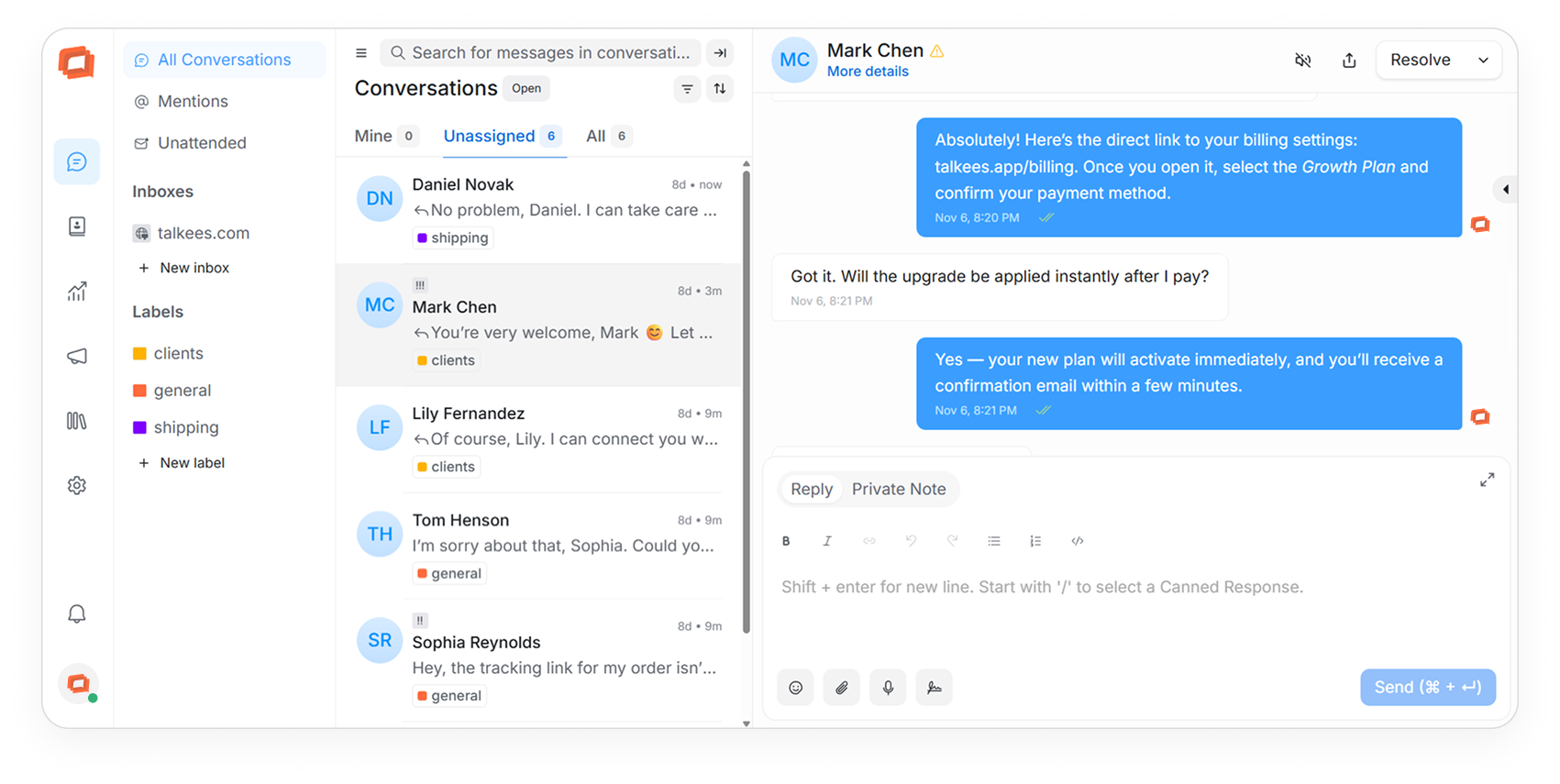
Talkees stands out as a modern, AI-first alternative to Desk365 that excels in conversational support while maintaining competitive pricing.
Features
- Cutting-edge AI chatbot builder: Create sophisticated, contextually aware chatbots without coding knowledge
- Omnichannel messaging: Seamless integration with website chat, WhatsApp, Instagram, and other messaging platforms
- Knowledge base integration: AI automatically leverages your knowledge base to provide accurate responses
- Advanced analytics: Detailed insights into conversation metrics, resolution rates, and agent performance
- No-code automation: Easily create complex workflows for routing, escalation, and follow-ups
- Microsoft Teams integration: Native integration for agent workflows within Teams
- Shopify/WooCommerce integration: Handle e-commerce queries with order information directly in the chat
Pricing
- Free Plan: Limited features for small teams (up to 3 agents, 100 conversations/month)
- Starter: $15/agent/month (billed annually) – Core features with basic AI capabilities
- Professional: $39/agent/month (billed annually) – Advanced AI, all channels, custom reporting
- Enterprise: $79/agent/month (billed annually) – Unlimited AI usage, priority support, dedicated CSM
Unlike Desk365’s fixed pricing model, Talkees offers flexible AI usage options, allowing businesses to scale their AI capabilities as needed without significant cost increases.
Pros
- Significantly more advanced AI capabilities than Desk365
- Intuitive, modern interface that requires minimal training
- Robust WhatsApp and Instagram integration
- Excellent e-commerce support with direct order management
- Transparent pricing with predictable AI costs
- Seamless knowledge base integration for accurate responses
Cons
- Newer platform with a smaller marketplace of integrations
- Less focus on traditional ticketing than Desk365
- Mobile app still maturing with some features only available on desktop
Ideal Use Cases
Talkees is perfect for:
- E-commerce businesses needing sophisticated customer support
- Companies prioritizing WhatsApp and social messaging channels
- Teams wanting advanced AI automation without complex setup
- Organizations seeking better cost efficiency at scale
Our Subjective Assessment
During our testing, we were particularly impressed with Talkees’ AI capabilities. The chatbot was able to handle complex queries and provide accurate responses with minimal training. The interface is intuitive and clean, making it easy for agents to manage multiple conversations simultaneously.
When we tested the WhatsApp integration, messages flowed seamlessly between platforms, and the context was maintained perfectly. The e-commerce integrations were equally impressive, allowing agents to view order details, process refunds, and update shipping information directly within conversations.
While Desk365 excels in Microsoft Teams integration, Talkees offers a more balanced approach across multiple channels with significantly better AI capabilities. For businesses prioritizing customer conversations over traditional ticketing, Talkees provides exceptional value.
Zoho Desk — Suite-Integrated Help Desk with Robust Automation

Zoho Desk offers a comprehensive helpdesk solution that’s deeply integrated with the broader Zoho ecosystem, making it an excellent Desk365 alternative for businesses already using other Zoho products.
Features
- Zia AI assistant: AI-powered ticket triage, sentiment analysis, and suggested responses
- Omnichannel support: Email, phone, chat, social media, and self-service portal
- Robust automation: Advanced workflow rules, time-based automations, and blueprint processes
- Comprehensive reporting: Custom reports, dashboards, and scheduled exports
- Knowledge base: Multi-brand, multi-language knowledge base with article suggestions
- Zoho ecosystem integration: Seamless connection with Zoho CRM, Analytics, and other Zoho apps
- Customization options: Custom fields, modules, and page layouts
Pricing
- Free Plan: Up to 3 agents with basic ticketing features
- Standard: $14/agent/month (billed annually) – Email ticketing, SLAs, automation
- Professional: $23/agent/month (billed annually) – Multi-department, time tracking, custom functions
- Enterprise: $40/agent/month (billed annually) – Custom modules, advanced workflow, AI features
- Ultimate: $52/agent/month (billed annually) – Advanced AI, enhanced security, premium support
Compared to Desk365’s $12-20 per agent pricing, Zoho Desk offers more feature-rich tiers but at a higher price point for advanced capabilities.
Pros
- Extensive customization capabilities
- Strong AI features with Zia
- Comprehensive reporting and analytics
- Excellent value for Zoho ecosystem users
- Multi-language and multi-brand support
- Mature platform with regular updates
Cons
- Steeper learning curve than Desk365
- UI can feel cluttered compared to more modern interfaces
- Less Microsoft-centric than Desk365 (weaker Teams integration)
- Some features limited to higher-tier plans
Ideal Use Cases
Zoho Desk works best for:
- Organizations already using other Zoho products
- Multi-department support teams needing complex workflows
- Businesses requiring multi-language and multi-brand support
- Companies needing deep customization of their helpdesk solution
Our Subjective Assessment
When testing Zoho Desk, we found the depth of functionality impressive but sometimes overwhelming. The platform offers extensive customization options, but this comes at the cost of simplicity. Setting up complex automations took significantly longer than with Desk365 or Talkees.
Zia AI performed well for sentiment analysis and basic response suggestions, though it wasn’t as conversationally fluent as Talkees’ AI. Where Zoho Desk truly shines is in its reporting capabilities and integration with the broader Zoho ecosystem.
For businesses already invested in Zoho products, Zoho Desk provides exceptional value. However, organizations heavily reliant on Microsoft Teams might find the transition from Desk365 challenging due to less seamless Teams integration.
Freshchat — Modern Conversational Support within Freshworks

Freshchat offers a conversational messaging platform that’s part of the Freshworks suite, focusing on real-time communication rather than traditional ticketing.
Features
- AI-powered chatbots: No-code bot builder with intent detection and contextual responses
- Omnichannel messaging: Web chat, mobile SDKs, WhatsApp, Apple Business Chat, and more
- Proactive campaigns: Trigger messages based on user behavior and segments
- Agent workspace: Unified interface for handling all conversations
- Freddy AI: Automated responses, routing, and prioritization
- Integration with Freshdesk: Seamless ticket creation from chats when needed
- Analytics dashboard: Conversation metrics, team performance, and bot effectiveness
Pricing
- Free Plan: Basic features for small teams (up to 10 agents)
- Growth: $15-23/agent/month (billed annually) – Core features with basic bots
- Pro: $59/agent/month (billed annually) – Advanced bots, campaigns, integrations
- Enterprise: $95/agent/month (billed annually) – Custom bots, advanced security, priority support
While more expensive than Desk365, Freshchat offers specialized conversational capabilities that Desk365 lacks.
Pros
- Superior real-time messaging experience
- Excellent WhatsApp and social messaging integration
- Strong proactive engagement capabilities
- Modern, intuitive interface
- Powerful bot-building capabilities without coding
- Part of comprehensive Freshworks ecosystem
Cons
- Less focused on traditional ticketing than Desk365
- Higher cost for advanced features
- Some users report occasional performance issues
- Bot setup can be complex for sophisticated scenarios
Ideal Use Cases
Freshchat is ideal for:
- E-commerce businesses needing real-time customer engagement
- Organizations prioritizing proactive customer outreach
- Companies requiring sophisticated WhatsApp integration
- Teams already using other Freshworks products
Our Subjective Assessment
During our hands-on testing, Freshchat impressed us with its modern interface and real-time messaging capabilities. The platform feels designed for conversation rather than ticket management, which creates a more natural customer experience.
The bot builder is particularly strong, allowing for complex conversational flows without coding. However, creating sophisticated bots still requires significant time investment compared to some alternatives.
WhatsApp integration worked flawlessly in our tests, maintaining context and rich messaging features across channels. For businesses prioritizing conversational support over traditional ticketing, Freshchat offers compelling advantages over Desk365, though at a higher price point.
Zendesk — Enterprise Omnichannel and App Ecosystem

Zendesk is a market leader in customer service software, offering a comprehensive platform with extensive customization options and a vast marketplace of integrations.
Features
- Omnichannel ticketing: Email, chat, phone, social media, messaging apps
- AI capabilities: Answer Bot, suggested responses, ticket routing
- Extensive marketplace: 1,000+ integrations and apps
- Advanced workflow engine: Complex automations and triggers
- Comprehensive reporting: Custom reports, dashboards, and analytics
- Knowledge base: Multi-brand, contextual article suggestions
- Developer platform: APIs, SDKs, and custom app development
Pricing
- Suite Team: $55/agent/month (billed annually) – Core omnichannel features
- Suite Growth: $89/agent/month (billed annually) – Advanced routing, multilingual support
- Suite Professional: $115/agent/month (billed annually) – Custom objects, advanced analytics
- AI Add-on: Approximately $50/agent/month (additional)
Zendesk is significantly more expensive than Desk365, but offers enterprise-grade capabilities and scalability.
Pros
- Comprehensive omnichannel support
- Mature, proven platform with regular updates
- Extensive marketplace of integrations
- Enterprise-grade security and compliance
- Powerful customization capabilities
- Strong community and abundant resources
Cons
- Substantially higher cost than Desk365
- Complex implementation and configuration
- AI features require expensive add-ons
- Can be overwhelming for smaller teams
- Some users report slow support response times
Ideal Use Cases
Zendesk works best for:
- Large enterprises with complex support requirements
- Organizations needing extensive customization
- Businesses requiring a mature, proven platform
- Companies with diverse channel requirements
Our Subjective Assessment
Testing Zendesk revealed both its strengths and challenges. The platform offers incredible depth and flexibility, but this comes with complexity. Setting up basic workflows took significantly longer than with Desk365 or Talkees.
The omnichannel capabilities are truly impressive, with seamless handling of conversations across multiple channels. The reporting capabilities are equally strong, offering deep insights into team performance and customer satisfaction.
However, the cost difference compared to Desk365 is substantial. For large enterprises with complex needs, Zendesk delivers exceptional value. For smaller organizations or those with simpler requirements, the additional cost may not be justified.
HappyFox — Streamlined Ticketing and Workflow Automation

HappyFox offers a balanced approach to helpdesk management with strong ticketing capabilities and workflow automation, making it a viable Desk365 alternative.
Features
- Comprehensive ticketing: Email-to-ticket, web forms, custom fields, SLAs
- Workflow automation: No-code workflow builder for routing and escalations
- AI capabilities: AI Agent Copilot (agent assistance) and AI Resolve (automated answers)
- Knowledge base: Self-service portal with article management
- Multi-channel support: Email, chat, phone, and social integrations
- Reporting: Customizable reporting with scheduling and exports
- Ticket-to-article conversion: Transform resolved tickets into knowledge base content
Pricing
Agent-based plans:
- Basic: $9/agent/month – Core ticketing features
- Team: $49/agent/month – Multi-brand, custom domain, custom roles
- Pro: $99/agent/month – Advanced features, asset management, 24/7 support
- Enterprise PRO: Custom pricing – Advanced security, dedicated CSM
Unlimited-agent bundles (with ticket caps):
- Growth: $1,999/month – Up to 20,000 tickets/year
- Scale: $3,999/month – Up to 150,000 tickets/year
- Scale Plus: $5,999/month – Up to 300,000 tickets/year
- Ultimate: Custom pricing – Up to 1,000,000 tickets/year
HappyFox’s unique pricing model offers both traditional per-agent pricing and unlimited-agent bundles for high-volume teams.
Pros
- Flexible pricing models for different team structures
- Strong workflow automation capabilities
- Solid AI features for agent assistance
- Ticket-to-article conversion streamlines knowledge base creation
- Clean, intuitive interface
- Multi-brand support
Cons
- Some users report missing ticket update notifications
- Knowledge base editor has usability issues (requires publishing to preview)
- Occasional timezone/daylight savings handling problems
- Higher tiers needed for advanced features
- Less Microsoft Teams integration than Desk365
Ideal Use Cases
HappyFox is ideal for:
- Organizations with many occasional agents (unlimited-agent bundles)
- Teams needing strong workflow automation
- Businesses requiring multi-brand support
- Companies with predictable ticket volumes
Our Subjective Assessment
During our testing, HappyFox impressed us with its clean interface and intuitive workflow builder. Creating complex automations was straightforward, and the platform generally felt responsive and well-designed.
The AI Agent Copilot performed adequately for suggesting responses and summarizing tickets, though it wasn’t as sophisticated as some competitors’ AI offerings. The ticket-to-article conversion feature was particularly useful, significantly streamlining knowledge base creation.
However, we did encounter some of the issues mentioned in user reviews, particularly with the knowledge base editor requiring publication to preview changes. For organizations that don’t heavily rely on Microsoft Teams, HappyFox offers a compelling alternative to Desk365 with its flexible pricing models.
Help Scout — Collaborative Inbox and Knowledge Base for SMBs

Help Scout offers a streamlined, email-centric approach to customer support with a focus on simplicity and collaboration.
Features
- Shared inbox: Collaborative email management with internal notes
- Beacon chat: Contextual chat and self-service widget
- Docs knowledge base: Simple, effective documentation platform
- Workflows automation: Rules-based automation for routing and tagging
- Reporting: Performance metrics and customer satisfaction tracking
- Integrations: HubSpot, Salesforce, Shopify, and more
- AI writing tools: Assistance for drafting responses and articles
Pricing
- Standard: $20/user/month (billed annually) – Core features, 25 mailboxes
- Plus: $40/user/month (billed annually) – Advanced reporting, API, SAML SSO
- Company: $65/user/month (billed annually) – Enterprise security, advanced permissions
Help Scout’s pricing is higher than Desk365’s base tier but offers a different approach focused on collaborative email management.
Pros
- Exceptionally clean, intuitive interface
- Excellent collaborative features for team communication
- Strong knowledge base functionality
- Simple implementation with minimal training required
- Transparent, predictable pricing
- High customer satisfaction ratings
Cons
- Less focus on traditional ticketing than Desk365
- Limited Microsoft Teams integration
- Fewer advanced automation capabilities
- Not ideal for complex, multi-department workflows
- Less robust for non-email channels
Ideal Use Cases
Help Scout works best for:
- Small to medium-sized businesses with email-centric support
- Teams prioritizing collaboration and simplicity
- Organizations with strong knowledge base requirements
- Companies seeking minimal training and quick implementation
Our Subjective Assessment
When testing Help Scout, we were immediately impressed by its clean, intuitive interface. The platform feels designed to get out of the way, allowing agents to focus on customer communication rather than managing a complex system.
The collaborative features are particularly strong, with seamless internal notes and collision detection. The Docs knowledge base is equally impressive—simple to use yet powerful enough for comprehensive documentation.
However, Help Scout is clearly less focused on traditional ticketing and complex workflows than Desk365. For organizations heavily reliant on Microsoft Teams or needing sophisticated automation, Help Scout may feel limiting. But for teams seeking simplicity and collaboration, it offers an excellent alternative.
LiveAgent — Live Chat Plus Call Center/VoIP in One Platform

LiveAgent combines comprehensive ticketing with robust live chat and built-in call center functionality, making it a versatile Desk365 alternative.
Features
- Universal inbox: Email, chat, social media, and voice in one interface
- Live chat: Real-time visitor monitoring, proactive invitations
- Built-in call center: IVR, call routing, voicemail, recording
- Video calling: Face-to-face support capabilities
- Ticketing system: Automation rules, SLAs, custom fields
- Knowledge base: Self-service portal with article management
- Time tracking: Monitor agent productivity and ticket handling time
Pricing
- Free: Basic ticketing for 1 agent (7-day ticket history)
- Ticket: $15/agent/month (billed annually) – Email ticketing and knowledge base
- Ticket+Chat: $29/agent/month (billed annually) – Adds live chat capabilities
- All-Inclusive: $49/agent/month (billed annually) – Adds call center, video calls, advanced features
LiveAgent offers competitive pricing compared to Desk365, especially considering its built-in call center functionality.
Pros
- Comprehensive omnichannel capabilities
- Built-in call center eliminates need for separate telephony solution
- Strong live chat features with visitor monitoring
- Good value for feature set
- Video calling capabilities
- Extensive language support
Cons
- Interface can feel busy compared to more modern alternatives
- Some advanced features require the highest tier
- Less Microsoft-centric than Desk365
- Setup and configuration can be complex
- Mobile apps have limited functionality
Ideal Use Cases
LiveAgent is ideal for:
- Organizations needing combined chat and voice support
- Businesses seeking comprehensive features at a competitive price
- Companies requiring video calling capabilities
- Teams supporting international customers
Our Subjective Assessment
During our testing, LiveAgent impressed us with its breadth of functionality, particularly the integrated call center capabilities. Setting up basic phone support was surprisingly straightforward, with features like IVR and call routing that would typically require separate solutions.
The live chat functionality is equally strong, with real-time visitor monitoring and proactive chat invitations based on visitor behavior. The universal inbox effectively consolidates communications across channels, though the interface sometimes feels cluttered compared to more modern alternatives.
While LiveAgent lacks the deep Microsoft Teams integration of Desk365, it compensates with comprehensive omnichannel capabilities and built-in telephony at a competitive price point. For organizations needing combined chat and voice support, LiveAgent offers exceptional value.
Kayako — Context-Driven Help Desk and Self-Service

Kayako focuses on providing context-rich customer support with its unified conversation view and strong self-service capabilities.
Features
- Unified conversations: Timeline view of all customer interactions
- Contextual help widget: Embedded support and self-service
- Automation engine: Rules-based routing and task automation
- SLA management: Track and enforce service level agreements
- Self-service portal: Knowledge base and community forums
- Reporting: Performance metrics and customer insights
- Integrations: Salesforce, Shopify, Slack, and more
Pricing
- Professional: $79/agent/month (billed annually) – Core features, unified conversations
- Enterprise: Custom pricing – Advanced automation, security, and customization
Kayako is positioned at a higher price point than Desk365, focusing on enterprise-level contextual support.
Pros
- Excellent conversation timeline for customer context
- Strong self-service and deflection capabilities
- Clean, intuitive interface
- Good automation capabilities
- Solid reporting and analytics
- Effective knowledge base functionality
Cons
- Higher price point than Desk365
- Limited free tier options
- Less Microsoft integration than Desk365
- Some users report occasional performance issues
- Advanced features require enterprise tier
Ideal Use Cases
Kayako works best for:
- Organizations prioritizing customer context and history
- Businesses focusing on self-service and deflection
- Companies needing a unified view of customer interactions
- Mid-size to enterprise teams with complex support requirements
Our Subjective Assessment
Testing Kayako revealed its strengths in providing contextual customer support. The conversation timeline gives agents a complete view of customer interactions across channels, significantly improving the support experience for both agents and customers.
The self-service capabilities are particularly impressive, with an intuitive help widget that provides contextual assistance based on the customer’s location and behavior on your website. This proactive approach to support helps reduce ticket volume while improving customer satisfaction.
While Kayako lacks the deep Microsoft Teams integration of Desk365, its contextual support capabilities and unified conversation view offer a different but valuable approach to customer support. For organizations prioritizing customer context and self-service, Kayako presents a compelling alternative despite its higher price point.
ProProfs Help Desk — Simple Ticketing with Built-In Knowledge Base

ProProfs Help Desk offers a straightforward, affordable ticketing solution with integrated knowledge base capabilities, making it an accessible Desk365 alternative.
Features
- Email ticketing: Convert emails to tickets automatically
- Knowledge base: Integrated documentation platform
- Live chat: Real-time customer communication
- Survey tools: Collect customer feedback
- AI suggestions: Smart responses for faster resolution
- SLA management: Track and enforce service levels
- Reporting: Basic performance and satisfaction metrics
Pricing
- Free: Single user with basic features
- Paid Plans: Starting at $19.99/user/month (billed annually) for 2+ users
ProProfs offers competitive pricing compared to Desk365, especially for small teams.
Pros
- Simple, intuitive interface requiring minimal training
- Integrated knowledge base and survey tools
- Affordable pricing structure
- Quick implementation
- Good for small to medium businesses
- AI suggestions speed up response time
Cons
- Less feature-rich than many competitors
- Limited customization options
- Basic automation capabilities
- Minimal Microsoft integration compared to Desk365
- Reporting less comprehensive than alternatives
Ideal Use Cases
ProProfs Help Desk is ideal for:
- Small businesses needing straightforward ticketing
- Teams requiring integrated knowledge base functionality
- Organizations with limited technical resources
- Companies seeking quick implementation with minimal training
Our Subjective Assessment
During our testing, ProProfs Help Desk stood out for its simplicity and ease of use. The platform focuses on doing a few things well rather than offering overwhelming complexity. Setting up basic ticketing workflows took minutes rather than hours, and the interface is intuitive enough that most agents can start using it with minimal training.
The integrated knowledge base is a particularly strong feature, allowing easy creation and management of help articles directly connected to your ticketing system. The AI suggestions feature, while not as advanced as some competitors, effectively speeds up response times for common queries.
While ProProfs lacks the depth of features and Microsoft integration found in Desk365, its simplicity and affordability make it an excellent alternative for small businesses or teams seeking a straightforward support solution without complexity.
Gorgias — Shopify-Centric Help Desk for DTC Brands
Gorgias is purpose-built for e-commerce businesses, offering deep integration with platforms like Shopify, BigCommerce, and Magento.
Features
- E-commerce integration: View and manage orders directly in tickets
- Omnichannel support: Email, live chat, social media, SMS
- Automation rules: Order-based macros and routing
- Revenue statistics: Track support impact on sales
- Shopify integration: Edit orders, process refunds, create discounts
- Macros library: Pre-built responses for common scenarios
- Intent detection: Automatically categorize customer queries
Pricing
- Basic: Starting at $10/month (based on ticket volume)
- Pro: Starting at $50/month (based on ticket volume)
- Advanced: Starting at $250/month (based on ticket volume)
- Enterprise: Starting at $750/month (based on ticket volume)
Unlike Desk365’s per-agent pricing, Gorgias uses a ticket volume-based model that can be more cost-effective for certain e-commerce businesses.
Pros
- Exceptional e-commerce integration
- Direct order management within tickets
- Revenue attribution for support interactions
- Purpose-built for online stores
- Ticket volume pricing model benefits certain businesses
- Strong social media integration
Cons
- Limited usefulness outside e-commerce
- Less Microsoft integration than Desk365
- Can become expensive at high ticket volumes
- Some advanced features require higher tiers
- Less suitable for internal IT support
Ideal Use Cases
Gorgias is perfect for:
- E-commerce businesses on Shopify, BigCommerce, or Magento
- Direct-to-consumer (DTC) brands
- Companies needing to manage orders within support conversations
- Organizations wanting to track support’s impact on revenue
Our Subjective Assessment
Testing Gorgias revealed its exceptional value for e-commerce businesses. The platform’s integration with Shopify is seamless, allowing agents to view complete order details, process refunds, create discounts, and edit shipping information directly within tickets.
The revenue statistics feature provides valuable insights into how support interactions impact sales, helping justify support investments. The social media integration is equally impressive, allowing teams to manage customer interactions across Instagram, Facebook, and other platforms alongside traditional support channels.
While Gorgias lacks the Microsoft Teams focus of Desk365, it offers unparalleled e-commerce capabilities that make it the superior choice for online stores. For businesses outside e-commerce, however, its specialized nature may be limiting.
Making the Right Choice for Your Team

After comparing these top Desk365 alternatives, how do you decide which platform is right for your organization? Consider these factors:
- Primary use case: Are you supporting external customers, internal employees, or both? Platforms like Talkees and Freshchat excel at external customer support, while Zoho Desk and Help Scout offer strong solutions for both.
- Channel priorities: If Microsoft Teams integration is crucial, Desk365 remains strong, but Talkees offers competitive Teams support plus superior WhatsApp and social integration. For voice-heavy support, LiveAgent’s built-in call center is compelling.
- AI requirements: For advanced AI capabilities, Talkees and Zendesk lead the pack, though Zendesk’s AI comes at a premium price.
- Budget constraints: Consider both immediate costs and scaling expenses. HappyFox’s unlimited-agent bundles can be economical for high-agent, predictable-volume scenarios.
- Industry specifics: E-commerce businesses should strongly consider Gorgias or Talkees, while IT departments might prefer Zoho Desk or Jira Service Management.
Before making your final decision, take advantage of free trials offered by these platforms. Most provide 14-21 day trial periods that allow you to test core functionality with your actual support scenarios.
For organizations currently using Desk365 who are considering a switch, prioritize platforms with robust migration tools and support. Talkees, Zoho Desk, and HappyFox all offer migration assistance to ease the transition.
Remember that the best helpdesk solution is one that aligns with your specific business needs, integrates with your existing tech stack, and provides room for growth as your support requirements evolve.