 English
 Slovenčina
 Français
 Magyar

Why Are Teams Seeking RocketChat Alternatives in 2025?

Organizations are increasingly looking beyond RocketChat for three main reasons:
- Rising pricing pressure has made businesses more cost-conscious. While mainstream SaaS collaboration tools like Slack Pro ($7.25/user/month) and Business+ ($12.50/user/month) set market expectations, newer entrants like Troop Messenger and Chanty offer competitive rates starting at just $2.50-$5 per user monthly. This pricing pressure is forcing teams to reevaluate their communication platform investments.
- Limited native AI capabilities in RocketChat have become a significant drawback as businesses seek to automate routine queries and improve agent productivity. Modern alternatives now offer sophisticated AI chatbots, intent recognition, and agent assistance features out of the box.
- Gaps in omnichannel coverage are problematic for customer-facing teams. While RocketChat offers some omnichannel features, many organizations need more comprehensive solutions that seamlessly integrate email, website chat, social media, and messaging apps in a single interface.
What Must a Strong RocketChat Alternative Include?

When evaluating RocketChat alternatives, look for these essential capabilities:
- Omnichannel inbox: Unified management of email, website chat, social media, WhatsApp, and optional SMS
- AI & automation: Chatbots, intent detection, routing, agent assistance, and knowledge base integration
- APIs & integrations: Connections to CRM, help desk, e-commerce platforms, webhooks, and SDKs
- Security & compliance: SSO/SAML/SCIM, audit logs, and clear uptime commitments
- Analytics: Built-in operational KPIs and business intelligence export options
The best alternatives provide these features while balancing ease of implementation with customization options that match your specific needs.
RocketChat vs Mattermost vs Slack vs Matrix vs Microsoft Teams: Which Architecture Fits Your Use Case?

Each platform offers a distinct architectural approach:
- RocketChat focuses on extensibility, control, and compliance. Its open-source nature and self-hosting options make it ideal for organizations with strict data sovereignty requirements or those needing deep customization.
- Mattermost excels in secure, self-hosted collaboration for DevOps and regulated industries. Its architecture prioritizes security and integration with development workflows.
- Slack delivers a polished SaaS experience with the largest app ecosystem (2,600+ integrations) and user-friendly workflows, though with less control over data and infrastructure.
- Matrix/Element offers a federated, decentralized approach with strong encryption and interoperability between different Matrix servers.
- Microsoft Teams provides tight integration with Microsoft 365 and enterprise-grade governance, making it compelling for organizations already invested in the Microsoft ecosystem.
Your choice depends on your priorities: data control, ease of use, integration ecosystem, or specialized workflows.
Understanding RocketChat’s Teams vs Channels Model

RocketChat organizes communications using a “Teams and Channels” model that influences how users collaborate:
- Teams in RocketChat function as workspaces that group users and related channels. They provide a structural layer for organizing people and conversations, similar to “Organizations” or “Workspaces” in other platforms.
- Channels are the conversation spaces where actual communication happens. They can be organized by topic, project, or department.
Other platforms map this structure differently:
- Slack uses Workspaces and Channels
- Microsoft Teams has Teams and Channels
- Mattermost employs Teams and Channels with similar concepts
- Talkees and other helpdesk-oriented tools use shared inboxes and queues
Understanding these structural differences is crucial when migrating from RocketChat to an alternative platform, as it affects how you’ll organize your communication flows.
Free vs Paid RocketChat Alternatives: Real TCO Comparison

When evaluating alternatives, consider the total cost of ownership (TCO), not just the headline price:
- SaaS per-user pricing typically ranges from:
- Budget options: $2.50-$5/user/month (Troop Messenger, Chanty)
- Mainstream tools: $7-$13/user/month (Slack Pro, Microsoft Teams)
- Enterprise tiers: Variable pricing based on features and scale
- SDK/white-label solutions like MirrorFly offer a different model:
- Fixed monthly fees ($999-$2,999+/month)
- No per-user charges
- Faster in-app implementation
- Developer resources required
- Self-hosted options like RocketChat or Mattermost may appear cheaper initially but consider:
- Infrastructure costs (servers, storage, bandwidth)
- Administrative time (0.2-0.5 FTE for mid-size deployments)
- Backup and security management
- Upgrade and maintenance overhead
For many organizations, especially smaller teams without dedicated IT resources, the operational overhead of self-hosting can make SaaS alternatives more cost-effective despite higher per-user fees.
How to Migrate from RocketChat Without Downtime

Migrating from RocketChat to another platform requires careful planning to avoid service disruptions. Here’s a streamlined approach:
- Export your RocketChat data:
- Use RocketChat’s export tools to extract messages, users, and channels
- Document your channel structure and user permissions
- Prepare your new platform:
- Set up SSO integration if applicable
- Configure user permissions and channel structure
- Test critical integrations and webhooks
- Implement a dual-write strategy during transition:
- Keep both systems running temporarily
- Implement bots or integrations to mirror critical messages
- Gradually shift users to the new system
- Migrate channels to inboxes or workspaces:
- Map RocketChat channels to appropriate structures in the new system
- Consider reorganizing for better workflow in the new platform
- Deploy mobile apps and widgets:
- Ensure all access points are configured before full cutover
- Test across different devices and browsers
A phased migration with proper testing minimizes disruption and ensures critical communications continue uninterrupted.
Talkees — Modern Omnichannel Live Chat + AI Chatbot

Talkees stands out as a flexible, affordable alternative to RocketChat, offering a modern approach to customer communication and team collaboration.
Features and Capabilities
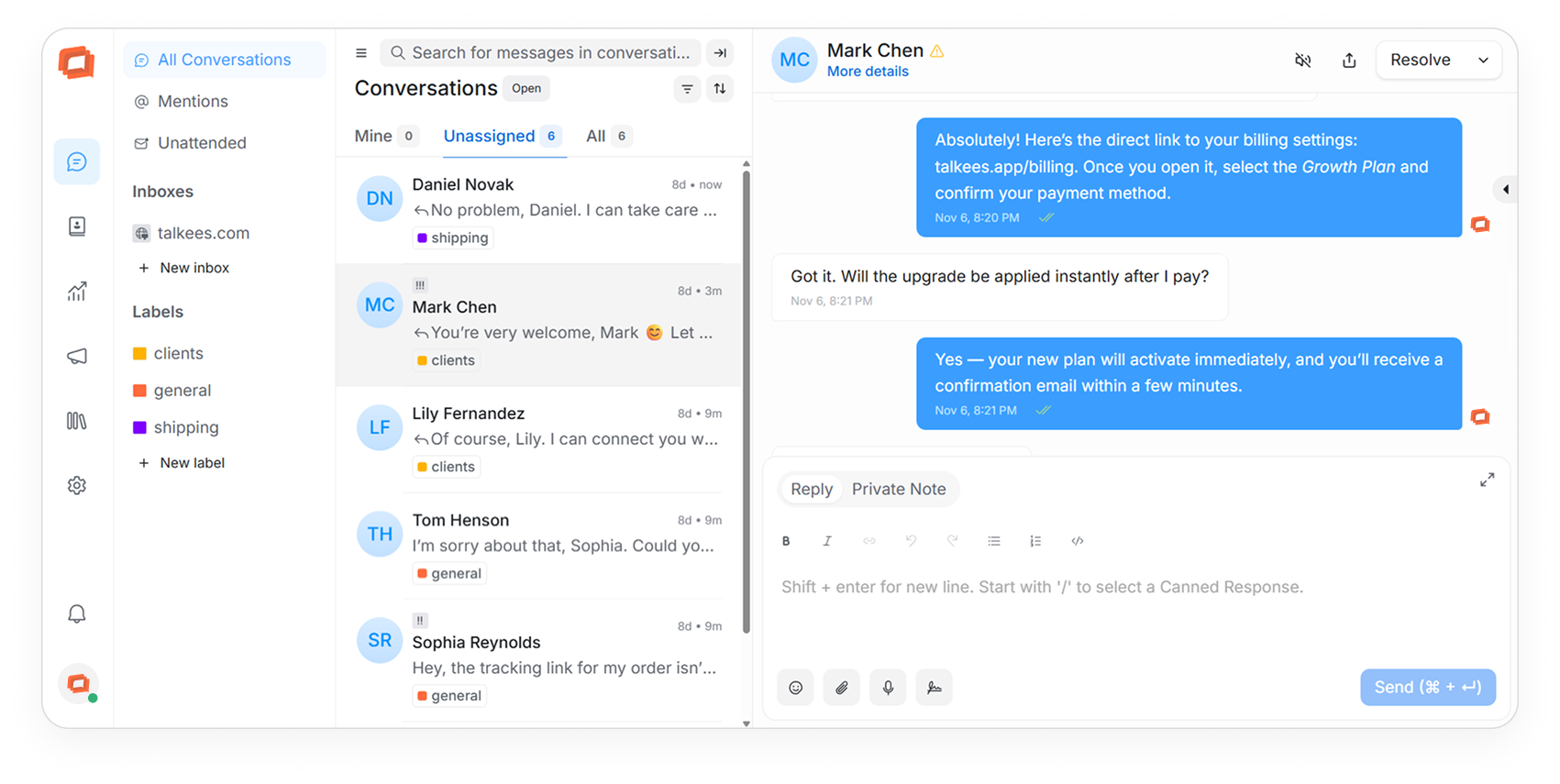
Talkees provides a comprehensive omnichannel inbox that unifies website chat, email, WhatsApp, Instagram, and Facebook Messenger in one interface. This eliminates the need to switch between multiple tools and creates a seamless experience for both agents and customers.
The platform includes an AI chatbot with fair, predictable pricing that can handle routine inquiries, qualify leads, and provide 24/7 support even when your team is offline. Unlike some competitors, Talkees’ AI capabilities come standard rather than as expensive add-ons.
Pricing Structure
- Standard Plan: $45/month (or $495/year)
- Includes 20 chat seats
- Unlimited conversations
- Core omnichannel features
- Basic AI chatbot functionality
- Professional Plan: $64/month (or $704/year)
- All Standard features
- Advanced AI capabilities
- Enhanced analytics
- Priority support
- Enterprise: Custom pricing for larger organizations with specific needs
Pros and Cons
- Advantages:
- Quick deployment (hours, not weeks)
- Intuitive interface requiring minimal training
- Transparent pricing without hidden fees
- Strong AI capabilities included in base packages
- Excellent value for small to medium businesses
- Limitations:
- Newer to market than some established competitors
- Enterprise-grade compliance features still maturing
- Fewer third-party integrations than Slack or Microsoft Teams
Our Experience with Talkees
During our testing, Talkees impressed us with its clean, intuitive interface and rapid setup process. We had a functioning omnichannel inbox connecting our website chat and social channels within an afternoon. The AI chatbot was surprisingly effective at handling common questions after minimal training.
For ecommerce operations and SMBs looking for an affordable all-in-one communication solution, Talkees delivers exceptional value without the complexity or high costs of enterprise platforms.
Mattermost vs RocketChat — Secure, Self-Hosted Collaboration

Mattermost positions itself as a secure, enterprise-grade alternative to RocketChat, particularly for DevOps teams and organizations in regulated industries.
Features and Capabilities
Like RocketChat, Mattermost is open-source and self-hostable, giving organizations complete control over their data. It excels in security features, offering end-to-end encryption, advanced access controls, and compliance capabilities for highly regulated environments.
Mattermost’s standout feature is its deep integration with developer tools and workflows. It supports ChatOps with native integrations for GitLab, GitHub, Jenkins, and other DevOps tools, making it particularly valuable for technical teams.
Pricing Structure
- Team Edition: Free, self-hosted
- Core messaging features
- Unlimited users and message history
- Basic integrations
- Enterprise E10: ~$10/user/month
- Advanced security features
- LDAP/SAML integration
- Compliance reporting
- Enterprise E20: Custom pricing
- Advanced compliance features
- High availability clustering
- Premium support
Pros and Cons
- Advantages:
- Exceptional security and compliance capabilities
- Strong DevOps integration ecosystem
- Complete data sovereignty with self-hosting
- Familiar Slack-like interface with good usability
- Limitations:
- Higher TCO when considering infrastructure and maintenance
- Less focus on customer-facing features than omnichannel alternatives
- Requires technical resources to deploy and maintain
Our Assessment of Mattermost
In our evaluation, Mattermost proved to be a robust alternative to RocketChat for organizations prioritizing security and control. Its user interface feels more polished than RocketChat, and its DevOps integrations are more comprehensive.
However, organizations should be prepared for the operational overhead of self-hosting. During our testing, we found that proper deployment required significant technical expertise, especially for high-availability configurations. For DevSecOps teams and organizations with strict compliance requirements, this tradeoff is often worthwhile.
Sendbird — In-App Chat API/SDKs vs RocketChat

Sendbird takes a fundamentally different approach than RocketChat, focusing on providing developers with APIs and SDKs to build chat directly into applications rather than offering a standalone chat platform.
Features and Capabilities
Sendbird provides comprehensive chat APIs and UI kits that allow developers to implement sophisticated messaging features in mobile and web applications. This includes real-time chat, group messaging, moderation tools, push notifications, and rich media sharing.
The platform also offers features like user presence indicators, typing status, read receipts, and message threading that create a polished chat experience within your own applications.
Pricing Structure
- Developer: Free up to 100 Monthly Active Users (MAU)
- Core chat features
- Up to 10 concurrent users
- Starter: From $399/month
- Up to 5,000 MAU
- Standard support
- Core chat features
- Pro: From $599/month
- Up to 10,000 MAU
- Advanced moderation tools
- Priority support
- Enterprise: Custom pricing
- Unlimited scale
- Dedicated infrastructure options
- Custom SLAs
Pros and Cons
- Advantages:
- Purpose-built for in-app chat experiences
- Excellent developer experience with comprehensive SDKs
- Managed infrastructure eliminates operational overhead
- Scales reliably for consumer applications
- Limitations:
- Not designed for team collaboration like RocketChat
- Fixed platform fees can be expensive for small applications
- Less control over infrastructure and data location
Our Experience with Sendbird
During our technical evaluation, Sendbird impressed us with its developer-friendly approach and the quality of its documentation. We were able to implement a functional chat feature in a test application within days rather than weeks.
For product teams building messaging into customer-facing applications, Sendbird offers a compelling alternative to building on top of RocketChat. The economics make particular sense for applications with high user counts but relatively low concurrent usage, as you’re paying for a platform rather than per-seat licenses.
Stream — Scalable Chat SDKs and Activity Feeds

Stream provides developer-focused APIs and SDKs for building chat and activity feed functionality into applications, similar to Sendbird but with some distinct differences.
Features and Capabilities
Stream offers a comprehensive set of APIs for implementing chat, activity feeds, and notifications in applications. Its chat SDK supports direct messaging, group chats, channels, and rich media sharing with features like typing indicators, read receipts, and offline support.
A key differentiator is Stream’s activity feed API, which allows developers to implement social network-style feeds showing user activities, updates, and content.
Pricing Structure
- Free Plan: Up to 100 users
- Core chat functionality
- Basic support
- Startup: From $499/month
- Up to 10,000 users
- Standard support
- Core features
- Growth: From $999/month
- Up to 25,000 users
- Priority support
- Advanced features
- Enterprise: Custom pricing
- Unlimited scale
- Dedicated support
- Custom features and SLAs
Pros and Cons
- Advantages:
- Highly scalable infrastructure built for consumer-scale applications
- Excellent performance for high-volume messaging
- Combined chat and activity feed capabilities
- Comprehensive UI kits reduce development time
- Limitations:
- Fixed monthly costs regardless of actual usage
- Not designed for team collaboration like RocketChat
- Requires development resources to implement
Our Assessment of Stream
In our testing, Stream demonstrated excellent performance under load and provided a smooth developer experience. The documentation and sample applications made implementation straightforward, though still requiring dedicated development resources.
For product teams building social or community features that require both chat and activity feeds, Stream offers capabilities that would be difficult and time-consuming to build on top of RocketChat. The pricing model works particularly well for applications with predictable growth trajectories.
Userlike — Website Live Chat with WhatsApp Business and CRM Handoffs

Userlike focuses on customer communication rather than team collaboration, making it a strong alternative to RocketChat for customer-facing scenarios.
Features and Capabilities
Userlike provides a polished website chat widget that can be easily implemented on any website. Its standout feature is deep integration with WhatsApp Business, allowing companies to connect their official WhatsApp account to the same interface agents use for website chat.
The platform also offers strong CRM integrations, allowing customer conversations to flow seamlessly between chat and your customer relationship management system.
Pricing Structure
- Free: Limited to 100 conversations/month
- Basic chat widget
- Email notifications
- Team: €99/month (approximately $110)
- 4 operator seats
- WhatsApp integration
- Basic chatbot
- Corporate: €299/month (approximately $330)
- 10 operator seats
- Advanced routing
- API access
- Full chatbot capabilities
- Enterprise: Custom pricing
- Unlimited seats
- Custom integrations
- Dedicated support
Pros and Cons
- Advantages:
- Seamless WhatsApp Business integration
- Strong focus on customer communication
- Easy implementation with minimal technical resources
- Good CRM handoff capabilities
- Limitations:
- Not designed for internal team collaboration
- Less customizable than open-source alternatives
- Limited features in the free tier
Our Experience with Userlike
During our evaluation, Userlike impressed us with its polished user experience and the seamless integration between website chat and WhatsApp. Setting up the platform required minimal technical knowledge, and the interface was intuitive for support agents.
For D2C brands and businesses that sell and support customers primarily through chat channels, Userlike offers capabilities that would be difficult to replicate with RocketChat. The WhatsApp integration is particularly valuable for businesses with international customers who prefer messaging apps over traditional support channels.
Tawk.to — Free Live Chat with Optional Paid Services

Tawk.to stands out in the market by offering a completely free live chat platform with optional paid services, making it an attractive alternative to RocketChat for budget-conscious organizations.
Features and Capabilities
Despite being free, tawk.to offers a surprisingly robust set of features, including a customizable chat widget, ticketing system, knowledge base, and basic reporting. The platform supports multiple agents, departments, and chat routing.
Tawk.to’s unique business model allows it to offer the core platform for free while generating revenue through optional services like removing the tawk.to branding or hiring their agents to handle your chats.
Pricing Structure
- Core Platform: Free
- Unlimited agents
- Unlimited chats
- Basic reporting
- Mobile apps
- Optional Add-ons:
- Remove branding: ~$19/month
- Hire tawk.to agents: ~$1/hour
- Additional features like video/voice: ~$29/month
Pros and Cons
- Advantages:
- Completely free core platform with no limitations on agents or chats
- Easy to implement and use
- Solid basic feature set
- Flexible add-on services
- Limitations:
- Less sophisticated than paid alternatives
- Fewer enterprise controls and integrations
- Limited analytics depth
- Less customizable than open-source solutions
Our Assessment of Tawk.to
In our testing, tawk.to delivered impressive value for a free platform. The chat widget was easy to implement, and the agent interface was straightforward and functional. Basic routing and department features worked as expected.
For early-stage businesses, small websites, and organizations with simple support needs, tawk.to provides an excellent entry point that can scale with your growth. The ability to hire agents on-demand is also a unique feature that can help manage support during peak periods or after hours.
LiveChat — Polished Suite with Marketplace and Advanced Reporting

LiveChat offers a comprehensive, polished live chat solution with a particular focus on conversion optimization and agent productivity.
Features and Capabilities
LiveChat provides a highly customizable chat widget, advanced routing capabilities, canned responses, and one of the most comprehensive reporting systems in the market. Its marketplace offers hundreds of integrations with CRM, ecommerce, and help desk platforms.
The platform excels at providing actionable analytics that help businesses improve conversion rates, reduce response times, and optimize agent performance.
Pricing Structure
- Starter: $20/agent/month (billed annually)
- Basic chat features
- 60-day chat history
- Basic reporting
- Team: $41/agent/month
- Advanced routing
- Full chat history
- Work scheduling
- Business: $59/agent/month
- Advanced reporting
- Security features
- Multiple brandings
- Enterprise: Custom pricing
- Custom reporting
- Dedicated account manager
- HIPAA compliance
Pros and Cons
- Advantages:
- Exceptional reporting and analytics
- Polished, professional interface
- Extensive marketplace of integrations
- Strong focus on conversion optimization
- Limitations:
- Higher cost per agent than some alternatives
- Less customizable than open-source solutions
- No self-hosting option for data sovereignty
Our Experience with LiveChat
During our evaluation, LiveChat stood out for its polished user experience and comprehensive reporting capabilities. The platform made it easy to track key metrics like first response time, chat satisfaction, and conversion rates, with ready-made dashboards available out of the box.
For sales and support teams focused on optimizing customer interactions and measuring ROI, LiveChat offers significant advantages over RocketChat. Its reporting capabilities alone can justify the higher per-agent cost for businesses where chat is a critical sales and support channel.
Tidio — Ecommerce-Focused Live Chat + Automation for Shopify/WooCommerce

Tidio has carved out a niche as a live chat solution specifically optimized for ecommerce platforms, particularly Shopify and WooCommerce.
Features and Capabilities
Tidio combines live chat, chatbots, and email marketing in a single platform designed to increase conversions and automate customer support for online stores. Its chatbots can be configured without coding to handle common ecommerce scenarios like abandoned carts, product questions, and order status inquiries.
The platform offers deep integration with major ecommerce platforms, allowing it to access order data, customer information, and product details to provide contextual support.
Pricing Structure
- Free: Up to 50 unique visitors/month
- Basic live chat
- Limited chatbot capabilities
- Communicator: $19/month for 3 operators
- Unlimited chats
- Visitor monitoring
- Basic reporting
- Chatbots: $39/month
- Advanced chatbot features
- Visual bot builder
- Abandoned cart recovery
- Tidio+: $394/month
- All features
- 5 operators
- Priority support
Pros and Cons
- Advantages:
- Specialized ecommerce features and templates
- Easy integration with Shopify and WooCommerce
- No-code chatbot builder with ecommerce templates
- Combined live chat and marketing automation
- Limitations:
- Less suitable for non-ecommerce businesses
- Limited customization compared to open-source alternatives
- Fewer enterprise features than some competitors
Our Assessment of Tidio
In our testing with a sample Shopify store, Tidio demonstrated excellent ecommerce-specific capabilities. The platform was able to access order information, suggest products, and recover abandoned carts with minimal configuration.
For small to medium-sized online stores, Tidio offers capabilities that would be difficult and time-consuming to implement with RocketChat. Its focus on ecommerce use cases means it includes templates and automations specifically designed to increase conversions and reduce common support inquiries in online stores.
Zendesk — Full Omnichannel Help Desk and Routing

Zendesk offers a comprehensive customer service platform that includes live chat as part of a broader omnichannel support solution.
Features and Capabilities
Zendesk’s chat capabilities are integrated into its complete help desk solution, allowing seamless handling of conversations across channels including chat, email, phone, social media, and messaging apps. The platform provides sophisticated routing, SLA management, and reporting across all these channels.
A key strength is Zendesk’s ability to maintain context as conversations move between channels, ensuring customers don’t have to repeat information when switching from chat to email or phone.
Pricing Structure
- Suite Team: $55/agent/month
- Omnichannel support
- Basic routing and automation
- Standard reporting
- Suite Growth: $89/agent/month
- Advanced routing
- Multilingual support
- Custom reporting
- Suite Professional: $115/agent/month
- Advanced workflow capabilities
- SLA management
- Advanced analytics
- Enterprise: Custom pricing
- Custom roles and permissions
- Enhanced security
- Dedicated support
Pros and Cons
- Advantages:
- Comprehensive omnichannel capabilities
- Mature ticketing and case management
- Strong workflow and automation tools
- Enterprise-grade reporting and analytics
- Limitations:
- Higher cost than chat-only solutions
- Steeper learning curve
- Less specialized for team collaboration than RocketChat
Our Experience with Zendesk
In our evaluation, Zendesk demonstrated superior capabilities for organizations that need to manage customer communications across multiple channels. The platform’s strength lies in maintaining context and consistent service levels regardless of how customers choose to reach out.
For customer service teams handling complex support scenarios across channels, Zendesk offers significant advantages over RocketChat. However, the higher cost and broader scope mean it’s typically best suited for dedicated support teams rather than general internal communication.
Intercom — Product-Led Messaging, AI Inbox, and Proactive Support

Intercom differentiates itself with a focus on product-led growth, combining messaging, targeted campaigns, and AI-powered support in a unified platform.
Features and Capabilities
Intercom provides a messaging platform that goes beyond reactive support, enabling proactive engagement with users based on their behavior within your product or website. Its standout features include in-product tours, targeted messages, and a powerful AI assistant called Fin that can answer questions and resolve issues automatically.
The platform excels at helping businesses convert website visitors, onboard new users, and provide contextual support throughout the customer journey.
Pricing Structure
- Starter: From $74/month (includes 2 seats)
- Basic messaging
- Chat widget
- Limited outbound messages
- Pro: From $119/month (includes 2 seats)
- Advanced targeting
- Custom bots
- More outbound messages
- Premium: Custom pricing
- Advanced security
- Custom reporting
- Dedicated support
- Additional seats: $59-$99/month per seat
Pros and Cons
- Advantages:
- Powerful proactive messaging capabilities
- Strong AI assistant for automated support
- In-product tours and onboarding flows
- Excellent for product-led companies
- Limitations:
- Higher cost than many alternatives
- Less suitable for internal team collaboration
- Can be complex to fully implement and optimize
Our Assessment of Intercom
During our testing, Intercom impressed us with its ability to deliver contextual messaging based on user behavior and its sophisticated AI assistant. The platform excelled at guiding users through product features and proactively addressing potential questions.
For SaaS companies and product-led businesses, Intercom offers capabilities that would be difficult to replicate with RocketChat. Its focus on the entire customer journey, from acquisition to retention, provides value that extends beyond simple chat functionality.
Conclusion: Choosing the Right RocketChat Alternative

After evaluating these top alternatives to RocketChat, it’s clear that the best choice depends on your specific needs and priorities:
- For ecommerce and customer support:
- Talkees offers an excellent balance of features and affordability for SMBs
- LiveChat provides superior analytics and conversion optimization
- Tidio excels for Shopify and WooCommerce stores
- Zendesk is ideal for enterprise-scale omnichannel support
- For team collaboration and secure communications:
- Mattermost is perfect for DevOps teams and regulated industries
- Slack offers the best balance of usability and integration ecosystem
- Microsoft Teams is the natural choice for Microsoft-centric organizations
- For developers building chat into applications:
- Sendbird provides comprehensive SDKs and managed infrastructure
- Stream offers excellent scalability for consumer applications
- For budget-conscious teams:
- Tawk.to’s free platform is hard to beat for basic needs
- Talkees delivers excellent value for small to medium businesses
When making your final decision, consider not just the features and pricing, but also the total cost of ownership, including implementation time, maintenance requirements, and the value of improved communication efficiency. Many organizations find that the right communication platform quickly pays for itself through increased productivity and improved customer satisfaction.