 English
 Slovenčina
 Français
 Magyar

Why Businesses Look Beyond SupportBox: Understanding the Limitations

Are you reaching the limits of what SupportBox can offer your growing business? You’re not alone. Many teams find themselves looking for alternatives when they encounter pricing ceilings, limited AI capabilities, and gaps in omnichannel support that ultimately hinder growth.
While SupportBox provides solid basic functionality, today’s customer service demands have evolved. Modern businesses need comprehensive solutions that combine AI-powered automation with human-touch service across multiple channels, all while maintaining control over sensitive customer data.
What Makes a Strong SupportBox Alternative: Key Requirements

A truly effective SupportBox competitor must deliver across several critical dimensions:
- Integrated AI + live chat capabilities: Not just basic chatbots, but intelligent systems that can understand context and seamlessly transition between automated and human support
- True omnichannel functionality: Unified conversation threads across email, chat, social media, and messaging platforms
- Robust automation capabilities: Advanced workflow tools that reduce repetitive tasks and improve efficiency
- EU-compliant data controls: Strong privacy protections and data governance, especially important for European businesses
The ideal alternative should enhance customer experience while reducing agent workload through intelligent automation—all at a price point that scales reasonably with your business growth.
How We Evaluate SupportBox Alternatives: Our Methodology

Our comparison methodology focuses on what matters most to e-commerce businesses and SMEs:
- Core functionality: We assess each platform’s channel coverage, AI capabilities, automation tools, and reporting features
- Pricing structure: We analyze not just base costs but total cost of ownership, including hidden fees and add-ons
- Ease of implementation: We evaluate setup complexity, integration capabilities, and migration pathways
- Data security: We examine compliance standards, data handling practices, and security protocols
We’ve gathered data from vendor documentation, hands-on testing, and verified user reviews to provide the most accurate assessment possible. Each alternative is evaluated based on how it performs in real-world customer service scenarios for e-shops and SMEs.
SupportBox vs Talkees: AI-First Live Chat with Omnichannel Capabilities

What is Talkees?
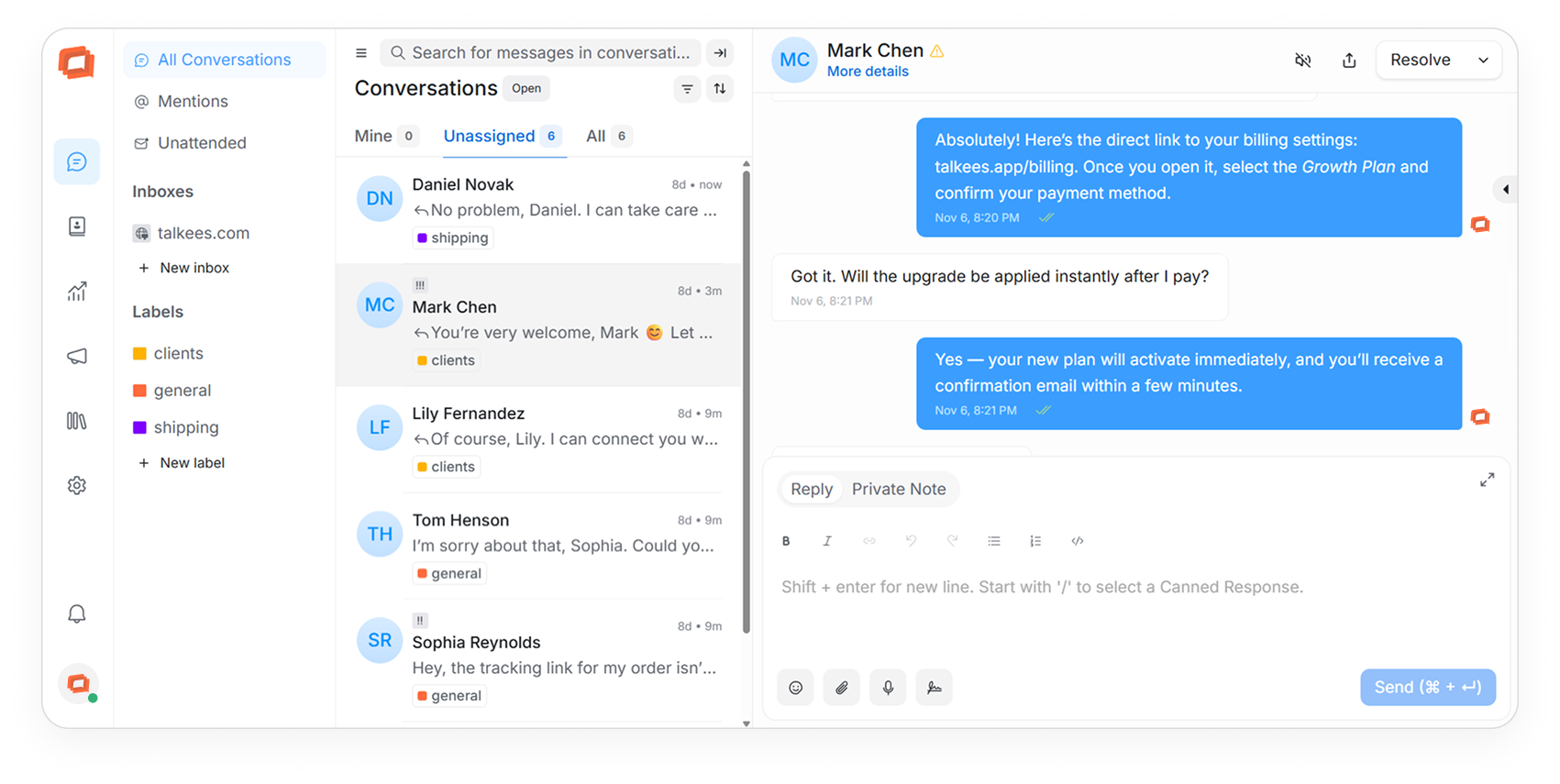
Talkees is a modern customer support platform built with AI at its core. It combines powerful live chat functionality with an omnichannel inbox and custom AI integrations to create a comprehensive support solution.
Key Features
- AI-powered live chat and chatbot: Talkees offers advanced conversational AI that can handle routine inquiries while seamlessly transferring complex issues to human agents
- Unified omnichannel inbox: All customer communications—whether from email, chat, social media, or messaging apps—appear in a single, organized timeline
- Custom AI integrations: Talkees allows you to connect your existing knowledge base and systems to its AI engine, creating truly contextual automated responses
- Flexible pricing: Plans scale reasonably with your business, without the steep increases common with other platforms
Detailed Pricing Structure
Talkees offers a transparent pricing model designed to grow with your business:
- Free Plan: Perfect for startups and small businesses
- Up to 3 team members
- Basic AI chatbot functionality
- Email and chat support
- 500 conversations per month
- Growth Plan: $29/agent/month
- Unlimited AI chatbot conversations
- Advanced routing and automation
- WhatsApp and social media integration
- Custom branding options
- Priority support
- Business Plan: $59/agent/month
- All Growth features
- Advanced AI training capabilities
- Custom integrations
- Dedicated account manager
- 99.9% uptime SLA
- Enterprise Plan: Custom pricing
- Unlimited everything
- Custom AI development
- On-premises deployment options
- 24/7 premium support
- Advanced security features
Unlike competitors that charge separately for AI interactions, Talkees includes AI capabilities in all plans with reasonable usage limits.
Complete Feature List
- Channels: Email, live chat, WhatsApp, Facebook Messenger, Instagram, Twitter/X
- AI Capabilities: Intent recognition, automated responses, sentiment analysis, conversation summarization, knowledge base integration
- Automation: Custom workflows, time-based triggers, tagging, routing rules
- Analytics: Real-time dashboards, conversation analytics, agent performance metrics, customer satisfaction tracking
- Integration: Open API, webhooks, native integrations with popular CRMs and e-commerce platforms
- Security: GDPR compliance, data encryption, role-based access controls, EU data residency options
User Experience and Reviews
Talkees consistently receives high marks for its intuitive interface and powerful AI capabilities. Users particularly appreciate:
- “The AI chatbot handles about 70% of our routine inquiries, freeing our team to focus on complex issues.” — E-commerce Manager
- “The omnichannel inbox has eliminated the need to switch between multiple tools, saving us hours each week.” — Customer Support Director
- “Implementation was surprisingly fast—we were up and running in days, not weeks.” — IT Administrator
G2 Rating: 4.7/5 (based on 120+ reviews)
Capterra Rating: 4.8/5 (based on 95+ reviews)
Pros and Cons
Pros:
- Powerful AI capabilities included in all plans
- True omnichannel functionality with unified conversation history
- Intuitive interface requiring minimal training
- Excellent value for features provided
- Strong EU data compliance
Cons:
- Mobile app has fewer features than web version
- Some advanced integrations require development resources
- Premium support only available on higher plans
Our Assessment
During our testing, Talkees impressed us with its balance of powerful features and user-friendly design. The AI chatbot was remarkably effective at understanding customer intent, even with complex queries, and the handoff to human agents was seamless when needed.
The platform’s analytics provided actionable insights that would genuinely help teams improve their performance, rather than just vanity metrics. We particularly appreciated the transparent pricing structure that includes AI functionality without surprise charges.
For businesses looking to move beyond SupportBox, Talkees represents an excellent balance of advanced capabilities and reasonable cost, especially for teams that need strong AI and omnichannel support.
SupportBox vs Gmelius: Gmail-Native Shared Inbox with Automation

Key Features and Pricing
- Gmail-native shared inbox: Works within Gmail, eliminating the need to learn a new interface
- Collaboration tools: Internal notes, @mentions, and email assignments
- Light automation: Rules-based routing and templates
- Kanban boards: Visual workflow management for email
- Pricing: Starts at $24/user/month for the Growth plan; $36/user/month for Pro
Strengths and Limitations
While Gmelius excels at email management within the Google ecosystem, it has notable limitations in omnichannel capabilities. Live chat and social media integration are limited, and its AI automation features aren’t as robust as dedicated support platforms like Talkees.
Gmelius is best suited for teams that primarily handle support through email and are deeply integrated with Google Workspace.
SupportBox vs Hiver: Google Workspace Help Desk with Limited AI

Key Features and Pricing
- Google Workspace integration: Native Gmail experience with shared inbox capabilities
- SLAs and CSAT: Basic service level agreements and customer satisfaction tracking
- Email collaboration: Collision detection, internal notes, and assignments
- Pricing: Typically ranges from $15-$59 per user/month depending on features
Where Hiver Falls Short
Hiver’s primary limitation is its channel coverage—it’s primarily designed for email support. Live chat capabilities are limited, and integration with social channels and messaging platforms is not as robust as omnichannel alternatives. Additionally, AI capabilities are minimal compared to AI-first platforms like Talkees.
SupportBox vs Front: Collaboration-Focused Inbox with Powerful Routing

Key Features and Pricing
- Collaborative inbox: Team comments, shared drafts, and assignments
- Advanced routing: Sophisticated rules for message distribution
- Strong API ecosystem: Extensive integration capabilities
- Pricing: Starting around $25/user/month, with higher tiers reaching $99/user/month
Cost Considerations
Front’s pricing can become significant as teams scale, particularly when advanced features are needed. The platform excels at email and collaboration but may require additional tools for comprehensive customer support, potentially increasing total cost of ownership.
SupportBox vs Help Scout: Clean Help Desk with Chat and Documentation
Key Features and Pricing
- Clean, intuitive interface: Easy to learn and use
- Beacon chat widget: Embedded support and self-service
- Docs knowledge base: Integrated self-service documentation
- Pricing: Starting around $20/user/month for basic features
Fit and Trade-offs
Help Scout works well for email-focused support teams that value simplicity. However, it has limitations in social media integration and advanced AI capabilities. The platform offers good value for email-centric teams but may not satisfy businesses looking for comprehensive omnichannel support with strong automation.
SupportBox vs Zendesk: Enterprise-Grade Suite with Marketplace

Key Features and Pricing
- Comprehensive suite: Ticketing, chat, voice, and self-service in one platform
- Extensive marketplace: Hundreds of integrations and add-ons
- Advanced reporting: Sophisticated analytics and insights
- Pricing: Suite Team starts at $55/agent/month, with higher tiers reaching $169/agent/month
Feature Depth vs Complexity
Zendesk offers extensive capabilities but comes with a steeper learning curve and higher implementation costs than more focused alternatives. The platform requires significant setup time and ongoing administration, and total costs can increase substantially with add-ons and premium features.
SupportBox vs LiveAgent: All-in-One Live Chat and Call Center

Key Features and Pricing
- Strong telephony integration: Built-in call center capabilities
- Extensive channel support: Email, chat, social, and voice
- Universal inbox: All communications in one place
- Pricing: Ranges from $15 to $69 per agent/month depending on features
Strengths and Current Limitations
LiveAgent excels in traditional support channels, particularly voice. However, its user interface is less modern than newer competitors, and its AI capabilities are still developing. For teams that need strong phone support alongside digital channels, LiveAgent offers good value, but those seeking cutting-edge AI might find it lacking.
SupportBox vs Zoho Desk: Ecosystem-Driven Help Desk with Zia AI

Key Features and Pricing
- Zia AI assistant: Automated responses and agent suggestions
- Zoho ecosystem integration: Seamless connection with Zoho CRM, Projects, and more
- Multi-channel support: Email, chat, social, and phone
- Pricing: Ranges from $14 to $40 per agent/month, with chat available through SalesIQ
Value and Integration Considerations
Zoho Desk provides excellent value for businesses already using other Zoho products. However, chat functionality requires Zoho SalesIQ integration, adding complexity and potential costs. The platform offers good AI capabilities with Zia, but integration with non-Zoho tools can be challenging.
SupportBox vs HappyFox: Robust Workflows and Reporting

Key Features and Pricing
- Advanced workflow automation: Sophisticated rules and triggers
- Strong reporting capabilities: Detailed analytics and custom reports
- Multi-channel support: Email, chat, and social media
- Pricing: Tiered structure with separate pricing for chat functionality
E-commerce Readiness and Considerations
HappyFox offers robust features for workflow management but requires separate products for chat and other channels, potentially increasing complexity and cost. The platform works well for businesses with established processes but may not be as agile as newer, more integrated alternatives for e-commerce businesses.
SupportBox vs HelpCrunch: Chat-First Support with In-App Messaging

Key Features and Pricing
- In-app messaging: Native SDK for web and mobile applications
- Email campaigns: Automated customer communications
- Live chat with chatbots: Real-time support with automation
- Pricing: Starting around $12/user/month for basic features
SMB Sweet Spot and Ticketing Limitations
HelpCrunch works well for small to medium-sized businesses that prioritize chat and in-app support. However, its ticketing capabilities have some limitations compared to dedicated help desk solutions. The platform offers good value for chat-centric teams but may not satisfy complex ticketing requirements.
Comparing Pricing Models: Understanding the True Cost

When evaluating SupportBox alternatives, understanding the various pricing models is crucial for accurate cost projection:
Per-Seat vs Usage-Based Pricing
- Per-seat pricing (Talkees, Gmelius, Hiver): You pay for each agent using the system
- Usage-based pricing: Charges based on volume of conversations or features used
- Hybrid models (some Zendesk plans): Combine per-seat costs with usage fees
Hidden Add-ons to Watch For
Many platforms advertise attractive base prices but require additional purchases for essential functionality:
- AI capabilities: Often charged separately or limited to higher tiers
- Channel add-ons: Additional fees for social media, WhatsApp, or voice support
- Storage limitations: Charges for exceeding conversation or attachment storage
- API usage: Restrictions or additional costs for integration capabilities
Comparative Cost Scenarios
For a typical 10-agent support team:
- Talkees Growth: $290/month ($29/agent)
- Zendesk Suite Team: $550/month ($55/agent)
- LiveAgent: $490/month (Large plan at $49/agent)
- Gmelius Growth: $240/month ($24/agent)
Remember that base pricing often doesn’t tell the full story—consider implementation costs, training requirements, and potential add-ons when calculating total cost of ownership.
Practical Migration from SupportBox: A Step-by-Step Guide

Transitioning from SupportBox to a new platform requires careful planning. Here’s a practical approach to ensure a smooth migration:
Data Export and Import
- Inventory your data: Identify all tickets, customer contacts, knowledge base articles, and macros to be migrated
- Export data from SupportBox: Use available export tools to create backups of all essential information
- Prepare data for import: Clean and format exported data to match the requirements of your new platform
- Test import process: Run a trial import with a subset of data to identify potential issues
Domain and Channel Setup
- Configure email domains: Update DNS records and email forwarding rules
- Set up chat widgets: Deploy new chat widgets on your website and test functionality
- Connect social channels: Authenticate social media accounts with your new platform
- Configure integrations: Set up connections to your CRM, e-commerce platform, and other essential tools
Agent Change Management
- Training plan: Create a comprehensive training program for your support team
- Parallel operation: Run both systems simultaneously during the transition period
- Phased cutover: Migrate channels one at a time to minimize disruption
- Feedback loop: Establish a process for agents to report issues and suggest improvements
With proper planning, most businesses can complete a migration within 2-4 weeks, depending on the complexity of their support operations.
Choosing Your SupportBox Alternative: Decision Framework by Use Case

The best alternative to SupportBox depends on your specific business needs:
For E-commerce Growth
If you run an online store experiencing rapid growth, prioritize:
- Strong integration with your e-commerce platform
- Robust AI chatbot to handle order status and return inquiries
- Omnichannel support including social media and messaging apps
Best options: Talkees, LiveAgent, or HelpCrunch
For Gmail-Based Teams
If your team is deeply integrated with Google Workspace:
- Consider Gmail-native solutions for minimal disruption
- Evaluate whether email-centric support meets your needs
- Assess integration capabilities with other Google services
Best options: Gmelius or Hiver (with awareness of channel limitations)
For Social-Heavy Support
If your customers primarily reach you through social media:
- Prioritize platforms with strong social channel integration
- Look for unified conversation history across channels
- Consider advanced routing capabilities for social inquiries
Best options: Talkees, Zendesk, or LiveAgent
For AI-First Projects
If automation and AI are your primary focus:
- Evaluate the sophistication of AI capabilities
- Consider how AI integrates with your knowledge base
- Assess pricing models for AI interactions
Best options: Talkees, Zoho Desk (with Zia), or Zendesk (with premium AI add-ons)
Conclusion: Making Your Final Decision

Choosing the right SupportBox alternative requires balancing features, cost, and implementation effort. Based on our comprehensive analysis:
- Talkees stands out for businesses seeking a modern, AI-first approach with true omnichannel capabilities at a reasonable price point
- Gmelius and Hiver work well for Google-centric teams with primarily email-based support
- Zendesk and LiveAgent offer comprehensive solutions for larger teams with complex requirements
- Specialized options like HelpCrunch and HappyFox excel in specific scenarios
Before making your final decision, take advantage of free trials to test how each platform performs with your specific support workflows and customer interactions. The right choice will balance your immediate needs with room for growth as your business evolves.