 English
 Slovenčina
 Français
 Magyar

Why Are Teams Looking for eDesk Alternatives?

Before diving into specific alternatives, let’s understand why businesses are evaluating options beyond eDesk:
Price Escalations and Cost Concerns
Many eDesk users report experiencing significant price increases, especially as their business scales. While eDesk’s starting price of approximately $69 per user per month may seem reasonable, costs can escalate quickly when adding additional marketplace integrations or exceeding ticket volume thresholds. For growing businesses, this pricing structure can create budgetary challenges.
AI Capabilities and Automation Limitations
While eDesk offers AI features, some users find its automation capabilities less sophisticated than newer alternatives. Modern helpdesk solutions now provide more advanced AI that can handle complex interactions, generate more accurate responses, and deliver higher automation rates—often at comparable or lower costs.
Marketplace-First Constraints
eDesk built its reputation on marketplace integration, but some businesses need a solution that excels equally across direct-to-consumer (DTC) channels, social media, and live chat. Teams looking for a more balanced approach may find eDesk’s marketplace-first orientation limiting, especially if their business model extends beyond platforms like Amazon and eBay.
What Should You Demand from an eDesk Alternative?

When evaluating helpdesk solutions, these key capabilities should be non-negotiable:
- Unified omnichannel inbox that consolidates messages from email, marketplaces, social media, and live chat
- Native AI chatbot and automation that can meaningfully reduce ticket volume
- Deep integration with your sales channels, including order context directly in the conversation
- Flexible pricing that scales reasonably with your business growth
- Intuitive interface that minimizes agent training and maximizes productivity
How We Evaluated These eDesk Alternatives

We assessed each platform using Research.com’s weighted evaluation framework:
- General Features & Functionality (40%): Core ticketing capabilities, automation tools, and user experience
- Cost & Pricing Model (15%): Pricing structure, scalability, and total cost of ownership
- Customer Support & Onboarding (15%): Vendor responsiveness, training resources, and migration assistance
- Integrations & Marketplace Depth (15%): Native connectors, third-party integrations, and API capabilities
- Mobile Support (15%): App quality, feature parity with desktop, and mobile-specific tools
Additionally, we’ve included real-world performance metrics where available, such as first response time improvements, ticket deflection rates, and customer satisfaction scores.
Talkees vs eDesk: The Modern, Flexible Alternative


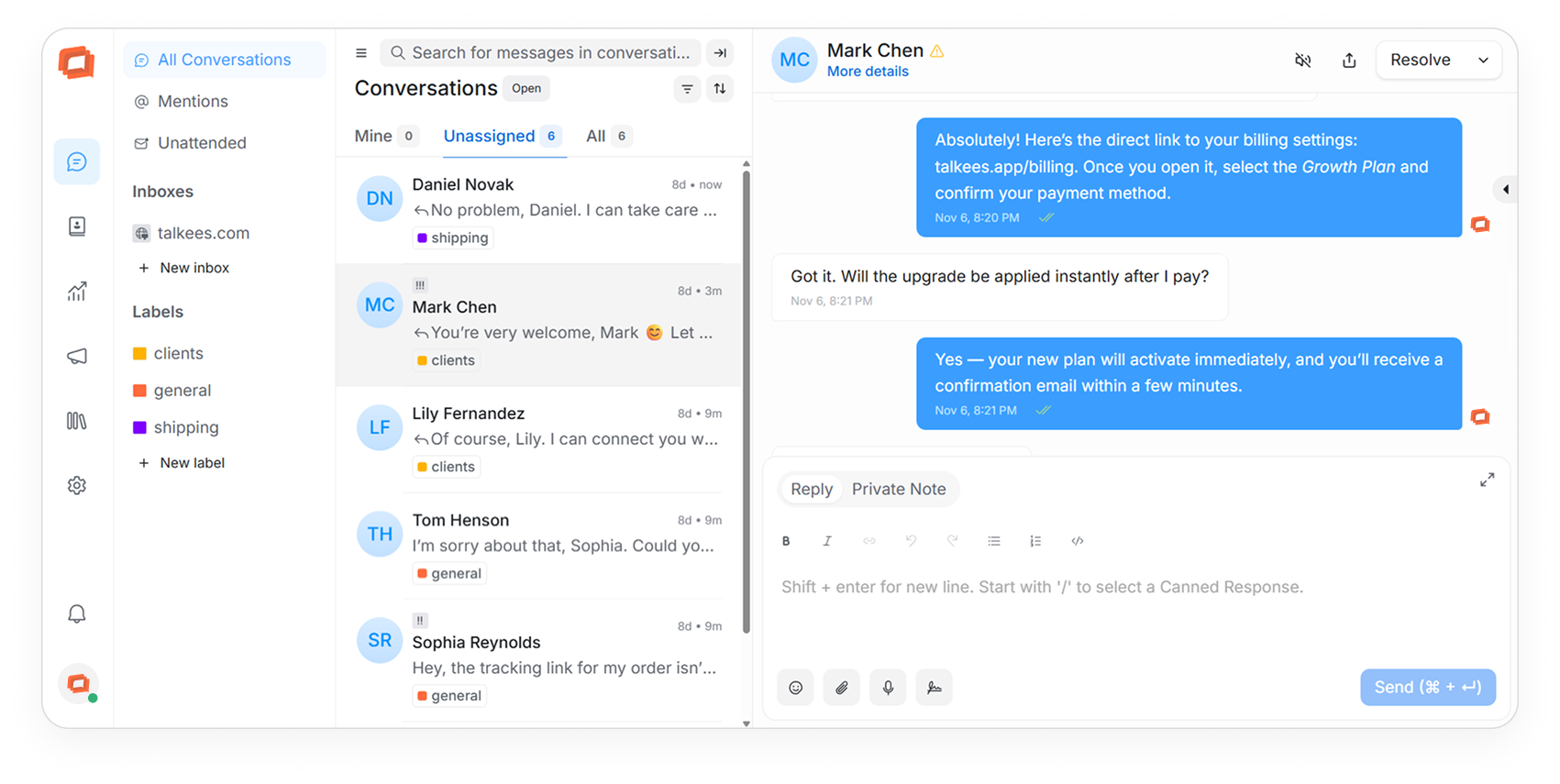
Talkees stands out as a modern alternative to eDesk, offering a powerful yet intuitive omnichannel inbox combined with a native AI chatbot. Unlike eDesk’s marketplace-first approach, Talkees provides equal strength across all customer communication channels.
Key Features
- Omnichannel inbox consolidating email, marketplace messages, social media, and live chat
- Built-in AI chatbot that requires no additional subscription
- Order-aware conversations showing complete customer purchase history
- No-lock-in pricing with month-to-month options (no annual contracts required)
- Advanced automation with confidence thresholds and human-in-the-loop safety
- Native integrations with Shopify, WooCommerce, Amazon, eBay, and more
Pricing
Talkees offers transparent, predictable pricing without the escalation issues that plague some competitors:
- Basic: $49/agent/month (billed monthly) – Includes omnichannel inbox, basic automation
- Pro: $79/agent/month – Adds full AI chatbot, advanced automation, priority support
- Enterprise: Custom pricing – For high-volume teams needing dedicated support
All plans include unlimited conversations, no hidden fees, and no long-term commitments.
Real User Experiences
Talkees users consistently praise the platform’s intuitive interface and powerful automation. On G2 and Capterra, users highlight the significant time savings:
“We reduced our response time by 62% within the first month. The AI chatbot handles about 40% of our routine questions completely autonomously.” – Sarah K., eCommerce Manager
“After switching from eDesk, we’re saving approximately $400 per month while handling more conversations. The order context feature alone has cut our handling time for WISMO tickets in half.” – Michael T., Customer Support Director
Our Subjective Assessment
When testing Talkees, we were immediately impressed by how quickly we could get up and running. The interface feels modern and intuitive, with no unnecessary complexity. Setting up automation rules took minutes rather than hours, and the AI chatbot required minimal training before delivering useful responses.
The standout feature is how Talkees presents order information directly in the conversation view. When a customer asks about their order, agents can see all relevant details without switching tabs or searching through systems. This alone can save several minutes per conversation.
For teams frustrated by eDesk’s pricing or limitations, Talkees represents a refreshing alternative that doesn’t compromise on functionality while offering better value and a more modern experience.
Pros and Cons
Pros:
- Truly intuitive interface with minimal training required
- Powerful AI chatbot included without additional cost
- Flexible month-to-month pricing without long-term commitments
- Excellent order context directly in conversations
- Responsive support team with quick resolution times
Cons:
- Newer platform with a smaller marketplace of integrations
- Advanced enterprise features still in development
- Phone support limited to higher-tier plans
How Does Gorgias Compare to eDesk for Shopify Stores?


Gorgias has established itself as the go-to helpdesk for Shopify-focused businesses, with deep integration that allows agents to take actions directly from the helpdesk interface.
Key Features
- Deep Shopify integration with ability to process refunds, edit orders, and view complete customer history
- Revenue attribution that shows the financial impact of your support team
- Macros and automation for routine ecommerce scenarios
- Live chat, email, and social media in one interface
- Self-service capabilities including help center and order lookup
Pricing
Gorgias uses a ticket-volume pricing model that can be advantageous for small stores but expensive for high-volume operations:
- Basic: $10/month (up to 50 tickets)
- Pro: $60-$360/month (based on ticket volume)
- Advanced: $360-$900+/month (for growing stores with higher volume)
Real User Experiences
Gorgias users particularly value the platform’s Shopify-specific capabilities:
“Being able to process refunds directly from the conversation has been a game-changer for our team efficiency.” – Taylor R., Support Manager
“The revenue attribution feature helps us demonstrate our support team’s value to leadership.” – Alex M., eCommerce Director
Our Subjective Assessment
During our testing, Gorgias impressed us with its Shopify-specific features. The ability to edit orders, process refunds, and see complete customer histories without leaving the ticket interface is genuinely useful for Shopify-centric businesses.
However, we found the platform less compelling for multi-marketplace sellers. While Gorgias does offer Amazon and eBay integration, these connections feel less robust than its Shopify capabilities. The ticket-based pricing model also becomes expensive quickly as volume increases.
Pros and Cons
Pros:
- Best-in-class Shopify integration
- Revenue attribution features
- Strong macros and automation for ecommerce workflows
- Excellent community and resources for Shopify merchants
Cons:
- Pricing becomes expensive at higher ticket volumes
- Less robust for marketplace sellers (Amazon/eBay)
- Limited AI capabilities compared to newer platforms
- Learning curve for complex automation setup
Is Richpanel a Good eDesk Alternative for Self-Service?


Richpanel takes a different approach to customer support, focusing heavily on self-service capabilities that deflect tickets before they reach your agents.
Key Features
- Self-service customer portal for order tracking, returns, and exchanges
- Guided flows that walk customers through common issues
- Integration with Shopify, WooCommerce, and major marketplaces
- Order management directly within the helpdesk
- Automation capabilities for routine support scenarios
Pricing
Richpanel’s pricing starts higher than some alternatives but includes robust self-service features:
- Starter: $99/month (includes self-service portal)
- Growth: $299/month (adds advanced automation)
- Pro: $599/month (enterprise features and priority support)
- Automation Success Kit: One-time $2,000 setup fee for custom automation
Real User Experiences
Richpanel users highlight the ticket deflection benefits:
“Our ticket volume dropped by 35% after implementing Richpanel’s self-service portal. Customers actually prefer solving simple issues themselves.” – Jamie L., Operations Manager
Our Subjective Assessment
Richpanel’s self-service approach is impressive and effective. During testing, we found the customer portal intuitive and comprehensive, allowing shoppers to track orders, initiate returns, and solve common problems without contacting support.
However, the trade-off comes in agent-facing features. While Richpanel’s helpdesk is capable, it lacks some of the advanced routing and AI capabilities found in competitors. The platform is best suited for brands that want to minimize ticket volume through self-service rather than handling high volumes efficiently.
Pros and Cons
Pros:
- Excellent self-service capabilities
- Significant ticket deflection potential
- Good integration with major ecommerce platforms
- Clean, modern interface for customers
Cons:
- Higher starting price point
- Less sophisticated agent tools compared to alternatives
- Limited customization for complex routing scenarios
- Setup can be complex for full benefit realization
Zendesk vs eDesk: Enterprise-Grade Support Solution

Zendesk is the established enterprise player in the customer support space, offering comprehensive capabilities that extend well beyond ecommerce.
Key Features
- Advanced routing and SLA management
- Comprehensive reporting and analytics
- Extensive app marketplace (1,000+ integrations)
- Powerful workflow automation
- Omnichannel support including email, chat, voice, social, and messaging
- AI capabilities through Answer Bot and AI-powered suggestions
Pricing
Zendesk’s pricing reflects its enterprise positioning:
- Suite Team: $55/agent/month (basic omnichannel support)
- Suite Growth: $115/agent/month (adds advanced routing and reporting)
- Suite Professional: $149/agent/month (full capabilities and premium support)
- Enterprise: Custom pricing (for large organizations with complex needs)
Additionally, marketplace integrations often require third-party connectors like ChannelReply, adding to the total cost.
Real User Experiences
Zendesk users value the platform’s depth and flexibility:
“We’ve been able to create incredibly complex workflows that perfectly match our support process. The reporting gives us insights we couldn’t get elsewhere.” – Chris B., Support Director
“The learning curve is steep, but once you master Zendesk, you can do almost anything with it.” – Robin S., Customer Experience Manager
Our Subjective Assessment
Testing Zendesk reveals both its strengths and challenges. The platform offers unmatched depth and customization potential, with virtually unlimited capabilities for enterprises willing to invest the time and resources to configure it properly.
However, this power comes with complexity. During our testing, simple tasks often required multiple steps, and the admin interface can be overwhelming. For ecommerce businesses without dedicated Zendesk administrators, the learning curve may be prohibitive.
Marketplace integration requires third-party connectors like ChannelReply, adding cost and potential points of failure. While these connections work well, they lack the seamless experience of purpose-built ecommerce helpdesks.
Pros and Cons
Pros:
- Unmatched depth and customization
- Excellent reporting and analytics
- Large ecosystem of apps and integrations
- Enterprise-grade security and compliance
- Sophisticated workflow capabilities
Cons:
- Significant complexity and steep learning curve
- Higher cost, especially with necessary add-ons
- Requires third-party connectors for marketplace integration
- May be overkill for small to medium businesses
- Setup and optimization often require professional services
For a clearer breakdown of capabilities and costs, see our full zendesk vs edesk comparison focused on ticketing, automation, and scalability.
Freshdesk: Broad Features on Friendly Pricing


Freshdesk offers a compelling balance of capabilities and cost, with a free tier that makes it accessible to businesses of all sizes.
Key Features
- Multichannel support for email, chat, phone, and social
- Freddy AI for ticket classification and suggested responses
- Automation workflows for routine tasks
- Knowledge base and community forum capabilities
- Marketplace apps for extended functionality
- SLA management and escalation rules
Pricing
Freshdesk’s tiered pricing includes a generous free plan:
- Free: Up to 10 agents (basic ticketing)
- Growth: $15/agent/month (automation and SLAs)
- Pro: $49/agent/month (advanced automation and reporting)
- Enterprise: $79/agent/month (AI capabilities and premium support)
Real User Experiences
Freshdesk users frequently highlight the platform’s value:
“We started on the free plan and gradually moved up as our needs grew. The transition was seamless, and we never felt pressured to upgrade before we needed to.” – Dana K., Customer Success Manager
“Freddy AI has reduced our response time by about 40% for common questions. The suggested replies are surprisingly accurate.” – Tyler W., Support Team Lead
Our Subjective Assessment
During our testing, Freshdesk impressed with its intuitive interface and quick setup. The platform strikes a good balance between simplicity and capability, making it accessible to teams without specialized technical knowledge.
Freddy AI works well for basic classification and suggestions, though it’s not as sophisticated as some dedicated AI solutions. The marketplace integration is functional but requires third-party connectors for deep ecommerce functionality.
The free tier is genuinely useful for small businesses, offering core ticketing capabilities without the limitations found in many “freemium” products.
Pros and Cons
Pros:
- Excellent value at all price points
- Intuitive interface with minimal learning curve
- Useful free tier for small businesses
- Good automation capabilities
- Solid AI features on higher tiers
Cons:
- Marketplace integration requires third-party connectors
- Limited ecommerce-specific features
- Mobile app lacks some desktop functionality
- Advanced reporting limited to higher tiers
- Some users report occasional performance issues
Kustomer: CRM-Like Conversational Platform


Kustomer takes a unique approach to customer support, organizing information around customer timelines rather than traditional tickets.
Key Features
- Timeline view showing complete customer history
- Strong messaging capabilities across channels
- CRM-like customer profiles with detailed attributes
- Powerful automation engine
- Advanced routing based on customer attributes
- Omnichannel support including chat, email, and social
Pricing
Kustomer’s pricing reflects its enterprise positioning:
- Enterprise: Custom pricing based on needs
- Ultimate: Custom pricing with advanced features
Most implementations start at several hundred dollars per month, making it suitable for established businesses rather than startups.
Real User Experiences
Kustomer users value the platform’s customer-centric approach:
“The timeline view gives our agents incredible context. They can see every interaction a customer has had with us, making conversations much more personalized.” – Morgan L., CX Director
“The automation capabilities are powerful once properly configured. We’ve reduced our handling time by 35% for routine inquiries.” – Jordan P., Support Operations
Our Subjective Assessment
Testing Kustomer reveals a sophisticated platform with a unique approach. The timeline view is genuinely useful, providing agents with comprehensive context that helps them deliver more personalized service.
However, the platform’s complexity can be challenging. During our testing, configuration often required consulting documentation, and the learning curve is steeper than with some alternatives. The enterprise pricing model also puts it out of reach for many small to medium businesses.
For ecommerce integration, Kustomer works well but requires setup time to fully leverage its capabilities. The platform excels for businesses with complex customer journeys spanning multiple channels and touchpoints.
Pros and Cons
Pros:
- Comprehensive customer context in timeline view
- Powerful automation capabilities
- Excellent for complex, multi-channel customer journeys
- Strong messaging platform integration
- Sophisticated routing and prioritization
Cons:
- Enterprise pricing limits accessibility
- Steeper learning curve than some alternatives
- Configuration complexity requires dedicated resources
- Less specialized for marketplace sellers
- Implementation often requires professional services
Re:amaze: Lightweight Multichannel for Stores


Re:amaze offers a streamlined approach to customer support, focusing on ease of use and quick implementation.
Key Features
- Multichannel inbox for email, chat, and social
- Proactive chat campaigns to engage customers
- Shopify, BigCommerce, and WooCommerce integration
- In-chat video calls (on Plus plan)
- Automation and chatbots
- Knowledge base and self-service options
Pricing
Re:amaze offers straightforward per-user pricing:
- Basic: $29/team member/month
- Pro: $49/team member/month
- Plus: $69/team member/month (includes video calls)
Real User Experiences
Re:amaze users highlight the platform’s simplicity:
“We were up and running with Re:amaze in less than a day. The interface is intuitive enough that our team needed minimal training.” – Casey R., Store Owner
“The proactive chat campaigns have increased our conversion rate by about 15%. Being able to engage customers at the right moment makes a big difference.” – Riley T., Marketing Manager
Our Subjective Assessment
During testing, Re:amaze impressed with its simplicity and focus. The platform does fewer things than some competitors, but what it does, it does well. Setup was quick, and the interface is intuitive enough that most agents can start working without extensive training.
The proactive chat campaigns are particularly effective, allowing businesses to engage customers based on behavior patterns. The Shopify integration works smoothly, though it’s not as deep as Gorgias in terms of in-ticket actions.
One notable limitation is analytics depth. While Re:amaze provides basic reporting, it lacks the sophisticated analytics found in enterprise platforms like Zendesk. The video call feature (Plus plan only) is useful but has limitations—it’s not supported on mobile, and customers cannot initiate calls.
Pros and Cons
Pros:
- Quick setup and minimal learning curve
- Effective proactive chat campaigns
- Clean, modern interface
- Good Shopify/BigCommerce integration
- Unique in-chat video call capability
Cons:
- Limited analytics capabilities
- Less sophisticated automation than some alternatives
- Video calls not supported on mobile
- Marketplace integration requires third-party connectors
- Fewer integrations than enterprise platforms
Zoho Desk: Value Within the Zoho Suite


Zoho Desk offers strong helpdesk capabilities at competitive prices, with particular value for businesses already using other Zoho products.
Key Features
- Deep configurability for workflows and automation
- Zia AI assistant for ticket classification and suggestions
- Strong integration with Zoho CRM and other Zoho products
- Multichannel support including email, social, and chat
- Knowledge base and community portal
- Blueprint process designer for complex workflows
Pricing
Zoho Desk offers tiered pricing with a free starter option:
- Free: Up to 3 agents
- Standard: $14/agent/month
- Professional: $23/agent/month
- Enterprise: $40/agent/month
- Zoho One: All Zoho applications for $37/user/month (minimum 5 users)
Real User Experiences
Zoho Desk users particularly value the platform’s integration capabilities:
“The seamless connection with Zoho CRM gives our support team complete visibility into sales activities and customer history.” – Avery J., Operations Manager
“Zia AI has gotten surprisingly good at categorizing tickets and suggesting responses. It saves our team several hours each week.” – Taylor M., Support Supervisor
Our Subjective Assessment
Testing Zoho Desk reveals a capable platform with exceptional value, especially for businesses already in the Zoho ecosystem. The interface is functional though not as modern as some competitors, but the depth of functionality compensates for any aesthetic limitations.
The Blueprint process designer is particularly powerful, allowing businesses to create sophisticated workflows without coding. Zia AI performs well for ticket classification and basic suggestions, though it’s not as advanced as some dedicated AI platforms.
For ecommerce and marketplace integration, Zoho Desk requires more setup than purpose-built solutions. While integrations exist, they lack the depth and seamlessness of platforms like Talkees or Gorgias.
Pros and Cons
Pros:
- Excellent value at all price points
- Powerful workflow capabilities with Blueprint
- Deep integration with Zoho ecosystem
- Functional AI with Zia
- Strong customization options
Cons:
- Interface feels dated compared to modern alternatives
- Ecommerce/marketplace integration requires setup
- Learning curve for advanced features
- Mobile app lacks some desktop functionality
- Some users report performance issues with complex automations
Help Scout: Email-First with a Human Touch


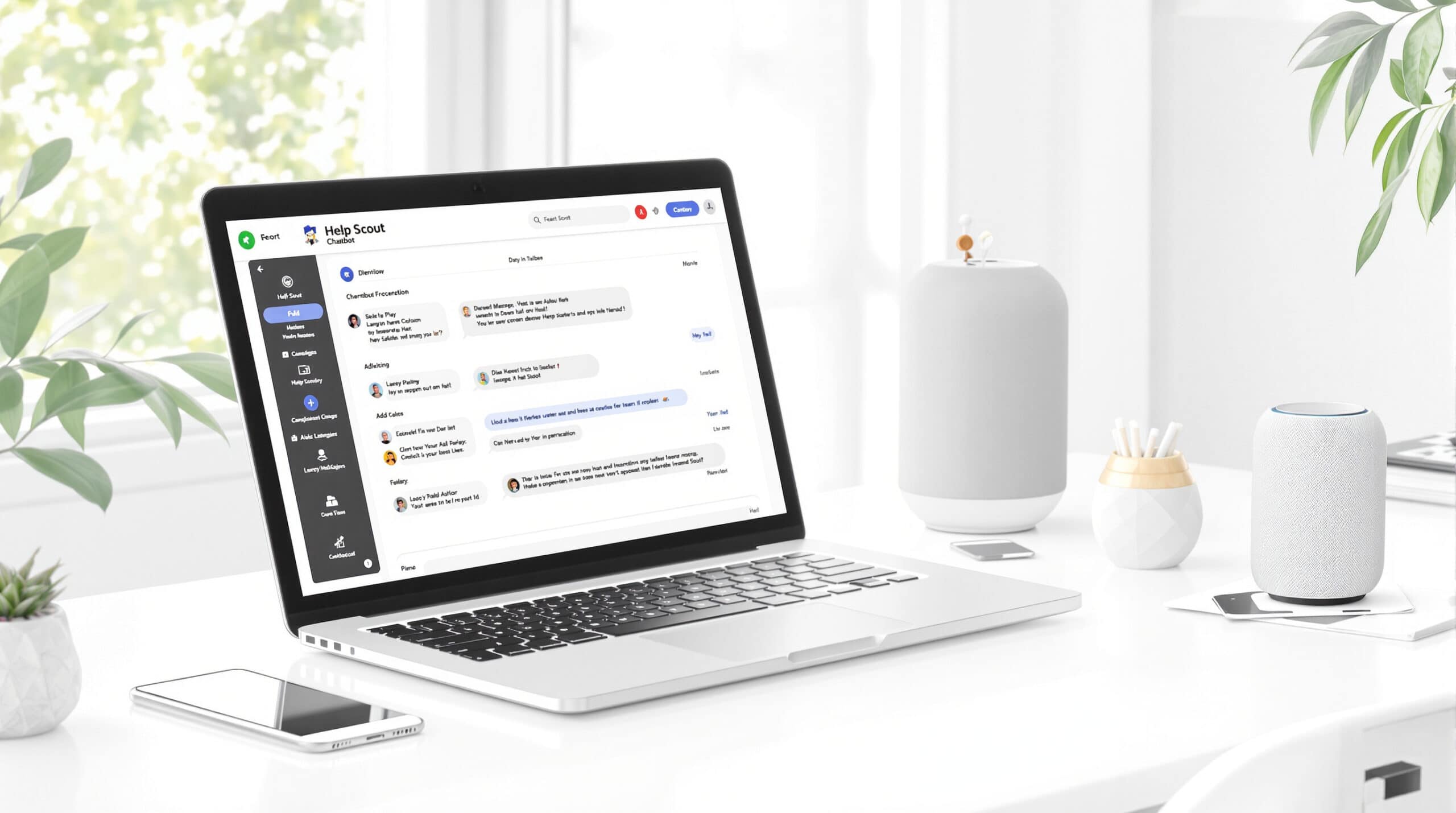
Help Scout takes a distinct approach to customer support, focusing on an email-like interface that feels natural and personal.
Key Features
- Shared inbox with collaborative tools
- Beacon chat and self-service widget
- Docs knowledge base platform
- Workflows for automation and routing
- Shopify integration for order context
- Reporting on team performance and customer satisfaction
Pricing
Help Scout’s pricing is straightforward:
- Standard: $20/user/month
- Plus: $40/user/month
- Pro: $65/user/month
- Company: Custom pricing for large teams
Real User Experiences
Help Scout users frequently highlight the platform’s ease of use:
“Help Scout feels like using email, but with all the power of a helpdesk. Our agents were productive from day one.” – Sam T., Support Lead
“The Docs platform is exceptional. We’ve created a comprehensive knowledge base that’s reduced our ticket volume by about 25%.” – Jamie R., Knowledge Manager
Our Subjective Assessment
During testing, Help Scout’s focus on simplicity and human connection was evident. The interface feels like a natural evolution of email rather than a complex helpdesk system, which reduces the learning curve significantly.
The Beacon widget is particularly effective, offering customers a way to search knowledge base articles before submitting a ticket. This helps deflect simple questions while making it easy to contact support when needed.
For ecommerce integration, Help Scout works well with Shopify but lacks the depth of marketplace integration found in specialized platforms. The platform is best suited for businesses that prioritize email support and want a personal touch in their customer communications.
Pros and Cons
Pros:
- Intuitive, email-like interface with minimal learning curve
- Excellent knowledge base platform with Docs
- Beacon widget effectively balances self-service and support
- Clean, distraction-free agent experience
- Strong focus on personal, human communication
Cons:
- Limited marketplace integration capabilities
- Less sophisticated routing than enterprise alternatives
- Automation not as powerful as some competitors
- Can struggle with high-volume support operations
- Limited native integrations compared to larger platforms
LiveAgent: All-in-One Helpdesk and Call Center


LiveAgent offers a comprehensive support solution that includes robust call center capabilities at competitive prices.
Key Features
- Rich channel mix including email, chat, social, and voice
- Built-in call center with IVR, call recording, and voicemail
- On-premise option for businesses with specific security requirements
- Video call support directly from tickets
- Automation rules and SLA management
- Knowledge base and forum capabilities
Pricing
LiveAgent offers tiered pricing with a free entry option:
- Free: Limited features for small teams
- Ticket: $15/agent/month (email support focus)
- Ticket+Chat: $29/agent/month (adds live chat)
- All-Inclusive: $49/agent/month (adds call center features)
Real User Experiences
LiveAgent users particularly value the platform’s comprehensive channel support:
“Having email, chat, and phone all in one platform has streamlined our operations significantly. Agents can handle any channel without switching systems.” – Reese K., Contact Center Manager
“The built-in call center features saved us from purchasing a separate solution. The value is exceptional.” – Morgan T., Support Director
Our Subjective Assessment
Testing LiveAgent reveals a platform with impressive breadth at competitive prices. The inclusion of full call center functionality in the All-Inclusive plan provides exceptional value for businesses that handle voice support.
The interface feels somewhat dated compared to newer platforms, but it’s functional and comprehensive. During testing, we found the learning curve moderate—not as intuitive as Help Scout but more accessible than Zendesk.
For ecommerce integration, LiveAgent offers basic connections but lacks the deep marketplace integration of specialized platforms. The platform excels for businesses that need to support multiple communication channels, particularly those with significant phone support requirements.
Pros and Cons
Pros:
- Comprehensive channel support including robust call center
- Excellent value, especially for voice support
- On-premise option for security-conscious organizations
- Good automation capabilities
- Competitive pricing at all tiers
Cons:
- Interface feels dated compared to modern alternatives
- Marketplace integration requires third-party connectors
- Mobile experience not as strong as desktop
- Setup can be complex for full multichannel deployment
- Reporting less sophisticated than enterprise alternatives
How Do These Alternatives Handle Amazon/eBay Marketplace Support?

When evaluating eDesk alternatives, marketplace integration is often a critical concern. Here’s how each platform handles Amazon, eBay, and other marketplace messages:
Talkees
- Native integrations with Amazon, eBay, Walmart
- Order context displayed directly in conversations
- SLA timers that match marketplace requirements
- Compliant messaging that follows marketplace rules
Gorgias
- Amazon/eBay support via ChannelReply or native connectors
- Evolving marketplace support (check current status)
- Stronger in Shopify than marketplaces
Zendesk
- Requires third-party connectors like ChannelReply
- Good functionality once connected but adds cost
- Enterprise-grade routing and SLA management
Freshdesk
- Marketplace apps rather than native connectors
- Functional but not specialized for marketplace sellers
- Additional costs for connectors
Re:amaze
- Third-party connectors for Amazon/eBay
- Basic marketplace support
Zoho Desk
- Limited native marketplace support
- Requires connectors for Amazon/eBay
Help Scout
- Limited marketplace depth
- Email forwarding for basic functionality
LiveAgent
- Third-party connectors required
- Email forwarding option for basic functionality
Migration Playbook: Moving from eDesk to an Alternative

Transitioning from eDesk to a new helpdesk solution requires careful planning, but it’s very doable with the right approach. Here’s a practical migration playbook:
Week 0: Preparation and Audit
- Inventory all channels (email, chat, social, marketplaces)
- Document templates, macros, SLAs, tags, and automations
- Decide what historical data to migrate (6-12 months is typically sufficient)
- Establish baseline metrics for comparison
Week 1: Connect Channels and Import History
- Set up primary channels first (Shopify/WooCommerce, email)
- Authorize marketplace accounts (Amazon, eBay, Walmart)
- Import customers and ticket history via CSV or API
- Validate sample conversations and attachments
Week 2: Recreate Workflows and Train Agents
- Build tags, queues, SLAs, and macros
- Map order fields into reply templates
- Configure AI features in suggestion-only mode initially
- Conduct agent training (2-3 hours typically covers basics)
Week 3: Dual-Run and Cutover
- Run eDesk and the new platform in parallel for 7-10 days
- Forward new messages to the new inbox
- Monitor SLA compliance and marketplace message posting
- Complete cutover when agents meet baseline KPIs
Compliance Considerations
- Ensure marketplace messages stay on approved channels
- Maintain audit trails for all customer communications
- Use policy-compliant templates for sensitive responses
- Document internal notes for high-value cases
Which eDesk Alternative Is Right for Your Business?

Based on our comprehensive evaluation, here are our recommendations for different business types:
For Small to Medium Businesses (SMBs)
- Talkees: Best overall balance of features, usability, and price
- Freshdesk: Excellent value with a useful free tier
- Re:amaze: Simple setup with good proactive chat capabilities
- Help Scout: Ideal for email-focused support with a personal touch
For Multi-Marketplace Sellers
- Talkees: Strong native marketplace integration
- LiveAgent: Good if voice support is also important
- Zendesk with ChannelReply: Enterprise-grade solution for complex needs
For Shopify-First Businesses
- Gorgias: Deepest Shopify integration with revenue attribution
- Talkees: Strong Shopify support plus broader channel capabilities
- Re:amaze: Good Shopify integration with proactive chat campaigns
For Enterprise Organizations
- Zendesk: Most customizable with extensive app ecosystem
- Kustomer: Excellent for complex customer journeys
- Zoho Desk: Value choice for enterprises already using Zoho products
Conclusion: Making the Right Choice

When selecting an eDesk alternative, consider your specific needs:
- Channel mix: Which platforms do your customers use to contact you?
- Volume and scalability: How many tickets do you handle monthly, and how fast are you growing?
- Integration requirements: Which sales channels and back-office systems need to connect?
- Budget constraints: What’s your per-agent monthly budget?
- Team capabilities: How much technical expertise do you have for setup and maintenance?
The good news is that the helpdesk market offers excellent options for every business type and budget. Whether you prioritize marketplace integration, AI capabilities, or value pricing, there’s a solution that fits your needs.
For most businesses moving from eDesk, Talkees offers the most balanced combination of modern features, intuitive interface, and reasonable pricing. Its built-in AI chatbot, order-aware conversations, and flexible pricing make it an excellent choice for businesses of all sizes.
Ready to explore further? Start a free trial with your top two candidates, import a sample of your historical data, and evaluate how each platform handles your specific support scenarios. This hands-on approach will give you confidence in your final decision.