 English
 Slovenčina
 Français
 Magyar

Why Teams Are Looking for Sleekflow Alternatives: Understanding the Limitations

When evaluating why businesses seek Sleekflow alternatives, several common pain points emerge. Understanding these limitations will help you identify which alternative best addresses your specific needs.
Pricing Ceilings and Unexpected Costs
Many teams outgrow Sleekflow’s pricing structure as they scale. The platform operates on a contact-based pricing model with reported tiers (Free: 100 contacts; Pro: $199/month for 5,000 contacts; Premium: $349/month for 40,000 contacts). However, this doesn’t include WhatsApp API fees, which reportedly come with an additional markup of approximately 20.5% over Meta’s official rates in some regions.
For high-volume campaigns, this markup can significantly impact your budget. For example, sending 100,000 marketing messages in India could cost approximately ₹16,000 more in markup alone compared to providers offering direct Meta billing with no markup.
Channel Caps and Broadcast Limitations
Sleekflow’s Pro plan reportedly caps broadcasts at 5,000 messages per month. For businesses with larger contact lists or more frequent campaign needs, this presents a major limitation. Imagine needing to reach 50,000 contacts for a time-sensitive promotion—you’d need to segment your campaign into 10 separate broadcasts or upgrade to a higher tier.
WhatsApp API Constraints
While Sleekflow is an official WhatsApp Business Solution Provider (BSP), some users report constraints in how WhatsApp Business API is implemented:
- The reported markup on WhatsApp message rates (approximately 20.5% in some regions)
- Limited flexibility in managing multiple WhatsApp Business Accounts (WABA)
- Restrictions on template approvals and broadcast scheduling
AI and Automation Gaps
Sleekflow’s AgentFlow is built on Azure OpenAI, which provides solid AI capabilities but lacks the flexibility of multi-LLM options. Teams working on sophisticated AI projects often need the ability to choose different models for different tasks or to integrate their own custom AI solutions.
Scaling Limitations for Growing Teams
As businesses grow, they may find themselves hitting various ceiling points with Sleekflow:
- Contact limits requiring plan upgrades
- Seat-based pricing that becomes costly for larger teams
- Limited automation flows or triggers that constrain campaign complexity
- Integration limitations with certain CRM or e-commerce platforms
What a Better Sleekflow Alternative Should Include: Key Features to Look For

Based on the limitations above, here’s what you should prioritize when selecting a Sleekflow alternative:
AI-First Omnichannel Inbox
Look for a platform that unifies all customer conversations across WhatsApp, Instagram, Facebook Messenger, web chat, and other channels in a single inbox. The platform should use AI to enrich these conversations with context, suggested replies, and automated routing.
Open APIs and Flexible Integration Options
Your chosen platform should offer robust API access, webhooks, and pre-built integrations with popular e-commerce platforms (Shopify, WooCommerce), CRMs (HubSpot, Salesforce), and payment processors. This ensures seamless data flow between systems and enables custom workflow automation.
Shopify, HubSpot, and Salesforce Native Integrations
Rather than relying on third-party connectors like Zapier, seek platforms with native integrations to these critical business systems. Native integrations typically provide deeper functionality, better reliability, and more seamless data synchronization.
Strong Security and Compliance Standards
Enterprise-grade security is non-negotiable. Look for alternatives with GDPR compliance, SOC 2 Type II certification, ISO 27001 certification, and features like role-based access control (RBAC), IP allowlisting, and data masking.
Fair, Usage-Based Pricing
The ideal pricing model should be transparent, with no hidden markups on WhatsApp API rates. Some alternatives offer direct Meta billing (0% markup) or clearly disclose any markup percentages. Look for platforms that provide flexible scaling options without forcing you into higher tiers prematurely.
How Sleekflow Compares to Competitors: Evaluation Criteria

When comparing Sleekflow with alternatives, we’ve focused on these key factors:
WhatsApp API Implementation and Pricing
We’ve examined how each platform handles WhatsApp Business API, including:
- Whether they add markups to official Meta rates
- How they manage template approvals and the 24-hour messaging window
- Support for multiple WhatsApp Business Accounts
- Broadcast capabilities and limitations
AI Capabilities and Automation Depth
We’ve evaluated each platform’s AI functionality:
- Rule-based automation vs. AI-powered agents
- Flexibility in LLM selection and customization
- Quality of human handoff when AI reaches its limits
- Ability to train on company-specific knowledge
Integration Capabilities and Commerce Features
We’ve assessed how well each platform connects to your business ecosystem:
- Native integrations vs. reliance on middleware
- In-chat payment options and product catalog features
- Revenue attribution and analytics depth
- Mobile app availability for on-the-go management
Pricing Transparency and Value
We’ve analyzed pricing structures to identify:
- Hidden fees and markups
- Broadcast and contact limitations
- Onboarding costs and implementation requirements
- Scalability for growing businesses
Pricing Models Across Sleekflow Alternatives: What to Expect

Before diving into specific alternatives, it’s important to understand the common pricing models you’ll encounter:
Per-Seat vs. Per-Conversation Models
Some platforms charge per agent seat (Zendesk: ~$55/user/month; Intercom: ~$39/user/month), while others use conversation-based or contact-based pricing (Sleekflow, Respond.io). Per-seat models work well for support-focused teams, while conversation-based pricing often benefits marketing-heavy use cases.
WhatsApp Template Costs and Vendor Markups
WhatsApp Business API charges vary by country and message type (Marketing, Utility, Authentication). Some vendors add markups to these rates:
- Sleekflow: Reportedly ~20.5% markup in some regions
- Zixflow: Reported markups of 12% (Marketing), 26% (Utility), and ~30% (Authentication) in India
- WANotifier and some others: Claim 0% markup with direct Meta billing
Free Tiers and Entry-Level Options
Many alternatives offer free plans with limitations:
- WANotifier: Free plan with 500 contacts and 1,000 broadcasts
- Tawk.to: Completely free live chat
- ProProfs Chat: Free for a single operator
Hidden Costs to Watch For
Be aware of these potential additional expenses:
- Onboarding fees (e.g., Respond.io reportedly charges $500 one-time)
- Integration add-ons (e.g., Shopify connector fees)
- Extra seat pricing beyond included allowances
- Broadcast overage charges
Talkees: The Premier Sleekflow Alternative

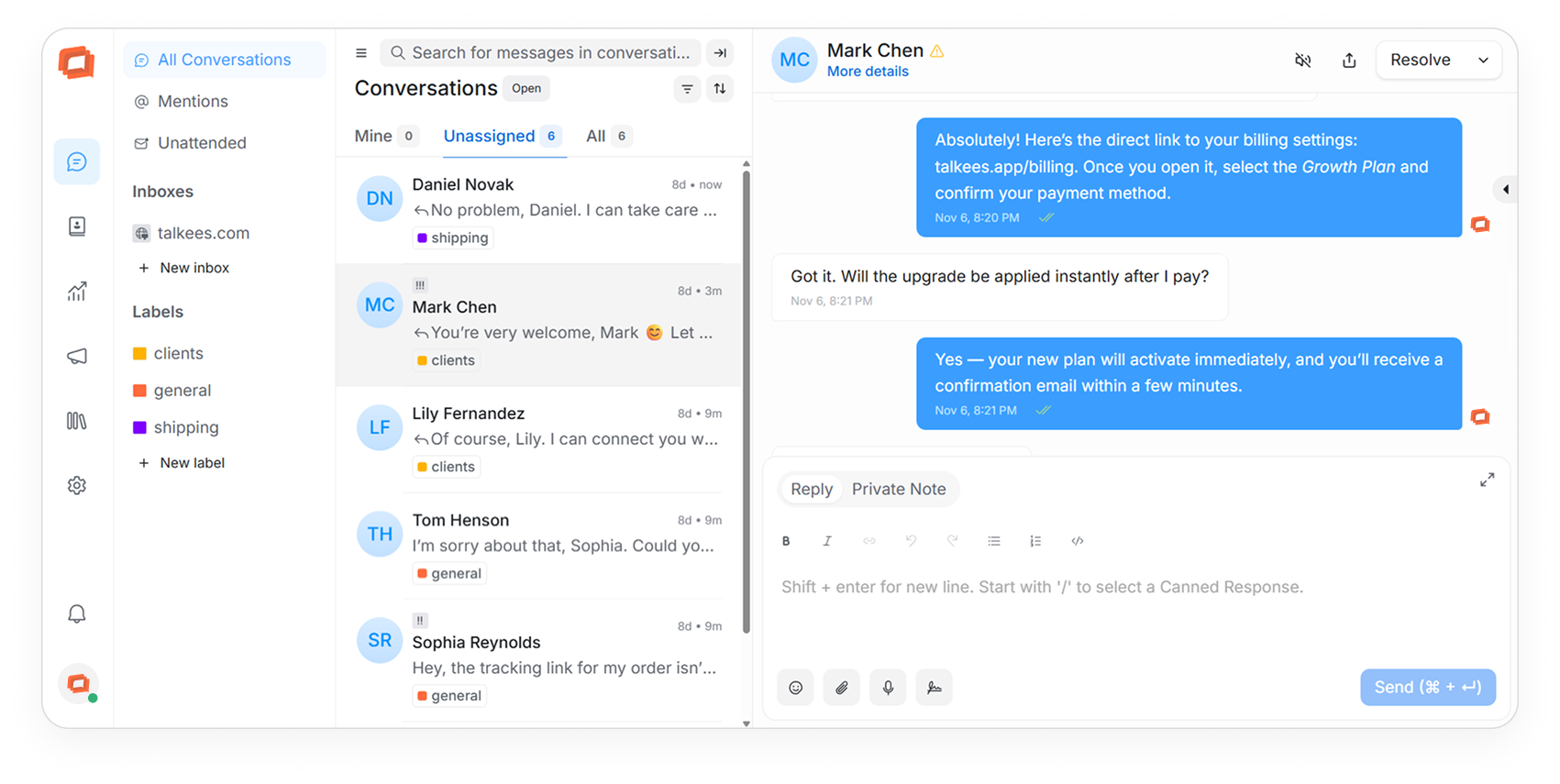
Talkees stands out as the most comprehensive Sleekflow alternative, offering an AI-native approach to customer messaging that balances powerful automation with transparent pricing.
Features and Capabilities
Talkees provides a unified inbox for WhatsApp, Instagram, Facebook Messenger, and other channels, powered by advanced AI that understands context across conversations. Its automation capabilities include:
- AI-Native Omnichannel Platform: Unlike Sleekflow’s AgentFlow which relies solely on Azure OpenAI, Talkees offers flexible custom AI integration with multiple LLM options, allowing you to choose the best AI model for different tasks.
- Powerful Workflow Automation: Create sophisticated customer journeys with a visual flow builder that supports complex branching, conditions, and triggers without the broadcast limitations found in Sleekflow.
- Seamless Commerce Integration: Connect your product catalog, generate payment links in-chat, and track conversions with robust attribution—all with native integrations to platforms like Shopify, WooCommerce, and major payment processors.
- Comprehensive Analytics: Track the entire customer journey from first contact to purchase with detailed conversion metrics and a 90-day attribution window.
Pricing and Value
Talkees offers transparent pricing with no hidden markups on WhatsApp API rates. Their tiered structure includes:
- Free Plan: Perfect for small businesses getting started with messaging automation
- Standard Plan: $149/month for growing teams with moderate messaging volume
- Professional Plan: $249/month for businesses with advanced automation needs
- Enterprise: Custom pricing for large-scale deployments
All plans include the core AI capabilities, with scaling based on contacts and messaging volume. Unlike Sleekflow, Talkees doesn’t impose strict broadcast caps that limit campaign reach.
Real User Experiences
Customers consistently praise Talkees for its intuitive interface and powerful automation capabilities. The platform receives high marks for reliability, with 99.9% uptime and responsive customer support.
“After switching from Sleekflow, we’ve seen a 35% increase in conversion rates from our WhatsApp campaigns. The ability to customize AI models for different customer scenarios has been game-changing for our team.” – Marketing Director at an e-commerce company
Pros and Cons
Pros:
- Flexible AI integration with multiple LLM options
- No markup on WhatsApp API fees (direct Meta billing)
- Unlimited automation flows without arbitrary caps
- Native integrations with major e-commerce and CRM platforms
- Intuitive interface with minimal learning curve
Cons:
- Newer to the market compared to some established competitors
- Advanced features on higher-tier plans may require additional training
Our Assessment
Talkees delivers exceptional value for businesses looking to maximize their conversational commerce potential. During our testing, we found its AI capabilities to be more flexible than Sleekflow’s, while its pricing structure eliminates the markup concerns that plague many WhatsApp BSPs. The platform’s open approach to integration and commitment to transparent pricing make it our top recommendation for businesses seeking a Sleekflow alternative.
Respond.io: Strong WhatsApp Business API Solution

Respond.io is a robust omnichannel messaging platform that excels in workflow automation and team routing capabilities.
Features and Capabilities
- Channel Support: Extensive channel coverage including WhatsApp, Instagram, Facebook, Telegram, Viber, TikTok, email, and VoIP calls.
- AI Agents: Can send payment links, update contacts, and create conversation summaries.
- Workflow Automation: Strong workflow engine with routing capabilities and team management.
- Uptime Claim: 99.999% uptime, making it reliable for mission-critical communications.
Pricing and Value
Respond.io uses a tiered pricing model:
- Starter: $99/month (unlimited contacts but no WhatsApp broadcasts)
- Growth: $199/month (includes 1,000 contacts and broadcast capabilities)
- Advanced: $349/month (1,000 contacts with additional features)
Note that there’s a reported one-time $500 onboarding fee for some accounts, though this may vary.
Real User Experiences
Respond.io has strong customer success stories:
- Lamarsa Coffee reportedly boosted sales across 6 countries by 50%
- Praga Medica recovered 70% more global leads
- Automax achieved 42.5x ROI with AI-powered WhatsApp broadcasts
Pros and Cons
Pros:
- Extensive channel support beyond just WhatsApp
- No reported markup on WhatsApp message rates
- Strong workflow automation capabilities
- Excellent uptime record for reliability
Cons:
- Broadcasts restricted to higher-tier plans
- Potential onboarding fee adds to initial cost
- Initial setup and customization can be time-consuming
- Less focus on commerce features compared to Talkees
Our Assessment
When testing Respond.io, we were impressed by its channel breadth and workflow stability. The platform performs exceptionally well for support teams that need reliable message routing and team management. However, the restriction of broadcasts to higher tiers and the potential onboarding fee are considerations for budget-conscious teams. While it lacks some of the commerce-focused features found in Talkees, it’s an excellent choice for support-heavy operations with multiple communication channels.
MessageBird: Enterprise-Grade Messaging Platform

MessageBird (now Bird) offers a CPaaS-grade messaging solution with powerful APIs and global channel support.
Features and Capabilities
- Developer-First Approach: Robust SDKs and APIs for custom implementation
- Global Channel Support: Extensive coverage of messaging channels worldwide
- Flexible Infrastructure: Enterprise-grade reliability and scalability
- Customization Options: Deep technical capabilities for tailored solutions
Pricing and Value
MessageBird typically operates on a pay-as-you-go model, though pricing details often require contacting sales directly. This lack of transparency makes budget planning challenging for smaller businesses.
Real User Experiences
Enterprise customers appreciate MessageBird’s reliability and technical depth, though smaller teams often report a steeper learning curve compared to more user-friendly alternatives.
Pros and Cons
Pros:
- Powerful APIs and SDKs for custom development
- Global reach with extensive channel support
- Enterprise-grade infrastructure and reliability
- Flexible implementation options
Cons:
- Limited mobile app functionality
- Less transparent pricing (requires sales contact)
- Higher complexity for smaller teams
- Some AI features reported as “coming soon” rather than available
Our Assessment
During our evaluation, we found MessageBird to be best suited for enterprise teams with developer resources and complex messaging needs. Its technical capabilities are impressive, but the platform presents a higher barrier to entry for small to mid-sized businesses without technical teams. The opacity around pricing and the reported lack of a robust mobile app further position this as an enterprise-focused solution rather than an accessible alternative for most Sleekflow users.
Trengo: Collaborative Inbox for Team Communication

Trengo focuses on providing a collaborative inbox for WhatsApp, email, and social channels with practical automation features designed for SMEs.
Features and Capabilities
- Centralized Communication: Unified inbox for WhatsApp, email, social media, and more
- Team Collaboration Tools: Internal notes, assignments, and shared inbox features
- CSAT Measurement: Built-in customer satisfaction tracking
- Basic Automation: Flow capabilities for routine communications
Pricing and Value
Trengo’s pricing starts around $49/month per user, with tiered plans based on features and channels. Flow bots may require additional payment as add-ons on some plans.
Real User Experiences
SME users highlight Trengo’s ease of use and collaborative features, though some note limitations in advanced automation compared to AI-focused alternatives.
Pros and Cons
Pros:
- Strong collaborative features for team communication
- Good CSAT measurement tools
- Straightforward interface with minimal training required
- Solid performance for customer service teams
Cons:
- Broadcasting limited to WhatsApp & SMS on some tiers
- Flow bots sold as add-ons on certain plans
- Limited sales enablement features (lacking in-chat payments and product catalogs)
- Support based in Europe may cause timezone delays for some regions
Our Assessment
In our testing, Trengo proved to be a solid choice for European SMEs focused on customer service rather than sales automation. The platform’s strength lies in its collaborative features and ease of use, making it ideal for support teams. However, businesses seeking advanced sales automation, in-chat payments, or sophisticated AI capabilities would be better served by Talkees or other alternatives with stronger commerce features.
Callbell: Lightweight WhatsApp and Instagram Team Inbox

Callbell offers a streamlined solution focused on WhatsApp and Instagram messaging with quick setup and basic analytics.
Features and Capabilities
- Simplified Interface: Easy-to-use shared inbox for WhatsApp and Instagram
- Team Assignment: Basic routing and assignment capabilities
- Quick Setup: Minimal configuration required to get started
- Essential Analytics: Basic performance metrics and reporting
Pricing and Value
Callbell offers straightforward pricing with plans starting at approximately $39/month for small teams, scaling based on user count and features.
Real User Experiences
Small business users appreciate Callbell’s simplicity and focus on the most popular messaging channels, though some note limitations when their needs grow more complex.
Pros and Cons
Pros:
- Fast and simple setup process
- Focused functionality without overwhelming options
- Affordable entry point for small businesses
- Good performance for basic WhatsApp and Instagram management
Cons:
- Limited advanced automation capabilities
- Basic analytics compared to data-rich alternatives
- Fewer integration options than full-featured platforms
- May not scale well for complex enterprise needs
Our Assessment
During our evaluation, Callbell stood out as an excellent entry-level solution for small businesses primarily using WhatsApp and Instagram. The platform excels at simplicity, making it perfect for teams that need basic messaging functionality without complex automation or analytics. However, growing businesses with increasing automation needs or those requiring advanced commerce features would likely outgrow Callbell’s capabilities relatively quickly.
Tidio: E-commerce Live Chat and Chatbot Specialist

Tidio focuses on providing affordable, easy-to-implement live chat and chatbot solutions primarily for e-commerce websites.
Features and Capabilities
- Website Chat Focus: Excellent website live chat implementation
- E-commerce Integration: Solid Shopify and other e-commerce platform connections
- AI Chatbots: Pre-built chatbot templates for common e-commerce scenarios
- Visitor Tracking: Real-time visitor monitoring and engagement tools
Pricing and Value
Tidio’s pricing starts at around $29/month, with tiered plans based on features and chat volume. The platform is known for its affordable entry point compared to enterprise solutions.
Real User Experiences
E-commerce store owners frequently praise Tidio’s ease of implementation and impact on conversion rates, though some note limitations in its native WhatsApp capabilities.
Pros and Cons
Pros:
- Quick implementation on e-commerce sites
- Affordable pricing structure
- Intuitive interface requiring minimal training
- Effective pre-built chatbot templates
Cons:
- Limited native WhatsApp functionality compared to dedicated BSPs
- Less robust for omnichannel strategies beyond website chat
- Basic analytics compared to enterprise alternatives
- Limited customization for complex automation scenarios
Our Assessment
When testing Tidio, we found it excels as a website chat solution for e-commerce businesses. Its strength lies in its simplicity and direct impact on website conversion rates. The chatbot templates are practical and effective for common customer queries. However, businesses seeking a comprehensive WhatsApp-first strategy or needing advanced omnichannel capabilities would find Tidio’s WhatsApp features somewhat limited compared to dedicated alternatives like Talkees or Respond.io.
Intercom: Enterprise Messenger with Comprehensive Features

Intercom offers a premium messaging solution with robust help center capabilities and sophisticated chatbots, though at a higher price point with channel add-ons.
Features and Capabilities
- Comprehensive Platform: Website messenger, help center, and chatbot capabilities
- Fin AI: AI-powered solution for knowledge retrieval and support automation
- Extensive Integrations: Connects with numerous enterprise tools and platforms
- Customer Data Platform: Rich customer data collection and segmentation
Pricing and Value
Intercom’s pricing starts around $39/user/month, but costs can increase significantly with add-ons and additional channels. Their AI solution Fin is reportedly priced at approximately $0.99 per resolution, adding variable costs based on volume.
Real User Experiences
Enterprise customers value Intercom’s comprehensive feature set and data capabilities, though smaller businesses often report concerns about the total cost of ownership, especially when adding multiple channels and features.
Pros and Cons
Pros:
- Comprehensive customer engagement platform
- Strong knowledge base and help center capabilities
- Sophisticated segmentation and targeting
- Excellent for in-app messaging and website support
Cons:
- Premium pricing with potentially expensive add-ons
- WhatsApp and other channels often require additional costs
- Can be complex to implement fully
- Less focused on WhatsApp-first strategies than dedicated alternatives
Our Assessment
In our evaluation, Intercom impressed with its comprehensive capabilities, particularly for SaaS and enterprise businesses with significant website and in-app support needs. The platform’s strength in knowledge management and customer data makes it powerful for complex support scenarios. However, the premium pricing and additional costs for channels like WhatsApp make it less suitable for businesses primarily seeking WhatsApp-focused communication. For those cases, more specialized alternatives like Talkees offer better value and focus.
Sendbird: In-App Chat SDKs and Developer Tools

Sendbird specializes in providing in-app chat SDKs, voice/video capabilities, and APIs primarily for product teams looking to embed communication features in their own applications.
Features and Capabilities
- Developer-Focused: SDKs for iOS, Android, and web applications
- Voice and Video: Communication capabilities beyond text chat
- Customizable UI: Extensive customization options for branded experiences
- Scalable Infrastructure: Enterprise-grade reliability for high-volume applications
Pricing and Value
Sendbird typically offers usage-based pricing that scales with message volume and user count. Starter plans begin around $399/month, making this a premium solution for dedicated development teams.
Real User Experiences
Product teams appreciate Sendbird’s reliability and customization options, though some note the significant development resources required for implementation compared to turnkey solutions.
Pros and Cons
Pros:
- Highly customizable for branded experiences
- Robust SDKs for multiple platforms
- Voice and video capabilities
- Reliable infrastructure for mission-critical applications
Cons:
- Requires development resources to implement
- Higher cost entry point than turnkey solutions
- Less focused on WhatsApp as a primary channel
- Build vs. buy tradeoff may not be worthwhile for all businesses
Our Assessment
During our testing, we found Sendbird to be best suited for businesses that need to embed communication directly within their own applications and have the development resources to implement custom solutions. The platform excels in providing the building blocks for communication rather than a turnkey messaging solution. For most businesses seeking a Sleekflow alternative for WhatsApp and omnichannel messaging, more accessible solutions like Talkees would provide faster time-to-value without the development overhead.
Textedly: SMS-First Campaigns and Alerts

Textedly focuses primarily on SMS marketing campaigns and alerts, offering high deliverability but limited omnichannel features.
Features and Capabilities
- SMS Campaign Focus: Specialized in text message marketing
- High Deliverability: Reliable message delivery infrastructure
- Scheduling Tools: Campaign planning and timing features
- Basic Analytics: Message delivery and response tracking
Pricing and Value
Textedly’s plans typically start around $29/month for basic SMS capabilities, with pricing scaling based on message volume and feature requirements.
Real User Experiences
Businesses focused on SMS marketing appreciate Textedly’s straightforward approach and reliability for text campaigns, though those seeking broader channel support note its limitations.
Pros and Cons
Pros:
- Strong SMS campaign management
- Good deliverability rates for text messages
- Straightforward interface for text marketing
- Reliable scheduling and timing features
Cons:
- Limited WhatsApp integration compared to dedicated BSPs
- Minimal omnichannel capabilities
- Basic analytics compared to more comprehensive platforms
- Less suitable for two-way conversational commerce
Our Assessment
In our evaluation, Textedly proved to be a solid choice for businesses with SMS-first marketing strategies who need reliable text message delivery. The platform is straightforward and effective for its intended purpose. However, businesses seeking comprehensive WhatsApp capabilities or true omnichannel messaging would find Textedly’s features too limited. For those use cases, alternatives like Talkees or Respond.io would provide much broader channel support and more sophisticated conversation management.
Tyntec Chat Inbox: WhatsApp API Provider with Compliance Focus

Tyntec offers a WhatsApp API provider service with a no-frills agent inbox, focusing on compliance, throughput, and reliability rather than advanced features.
Features and Capabilities
- WhatsApp API Specialization: Focused on reliable WhatsApp Business API provision
- Compliance Emphasis: Strong focus on regulatory compliance
- High Throughput: Reliable message delivery at scale
- Basic Agent Interface: Functional but minimalist conversation management
Pricing and Value
Tyntec typically operates on usage-based pricing models that scale with message volume. Detailed pricing often requires contacting sales directly.
Real User Experiences
Enterprise users value Tyntec’s reliability and compliance focus, though some note the limited feature set compared to more comprehensive messaging platforms.
Pros and Cons
Pros:
- Reliable WhatsApp API provision
- Strong focus on compliance and security
- Good message throughput capabilities
- Solid choice for regulated industries
Cons:
- Limited feature set beyond basic messaging
- Minimal automation capabilities compared to alternatives
- Basic agent interface lacking advanced tools
- Less suitable for sophisticated marketing campaigns
Our Assessment
During testing, we found Tyntec to be best suited for businesses in regulated industries that prioritize compliance and reliability over advanced features. The platform delivers solid WhatsApp API performance with an emphasis on security and throughput. However, businesses seeking sophisticated automation, AI capabilities, or comprehensive omnichannel features would find Tyntec too limited for their needs. For those use cases, more feature-rich alternatives like Talkees would provide significantly more business value.
Migration Checklist: Moving from Sleekflow to an Alternative

When transitioning from Sleekflow to a new platform, follow these steps to ensure a smooth migration:
Porting WhatsApp Numbers and Templates
- Verify Number Portability: Confirm that your chosen alternative supports WhatsApp number migration.
- Template Migration: Export all approved WhatsApp templates and prepare them for import.
- Compliance Check: Ensure templates meet current WhatsApp guidelines before migration.
- Staggered Transition: Consider running both platforms in parallel initially to prevent service disruption.
Mapping Workflows and Automation
- Workflow Inventory: Document all existing Sleekflow automations, triggers, and conditions.
- Feature Mapping: Identify equivalent features in your new platform and note any gaps.
- Test Environment: Build key workflows in a test environment before full migration.
- Performance Benchmarking: Establish baseline metrics to compare performance post-migration.
API and Webhook Swaps
- API Documentation: Review the new platform’s API documentation thoroughly.
- Endpoint Updates: Systematically update all webhook endpoints in your existing systems.
- Authentication Changes: Implement new authentication methods required by the alternative platform.
- Testing Protocol: Develop a comprehensive testing plan for all integration points.
Data Import Steps
- Contact Export: Export all contacts with relevant tags and attributes from Sleekflow.
- Conversation History: Determine if historical conversations need migration and what format is required.
- Custom Field Mapping: Create a mapping document for custom fields between platforms.
- Validation Process: Implement validation checks to ensure data integrity post-import.
Conclusion: Making the Right Choice for Your Business

After thoroughly evaluating the top Sleekflow alternatives, Talkees emerges as our recommended choice for most businesses. Its combination of AI-native design, flexible integration options, transparent pricing, and comprehensive feature set addresses the key limitations that drive teams to seek Sleekflow alternatives.
When making your final decision, prioritize these four factors:
- Channel Support and Integration Depth: Ensure the platform supports all your required messaging channels and integrates seamlessly with your critical business systems.
- AI Capabilities and Flexibility: Look for solutions that offer both rule-based automation and sophisticated AI agents, with the flexibility to customize or choose different models for different tasks.
- Pricing Transparency and Scalability: Choose platforms with clear pricing structures, no hidden markups, and smooth scaling options as your business grows.
- Commerce Features and Revenue Attribution: If you’re using messaging for sales, prioritize platforms with strong in-chat payment capabilities, product catalogs, and robust revenue attribution.
For most businesses migrating from Sleekflow, Talkees provides the best balance of these factors, with its AI-native approach, transparent pricing, and comprehensive feature set. However, specific use cases might benefit from other alternatives:
- Support-heavy teams might prefer Respond.io’s routing capabilities
- Developer-focused organizations could benefit from MessageBird’s APIs
- Small businesses seeking simplicity might find Callbell or Tidio sufficient
By carefully assessing your specific needs against the capabilities of these alternatives, you’ll find the platform that not only replaces Sleekflow but enhances your overall customer communication strategy.