 English
 Slovenčina
 Français
 Magyar

Why Users Seek TeamSupport Alternatives in 2025
Many businesses are looking beyond TeamSupport due to several key limitations:
- Pricing lock-ins: TeamSupport’s subscription model can become costly as you scale, especially when you need to add modules like Messaging & Live Chat ($15/agent/month) or Insights analytics ($270/month).
- Limited AI capabilities: While TeamSupport offers some AI features, they often fall short of the comprehensive AI-powered solutions available from competitors.
- Omnichannel gaps: Teams requiring seamless integration across multiple communication channels may find TeamSupport’s offerings insufficient.
- E-commerce integration limitations: Businesses with online stores often struggle with TeamSupport’s limited native e-commerce integrations.
- User interface challenges: Some users report an outdated interface that impacts productivity and agent experience.
What a Strong TeamSupport Replacement Must Offer
When evaluating alternatives, look for platforms that provide:
- AI chatbots and automation: Advanced AI capabilities for ticket triage, automated responses, and conversation summaries.
- Unified inbox: A single interface that consolidates email, chat, social media, and other communication channels.
- Robust workflow automation: Customizable rules and triggers that streamline support processes.
- E-commerce and CRM integrations: Native connections to popular platforms like Shopify, Salesforce, and HubSpot.
- Transparent pricing: Clear cost structures without hidden fees or unexpected add-ons.
- Data control and portability: Easy export options and ownership of your support data.
How We Compared TeamSupport Competitors
To ensure a fair and comprehensive comparison, we evaluated each platform using the following methodology:
Evaluation Criteria and Weights
- General features & product fit (40%): Omnichannel coverage, automation capabilities, AI assistance, SLA engine, reporting, knowledge base functionality.
- Cost & TCO predictability (15%): Transparent pricing, clarity on add-ons, ease of estimating long-term costs.
- Customer support & SLAs (15%): Support hours, response targets, uptime guarantees, onboarding resources.
- Integrations & extensibility (15%): Native connectors to CRMs, e-commerce platforms, collaboration tools, API quality.
- Mobile & remote agent support (15%): Feature parity between desktop and mobile, notifications, offline capabilities.
We tested each platform through trials, analyzed real customer reviews, and normalized pricing across different models to provide accurate comparisons.
Talkees — AI-Native Omnichannel Support with No-Code Bot Builder
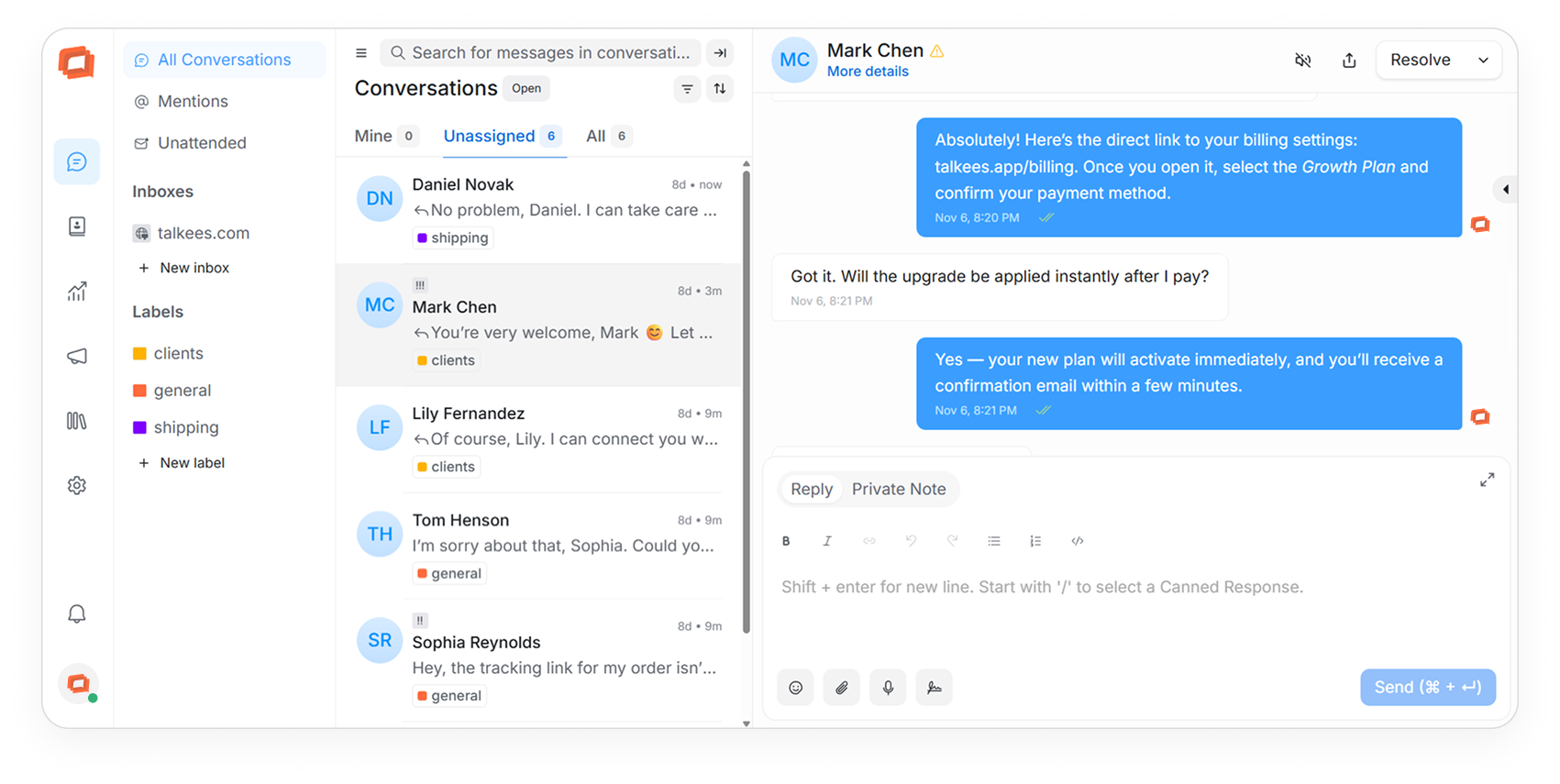
Talkees stands out as a modern, AI-first alternative to TeamSupport that balances powerful features with user-friendly design and transparent pricing.
Features Overview
- AI-native platform: Advanced chatbot builder with no-code interface and BYO-AI integrations
- Omnichannel inbox: Unified management of email, live chat, social media, and messaging apps
- Automation workflows: Customizable triggers and actions to streamline support processes
- Knowledge base integration: Smart content suggestions based on customer queries
- Detailed analytics: Comprehensive reporting on team performance and customer satisfaction
Pricing
- Free Plan: Limited features for small teams to test the platform
- Starter: $29/agent/month (billed annually) – Core features with basic automation
- Professional: $49/agent/month – Advanced automation and AI capabilities
- Enterprise: Custom pricing – Full feature set with dedicated support
All plans include the core unified inbox, while AI capabilities and advanced integrations scale with higher tiers. Unlike TeamSupport, Talkees doesn’t charge separately for live chat functionality.
User Experience and Reviews
Users consistently praise Talkees for its intuitive interface and quick setup process. The platform receives particularly high marks for its AI capabilities that actually work as advertised, unlike some competitors that overpromise and underdeliver.
From G2 and Capterra reviews, customers highlight the platform’s reliability, responsive support team, and continuous feature improvements based on user feedback.
Pros and Cons
Pros:
- Truly intuitive no-code bot builder that non-technical staff can master
- Flexible AI integration options (use your preferred AI model)
- Transparent, predictable pricing without hidden costs
- Excellent mobile experience with full feature parity
- Quick implementation compared to enterprise alternatives
Cons:
- Newer platform with a growing (but not yet extensive) marketplace
- Advanced enterprise features still in development
- May require customization for complex B2B use cases
Our Subjective Assessment
During our testing, Talkees impressed us with how quickly we could set up meaningful automations. The platform strikes an excellent balance between power and usability—something many competitors struggle with. The AI capabilities are genuinely helpful rather than just a marketing checkbox, with chatbots that can actually resolve common issues without frustrating customers.
What surprised us most was the quality of the mobile experience. Unlike TeamSupport’s limited mobile functionality, Talkees offers nearly identical capabilities on mobile devices, making it ideal for support teams that need flexibility.
For businesses looking to escape TeamSupport’s pricing structure while gaining better AI capabilities, Talkees represents one of the most compelling options on the market, especially for SMBs and mid-market companies.
Zendesk — Enterprise Suite Depth with Higher TCO and Implementation Complexity
Zendesk is a well-established player in the customer support space, offering comprehensive features but at a premium price point compared to TeamSupport.
Features Overview
- Comprehensive omnichannel support: Email, chat, voice, social media, and messaging
- Advanced workflow automation: Sophisticated rules and triggers
- Extensive marketplace: Thousands of integrations and add-ons
- Enterprise-grade reporting: Detailed analytics and custom dashboards
- AI capabilities: Answer Bot and AI-powered suggestions
Pricing
- Suite Team: $55/agent/month (billed annually)
- Suite Growth: $89/agent/month
- Suite Professional: $115/agent/month
- Enterprise: Custom pricing
Additional costs to consider:
- Advanced AI: $50/agent/month
- Talk/voice usage: Usage-based billing
- Professional services: Implementation typically costs $5,000-$15,000
- Marketplace apps: Many essential integrations cost extra
User Experience and Reviews
Zendesk users appreciate the platform’s reliability and depth of features. Enterprise customers particularly value the extensive customization options and robust reporting capabilities.
However, many reviews mention the steep learning curve and implementation complexity. Small and medium-sized businesses often report feeling overwhelmed by the number of options and settings.
Pros and Cons
Pros:
- Comprehensive feature set that scales to enterprise needs
- Excellent reliability and uptime
- Vast marketplace of integrations
- Sophisticated reporting and analytics
- Strong security and compliance features
Cons:
- Significantly higher TCO than TeamSupport when including add-ons
- Complex implementation requiring dedicated resources
- Steep learning curve for agents and administrators
- Mobile experience lags behind desktop functionality
- Essential features often require higher tiers or add-ons
Our Subjective Assessment
When testing Zendesk, we were impressed by the sheer depth of functionality but quickly realized why many organizations hire dedicated Zendesk administrators. The platform requires significant configuration to realize its full potential, and the costs add up quickly with necessary add-ons.
The implementation process is considerably more involved than with TeamSupport or more modern alternatives like Talkees. For large enterprises with complex support requirements, this investment may be justified, but smaller teams might find themselves paying for capabilities they’ll never use.
Zendesk’s AI features, while powerful, come at a premium that substantially increases the per-agent cost. For organizations seeking a TeamSupport alternative primarily due to cost concerns, Zendesk may not be the ideal solution unless enterprise-grade features are essential.
Freshchat — Conversational Support with Native Bots and Value Pricing
Freshchat, part of the Freshworks suite, offers a modern approach to customer support with a focus on conversational experiences and AI automation.
Features Overview
- Conversational messaging: Real-time chat across web, mobile, and social channels
- Freddy AI: Native AI bot with no-code builder
- Proactive messaging: Targeted outreach based on user behavior
- Team collaboration: Internal notes, assignments, and shared inbox
- Integration with Freshworks suite: Seamless connection with Freshdesk, Freshsales, etc.
Pricing
- Free: Basic features for up to 10 agents
- Growth: $19/agent/month (billed annually)
- Pro: $49/agent/month
- Enterprise: $79/agent/month
Additional considerations:
- Freddy AI capabilities require higher tiers
- WhatsApp integration available but with usage-based costs
- Volume-based pricing may benefit seasonal businesses
User Experience and Reviews
Freshchat receives positive reviews for its modern interface and ease of use. Users particularly appreciate the seamless integration with other Freshworks products, creating a cohesive experience.
Small and medium-sized businesses highlight the value for money, especially compared to enterprise solutions like Zendesk or the limitations of TeamSupport.
Pros and Cons
Pros:
- Modern, intuitive interface that requires minimal training
- Strong conversational capabilities across channels
- Freddy AI provides effective automation without separate billing
- Excellent value pricing compared to TeamSupport
- Good mobile experience for agents
Cons:
- Advanced routing capabilities limited compared to enterprise alternatives
- Reporting less robust than Zendesk or TeamSupport
- Some features limited to higher tiers
- Integration ecosystem smaller than Zendesk’s marketplace
Our Subjective Assessment
During our evaluation, Freshchat impressed us with its balance of functionality and simplicity. The platform feels modern and purpose-built for conversational support, unlike TeamSupport’s more traditional ticketing approach.
The Freddy AI capabilities are surprisingly effective and well-integrated, making bot creation accessible to non-technical team members. We found the implementation process straightforward, with most teams able to go live within days rather than weeks.
For organizations looking to move beyond TeamSupport’s limited conversational capabilities without the complexity of enterprise platforms, Freshchat offers an excellent middle ground with predictable pricing and a modern approach to customer interactions.
Zoho Desk — Affordable Automations and Contextual Help Desk
Zoho Desk provides a cost-effective alternative to TeamSupport with strong automation capabilities and deep integration with the broader Zoho ecosystem.
Features Overview
- Context-aware help desk: Customer information and interaction history in one place
- Zia AI assistant: Automated ticket triage and agent suggestions
- Multi-department management: Customizable workflows for different teams
- Self-service portal: Knowledge base and community forums
- Seamless Zoho integration: Native connection to Zoho CRM, Projects, Analytics, etc.
Pricing
- Free: Up to 3 agents with basic features
- Standard: $14/agent/month (billed annually)
- Professional: $23/agent/month
- Enterprise: $40/agent/month
Additional considerations:
- No separate charges for basic AI features (included in Professional+)
- Very affordable compared to TeamSupport and Zendesk
- Some advanced features require Enterprise tier
User Experience and Reviews
Zoho Desk users frequently mention the platform’s value proposition and ease of integration with other Zoho products. Small businesses particularly appreciate the free tier and affordable scaling options.
Reviews highlight the platform’s continuous improvement, with regular feature updates and enhancements based on customer feedback.
Pros and Cons
Pros:
- Exceptional value pricing with free tier for small teams
- Strong automation capabilities included without add-on fees
- Excellent integration with Zoho ecosystem
- Zia AI included in Professional and Enterprise plans
- Good customization options for workflows
Cons:
- User interface can feel cluttered at scale
- Mobile experience less refined than desktop
- Limited integration options outside Zoho ecosystem
- Advanced reporting requires additional Zoho Analytics
- Learning curve for complex automations
Our Subjective Assessment
Testing Zoho Desk revealed a platform that delivers surprising depth at a fraction of the cost of enterprise alternatives. For organizations already using Zoho products, the integration is seamless and provides contextual information that enhances agent productivity.
The Zia AI assistant, while not as advanced as some dedicated AI platforms, offers practical automation that works well for common support scenarios. We were impressed by how much functionality is available at the Professional tier ($23/agent/month), making it significantly more affordable than TeamSupport’s comparable offerings.
The platform’s main limitation is its user experience, which can feel overwhelming with numerous options and settings. However, for budget-conscious teams willing to invest in configuration, Zoho Desk offers excellent value and functionality that rivals much more expensive alternatives.
HappyFox — Clean Agent Workflows and Strong Automations
HappyFox delivers a streamlined support experience with intuitive agent workflows and powerful automation capabilities, making it a worthy TeamSupport alternative.
Features Overview
- Smart ticket management: Intelligent routing and categorization
- Automation engine: Advanced rule creation for workflows
- Knowledge base: Integrated self-service portal
- Multi-channel support: Email, chat, phone, and social media
- Customizable reporting: Detailed analytics and dashboards
Pricing
- Mighty: $29/agent/month (billed annually)
- Fantastic: $49/agent/month
- Enterprise: $69/agent/month
- Enterprise Plus: Custom pricing
Additional considerations:
- Chat functionality requires separate HappyFox Chat add-on
- Advanced bot capabilities available as add-ons
- Implementation services recommended for complex setups
User Experience and Reviews
HappyFox receives consistently positive reviews for its clean interface and agent-friendly workflows. Users highlight the platform’s reliability and the quality of customer support provided by the HappyFox team.
Mid-market companies particularly appreciate the balance of functionality and usability, with many mentioning smooth transitions from other platforms.
Pros and Cons
Pros:
- Exceptionally clean and intuitive agent interface
- Strong automation capabilities that reduce manual work
- Excellent ticket organization and categorization
- Reliable performance with minimal downtime
- Good customization options without overwhelming complexity
Cons:
- Full chat and bot stack requires additional costs
- Mobile app functionality more limited than desktop
- Integration marketplace smaller than enterprise competitors
- Implementation can require professional services
- Advanced reporting features limited to higher tiers
Our Subjective Assessment
During our evaluation, HappyFox stood out for its agent-friendly design and workflow efficiency. The platform clearly prioritizes the day-to-day experience of support teams, with thoughtful features that streamline common tasks.
The automation engine is particularly impressive, allowing for sophisticated rules without requiring technical expertise. This enables support teams to reduce manual work and maintain consistent service levels.
The main consideration when comparing to TeamSupport is the add-on structure for chat and bot functionality, which can increase the effective per-agent cost. However, for teams prioritizing ticket management efficiency and clean workflows, HappyFox represents an excellent alternative with predictable pricing and strong core capabilities.
Kayako — Unified Customer Timeline with Legacy Strengths
Kayako offers a customer-centric approach with its unified conversation view and strong focus on context, though the platform has seen slower product development compared to newer alternatives.
Features Overview
- Unified customer timeline: Complete interaction history in one view
- Collaborative tools: Internal notes, assignments, and team mentions
- Self-service options: Knowledge base and community portal
- Multi-channel support: Email, live chat, and social media
- Custom fields and workflows: Flexible ticket management
Pricing
- Standard: $30/agent/month (billed annually)
- Growth: $60/agent/month
- Scale: $100/agent/month
- Enterprise: Custom pricing
Additional considerations:
- All plans include basic live chat functionality
- Higher tiers required for advanced automation and reporting
- Implementation services recommended for complex migrations
User Experience and Reviews
Kayako users appreciate the platform’s unified customer view, which provides comprehensive context for support interactions. Long-time customers highlight the platform’s reliability and stability.
However, some reviews mention slower product development compared to newer competitors, with feature requests taking longer to implement.
Pros and Cons
Pros:
- Excellent unified customer timeline for complete context
- Strong email management capabilities
- Solid reliability and performance
- Included live chat functionality across all plans
- Good customization options for fields and workflows
Cons:
- Slower product development velocity than competitors
- Limited integration options compared to Zendesk or Freshdesk
- Mobile experience needs improvement
- Advanced automation requires higher tiers
- User interface feels dated compared to newer alternatives
Our Subjective Assessment
Our testing of Kayako revealed a platform with strong fundamentals but showing its age compared to more modern alternatives. The unified customer timeline remains one of its standout features, providing agents with comprehensive context that enhances resolution quality.
The platform’s stability and reliability are notable strengths, with consistent performance even under load. For organizations prioritizing dependability over cutting-edge features, Kayako represents a solid choice.
However, when compared directly to TeamSupport, Kayako doesn’t offer significant advantages in terms of modern capabilities like AI or advanced integrations. The value proposition is strongest for teams transitioning from legacy systems who want improved customer context without a radical change in workflow.
Help Scout — Email-First Simplicity with Docs and Lightweight Chat
Help Scout delivers a streamlined, email-focused support experience with excellent documentation tools and a straightforward approach to customer service.
Features Overview
- Shared inbox: Collaborative email management
- Docs knowledge base: Powerful self-service documentation
- Beacon chat widget: Lightweight chat with knowledge integration
- Workflow automation: Rules and triggers for common scenarios
- Customer profiles: Contextual information and interaction history
Pricing
- Standard: $20/user/month (billed annually)
- Plus: $40/user/month
- Pro: $65/user/month
- Company: Custom pricing
Help Scout uses a unique pricing model based on mailboxes and users rather than strictly per-agent pricing, potentially offering better value for teams with shared responsibilities.
User Experience and Reviews
Help Scout consistently receives high marks for usability and simplicity. Users appreciate the clean interface and the focus on making email support efficient and personal.
Small and medium-sized businesses particularly value the platform’s straightforward approach and excellent documentation capabilities through the Docs feature.
Pros and Cons
Pros:
- Exceptionally intuitive interface with minimal learning curve
- Outstanding knowledge base functionality with Docs
- Unique pricing model that can be cost-effective for small teams
- Personal, human-feeling customer interactions
- Excellent reporting on team performance
Cons:
- Limited compared to full omnichannel platforms
- Chat functionality is basic compared to dedicated solutions
- Fewer integration options than enterprise alternatives
- Automation capabilities less advanced than some competitors
- Less suitable for complex, multi-department organizations
Our Subjective Assessment
During our evaluation, Help Scout impressed us with its focused approach and attention to detail. The platform excels at making email support feel personal and efficient, with thoughtful features that enhance the quality of customer interactions.
The Docs knowledge base functionality is particularly outstanding, offering one of the best self-service experiences available. The integration between support conversations and documentation helps both agents and customers find solutions quickly.
For teams transitioning from TeamSupport who primarily handle email support and don’t need extensive chat or voice capabilities, Help Scout offers a refreshing alternative with transparent pricing and a human-centered approach. Its simplicity is a feature, not a limitation, for the right type of support organization.
LiveAgent — Broad Channel Coverage and Call Center Features
LiveAgent provides comprehensive omnichannel support with particularly strong phone capabilities, making it an excellent TeamSupport alternative for voice-heavy support teams.
Features Overview
- Universal inbox: Email, chat, social media, and voice in one place
- Built-in call center: Native telephony without third-party integration
- Video calling: Face-to-face support capabilities
- Time tracking: Monitor agent productivity and ticket handling time
- Gamification: Agent performance leaderboards and achievements
Pricing
- Free: Limited features for small teams
- Ticket: $15/agent/month (billed annually)
- Ticket+Chat: $29/agent/month
- All-Inclusive: $49/agent/month
Additional considerations:
- Built-in call center included in All-Inclusive plan
- Video calling available without additional cost
- Free plan available for very small teams
User Experience and Reviews
LiveAgent users frequently highlight the platform’s value for money and comprehensive feature set. The built-in call center functionality receives particular praise for eliminating the need for separate telephony solutions.
Reviews mention the platform’s reliability and the responsive support team, though some note the interface feels less modern than newer competitors.
Pros and Cons
Pros:
- Exceptional value with comprehensive features at competitive prices
- Built-in call center eliminates need for separate telephony
- Broad channel coverage across email, chat, social, and voice
- Good time tracking and productivity features
- Solid reliability and performance
Cons:
- User interface feels dated compared to modern alternatives
- Mobile experience needs improvement
- Setup and configuration can be complex
- Reporting less sophisticated than enterprise platforms
- Knowledge base functionality basic compared to specialized solutions
Our Subjective Assessment
Testing LiveAgent revealed a platform that delivers remarkable breadth of functionality at a price point significantly lower than many competitors. The built-in call center capability is a standout feature, providing integrated voice support without the complexity and cost of third-party integrations.
The platform’s comprehensive channel coverage makes it an excellent TeamSupport alternative for organizations needing to support customers across multiple communication methods. The all-in-one pricing model is refreshingly transparent compared to competitors with numerous add-ons.
The main trade-off is the user interface, which prioritizes functionality over modern design. For teams valuing practical capabilities and cost-effectiveness over cutting-edge aesthetics, LiveAgent represents one of the best values in the market, especially for phone-heavy support operations.
Kustomer — CRM-Style Support and Robust Automation
Kustomer, now owned by Meta, offers a relationship-centric approach to customer support with powerful automation and a unique CRM-style interface.
Features Overview
- Customer-centric timeline: Comprehensive view of all customer interactions
- Powerful workflow engine: Advanced automation and routing
- Omnichannel capabilities: Email, chat, social, messaging, and voice
- AI-powered assistance: Smart classification and response suggestions
- Deep social integration: Enhanced Facebook and Instagram support
Pricing
- Enterprise: Starting around $89/user/month (billed annually)
- Ultimate: Custom pricing
- Business Intelligence: Custom pricing
Additional considerations:
- Meta ownership raises potential data usage and compliance questions
- Advanced AI features available at additional cost
- Implementation services typically required
User Experience and Reviews
Kustomer users praise the platform’s comprehensive customer view and powerful automation capabilities. The timeline approach to customer interactions receives particular appreciation for providing complete context.
Enterprise customers highlight the platform’s scalability and the effectiveness of its workflow engine, though some express concerns about Meta’s acquisition and potential data usage.
Pros and Cons
Pros:
- Excellent customer-centric view of all interactions
- Powerful automation capabilities reduce manual work
- Strong integration with Facebook and Instagram
- Sophisticated routing and queue management
- Good scalability for growing organizations
Cons:
- Higher starting price point than many alternatives
- Meta ownership raises privacy and compliance questions
- Complex implementation requiring professional services
- Less transparent pricing than some competitors
- Potential vendor lock-in concerns
Our Subjective Assessment
Our evaluation of Kustomer revealed a sophisticated platform with excellent relationship management capabilities. The customer timeline approach provides comprehensive context that enhances resolution quality and personalization.
The workflow engine is particularly impressive, enabling complex automation scenarios that can significantly reduce manual effort. For organizations with sophisticated routing needs, Kustomer offers capabilities that exceed most competitors.
However, the Meta acquisition introduces considerations around data usage and privacy that organizations in regulated industries should carefully evaluate. Additionally, the pricing structure and implementation requirements position Kustomer as an enterprise solution rather than an option for smaller teams looking for a straightforward TeamSupport replacement.
ReAmaze — E-commerce-Centric Inbox with Proactive Chat
ReAmaze offers specialized support capabilities for e-commerce businesses, with deep Shopify integration and features designed specifically for online retail customer service.
Features Overview
- E-commerce focus: Deep integration with Shopify and other platforms
- Order management: View and manage orders directly within tickets
- Proactive chat: Targeted engagement based on customer behavior
- Automated workflows: Pre-built automations for common e-commerce scenarios
- Customer profiles: Purchase history and behavior in context
Pricing
- Starter: $29/month for 3 users
- Professional: $59/month for 5 users
- Business: $199/month for 15 users
- Enterprise: Custom pricing
Additional users can be added to each plan for an incremental fee, providing flexible scaling.
User Experience and Reviews
ReAmaze receives strong reviews from e-commerce operators, particularly Shopify store owners. Users highlight the seamless integration with their stores and the effectiveness of the proactive chat features for increasing conversions.
Small and medium-sized online retailers appreciate the platform’s focus on their specific needs, with features designed around the e-commerce customer journey.
Pros and Cons
Pros:
- Exceptional Shopify integration with order management
- Effective proactive chat for conversion optimization
- Purpose-built for e-commerce use cases
- Good automation for common retail scenarios
- Reasonable pricing for small to medium online stores
Cons:
- Limited depth for enterprise or complex B2B use cases
- Fewer integration options outside e-commerce ecosystems
- Reporting less sophisticated than enterprise platforms
- Team management features basic compared to alternatives
- Knowledge base functionality less developed than specialized solutions
Our Subjective Assessment
During our testing, ReAmaze demonstrated clear value for e-commerce businesses seeking a TeamSupport alternative. The platform’s deep integration with Shopify provides contextual information that significantly enhances agent efficiency when handling order-related inquiries.
The proactive chat capabilities are particularly effective, with intelligent triggers based on cart value, browsing behavior, and other factors that can help recover abandoned carts and increase conversions.
For online retailers, the specialized nature of ReAmaze represents an advantage rather than a limitation, with features specifically designed around common e-commerce support scenarios. However, businesses with complex B2B requirements or needs beyond e-commerce might find the platform’s specialized focus too limiting compared to more general-purpose alternatives.
Choosing Your TeamSupport Alternative by Use Case
Finding the right TeamSupport replacement depends on your specific business needs. Here’s our recommendation based on common use cases:
For E-commerce Businesses
Best options: ReAmaze, Gorgias, Freshchat
Why: These platforms offer deep integration with online stores, order management within tickets, and features designed specifically for retail customer service.
For SaaS and B2B Support
Best options: Talkees, Zendesk, Help Scout
Why: These solutions provide the relationship management, technical support workflows, and knowledge base capabilities essential for supporting business customers.
For Phone-Heavy Support Teams
Best options: LiveAgent, Zendesk (with Talk), Freshchat
Why: These platforms offer strong call center capabilities, call recording, and voice integration with the ticketing system.
For AI-First Support Strategies
Best options: Talkees, Freshchat (with Freddy), Zendesk
Why: These solutions provide advanced AI capabilities for automation, chatbots, and agent assistance that can significantly reduce resolution times.
For Regulated Industries
Best options: Zendesk, HappyFox, Zoho Desk
Why: These platforms offer the security features, compliance certifications, and data governance tools necessary for healthcare, financial services, and other regulated sectors.
Migration Notes for TeamSupport Users
Transitioning from TeamSupport requires careful planning. Here’s a streamlined approach:
- Data export preparation:
- Export all historical tickets, customer records, and knowledge base articles
- Document custom fields, workflows, and automations
- Preserve attachments and important conversation history
- SLA and workflow parity:
- Map TeamSupport SLAs to equivalent settings in your new platform
- Recreate critical automations and workflows
- Test routing rules with sample tickets before full migration
- Channel cutover planning:
- Schedule email domain changes and forwarding rules
- Plan chat widget replacement on websites and applications
- Prepare customer communications about the transition
- Bot training and knowledge transfer:
- Import knowledge base articles to train AI systems
- Set up equivalent customer self-service resources
- Test bot responses against common customer queries
- Agent onboarding:
- Provide training on the new interface and workflows
- Create quick reference guides for common actions
- Consider a phased approach with super-users leading the way
Many TeamSupport alternatives offer migration assistance or professional services to help with the transition. Talkees, for example, provides a specialized migration toolkit and guidance specifically designed for TeamSupport users.
FAQs: TeamSupport vs Alternatives
How do pricing models compare between TeamSupport and alternatives?
TeamSupport uses per-agent pricing (commonly cited at $45-85/user/month) plus add-ons like Messaging & Live Chat ($15/agent/month) and Insights analytics ($270/month). Alternatives offer various models:
- Per-agent pricing: Zendesk, Freshchat, Zoho Desk follow similar models but often include more features in the base price.
- Ticket-based pricing: Some platforms like ReAmaze charge based on volume rather than users.
- Hybrid models: Talkees offers predictable per-agent pricing with AI capabilities included rather than as expensive add-ons.
Always calculate total cost of ownership including all necessary features and integrations.
Which platforms offer the strongest AI capabilities compared to TeamSupport?
Several alternatives provide more advanced AI features:
- Talkees: No-code bot builder with flexible AI model integration and conversation design
- Freshchat: Freddy AI for automated responses and ticket classification
- Zendesk: Advanced AI capabilities (though at a premium price of $50/agent/month)
- Zoho Desk: Zia AI assistant included in Professional and Enterprise plans
The key difference is how deeply integrated these AI capabilities are with the core platform and whether they require separate billing.
How do integration ecosystems compare across platforms?
Integration depth varies significantly:
- Zendesk: Largest marketplace with thousands of integrations
- Freshchat: Strong integration with Freshworks suite and growing third-party options
- Talkees: Focused integrations with popular platforms and BYO-AI flexibility
- Zoho Desk: Excellent within Zoho ecosystem, more limited externally
- ReAmaze: Deep e-commerce integrations but narrower general coverage
Consider your critical integration needs (CRM, e-commerce, collaboration tools) when evaluating alternatives.
What should I know about SLAs and uptime guarantees?
Most enterprise-grade alternatives offer stronger SLAs than TeamSupport:
- Zendesk: 99.9%+ uptime guarantee with financial penalties
- Freshchat: 99.9% uptime commitment on paid plans
- Talkees: 99.95% uptime with transparent status page
- Zoho Desk: 99.9% availability guarantee
Review vendor SLAs carefully, especially for mission-critical support operations.
How do alternatives handle data residency and compliance requirements?
Compliance capabilities vary by platform:
- Zendesk: Comprehensive compliance (GDPR, HIPAA, SOC2, ISO27001)
- HappyFox: Strong security controls and compliance certifications
- Talkees: GDPR compliance, SOC2, and flexible data residency options
- Kustomer: Enterprise compliance features but Meta ownership raises questions
Organizations in regulated industries should verify specific compliance needs with each vendor.
Making Your Decision
Choosing the right TeamSupport alternative requires balancing features, cost, and implementation complexity. For most organizations, the decision comes down to:
- Identifying your must-have features and ensuring your chosen platform delivers them without expensive add-ons
- Understanding your growth trajectory and how pricing will scale as your team expands
- Evaluating implementation complexity and the resources required for migration
- Testing the user experience through free trials to ensure agent adoption
The good news is that today’s market offers numerous strong alternatives to TeamSupport, with options tailored to different business sizes, industries, and support philosophies. Whether you prioritize AI capabilities, e-commerce integration, or simply better value for money, there’s a platform that can meet your needs while addressing the limitations that led you to seek an alternative in the first place.
For most teams looking for a modern, flexible alternative with strong AI capabilities and transparent pricing, Talkees offers an excellent balance of functionality and usability without the implementation complexity of enterprise platforms or the limitations of TeamSupport.