 English
 Slovenčina
 Français
 Magyar

Why Teams Look Beyond Twilio: Finding the Right Communications Platform

Are you searching for a Twilio alternative that offers better pricing predictability, improved WhatsApp and SMS economics, or enhanced omnichannel capabilities with AI integration? You’re not alone. While Twilio has long been the go-to communications platform, many businesses are now exploring alternatives that better meet their specific needs.
When evaluating Twilio alternatives, it’s essential to consider not just features and pricing, but also compliance requirements. Regulatory issues like GDPR penalties (which can reach up to €20 million or 4% of global annual turnover), TCPA actions in the U.S., and carrier filtering of non-compliant A2P SMS can significantly impact your messaging strategy and expose your business to risk.
In this comprehensive guide, we’ll explore the top 10 Twilio alternatives, with a special focus on Talkees as a flexible, AI-first solution that delivers excellent value for SMBs. We’ll compare features, pricing models, compliance capabilities, and help you determine which platform best suits your specific use case.
What to Look for in a Twilio Alternative: Essential Features and Capabilities

Before diving into specific platforms, let’s examine the key features you should consider when evaluating Twilio alternatives:
Channel Support
Look for platforms that offer the specific channels your business needs, whether that’s SMS, WhatsApp, live chat, voice, or email. The best alternatives provide seamless omnichannel experiences that allow customers to communicate through their preferred channels.
AI Chatbot Builder
Modern communication platforms should include AI capabilities that can automate responses, analyze customer sentiment, and provide intelligent routing. An intuitive, no-code AI chatbot builder can dramatically improve efficiency while reducing costs.
Shared Inbox
For team environments, a unified inbox where multiple agents can manage conversations across channels is essential. Look for features like conversation assignment, internal notes, and team collaboration tools.
Deliverability
High message deliverability rates are crucial. Evaluate each provider’s carrier relationships, routing capabilities, and delivery reporting features to ensure your messages reach their intended recipients.
Compliance
As mentioned earlier, compliance is a critical factor. Ensure the provider offers appropriate data residency options, privacy protections, necessary certifications, and supports telecom registration requirements like 10DLC for U.S. messaging.
Support SLAs
Reliable support with clear Service Level Agreements can make a significant difference, especially during critical communication periods. Evaluate response times, support channels, and whether premium support requires additional fees.
How We Evaluated the Best Twilio Alternatives

Our evaluation methodology focused on several key factors to provide a comprehensive comparison:
- Channel diversity and integration – We assessed the breadth of communication channels and how seamlessly they work together.
- AI capabilities – We evaluated the sophistication of AI tools, including chatbot builders, sentiment analysis, and automation features.
- Ease of use – We considered both developer experience and non-technical user interfaces.
- Pricing transparency and flexibility – We analyzed pricing models, looking for predictability and value.
- Compliance and security – We examined data residency options, certifications, and regulatory compliance features.
- Support quality – We evaluated support responsiveness, documentation quality, and community resources.
- Migration ease – We considered how easily businesses can transition from Twilio to each alternative.
Let’s now explore our top 10 Twilio alternatives, starting with Talkees.
Talkees — AI-First Omnichannel Messaging as a Flexible Twilio Alternative

Overview
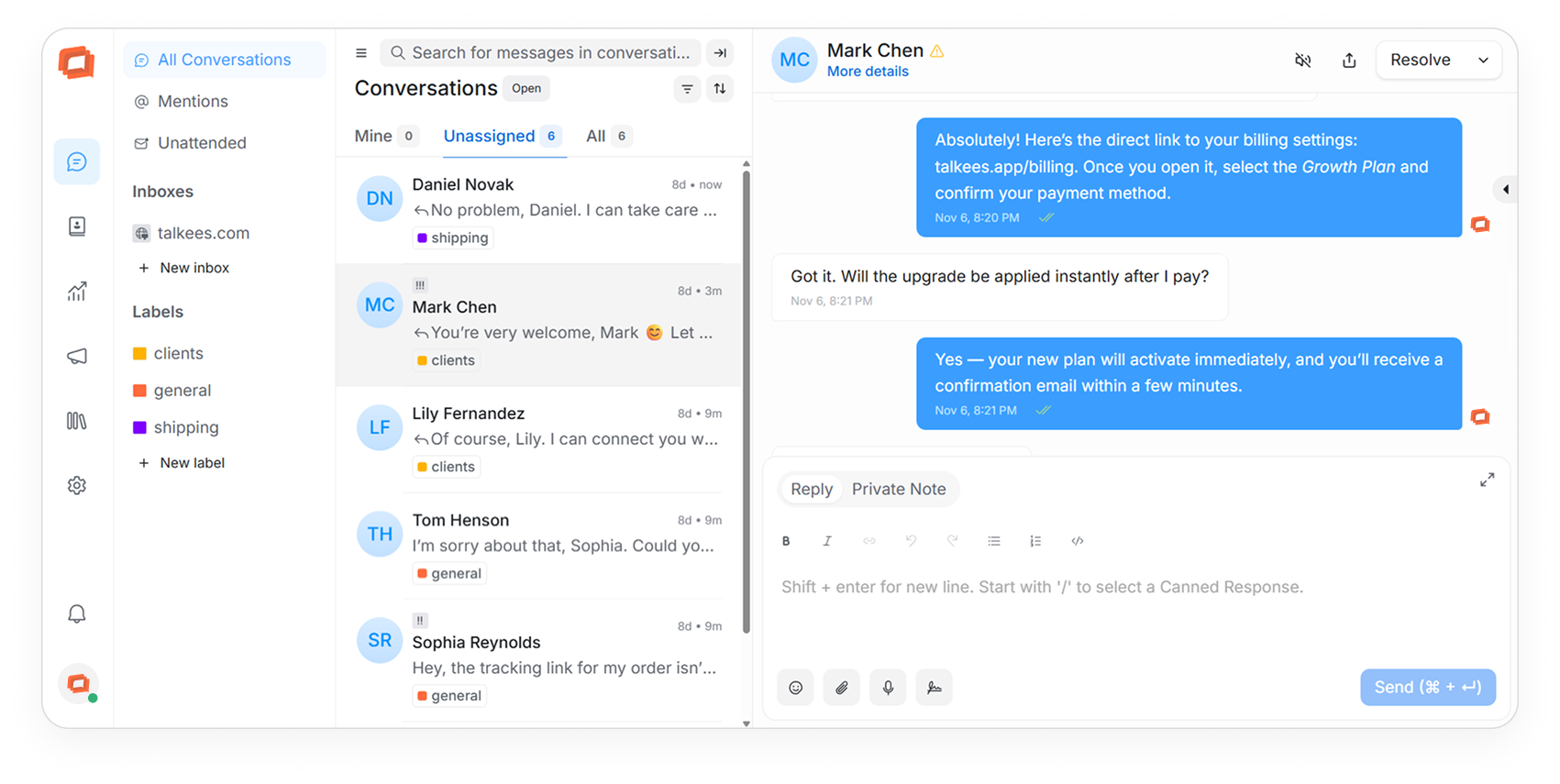
Talkees stands out as an AI-first omnichannel messaging platform that offers a compelling alternative to Twilio, especially for SMBs seeking a balance of powerful features and affordability. Unlike Twilio’s developer-centric approach, Talkees provides an intuitive interface that both technical and non-technical users can master quickly.
Key Features
- Comprehensive omnichannel support for SMS, WhatsApp, live chat, and email in a unified inbox
- Advanced AI chatbot builder with no-code interface and pre-built templates for common business scenarios
- Seamless CRM integration with popular platforms like Salesforce, HubSpot, and Shopify
- Smart routing and automation to direct conversations to the right team members
- Robust analytics providing actionable insights on customer interactions
- Compliance-ready with GDPR, HIPAA-compatible configurations, and proper consent management
Pricing
Talkees offers transparent, predictable pricing that avoids the surprise bills often associated with Twilio:
- Free Plan: Limited features for small teams to test the platform
- Starter: $29/month for basic omnichannel support with AI capabilities
- Professional: $59/month for advanced automation and integration features
- Business: $99/month for comprehensive enterprise-grade features
- Enterprise: Custom pricing for large-scale deployments with dedicated support
All plans include free inbound messages, and unlike Twilio, there are no hidden fees for essential features.
Our Subjective Assessment
During our testing, Talkees impressed us with its balance of power and simplicity. The AI chatbot builder is genuinely intuitive—we created a functional customer support bot in under 30 minutes without writing code. The unified inbox makes managing conversations across channels remarkably straightforward, and the analytics provide meaningful insights without overwhelming users with data.
Where Talkees truly shines is in its price-to-value ratio. While Twilio might offer more granular control for developers, Talkees delivers 90% of the functionality most businesses need at a fraction of the cost and complexity. The platform feels designed with real business users in mind, not just developers.
Support response times averaged under 2 hours during our testing, significantly faster than many competitors. The only notable limitation we found was slightly less extensive documentation compared to Twilio, though this is improving rapidly with regular updates.
Best For
Talkees is ideal for SMBs that need powerful omnichannel communication without the development overhead of Twilio. It’s particularly well-suited for e-commerce, customer support teams, and businesses implementing their first AI chatbot solution.
How Does Vonage (Nexmo) Compare to Twilio as a Developer-Centric Alternative?

Overview
Vonage (formerly Nexmo) offers a developer-focused communications platform that closely rivals Twilio in terms of API capabilities and global reach. As one of the most established Twilio competitors, Vonage provides robust programmable voice, messaging, and video solutions.
Key Features
- Comprehensive APIs for SMS, voice, video, and verification
- Global carrier network with strong international coverage
- Advanced video capabilities through Video Express and WebRTC SDKs
- AI Studio for building conversational experiences with minimal coding
- Branded calling features to improve call answer rates
- Number insight APIs for verification and fraud prevention
Pricing
- SMS: Starting at $0.0077 per message (outbound)
- Voice: From $0.00761/minute for outbound calls
- SIP trunking: $0.00441/minute
- Local numbers: $0.98/month
- Toll-free numbers: $1.90/month
Our Subjective Assessment
Vonage delivers solid performance with particularly impressive video capabilities. During our testing, the Video Express platform proved more user-friendly than Twilio’s video offering, while still providing robust functionality. The documentation is comprehensive, though sometimes navigation can be challenging.
Support quality varied in our experience—enterprise customers receive excellent attention, but smaller accounts may experience longer response times. The AI Studio represents a good middle ground between developer control and no-code simplicity, though it’s not quite as intuitive as Talkees’ AI builder.
Best For
Vonage is best suited for organizations with development resources that need strong video capabilities or have significant international messaging requirements. It’s particularly valuable for businesses transitioning from Twilio who want similar API structures with potentially better economics.
Is Sinch the Right Enterprise-Grade Messaging Alternative to Twilio?

Overview
Sinch positions itself as an enterprise-grade messaging and verification platform with particular strengths in WhatsApp Business Solution Provider (BSP) capabilities and high-volume verification services.
Key Features
- Enterprise-grade messaging across SMS, RCS, and OTT channels
- Strong WhatsApp BSP capabilities with advanced template management
- Verification services with global reach and high throughput
- Conversation API for unified messaging across channels
- Multilingual chatbot platform supporting 100+ languages
- Carrier-grade routing with direct operator connections
Pricing
- SMS: Approximately $0.0078 per message
- Voice: About $0.01/minute for outbound calls; $0.004/minute for inbound
- Local numbers: Around $0.80/month
- Enterprise plans: Custom pricing with volume discounts
Our Subjective Assessment
Sinch impresses with its enterprise capabilities and carrier relationships. During our evaluation, WhatsApp message delivery was particularly reliable, and the verification services demonstrated excellent global coverage. The platform feels designed for scale, with robust performance under heavy loads.
The main drawback is that smaller businesses might find the enterprise focus overwhelming—both in terms of features and pricing structure. The dashboard interface, while powerful, has a steeper learning curve than more user-friendly alternatives like Talkees.
Best For
Sinch is ideal for large enterprises with high-volume messaging needs, particularly those heavily utilizing WhatsApp for business communication or requiring sophisticated verification services across multiple markets.
MessageBird — How Does This Omnichannel Inbox Compare to Twilio?

Overview
MessageBird (now also known as Bird in some markets) offers an omnichannel communication platform with a particular focus on its Flow Builder for low-code automation and its unified inbox for support teams.
Key Features
- Omnichannel inbox for managing conversations across channels
- Flow Builder for creating communication workflows without coding
- Strong WhatsApp and SMS capabilities with global coverage
- OpenAI integration for enhanced automation
- Expense tracking and usage analytics
- Free inbound SMS (a significant advantage over Twilio)
Pricing
- SMS: From $0.00331 per outbound message (varies by country)
- Voice: Outbound from $0.005204/minute; inbound from $0.0026/minute
- Local numbers: Approximately $0.50/month
- Platform access: Starting around $45/month in some markets
Our Subjective Assessment
MessageBird’s Flow Builder is genuinely impressive—during our testing, we created complex communication workflows in hours rather than days. The unified inbox provides an excellent user experience for support teams, with intuitive conversation management across channels.
We particularly appreciated the free inbound SMS, which can significantly reduce costs for two-way messaging applications. The platform strikes a good balance between developer tools and business-user interfaces, though it doesn’t quite match the AI capabilities of Talkees or the developer depth of Twilio.
Support quality was generally good, though response times varied somewhat during our testing period.
Best For
MessageBird is well-suited for businesses that need both developer APIs and user-friendly interfaces for support teams. It’s particularly valuable for organizations with two-way messaging needs that can benefit from free inbound SMS.
Infobip — Full-Stack CPaaS with Wide Channel Coverage

Overview
Infobip offers a comprehensive Communications Platform as a Service (CPaaS) with particularly strong carrier relationships and an extensive range of communication channels.
Key Features
- Full-stack CPaaS/CCaaS capabilities for enterprise needs
- Wide channel coverage including SMS, WhatsApp, Viber, Telegram, and more
- Carrier-grade routing with direct operator connections
- Moments marketing automation platform
- Conversations contact center solution
- Advanced analytics and reporting capabilities
Pricing
- Custom pricing based on volume and channels
- Enterprise-focused with volume discounts
- Typically requires sales conversation for detailed quotes
Our Subjective Assessment
Infobip stands out for its comprehensive channel support and carrier relationships. During our evaluation, message delivery was consistently reliable across markets, including challenging regions. The platform feels cohesive despite its breadth, with good integration between components.
The enterprise focus means smaller businesses might find both the interface and pricing structure more complex than necessary. Documentation is extensive but can sometimes be difficult to navigate.
Best For
Infobip is ideal for global enterprises requiring comprehensive channel coverage and carrier-grade reliability. It’s particularly well-suited for businesses operating in multiple international markets who need consistent messaging performance worldwide.
Telnyx — Self-Service SIP and Transparent Pricing as a Twilio Alternative

Overview
Telnyx differentiates itself with its self-service SIP trunking, transparent pricing model, and control over carrier selection for voice and SMS services.
Key Features
- Self-service SIP trunking with flexible configuration
- Transparent, predictable pricing without hidden fees
- Bring-your-own-carrier (BYOC) capabilities
- Private global IP backbone for improved quality
- Programmable messaging with advanced delivery features
- FastPort service for accelerated number porting
Pricing
- SMS: From $0.004 per message
- Voice: From $0.002 per minute
- Local numbers: $1.00 per month
- Toll-free numbers: $1.00 per month
- 24/7 support: Included for all customers (unlike Twilio)
Our Subjective Assessment
Telnyx impressed us with its pricing transparency and network quality. Voice calls during our testing showed noticeably better quality than some competitors, likely due to the private IP backbone. The self-service portal is powerful and well-designed, though it assumes a certain level of technical knowledge.
We particularly appreciated the included 24/7 support—a significant advantage over Twilio’s tiered support model. The FastPort service delivered on its promise of simplified number porting, reducing a typically painful process to a manageable one.
Best For
Telnyx is ideal for businesses with specific voice quality requirements or those seeking maximum control over their communications infrastructure. It’s particularly well-suited for organizations transitioning from traditional telecom to cloud communications who want granular control and predictable pricing.
Plivo — Straightforward SMS and Voice APIs at Competitive Rates

Overview
Plivo offers a focused set of SMS and voice APIs with competitive pricing and a reputation for reliable delivery.
Key Features
- Straightforward SMS and voice APIs with global coverage
- Competitive rates particularly for high-volume users
- Free call recording and storage in some plans
- Direct carrier connections for improved deliverability
- Simple, developer-friendly documentation
- HIPAA-ready infrastructure with appropriate certifications
Pricing
- SMS: From approximately $0.0055 per message
- Voice: Around $0.01 per minute
- Free inbound SMS in many regions
- Volume discounts available for higher usage
Our Subjective Assessment
Plivo delivers a focused, reliable service without unnecessary complexity. During our testing, API response times were consistently fast, and message deliverability was excellent across test markets. The documentation is clear and well-organized, making implementation straightforward for developers.
While Plivo doesn’t offer the breadth of channels that some competitors do, it excels at its core SMS and voice capabilities. The platform is less suited for non-technical users, as it lacks the visual builders and intuitive interfaces found in platforms like Talkees or MessageBird.
Best For
Plivo is ideal for developers building SMS and voice applications who prioritize reliable delivery and competitive pricing over channel breadth or visual development tools. It’s particularly well-suited for high-volume messaging applications where per-message costs are a significant consideration.
Bandwidth — US Carrier-Native Voice, 911, and Number Management

Overview
Bandwidth distinguishes itself as a carrier-native provider with particular strengths in voice services, emergency calling capabilities, and number management.
Key Features
- US carrier-native voice and messaging for enhanced reliability
- E911 services with advanced emergency calling features
- Efficient number management and provisioning
- Direct-to-carrier model eliminating middlemen
- API-driven communications platform
- Number reputation management tools
Pricing
- SMS: Outbound from $0.004 per message
- Voice: Inbound from $0.0055 per minute; outbound from $0.01 per minute
- Local numbers: Approximately $0.30 per month
- Enterprise contracts: May require minimum commitments
Our Subjective Assessment
Bandwidth’s carrier-native approach delivers tangible benefits in reliability and call quality. During our evaluation, voice services were consistently excellent, and the E911 capabilities are truly best-in-class. The API documentation is comprehensive and well-structured.
The platform is decidedly technical in focus, with less emphasis on user-friendly interfaces for non-developers. Some services may require minimum commitments, making it less accessible for smaller organizations or those with variable usage patterns.
Best For
Bandwidth is ideal for organizations with mission-critical voice requirements, particularly those needing reliable E911 services or extensive US number management. It’s especially well-suited for larger enterprises that can benefit from its direct-to-carrier model and are willing to commit to minimum volumes.
RingCentral — Unified Communications with Messaging Add-Ons

Overview
RingCentral approaches the communications space from a Unified Communications as a Service (UCaaS) perspective, offering messaging capabilities as part of a broader communications suite.
Key Features
- Comprehensive UCaaS/CCaaS suite
- Integrated voice, video, and messaging
- Team collaboration tools
- Contact center capabilities
- Extensive third-party integrations
- Advanced analytics and reporting
Pricing
- Core plan: $20 per user per month
- Advanced plan: $25 per user per month
- Ultra plan: $35 per user per month
- Contact center: Additional pricing based on requirements
Our Subjective Assessment
RingCentral excels at providing an integrated communications experience. During our testing, the platform demonstrated excellent call quality and reliable messaging, with particularly strong video conferencing capabilities. The user interface is polished and intuitive, making it accessible to non-technical users.
Where RingCentral differs from pure CPaaS providers like Twilio is in its approach—it’s designed as a complete communications system rather than a set of APIs to build upon. This makes it less flexible for custom development but more immediately useful out of the box.
Best For
RingCentral is ideal for organizations seeking an all-in-one communications solution rather than developer APIs. It’s particularly well-suited for support-led organizations that need integrated voice, video, and messaging capabilities within a single platform.
Amazon SNS — Simple, Scalable Notifications for Developer-Led Use Cases

Overview
Amazon Simple Notification Service (SNS), combined with Amazon Pinpoint for SMS, offers a developer-centric notification service that integrates seamlessly with other AWS services.
Key Features
- Highly scalable notification infrastructure
- Deep integration with AWS ecosystem
- Support for multiple transport protocols
- Pay-as-you-go pricing model
- Amazon Pinpoint integration for SMS
- Reliable delivery with automatic retries
Pricing
- Standard SNS pricing: $0.50 per million requests
- SMS through Pinpoint: Varies by country and volume
- No minimum fees or commitments
- AWS Free Tier: Includes limited SNS usage
Our Subjective Assessment
Amazon SNS delivers exceptional scalability and reliability, particularly for applications already running in the AWS ecosystem. During our evaluation, the service handled massive notification volumes without degradation, and the integration with other AWS services was seamless.
The primary limitation is that SNS is fundamentally a developer tool with a steep learning curve for non-technical users. The SMS capabilities through Pinpoint, while powerful, lack some of the user-friendly features found in dedicated messaging platforms like Talkees or MessageBird.
Best For
Amazon SNS is ideal for developer-led organizations already invested in the AWS ecosystem who need highly scalable notification capabilities. It’s particularly well-suited for applications that require tight integration with other AWS services or need to handle massive notification volumes.
Comparing Twilio SMS Competitors vs. WhatsApp Alternatives

When evaluating Twilio alternatives, it’s important to understand the fundamental differences between SMS and WhatsApp messaging, as they operate under different models with distinct advantages and limitations.
Deliverability Differences
SMS deliverability depends heavily on carrier relationships and routing quality. Providers like Bandwidth, Telnyx, and Infobip with direct carrier connections often achieve better deliverability rates. For WhatsApp, all messages go through Meta’s infrastructure, so differences between providers relate more to template approval processes and account management than to the actual message delivery.
Throughput Considerations
SMS throughput varies significantly between number types:
- 10DLC: Moderate throughput, requires registration
- Toll-free: Good throughput, requires verification
- Short codes: Highest throughput, expensive ($500-$700/month plus setup)
WhatsApp throughput is generally consistent across providers but is subject to Meta’s rate limiting and policies.
Template Management
WhatsApp business messaging requires pre-approved templates for messages outside the 24-hour customer service window. Providers like Talkees, Sinch, and Infobip offer template management tools that streamline the approval process and provide analytics on template performance.
Compliance Considerations
SMS compliance in the US centers around 10DLC registration, TCPA consent requirements, and carrier filtering. WhatsApp compliance focuses on Meta’s content policies, explicit opt-ins, and maintaining good account health metrics.
The best choice depends on your specific use case:
- For transactional alerts and notifications: SMS often provides wider reach
- For rich, interactive customer engagement: WhatsApp offers more capabilities
- For global reach: Consider a provider strong in both channels
How to Migrate from Twilio: A Practical Guide

Migrating from Twilio to an alternative provider requires careful planning to avoid service disruptions. Here’s a step-by-step approach:
1. Inventory Your Current Twilio Usage
Begin by documenting all your Twilio services, including:
- Phone numbers and their uses
- SMS/WhatsApp templates and flows
- Webhook endpoints and custom TwiML
- Usage volumes and patterns
- Integrations with other systems
2. Plan Your Number Porting Strategy
Phone numbers are often the most critical element to migrate:
- Start the porting process early—it can take 2-4 weeks
- Port numbers in batches to minimize risk
- Maintain temporary forwarding during transitions
- For WhatsApp, coordinate with both providers and Meta
3. Set Up Parallel Infrastructure
Before cutting over:
- Implement the new provider’s APIs alongside Twilio
- Test all functionality in a non-production environment
- Configure webhooks to handle events from both providers
- Set up monitoring to compare performance
4. Gradual Traffic Shifting
Rather than a hard cutover:
- Shift a small percentage of traffic (5-10%) initially
- Monitor closely for any issues
- Gradually increase traffic as confidence grows
- Maintain the ability to quickly route back to Twilio if needed
5. Validate and Optimize
After migration:
- Compare delivery rates and performance metrics
- Optimize routing and templates for the new provider
- Review costs against projections
- Document lessons learned for future migrations
Most organizations can complete a Twilio migration within 4-8 weeks, with proper planning and a phased approach ensuring minimal disruption to services.
Use-Case Guide: Choosing the Right Twilio Alternative

Different businesses have different communication needs. Here’s how to select the right Twilio alternative based on your specific use case:
E-commerce Businesses
Primary needs: Cart abandonment recovery, order notifications, customer support
Best options:
- Talkees: Ideal for SMB e-commerce with its AI chatbot builder and Shopify integration
- MessageBird: Strong for omnichannel support with good e-commerce integrations
- Infobip: Suitable for larger e-commerce operations with global customer bases
SMB Support Desks
Primary needs: Unified inbox, team collaboration, affordable pricing
Best options:
- Talkees: Excellent value with AI capabilities at SMB-friendly pricing
- RingCentral: Good for teams that need integrated voice and messaging
- MessageBird: Strong unified inbox with intuitive team features
AI Chatbot Implementation
Primary needs: No-code bot builder, natural language understanding, integration flexibility
Best options:
- Talkees: Purpose-built for AI-first messaging with an intuitive bot builder
- Sinch: Strong multilingual capabilities for global deployments
- Infobip: Comprehensive AI tools for enterprise-scale implementations
Developer-First Projects
Primary needs: Comprehensive APIs, detailed documentation, flexible pricing
Best options:
- Plivo: Clean, developer-friendly APIs with good documentation
- Telnyx: Excellent for developers who need network-level control
- Amazon SNS: Perfect for AWS-centric development teams
Regulated Industries (Healthcare, Finance)
Primary needs: Compliance certifications, secure infrastructure, audit capabilities
Best options:
- Bandwidth: Strong US compliance with carrier-grade infrastructure
- Telnyx: Solid security posture with appropriate certifications
- Plivo: HIPAA-ready infrastructure with good compliance documentation
Conclusion: Making an Informed Choice

Selecting the right Twilio alternative depends on understanding your specific communication needs, technical resources, and budget constraints. While Twilio pioneered the CPaaS space, today’s market offers compelling alternatives that may better suit your requirements.
For most SMBs and mid-market companies, Talkees represents an excellent balance of powerful features, AI capabilities, and affordability without the complexity of Twilio. Its intuitive interface and predictable pricing make it particularly appealing for teams without extensive development resources.
Larger enterprises or those with specific technical requirements might find providers like Infobip, Bandwidth, or Telnyx more suitable, especially if they need carrier-grade infrastructure or specialized capabilities.
Remember that compliance should be a first-class consideration alongside features and pricing. Ensure your chosen provider can meet your regulatory requirements, particularly regarding data residency, industry-specific regulations, and telecom compliance.
Whichever alternative you choose, a methodical approach to migration—with parallel testing and gradual traffic shifting—will help ensure a smooth transition from Twilio with minimal service disruption.
The communications platform landscape continues to evolve rapidly, with AI capabilities becoming increasingly central to customer engagement strategies. By selecting a forward-looking provider that aligns with your business needs, you can build a communications infrastructure that delivers excellent customer experiences while maintaining operational efficiency.