 English
 Slovenčina
 Français
 Magyar
Why Teams Are Leaving Help Scout in 2024

Before diving into the alternatives, let’s understand why businesses are considering a switch from Help Scout. According to user reports on platforms like Reddit, G2, and Capterra, several key issues are driving the search for Help Scout alternatives:
- Per-seat pricing model: As teams grow, Help Scout’s pricing structure can become prohibitively expensive compared to alternatives offering more flexible pricing options.
- Beacon and Inbox limitations: Users report restrictions in customization and functionality in Help Scout’s core features.
- AI Answers accuracy concerns: While Help Scout offers AI capabilities, many users find the accuracy and reliability lacking compared to more advanced alternatives.
- WhatsApp integration gap: In today’s omnichannel support environment, Help Scout’s limited WhatsApp capabilities are a significant drawback for many businesses.
What to Look for in a Help Scout Alternative

When evaluating Help Scout competitors, consider these essential features:
- Omnichannel support: Look for platforms that seamlessly integrate email, live chat, social media, WhatsApp, and SMS.
- AI chatbot quality: The effectiveness of AI automation can dramatically reduce support costs and improve customer satisfaction.
- Workflows and automation: Advanced automation capabilities can significantly boost your team’s efficiency.
- Integration ecosystem: Ensure the platform connects with your existing tech stack.
- Migration readiness: The ability to easily export data from Help Scout and import it into your new system is crucial.
How We Evaluated Help Scout Competitors

Our assessment process focused on real-world scenarios for e-commerce businesses and SMBs, examining:
- Bot deflection rate: How effectively does the AI chatbot handle customer inquiries without human intervention?
- SLA and routing depth: How sophisticated are the service level agreement features and routing capabilities?
- Collaboration features: We evaluated collision detection, internal notes, tagging systems, and team collaboration tools.
- Total cost of ownership: We calculated costs at different team sizes (5, 15, and 50 agents) to provide a comprehensive view of pricing structures.
Free Help Scout Alternatives Among Our Top Picks

Several platforms offer genuinely useful free plans that can serve as viable Help Scout alternatives:
- Some provide unlimited agents but cap conversations
- Others offer full feature sets but limit the number of team members
- We’ve identified which free plans are truly usable versus those that are too restricted for real business use
Now, let’s explore the top Help Scout alternatives, starting with our leading recommendation.
Talkees vs Help Scout: AI-First Live Chat + Chatbot Solution

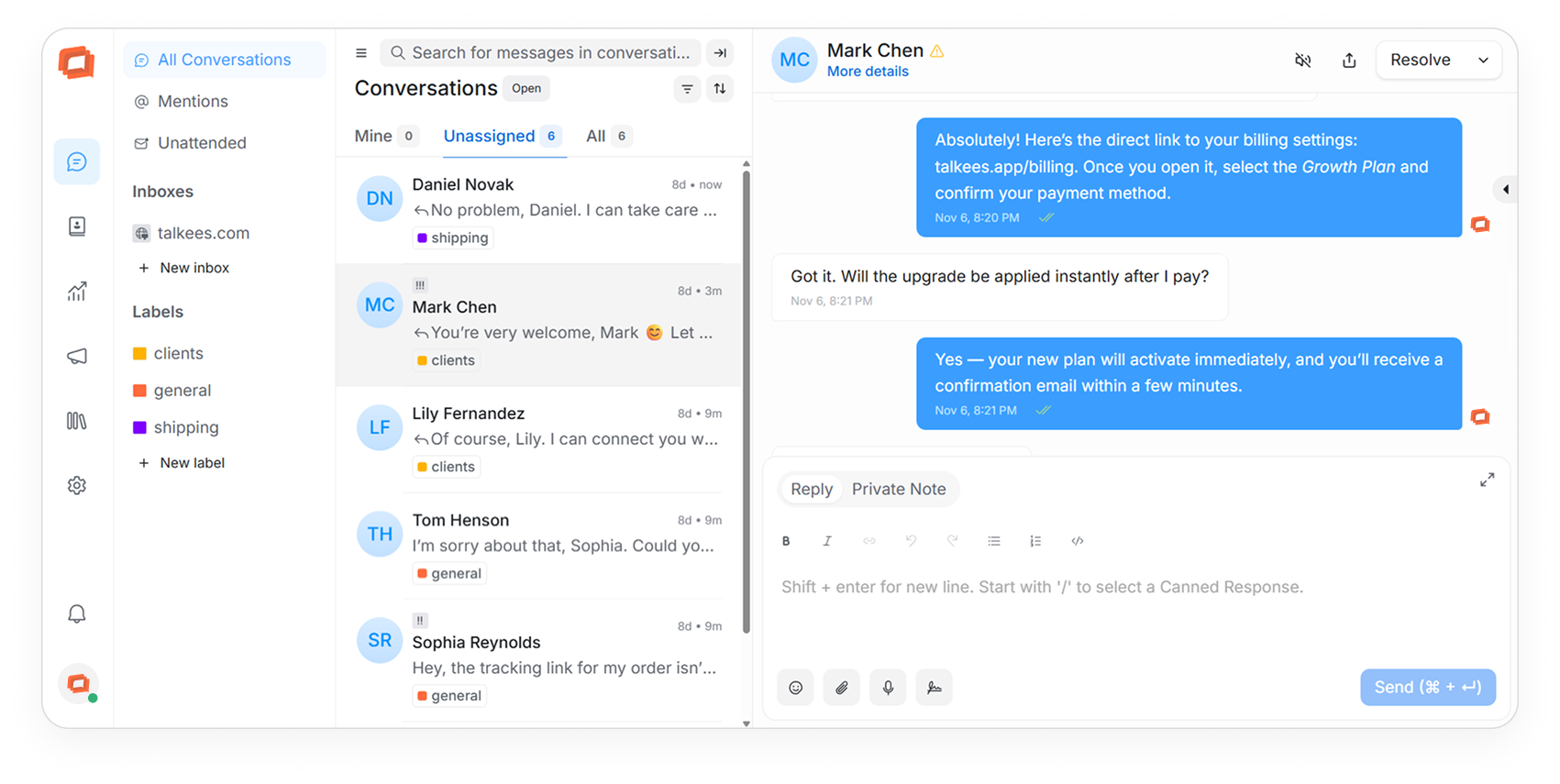
Talkees stands out as a premier Help Scout alternative, offering an AI-first approach to customer support that balances automation with human touch.
Detailed Pricing Overview
Talkees Pricing:
- Free Plan: Includes basic AI chatbot, 1 human agent, 500 conversations/month
- Starter: $29/month for 3 agents, advanced AI chatbot, 2,000 conversations/month
- Professional: $79/month for 10 agents, custom AI training, 10,000 conversations/month
- Business: $199/month for unlimited agents, enterprise-grade features, 50,000 conversations/month
All paid plans include WhatsApp integration, with AI credits that scale based on usage rather than per-seat charges, making Talkees particularly cost-effective for growing teams.
Help Scout Pricing:
- Uses per-seat pricing that starts at approximately $20/user/month
- Advanced features require higher-tier plans
- AI Answers costs approximately $0.75 per resolution
Complete Features List
Talkees Key Features:
- AI-first chatbot: Uses advanced natural language processing to understand customer intent
- WhatsApp omnichannel: Native integration with WhatsApp Business API
- Custom AI via API/n8n: Highly customizable AI that can be tailored to your specific business needs
- Rapid setup: Most users can be fully operational within hours
- Transparent pricing: No hidden fees or surprising costs as you scale
- Knowledge base integration: AI automatically pulls from your knowledge resources
- Team collaboration tools: Real-time agent collaboration features
- Advanced analytics: Comprehensive reporting on conversation metrics and AI performance
In practice, Talkees’ AI chatbot can handle routine inquiries like order status checks, product information requests, and basic troubleshooting without human intervention, while seamlessly escalating complex issues to your support team.
Real User Experiences and Reviews
Customers consistently praise Talkees for its balance of automation and human support:
“After switching from Help Scout, we saw a 40% reduction in ticket volume thanks to Talkees’ AI chatbot. Our team can now focus on complex customer issues rather than repetitive questions.” – E-commerce Store Manager
According to aggregated reviews from G2 and Capterra, users highlight:
- Ease of implementation (average 4.8/5)
- AI accuracy (average 4.6/5)
- Value for money (average 4.7/5)
- Customer support quality (average 4.9/5)
Common praise includes the platform’s intuitive interface and the quality of AI-human handoffs, which maintain context throughout the customer journey.
Advantages and Disadvantages
Talkees Advantages:
- Superior AI chatbot capabilities with demonstrably higher resolution rates
- Native WhatsApp integration without additional costs
- More flexible pricing model that scales efficiently with business growth
- Faster implementation compared to enterprise alternatives
- Custom AI training that improves over time based on your specific customer interactions
Talkees Disadvantages:
- Newer platform with a growing (though already substantial) integration marketplace
- Mobile app still developing advanced features
- May require initial AI training period for optimal performance
Our Subjective Assessment
When testing Talkees, we were particularly impressed by how quickly the AI learned our product information. Within days, the chatbot was accurately answering specific product questions and appropriately routing more complex inquiries to our team. For businesses frustrated with Help Scout’s limited AI capabilities or WhatsApp integration, Talkees represents a significant upgrade without the enterprise-level complexity or cost of platforms like Zendesk.
Zendesk vs Help Scout: Enterprise-Grade Support Solution

Zendesk is a comprehensive customer service platform that offers significantly more robust features than Help Scout, particularly for larger organizations with complex support needs.
Detailed Pricing Overview
Zendesk Pricing:
- Support Team: $19/agent/month (billed annually)
- Suite Team: $55/agent/month (includes omnichannel capabilities)
- Suite Growth: $89/agent/month
- Suite Professional: $115/agent/month
Enterprise pricing is available for larger organizations requiring advanced customization and support. Additional costs apply for certain AI features and add-ons.
Complete Features List
Zendesk Key Features:
- Enterprise-grade routing: Sophisticated rules-based and skills-based routing options
- Comprehensive SLA management: Advanced SLA tracking, escalation paths, and reporting
- Extensive reporting capabilities: Zendesk Explore provides deep analytics and customizable dashboards
- Broad channel support: Email, chat, phone, social media, and messaging apps
- Marketplace with 1,300+ apps: Extensive integration ecosystem
- Advanced workflow automation: Complex business rules and triggers
- Knowledge management: Robust knowledge base and community forum capabilities
- AI-powered solutions: Answer Bot and other AI tools for ticket deflection
In practice, Zendesk’s unified Agent Workspace provides a single view of the customer across all channels, significantly improving agent efficiency for organizations handling high support volumes.
Real User Experiences and Reviews
Zendesk users frequently highlight the platform’s comprehensive capabilities:
“Zendesk’s reporting capabilities are far superior to Help Scout’s. We can now track complex metrics and create custom dashboards that give us actionable insights.” – Customer Support Director
From G2 and Capterra reviews, users consistently mention:
- Feature depth (average 4.7/5)
- Customization options (average 4.5/5)
- Enterprise readiness (average 4.8/5)
- Integration capabilities (average 4.6/5)
The most common praise focuses on Zendesk’s ability to handle complex, high-volume support environments with sophisticated routing and automation.
Advantages and Disadvantages
Zendesk Advantages:
- Comprehensive omnichannel support capabilities
- Sophisticated routing and SLA management
- Extensive reporting and analytics
- Large marketplace of integrations
- Scalable for enterprise needs
Zendesk Disadvantages:
- Higher total cost of ownership compared to Help Scout
- Steeper learning curve and more complex setup
- Can be overwhelming for small teams
- Implementation often requires dedicated resources
Our Subjective Assessment
During our testing, Zendesk impressed us with its depth of features and customization options. The platform feels designed for organizations that have outgrown simpler solutions like Help Scout and need enterprise-grade capabilities. For larger organizations with complex support requirements and the resources to implement and maintain a sophisticated platform, Zendesk represents a significant upgrade from Help Scout—but at a premium price point and with added complexity.
Freshdesk vs Help Scout: Broad Ticketing Platform with Free Tier

Freshdesk offers a robust ticketing system with a workable free tier, making it an attractive Help Scout alternative for budget-conscious teams that don’t want to sacrifice functionality.
Detailed Pricing Overview
Freshdesk Pricing:
- Free: Up to 10 agents, basic ticketing, knowledge base
- Growth: $15/agent/month (billed annually)
- Pro: $49/agent/month
- Enterprise: $79/agent/month
- Forest: $109/agent/month
Each tier progressively unlocks more advanced features, with the free tier being genuinely usable for small teams.
Complete Features List
Freshdesk Key Features:
- Comprehensive ticketing system: Robust ticket management with automation
- Extensive marketplace: Wide range of integrations and extensions
- Freddy AI assistant: AI capabilities for agent assistance and customer self-service
- Multi-channel support: Email, chat, phone, and social media
- Self-service portal: Knowledge base and community forums
- Automation tools: Scenario automation, ticket dispatch, and assignment rules
- SLA management: Service level agreement tracking and enforcement
- Team collaboration: Shared ownership, collision detection, and internal notes
In practice, Freshdesk’s ticketing system excels at organizing and prioritizing customer issues, while Freddy AI helps reduce agent workload by suggesting responses and automating routine tasks.
Real User Experiences and Reviews
Freshdesk users often highlight the platform’s balance of features and usability:
“Freshdesk’s free tier gave us everything we needed to get started, and the upgrade path was clear as we grew. The ticketing system is much more robust than what we had with Help Scout.” – Support Team Lead
Aggregated reviews from G2 and Capterra show strong ratings for:
- Value for money (average 4.5/5)
- Ease of use (average 4.3/5)
- Feature set (average 4.4/5)
- Customer support (average 4.2/5)
Users particularly appreciate the comprehensive ticketing capabilities and the quality of the free tier.
Advantages and Disadvantages
Freshdesk Advantages:
- Genuinely useful free tier
- Strong ticketing and automation capabilities
- Freddy AI provides useful agent assistance
- Comprehensive marketplace of integrations
- Clear upgrade path as teams grow
Freshdesk Disadvantages:
- Uneven depth across channels (strongest in ticketing)
- Mobile app has some limitations
- Advanced reporting requires higher-tier plans
- Some users report occasional performance issues
Our Subjective Assessment
When testing Freshdesk, we found the ticketing system to be notably more sophisticated than Help Scout’s conversation-based approach. The ability to create complex workflows and automation rules was impressive, especially considering the accessible price point. For organizations that prioritize ticketing functionality and want a platform that can scale from free to enterprise, Freshdesk offers a compelling alternative to Help Scout with more depth in key areas.
Front vs Help Scout: Shared Inbox Speed and Collaboration

Front takes a different approach to customer support, focusing on shared inbox functionality that blends personal and team email workflows with powerful collaboration features.
Detailed Pricing Overview
Front Pricing:
- Starter: $25/seat/month (billed annually)
- Prime: $59/seat/month
- Enterprise: Custom pricing
All plans include unlimited shared inboxes, but higher tiers add advanced analytics, integrations, and automation capabilities.
Complete Features List
Front Key Features:
- Shared inbox excellence: Superior handling of email-based support
- Team collaboration tools: Internal comments, @mentions, and shared drafts
- Speed-focused interface: Designed for rapid email processing
- Personal + team email management: Unique ability to handle both in one interface
- Assignment rules: Automated ticket distribution
- Basic automation: Rules for tagging and categorizing
- Analytics: Performance metrics for team and individual productivity
- Integrations: CRM, help desk, and project management connections
In practice, Front excels at helping teams process high volumes of email quickly, with collaboration features that make it easy for team members to work together on complex customer issues.
Real User Experiences and Reviews
Front users consistently highlight the platform’s speed and collaboration capabilities:
“Front transformed how our team handles email support. The collaboration features and speed are unmatched—we’re processing twice as many emails in the same amount of time compared to Help Scout.” – Operations Manager
From G2 and Capterra reviews, users emphasize:
- Interface speed (average 4.7/5)
- Collaboration features (average 4.8/5)
- Email management (average 4.6/5)
- Learning curve (average 4.5/5)
The most common praise focuses on Front’s ability to blend personal and team email workflows in a single, fast interface.
Advantages and Disadvantages
Front Advantages:
- Superior email handling and processing speed
- Excellent collaboration features
- Combined personal and team inbox management
- Clean, intuitive interface
- Strong assignment and internal discussion tools
Front Disadvantages:
- Less robust in non-email channels
- Limited knowledge base capabilities compared to dedicated help desks
- Fewer advanced automation options than ticketing-focused systems
- Classic helpdesk automation gaps in higher-volume scenarios
Our Subjective Assessment
During our testing, Front’s speed and collaboration features stood out immediately. The interface is remarkably intuitive, allowing new team members to become productive quickly with minimal training. For teams that are primarily email-focused and value speed and collaboration over complex ticketing and omnichannel capabilities, Front represents an excellent alternative to Help Scout that can significantly improve productivity.
Intercom vs Help Scout: Conversational Support Platform

Intercom takes a conversational approach to customer support, focusing on proactive messaging, powerful chatbots, and a unified platform for engagement across the customer journey.
Detailed Pricing Overview
Intercom Pricing:
- Starter: $74/month (includes 1 seat, additional seats $19/month)
- Pro: $499/month (includes 5 seats, additional seats $99/month)
- Scale: Custom pricing for larger teams
Intercom’s pricing model combines a base platform fee with per-seat costs, which can become expensive as teams grow.
Complete Features List
Intercom Key Features:
- Conversational support: Chat-first approach to customer engagement
- Proactive messaging: Targeted outreach based on user behavior
- Powerful chatbots: Advanced automation for customer inquiries
- Customer data platform: Rich user profiles and segmentation
- Product tours and onboarding: In-app messaging and guidance
- Resolution bots: Automated issue resolution
- Knowledge base: Self-service support content
- Team inbox: Collaborative customer communication
In practice, Intercom’s platform enables businesses to engage customers proactively through targeted messaging while efficiently handling inbound support through a combination of bots and human agents.
Real User Experiences and Reviews
Intercom users frequently highlight the platform’s conversational capabilities:
“Intercom’s chatbots and proactive messaging transformed our support approach. We’re now resolving issues before customers even need to ask for help.” – Customer Success Director
From G2 and Capterra reviews, users consistently mention:
- Chat functionality (average 4.7/5)
- Bot capabilities (average 4.5/5)
- Proactive engagement (average 4.6/5)
- User interface (average 4.4/5)
The most common praise focuses on Intercom’s ability to blend marketing, sales, and support in a unified conversational platform.
Advantages and Disadvantages
Intercom Advantages:
- Superior chat and messaging capabilities
- Powerful, customizable bots
- Proactive customer engagement tools
- Rich customer data and segmentation
- Unified platform for multiple customer touchpoints
Intercom Disadvantages:
- Premium seat-based pricing can become expensive
- Email support less robust than chat
- More complex setup than email-focused alternatives
- Can be overwhelming for teams focused solely on support
Our Subjective Assessment
When testing Intercom, the platform’s conversational approach to customer engagement was immediately apparent. The chatbots are among the most sophisticated we’ve tested, capable of handling complex inquiries and seamlessly transferring to human agents when needed. For organizations that prioritize chat-based support, proactive engagement, and a unified approach to customer communication, Intercom offers powerful capabilities that Help Scout can’t match—but at a premium price point that requires consideration.
HubSpot Service Hub vs Help Scout: CRM-Native Support Solution

HubSpot Service Hub integrates customer support directly into the HubSpot CRM ecosystem, offering a unified approach to customer data and engagement across marketing, sales, and service.
Detailed Pricing Overview
HubSpot Service Hub Pricing:
- Free: Basic ticketing for unlimited users
- Starter: $20/month for 2 users ($10/month per additional user)
- Professional: $500/month for 5 users ($100/month per additional user)
- Enterprise: $1,200/month for 10 users ($120/month per additional user)
The pricing structure includes both platform fees and per-user costs, with significant jumps between tiers.
Complete Features List
HubSpot Service Hub Key Features:
- CRM-native support: Seamless integration with HubSpot CRM
- Ticketing system: Comprehensive ticket management
- Knowledge base: Self-service content creation and management
- Automation workflows: Sophisticated process automation
- Conversation routing: Rules-based ticket assignment
- Customer feedback tools: NPS, CSAT, and custom surveys
- Reporting dashboards: Performance analytics and insights
- Service playbooks: Standardized processes and scripts
In practice, Service Hub’s tight integration with the HubSpot CRM provides agents with complete customer context, including marketing interactions, sales history, and previous support issues.
Real User Experiences and Reviews
HubSpot Service Hub users often highlight the benefits of CRM integration:
“Having our support system directly integrated with our CRM has eliminated data silos. Our agents have complete customer context that was impossible to achieve with Help Scout.” – Customer Experience Manager
From G2 and Capterra reviews, users consistently mention:
- CRM integration (average 4.8/5)
- Unified customer view (average 4.7/5)
- Automation capabilities (average 4.5/5)
- Reporting (average 4.4/5)
The most common praise focuses on the platform’s ability to connect support with marketing and sales data in a single ecosystem.
Advantages and Disadvantages
HubSpot Service Hub Advantages:
- Seamless integration with HubSpot CRM
- Comprehensive customer context across departments
- Sophisticated automation and workflow tools
- Robust knowledge base and self-service options
- Strong reporting and analytics
HubSpot Service Hub Disadvantages:
- Bundle lock-in with HubSpot ecosystem
- Significant cost increases at higher tiers
- Can be complex to implement fully
- May be overkill for teams not using other HubSpot products
Our Subjective Assessment
During our testing of HubSpot Service Hub, the CRM integration proved to be a significant advantage. Agents could see a customer’s complete history—including marketing interactions, sales opportunities, and previous support issues—providing context that standalone help desks like Help Scout simply can’t match. For organizations already invested in the HubSpot ecosystem or looking for a unified platform across customer-facing departments, Service Hub offers powerful capabilities that Help Scout can’t match—but comes with ecosystem lock-in and scaling costs that require careful consideration.
Zoho Desk vs Help Scout: Cost-Effective Multichannel Platform

Zoho Desk offers a comprehensive, affordable help desk solution with strong customization capabilities and multi-brand support, making it an attractive alternative to Help Scout for budget-conscious teams.
Detailed Pricing Overview
Zoho Desk Pricing:
- Free: Up to 3 agents
- Standard: $14/agent/month (billed annually)
- Professional: $23/agent/month
- Enterprise: $40/agent/month
All paid plans include multichannel support, with advanced features available at higher tiers.
Complete Features List
Zoho Desk Key Features:
- Cost-effective multichannel: Email, chat, phone, and social at competitive pricing
- Extensive customization: Highly adaptable to specific business needs
- Multi-brand support: Manage multiple brands from a single platform
- Zia AI assistant: AI-powered agent assistance and customer self-service
- Context-aware help desk: Customer context from integrated Zoho products
- Advanced automation: Time and event-based triggers
- Custom reports and dashboards: Flexible analytics
- Field service management: On-site service coordination
In practice, Zoho Desk provides a balance of affordability and functionality, with particularly strong customization options that allow businesses to tailor the platform to their specific support processes.
Real User Experiences and Reviews
Zoho Desk users frequently highlight the platform’s value and flexibility:
“We switched from Help Scout to Zoho Desk primarily for the multichannel capabilities and customization options. The price-to-feature ratio is unbeatable, and we’re now supporting multiple brands efficiently.” – IT Support Manager
From G2 and Capterra reviews, users consistently mention:
- Value for money (average 4.6/5)
- Customization options (average 4.5/5)
- Multi-brand capabilities (average 4.7/5)
- Integration with Zoho ecosystem (average 4.5/5)
The most common praise focuses on Zoho Desk’s ability to deliver enterprise-grade features at a mid-market price point.
Advantages and Disadvantages
Zoho Desk Advantages:
- Excellent value for money
- Strong multichannel capabilities
- Extensive customization options
- Robust multi-brand support
- Integration with Zoho ecosystem
Zoho Desk Disadvantages:
- UI polish less refined than some competitors
- Learning curve for advanced customizations
- Mobile app has some limitations
- Best value realized when using other Zoho products
Our Subjective Assessment
When testing Zoho Desk, we were impressed by the breadth of features available at such competitive pricing. The multichannel capabilities—spanning email, chat, phone, and social media—provide significantly more options than Help Scout’s primarily email-focused approach. The interface, while functional, lacks some of the polish found in more expensive alternatives. There’s also a learning curve associated with the extensive customization options.
For organizations seeking a cost-effective, feature-rich alternative to Help Scout with strong multichannel and multi-brand capabilities, Zoho Desk offers exceptional value—particularly for businesses willing to invest some time in customization.
LiveAgent vs Help Scout: All-in-One Help Desk with Call Center

LiveAgent offers a comprehensive help desk solution with integrated call center capabilities, making it a strong Help Scout alternative for businesses that need robust phone support alongside traditional channels.
Detailed Pricing Overview
LiveAgent Pricing:
- Free: Limited features, 7-day ticket history
- Ticket: $15/agent/month
- Ticket+Chat: $29/agent/month
- All-Inclusive: $49/agent/month
The All-Inclusive plan includes call center functionality with IVR and advanced features.
Complete Features List
LiveAgent Key Features:
- All-in-one help desk: Comprehensive ticketing, chat, and call center
- Integrated call center/IVR: Advanced voice support capabilities
- Social inbox: Unified social media message management
- Video calling: Built-in video support options
- Time tracking: Agent productivity monitoring
- SLA management: Comprehensive service level agreements
- Knowledge base: Self-service portal with analytics
- Gamification: Agent performance incentives
In practice, LiveAgent’s unified platform allows businesses to handle customer support across all channels—including sophisticated phone support—from a single interface, reducing the need for multiple tools.
Real User Experiences and Reviews
LiveAgent users often highlight the platform’s comprehensive capabilities:
“After switching from Help Scout, we finally have a truly all-in-one solution. The call center functionality eliminated the need for a separate phone system, and the unified inbox has streamlined our workflow.” – Customer Service Director
From G2 and Capterra reviews, users consistently mention:
- Channel breadth (average 4.7/5)
- Call center functionality (average 4.6/5)
- Value for money (average 4.5/5)
- Unified inbox (average 4.6/5)
The most common praise focuses on LiveAgent’s ability to handle all support channels effectively in a single platform.
Advantages and Disadvantages
LiveAgent Advantages:
- Comprehensive channel coverage including advanced call center
- Strong social media integration
- Good value for feature breadth
- Robust SLA management
- Built-in time tracking and gamification
LiveAgent Disadvantages:
- Legacy UI in some areas
- Setup effort for full functionality
- Learning curve for advanced features
- Mobile experience less refined than desktop
Our Subjective Assessment
During our testing of LiveAgent, the platform’s breadth of functionality was immediately apparent. The integrated call center capabilities—including IVR, call routing, and recording—provide a level of phone support that Help Scout simply doesn’t offer without significant third-party integration. For businesses that require robust phone support alongside traditional channels and want to consolidate their support stack into a single platform, LiveAgent offers a compelling alternative to Help Scout—particularly for those willing to invest some time in setup and configuration.
Kayako vs Help Scout: Unified Conversations with Simplicity

Kayako focuses on providing a unified view of customer conversations across channels with an emphasis on simplicity and usability, making it a good Help Scout alternative for teams seeking a clean, straightforward approach.
Detailed Pricing Overview
Kayako Pricing:
- Inbox: $30/agent/month (billed annually)
- Growth: $60/agent/month
- Scale: $100/agent/month
- Enterprise: Custom pricing
All plans include multichannel support, with advanced features available at higher tiers.
Complete Features List
Kayako Key Features:
- Unified conversations: Single view of customer interactions across channels
- Timeline interface: Chronological view of customer engagement
- Simplicity-focused design: Clean, intuitive user interface
- Multichannel support: Email, live chat, and social media
- Self-service portal: Knowledge base and community
- Automation rules: Workflow automation and routing
- Collaboration tools: Internal notes and team mentions
- Customer insights: Contextual customer information
In practice, Kayako’s unified timeline approach provides agents with a clear, chronological view of customer interactions across all channels, making it easy to understand the full context of a support issue.
Real User Experiences and Reviews
Kayako users often highlight the platform’s unified approach and simplicity:
“Kayako’s timeline view gives us a much clearer picture of customer interactions than Help Scout’s conversation-based approach. It’s easier for our agents to get up to speed quickly on complex issues.” – Support Team Lead
From G2 and Capterra reviews, users consistently mention:
- Interface simplicity (average 4.5/5)
- Unified view (average 4.6/5)
- Ease of use (average 4.4/5)
- Customer context (average 4.5/5)
The most common praise focuses on Kayako’s ability to provide a clear, comprehensive view of customer interactions without unnecessary complexity.
Advantages and Disadvantages
Kayako Advantages:
- Clean, unified conversation view
- Intuitive timeline interface
- Good balance of features and simplicity
- Solid multichannel capabilities
- Strong customer context
Kayako Disadvantages:
- Slower product momentum than some competitors
- Limited ecosystem compared to larger platforms
- Advanced reporting requires higher tiers
- Some users report occasional performance issues
Our Subjective Assessment
When testing Kayako, the timeline approach to customer conversations stood out as a significant advantage over Help Scout’s more traditional conversation view. The chronological presentation of all interactions—regardless of channel—provides clear context that helps agents understand complex customer journeys. For teams that value a clean, unified approach to customer conversations across channels and prefer simplicity over cutting-edge features, Kayako offers a compelling alternative to Help Scout that can improve agent productivity and customer context.
Gorgias vs Help Scout: Shopify-First E-Commerce Support

Gorgias is purpose-built for e-commerce support, with deep integrations into platforms like Shopify, Magento, and BigCommerce, making it the ideal Help Scout alternative for online retailers.
Detailed Pricing Overview
Gorgias Pricing:
- Basic: $50/month for up to 300 tickets
- Pro: $300/month for up to 2,000 tickets
- Advanced: $750/month for up to 5,000 tickets
- Enterprise: Custom pricing for higher volumes
Gorgias uses a ticket-based pricing model rather than per-agent, which can be more economical for teams with higher agent counts but controlled ticket volumes.
Complete Features List
Gorgias Key Features:
- Deep e-commerce integration: Native connections to Shopify, Magento, BigCommerce
- Order management in tickets: View and edit orders directly from support interface
- Commerce data integration: Complete order history and customer data
- Revenue attribution: Track support impact on sales
- Macros with order actions: Automate common e-commerce workflows
- Social selling: Convert social comments into sales opportunities
- Intent detection: Automatically categorize and prioritize tickets
- Centralized customer view: Complete purchase and support history
In practice, Gorgias allows support agents to view order details, process refunds, edit shipping information, and resolve other e-commerce-specific issues without leaving the support interface, significantly improving efficiency.
Real User Experiences and Reviews
Gorgias users consistently highlight the platform’s e-commerce focus:
“After switching from Help Scout, our support team can now handle order issues in half the time. Being able to process refunds and shipping changes directly from the ticket has transformed our workflow.” – E-commerce Support Manager
From G2 and Capterra reviews, users emphasize:
- E-commerce integration (average 4.8/5)
- Order management (average 4.7/5)
- Efficiency gains (average 4.6/5)
- ROI for online stores (average 4.5/5)
The most common praise focuses on Gorgias’s ability to streamline e-commerce-specific support workflows that require order context and actions.
Advantages and Disadvantages
Gorgias Advantages:
- Superior e-commerce platform integrations
- Order management directly within tickets
- Revenue attribution for support interactions
- Ticket-based pricing beneficial for many-agent teams
- Purpose-built for online retail support scenarios
Gorgias Disadvantages:
- Per-ticket pricing can be expensive during high-volume periods
- Less suitable for non-e-commerce businesses
- Channel limitations compared to omnichannel platforms
- More specialized than general-purpose help desks
Our Subjective Assessment
During our testing of Gorgias, the e-commerce specialization was immediately apparent and impressive. The ability to view complete order details—including items, payment information, shipping status, and previous purchases—directly within support tickets provides context that’s simply unavailable in Help Scout without significant custom integration work. For online retailers using Shopify, Magento, or BigCommerce, Gorgias offers specialized capabilities that Help Scout can’t match—particularly for teams that spend significant time handling order-related support issues.
Conclusion: Choosing the Best Help Scout Alternative for Your Needs

After thoroughly evaluating the top Help Scout alternatives, several clear options emerge depending on your specific requirements:
- Best Overall Alternative: Talkees Talkees stands out for its AI-first approach, native WhatsApp integration, and transparent pricing model that scales efficiently with business growth. It offers the best balance of advanced features and usability, making it our top recommendation for most businesses looking to move beyond Help Scout.
- Best for Enterprise: Zendesk For larger organizations with complex support requirements, Zendesk provides the depth of features, customization, and scalability needed—though at a higher price point and with increased complexity.
- Best Free Option: Freshdesk Freshdesk’s genuinely useful free tier makes it the top choice for small teams or those with limited budgets who still need robust ticketing capabilities.
- Best for E-Commerce: Gorgias Online retailers will find Gorgias’s deep integration with e-commerce platforms and order management capabilities to be transformative for support efficiency.
- Best for Email-Heavy Teams: Front Teams that primarily handle email support will appreciate Front’s speed, collaboration features, and unified approach to personal and team inboxes.
When selecting your Help Scout alternative, consider these key factors:
- Your primary support channels and volume
- Team size and growth projections
- Budget constraints and pricing model preferences
- Integration requirements with your existing tech stack
- Specific industry needs (e-commerce, SaaS, etc.)
- AI and automation capabilities you require
By focusing on these considerations and the detailed comparisons provided in this guide, you can confidently select the Help Scout alternative that best fits your business needs and support philosophy.