 English
 Slovenčina
 Français
 Magyar

How We Evaluated Front App Competitors

Our evaluation process focused on real-world performance in customer support scenarios. We assessed each platform based on:
- Feature completeness: Core functionality, automation capabilities, and channel coverage
- AI capabilities: Chatbot effectiveness, agent assistance, and automation potential
- Integration ecosystem: Native integrations, API flexibility, and third-party compatibility
- Pricing structure: Transparency, scalability, and value for different team sizes
- Ease of implementation: Migration pathways, onboarding support, and learning curve
- User experience: Agent interface, collaboration tools, and administrative overhead
We tested each platform with typical support scenarios, from simple email inquiries to complex multi-channel conversations requiring team collaboration.
Free vs Paid Front Alternatives: Understanding Total Cost of Ownership

When comparing free and paid alternatives to Front, it’s important to look beyond the initial price tag and consider the total cost of ownership (TCO).
Free Plans: Benefits and Limitations
Several Front alternatives offer free plans that can work well for very small teams or specific use cases:
- Freshdesk: Free for up to 10 agents, but limited in features
- Crisp: Free basic workspace with 2 seats
- Google Collaborative Inbox: Free with Google Workspace subscription
However, free plans typically lack advanced features like automation, AI capabilities, and comprehensive analytics that drive efficiency at scale.
Hidden Costs to Consider
When evaluating paid alternatives, watch for these potential hidden costs:
- Per-agent pricing that scales linearly with team growth
- AI usage fees that can add up quickly with high volume
- Integration costs for connecting essential tools
- Add-on features that weren’t included in the advertised price
- Implementation and training expenses
Licensing and Seat Models
Front alternatives use several different pricing models:
- Per-agent pricing: Most common, charges for each support agent (Zendesk, Freshdesk)
- Per-workspace pricing: Fixed fee regardless of user count (Crisp)
- Team-based pricing: Tiered by team size (Trengo)
- Usage-based pricing: Charges based on volume or AI resolutions (some Kayako plans)
Choose the model that best aligns with your team structure and growth projections.
Front vs Top Competitors at a Glance

Front excels at providing an email-first collaborative inbox that feels familiar to teams accustomed to traditional email workflows. It offers:
- A Gmail/Outlook-like interface with team features
- Internal comments and shared drafting capabilities
- Basic automation and rules
- A growing set of AI features
However, Front users often encounter friction when:
- Scaling beyond small teams due to per-seat pricing
- Requiring advanced omnichannel support
- Needing robust AI-powered deflection
- Wanting comprehensive analytics without upgrading tiers
- Requiring deep integrations with e-commerce platforms
Now let’s explore the top alternatives that address these limitations.
Talkees — AI-First Omnichannel Live Chat + Chatbot for SMBs and E-commerce

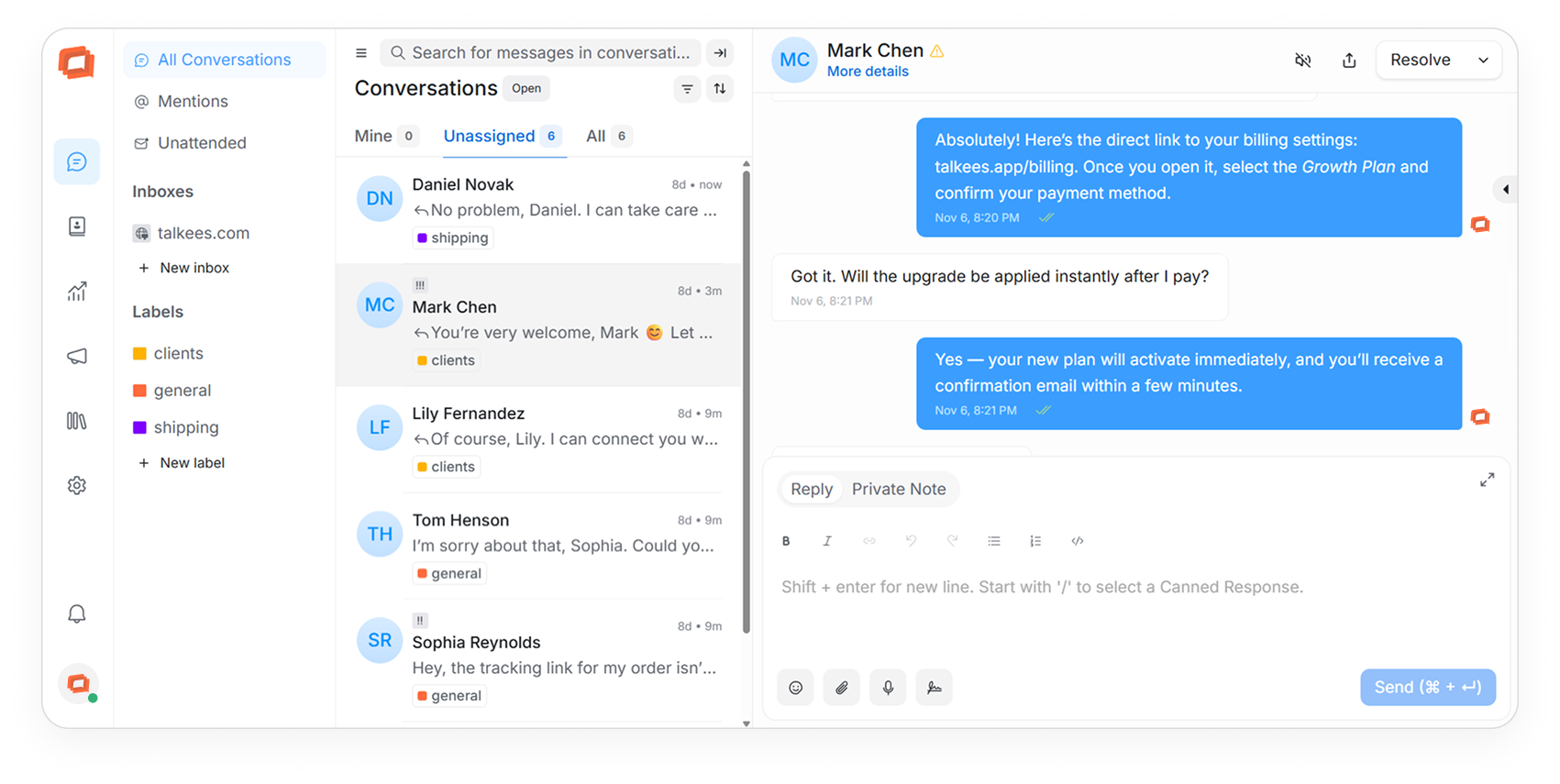
Talkees stands out as a modern AI-first alternative to Front, specifically designed for small-to-medium businesses and e-commerce operations that need powerful customer communication tools without enterprise complexity or cost.
Detailed Pricing Overview
- Free Plan: Available for small teams with up to 3 agents, includes basic live chat and limited AI responses
- Starter: $19/agent/month (billed annually) – Includes AI chatbot, omnichannel inbox, basic integrations
- Growth: $39/agent/month (billed annually) – Adds advanced automation, full API access, custom AI training
- Business: $69/agent/month (billed annually) – Enterprise features, dedicated support, advanced analytics
Unlike Front, Talkees doesn’t gate essential features like analytics or integrations behind higher tiers, making it more cost-effective for growing teams. The platform uses a credit system for AI interactions rather than charging per resolution, providing more predictable costs.
Complete Feature Set
- AI-First Chatbot: Handles up to 40% of routine inquiries without human intervention, trained on your specific products and services
- Omnichannel Inbox: Unifies conversations across email, live chat, WhatsApp, Instagram, and Facebook Messenger
- Smart Routing: AI-powered routing based on intent, sentiment, and agent expertise
- Collaborative Tools: Shared drafts, internal notes, and @mentions similar to Front but with added AI suggestions
- E-commerce Integrations: Native connections to Shopify, WooCommerce, and Magento with order lookup, product recommendations, and refund processing
- Knowledge Base: Built-in self-service portal that continuously improves through AI learning
- Analytics Dashboard: Comprehensive reporting on conversation metrics, AI performance, and team productivity
Talkees differentiates itself from Front with its focus on AI-powered automation that works across all channels, not just email.
Real User Experiences and Reviews
- “Reduced our first response time by 78% within two weeks of implementation” – E-commerce manager at a fashion retailer
- “The AI chatbot handles basic questions so well that our team now focuses only on complex issues” – Customer support lead at SaaS company
- “Significantly more intuitive than Front, with better AI capabilities at a lower price point” – Operations director
On G2 and Capterra, Talkees maintains a 4.7/5 rating, with particular praise for its AI accuracy and ease of implementation.
Key Advantages
- AI-First Architecture: Built from the ground up for AI assistance, not added as an afterthought
- Omnichannel by Default: Treats all channels equally, unlike Front’s email-first approach
- E-commerce Optimized: Specialized features for online retailers including order tracking, returns management, and product recommendations
- Predictable Pricing: No surprise fees or feature gating
- Fast Implementation: Typical setup takes hours instead of days or weeks
Potential Drawbacks
- Newer Platform: Doesn’t have the longevity of established players like Zendesk or Front
- Mobile App: Still developing feature parity with desktop version
- Enterprise Features: Some advanced enterprise capabilities still in development
Our Subjective Assessment
After testing Talkees extensively, we found it strikes an impressive balance between sophistication and usability. The AI chatbot performed remarkably well at understanding customer intent, even with complex queries about product specifications and return policies.
What surprised us most was how quickly the AI adapted to our test company’s voice and policies. Within a week, it was handling about 35% of incoming queries without human intervention, and those responses were indistinguishable from agent-written ones.
The interface feels modern and intuitive, avoiding the complexity that plagues many enterprise support tools. For SMBs and e-commerce operations, Talkees represents an excellent value proposition compared to Front, especially when considering the advanced AI capabilities included at every price tier.
Zendesk — Enterprise-Grade Ticketing and Workflows with Deep Channel Coverage

Zendesk is the established enterprise player in the customer support space, offering comprehensive ticketing and workflow capabilities that extend far beyond Front’s shared inbox approach.
Detailed Pricing Overview
- Support Team: $19/agent/month (billed annually)
- Support Professional: $55/agent/month (billed annually)
- Support Enterprise: $115/agent/month (billed annually)
- Suite Team/Professional/Enterprise: Higher pricing with bundled products (chat, voice, guide)
- AI Add-ons: Typically +$50/agent/month on most plans
Zendesk offers a 14-day free trial but no permanent free tier. With 160,000+ customers and 1,500+ marketplace integrations, it’s a mature platform with extensive capabilities.
Complete Feature Set
- Ticketing System: Robust ticket management with custom fields, automations, and macros
- Omnichannel Support: Email, chat, phone, social media, and messaging apps
- Knowledge Base (Guide): Self-service portal with AI-suggested articles
- Voice (Talk): Built-in call center functionality with IVR and call routing
- Analytics: Advanced reporting and custom dashboards
- Marketplace: 1,500+ integrations including CRMs, e-commerce platforms, and productivity tools
- AI Capabilities: Intelligent triage, bot-led deflection, and agent assistance
Real User Experiences and Reviews
- “Handles our volume of 50,000+ monthly tickets across channels effortlessly” – Enterprise support director
- “The reporting capabilities are unmatched, but require dedicated analysts to fully utilize” – Customer experience manager
- “Excellent for large teams with specialized roles, overkill for small operations” – SMB owner
G2 and Capterra reviews average 4.3/5, with highest marks for scalability and feature depth.
Key Advantages
- Enterprise Scalability: Handles massive ticket volumes across multiple brands and regions
- Comprehensive Channel Support: Native handling of voice, chat, email, and messaging
- Deep Customization: Workflows can be tailored to complex business requirements
- Robust Reporting: Advanced analytics and custom dashboards
- Extensive Integration Ecosystem: 1,500+ pre-built integrations
Potential Drawbacks
- Complexity: Steeper learning curve than Front or Talkees
- Cost: Higher total cost when including necessary add-ons and higher tiers
- Implementation Time: Typically requires weeks or months for full deployment
- Administrative Overhead: Often requires dedicated admins
Our Subjective Assessment
Having worked with Zendesk implementations across various companies, we’ve found it excels in large, complex support environments but can feel overwhelming for smaller teams. The platform offers tremendous power but demands significant investment in configuration and training.
The ticketing model provides structure and accountability that Front’s email-first approach lacks, making it better suited for high-volume support scenarios. However, this comes at the cost of a less intuitive user experience for agents accustomed to email workflows.
For enterprises with complex support needs spanning multiple channels, products, and regions, Zendesk remains the gold standard despite its premium pricing. Smaller teams should carefully evaluate whether this power justifies the additional cost and complexity compared to more streamlined alternatives like Talkees.
Freshdesk — Cost-Effective Omnichannel Support with Strong Automation for Growing Teams

Freshdesk offers a compelling middle ground between Front’s simplicity and Zendesk’s enterprise capabilities, with particularly strong automation features at competitive price points.
Detailed Pricing Overview
- Free Plan: Up to 10 agents, basic ticketing
- Growth: $15/agent/month (billed annually)
- Pro: $49/agent/month (billed annually)
- Enterprise: $79/agent/month (billed annually)
- AI Copilot: Additional fee on higher tiers, often usage-based
Freshdesk’s free tier makes it accessible for small teams, while its paid plans scale competitively for growing organizations.
Complete Feature Set
- Ticketing System: Email to ticket conversion, custom fields, and automations
- Omnichannel Support: Email, chat, phone, WhatsApp, and social channels
- Knowledge Base: Self-service portal with suggested articles
- Freddy AI: Chatbots for web and messaging that support 25+ languages
- Automation: No-code workflows for categorization, routing, and SLA management
- Reporting: SLA tracking, team performance, and customer satisfaction metrics
- Marketplace: Extensive app marketplace including Shopify, BigCommerce, and WhatsApp
Real User Experiences and Reviews
- “Gives us 80% of what Zendesk offers at half the price” – Mid-market support manager
- “The automation capabilities dramatically reduced our manual ticket handling” – E-commerce support lead
- “Freddy AI chatbot deflects about 25% of our basic inquiries” – Customer service director
Reviews average 4.4/5 on major platforms, with particular praise for the pricing model and ease of setup.
Key Advantages
- Value Pricing: More features per dollar than many competitors
- Strong AI Capabilities: Freddy AI provides effective deflection and agent assistance
- Omnichannel Support: Unified view across email, chat, social, and messaging
- Free Tier: Generous free plan for small teams
- Automation Strength: Powerful workflow tools without coding
Potential Drawbacks
- UI Complexity: Less intuitive than Front’s email-like interface
- Mobile Experience: Some users report limitations in the mobile app
- Advanced Analytics: May require higher tiers for comprehensive reporting
Our Subjective Assessment
In our testing, Freshdesk impressed with its balance of capability and cost. The platform handles omnichannel support more naturally than Front, with particularly strong automation capabilities that reduce repetitive work.
Freddy AI performed admirably in our e-commerce scenarios, correctly identifying intent and providing appropriate responses for common queries about order status, returns, and product information. The chatbot’s ability to support multiple languages makes it particularly valuable for global operations.
For growing teams that need more structure than Front provides but aren’t ready for Zendesk’s complexity, Freshdesk hits a sweet spot. Its free tier offers a risk-free way to evaluate the platform, while its paid plans provide excellent value as teams scale.
Help Scout — Lightweight Shared Inbox with Docs for Email-First, Personable Support

Help Scout takes a deliberately simpler approach than enterprise platforms, focusing on delivering excellent email-based support with a human touch.
Detailed Pricing Overview
- Standard: $20/user/month (billed annually)
- Plus: $40/user/month (billed annually)
- Pro: $65/user/month (billed annually)
- Free Trial: 15 days available
Help Scout’s pricing is straightforward, with approximately 100 integrations available across plans.
Complete Feature Set
- Shared Inbox: Collaborative email management with assignments and notes
- Docs: Built-in knowledge base that integrates with the support workflow
- Beacon: In-app and website messaging with self-service options
- Reporting: Basic analytics on team performance and customer satisfaction
- Workflows: Automation rules for routing and basic responses
- Integrations: Connects with popular CRMs, e-commerce platforms, and productivity tools
- API: Developer access for custom integrations
Real User Experiences and Reviews
- “Keeps our support feeling human rather than ticket-number focused” – Customer experience director
- “The Docs integration saves us countless repetitive responses” – Support team lead
- “Perfect balance of features without overwhelming our small team” – Startup founder
Reviews typically score around 4.6/5, with highest marks for ease of use and customer experience.
Key Advantages
- Simplicity: Clean, focused interface without unnecessary complexity
- Human Touch: Designed to maintain personal connection with customers
- Docs Integration: Seamless knowledge base that reduces repetitive answers
- Transparent Pricing: Clear structure without hidden fees
- Quick Implementation: Can be deployed in days rather than weeks
Potential Drawbacks
- Limited Channels: Primarily focused on email, with less robust support for other channels
- Automation Limitations: Less sophisticated than AI-powered alternatives
- Scaling Challenges: May not be ideal for very large support operations
Our Subjective Assessment
Help Scout excels at what it aims to do: provide straightforward, human-centric support primarily through email. During our testing, we found its interface refreshingly simple compared to more complex platforms, allowing new agents to become productive quickly.
The Docs knowledge base is particularly well-executed, making it easy for agents to share articles and for customers to find answers themselves. This integration alone can significantly reduce repetitive questions.
For teams that prioritize email support and want to maintain a personal connection with customers, Help Scout offers a compelling alternative to Front. It lacks the advanced AI capabilities of platforms like Talkees or the omnichannel depth of Zendesk, but its focused approach will appeal to many small-to-medium businesses.
Intercom — Product-Led Support and Proactive Messaging with Powerful Bots (Premium Pricing)

Intercom takes a distinctly different approach from Front, focusing on in-product support and proactive customer engagement rather than traditional email-based support.
Detailed Pricing Overview
- Starter: Approximately $29/user/month (varies by source)
- Pro: Significantly higher, with complex add-ons
- Premium/Enterprise: Custom pricing
- Add-ons: Product tours, advanced bots, and additional features often priced separately
Intercom is generally considered premium-priced, with costs that can escalate quickly as features are added.
Complete Feature Set
- Messenger: In-app and website chat with targeted messaging
- Chatbots: AI-powered bots (including “Fin”) that can resolve common questions
- Product Tours: Guided walkthroughs for user onboarding
- Articles: Knowledge base for self-service support
- Inbox: Team inbox for managing customer conversations
- Outbound Messaging: Proactive communication based on user behavior
- Integrations: Connects with CRMs, analytics platforms, and development tools
- Developer Platform: APIs and SDKs for custom implementations
Real User Experiences and Reviews
- “Transformed our support from reactive to proactive” – SaaS product manager
- “The bots handle around 40% of initial inquiries successfully” – Customer success director
- “Powerful but expensive as you scale” – Startup founder
Reviews average around 4.5/5, with highest marks for the messenger experience and bot capabilities.
Key Advantages
- Product-Led Approach: Seamlessly integrates with web and mobile applications
- Proactive Engagement: Targets users based on behavior and attributes
- Bot Effectiveness: Advanced AI capabilities that improve over time
- Modern Interface: Clean, contemporary design for both agents and customers
- Developer-Friendly: Strong APIs and customization options
Potential Drawbacks
- Premium Pricing: Generally more expensive than alternatives, especially at scale
- Complex Pricing Structure: Add-ons and usage-based components can be difficult to predict
- Email Limitations: Less focused on traditional email support than Front
- Learning Curve: Requires adjustment for teams used to email-centric workflows
Our Subjective Assessment
Intercom represents a fundamental shift in approach compared to Front. Rather than organizing around email, it centers on in-product messaging and proactive engagement. In our testing, this proved extremely effective for SaaS products and digital services but less ideal for businesses primarily handling support through traditional channels.
The bot capabilities are genuinely impressive, with Fin (Intercom’s AI) correctly handling a wide range of inquiries without human intervention. For companies willing to invest in this technology, the reduction in routine inquiries can be substantial.
However, this power comes at a price. Intercom’s premium positioning makes it significantly more expensive than many alternatives, particularly as team size grows. For businesses that can justify the investment based on improved customer experience and reduced support volume, Intercom offers capabilities that more traditional platforms struggle to match.
HubSpot Service Hub — CRM-Native Help Desk with Knowledge Base and Automation

HubSpot Service Hub takes a different approach by integrating customer support directly into its broader CRM platform, creating a unified view of the customer across marketing, sales, and service.
Detailed Pricing Overview
- Free: Basic tools with limited features
- Starter: $45/month (base price, not per-agent)
- Professional: $450/month (base price)
- Enterprise: $1,200/month (base price)
- Free Trial: 14 days available
HubSpot’s pricing model differs from per-agent models, with base platform prices that include certain numbers of users.
Complete Feature Set
- Ticketing: Convert emails, chat, and forms into trackable tickets
- Conversations Inbox: Unified inbox for email, chat, and forms
- Knowledge Base: Self-service content creation and management
- Customer Portal: Client access to tickets and knowledge
- Automation: Workflow tools for routing and follow-up
- Reporting: Service analytics and customer feedback tools
- CRM Integration: Native connection to HubSpot’s sales and marketing tools
- Survey Tools: Customer satisfaction and feedback collection
Real User Experiences and Reviews
- “Having support history alongside sales and marketing data gives us incredible context” – Customer experience director
- “The knowledge base has dramatically reduced repeat questions” – Support manager
- “Powerful when used with the full HubSpot suite, less compelling standalone” – Operations leader
Reviews average around 4.3/5, with highest marks for CRM integration and knowledge base functionality.
Key Advantages
- CRM Integration: Seamless connection with customer data across departments
- Unified Platform: Single system for marketing, sales, and service
- Knowledge Base: Strong self-service capabilities
- Automation: Powerful workflow tools within the HubSpot ecosystem
- Reporting: Cross-functional analytics that span the customer journey
Potential Drawbacks
- Pricing Structure: Can become expensive as you scale
- Standalone Value: Less compelling when not using other HubSpot products
- Feature Depth: Some specialized support features lag behind dedicated platforms
- Learning Curve: Requires understanding the broader HubSpot ecosystem
Our Subjective Assessment
HubSpot Service Hub shines in environments already using the HubSpot CRM platform. The ability to see a customer’s marketing interactions, sales history, and support tickets in one place creates a context-rich support experience that’s difficult to match with standalone tools like Front.
During our testing, we found the knowledge base particularly well-designed, making it easy to create, organize, and measure the effectiveness of self-service content. The automation capabilities benefit from HubSpot’s mature workflow engine, allowing sophisticated routing and follow-up sequences.
However, for organizations not already invested in the HubSpot ecosystem, Service Hub may represent an expensive and somewhat overwhelming option compared to more focused alternatives. The value proposition depends heavily on how much you’ll leverage the cross-functional capabilities of the unified platform.
Salesforce Service Cloud — Advanced Case Management Inside the Salesforce Ecosystem

Salesforce Service Cloud represents the enterprise end of the spectrum, offering deeply customizable support capabilities within the world’s leading CRM platform.
Detailed Pricing Overview
- Essentials: $25/user/month (limited features)
- Professional: $75/user/month
- Enterprise: $150/user/month
- Unlimited: $300/user/month
- Add-ons: Einstein AI, Field Service, and other capabilities often priced separately
Salesforce typically requires annual contracts and may have minimum seat requirements.
Complete Feature Set
- Case Management: Sophisticated ticket handling with custom fields and processes
- Omnichannel Routing: Intelligent assignment across channels
- Knowledge Management: Enterprise-grade knowledge base with version control
- Field Service: Scheduling and management for on-site support
- Einstein AI: Intelligent recommendations and predictions
- Community Cloud: Customer and partner portals
- CTI Integration: Advanced telephony capabilities
- Analytics: Comprehensive reporting and dashboards
- AppExchange: Vast ecosystem of third-party integrations
Real User Experiences and Reviews
- “Handles our complex global support organization with unmatched flexibility” – Enterprise IT director
- “The customization capabilities allow us to perfectly match our business processes” – Operations VP
- “Powerful but requires significant investment in configuration and maintenance” – Support director
Reviews typically average around 4.2/5, with highest marks for customization and enterprise scalability.
Key Advantages
- Enterprise Scale: Handles massive, complex support operations
- Customization: Nearly unlimited flexibility to match business processes
- CRM Integration: Seamless connection with sales and marketing data
- Global Capabilities: Multi-language, multi-currency, multi-brand support
- Ecosystem: Vast network of integrations, consultants, and resources
Potential Drawbacks
- Cost: Premium pricing with potentially significant implementation expenses
- Complexity: Steep learning curve and ongoing administrative overhead
- Implementation Time: Typically requires months for full deployment
- Resource Requirements: Often needs dedicated administrators and developers
Our Subjective Assessment
Salesforce Service Cloud represents the opposite end of the spectrum from Front’s relatively simple shared inbox approach. It’s a comprehensive enterprise platform that can be molded to fit virtually any support process, no matter how complex.
In our experience working with Service Cloud implementations, the platform’s greatest strength is also its challenge: extreme customizability. Organizations with unique support requirements can build exactly what they need, but this flexibility requires significant investment in configuration, training, and ongoing maintenance.
For enterprises already using Salesforce CRM, Service Cloud offers powerful synergies that can justify its premium positioning. The ability to see the complete customer journey across departments creates opportunities for more personalized, effective support.
However, for organizations seeking an alternative to Front, Service Cloud likely represents significant overkill unless you have complex enterprise requirements and are prepared for a major platform investment.
Zoho Desk — Customizable, Budget-Friendly Help Desk in the Zoho Suite

Zoho Desk offers a cost-effective ticketing solution that balances functionality with affordability, particularly for organizations already using other Zoho products.
Detailed Pricing Overview
- Free: Up to 3 agents
- Standard: $14/agent/month (billed annually)
- Professional: $23/agent/month (billed annually)
- Enterprise: $40/agent/month (billed annually)
- Free Trial: Available for paid plans
Zoho Desk’s pricing is notably lower than many competitors while still offering substantial functionality.
Complete Feature Set
- Ticketing: Multi-channel ticket management with automation
- Knowledge Base: Self-service portal with analytics
- Zia AI: Virtual assistant for agents and customers
- Customization: Custom fields, layouts, and business rules
- Reporting: Pre-built and custom reports
- Zoho Integration: Native connection to Zoho CRM and other Zoho apps
- Multichannel: Email, phone, chat, social media support
- Developer Platform: APIs and SDK for customization
Real User Experiences and Reviews
- “Gives us 90% of what enterprise platforms offer at a fraction of the cost” – SMB support manager
- “The Zoho ecosystem integration saves us countless hours of data synchronization” – IT director
- “Surprisingly powerful automation capabilities for the price point” – Operations manager
Reviews typically average around 4.4/5, with highest marks for value and Zoho ecosystem integration.
Key Advantages
- Cost-Effectiveness: Competitive pricing with substantial features
- Zoho Integration: Seamless connection with other Zoho applications
- Customization: Flexible adaptation to various business needs
- Zia AI: Improving AI capabilities for automation and assistance
- Scalability: Grows from small teams to enterprise deployments
Potential Drawbacks
- UI Experience: Less polished than some premium alternatives
- Advanced Features: Some capabilities limited compared to enterprise platforms
- Third-Party Integrations: Fewer options than Zendesk or Salesforce
- Mobile Experience: Some limitations in the mobile application
Our Subjective Assessment
Zoho Desk impressed us with its balance of capability and cost. During our testing, we found it handles the core help desk functions well, with particularly strong automation capabilities for a platform in its price range.
The Zia AI assistant shows promise, helping agents with suggested responses and automating routine tasks. While not as advanced as AI offerings from Talkees or some enterprise platforms, it provides genuine value, especially considering the price point.
For organizations already using Zoho CRM or other Zoho applications, Desk offers particularly compelling synergies. The unified data model across the Zoho suite creates a seamless experience that would require significant integration work with disparate systems.
Zoho Desk represents an excellent value alternative to Front for budget-conscious teams that need more structured ticketing capabilities without the premium pricing of enterprise platforms.
Kustomer — CRM-Style Timelines for High-Volume, Multichannel Conversations

Kustomer (now part of Meta) takes a unique approach to customer support with its timeline-based customer view and strong focus on social and messaging channels.
Detailed Pricing Overview
- Enterprise: Custom pricing, typically higher than mid-market alternatives
- Ultimate: Premium tier with advanced features
- Add-ons: AI capabilities and specialized features often priced separately
Kustomer generally positions as a premium solution with pricing that reflects its enterprise focus.
Complete Feature Set
- Customer Timeline: Unified view of all customer interactions across channels
- Omnichannel Support: Strong focus on social, messaging, and traditional channels
- Automation: Workflow engine for routing and responses
- AI Capabilities: Intent detection and suggested responses
- CRM Functionality: Customer data management beyond traditional support
- Reporting: Comprehensive analytics across channels
- Integration: Connects with e-commerce, social, and business platforms
- Knowledge Management: Self-service capabilities and agent knowledge tools
Real User Experiences and Reviews
- “The customer timeline gives agents unprecedented context for each interaction” – CX director
- “Particularly strong with Facebook and Instagram support since the Meta acquisition” – Social media manager
- “Powerful for high-volume consumer brands with social presence” – Retail support director
Reviews typically average around 4.3/5, with highest marks for the timeline view and social channel support.
Key Advantages
- Unified Timeline: Comprehensive view of customer history across channels
- Social Channel Strength: Particularly effective for Facebook and Instagram support
- CRM Capabilities: Customer data management beyond traditional ticketing
- Automation Power: Sophisticated workflow capabilities
- Enterprise Design: Built for high-volume, complex support environments
Potential Drawbacks
- Premium Pricing: Generally positioned as a higher-cost solution
- Implementation Complexity: Requires significant configuration for full value
- Learning Curve: Timeline approach differs from traditional ticketing or inbox models
- Resource Requirements: Often needs dedicated administration
Our Subjective Assessment
Kustomer’s approach to customer support feels fundamentally different from traditional ticketing systems or shared inboxes like Front. By organizing around the customer timeline rather than tickets or conversations, it provides agents with rich context that can significantly improve the support experience.
During our evaluation, we found the platform particularly strong for social media and messaging channels, likely enhanced by its acquisition by Meta. For brands with significant Facebook and Instagram presence, this integration provides valuable capabilities.
The platform’s automation capabilities are impressive, allowing complex workflows that can dramatically reduce manual handling. However, configuring these automations requires investment in setup and ongoing management.
For high-volume consumer brands with significant social media presence, Kustomer offers capabilities that more traditional platforms struggle to match. However, its premium positioning and implementation requirements make it a substantial commitment compared to simpler Front alternatives.
Hiver — Gmail-Based Help Desk for Teams Living in Google Workspace

Hiver takes a unique approach by transforming Gmail into a collaborative help desk without requiring users to learn a new interface.
Detailed Pricing Overview
- Lite: $15/user/month (billed annually)
- Pro: $39/user/month (billed annually)
- Elite: $59/user/month (billed annually)
- Free Trial: 7 days available
- Free Plan: Available with limited features
Hiver’s pricing is competitive for teams already invested in Google Workspace.
Complete Feature Set
- Gmail Integration: Works directly inside Gmail without a separate interface
- Shared Inbox: Collaborative access to team email addresses
- Email Assignment: Task distribution and ownership tracking
- Email Templates: Standardized responses for common inquiries
- Collision Detection: Prevents duplicate responses
- Analytics: Performance metrics for team management
- Automation: Basic rules for routing and organization
- Notes: Internal comments visible only to team members
- AI CoPilot: AI assistance for drafting and summarizing
Real User Experiences and Reviews
- “Zero learning curve for our team since everyone already knows Gmail” – Support team lead
- “Perfect for teams that want collaboration without leaving Google Workspace” – IT director
- “Not as feature-rich as dedicated platforms, but excels at its core purpose” – Operations manager
Reviews typically average around 4.5/5, with highest marks for ease of adoption and Gmail integration.
Key Advantages
- Familiar Interface: No new platform to learn for Gmail users
- Implementation Speed: Can be deployed in hours rather than days or weeks
- Google Workspace Integration: Seamless connection with Calendar, Drive, and other Google tools
- Low Training Requirements: Minimal onboarding needed for Gmail users
- Simplicity: Focused feature set without overwhelming complexity
Potential Drawbacks
- Gmail Dependency: Only works for organizations using Google Workspace
- Feature Limitations: Less comprehensive than dedicated platforms
- Channel Constraints: Primarily focused on email support
- Customization: Less flexible than enterprise alternatives
Our Subjective Assessment
Hiver delivers exactly what it promises: a way to transform Gmail into a collaborative help desk without forcing users to adopt a new platform. During our testing, this approach proved remarkably effective for teams already comfortable with Google Workspace.
The implementation process was among the fastest we’ve experienced, with teams becoming productive almost immediately due to the familiar Gmail interface. This represents a significant advantage over platforms like Front that require users to adapt to a new environment.
While Hiver lacks some of the advanced features found in dedicated help desk platforms, its AI CoPilot shows promise for increasing agent productivity within the Gmail environment. For teams primarily handling email support within Google Workspace, Hiver offers a compelling alternative to Front with minimal disruption.
Picking the Right Front Competitor for Your Use Case

With so many alternatives available, selecting the right Front competitor depends on your specific requirements and priorities. Here’s our guidance for different scenarios:
For E-commerce Businesses
If you’re running an online store, prioritize platforms with:
- Strong integration with your e-commerce platform (Shopify, WooCommerce, Magento)
- Effective AI chatbots to handle routine inquiries about orders, shipping, and returns
- Omnichannel capabilities that include social messaging channels where customers reach out
Best choices: Talkees offers the strongest combination of e-commerce integration and AI capabilities at a competitive price point. Gorgias (not covered in detail here) is also worth considering for Shopify-specific needs.
For Small Support Teams (3-10 agents)
Small teams should focus on:
- Ease of implementation and low administrative overhead
- Affordable pricing with transparent structure
- Core functionality without overwhelming complexity
Best choices: Talkees provides an excellent balance of capability and simplicity for small teams. Help Scout and Hiver are also strong contenders, particularly if you’re primarily focused on email support.
For AI-First Projects
If leveraging AI for support is your priority, look for:
- Sophisticated chatbot capabilities that can handle complex scenarios
- Agent assistance features that boost productivity
- Continuous learning from your knowledge base and past interactions
Best choices: Talkees leads with its purpose-built AI architecture. Intercom offers strong bot capabilities but at a premium price point. Freshdesk’s Freddy AI provides good value for its capabilities.
For Omnichannel Support Hubs
Teams managing multiple communication channels should prioritize:
- Unified agent workspace across all channels
- Consistent customer experience regardless of channel
- Channel-specific features (like IVR for voice or rich messaging for WhatsApp)
Best choices: Zendesk offers the most comprehensive omnichannel capabilities but at a premium price. Freshdesk provides excellent value for omnichannel teams. Kustomer excels for social-heavy support operations.